Hume does not complete his clerical studies but does obtain an M.A. degree in French and history from the college in 1958. He then returns home to his native Derry, where he becomes a teacher at his alma mater, St. Columb’s College. He is a founding member of the Credit Union movement in the city and is chair of the University for Derry Committee in 1965, an unsuccessful fight to have Northern Ireland’s second university established in Derry in the mid-1960s.
Hume becomes the youngest ever President of the Irish League of Credit Unions at age 27. He serves in the role from 1964 to 1968. He once says that “all the things I’ve been doing, it’s the thing I’m proudest of because no movement has done more good for the people of Ireland, north and south, than the credit union movement.”
Hume becomes a leading figure in the civil rights movement in the late 1960s along with people such as Hugh Logue. He is a prominent figure in the Derry Citizens’ Action Committee. The DCAC is set up in the wake of the October 5, 1968, march through Derry which had caused much attention to be drawn towards the situation in Northern Ireland. The purpose of the DCAC is to make use of the publicity surrounding recent events to bring to light grievances in Derry that had been suppressed by the Unionist Government for years. The DCAC, unlike the Northern Ireland Civil Rights Association (NICRA), is aimed specifically at a local campaign, improving the situation in Derry for everyone, and maintaining a peaceful stance. The committee also has a Stewards Association that is there to prevent any violence at marches or sit-downs.
In October 1971, Hume joins four Westminster MPs in a 48-hour hunger strike to protest at the internment without trial of hundreds of suspected Irish republicans. State papers that have been released under the 30-year rule that an Irish diplomat eight years later in 1979 believes Hume supported the return of internment.
Hume is directly involved in secret talks with the British government and Sinn Féin, in an effort to bring Sinn Féin to the discussion table openly. The talks are speculated to lead directly to the Anglo-Irish Agreement in 1985.
The vast majority of unionists reject the agreement and stage a massive and peaceful public rally in Belfast City Centre to demonstrate their distaste. Many Republicans and nationalists also reject it, as they see it as not going far enough. Hume, however, continues dialogue with both governments and Sinn Féin. The “Hume–Adams process” eventually delivers the 1994 Irish Republican Army (IRA) ceasefire which ultimately provides the relatively peaceful backdrop against which the Good Friday agreement is brokered.
In 2015, Hume is diagnosed with Alzheimer’s disease, of which he had first displayed symptoms in the late 1990s. He dies in the early hours of August 3, 2020, at a nursing home in Derry, at the age of 83. On his death, former Labour Party leader and prime ministerTony Blair says, “John Hume was a political titan; a visionary who refused to believe the future had to be the same as the past.” The Dalai Lama says on Twitter, “John Hume’s deep conviction in the power of dialogue and negotiations to resolve conflict was unwavering… It was his leadership and his faith in the power of negotiations that enabled the 1998 Good Friday Agreement to be reached. His steady persistence set an example for us all to follow.”
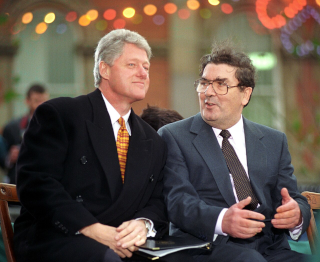
(Pictured: John Hume with U.S. President Bill Clinton in 1995)
After the death of Brendan Doris in 2006, Martin McGuinness pays tribute to the Doris family as “a well-known and respected republican family [who] have played a significant role in the republican struggle for many years.”
O’Neill becomes involved in republican politics in her teens, assisting her father with constituency work in his role as a Dungannon councillor. She joins Sinn Féin after the Good Friday Agreement in 1998, at the age of 21, and starts working as an advisor to Francie Molloy in the Northern Ireland Assembly, holding this role until 2005.
O’Neill automatically relinquishes her office following Paul Givan‘s resignation as first minister on February 3, 2022. Sinn Féin becomes the largest party after the 2022 Northern Ireland Assembly election, putting O’Neill in line to become the First Minister of Northern Ireland, and the Democratic Unionist Party (DUP) leader to become the deputy First Minister of Northern Ireland. However, she remains to be officially sworn in as First Minister because, as part of its opposition to the Northern Ireland Protocol, the DUP has refused to nominate a deputy First minister and there is therefore no functioning executive of Northern Ireland.
In August 2022, O’Neill is asked in a BBC interview whether it was right during the Troubles for the Provisional IRA “to engage in violent resistance to British rule.” She is criticised for her response, “I think at the time there was no alternative, but now thankfully we have an alternative to conflict, and that is the Good Friday Agreement – that is why it’s so precious to us all.”
In May 2023, O’Neill attends the coronation of King Charles, saying, “Well obviously I wanted to be here. We live in changing times, and it was the respectful thing to do, to show respect and to be here for all those people at home, who I had said I would be a first minister for all. Attendance here is about honouring that and fulfilling my promise.”
Price and her sister, Marian, also an IRA member, are the daughters of Albert Price, a prominent Irish republican and former IRA member from Belfast. Their aunt, Bridie Dolan, is blinded and loses both hands in an accident while handling IRA explosives.
Price becomes involved in Irish republicanism in the late 1960s and she and Marian participate in the Belfast to Derrycivil rights march in January 1969 and are attacked in the Burntollet Bridge incident.
In 1971 Price and her sister join the Provisional Irish Republican Army (IRA). In 1972 she joins an elite group within the IRA called “The Unknowns” commanded by Pat McClure. The Unknowns are tasked with various secretive activities and transport several accused traitors across the border into the Republic of Ireland where they are “disappeared.” She personally states that she had driven Joe Lynskey across the border to face trial. In addition, she states that she, Pat McClure and a third Unknown were tasked with killing Jean McConville, with the third Unknown actually shooting her.
Price leads the car bombing attacks in London on March 8, 1973, which injure over 200 people and is believed to have contributed to the death of one person who suffers a fatal heart attack. The two sisters are arrested, along with Gerry Kelly, Hugh Feeney and six others, on the day of the bombing as they are boarding a flight to Ireland. They are tried and convicted at the Great Hall in Winchester Castle on November 14, 1973. Although originally sentenced to life imprisonment, which is to run concurrently for each criminal charge, their sentence is eventually reduced to 20 years. She serves seven years for her part in the bombing. She immediately goes on a hunger strike demanding to be moved to a prison in Northern Ireland. The hunger strike lasts for 208 days because the hunger strikers are force-fed by prison authorities to keep them alive.
On the back of the hunger-striking campaign, Price’s father contests Belfast West at the February 1974 United Kingdom general election, receiving 5,662 votes (11.9%). The Price sisters, Hugh Feeney, and Gerry Kelly are moved to Northern Ireland prisons in 1975 as a result of an IRA truce. In 1980 she receives the royal prerogative of mercy and is freed on humanitarian grounds in 1981, purportedly suffering from anorexia nervosa due to the invasive trauma of daily force feedings.
After her release in 1980, Price marries Irish actor Stephen Rea, with whom she has two sons, Danny and Oscar. They divorce in 2003.
The Price sisters remain active politically. In the late 1990s, Price and her sister claim that they have been threatened by their former colleagues in the IRA and Sinn Féin for publicly opposing the Good Friday Agreement (i.e. the cessation of the IRA’s military campaign). she is a contributor to The Blanket, an online journal, edited by former Provisional IRA member Anthony McIntyre, until it ceases publication in 2008.
In 2001, Price is arrested in Dublin and charged with possession of stolen prescription pads and forged prescriptions. She pleads guilty and is fined £200 and ordered to attend Alcoholics Anonymous meetings.
In February 2010, it is reported by The Irish News that Price had offered help to the Independent Commission for the Location of Victims’ Remains in locating graves of three men, Joe Lynskey, Seamus Wright, and Kevin McKee. The bodies of Wright and McKee are recovered from a singular grave in County Meath in August 2015. It is unclear if Price played a role in their recovery. The remains of Joe Lynskey have not been recovered as of April 2021.
Price is the subject of the 2018 feature-length documentary I, Dolours in which she gives an extensive filmed interview.
In 2010, Price claims Gerry Adams had been her officer commanding (OC) when she was active in the IRA. Adams, who has always denied being a member of the IRA, denies her allegation. She admits taking part in the murder of Jean McConville, as part of an IRA action in 1972. She claims the murder of McConville, a mother of ten, was ordered by Adams when he was an IRA leader in West Belfast. Adams subsequently publicly further denies Price’s allegations, stating that the reason for them is that she is opposed to the Provisional Irish Republican Army’s abandonment of paramilitary warfare in favour of politics in 1994, in the facilitation of which Adams has been a key figure.
Oral historians at Boston College interview both Price and her fellow IRA paramilitary Brendan Hughes between 2001 and 2006. The two give detailed interviews for the historical record of the activities in the IRA, which are recorded on condition that the content of the interviews is not to be released during their lifetimes. Prior to her death in May 2011, the Police Service of Northern Ireland (PSNI) subpoena the material, possibly as part of an investigation into the disappearance of a number of people in Northern Ireland during the 1970s. In June 2011, the college files a motion to quash the subpoena. A spokesman for the college states that “our position is that the premature release of the tapes could threaten the safety of the participants, the enterprise of oral history, and the ongoing peace and reconciliation process in Northern Ireland.” In June 2011, U.S. federal prosecutors ask a judge to require the college to release the tapes to comply with treaty obligations with the United Kingdom. On July 6, 2012, the United States Court of Appeals for the First Circuit agrees with the government’s position that the subpoena should stand. On October 17, 2012, the Supreme Court of the United States temporarily blocks the college from handing over the interview tapes. In April 2013, after Price’s death, the Supreme Court turns away an appeal that seeks to keep the interviews from being supplied to the PSNI. The order leaves in place a lower court ruling that orders Boston College to give the Justice Department portions of recorded interviews with Price. Federal officials want to forward the recordings to police investigating the murder of Jean McConville.
Price dies in her Malahide, County Dublin, home on January 23, 2013, from a toxic effect of mixing prescribed sedative and anti-depressant medication. Her body is found the following day. The inquest returns a verdict of death by misadventure. She is buried at Milltown Cemetery in West Belfast.
The 32CSM has been described as the “political wing” of the now defunct Real Irish Republican Army (RIRA), but this is denied by both organisations. The group originates in a split from Sinn Féin over the Mitchell Principles.
Those present at the initial meeting are opposed to the direction taken by Sinn Féin and other mainstream republican groups in the Northern Ireland peace process, which leads to the Belfast Agreement (also known as the Good Friday Agreement) the following year. The same division in the republican movement leads to the paramilitary group now known as the Real IRA breaking away from the Provisional Irish Republican Army at around the same time.
Most of the 32CSM’s founders had been members of Sinn Féin. Some had been expelled from the party for challenging the leadership’s direction, while others felt they had not been properly able to air their concerns within Sinn Féin at the direction its leadership had taken. Bernadette Sands McKevitt, wife of Michael McKevitt and a sister of hunger strikerBobby Sands, is a prominent member of the group until a split in the organisation.
The name refers to the 32 counties of Ireland which are created during the Lordship and Kingdom of Ireland. With the partition of Ireland in 1920–22, twenty-six of these counties form the Irish Free State which is abolished in 1937 and is now known as Ireland since 1949. The remaining six counties of Northern Ireland remain part of the United Kingdom. Founder Bernadette Sands McKevitt says in a 1998 interview with the Irish Mirror that people did not fight for “peace” – “they fought for independence” – and that the organisation reaffirms to the republican position in the 1919 Irish Declaration of Independence.
Before the referendums on the 1998 Good Friday Agreement, the 32CSM lodges a legal submission with the United Nations challenging British sovereignty in Ireland. The referendums are opposed by the 32CSM but are supported by 71% of voters in Northern Ireland and by 94% in the Republic of Ireland. It is reported in February 2000 that the group established a “branch” in Kilburn, London.
In November 2005, the 32CSM launches a political initiative titled Irish Democracy, A Framework for Unity.
On May 24, 2014, Gary Donnelly, a member of the 32CSM, is elected to the Derry City and Strabane District Council. In July 2014, a delegation from the 32CSM travels to Canada to take part in a six-day speaking tour. On arrival the delegation is detained and refused entry into Canada.
In 2015, the 32CSM organises a demonstration in Dundee, Scotland, in solidarity with the men convicted of shooting Constable Stephen Carroll, the first police officer to be killed in Northern Ireland since the formation of the PSNI. The organisation says the “Craigavon Two” are innocent and have been victims of a miscarriage of justice.
The group is currently considered a Foreign Terrorist Organization (FTO) in the United States, because the group is considered to be inseparable from the Real IRA, which is designated as an FTO. At a briefing in 2001, a spokesman for the U.S. Department of State states that “evidence provided by both the British and Irish governments and open-source materials demonstrate clearly that the individuals who created the Real IRA also established these two entities to serve as the public face of the Real IRA. These alias organizations engage in propaganda and fundraising on behalf of and in collaboration with the Real IRA.” The U.S. Department of State’s designation makes it illegal for Americans to provide material support to the Real IRA, requires U.S. financial institutions to block the group’s assets and denies alleged Real IRA members visas into the U.S.
The 32CSM also operates outside of the island of Ireland to some extent. The Gaughan/Stagg Cumann covers England, Scotland and Wales, and has an active relationship of mutual promotion with a minority of British left-wing groups and anti-fascist organisations. The James Larkin Republican Flute Band in Liverpool, and the West of Scotland Band Alliance, the largest section of which is the Glasgow-based Parkhead Republican Flute Band, are also supporters of the 32CSM. As of 2014, the 32CSM’s alleged paramilitary wing, the Real IRA, is reported to have been still involved in attempts to perpetrate bombings in Britain as part of the Dissident Irish Republican campaign, which has been ongoing since 1998.
In 1974 and 1975, London is subjected to a 14-month campaign of gun and bomb attacks by the Provisional IRA. Some 40 bombs explode in London, killing 35 people and injuring many more. The four members of what becomes known as the “Balcombe Street gang,” Joe O’Connell, Edward Butler, Harry Duggan and Hugh Doherty, are part of a six-man IRA Active Service Unit (ASU) that also includes Brendan Dowd and Liam Quinn.
The Balcombe Street siege starts after a chase through London, as the Metropolitan Police pursues Doherty, O’Connell, Butler and Duggan through the streets after they had fired gunshots through the window of Scott’s restaurant in Mount Street, Mayfair. The four IRA men ultimately run into a block of council flats in Balcombe Street, adjacent to Marylebone station, triggering the six-day standoff.
The four men go to 22b Balcombe Street in Marylebone, taking its two residents, middle-aged married couple John and Sheila Matthews, hostage in their front room. The men declare that they are members of the IRA and demand a plane to fly both them and their hostages to Ireland. Scotland Yard refuses, creating a six-day standoff between the men and the police. Peter Imbert, later Commissioner of the Metropolitan Police Service, is the chief police negotiator.
The siege ends peacefully on December 12, 1975, after the men free their two hostages and surrender following several days of intense negotiations between Metropolitan Police Bomb squad officers, Detective Superintendent Peter Imbert and Detective Chief Superintendent Jim Nevill, and the unit’s leader Joe O’Connell, who goes by the name of “Tom.” The other members of the gang are named “Mick” and “Paddy,” thereby avoiding revealing to the negotiators precisely how many of them are in the living room of the flat. The resolution of the siege is a result of the combined psychological pressure exerted on the gang by Imbert and the deprivation tactics used on the four men. The officers also use carefully crafted misinformation, through the BBC Radio news to further destabilise the gang into surrender. A news broadcast states that the British Special Air Service are going to be sent in to storm the building and release the hostages. This seems to deter the gang and they eventually give themselves up to the police.
The four are found guilty at their Old Bailey trial in 1977 of seven murders, conspiring to cause explosions, and falsely imprisoning John and Sheila Matthews during the siege. O’Connell, Butler and Duggan each receive 12 life sentences, and Doherty receives 11. Each of the men is later given a whole life tariff, the only IRA prisoners to receive this tariff. During the trial they instruct their lawyers to “draw attention to the fact that four totally innocent people were serving massive sentences” for three bombings in Woolwich and Guildford. Despite telling the police that they are responsible, they are never charged with these offences and the Guildford Four and Maguire Seven remain in prison for 15 more years, until it is ruled that their convictions are unsafe.
The meeting is an important opportunity to discuss developments and reflect on the perspectives and priorities of all participants since the last British-Irish Council summit in July 2016. There is specific focus during the EU exit roundtable session on agriculture, agri-food and fisheries, trade, and implications of the UK’s exit from the EU.
UK government ministers also emphasize their continued commitment to work closely with all seven member administrations on the UK’s exit from the EU, using existing structures of bilateral and multilateral engagement.
Secretary of State for Wales, Alun Cairns, says, “The British-Irish Council summit is an important forum as we prepare to leave the European Union. The meeting allows us to maintain and strengthen relations between our governments and ensure we are all in the best position to face challenges and find new opportunities. It’s important to remember the UK is leaving the EU, but we are not leaving Europe. We want the best possible relationship with the EU as a whole. The eight council members will discuss issues including Brexit and provide the best opportunities for our young people as part of Early Years strategy. I look forward to some positive and constructive talks on both topics.”
Secretary of State for Northern Ireland, James Brokenshire, says, “At July’s BIC meeting we established an important commitment to maintain intensive and open dialogue and today’s sessions reflected the kind of mature cooperation that close friends and partners enjoy. There was a strong collective will to continue to work together in order to achieve the best outcomes for the people we represent. The UK wants the strongest possible economic links with our European neighbours, especially with Ireland – our nearest neighbour and the only EU member with which we share a land border. So as we forge a new relationship between the UK and Europe we must also maintain and strengthen the bonds within these islands. The BIC will continue to make a vital contribution to that effort and underlines our commitment to the structures set out in the Belfast Agreement and its successors.”
Minister at the Department for Exiting the European Union, Robin Walker, says, “As we begin the work of leaving the European Union, forums such as the British-Irish Council are an important way of maintaining close cooperation and open dialogue between our governments. This includes maintaining our special and friendly relationship with Ireland which has gone from strength to strength over many years. And we will continue to build on this strong relationship as we make a success of Brexit and maximise the opportunities for both our countries.”
A second session at the council addresses the Early Years policies of the eight administrations and welcomes the latest sector report highlighting progress since the 2012 summit. All in attendance acknowledge the critical importance of investment in early years provision in creating strong foundations for children, families and societies to thrive.
The British-Irish Council is a forum for discussion. It was established by the Belfast Agreement to promote positive, practical relationships among the people of the islands and to provide a forum for consultation and co-operation.
(From: “British-Irish Council Summit: Focus on EU exit and ‘Early Years’ policy” press release by the Government of the United Kingdom, http://www.gov.uk, November 25, 2016)
Ó Brádaigh is born into a middle-class republican family. His father, Matt Brady, is an IRA volunteer who is severely wounded in an encounter with the Royal Irish Constabulary (RIC) in 1919. His mother, May Caffrey, is a Cumann na mBan volunteer and a 1922 graduate of University College Dublin (UCD). His father dies when he is ten and is given a paramilitary funeral led by his former IRA colleagues. His mother, prominent as the Secretary for the County Longford Board of Health, lives until 1974. He is educated at Melview National School at primary level and attends secondary school at St. Mel’s College, leaving in 1950, and graduates from University College Dublin in 1954. That year he takes a job teaching Irish language at Roscommon Vocational School in Roscommon. He is a deeply religious Catholic who refrains from smoking or drinking.
Ó Brádaigh joins Sinn Féin in 1950. While at university, in 1951, he joins the Irish Republican Army. In September 1951, he marches with the IRA at the unveiling of the Seán Russell monument in Fairview Park, Dublin. A teacher by profession, he is also a Training Officer for the IRA. In 1954, he is appointed to the Military Council of the IRA, a subcommittee set up by the IRA Army Council in 1950 to plan a military campaign against Royal Ulster Constabulary (RUC) barracks in Northern Ireland.
On August 13, 1955, Ó Brádaigh leads a ten-member IRA group in an arms raid on Hazebrouck Barracks, near Arborfield, Berkshire, England, a depot for the No. 5 Radar Training Battalion of the Royal Electrical and Mechanical Engineers. It is the biggest IRA arms raid in Britain. Most, if not all, of the weapons are recovered in a relatively short period of time. A van, traveling too fast, is stopped by the police and IRA personnel are arrested. Careful police work leads to weapons that had been transported in a second van and stored in London.
The IRA Border Campaign commences on December 12, 1956. As an IRA General Headquarters Staff (GHQ) officer, Ó Brádaigh is responsible for training the Teeling Column in the west of Ireland. During the Campaign, he serves as second-in-command of the Teeling Column. On December 30, 1956, he partakes in the Teeling Column attack on RUC barracks in Derrylin, County Fermanagh. RUC Constable John Scally is killed in the attack and is the first fatality of the new IRA campaign. Ó Brádaigh and others are arrested by the Garda Síochána across the border in County Cavan the day after the attack. They are tried and jailed for six months in Mountjoy Prison. A leading abstentionist, upon his arrest he refuses to recognize the authority of the Irish government and refuses to renounce violence in exchange for his release.
Upon completing his prison sentence, Ó Brádaigh is immediately interned at the Curragh Camp along with other republicans. On September 27, 1958, he escapes from the camp along with Dáithí Ó Conaill. While a football match is in progress, the pair cuts through a wire fence and escapes from the camp under a camouflage grass blanket. This is an official escape, authorised by the officer commanding (OC) of the IRA internees, Tomás Óg Mac Curtain. He is the first Sinn Féin TD on the run since the 1920s.
In October 1958, Ó Brádaigh becomes the IRA Chief of Staff, a position he holds until May 1959, when Seán Cronin is elected as his replacement. He is arrested in November 1959, refuses to answer questions, and is jailed in Mountjoy Prison under the Offences against the State Act. He is released in May 1960 and, after Cronin is arrested, again becomes Chief of Staff. Although he always emphasises that it is a collective declaration, he is the primary author of the statement ending the IRA Border Campaign in 1962. At the IRA 1962 Convention he indicates that he is not interested in continuing as Chief of Staff.
After Ó Brádaigh’s arrest in December 1956, he takes a leave from teaching at Roscommon Vocational School. He is re-instated and begins teaching again in late 1962, just after he is succeeded by Cathal Goulding in the position of Chief of Staff of the IRA. He remains an active member of Sinn Féin and is also a member of the IRA Army Council throughout the decade.
Ó Brádaigh opposes the decision of the IRA and Sinn Féin to drop abstentionism and to recognise the Westminster parliament in London, the Stormont parliament in Belfast and the Leinster House parliament in 1969/1970. On January 11, 1970, along with Seán Mac Stíofáin, he leads the walkout from the 1970 Sinn Féin Ard Fheis after the majority votes to end the policy of abstentionism, although the vote to change the Sinn Féin constitution fails to receive the required two-thirds majority. The delegates who walk out reconvene at the Kevin Barry Hall in Parnell Square, Dublin, and establish Provisional Sinn Féin.
Ó Brádaigh is voted chairman of the Caretaker Executive of Provisional Sinn Féin. That October, he formally becomes president of the party. He holds this position until 1983. In his presidential address to the 1971 Provisional Sinn Féin Ard Fheis, he says that the first step to achieving a United Ireland is to make Northern Ireland ungovernable. He apparently also serves on the Army Council or the executive of the Provisional Irish Republican Army until he is seriously injured in a car accident on January 1, 1984.
On May 31, 1972, Ó Brádaigh is arrested under the Offences Against the State Act and immediately commences a hunger strike. A fortnight later the charges against him are dropped and he is released. With Dáithí Ó Conaill he develops the Éire Nua policy, which is launched on June 28, 1972. The policy calls for a federal Ireland.
On December 3, 1972, Ó Brádaigh appears on the London Weekend TelevisionWeekend World programme. He is arrested by the Gardaí again on December 29, 1972, and charged in the newly established Special Criminal Court with Provisional IRA membership. In January 1973 he is the first person convicted under the Offences Against the State (Amendment) Act 1972 and is sentenced to six months in the Curragh Camp.
On December 10, 1974, Ó Brádaigh participates in the Feakle talks between the IRA Army Council and Sinn Féin leadership and the leaders of the Protestant churches in Ireland. Although the meeting is raided and broken up by the Gardaí, the Protestant churchmen pass on proposals from the IRA leadership to the British government. These proposals call on the British government to declare a commitment to withdraw, the election of an all-Ireland assembly to draft a new constitution and an amnesty for political prisoners.
The IRA subsequently calls a “total and complete” ceasefire intended to last from December 22, 1974, to January 2, 1975, to allow the British government to respond to proposals. British government officials also hold talks with Ó Brádaigh in his position as president of Sinn Féin from late December to January 17, 1975.
On February 10, 1975, the IRA Army Council, unanimously endorses an open-ended cessation of IRA “hostilities against Crown forces,” which becomes known as the 1975 truce. The IRA Chief of Staff at the time is Seamus Twomey of Belfast. It is reported in some quarters that the IRA leaders mistakenly believe they had persuaded the British Government to withdraw from Ireland and the protracted negotiations between themselves and British officials are the preamble to a public declaration of intent to withdraw. In fact, as British government papers now show, the British entertain talks with the IRA in the hope that this would fragment the movement further and score several intelligence coups during the talks. This bad faith embitters many in the republican movement, and another ceasefire does not happen until 1994.
In late December 1976, along with Joe Cahill, Ó Brádaigh meets two representatives of the Ulster Loyalist Central Co-ordinating Committee (ULCCC), John McKeague and John McClure, at the request of the latter body. Their purpose is to try to find a way to accommodate the ULCCC proposals for an independent Northern Ireland with the Sinn Féin’s Éire Nua programme. It is agreed that if this can be done, a joint Loyalist-Republican approach can then be made to request the British government to leave Ireland. Desmond BoalQC and Seán MacBrideSC are requested and accepted to represent the loyalist and republican positions. For months they have meetings in various places including Paris. The dialogue eventually collapses when Conor Cruise O’Brien, then Minister for Posts and Telegraphs and vociferous opponent of the Provisional IRA, becomes aware of it and condemns it on RTÉ Radio. As the loyalists had insisted on absolute secrecy, they feel unable to continue with the talks as a result.
In the aftermath of the 1975 truce, the Ó Brádaigh/Ó Conaill leadership comes under severe criticism from a younger generation of activists from Northern Ireland, headed by Gerry Adams, who becomes a vice-president of Sinn Féin in 1978. By the early 1980s, Ó Brádaigh’s position as president of Sinn Féin is openly under challenge and the Éire Nua policy is targeted in an effort to oust him. The policy is rejected at the 1981 Sinn Féin Ard Fheis and finally removed from the Sinn Féin constitution at the 1982 Ard Fheis. At the following year’s Ard Fheis, Ó Brádaigh and Ó Conaill resign from their leadership positions, voicing opposition to the dropping of the Éire Nua policy by the party.
On November 2, 1986, the majority of delegates to the Sinn Féin Ard Fheis vote to drop the policy of abstentionism if elected to Dáil Éireann, but not the British House of Commons or the Northern Ireland parliament at Stormont, thus ending the self-imposed ban on Sinn Féin elected representatives from taking seats at Leinster House. Ó Brádaigh and several supporters walk out and immediately assemble at Dublin’s West County Hotel and set up Republican Sinn Féin (RSF). As an ordinary member, he had earlier spoken out against the motion (resolution 162) in an impassioned speech. The Continuity IRA becomes publicly known in 1996. Republican Sinn Féin’s relationship with the Continuity IRA is similar to the relationship between Sinn Féin and the Provisional IRA when Ó Brádaigh was Sinn Féin’s president.
Ó Brádaigh believes RSF to be the sole legitimate continuation of the pre-1986 Sinn Féin, arguing that RSF has kept the original Sinn Féin constitution. RSF readopts and enhances his Éire Nua policy. His party has electoral success in only a few local elections.
Ó Brádaigh remains a vociferous opponent of the Good Friday Agreement, viewing it as a programme to copperfasten Irish partition and entrench sectarian divisions in the north. He condemns his erstwhile comrades in Provisional Sinn Féin and the Provisional IRA for decommissioning weapons while British troops remain in the country. In his opinion, “the Provo sell-out is the worst yet – unprecedented in Irish history.” He condemns the Provisional IRA’s decision to seal off a number of its arms dumps as “an overt act of treachery,” “treachery punishable by death” under IRA General Army Order Number 11.
In July 2005, Ó Brádaigh hands over a portion of his personal political papers detailing discussions between Irish Republican leaders and representatives of the British Government during 1974–1975 to the James Hardiman Library, National University of Ireland, Galway.
In September 2009, Ó Brádaigh announces his retirement as leader of Republican Sinn Féin. His successor is Des Dalton. He is also a long-standing member of the Celtic League, an organization which fosters cooperation between the Celtic people and promotes the culture, identity and eventual self-determination for the people, in the form of six sovereign states, for the Celtic nations – Wales, Cornwall, Brittany, Scotland, Isle of Man and Ireland.
After suffering a period of ill-health, Ó Brádaigh dies on June 5, 2013, at Roscommon County Hospital. His funeral is attended by 1,800 mourners including Fine Gael TD Frank Feighan and is policed by the Garda Emergency Response Unit and Gardaí in riot gear, for “operational reasons,” a show of force believed to have been to deter the republican tradition of firing a three-volley salute of shots over the final place of rest during the graveyard oration. As a result, there are some minor scuffles between gardai and mourners.
In the late 1980s, Reid facilitates a series of meetings between Gerry Adams and John Hume, in an effort to establish a “Pan-Nationalist front” to enable a move toward renouncing violence in favour of negotiation. Reid, himself a staunch nationalist who favours a united Ireland and the withdrawal of British forces from Northern Ireland, then acts as their contact person with the Irish Government in Dublin from a 1987 meeting with Charles Haughey up to the signing of the Good Friday Agreement in 1998. In this role, which is not public knowledge at the time, he holds meetings with various Taoisigh, and particularly with Martin Mansergh, advisor to various Fianna Fáil leaders. After the eventual success of the peace negotiations, Gerry Adams says, “there would not be a peace process at this time without [Father Reid’s] diligent doggedness and his refusal to give up.”
After he moves to Dublin, Reid is involved in peace efforts in the Basque Country. In January 2003, he is awarded the Sabino Arana 2002 “World Mirror” prize, by the Sabino Arana Foundation in Bilbao, in recognition of his efforts at promoting peace and reconciliation. He and a Methodist minister, the Rev. Harold Good, announce that the IRA has decommissioned their arms at a news conference in September 2005.
Reid is involved in controversy in November 2005 when he makes comments during a meeting in Fitzroy Presbyterian Church concerning the Unionist community in Northern Ireland. When the loyalist activist Willie Frazer makes remarks that Catholics had butchered Protestants during the Troubles, Reid angrily responds, “You don’t want to hear the truth. The reality is that the nationalist community in Northern Ireland were treated almost like animals by the unionist community. They were not treated like human beings. They were treated like the Nazis treated the Jews.” Reid later apologises, saying his remarks had been made in the heat of the moment. In an interview with CNN, he says that “The IRA were, if you like, a violent response to the suppression of human rights.”
Reid dies in a Dublin hospital on November 22, 2013. He is survived by two sisters and an aunt, and is buried in Milltown Cemetery, Belfast.
Seán MacManus, Sinn Féin politician, is elected Mayor of Sligo on July 3, 2000. He is the national chairperson of the party from 1984 to 1990.
MacManus is born in 1950 near Blacklion, County Cavan, and moves to London in the 1960s to find work. There he meets and marries Helen McGovern, a native of Glenfarne, County Leitrim. In 1976, he returns to Ireland and settled in the Maugheraboy area of Sligo, County Sligo, so that their family of two boys can be educated in Ireland.
Still based in Maugheraboy, MacManus is involved in Irish Republican politics since the early 1970s and is secretary of the County Sligo Anti-H-Block Committee which campaigns in support of the republican prisoners hunger strikes of 1980/81. He becomes a member of the Sinn Féin Ard Comhairle (National Executive) in 1982 and remains there for over twenty years. He is elected as the first Sinn Féin National Chairperson from 1984 until 1990. After the Irish Republican Army (IRA) ceasefire in 1994 he is part of the first Sinn Féin delegation to meet with the British government in over seventy years. He is also involved in the protracted negotiations leading to the Good Friday Agreement.
First elected to Sligo Corporation (now Sligo Borough Council) in 1994, MacManus remains until its abolition in May 2014. He is also elected to Sligo County Council in 1999 and is re-elected in 2004, 2009 and 2014. He steps down from elected politics in February 2017 being replaced by his son, Chris MacManus.
On July 3, 2000, MacManus is elected Mayor of Sligo, the first Sinn Féin Mayor in the Republic of Ireland since the beginning of the Troubles in 1969. He is also elected mayor in 2003. Sinn Féin PresidentGerry Adams says the election of McManus is a sign of “Sinn Féin’s rise as an active campaigning alternative in politics in the 26 counties”.
MacManus has two sons. Chris MacManus, the youngest, is also an elected member of Sligo Borough Council (1999–2014) and Sligo County Council (2017–2020) and is an MEP since March 2020. His eldest son, Joseph MacManus, was an IRA volunteer who was killed in a firefight against an off-duty Ulster Defence Regiment (UDR) soldier in Belleek, County Fermanagh, in February 1992.
O’Hagan, known to all and sundry simply as JB, dies on Monday, April 23, 2001, in the town in which he was born almost 79 years previously and from which he and his wife Bernadette had been exiled for 25 years during the current phase of the conflict. As befitted a soldier of Óglaigh na hÉireann, a uniformed IRA Guard of Honour attends O’Hagan’s body in the wake house and it is six of his comrades who carry the coffin, bedecked in the Irish Tricolour and beret and gloves, from the family home on the first section of its journey to St. Paul’s Chapel for the Funeral Mass.
Up to 2,000 people attend the funeral and businesses in the bustling North Armagh town close along the route as a mark of respect. At St. Colman’s Cemetery just outside the town, Sinn Féin President Gerry Adams pays fulsome tribute to a republican who had been active from the 1940s into the 1990s and right up to his sudden death. Adams notes O’Hagan’s strong faith and welcomes the tribute paid during the Funeral Mass to JB’s republican beliefs and exploits. He adds, however, that it is high time the Catholic hierarchy reverses its directive banning the Tricolour from republican funerals in church premises. “Our National Flag should be allowed to stay on the coffin for the entire ceremony,” he says.
“I have always associated JB with Bernadette,” he tells those gathered at the graveside, “even though they were apart for so many years. They were married for 52 years, and Bernadette told me yesterday that she wouldn’t change a day of it, that she was proud of him and of his life.”
“In many ways he died the way he had lived, very quietly, modestly, not complaining, unassuming to the end. He was one of the most respected republicans of our time. There is no greater tribute that can be paid to any man or woman than to be known as a decent human being and Joe B. was that and more.”
Adams goes on to briefly record the extraordinary history of O’Hagan’s involvement in the republican struggle, as soldier and political activist, since he first joined the IRA in 1940, including that famous 1973 escape from Mountjoy Jail by helicopter, accompanied by Kevin Mallon and the late Seamus Twomey.
“JB grew up in the 1920s in a state abandoned by the Irish Government, where nationalists were subjected to the B-Specials and the Special Powers Act. He stood up at a time when standing up was a very very dangerous thing to do,” says Adams. “It is a wonder to me that he was active in every decade from the 1940s on. There is a mighty man!”
“He also personifies why Irish republicanism has never been defeated. He was an example of a physical force republican who was prepared to support and exhaust other means of struggle. He saw armed struggle as a means rather than as an end, but he never ceased to be an unrepentant republican and to work always for the establishment of an Irish Republic based on national rights for the people of this island. He supported the Good Friday Agreement not as an end but as an effort to build a new accord with our opponents and enemies. Political unionism has found it very difficult to deal with this strategy.”
“Joe B was very philosophical and very wise. He is representative of that republican element who never broke a promise in their lives.”
“Those who seek to defeat the republican struggle by blaming the IRA for everything need to know that none of this will work. That is because of the work that JB and people like him put into this struggle. We won’t be worn down or accept anything less than our full rights. The message for David Trimble and Tony Blair is that it is impossible for us to accept inequality, injustice and second-class citizenship. That is the past. We are looking to the future.”
“Joe B’s passing has left a huge gap, but we should celebrate his life. He touched so many of us. Joe B kept us right. The flame he kept flickering in the lean times is burning brightly now because of his contribution.”
Adams extends his solidarity and sympathy and that of all those present to Bernadette, to O’Hagan’s children, Barry, Kevin, Fintan, Siobhán, Felim and Dara, to his eleven grandchildren and four great-grandchildren, his sisters and entire family circle.
At the end of the Funeral Mass for O’Hagan, the O’Hagan family lead by Joe’s son Fintan place the Irish Tricolour on the coffin before the remains are taken from the chapel. This act is borne out of anger and frustration.
O’Hagan was a republican, an honourable man and a religious man who went to Mass every day. So, his family feels that the Catholic Church, that was as much an influence on O’Hagan’s life as was his republicanism, should respect his wish and allow his coffin to be draped in the Tricolour. The family appeals to the Catholic Church authorities and Adams intercedes on their behalf, but they are refused the right to grant O’Hagan his wish that the Flag not be removed from his coffin.
Dara O’Hagan, the Sinn Féin Northern Ireland Assembly member for Upper Bann, tells the bishop that by sticking to their old policy the Catholic Church is criminalising republicanism and indeed criminalising her father.
Also, the Catholic hierarchy misses a great opportunity to heal a hurt that has existed for over 20 years, when the remains of IRA Volunteer Kevin `Dee’ Delaney were refused entry into Corpus Christi Church in Springhill while bearing the Irish Tricolour. The rancour and hurt felt by republicans over this slight, coming as it does, in conjunction with the British Government’s attempts to criminalise republicanism, has long been an insult that republicans have resented. After all, churches are the people’s property as it is their money and effort that build them. The people of Springhill and the Greater Ballymurphy area paid £5 a brick for the Corpus Christi building and the Delaney family no doubt contributed to that fund.
By taking matters into their own hands, the O’Hagan family claims back some ground for republicans and sends a message to the bishops that they have a part to play in this new political era and that they need to look at their attitude to republicanism.
O’Hagan’s wife Bernadette says that as Fintan draped the Irish Trocolour on Joe’s coffin and the church burst into spontaneous applause, her heart was lifted. “I was so glad, and I walked down the aisle with a smile on my face,” said Bernadette.
(From: “Unassuming and mighty man laid to rest” by Martin Spain, An Phoblacht Republican News, May 3, 2001)





 seamus dubhghaill