seamus dubhghaill

Promoting Irish Culture and History from Little Rock, Arkansas, USA


Leave a comment

Birth of Kevin Barry, IRA Volunteer & Medical Student

Kevin Gerard Barry, Irish Republican Army (IRA) volunteer and medical student, is born on January 20, 1902, at 8 Fleet Street, Dublin. He becomes the first Irish republican to be executed by the British Government since the leaders of the Easter Rising.

Barry is the fourth of seven children born to Thomas Barry, dairyman, and Mary Barry (née Dowling), both originally from northeast County Carlow. His father dies of heart disease on February 8, 1908, at the age of 56. His mother then moves the family to the family’s farm at Tombeagh, Hacketstown, County Carlow, while retaining the family’s townhouse on Fleet Street. As a child he goes to the National School in Rathvilly. In 1915, he is sent to live in Dublin and attends the O’Connell Schools for three months, before enrolling in the Preparatory Grade at St. Mary’s College, Rathmines, in September 1915. He remains at that school until May 31, 1916, when it is closed by its clerical sponsors. With the closure of St. Mary’s College, he transfers to Belvedere College, a Jesuit school in Dublin. He joins the Irish Volunteers, the forerunner of the IRA, while still at Belvedere College, and enters University College Dublin (UCD) in 1919 to study medicine.

As a member of 1st Battalion, Dublin Brigade of the Irish Volunteers, he takes part in a successful raid for arms on the military post in King’s Inns, Dublin, on June 1, 1920. Within only six minutes the raiders secure rifles, light machine guns, and large quantities of ammunition, and depart the site with no casualties. He also takes part in an abortive attempt to burn Aughavanagh House, Aughrim, County Wicklow in July 1920, and an attack on a British ration party in Church Street, Dublin, on September 20, with the aim of seizing arms. The final operation fails. Gunfire breaks out, three soldiers of around Barry’s own age are killed or fatally wounded, and he becomes the first Volunteer to be captured in an armed attack since 1916.

During interrogation, Barry is threatened with a bayonet and is mistreated. A general court-martial on October 20, which he refuses to recognise, condemns him to death for murdering the three soldiers, although one of the bullets taken from Private Marshall Whitehead’s body is a .45 calibre, while all witnesses state that Barry was armed with a .38 Mauser Parabellum. Despite widespread appeals on grounds of both clemency and expediency, the cabinet in London and officials in Dublin decide separately against a reprieve, probably because of its likely effect on the morale of soldiers and police.

On October 28, the Irish Bulletin, the official propaganda newspaper produced by Dáil Éireann‘s Department of Publicity, publishes Barry’s statement alleging torture. The headline reads English Military Government Torture a Prisoner of War and are about to Hang him. The Irish Bulletin declares Barry to be a prisoner of war, suggesting a conflict of principles is at the heart of the conflict. The British do not recognise a war and treat all killings by the Irish Republican Army (IRA) as murder. The public learns on this day that the date of execution has been fixed for November 1.

He was hanged in Mountjoy Prison, Dublin, on November 1, after hearing two Masses in his cell. The timing of the execution, only seven days after the death by hunger strike of Terence MacSwiney, the republican Lord Mayor of Cork, brings public opinion to a fever-pitch. He is buried in unconsecrated ground on the jail property. His comrade and fellow student Frank Flood is buried alongside him four months later. A plain cross marks their graves and those of Patrick Moran, Thomas Whelan, Thomas Traynor, Patrick Doyle, Thomas Bryan, Bernard Ryan, Edmond Foley and Patrick Maher who are hanged in the same prison before the Anglo-Irish Treaty of July 1921 which ends hostilities between Irish republicans and the British. The graves go unidentified until 1934. They become known as the Forgotten Ten by republicans campaigning for the bodies to be reburied with honour and proper rites. On October 14, 2001, the remains of the ten men are given a state funeral and moved from Mountjoy Prison to be re-interred at Glasnevin Cemetery in Dublin.

Barry is the first person to be tried and executed for a capital offence under the Restoration of Order in Ireland Act 1920, passed twelve weeks earlier. Together with his youth, this makes him a republican martyr celebrated in many ballads and verses. The best-known, set to a tune popular with British servicemen, is recorded by the American singer Paul Robeson, among others. A memorial stained-glass window by Richard King of the Harry Clarke Studio is later installed in the former UCD council chamber (afterward called the Kevin Barry Room), Earlsfort Terrace, Dublin.


Leave a comment

Birth of William MacNeely, Bishop of Raphoe

The Most Reverend William MacNeely, the Bishop of Raphoe from 1923 until 1963, is born in County Donegal on December 28, 1889. He has the distinction of being Raphoe’s first completely Roman-educated bishop.

MacNeely is the son of a butcher in Donegal Town. He is educated at the High School in Letterkenny, and in Rome from 1906–12. He is ordained to the priesthood on February 4, 1912, and upon his return to Ireland is appointed to the staff of St. Eunan’s College.

MacNeely serves for two years as chaplain with the Irish Battalions in the British Army in World War I. He sees action on the Western Front and is injured in a gas attack.

On July 27, 1923, at the comparatively young age of 35, MacNeely is ordained as Bishop of Raphoe in succession to Bishop Patrick O’Donnell who had been appointed coadjutor Archbishop of Armagh the previous year. In this role he is responsible for the completion of the Cathedral of St. Eunan and St. Columba in Letterkenny and negotiating with Harry Clarke to finish the work of glazing the cathedral.

Keen to develop religious life in his diocese, MacNeely invites the Capuchin Franciscans to the Creeslough area in 1930 to a site that becomes known as Ards Priory.

In a diocese where farming is the main industry, MacNeely maintains a strong interest in farming, being himself a successful breeder of Shorthorn cattle.

In 2008, it is reported that MacNeely was one of the two Irish episcopal coordinators who worked alongside “an intelligence-gathering secret service” set up in 1948 to monitor any sign of a “Communist takeover” of Ireland.

In 1953, MacNeely is a member of the inaugural Episcopal Commission for Emigrants reflecting the high levels of migration that afflict his diocese and wider Donegal for much of the twentieth century.

MacNeely serves as Bishop for over forty years, attending the early sessions of the Second Vatican Council. Shortly before his death, he is appointed Assistant to the Papal Throne. He dies on December 11, 1963, and is interred beside the Cathedral of St. Eunan and St. Columba.


Leave a comment

Death of Harry Clarke, Stained-Glass Artist & Illustrator

Henry Patrick (Harry) Clarke, Irish stained-glass artist and book illustrator, dies on January 6, 1931, in Chur, Switzerland. He is a leading figure in the Irish Arts and Crafts movement.

Clarke is born in Dublin on March 17, 1889, the younger son and third child of Joshua Clarke and Brigid Clarke (née MacGonigal). Church decorator Joshua Clarke moves to Dublin from Leeds, West Yorkshire, England, in 1877 and starts a decorating business, Joshua Clarke & Sons, which later incorporates a stained-glass division. Through his work with his father, Clarke is exposed to many schools of art but Art Nouveau in particular.

Clarke is educated at the Model School in Marlborough Street, Dublin, and Belvedere College, which he leaves in 1905. After his mother’s death in 1903, he is apprenticed into his father’s studio and attends evening classes in the Metropolitan College of Art and Design. His The Consecration of St. Mel, Bishop of Longford, by St. Patrick wins the gold medal for stained-glass work in the 1910 Board of Education National Competition. At the art school in Dublin, he meets fellow artist and teacher Margaret Crilley. They marry on October 31, 1914.

Clarke moves to London to seek work as a book illustrator. Picked up by London publisher George G. Harrap and Co., he starts with two commissions which are never completed. Difficulties with these projects makes Fairy Tales by Hans Christian Andersen his first printed work, in 1916. It includes 16 colour plates and more than 24 halftone illustrations. This is followed by illustrations for an edition of Edgar Allan Poe‘s Tales of Mystery and Imagination, the second version of which, published in 1923, makes his reputation as a book illustrator. His work can be compared to that of Aubrey Beardsley, Kay Nielsen, and Edmund Dulac. His final book, Selected Poems of Algernon Charles Swinburne, is published in 1928.

Clarke also continues to work in stained-glass, producing more than 130 windows. His glass is distinguished by the finesse of its drawing and his use of rich colours. He is especially fond of deep blues. His use of heavy lines in his black-and-white book illustrations echoes his glass techniques.

Clarke’s stained-glass work includes many religious windows, including the windows of the Honan Chapel in University College Cork. He also produces much secular stained-glass such as a window illustrating John KeatsThe Eve of St. Agnes (now in the Hugh Lane Gallery in Dublin) and the Geneva Window, (now in the Wolfsonian Museum, Miami Beach, Florida). Perhaps his most seen works are the windows he creates for Bewley’s on Dublin’s Grafton Street.

Clarke is plagued with ill health, in particular respiratory problems. He is diagnosed with tuberculosis in 1929 and goes to a sanatorium in Davos, Switzerland. Fearing that he will die abroad, he begins his journey back to Dublin in 1931, but dies on this journey on January 6, 1931, in Chur where he is buried. A headstone is erected but local law requires that the family pledge to maintain the grave 15 years after the death. This is not explained to the Clarke family and Harry Clarke’s remains are disinterred in 1946 and reburied in a communal grave.


Leave a comment

Death of Margaret Clarke, Portrait Painter

Margaret Clarke RHA (née Crilley), Irish portrait painter, dies in Dublin on October 31, 1961.

Crilley is born in Newry, County Down, (present-day Northern Ireland), on August 1, 1884, one of six children of Patrick Crilley. Her date of birth is often given as July 29, 1888, though local records do not support this, suggesting she is born four years earlier. Having initially trained at Newry technical school with her sister Mary, intending to become a teacher, in 1905, she wins a scholarship to attend the Dublin Metropolitan School of Art. There she studies under William Orpen, who regards her as one of his most promising students. She completes her studies in 1911 attaining an Art Teacher’s Certificate and begins working as Orpen’s assistant.

In 1914, Crilley marries her fellow student Harry Clarke, much to the surprise of their family and acquaintances. The couple moves into a flat at 33 North Frederick Street. They have three children, Michael, David and Ann. Harry’s brother, Walter, marries Margaret’s sister, Mary, in 1915.

Clarke first exhibits with the Royal Hibernian Academy in 1913 and goes on to exhibit over 60 artworks in the forty years until 1953, the majority being portraits. Among the portrait commissions she receives are ones for Dermod O’Brien, President Éamon de Valera, Archbishop John Charles McQuaid, and Lennox Robinson. She spends a great deal of time on the Aran Islands with fellow artist Seán Keating and her husband, from which she produces a number of landscapes and smaller studies.

Clarke becomes the director of the Harry Clarke Stained Glass Studios following the death of her husband in 1931.

A critic notes in 1939 that Clarke produces “remarkable drawings in which individuality is caught in a few swift economical lines.” Over her lifetime she wins many awards including the Tailteann gold, silver and bronze medals in 1924, and another Tailteann bronze in both 1928 and 1932. She is elected an Associate of the Royal Hibernian Academy (ARHA) in 1926, and a full RHA member in 1927. Upon the founding of the Irish Exhibition of Living Art in 1943, she is appointed a member of the executive committee.

Clarke dies in Dublin on 31 October 31, 1961, and is buried in the Redford Cemetery, Greystones, County Wicklow. She is commemorated with a blue plaque at her birthplace in Newry.

Clarke’s work can be found in the collections of the National Gallery of Ireland, the Hugh Lane Gallery, the Crawford Art Gallery, the Ulster Museum, Limerick City Gallery of Art, The National Self-Portrait Collection of Ireland, and the Pontifical Irish College in Rome.

The exhibition at National Gallery of Ireland in 2017 reevaluates Margaret Clarke’s great artistic reputation.

(Pictured: “Self-portrait,” 1914, by Margaret Clarke, © Artist’s Estate)


Leave a comment

First Exhibition of the Society of Dublin Painters

The first exhibition of the Society of Dublin Painters or Dublin Painters Group takes place at its premises at 7 St. Stephen’s Green on August 5, 1920. The Society is formed to promote Irish modern art.

The Society of Dublin Painters is founded in 1920 by Paul and Grace Henry, Mary Swanzy, Letitia Marion Hamilton, Jack B. Yeats, and Harry Clarke. As the original meeting notes have been lost, there is some uncertainty as to which artists are there at the inaugural meeting. Along with these potential founding members, Clare Marsh, E.M. O’Rorke Dickey, and James Sleator are featured in the first exhibition. The Society’s first exhibition runs until September 1 and attracts good reviews. Yeats, Marsh, and Paul Henry are all signatories to the lease of this premises. The group seeks to bring modernism to Ireland, and provide a freer, less academic space for artistic expression and experimentation less focused on accuracy and realism. Its foundation is seen as providing an alternative public exhibition space to the more conservative Royal Hibernian Academy (RHA), which does not favour exhibiting Irish modern art. At its 1923 exhibition, Mary Swanzy exhibits one of her earliest cubist paintings, Decoration. The membership always has a large proportion of women.

The Society holds annual exhibitions and one-person shows at its premises on St. Stephen’s Green. Unlike the Royal Hibernian Academy, the Society does not mandate a particular style of painting for inclusion in its exhibitions, with the only limitation on the number of paintings an artist can submit. The members are free to submit paintings to other exhibitions such as the Royal Hibernian Academy, The White Stag Group and Irish Exhibition of Living Art. Membership is limited, with just ten members initially, rising to twelve in 1932, and eighteen in 1934 owing to limited exhibition and studio space. By 1943, the Society is being overtaken by exhibitions like the Irish Exhibition of Living Art and is no longer seen as the premier outlet for avant-garde Irish art. After a decline in membership, the Society ceases to exist by the early 1960s.

(Pictured: “The Post Car” by Jack B. Yeats displayed at the first exhibition, Adam’s Auctioneers of Dublin)


Leave a comment

Birth of Artist & Illustrator Harry Clarke

harry-clarke

Henry Patrick (Harry) Clarke, Irish stained-glass artist and book illustrator, is born in Dublin on March 17, 1889. He is a leading figure in the Irish Arts and Crafts movement.

Clarke is the younger son and third child of Joshua Clarke and Brigid Clarke (née MacGonigal). Church decorator Joshua Clarke moves to Dublin from Leeds in 1877 and starts a decorating business, Joshua Clarke & Sons, which later incorporates a stained-glass division. Through his work with his father, Clarke is exposed to many schools of art but Art Nouveau in particular.

Clarke is educated at the Model School in Marlborough Street, Dublin and Belvedere College, which he leaves in 1905. After his mother’s death in 1903, he is apprenticed into his father’s studio and attends evening classes in the Metropolitan College of Art and Design. His The Consecration of St. Mel, Bishop of Longford, by St. Patrick wins the gold medal for stained glass work in the 1910 Board of Education National Competition. At the art school in Dublin, he meets fellow artist and teacher Margaret Crilley. They marry on October 31, 1914.

Clarke moves to London to seek work as a book illustrator. Picked up by London publisher George G. Harrap and Co., he starts with two commissions which are never completed. Difficulties with these projects makes Fairy Tales by Hans Christian Andersen his first printed work, in 1916. It includes 16 colour plates and more than 24 halftone illustrations. This is followed by illustrations for an edition of Edgar Allan Poe‘s Tales of Mystery and Imagination, the second version of which, published in 1923, makes his reputation as a book illustrator. His work can be compared to that of Aubrey Beardsley, Kay Nielsen, and Edmund Dulac. His final book, Selected Poems of Algernon Charles Swinburne, is published in 1928.

Clarke also continues to work in stained-glass, producing more than 130 windows. His glass is distinguished by the finesse of its drawing and his use of rich colours. He is especially fond of deep blues. His use of heavy lines in his black-and-white book illustrations echoes his glass techniques.

Clarke’s stained-glass work includes many religious windows, including the windows of the Honan Chapel in University College Cork. He also produces much secular stained glass such as a window illustrating John KeatsThe Eve of St. Agnes (now in the Hugh Lane Gallery in Dublin) and the Geneva Window, (now in the Wolfsonian Museum, Miami Beach, Florida). Perhaps his most seen works are the windows he creates for Bewley’s on Dublin’s Grafton Street.

Clarke is plagued with ill health, in particular respiratory problems. He is diagnosed with tuberculosis in 1929 and goes to a sanatorium in Davos, Switzerland. Fearing that he will die abroad, he begins his journey back to Dublin in 1931, but dies on this journey on January 6, 1931, in Chur where he is buried. A headstone is erected but local law requires that the family pledge to maintain the grave 15 years after the death. This is not explained to the Clarke family and Harry Clarke’s remains are disinterred in 1946 and reburied in a communal grave.


Leave a comment

Birth of Irish Artist Nano Reid

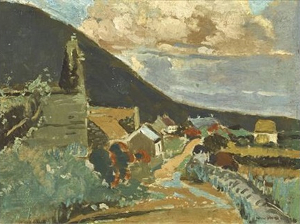
nano-reid-crumphan-achill

Nano Reid, Irish landscape artist, figure painter and portraitist, is born in Drogheda, County Louth on March 1, 1900. An individual, expressionistic artist, Reid is acknowledged to be one of the finest Irish woman painters of twentieth-century visual art in Ireland. Her works are represented in many public collections throughout Ireland.

In 1920, Reid wins a scholarship to study fine art painting and drawing at the Dublin Metropolitan School of Art, now the National College of Art and Design, under Harry Clarke. At the time, she is, in the words of fellow student Hilda van Stockum, “a fierce redhead…uncompromising and looking for truth.” In 1925 she starts showing at the Royal Hibernian Academy (RHA), submitting a total of 42 canvases until the late 1960s.

In 1928, Reid goes to Paris and enrolls briefly at the Académie de la Grande Chaumière, after which she spends a year in London studying fine art at the Central School of Arts and Crafts under Bernard Meninsky. She returns to Ireland in 1931 and once more begins exhibiting her landscape painting at the RHA.

In 1950, with Norah McGuinness, Reid represents Ireland at the Venice Biennale. This is followed by the Exhibition of Contemporary Irish Art in Aberystwyth, Wales (1953), and the Mostra Internazionale di Bianco e Nero in Lugano, Switzerland (1956), the Guggenheim International Award Exhibition in New York City (1960) and the Twelve Irish Painters show in New York City (1963). In 1974, the Arts Council and the Arts Council of Northern Ireland stage a major retrospective of Reid’s artworks.

Nano Reid dies in Drogheda in 1981. Retrospectives are held at Taylor Galleries in Dublin (1984), Droichead Arts Centre in Drogheda (1991), and at Linenhall Arts Centre in Castlebar, County Mayo (1999).

(Pictured: “Crumphan, Achill,” oil on canvas)