seamus dubhghaill

Promoting Irish Culture and History from Little Rock, Arkansas, USA


Leave a comment

Founding of the Irish National Land League

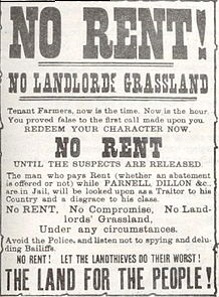
land-league-poster

The Irish National Land League, one of the most important political organizations in Irish history which seeks to help poor tenant farmers, is founded at the Imperial Hotel in Castlebar, County Mayo, on October 21, 1879. Its primary aim is to abolish landlordism in Ireland and enable tenant farmers to own the land they work on. The national organization is modeled on the Land League of Mayo, which Michael Davitt had helped found earlier in the year.

At the founding meeting Charles Stewart Parnell is elected president of the league. Davitt, Andrew Kettle, and Thomas Brennan are appointed as honorary secretaries. This unites practically all the different strands of land agitation and tenant rights movements under a single organisation.

Parnell, Davitt, John Dillon, and others including Cal Lynn then go to the United States to raise funds for the League with spectacular results. Branches are also set up in Scotland, where the Crofters Party imitates the League and secures a reforming Act in 1886.

The government introduces the Landlord and Tenant (Ireland) Act 1870, which proves largely ineffective. It is followed by the marginally more effective Land Acts of 1880 and 1881. These establish a Land Commission that starts to reduce some rents. Parnell together with all of his party lieutenants including Father Eugene Sheehy, known as “the Land League priest,” go into a bitter verbal offensive and are imprisoned in October 1881 under the Protection of Person and Property Act 1881 in Kilmainham Gaol for “sabotaging the Land Act.” It is from here that the No-Rent Manifesto is issued, calling for a national tenant farmer rent strike until “constitutional liberties” are restored and the prisoners freed. It has a modest success In Ireland and mobilizes financial and political support from the Irish Diaspora.

Although the League discourages violence, agrarian crimes increase widely. Typically, a rent strike is followed by eviction by the police and the bailiffs. Tenants who continue to pay the rent can be subject to a boycott by local League members. Where cases go to court, witnesses would change their stories, resulting in an unworkable legal system. This in turn leads on to stronger criminal laws being passed that are described by the League as “Coercion Acts.”

The bitterness that develops helps Parnell later in his Home Rule campaign. Davitt’s views as seen in his famous slogan: “The land of Ireland for the people of Ireland” is aimed at strengthening the hold on the land by the peasant Irish at the expense of the alien landowners. Parnell aims to harness the emotive element, but he and his party are strictly constitutional. He envisions tenant farmers as potential freeholders of the land they have rented.


Leave a comment

Birth of the Liberator, Daniel O’Connell

daniel-oconnell

Daniel O’Connell, Irish political leader often referred to as The Liberator or The Emancipator, is born on August 6, 1775, at Carhan near Cahersiveen, County Kerry, to the O’Connells of Derrynane, a once-wealthy Roman Catholic family, that has been dispossessed of its lands.

Raised by his uncle, Daniel learns the Irish language and Irish lore in Kerry. O’Connell does part of his schooling in France during the revolution. On May 19, 1798, O’Connell is called to the Irish Bar and becomes a barrister. Four days later, the United Irishmen stage their rebellion which is put down by the British with great bloodshed. O’Connell does not support the rebellion. He believes that the Irish need to assert themselves politically rather than by force. The violent excesses he witnesses in France, the slaughter of the 1798 Rising, and finally his own killing of a man in a duel in 1815 leads him to renounce violence forever.

Moving into politics, O’Connell founds the Catholic Association in 1823, creating one of the first massive political movements in Europe or the Americas. The Catholic Association embraces other aims to better Irish Catholics, such as electoral reform, reform of the Church of Ireland, tenants’ rights, and economic development.

When he is elected to Parliament in 1828, he is unable to take his seat as members of parliament have to take the Oath of Supremacy, which is incompatible with Catholicism.  Fear of the reaction of his millions of followers leads to the passage of the Roman Catholic Relief Act 1829. O’Connell works for Home Rule for Ireland for the rest of his days but never achieves it. The British ban his mass Repeal of the Union rallies in 1843 and jail him for a time. The movement loses momentum at that point and the long years of hard work wear “The Liberator” down.

O’Connell dies at the age of 71 of cerebral softening on May15, 1847, in Genoa, Italy, while on a pilgrimage to Rome. His time in prison seriously weakens him and the appallingly cold weather he has to endure on his journey is likely the final blow. According to his dying wish, his heart is buried in Rome at Sant’Agata dei Goti, then the chapel of the Irish College, and the remainder of his body in Glasnevin Cemetery in Dublin, beneath a round tower.


Leave a comment

Birth of Charles Stewart Parnell

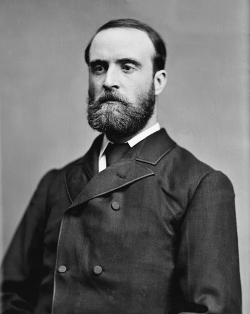
charles-stewart-parnell

Charles Stewart Parnell, Irish nationalist politician and one of the most powerful figures in the British House of Commons in the 1880s, is born on June 27, 1846, in County Wicklow.

Born into a wealthy and powerful Anglo-Irish Protestant landowning family, Parnell enters the House of Commons in 1875. He is a land reform agitator and becomes leader of the Home Rule League in 1880, insisting on operating independently of the Liberals, and winning great influence by his balancing of constitutional, radical, and economic issues, and by his skillful use of parliamentary procedure. He is imprisoned in Kilmainham Gaol in 1882 but, being a very capable negotiator, is released when he renounces violent extra-Parliamentary action in an informal agreement, the Kilmainham Treaty, with British Prime Minister William Ewart Gladstone. That same year he reforms the Home Rule League as the Irish Parliamentary Party, which he controls minutely as Britain’s first disciplined democratic party.

The hung Parliament of 1885 sees him hold the balance of power between Gladstone’s Liberals and Lord Salisbury‘s Conservatives. His power is one factor in Gladstone’s adoption of Home Rule as the central tenet of the Liberal Party. His reputation peaks in 1889-1890 when letters published in The Times linking him to the Phoenix Park murders of 1882 are shown to have been forged by Richard Pigott. However, the Irish Parliamentary Party splits in 1890 after the revelation of Parnell’s long adulterous love affair, causing many English Liberals, many of them nonconformists, to refuse to work with him, and strong opposition from Catholic bishops. He heads a small minority faction until his death in 1891.

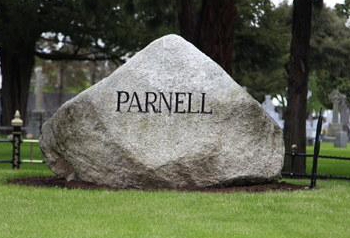
parnell-marker

In describing Parnell, Gladstone says, “I do not say the ablest man; I say the most remarkable and the most interesting. He was an intellectual phenomenon.” Liberal leader H. H. Asquith calls him as one of the three or four greatest men of the 19th century, while Lord Haldane describes him as the strongest man the House of Commons has seen in 150 years. Historian A.J.P. Taylor says, “More than any other man he gave Ireland the sense of being an independent nation.”

Charles Stewart Parnell dies of pneumonia at age 45 in his home at 10 Walsingham Terrace, Hove, England on October 6, 1891, in the arms of his wife Katharine. Though an Anglican, his funeral on October 11 is at the Irish National nondenominational Glasnevin Cemetery in Dublin and is attended by more than 200,000 people. His notability is such that his gravestone of unhewn Wicklow granite, erected in 1940, reads only “Parnell.”


Leave a comment

The Phoenix Park Murders

phoenix-park-murders

Lord Frederick Cavendish, newly appointed Chief Secretary for Ireland, and Thomas Henry Burke, the Permanent Undersecretary, are fatally stabbed in Phoenix Park, Dublin, on May 6, 1882 in what becomes known as the Phoenix Park Murders.

Cavendish, who is married to Lucy Cavendish, the niece of British Prime Minister William Ewart Gladstone, and has worked as Gladstone’s personal secretary, arrives in Ireland on the day he is murdered. Cavendish and Burke are attacked as they walk to the Viceregal Lodge, which is the out-of-season residence of the Lord Lieutenant of Ireland. Thomas Myles, resident surgeon at nearby Dr. Steevens’ Hospital, is summoned to render medical assistance to the victims. The then Lord Lieutenant, Lord Spencer, describes suddenly hearing screams, before witnessing a man running to the Lodge grounds shouting “Lord Frederick Cavendish and Mr. Burke are killed.” Responsibility for the assassinations is claimed by a small hitherto unheard-of Republican organisation called the Irish National Invincibles.

The hunt for the perpetrators is led by Superintendent John Mallon, a Catholic man from Armagh. Mallon has a pretty shrewd idea of who has committed the crime and suspects a number of former Fenian activists. A large number of suspects are arrested and kept in prison by claiming they are connected with other crimes. By playing one suspect against another, Mallon gets several of them to reveal what they know.

James Carey, leader of The Invincibles, Michael Kavanagh, and Joe Hanlon agree to testify against the others. Joe Brady, Michael Fagan, Thomas Caffrey, Dan Curley, and Tim Kelly are convicted of the murders and all are hanged by William Marwood in Kilmainham Gaol in Dublin between May 14 and June 9, 1883. Others, convicted as accessories to the crime, are sentenced to long prison terms. The getaway driver, James Fitzharris, is acquitted of murder but is retried as an accessory and convicted.

Only the case of Tim Kelly gives any real difficulty as he is only nineteen and generally said to look much younger. By referring to him as “a child” his defence counsel creates enough unease for two juries to disagree. He is found guilty only after an unprecedented third trial.

Charles Stewart Parnell makes a speech condemning the murders in 1882, which increases his already huge popularity in both Britain and Ireland. He has just enabled some reforms under the Kilmainham Treaty four days prior to the murders. Parnell’s reputation increases in Ireland, being seen as a more moderate reformer who would never excuse such tactics.

However, Parnell’s policy of allying his party to Gladstone’s Liberal Party in 1886 to enable Home Rule is also ultimately defeated by the murders. Gladstone’s Minister, Lord Hartington, is the elder brother of Lord Frederick Cavendish. Infuriated by the manner of his brother’s early death, Hartington splits with Gladstone on the Home Rule bills of 1886 and 1893 and leads the breakaway Liberal Unionist Association which allies itself to Lord Salisbury‘s conservative governments. In the ensuing 1886 general election, the Conservatives and Liberal Unionists sweep the board. This delays Home Rule by twenty-eight years, when the Third Irish Home Rule Bill is passed in 1914 but never effected.

In March 1887, The Times prints letters purportedly from Parnell claiming sympathy with the murderers and that his public denunciation of them was insincere. It emerges that the letters are forgeries written by journalist Richard Pigott. Parnell is personally vindicated by the Parnell Commission in 1888–89.


Leave a comment

John Redmond Elected Leader of the Irish Parliamentary Party

john-redmond-1917

John Edward Redmond, Irish nationalist politician, barrister, and Member of Parliament (MP) in the British House of Commons, is elected leader of the Irish Parliamentary Party on February 6, 1900.

Redmond is born at Ballytrent House, his grandfather’s old family mansion, in Kilrane, County Wexford. As a student at Clongowes Wood College, he exhibits the seriousness that many soon come to associate with him. After finishing at Clongowes, Redmond attends Trinity College, Dublin to study law, but his father’s ill health leads him to abandon his studies before taking a degree and, in 1876, goes to live with him in London. As a clerk in the House of Commons he increasingly identifies himself with the fortunes of Charles Stewart Parnell, one of the founders of the Irish Land League.

Redmond first attends political meetings with Parnell in 1879. Upon the death of his father, a Member of Parliament for Wexford, in 1880, Redmond writes to Parnell asking for adoption as the Nationalist Party, which becomes the Irish Parliamentary Party in 1882, candidate in the by-election to fill the open seat, but is disappointed to learn that Parnell has already promised the next vacancy to his secretary Timothy Healy. When a vacancy arises in New Ross, he wins election unopposed as the Parnellite candidate for the seat. He served as MP for New Ross from 1881 to 1885, for North Wexford from 1885 to 1891 and finally for Waterford City from 1891 until his death in 1918.

In 1890, the Irish Parliamentary Party splits over Parnell’s leadership when his long-standing adultery with Katharine O’Shea is revealed in a spectacular divorce case. Redmond stands by Parnell and works to keep the minority faction active. When Parnell dies in 1891, Redmond takes over leadership of the Parnellite faction of the split party, called the Irish National League (INL). The larger anti-Parnellite group forms the Irish National Federation (INF) under John Dillon.

Through the initiative of William O’Brien and his United Irish League (UIL), the INL and the INF re-unite on February 6, 1900, within the Irish Parliamentary Party. Redmond is elected its chairman, a position he holds until his death in 1918, a longer period than any other nationalist leader with the exceptions of Éamon de Valera and Daniel O’Connell.

The achievement of Home Rule is his life’s goal, having strongly supported William Gladstone’s Home Rule bills of 1886 and 1893. His best opportunity arises when the Irish Parliamentary Party holds the balance of power under H. H. Asquith in the period from 1910 onwards.  Opposition by the Ulster Unionists frustrates his plans, his main worry being that Home Rule will result in the permanent exclusion of at least some of the Ulster counties. He also fears that the activities of the Irish Volunteers might hinder the enactment of Home Rule. To guard against this eventuality, he secures the control of the organisation in June 1914.  He welcomes the Government of Ireland Act, 1914 as the only measure of Home Rule then possible. Its suspension for the duration of the war postpones addressing the issue of partition.

To ensure the success of the war effort and the speedier implementation of Home Rule, Redmond offers the services of the Irish Volunteers for the defence of the country, an offer rejected by the government. By encouraging the Volunteers to join the British army, he splits the organisation. The vast majority, totaling 170,000 and thereafter known as the National Volunteers, follow Redmond, many of them enlisting in the British army.  Those who aspire to an Irish republic or who have lost faith in Home Rule remain as the Irish Volunteers, their numbers now reduced to about 10,000.

Consequently, the 1916 Easter Rising takes him completely by surprise. Committed to keeping Ireland within the Union, he regards the Rising as treason and a “German intrigue.”  He has no sympathy with the leaders or their objective of a republic.  Nevertheless, he pleads for leniency in the House of Commons.

An operation in March 1918 to remove an intestinal obstruction appears to progress well at first, but then he suffers heart failure. He dies a few hours later at a London nursing home on March 6, 1918. One of the last things he says to the Jesuit Father who is with him to the end is, “Father, I am a broken-hearted man.”