Forty Republicans burn the railway station in Sligo, County Sligo on January 11, 1923 during the Irish Civil War, destroying it and badly damaging seven engines and forty carriages. Seven engines are sent down the line to the quay and one crashes through a concrete wall into the harbour.
The Great Southern and Western Railway Company releases a report detailing the damage Anti-Treaty forces have caused to their property over the previous six months – 375 lines damaged, 42 engines derailed, 51 over-bridges and 207 under-bridges destroyed, 83 signal cabins, and 13 other buildings destroyed. In the same month, Republicans destroy the railway stations at Ballybunion and Listowel.
The Sligo station opens on December 3, 1862 when Sligo acquires rail links to Dublin. The Sligo, Leitrim and Northern Counties Railway link to Enniskillen to the north in 1881. A link to Limerick and the south follows in 1895. The line to Enniskillen closes in 1957 and passenger services to Limerick close in 1963. For many years CIÉ keeps the latter line open for freight traffic, and although it is now disused, it forms part of the Western Rail Corridor redevelopment project.
Today, Sligo Mac Diarmada station is a mainline railway station which serves the town of Sligo. It is a terminal station, with two platforms. There is a passing loop at the approach to the station. Iarnród Éireann, Ireland’s national railway operator, runs inter-city rail services between Sligo and Dublin on the Dublin-Sligo railway line.
Galvin serves as the publicity director for the New York-based NORAID, an Irish American group fundraising organization which raises money for the families of Irish republican prisoners, but is also accused by the American, British, and Irish governments to be a front for the supply of weapons to the Provisional Irish Republican Army
Galvin becomes a publisher of The Irish People in the 1980s. He is banned from Northern Ireland because of a speech he gives that seems to endorse terrorism. In August 1984 he defies the ban and enters Northern Ireland from the Republic of Ireland. The following year he returns to Northern Ireland to attend a funeral for an IRA member killed when a makeshift grenade launcher he is trying to fire at a Royal Ulster Constabulary barracks explodes. In 1989 Galvin is arrested and deported for violating the exclusion ban yet again.
During the subsequent Irish War of Independence (1919-1921) O’Connor is made Director of Engineering of the Irish Republican Army (IRA) – a military organisation descended from the Irish Volunteers.
O’Connor does not accept the Anglo-Irish Treaty of 1921, which establishes the Irish Free State and abolishes the Irish Republic declared in 1916, which he and his comrades had sworn to uphold. On March 26, 1922, the anti-treaty officers of the IRA hold a convention in Dublin in which they reject the Treaty compromise and repudiate the authority of the Dáil, the elected Irish Parliament. Asked by a journalist if this means they are proposing a military dictatorship in Ireland, O’Connor replies, “you can take it that way if you want.”
On April 14, 1922, O’Connor, with 200 other hardline anti-treaty IRA men under his command, takes over the Four Courts building in the centre of Dublin in defiance of the new Irish government. They want to provoke the British troops, who are still in the country, into attacking them, which they believe will restart the war with Britain and re-unite the IRA against their common enemy. Michael Collins tries desperately to persuade O’Connor and his men to leave the building before fighting breaks out.
On June 28, 1922, after the Four Courts garrison has kidnapped JJ “Ginger” O’Connell, a general in the new Free State Army, Collins shells the Four Courts with borrowed British artillery. O’Connor surrenders after two days of fighting and is arrested and held in Mountjoy Prison. This incident sparks the Irish Civil War as fighting breaks out around the country between pro and anti-treaty factions.
On December 8, 1922, along with Liam Mellows, Richard Barrett and Joe McKelvey, three other republicans captured with the fall of the Four Courts, Rory O’Connor is executed by firing squad in reprisal for the anti-treaty IRA’s killing of Free State member of parliament Sean Hales. The execution order is given by Kevin O’Higgins, who less than a year earlier had appointed O’Connor to be best man at his wedding, symbolising the bitterness of the division that the Treaty has caused. O’Connor, one of 77 republicans executed by the Cumann na nGaedheal government of the Irish Free State, is seen as a martyr by the Republican movement in Ireland.
Theobald Wolfe Tone, Irish republican and rebel who sought to overthrow English rule in Ireland and who led a French military force to Ireland during the Irish Rebellion of 1798, dies at Provost’s Prison, Dublin on November 19, 1798, from a stab wound to his neck which he inflicted upon himself on November 12. His attempted suicide is the result of being refused a soldier’s execution by firing squad and being sentenced to death by hanging.
Wolfe Tone is born in Dublin on June 20, 1763. The son of a coach maker, he studies law and is called to the Irish bar in 1789 but soon gives up his practice. In October 1791 he helps found the Society of United Irishmen, initially a predominantly Protestant organization that works for parliamentary reforms, such as universal suffrage and Roman Catholic emancipation. In Dublin in 1792 he organizes a Roman Catholic convention of elected delegates that forces Parliament to pass the Catholic Relief Act of 1793. He himself, however, is anticlerical and hopes for a general revolt against religious creeds in Ireland as a sequel to the attainment of Irish political freedom.
By 1794 Wolfe Tone and his United Irishmen friends begin to seek armed aid from Revolutionary France to help overthrow English rule. After an initial effort fails, he goes to the United States and obtains letters of introduction from the French minister at Philadelphia to the Committee of Public Safety in Paris. In February 1796 he arrives in the French capital, presents his plan for a French invasion of Ireland, and is favourably received. The Directory then appoints one of the most brilliant young French generals, Lazare Hoche, to command the expedition and makes Tone an adjutant in the French army.
On December 16, 1796, Wolfe Tone sails from Brest with 43 ships and nearly 14,000 men. But the ships are badly handled and, after reaching the coast of west Cork and Kerry, are dispersed by a storm. He again brings an Irish invasion plan to Paris in October 1797, but the principal French military leader, Napoleon Bonaparte, takes little interest. When insurrection breaks out in Ireland in May 1798, Wolfe Tone can only obtain enough French forces to make small raids on different parts of the Irish coast. In September he enters Lough Swilly, Donegal, with 3,000 men and is captured there.
At his trial in Dublin on November 10, Wolfe Tone defiantly proclaims his undying hostility to England and his desire “in fair and open war to produce the separation of the two countries.” He is found guilty and is sentenced to be hanged. Early in the morning of November 12, 1798, the day he is to be hanged, he cuts his throat with a penknife and dies at the age of 35 in Provost’s Prison, Dublin, not far from where he was born. He is buried in Bodenstown, County Kildare, near his birthplace, and his grave is in the care of the National Graves Association.
Nationalists throughout Ireland wish to see the end of the IRA. In a response to a major speech by Adams, Mark Durkan, leader of the Social Democratic and Labour Party (SDLP), says IRA activity is playing into the hands of anti-Agreement unionists and calls on the IRA to cease all activity.
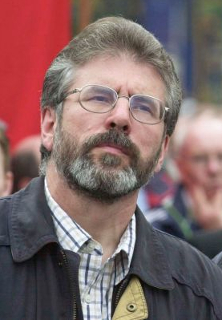
Adams tells elected Sinn Féin representatives from both sides of the Irish border in Monaghan that he can envision a future without the IRA. He also admits that “alleged” IRA activities are boosting the cause of those opposing the Northern Ireland peace process. However, he also tells Tony Blair that the IRA will never disband in response to ultimatums.
“He needs to recognise, however, that the Agreement requires an end to paramilitarism and that nationalists throughout this island fervently want one. It is time that republicans took heed of their call.”
The former Deputy First Minister in the devolved administration at Stormont says he welcomes Adams’ recognition that IRA activity is exacerbating the difficulties within unionism. “The reality is that IRA activity is playing right into the hands of anti-Agreement unionists. And letting the nationalist community badly down,” he said.
“It is also welcome that Gerry Adams has begun to recognise Sinn Féin’s credibility crisis. Too often republican denials have proved to be false in the past – be it over Colombia or Florida. This too has served only to create distrust and destabilise the Good Friday Agreement,” he adds.
In a major speech billed by his party as a considered response to the Prime Minister’s demand for an end to Republican-linked violence, Adams declares “Our view is that the IRA cessations effectively moved the army out of the picture – and allowed the rest of us to begin an entirely new process.” His speech is understood to have been handed in advance to both the British and Irish governments.
Adams says the continued IRA ceasefire and decommissioning initiatives demonstrated the organisation’s commitment to the peace process. “I do not pretend to speak for the army (IRA) on these matters, but I do believe that they are serious about their support for a genuine peace process. They have said so. I believe them,” he said. He adds, “The IRA is never going to respond to ultimatums from the British government or David Trimble.”
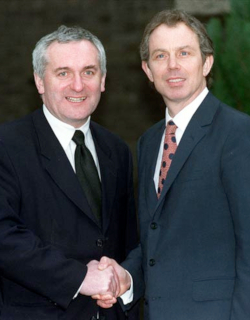
Fianna Fáil leader Bertie Ahern later says he welcomes and is encouraged by many aspects of Adams’ speech. He says the Sinn Féin leader’s strong statement of determination to keep the peace process intact and the recognition of the need to bring closure to all the key issues is a positive contribution at this difficult time in the Northern Ireland peace process.
“It was really quite something, there’s never been any peace agreement exactly like it before,” says Clinton on the Good Friday Agreement. “It broke like a thunder cloud across the world and other people were fighting in other places and they had this talk to say ‘well really do I want to put our children’s generation through this? Or if they can pull this off after all those decades maybe we could too.’”
Clinton says universities should be a place for open discussion about if people should live in individual tribes, or as communities with shared values and respect for one another, especially in today’s political climate.
“It is no exaggeration to say that the success of the Northern Ireland peace process is in very many ways due to the fact that President Clinton took the view that it was a conflict that could be resolved by his personal input and by the power and influence of the United States of America,” said Gary Murphy, from the School of Law and Government in the president’s introductory citation.
“There can be little doubt that the conflict in Northern Ireland was ultimately resolved because that great beacon of liberty, the United States of America, decided that it could use its influence to make a vital difference. That fateful decision was taken in the Oval Office by President Bill Clinton.”
“There was no electoral gain for him taking it. If anything, his initial forays into the Northern Ireland peace process were greeted with skepticism by both republicans and unionists in Northern Ireland and by downright distrust and suspicion in the corridors of power in London. But Bill Clinton persevered, and thanks to that perseverance we have peace in Ireland today.”
Also celebrated at the ceremony is Dr. Martin Naughton, KBE, founder of Glen Electric and one of Ireland’s most successful entrepreneurs and business leaders. From humble roots in Newry, County Down he becomes the global leader in electric heating and credits his success to his family ethos of honesty, morality, decency and integrity.
Sr. Stanislaus Kennedy is awarded the honorary doctorate for her longstanding work with the homeless and marginalised. She is the founder of Focus Ireland, which is now the largest voluntary organisation in Ireland, and has written many books on mindfulness and the importance of spirituality.
“As president I am often asked why DCU awards honorary doctorates, but Ireland has no national honours system, so it’s important that we recognise and honour outstanding achievements and role model individuals,” says Brian MacCraith.
Keating is born on January 2, 1902, in Castlemaine, County Kerry. He receives his education in local schools, including the Christian Brothers’ School in Tralee. Tralee is also the place where Keating does his apprenticeship. During this time, he becomes a skillful Gaelic football player in his native Kerry.
Keating joins Fianna Éireann in 1918. In 1920, during the Irish War of Independence, he joins the Boherbee B Company, 3rd Battalion, 1st Kerry Brigade, Irish Republican Army (IRA). He first brings a firearm of a Liverpool Irish soldier of the British Army into a public house in which he works. On April 21, 1921, Royal Irish Constabulary (RIC) Constable Denis O’Loughlin is shot dead in Knightly’s public house in Tralee. Keating, Jimmy O’Connor and Percy Hanafin are suspected of the killing and are forced to go on the run. On June 1, Keating is involved in an ambush between Castlemaine and Milltown which claims the lives of five RIC men. On July 10, a day before the truce between the IRA and British forces, his unit is involved in a gun battle with the British Army near Castleisland. This confrontation results in the deaths of four British soldiers and five IRA volunteers.
Keating remains an IRA member for a long time after the Civil War. He is arrested several times during the 1930s on various charges. He is active in London during the 1939/1940 IRA bombing campaign.
In 1933, Keating is involved in an attempt to assassinate the leader of the Irish Blueshirts, Eoin O’Duffy, during a visit to County Kerry. The attack is to happen at Ballyseedy, where Free State forces had carried out the Ballyseedy Massacre during the Irish Civil War. However, the plot fails when the person travelling with O’Duffy refuses to divulge in which car O’Duffy would be riding.
Keating subsequently returns to Dublin and works as a barman in several public houses. He retires and returns to his native Kerry in 1978, living out the rest of his life with relatives in Knockbrack. Until his death he refuses to accept a state pension because he considers the 26-county Republic of Ireland an illegitimate state which usurps the 1916 Irish Republic.
“All the talk you hear these days is of peace. But there will never be peace until the people of the 32 counties elect one parliament without British interference.”
In 2002, Keating refuses the state’s standard €2,500 award to centenarians from PresidentMary McAleese. After former IRA volunteer George Harrison dies in November 2004, Keating becomes patron of Republican Sinn Féin until his own death. At the time of his death at the age of 105 on October 2, 2007, he is the oldest man in Ireland. He is buried in Kiltallagh Cemetery, Castlemaine.
On September 5, 1798, Teeling clears the way for the advancing Irish-French army by single handedly disabling a British gunner post during the Battle of Collooney in Sligo when he breaks from the French ranks and gallops towards Union Rock. He is armed with a pistol and shoots the cannon’s marksman and captures the cannon. The French and Irish advance and the British, after losing the cannon position, retreat towards their barracks at Sligo, leaving 60 dead and 100 prisoners.
During the Battle of Ballinamuck at Longford, Teeling and approximately 500 other Irishmen are captured along with their French allies. The French troops are treated as prisoners of war and later returned to France, however the Irish troops are executed by the British.
Teeling is court-martialled by Britain as an Irish rebel and for committing treason. To positively identify him, the authorities enlist William Coulson, a damask manufacturer from Lisburn, who identifies him as a son of Luke Teeling, a linen merchant who lived in Chapel Hill, Lisburn. Bartholomew Teeling is hanged at Arbour Hill Prison in Dublin on September 24, 1798.
In 1898, the centenary year of the battle, a statue of Teeling is erected in Carricknagat. One of the main streets in Sligo, which accommodates the Sligo Courthouse and main Garda Síochána barracks, is later named Teeling Street also in honour of Bartholomew Teeling.
By the middle of August, the Provisional Government of the Irish Free State under Collins has control of Dublin. Collins himself has established a Criminal Investigation Department based at Oriel House, Westland Row. These former IRA Volunteers, turned Free Staters, acquire a ruthless reputation and become known to republicans as the Oriel House Gang. They are plain-clothed and heavily armed and Oriel House is notorious for ill-treatment of republican prisoners held there. Accounts of the killings of August 26 indicate that the Oriel House Gang is responsible.
The day after Collins is assassinated, Richard Mulcahy, Chief of Staff of the Free State Army, sends a message to his soldiers. He urges them to “stand calmly by your posts” and says, “Let no cruel act of reprisal blemish your bright honour.” Yet in Dublin, within days of that message, and as the body of Collins lay in state in City Hall, Free State forces carry out atrocities which have been almost totally forgotten.
Following the assassination at Béal na mBláth on August 22, Collins’s body is brought to Dublin and lay in state in City Hall. On August 26, a short distance away from City Hall where crowds are still filing past the coffin, Bernard Daly is working as a bartender in Hogan’s licensed premises in Suffolk Street. At about 3:30 PM three armed men enter the pub and arrest Daly at gunpoint. He is dragged to the cellar and then taken away in a Ford car.
Plain-clothed, armed men travelling in a large Ford car, possibly some or all of the same individuals, are responsible for the second summary execution of August 26. Seán Cole of Lower Buckingham Street and Alf Colley of Parnell Street are officers of Fianna Éireann, the republican youth organisation. They are arrested at Annesley Bridge and taken to Yellow Lane, Whitehall. They suffer the same fate as Bernard Daly, only this time there are witnesses.
The Irish News reports that soon after 6:00 PM, a group of children and young people playing on the road are surprised when a large Ford car comes to a sharp halt. There are five or six men inside – Cole and Colley and their abductors. The two Fianna members are forced out of the car while the crowd is held back at gunpoint. One of the Free Staters tries to open a gate to a field, which is presumably to be the site of the executions, but the gate is locked.
Cole and Colley are placed with their backs to the gate, held in position and killed with revolver shots to the body and head. Their killers then drive away from the scene.
The sites of the executions of Bernard Daly, Seán Cole and Alf Colley are marked by small memorials.
(Pictured: Seán Cole and Alf Colley – summarily executed in revenge for death of Michael Collins)
The crisis, triggered by the 1981 Irish hunger strike of Provisional IRA and Irish National Liberation Army (INLA) prisoners, leads to an increase in militant Irish republican activity in Northern Ireland. British intelligence reports unveil IRA intentions of mounting illegal checkpoints and hijacking vehicles on the IRA-controlled roads in South County Armagh, near the Irish border. To counter it, the British Army deploy the so-called COPs (close observation platoons), small infantry sections acting as undercover units, a tactic introduced by Major GeneralRichard Trant in 1977.
On May 6, 1981, a day after the death of hunger-striker Bobby Sands, one IRA member from a three-man unit is arrested while trying to set up a roadblock east of the main Belfast-Dublin road by twelve members of the Royal Green Jackets, divided in three teams. A second volunteer crosses the border, only to be arrested by the Irish Army. The third IRA man escapes apparently injured. A total of 689 rounds are fired by the soldiers.
After this initial success, the British Army continues these tactics. On July 16, another operation is carried out by eighteen Royal Green Jackets soldiers. That night, four concealed positions – Alpha, Bravo, Charlie and Delta – are inserted into the Glassdrumman area, around a scrapyard along the border. The plan is that another unit, called the triggering team, would ambush any IRA unit on sight, while the other four would block the expected escape routes. On July 17, the commanders in charge of Alpha and Delta teams, suspecting that the operation has been compromised by the presence of local civilians, orders the withdrawal of their men. Shortly thereafter, Bravo team is suddenly engaged by automatic fire from an M60 machine gun and AR-15 rifles fired by six or seven IRA members. The concealed position, emplaced inside a derelict van, is riddled by more than 250 bullets. The team’s leader, Lance Corporal Gavin Dean, is killed instantly and one of his men, Rifleman John Moore, is seriously wounded. Moore is later awarded the Military Medal. The IRA members fire their weapons from across the border, 160 yards away.
British army commanders conclude that “it was not worth risking the lives of soldiers to prevent an IRA roadblock being set up.” The incident also exposes the difficulties of concealing operations from local civilians in South Armagh, whose sympathy with the IRA is manifest. Several years later, the IRA would repeat its success against undercover observation posts in the course of Operation Conservation in 1990.