seamus dubhghaill

Promoting Irish Culture and History from Little Rock, Arkansas, USA


Leave a comment

Martial Law Declared in Ireland

martial-law-april-1916

The United Kingdom declares martial law in Ireland for one month on April 25, 1916, the day after the commencement of the Easter Rising. A curfew is imposed from 8:30 PM until 5:00 AM. Anyone spotted on the streets during the hours of darkness are to be shot on sight. The trams stop running at 7:00 PM and the theatres and cinemas close by 8:00 PM. Those rushing for trams leaving the city centre have to pass through a stop-and-search military cordon.

The Easter Rising, also known as the Easter Rebellion, is an armed insurrection in Ireland during Easter Week, 1916. The Rising is mounted by Irish republicans in an attempt to end British rule in Ireland, secede from the United Kingdom of Great Britain and Ireland and establish an independent Irish Republic. This takes place while the United Kingdom is heavily engaged in World War I. It is the most significant uprising in Ireland since the Irish Rebellion of 1798.

Organized by seven members of the Military Council of the Irish Republican Brotherhood (IRB), the Rising begins on Easter Monday, April 24, 1916, and lasts for six days. The following day the British Government immediately declares martial law in Ireland. Members of the Irish Volunteers, led by schoolmaster and Irish language activist Patrick Pearse and joined by the smaller Irish Citizen Army of James Connolly and 200 members of Cumann na mBan, seize key locations in Dublin and proclaim the Irish Republic independent of the United Kingdom. There are actions in other parts of Ireland, however, except for the attack on the Royal Irish Constabulary barracks at Ashbourne in County Meath, they are minor.

With vastly superior numbers and artillery, the British army quickly suppresses the Rising and Pearse agrees to an unconditional surrender on Saturday, April 29, 1916. Most of the leaders are executed following courts-martial, but the Rising succeeds in bringing physical force republicanism back to the forefront of Irish politics. Support for republicanism continues to rise in Ireland in the context of the ongoing war in Europe and the Middle East and revolutions in other countries, and especially as a result of the Conscription Crisis of 1918 and the failure of the British-sponsored Irish Convention.

In the 1918 Irish general election, republicans, by then represented by Sinn Féin, secure an overwhelming victory, winning 73 Irish seats out of 105 to the British Parliament, on a policy of abstentionism and Irish independence. The following year Éamon de Valera escapes from Lincoln Gaol to become party leader. On January 21, 1919, they convene the First Dáil and declare the independence of the Irish Republic. Later that same day the Irish Republican Army, organised by Minister for Finance and IRB president Michael Collins, begins the Irish War of Independence with the Soloheadbeg ambush.

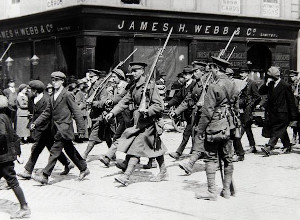
(Pictured: Rebel prisoners are marched out of Dublin by the British Army)


Leave a comment

Murder of George Clancy, Mayor of Limerick

george-clancy

George Clancy, Irish nationalist politician and Mayor of Limerick, is shot in his home by Royal Irish Constabulary (RIC) Auxiliaries and dies on March 7, 1921, during the Irish War of Independence.

Clancy is born at Grange, County Limerick in 1881 to a family with a strong republican tradition. He is educated at Crescent College, Limerick, and thereafter at the Catholic University in St. Stephen’s Green, now University College, Dublin. Among his friends at the university are James Joyce, Francis Sheehy-Skeffington, Tomás Mac Curtain and Terence MacSwiney. He helps form a branch of the Gaelic League at college and persuades his friends, including Joyce, to take lessons in the Irish language. He plays hurling and is a good friend of Michael Cusack. With Arthur Griffin he joins the Celtic Literary Society. It is said that he is the model for the character of Michael Davin in Joyce’s A Portrait of the Artist as a Young Man.

Clancy graduates in 1904 and finds a position teaching the Irish language at Clongowes Wood College and is active in the Gaelic Athletic Association. Due to ill health he has to return to his home at Grange. In 1908 he comes to Limerick to teach Irish. In 1913 he joins the Irish Volunteers. In 1915 he marries Máire Killeen, a teacher. After the 1916 Easter Rising, he is arrested and imprisoned in Cork, but is released before he comes to trial following a hunger strike.

Clancy helps in Éamon de Valera‘s election campaign in East Clare. He nearly dies of Spanish flu during the 1918 epidemic but recovers and, in January 1921, he is elected Sinn Féin Mayor of Limerick.

On the night of March 6, 1921, three Auxiliaries come to Clancy’s house and one of them shoots him, injuring him fatally. His wife is also injured in the attack. The previous Mayor, Michael O’Callaghan, is also murdered on the same night by the same group.

Suspicion immediately falls upon members of the Black and Tans, but a British inquiry into the murder, like most such inquiries through the years, absolve Crown forces of any blame. One of Clancy’s killers is later said to be George Nathan who dies in the Spanish Civil War in July 1937.


1 Comment

Archibald Hamilton Rowan Tried for Distribution of Seditious Paper

archibald-hamilton-rowan

Archibald Hamilton Rowan, a founding member of the Dublin Society of United Irishmen, is tried on a charge of distributing seditious paper on January 29, 1794.

Hamilton Rowan is born in the home of his grandfather, William Rowan, in London on May 1, 1751, and lives there with his mother and sister for much of his early life. He is admitted to Queens’ College, Cambridge in 1768, but is expelled from the college and rusticated for an attempt to throw a tutor into the River Cam. He is sent for a period in 1769 to Warrington Academy.

Hamilton Rowan travels throughout the 1770s and 1780s, visiting parts of Europe, the Americas, and North Africa. In 1781 he marries Sarah Dawson in Paris, France. The couple has ten children. He is the godfather of the Irish mathematician William Rowan Hamilton.

Hamilton Rowan returns to Ireland in his thirties, in 1784, to live at Rathcoffey near Clane in County Kildare. He becomes a celebrity and, despite his wealth and privilege, a strong advocate for Irish liberty. That same year he joins the Killyleagh Volunteers, a militia group later associated with radical reform. He first gains public attention by championing the cause of fourteen-year-old Mary Neal in 1788. Neal had been lured into a Dublin brothel and then assaulted by Lord Carhampton. Hamilton Rowan publicly denounces Carhampton and publishes a pamphlet A Brief Investigation of the Sufferings of John, Anne, and Mary Neal in the same year. An imposing figure at more than six feet tall, his notoriety grows when he enters a Dublin dining club threatening several of Mary Neal’s detractors, with his massive Newfoundland at his side and a shillelagh in hand. The incident wins him public applause and celebrity as a champion of the poor.

In 1790 Hamilton Rowan joins the Northern Whig Club, and by October has become a founding member of the Dublin Society of United Irishmen, working alongside famous radicals such as William Drennan and Theobald Wolfe Tone. He is arrested in 1792 for seditious libel when caught handing out “An Address to the Volunteers of Ireland,” a piece of United Irish propaganda. Unknown to him, from 1791 Dublin Castle has a spy in the Dublin Society, Thomas Collins, whose activity is never discovered. From February 1793 Britain and Ireland join the War of the First Coalition against France, and the United Irish movement is outlawed in 1794.

Hamilton Rowan’s reputation for radicalism and bluster grow during this time when he leaves Ireland to confront the Lord Advocate of Scotland about negative comments made in respect to his character and that of members of the Society of United Irishmen. As a prominent member of the Irish gentry, he is an important figure in the United Irishmen and becomes the contact for the Scottish radical societies as a result of his visit. Upon his return to Dublin, he is charged and was found guilty of seditious libel, even though he is excellently defended by the famous John Philpot Curran. He is sentenced to two years imprisonment, receives a fine of £500, and is forced to pay two assurities for good behaviour of £1,000 each. In January 1794 he retires to his apartments in Dublin’s Newgate Prison.

In the years following, Hamilton Rowan spends time in exile in France, the United States and Germany. He is allowed to return to Ireland in 1806. He returns to the ancestral home of Killyleagh Castle, County Down, receiving a hero’s welcome. While he has agreed to be a model citizen under the conditions of his return to Ireland, he remains active in politics and retains his youthful radicalism. Following his last public appearance at a meeting in the Rotunda in Dublin on January 20, 1829, he is lifted up by a mob and paraded through the streets.

Hamilton Rowan dies at the age of 84 in his home on November 1, 1834. He is buried in the vaults of St. Mary’s Church, Dublin.


Leave a comment

Death of Helena Molony, Feminist & Labour Activist

helena-moloney

Helena Mary Molony, prominent Irish republican, feminist and labour activist, dies in Dublin on January 28, 1967. She fights in the 1916 Easter Rising and later becomes the second woman president of the Irish Trades Union Congress (ITUC).

Molony is born in Dublin on January 15, 1883, to Michael Molony, a grocer, and Catherine McGrath. Her mother dies early in her life. Her father later remarries, but both became alcoholics, something which influences her years later.

In 1903, inspired by a pro-nationalist speech given by Maud Gonne, Molony joins Inghinidhe na hÉireann and begins a lifelong commitment to the nationalist cause. In 1908 she becomes the editor of the organisation’s monthly newspaper, Bean na hÉireann (Woman of Ireland). The newspaper brings together a nationalist group – Constance Markievicz designs the title page and writes the gardening column, Sydney Gifford writes for the paper and is on its production team and contributors include Eva Gore-Booth, Susan L. Mitchell, and Katharine Tynan, as well as Patrick Pearse, Thomas MacDonagh, George William Russell, Roger Casement, Arthur Griffith and James Stephens.

Molony is central to the school meals activism of the movement. With Maud Gonne, Marie Perolz and others, she organises the supply of daily school meals to children in impoverished areas, and pressures Dublin Corporation and other bodies to provide proper meals to the starved children of Dublin city.

Molony also has a career as an actress and is a member of the Abbey Theatre. However, her primary commitment is to her political work. She is a strong political influence, credited with bringing many into the movement, including Constance Markievicz and Dr. Kathleen Lynn.

As a labour activist, Molony is a close colleague of Markievicz and of James Connolly. In November 1915 Connolly appoints her secretary of the Irish Women Workers’ Union, in succession to Delia Larkin. This union had been formed during the strike at Jacob’s Biscuit Factory that was part of the 1913 Dublin lock-out. She manages the union’s shirt factory in Liberty Hall, founded to give employment to the strikers put out of work and blacklisted after the strike. She is friendly with the family of Thomas MacDonagh and his wife, Muriel, and is the godmother of their daughter Barbara, whose godfather is Patrick Pearse.

Fianna Éireann, the cadet body of the Irish Volunteers, is founded by Constance Markievicz in Molony’s home at 34 Lower Camden Street, Dublin, on August 16, 1909. Markievicz works closely with Molony and Bulmer Hobson in organising the fledgling Fianna. It is during this period of working together in building the Fianna that Molony and Hobson grow close and became romantically linked. However, the relationship does not last.

Molony is a prominent member of Cumann na mBan, the republican women’s paramilitary organisation formed in April 1914 as an auxiliary of the Irish Volunteers. Members of Cumann na mBan train alongside the men of the Irish Volunteers in preparation for the armed rebellion against the English forces in Ireland.

During the 1916 Easter Rising, Molony is one of the Citizen Army soldiers who attacks Dublin Castle. During the defence of City Hall, her commanding officer, Sean Connolly, is killed and she is captured and imprisoned until December 1916.

After the Irish Civil War, Molony becomes the second female president of the Irish Trades Union Congress. She remains active in the republican cause during the 1930s, particularly with the Women’s Prisoner’s Defense League and the People’s Rights Association.

Molony retires from public life in 1946 but continued to work for women’s labour rights. She dies in Dublin on January 28, 1967.


Leave a comment

Death of Jennie Wyse Power, Activist & Feminist

jennie-wyse-power

Jennie Wyse Power, Irish activist, feminist, politician, and businesswoman, dies at her home in Dublin on January 5, 1922. She is a founder member of Sinn Féin and also of Inghinidhe na hÉireann.

Power is born Jane O’Toole in Baltinglass, County Wicklow on May 1, 1858. In the 1880s she joins the Ladies’ Land League and finds herself immersed in their activities during the Land War. She compiles lists of those evicted from their homes and also organises the Land League in Wicklow and Carlow. In 1883 she marries John Wyse Power, a journalist who shares her political beliefs and is a member of the Irish Republican Brotherhood (IRB). They have four children together, a fact that does not interfere with her political work.

Power helps set up the Irish Women’s Franchise League and is also a founding member of Inghinidhe na hÉireann and Sinn Féin becoming Vice-President of both organisations. She is later on the Provisional Committee that sets up Cumann na mBan. She rises in the ranks to become one of the most important women of the revolution. In October 1914, she is elected the first President of Cumann na mBan. She is a successful businesswoman owning four branches of her Irish Farm Produce Company. The 1916 Proclamation of the Irish Republic is written in her home at 21 Henry Street, and she always maintains that the Military Council signed the proclamation in no particular order; they just signed as it was passed to each of the signatories, though, with James Connolly being eager to be the first to sign. Even the identity of the head of the Provisional Government was not altogether clear.

During the 1916 Easter Rising she supplies food to the Irish Volunteers. After the Rising she and her daughter, Nancy, help re-organise Cumann na mBan and distribute funds to families suffering hardships, as well as the Prisoners Dependants Fund. These funds had been sent by Clan na Gael in the United States. She is subsequently elected as one of five women members onto Dublin Corporation in 1920 for the Inns Quay – Rotunda District.

Power supports the Anglo-Irish Treaty and by the end of 1921, she is convinced that in doing so, will mean the need to leave Cumann na mBan to form a separate organisation. She helps set up Cumann na Saoirse (The League for Freedom), the pro-Treaty women’s organisation and becomes its Vice-President. She is a Free State Senator from 1922 until 1936 and is also a member of Cumann na nGaedheal.

Jennie Wyse Power dies on January 5, 1941, aged 82, at her home in Dublin. She is interred in Glasnevin Cemetery with her husband and daughter, Máire (who predeceased her). Her funeral is attended by many from both sides of the Dáil and the former revolutionary movement.


Leave a comment

Birth of Suffragist Winifred Carney

winifred-carney

Maria Winifred Carney, also known as Winnie Carney, suffragist, trade unionist and Irish independence activist, is born into a lower-middle class Catholic family in Bangor, County Down on December 4, 1887. Her father is a Protestant who leaves the family. Her mother and six siblings move to Falls Road in Belfast when she is a child.

Carney is educated at St. Patrick’s Christian Brothers School in Donegall Street in Belfast, later teaching at the school. She enrolls at Hughes Commercial Academy around 1910, where she qualifies as a secretary and shorthand typist, one of the first women in Belfast to do so. However, from the start she is looking towards doing more than just secretarial work.

In 1912 Carney is in charge of the women’s section of the Northern Ireland Textile Workers’ Union in Belfast, which she founds with Delia Larkin in 1912. During this period, she meets James Connolly and becomes his personal secretary. She becomes Connolly’s friend and confidant as they work together to improve the conditions for female labourers in Belfast. Carney then joins Cumann na mBan, the women’s auxiliary of the Irish Volunteers, and attends its first meeting in 1914.

Carney is present with Connolly in Dublin‘s General Post Office (GPO) during the Easter Rising in 1916. She is the only woman present during the initial occupation of the building. While not a combatant, she is given the rank of adjutant and is among the final group to leave the GPO. After Connolly is wounded, she refuses to leave his side despite direct orders from Patrick Pearse and Connolly. She leaves the GPO with the rest of the rebels when the building becomes engulfed in flames. They make their new headquarters in nearby Moore Street before Pearse surrenders.

After her capture, Carney is held in Kilmainham Gaol before being moved to Mountjoy Prison and finally to an English prison. By August 1916 she is imprisoned in HM Prison Aylesbury alongside Nell Ryan and Helena Molony. The three request that their internee status be revoked so that they could be held as normal prisoners with Countess Markievicz. Their request is denied, however Carney and Molony are released two days before Christmas 1916.

Carney is a delegate at the 1917 Belfast Cumann na mBan convention. She stands for Parliament as a Sinn Féin candidate for Belfast Victoria in the 1918 United Kingdom general election but loses to the Labour Unionists. Following her defeat, she decides to continue her work at the Irish Transport and General Workers’ Union until 1928. By 1924 she has become a member of the Labour Party. In the 1930s she joins the Socialist Party of Northern Ireland.

Following the Irish Civil War, Carney becomes much more disillusioned with politics. She is very critical and outspoken of Éamon de Valera and his governments.

In 1928 she marries George McBride, a Protestant Orangeman and former member of the Ulster Volunteers. Ironically, the formation of the Ulster Volunteers prompts the formation of the Irish Volunteers, of which Carney was a member. She alienates anyone in her life that does not support her marriage to McBride.

A number of serious health problems limit Carney’s political activities in the late 1930s. She dies in Belfast on November 21, 1943, and is buried in Milltown Cemetery. Her resting place is located years later, and a headstone is erected by the National Graves Association, Belfast. Because she married a Protestant and former Orangeman, she is not allowed to have his name on her gravestone due to the religious differences.

In 2013, the Seventieth Anniversary of Carney’s death is remembered by the Socialist Republican Party. Almost one hundred people attend as a short parade follows, marking and commemorating the work she did for the cause. She is placed in high esteem among the other hundreds of radical women, who stand up for what they believe in, regardless of the consequences they face.


Leave a comment

Birth of Michael Hayes, Politician & Professor

michael-hayes

Michael Joseph Hayes, Fine Gael politician and professor of Irish, is born in Dublin on December 1, 1889. He serves as Ceann Comhairle of Dáil Éireann from 1922 to 1932, Minister for Foreign Affairs from August 1922 to September 1922 and Minister for Education January 1922 to August 1922. He serves as a Teachta Dála (TD) for the National University of Ireland constituency from 1921 to 1933. He is a Senator from 1938 to 1965.

Hayes is educated at the Synge Street CBS and at University College Dublin (UCD). He later becomes a lecturer in French at the University. In 1913, he joins the Irish Volunteers and fights in Jacob’s biscuit factory during the Easter Rising in 1916. He escapes capture but is arrested in 1920 and interned at Ballykinlar, County Down.

Hayes is first elected to Dáil Éireann as a Sinn Féin TD for the National University of Ireland constituency at the 1921 Irish elections. At the 1922 general election he is elected as a Pro-Treaty Sinn Féin TD. He serves as Minister for Education from January to September 1922, as part of the Dail Aireacht ministry as opposed to the Provisional Government. He has special responsibility for secondary education. He is also acting Minister for Foreign Affairs from August to September 1922. He supports the Anglo-Irish Treaty during the crucial debates in 1922. That same year he is elected Ceann Comhairle of the First Dáil of the Irish Free State. He holds that post for ten years until 1932.

At the 1923 general election, Hayes is elected as a Cumann na nGaedheal TD for two constituencies, Dublin South and National University of Ireland. He resigns his seat in Dublin South following the election.

Hayes loses his Dáil seat at the 1933 general election but is elected to Seanad Éireann in 1938 for Fine Gael. He remains a Senator until 1965, acting as leader of government and opposition there.

Hayes becomes Professor of Irish at University College Dublin in 1951.

Michael Hayes dies at the age of 86 on July 11, 1976, in Dublin.


Leave a comment

Death of Peadar Kearney, Composer & Irish Republican

peadar-kearney

Peadar Kearney, Irish republican and composer of numerous rebel songs, dies in Inchicore, Dublin on November 24, 1942. In 1907 he writes the lyrics to “The Soldier’s Song” (“Amhrán na bhFiann“), now the Irish national anthem. He is the uncle of Irish writers Brendan Behan, Brian Behan, and Dominic Behan.

Kearney was born on December 12, 1883, at 68 Lower Dorset Street, Dublin, above one of the two grocer’s shops owned by his father, John Kearney, originally from Funshog, Collon, County Louth. His mother, Katie (née McGuinness), is from Rathmaiden, Slane, County Meath. He is educated at the Model School, Schoolhouse Lane and St. Joseph’s Secondary C.B.S. in Fairview. He hears Willie Rooney give nationalist lectures on history in the Mechanics’ Institute. For a short time, he attends Belvedere College. Following the death of his father, he is left to support his mother and five younger siblings. He has various menial jobs for three years before being apprenticed to a house painter.

In 1901, the death of Willie Rooney prompts Kearney to join the Willie Rooney Branch of the Gaelic League. He joins the Irish Republican Brotherhood in 1903. He teaches night classes in Irish and numbers Seán O’Casey among his pupils. He finds work with the National Theatre Society and in 1904 is one of the first to inspect the derelict building that becomes the Abbey Theatre. He assists with props and performs occasional walk-on parts at the Abbey until 1916.

Kearney is a co-founder of the Irish Volunteers in 1913 and takes part in the Howth and Kilcoole gun runnings in 1914. In the Easter Rising of 1916 he fights at Jacob’s biscuit factory under Thomas MacDonagh, abandoning an Abbey Theatre tour in England to take part in the Rising. He escapes before the garrison is taken into custody.

Kearney is also active in the Irish War of Independence. On November 25, 1920, he is captured at his home in Summerhill, Dublin and is interned first in Collinstown Camp in Dublin and later in Ballykinler Camp in County Down.

A personal friend of Michael Collins, Kearney at first takes the Free State side in the Irish Civil War but loses faith in the Free State after Collins’s death. He takes no further part in politics, returning to his original trade of house painting.

Kearney’s songs are highly popular with the Irish Volunteers (which later becomes the Irish Republican Army) in the 1913–1922 period. Most popular is “The Soldier’s Song.” He pens the original English lyrics in 1907 and his friend and musical collaborator Patrick Heeney composes the music. The lyrics are published in 1912 and the music in 1916. After 1916 it replaces “God Save Ireland” as the anthem of Irish nationalists. The Irish Free State is established in 1922 and formally adopts the anthem in 1926.

Other well-known songs by Kearney include “Down by the Glenside,” “The Tri-coloured Ribbon,” “Down by the Liffey Side,” “Knockcroghery” (about the village of Knockcroghery) and “Erin Go Bragh” (Erin Go Bragh is the text on the Irish national flag before the adoption of the tricolour).

Peadar Kearney dies in relative poverty in Inchicore on November 24, 1942. He is buried in Glasnevin Cemetery in Dublin.


Leave a comment

Patrick Pearse Arrives in Ros Muc

patrick-pearse-cottage

Patrick Pearse arrives in Ros Muc, County Galway on September 13, 1903, and takes up residence at his cottage in Inbhear.

Born in Dublin on November 10, 1879, Pearse joins the Irish Republican Brotherhood (IRB) in September 1913, becoming Director of Military Organisation of the Irish Volunteers in 1914 and is later co-opted into the IRB’s secretive Military Council, which infiltrates the Volunteers for the Easter Rising.

A writer and Irish language enthusiast long before he becomes a revolutionary, Pearse first comes to Ros Muc in 1903 as a 23-year-old handpicked by Conradh na Gaeilge to act as an Irish examiner.

Pearse develops a strong affinity with the area, buying land on Loch Eileabhrach in 1905, upon which he builds a cottage in 1909. Unusually for a professional at the time, he has it thatched in the style of poor country dwellings and on his regular visits between 1903 and 1915, spends time in the cabins of the poor, soaking up the folklore which finds its way into his writings.

Pearse has a rival for the affections of the locals in the shape of the Lord Lieutenant of Ireland, the Queen’s representative in Ireland. William Ward, 2nd Earl of Dudley also spends summers in the area, where he organises hunts with gentry and children’s fetes.

In response, Pearse organises an evening of Irish festivities for Ros Muc. Pearse gives scholarships to local gaeilgeoiri boys to his St. Enda’s School in Dublin.

Pearse’s last visit to the cottage is in 1915, when he composes the rousing oration for the funeral of Jeremiah O’Donovan Rossa. The following April, he goes one step further, declaring a Republic on the steps of the General Post Office (GPO) in Dublin.

After Pearse’s execution on May 3, 1916, his cottage passes to his mother Margaret. In 1921 it is burned down by the “Black and Tans” and Auxiliaries. Restored by Ó Conghaile and then again by Criostóir Mac Aonghusa, by 1943 Pearse’s sisters Senator Margaret Mary Pearse and Mary Brigid Pearse hand the cottage to the State.

Opened in 2016, a new visitor centre next to Pearse’s Cottage provides an introduction to the Irish language, Gaeltacht culture, and Pearse’s connection to Ros Muc.

(From: “Patrick Pearse’s cottage: a cultural visit to Ros Muc,” Darragh Murphy, The Irish Times, January 13, 2016)


Leave a comment

Birth of Dan Breen, IRA Volunteer & Fianna Fáil Politician

Irish republican Dan Breen (1967)

Daniel “Dan” Breen, volunteer in the Irish Republican Army (IRA) during the Irish War of Independence and the Irish Civil War, is born in Grange, Donohill parish, County Tipperary, on August 11, 1894. In later years, he is a Fianna Fáil politician.

Breen’s father dies when he is six, leaving the family very poor. He is educated locally before becoming a plasterer and later a linesman on the Great Southern Railways.

Breen is sworn into the Irish Republican Brotherhood in 1912 and the Irish Volunteers in 1914. On January 21, 1919, the day the First Dáil meets in Dublin, Breen takes part in the Soloheadbeg Ambush. The ambush party of eight men, led by Seán Treacy, attacks two Royal Irish Constabulary (RIC) men who are escorting explosives to a quarry. The two policemen, James McDonnell and Patrick O’Connell, are fatally shot during the incident. The ambush is considered to be the first incident of the Irish War of Independence.

During the conflict, the British put a £1,000 price on Breen’s head, which is later increased to £10,000. He quickly establishes himself as a leader within the Irish Republican Army. He is known for his courage. On May 13, 1919 he helps rescue his comrade Seán Hogan at gunpoint from a heavily guarded train at Knocklong station in County Limerick. Breen, who is wounded, remembers how the battalion is “vehemently denounced as a cold-blooded assassins” and roundly condemned by the Catholic Church. After the fight, Treacy, Séumas Robinson, and Breen meet Michael Collins in Dublin, where they are told to make themselves scarce although they do not necessarily agree.

Breen and Sean Treacy shoot their way out through a British military cordon in the northern suburb of Drumcondra (Fernside). They escape, only for Treacy to be killed the next day. Breen is shot at least four times, twice in the lung.

The British reaction is to make Tipperary a “Special Military Area,” with curfews and travel permits. Volunteer GHQ authorises entrerprising attacks on barracks. The British policy forces Breen and Treacy to retreat to Dublin. They join Michael Collins’ Squad of assassins, later known as the Dublin Guard, and Dublin becomes the centre of the war.

Breen is present in December 1919 at the ambush in Ashtown beside Phoenix Park in Dublin where Martin Savage is killed while trying to assassinate the Lord Lieutenant of Ireland, Viscount John French. The IRA hides behind hedges and a dungheap as the convoy of vehicles drives past. They have been instructed to ignore the first car but this contains their target, Lord French. Their roadblock fails as a policeman removes the horse and cart intended to stop the car.

Breen utterly rejects the Anglo-Irish Treaty, which makes him, like many others, angry and embittered. In the June 1922 elections Breen is nominated as a candidate by both the pro- and anti-Treaty sides, but is not elected.

Breen is elected to Dáil Éireann at the 1923 general election as a Republican anti-Treaty Teachta Dála (TD) for the Tipperary constituency. Following the Anglo-Irish Treaty, Breen joins the Anti-Treaty IRA in the civil war, fighting against those of his former comrades in arms who support the Treaty. He is arrested by the National Army of the Irish Free State and interned at Limerick Prison. He spends two months there before going on hunger strike for six days followed by a thirst strike of six days, prompting his release.

Breen writes a best-selling account of his guerrilla days, My Fight for Irish Freedom, in 1924. He represents Tipperary from the fourth Dáil in 1923 as a Republican with Éamon de Valera and Frank Aiken. He is defeated in the June 1927 Irish general election and travels to the United States where he opens a prohibition speakeasy. In 1932 he returns to Ireland and regains his seat as a member of Fianna Fáil in the Dáil at that year’s general election. During World War II he is said to hold largely pro-Axis views. He represents his Tipperary constituency without a break until his retirement at the 1965 election.

Breen dies in Dublin on December 27, 1969 and is buried in Donohill, near his birthplace. His funeral is the largest seen in west Tipperary since that of his close friend and comrade-in-arms Seán Treacy at Kilfeacle in October 1920. An estimated attendance of 10,000 mourners assemble in the tiny hamlet, giving ample testimony to the esteem in which he was held.

Breen is the subject of a 2007 biography Dan Breen and the IRA by Joe Ambrose.