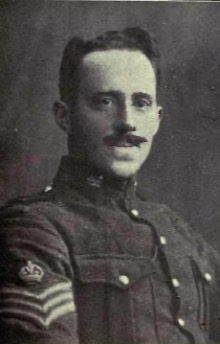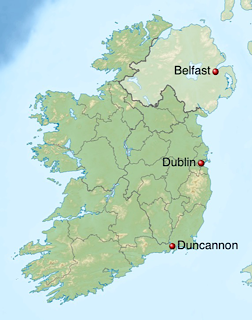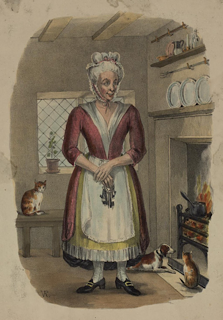
Mary Carryl, an Irish-born loyal servant and friend of the celebrated Ladies of Llangollen, dies on November 22, 1809. She serves them up to her death. When the Ladies die, they share the same grave.
Carryl is brought up in a poor family in Ross, County Wexford. Little is known about her until she is employed by Lady Elizabeth “Betty” and Sir William Fownes, 2nd Baronet, at the Woodstock Estate near Inistioge, County Kilkenny. He inherits the baronetcy from his father Sir William Fownes, 1st Baronet, the Lord Mayor of Dublin, and over 21,000 acres from his grandfather. When Fownes marries Elizabeth Ponsonby, he receives £4,000 as a dowry and the couple builds the six-bayed, three-story Woodstock House in County Kilkenny in 1745-47. In 1769, the Fownes have a thirteen-year-old guest to stay for some time named Sarah Ponsonby, who is Elizabeth’s cousin and the orphaned daughter of Chambré Brabazon Ponsonby. She attends school at Kilkenny.
Sarah develops a friendship with Eleanor Butler, which is not approved of by the Fownes nor by Eleanor’s family guardians. When the friendship begins, Sarah is an unhappy thirteen-year-old orphan. She is captivated by the well-educated Eleanor Butler, a 30-year-old spinster no longer considered marriageable. Sarah is also receiving unwanted attention from Sir William, her guardian.
When Eleanor Butler runs away from home, she is hidden in Sarah’s room and Carryl smuggles in food for her stowaway. Eventually Butler and Ponsonby agree that they can leave Ireland together. They go to Llangollen in Wales where they set up home in a cottage called Plas Newydd. Meanwhile Carryl, who is known as Mary the Bruiser, has been fired after throwing a candlestick that wounds another servant. Her prospects are saved when Eleanor and Sarah send for her to come to Llangollen.
In time Eleanor and Sarah become notorious as “The Ladies of Llangollen,” and Carryl becomes both their servant and the head of the household. She is loyal to her employers. She is said to have “masculine qualities” and Lady Eleanor’s diary records how she gives as good as she gets as she bargains loudly with the fishermen, the butchers and the inebriated.
Carryl dies at Plas Newydd on November 22, 1809, and is buried in the churchyard of St. Collen’s Church, Llangollen. She leaves a shilling to her brother and sister, but leaves the field she owns to Sarah. When in time the Ladies of Llangollen die, they are buried beside their faithful servant.
The memorial monument to Mary Carryl, Eleanor Butler and Sarah Ponsonby in the churchyard of St. Collen’s Church is erected in 1810. The inscription on Carryl’s part of the monument reads: “In Memory of / Mrs Mary Carryl / Deceased 22 November 1809 / This monument is erected by Eleanor Butler, / and Sarah Ponsonby, of Plasnewydd in this Parish. / Released from Earth and all its transient woes, / She whose remains beneath this stone repose, / Stedfast in Faith resigned her parting breath, / Looked up with Christian joy, and smiled in Death! / Patient, Industrious, Faithful, Generous, Kind, / Her Conduct left the proudest far behind, / Her Virtues dignified her humble birth, / And raised her mind above this sordid earth, / Attachment (Sacred bond of grateful breasts) / Extinguished but with life, this Tomb attests, / Reared by Two Friends who will her loss bemoan, / ‘Till with Her Ashes…Here shall rest, Their own.”
(Pictured: A portrait of Mary Carryl from the Welsh Portrait Collection at the National Library of Wales)
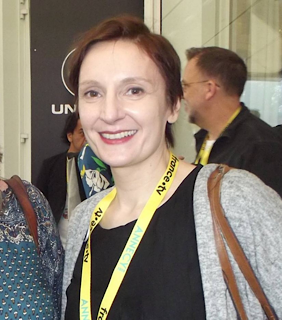
Twomey is educated at St. Mary’s Secondary School in Midleton, County Cork but leaves before completing the Leaving Certificate at the age of fifteen. She does manual labor at a local factory but continues to draw and briefly studies fine art before she is admitted to Ballyfermot Senior College in Dublin to their School of Animation program on the basis of her portfolio. In the factory she operates a conveyor belt for up to twelve hours on end during the night shift. She credits this period of her life to much of her success, as she wears headphones to drown out the loud noise of machinery, the silence combined with the monotony of the task she performs allows her to ponder concepts and generate ideas, many of which are put to film later in her life.
After graduating from Ballyfermot Senior College in 1995, Twomey begins to work for Brown Bags Film, an animation studio in Dublin. In 1999, she helps found Cartoon Saloon, along with Tomm Moore, Paul Young and Ross Murray. In 2002, she directs the award-winning short animated film From Darkness. The short film has no dialogue and is based on an Inuit folk tale where a man helps a woman with only a skeleton for a body to regenerate. She also works on the successful animated TV series Skunk Fu!.
Twomey goes on to write and direct the animated short Cúilín Dualach (Backwards Boy), released in 2004. Based on a story by Jackie Mac Donacha, a boy with his head on backwards finds only love and acceptance in his mother and has to work to gain that from the rest of his community but most of all his father.
Twomey continues to work on feature films with Cartoon Saloon with 2014’s Song of the Sea directed by Tomm Moore. She works as the film’s head of story and voice director.
Twomey next directs the animated film The Breadwinner, released in 2017. Based on the best-selling young adult novel by Deborah Ellis, an 11-year-old girl named Parvana must dress as a boy and become the titular breadwinner for her family when her father is wrongfully arrested by the Taliban. It premieres at the Toronto International Film Festival in September 2017 with a wide release in November 2017. It is the first feature-length film she has sole director credit on. She works on the project with actress Angelina Jolie, who helps fund the project and works as an executive producer. The project is a huge success for Twomey, as she is recognized as a solo female filmmaker, and given accolades as well as being lauded by many as a source of female empowerment, all while battling cancer during production. During the development of The Breadwinner, she is named in Variety‘s “2017 10 Animators to Watch.”
Twomey becomes the seventh graduate of Ballyfermot Senior College to be nominated for an Academy Award with her work on The Breadwinner when it is nominated for Best Animated Feature at the 90th Academy Awards. She is also nominated for an award at the Golden Globe Awards.
Twomey’s work also has a heavy presence at the Emile Awards, an annual event held by the European Animation Awards Association that honors European creators of animation. During the awards of 2018, which are hosted in Lile, France, her film The Breadwinner wins awards in five categories: Best Direction, Best Storyboarding, Best Character Animation, Best Background, and Best Character Design.
Twomey has won several awards according to the Screen Directors Guild of Ireland (SDGI). These awards include the best New Irish Short Animation at the Galway Film Fleadh (2002), Best Short at the Boston Irish Film Festival (2003), Best Animation at the Kerry Film Festival (2003), and the Silver Award at the Kalamazoo Animation Festival International (2003) for her film From Darkness. Her film Cúilín Dualach (Backwards Boy) also wins the Best Animated Short from the Irish Film & Television Academy (2005), Best Short Film at Cartoons on the Bay (2005), Best Animation for Children at Animadrid (2005) and the Best Animation at the Celtic Film Festival (2005). Among other awards, the 2018 Cinema for Peace Award for Justice for her movie The Breadwinner can be included.
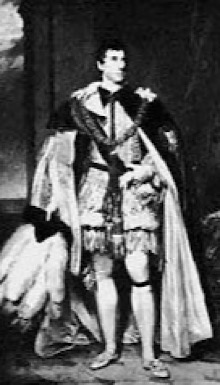
Cuffe is the son of John Otway Cuffe, 2nd Earl of Desart, and Catherine, daughter of Maurice O’Connor. He succeeds in the earldom in November 1820, aged two, on the early death of his father. He is educated at Eton College and enters Christ Church, Oxford in 1836 but takes no degree.
Cuffe marries Lady Elizabeth Lucy Campbell, daughter of John Campbell, 1st Earl Cawdor, in 1842. They have three sons and a daughter. He dies at the age of 46 at his home in Belgravia, City of Westminster, Greater London on April 1, 1865, due to a fall suffered during an attack of paralysis. He is buried in Castleinch Cemetery, Kilkenny, County Kilkenny. He is succeeded in the earldom by his son, William. The Countess of Desart dies in April 1898, aged 76.
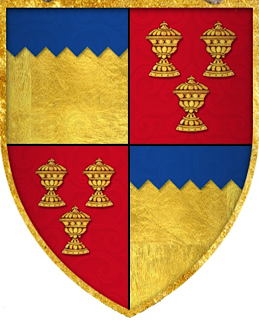
Butler is born c. 1467, the third son of James Butler and Sabh Kavanagh. His father is Lord Deputy of Ireland, Lord of the Manor of Advowson of Callan (1438–87). His father’s family is the Polestown cadet branch of the Butler dynasty that started with Sir Richard Butler of Polestown, second son of James Butler, 3rd Earl of Ormond. His mother, whose first name is variously given as Sabh, Sadhbh, Saiv, or Sabina, is a princess of Leinster, eldest daughter of Donal Reagh Kavanagh, MacMurrough (1396–1476), King of Leinster.
In 1485, Butler marries Lady Margaret FitzGerald, daughter of Gerald FitzGerald, 8th Earl of Kildare and Alison FitzEustace. The marriage is political, arranged with the purpose of healing the breach between the two families. In the early years of their marriage, Margaret and her husband are reduced to penury by James Dubh Butler, a nephew, heir to the earldom and agent of the absentee Thomas Butler, 7th Earl of Ormond, who resides in England. Butler retaliates by murdering James Dubh in an ambush in 1497. He is pardoned for his crime on February 22, 1498.
Butler and Margaret have three sons: James (1496–1546), also called “the Lame,” who succeeds him as the 9th Earl, Richard (1500–1571), who becomes the 1st Viscount Mountgarret, and Thomas, who is slain by Dermoid Mac Shane, MacGillaPatrick of Upper Ossory, and six daughters: Margaret, Catherine (1506–53), Joan (born 1528), married James Butler, 10th Baron Dunboyne, Ellice (1481–1530), Eleanor, married Thomas Butler, 1st Baron Cahir, and Helen, also called Ellen (1523–97), married Donough O’Brien, 2nd Earl of Thomond.
Butler also has an illegitimate son, Edmund Butler, who becomes Archbishop of Cashel and conforms to the established religion in 1539.
During the prolonged absence from Ireland of the earls, Butler’s father lays claim to the Ormond land and titles. This precipitates a crisis in the Ormond succession when the seventh earl later dies without a male heir. On March 20, 1489, King Henry VII appoints him High Sheriff of County Kilkenny. He is knighted before September 1497. The following year (1498) he seizes Kilkenny Castle and with his wife, the dynamic daughter of the Earl of Kildare, likely improve the living accommodations there. On February 28, 1498, he receives a pardon for crimes committed in Ireland, including the murder of James Ormonde, heir to the 7th Earl. He is also made Seneschal of the Liberty of Tipperary on June 21, 1505, succeeding his distant relation, James Butler, 9th Baron Dunboyne.
One of the heirs general to the Ormond inheritance is Thomas Boleyn, whose mother is Lady Margaret Butler, second daughter of the 7th Earl. Thomas Boleyn is the father of Anne, whose star is rising at the court of King Henry VIII. As the king wants the titles of Ormond and Wiltshire for Thomas Boleyn, he induces Butler and his coheirs to resign their claims on February 17, 1528. Aided by the king’s Chancellor, Cardinal Thomas Wolsey, Butler is created Earl of Ossory instead. On February 22, 1538, the earldom of Ormond is restored to him.
The GS&WR is an Irish gauge (1,600 mm (5 ft. 3 in.)) railway company that operates in Ireland from 1844 until 1924. The GS&WR grows by building lines and making a series of takeovers, until in the late 19th and early 20th centuries it is the largest of Ireland’s “Big Four” railway networks. At its peak the GS&WR has an 1,100-mile (1,800 km) network, of which 240 miles (390 km) are double track.
The core of the GS&WR is the Dublin Kingsbridge – Cork main line, Ireland’s “Premier Line,” and still one of her most important main line railways. The company’s headquarters are at Kingsbridge station. At its greatest extent, the GS&WR includes, in addition to the Dublin – Cork main line, the Dublin – Waterford and Mallow – Waterford lines and numerous branch lines.
There are earlier attempts to set up main line railways into the south of Ireland, but the 1840s efforts of Peter Purcell, a wealthy landowner and mail coach operator, and his associates ultimately prove successful with the implementation of a bill passed on August 6, 1844, for the GS&WR. Purcell is actively assisted by engineer John Benjamin Macneill, who has done surveys for the London and Birmingham Railway and has connections in London. The GS&WR’s vision to provide a single railway for most of the south of Ireland finds favour with United Kingdom Prime MinisterRobert Peel as having likely more profitably for wealthy investors and because a single company will be easier to control. These factors likely ease the passage of relevant legislation.
William Dargan, Ireland’s foremost railway contractor, builds much of the GS&WR’s main line and a number of its other routes.
The directors choose to begin by construction of the 32.5 mile (52.3 km) stretch of the Dublin – Cork main line as far as Cherryville Junction just west of Kildare and the 23.5 mile (37.8 km) branch to Carlow with contracts shared between McCormack and Dargan. Work begins in January 1845 with services commencing on August 4, 1846. Trains are scheduled to take about 2 hours, 35 minutes for the 56 mile (90 km) stretch to Carlow and coach connections are arranged to Kilkenny, Clonmel, Waterford and the evening mail coach for Cork.
In October 1849, the main line reaches the outskirts of Cork, where the GS&WR opens a temporary terminus at Blackpool. The final 1-mile (1.6 km) of line from Blackpool to the centre of Cork includes a 1,355-yard (1,239 m) tunnel and is not completed for another six years. Services through the tunnel begin in December 1855, running to and from a second temporary terminus beside the River Lee. Finally, the present Cork terminus in Glanmire Road opens in July 1856.
Pack is born on October 7, 1775 in Kilkenny, County Kilkenny, the younger son of Rev. Thomas Pack, Dean of Ossory, and Catherine Pack (née Sullivan), of St. Andrew’s parish, Dublin. In June 1790, he enters Trinity College Dublin (TCD), aged 15, but does not take his degree. His elder brother, Thomas Pack, previously attends TCD, but dies in December 1786.
Promoted to lieutenant colonel in December 1800, Pack commands the 71st (Highland) Regiment of Foot and takes part in the expedition to the Cape of Good Hope in 1806. He then takes part in General John Whitelocke‘s expedition to South America and is captured after an unsuccessful attack on Montevideo. His fellow-prisoner is William Carr Beresford, later 1st Viscount Beresford, and the two men remain friends for the rest of their lives. Refusing to give their parole to General Santiago de Liniers, they escape from La Plata in a boat, meeting a British cruiser at sea. Pack later takes part in the successful attack on Montevideo on February 9, 1807.
Pack is posted to Portugal in 1808 and is present at the Battle of Roliça on August 17 and the Battle of Vimeiro on August 21. In 1809, he takes part in the Walcheren Campaign and, promoted to colonel in July 1810, he is made aide-de-camp to George III. Returning to Portugal in 1810, he serves under Beresford, commanding a Portuguese brigade, and takes part in the Battle of Bussaco on September 27, 1810. Promoted to brigadier general in January 1812, he takes part in the Siege of Ciudad Rodrigo and is present at the Battle of Salamanca on July 22, 1812. In June 1813, he is promoted to major general and later is present at the battles of Vitoria (June 21, 1813), Nivelle (November 10, 1813), Nive (December 10-13, 1813), Orthez (February 27, 1814) and the final French defeat at Toulouse (April 10, 1814). In January 1815, he is made a Knight Commander of the Order of the Bath (KCB) in recognition of his services in the Peninsula.
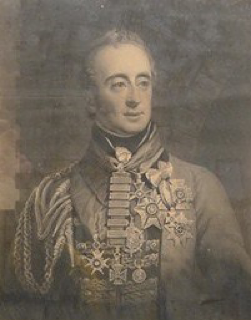
In July 1816, Pack marries Lady Elizabeth Louisa de la Poer Beresford, daughter of George Beresford, 1st Marquess of Waterford. They have two sons and two daughters. His descendants adopted “Pack-Beresford” as their family name. He dies on July 24, 1823, at Lord Beresford’s house in Upper Wimpole Street, London. A monument to him is later erected in St. Canice’s Cathedral, Kilkenny. A portrait by G. L. Saunders is in family possession; another by Charles Turner, showing Pack wearing his numerous orders and decorations, is in the National Portrait Gallery, London. A collection of his papers is held by the University of Southampton.
O’Toole is the second son among five children of John O’Toole and Bridie O’Toole (née Doran). Of farming stock on both sides, he is educated at the local national school at Ballycumber and at a Dublinsecondary school. When in the mid-1890s he moves to Dublin, he joins the Benburb Gaelic Football Club at Donnybrook, where his teammates include the future nationalist parliamentarian Thomas M. Kettle, who is killed in 1916 near Ginchy, France, during World War I. The proprietor of two newsagents’ shops near his home in Mount Pleasant Square, he soon becomes his club’s delegate to the Dublin county committee of the Gaelic Athletic Association about 1899. Founded in 1884 by Michael Cusack, the GAA by the late 1890s is insolvent and almost moribund, having been riven by rival nationalist factions. However, a group of younger officials which includes O’Toole is determined not to allow the Association to die, and at its annual congress in Thurles on September 22, 1901, stages what is in effect a palace coup. Alderman James Nowlan of Kilkenny, County Kilkenny, a labour activist and Gaelic League enthusiast, is elected president, and in a contest for the post of secretary, O’Toole defeats Cusack.
O’Toole holds the post of chief officer of the GAA until his death almost thirty years later. During this period, despite major political and military turmoil, including the world war, the Irish War of Independence, and the Irish Civil War, he is instrumental in turning the Association into the biggest Irish sports body, and some leading members, such as Michael Collins and Harry Boland, play major political roles between 1913 and 1923. Essentially a backroom administrator, O’Toole rarely appears in public apart from GAA events, one notable exception being on November 25, 1913, at the foundation meeting of the Irish Volunteers at the Rotunda Rink, Dublin, where he is one of the platform party. After the suppression of the 1916 Easter Rising, he goes into hiding temporarily in his native Wicklow. From then until the cessation of hostilities in mid-1921 he manages to evade the notice of the authorities though he is always a close associate of Sinn Féin leaders. He plays a big part in reviving the fortunes of the GAA after the Irish Civil War and is a principal organiser of the Tailteann Games in 1924 and 1928. His career, however, is cut short at the age of 56 by his sudden death at his desk on July 17, 1929.
For most of his life O’Toole resides in a house provided by the GAA beside Croke Park, the Association’s headquarters and principal stadium. He marries Bridget Doyle, a shopkeeper of Dublin. They have four sons and four daughters.
(From: “O’Toole, Luke” by Marcus de Búrca, Dictionary of Irish Biography, http://www.dib.ie, October 2009 | Pictured: Michael Collins, Luke O’Toole and Harry Boland in 1921, Image credit: GAA)
Coogan’s particular focus is on Ireland’s nationalist/independence movement in the 20th century, a period of unprecedented political upheaval. He blames the Troubles in Northern Ireland on “Paisleyism.”
In 2000, Irish writer and editor Ruth Dudley Edwards is awarded £25,000 damages and a public apology by the High Court in London against Coogan for factual errors in references to her in his book Wherever Green is Worn: The Story of the Irish Diaspora (2000). In the book, he writes that Dudley Edwards had “groveled to and hypocritically ingratiated herself with the English establishment to further her writing career.” He also alleges that Dudley Edwards “had abused the position of chairwoman of the British Association for Irish Studies (BAIS) by trying to impose her political views on it” and that her commission to write True Brits had been awarded because of political favouritism.
When TaoiseachEnda Kenny causes confusion following a speech at Béal na Bláth by incorrectly claiming Michael Collins had brought Lenin to Ireland, Coogan comments, “Those were the days when bishops were bishops and Lenin was a communist. How would that have gone down with the churchyard collections?”
Coogan has been criticised by the Irish historians Liam Kennedy and Diarmaid Ferriter, as well as Cormac Ó Gráda, for a supposed lack of thoroughness in his research and bias:
“Well, I waited in this book to hear some great revelation, and it just isn’t there. It’s anticlimactic. I could not see the great plot, and indeed there is no serious historian who … I can’t think of a single historian who has researched the Famine in depth – and Tim Pat has not researched it in depth” (The Famine Plot).
“Coogan is not remotely interested in looking at what others have written on 20th-century Irish history…. he does not appear interested in context and shows scant regard for evidence. He does not attempt to offer any sustained analysis in relation to the challenges of state building, the meaning of sovereignty, economic and cultural transformations, or comparative perspectives on the evolution of Irish society. There is no indication whatsoever that Coogan has engaged with the abundant archival material relating to the subject matter he pronounces on. There is no rhyme or reason when it comes to the citation of the many quotations he uses; the vast majority are not referenced. For the 300-page text, 21 endnotes are cited and six of them relate to Coogan’s previous books, a reminder that much of this tome consists of recycled material…. Tim Pat Coogan… he is a decent, compassionate man who has made a significant contribution to Irish life. But he has not read up on Irish history; indeed, such is the paucity of his research efforts that this book amounts to a travesty of 20th-century Irish history” (1916: The Mornings After).
Pattison serves as Mayor of Kilkenny on three occasions: 1967, 1976 and 1992. He becomes an MEP for Leinster in 1981, to replace Liam Kavanagh who becomes Minister for Labour following the 1981 Irish general election. He resigns as an MEP in 1983, following his appointment as Minister of State at the Department of Social Welfare, a position in which he serves until Labour leaves the government in January 1987.
Pattison is unanimously elected Ceann Comhairle of Dáil Éireann on June 26, 1997, serving for the 28th Dáil. When the 29th Dáil assembles following the 2002 Irish general election he is succeeded by Rory O’Hanlon but is appointed as Leas-Cheann Comhairle (deputy chairperson) for the 29th Dáil.
In September 2005, Pattison announces he will retire at the 2007 Irish general election, and his nephew Eoin Pattison unsuccessfully seeks the nomination. Labour county councillor Michael O’Brien is selected in February 2006 to contest the seat but is unsuccessful in the 2007 Irish general election.
When Pattison retires from politics at the 2007 election, he has served in Dáil Éireann for 45 years and 7 months, making him the fifth-longest serving TD ever, and the longest-ever-serving Labour Party TD. He is the longest-serving sitting TD from 1995 to 2007 and has the informal title of Father of the Dáil.
Pattison dies at the age of 81 from Parkinson’s disease at his home in Kilkenny on February 4, 2018.
Byrne is born on March 20, 1780, at Ballylusk, Monaseed, County Wexford, the eldest son of Patrick Byrne, a middling Catholic farmer, and Mary (née Graham). He joins the United Irishmen in the spring of 1797 and, although only seventeen, becomes one of the organisation’s most active agents in north Wexford.
When rebellion engulfs his home district on May 27, 1798, Byrne assumes command of the local Monaseed corps and rallies them at Fr. John Murphy‘s camp on Carrigrew Hill on June 3. They fight at the rebel victory at Tubberneering on June 4 and the unsuccessful attempt to capture Arklow five days later. After the dispersal of the main rebel camp at Vinegar Hill on June 21, he accompanies Murphy to Kilkenny but begins the retreat to Wexford four days later. Heavily attacked at Scollagh Gap, he is one of a minority of survivors who spurn the proffered amnesty and join the rebel forces in the Wicklow Mountains. He is absent when the main force defeats a cavalry column at Ballyellis on June 30 but protects the wounded who are left in Glenmalure when the rebels launch a foray into the midlands the following week. He takes charge of the Wexfordmen who regain the mountains and fight a series of minor actions in the autumn and winter of 1798 under the militant Wicklow leader Joseph Holt. On November 10, he seizes an opportunity to escape into Dublin, where he works as a timber-yard clerk with his half-brother Edward Kennedy.
Byrne is introduced to Robert Emmet in late 1802 and immediately becomes a prominent figure in his insurrection plot. He is intended to command the many Wexford residents of the city during the planned rising of 1803. On July 23, 1803, he assembles a body of rebels at the city quays, which disperse once news is received that the rising has miscarried. At Emmet’s request, he escapes to Bordeaux in August 1803 and makes his way to Paris to inform Thomas Addis Emmet and William James MacNeven of the failed insurrection. In his Paris diary, the older Emmet recalls passing on “the news brought by the messenger” to Napoleon Bonaparte‘s military advisors.
Byrne enlists in the newly formed Irish Legion in December 1803 as a sub-lieutenant and is promoted to lieutenant in 1804 but only sees garrison duty. The regiment eventually moves to the Low Countries, and is renamed the 3rd Foreign Regiment in 1808, the year he is promoted to captain. He campaigns in Spain until 1812, participating in counterinsurgency against Spanish guerillas. He fights in Napoleon’s last battles and is appointed Chevalier de la Légion d’Honneur on June 18, 1813. With Napoleon’s defeat in 1815, the former Irish Legion, with its undistinguished and somewhat unfortunate history, is disbanded.
Though a supporter of Napoleon during the Hundred Days, Byrne is not involved in his return, yet he is included in an exclusion order from France which he successfully appeals. In November 1816, he swears the oath of loyalty to the now Royal Order of the Legion of Honour and becomes a naturalised French subject by royal decree on August 20, 1817. He becomes a half-pay captain but is recalled for active service in 1828 and serves as a staff officer in the French expeditionary force in Morea in support of Greek independence (1828–1830). His conduct on this campaign leads to his promotion as chef de bataillon (lieutenant-colonel) of the 56th Infantry Regiment in 1830.
After five years of service in garrisons around France, including counterinsurgency duty in Brittany, Byrne retires from the army in 1835. On December 24, 1835, he marries a Scottish woman, Frances “Fanny” Horner, at the British Embassy Chapel in Paris. They live in modest circumstances in various parts of Paris and remain childless. Though it is unclear when he is awarded the Chevalier de St Louis, having initially applied for it unsuccessfully in 1821, this distinction is mentioned in his tomb inscription, under his Legion of Honour. John Mitchel, who visits him regularly in Paris in the late 1850s, recalls Byrne sporting the rosette of the Médaille de Sainte Hélène, awarded in 1857 to surviving veterans of Napoleon’s campaigns.
An early list of Irish Legion officers describes Byrne as an upright and disciplined man, with little formal instruction but aspiring to improve himself. He becomes fully fluent in French but also learns Spanish and his language skills are a useful asset in various campaigns. Because of his suspected Bonapartist leanings, he is under police surveillance for some time after the Bourbon Restoration. He does, however, cultivate a wide social circle in Paris over the years. Various references throughout his writings testify to an inquisitive and cultured mind. He intended publishing a lengthy criticism of Gustave de Beaumont‘s Irlande, sociale, politique et religieuse (1840), claiming that it misrepresented the 1798 rebellion, but he withdraws it after meeting the author, not wishing to prejudice the reception of such an important French work on “the sufferings of Ireland.”
A lifelong nationalist, Byrne acts as Paris correspondent of The Nation in the 1840s and is a well-known figure in the Irish community there. He works in the 1850s on his notably unapologetic and candid Memoirs, an early and significant contribution to the Irish literature of exile. This autobiography is acclaimed by nationalists when published posthumously by his wife in 1863, with a French translation swiftly following in 1864. His detailed testimony of key battles of the 1798 rebellion in the southeast and Emmet’s conspiracy are written with the immediacy of an eyewitness and make them an invaluable contribution to that period of Irish history.
Byrne dies on January 24, 1862, in Paris, and is buried in Montmartre Cemetery. On November 25, 1865, John Martin writes of him: “In truth he was a beautiful example of those natures that never grow old. A finer, nobler, gentler, kindlier, gayer, sunnier nature never was than his, and to the last he had the brightness and quickness and cheeriness of youth”.
Byrne’s engaging and dispassionate Memoirs have ensured his special status among Irish nationalists. Because of his longevity he is the only United Irishman to have been photographed. His wife had sketched him in profile in middle age, and the photograph taken almost three decades later shows the same, strong features though those of a frail, but dignified man of 79 years.
(From: “Byrne, Miles” by Ruan O’Donnell and Sylvie Kleinman, Dictionary of Irish Biography, http://www.dib.ie, October 2009, last revised August 2024 | Pictured: Photograph of Miles Byrne taken in Paris in 1859)