seamus dubhghaill

Promoting Irish Culture and History from Little Rock, Arkansas, USA


Leave a comment

Ceremony Marks the Centennial of First Easter Rising Executions

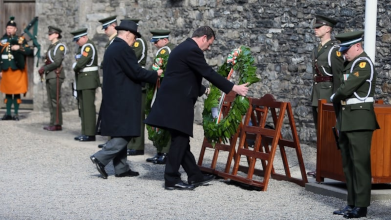
On Tuesday, May 3, 2016, ceremonies to mark the 100th anniversary of the executions of Tom Clarke, Patrick Pearse and Thomas MacDonagh are held in the Stonebreakers’ Yard in Kilmainham Gaol, the first executions of the leaders of the Easter Rising. Pearse, Clarke and MacDonagh are remembered in similar but distinct commemorations which take place on the spot where they died on May 3, 1916.

The transcripts of the short courts-martial are read aloud. In the case of Tom Clarke, who offered no defence and made no statement prior to his execution, the proceedings take only a few minutes to recount.

The presence of Capuchin friars from Church Street lends a sense of continuity to proceedings. Their predecessors had been there for the men in their final hours and their testimony is read aloud by their contemporaries.

The Government is represented by Minister for the Environment Alan Kelly, Minister for Foreign Affairs Charles Flanagan and Minister of State at the Department of Heritage Joe McHugh. Kelly speaks of living up to the ideals of the Proclamation of the Irish Republic, namely a nation that “cherishes all of the children equally.” He says Pearse was well aware of the effect on his family of his pending execution and had written his poem “The Mother” foreseeing his death.

Capuchin friar Adrian Kearns recalls the testimony of Fr. Columbus Murphy, who ministered to Pearse in his final hours. He did not “quail before the possibility of death . . . but faced his last moments with dignity and with grace.” Fr. Murphy remembered Pearse being a “sad, forlorn figure weighed down by the sense of responsibility” who lamented the loss of life and hoped it would not be in vain.

A wreath is laid on behalf of the Pearse family by his namesake Patrick Pearse, a great grandnephew.

Brother Peter Rogers recalls that Clarke was defiant rather than melancholic in his last hours. Fr. Murphy visited him as well. Clarke, the friar recalls, was “relieved that he was to be executed. His one dread was that he would be sent to prison again.” There is no member of Clarke’s family present to represent him at the commemorations, so a wreath is laid on behalf of the family by the staff of Kilmainham Gaol.

Several of MacDonagh’s surviving grandchildren are present. His granddaughter, Barbara Cashin, lays a wreath on behalf of the family. Her father Donagh and her aunt Barbara are left orphans a year after the Easter Rising when MacDonagh’s wife Muriel drowns off the coast of Skerries in July 1917. Cashin says her father had mixed feelings about the Rising, given the double tragedy that befell him and his sister a short time afterwards. “He had a horrendous childhood. He had a strange upbringing and hated to talk about it,” she says. “He had a split mind about it. I remember asking him as a child about it and saying he must be proud. Weren’t they wonderful. He said, ‘they may have been fools as well.’”

The ceremony takes place with full military honours. The “Last Post” and “Reveille” are played, and the service concludes with the national anthem of Ireland, “Amhrán na bhFiann.”

The commemorations are repeated the following day for the next four to have been executed: Joseph Plunkett, Edward Daly, Michael O’Hanrahan and Willie Pearse. Similar events are scheduled through May 12 to mark the exact centenary of the executions of the remaining eight men killed by a British Army firing squad at the Stonebreakers’ Yard.

Meanwhile, President Michael D. Higgins formally renames the East-Link Toll Bridge in Dublin the Tom Clarke Bridge.

(From: “Executed Rising rebels honoured at Kilmainham Gaol” by Ronan McGreevy, The Irish Times, http://www.irishtimes.com, May 3, 2016)

Leave a comment

Thomas MacDonagh’s Letter to Family at End of Easter Week 1916

In a letter to his family written on April 30, 1916, Thomas MacDonagh recalls “I was astonished to receive by a messenger from P.H. Pearse, Commandant General of the Army of the Irish Republic, an order to surrender unconditionality to the British General. I did not obey the order as it came from a prisoner. I as then in supreme command of the Irish Army, consulted with my second in command and decided to confirm the order. I knew that it would involve my death and the deaths of other leaders. I hoped that it would save many true men among our followers, good lives for Ireland. God grant it has done so and God approve our deed. For my self I have no regret. The one bitterness that death has for me is the separation it brings from my beloved wife Muriel, and my beloved children, Donagh and Barbara. My country will then treat them as wards, I hope. I have devoted myself too much to National work and too little to the making of money to leave them a competence. God help them and support them, and give them a happy and prosperous life. Never was there a better, truer, purer woman than my wife Muriel, or more adorable children than Don and Barbara. It breaks my heart that I shall never see my children again, but I have not wept or murmured. I counted the cost of this and am ready to pay it. Muriel has been sent for here. I do not know if she can come. She may have no one to take the children while she is coming. If she does.”

MacDonagh and Pearse are contemporaries of one another: poets, progressive educators, Gaelic revivalists. They are men who gird for battle “with a revolver in one hand and a copy of Sophocles in the other.” Each man commands a unit of Irish Volunteers during the Easter Rising, which takes place the week of April 24-30,1916. MacDonagh occupies Jacob’s biscuit factory and Pearse the General Post Office (GPO), from which he issues the surrender at the end of the week.

McDonagh and Pearse are signatories of the Proclamation of the Irish Republic, a document issued by the Irish Volunteers and the Irish Citizen Army at the beginning of the Easter Rising, proclaiming Ireland’s independence from the United Kingdom. The reading of the proclamation by Pearse outside the General Post Office (GPO) on Sackville Street (now O’Connell Street), Dublin‘s main thoroughfare, marks the beginning of the Rising.

Pearse’s and MacDonagh’s signatures on the Proclamation are a fatal endorsement for them and for each of the other five men to lend it their signatures. After being court-martialed, both Pearse and MacDonagh, along with Thomas Clarke, are executed by firing squad at Kilmainham Gaol in Dublin on May 3, 1916, the first of the rebels to be executed.

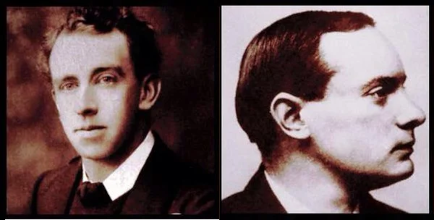
(Pictured: Thomas McDonagh (left) and Patrick Pearse)


2 Comments

Birth of Simon Donnelly, Irish Republican Army Volunteer

Simon John Donnelly, a member of the Irish Republican Army is born at 7 Aungier Street, Dublin, on January 7, 1891. He is a founder member of both Córas na Poblachta and Clann na Poblachta, Irish republican political parties formed in 1940 and 1946 respectively.

Donnelly is the son of Timothy Donnelly, a master plumber, and Mary Brennan. He is the sixth of eight surviving children. The 1911 Census lists him living with his family at 34 Wexford Street. Apprenticed as a plumber, he becomes involved in the Irish Volunteers. During the Easter Rising of 1916 he is the commander of C Company of Éamon de Valera‘s command in Boland’s Mill.

Donnelly is Vice-Commandant of the 3rd Battalion of the Dublin Brigade of the IRA during the Irish War of Independence. On February 10, 1921, he is arrested. Four days later he escapes from Kilmainham Gaol along with Ernie O’Malley and Frank Teeling. Returning to his command in the IRA, he is appointed chief of the Irish Republican Police (IRP) in mid-1921 as part of an attempt to enforce law and order in those areas of the country where the Royal Irish Constabulary (RIC) have been forced out.

Donnelly takes the anti-Treaty side in the Irish Civil War and takes part in the Battle of Dublin (June 28 – July 5, 1922).

Donnelly founds the National Association of the Old IRA in an attempt to mend some of the rifts in the Republican Movement. He is a member of the provisional National Executive of the Republican Prisoners’ Release Association.

On March 2, 1940, Donnelly is one of the founders of Córas na Poblachta and serves as its president. He becomes a founding member of Clann na Poblachta in 1946.

As one of the most senior surviving veterans of the Easter Rising, Donnelly plays a prominent role in the 50th anniversary commemorations in 1966. He dies in Dublin on December 7 of that year.


Leave a comment

Death of Thomas Addis Emmet, Lawyer & Politician

Thomas Addis Emmet, Irish and American lawyer and politician, dies at his home in New York on November 14, 1827, following a seizure while in court. He is a senior member of the revolutionary republican group Society of United Irishmen in the 1790s and Attorney General of New York 1812–1813.

Emmett is born in the Hammond’s Marsh area of Cork, County Cork, on April 24, 1764, the son of Dr. Robert Emmet from County Tipperary (later to become State Physician of Ireland) and Elizabeth Mason of County Kerry, both of whose portraits are today displayed at Cork’s Crawford Art Gallery. He is the elder brother of Robert Emmet, who is executed for leading the Irish Rebellion of 1803, becoming one of Ireland’s most famous republican martyrs. His sister, Mary Anne Holmes, holds similar political beliefs.

Emmet is educated at Trinity College, Dublin and is a member of the committee of the College Historical Society. He later studies medicine at the University of Edinburgh and is a pupil of Dugald Stewart in philosophy. After visiting the chief medical schools on the continent, he returns to Ireland in 1788. However, the sudden death of his elder brother, Christopher Temple Emmet (1761–1788), a student of great distinction, induces him to follow the advice of Sir James Mackintosh to forsake medicine for the law as a profession.

Emmet is a man of liberal political sympathies and becomes involved with a campaign to extend the democratic franchise for the Irish Parliament and to end discrimination against Catholics. He is called to the Irish bar in 1790 and quickly obtains a practice, principally as counsel for prisoners charged with political offenses. He also becomes the legal adviser of the Society of the United Irishmen.

When the Dublin Corporation issues a declaration of support of the Protestant Ascendancy in 1792, the response of the United Irishmen is their nonsectarian manifesto which is largely drawn up by Emmet. In 1795 he formally takes the oath of the United Irishmen, becoming secretary in the same year and a member of the executive in 1797. As by this time the United Irishmen had been declared illegal and driven underground, any efforts at peaceful reform of government and Catholic emancipation in Ireland are abandoned as futile, and their goal is now the creation of a non-sectarian Irish republic, independent from Britain and to be achieved by armed rebellion. Although Emmet supports this policy, he believes that the rebellion should not commence until French aid has arrived, differing from more radical members such as Lord Edward FitzGerald.

British intelligence infiltrates the United Irishmen and manages to arrest most of their leaders on the eve of the rebellion. Though not among those taken at the house of Oliver Bond on March 12, 1798, Emmet is arrested about the same time and is one of the leaders imprisoned initially at Kilmainham Gaol and later in Scotland at Fort George until 1802. Upon his release he goes to Brussels where he is visited by his brother Robert in October 1802 and is informed of the preparations for a fresh rising in Ireland in conjunction with French aid. However, at that stage France and Britain are briefly at peace, and the Emmets’ pleas for help are turned down by Napoleon.

Emmet receives news of the failure of his brother’s rising in July 1803 in Paris, where he is in communication with Napoleon. He then emigrates to the United States and joins the New York bar where he obtains a lucrative practice.

After the death of Matthias B. Hildreth, Emmet is appointed New York State Attorney General in August 1812 but is removed from office in February 1813 when the opposing Federalist Party obtains a majority in the Council of Appointment.

Emmet’s abilities and successes become so acclaimed, and his services so requested that he becomes one of the most respected attorneys in the nation, with United States Supreme Court Justice Joseph Story declaring him to be “the favourite counsellor of New York.” He argues the case for Aaron Ogden in the landmark United States Supreme Court case of Gibbons v. Ogden, 22 U.S. 1 (1824) relating to the Commerce and Supremacy clauses of the United States Constitution.

Emmet dies on November 14, 1827, while conducting a case in court regarding the estate of Robert Richard Randall, the founder of Sailors’ Snug Harbor, a home for needy seamen in Staten Island, New York. He is buried in St. Mark’s Church in-the-Bowery churchyard in the East Village, New York City, where a large white marble monument marks his grave.


Leave a comment

Irish National Land League Outlawed by the British Government

The Irish National Land League, also known as the Land League, is outlawed by the British government on October 20, 1881. From the start, the League is a thorn in the side of the government of British Prime Minister William Ewart Gladstone.

The Irish National Land League is an Irish political organisation of the late 19th century which organises tenant farmers in their resistance to exactions of landowners. Its primary aim is to abolish landlordism in Ireland and enable tenant farmers to own the land they work on. The period of the Land League’s agitation is known as the Land War.

The Irish National Land League is founded at the Imperial Hotel in Castlebar, County Mayo, on October 21, 1879. At that meeting Charles Stewart Parnell, the prominent Home Rule Member of Parliament, is elected president of the league. Andrew Kettle, Michael Davitt and Thomas Brennan are appointed as honorary secretaries. This unites practically in a single organisation all the different strands of land agitation and tenant rights movements on the nationalist side of the increasingly frozen sectarian-political divide in Ireland. 

The government had introduced the Landlord and Tenant (Ireland) Act 1870, the first Land Act, which proves largely ineffective. It is followed by further marginally more effective Irish Land Acts of 1880 and 1881. These establish the Irish Land Commission that starts to reduce some rents. The passage of the second Land Act in 1881 fails to mollify many of the leaders of the Land League, mainly due to the fact that close to 300,000 tenants behind in their rents are excluded from its benefits. Parnell together with all of his party lieutenants, including Father Eugene Sheehy, known as “the Land League priest,” go into a bitter verbal offensive.

William Ewart Gladstone has them arrested and imprisoned in Kilmainham Gaol in October 1881 under the Irish Coercion Act for “sabotaging the Land Act,” from where the No Rent Manifesto is issued, calling for a national tenant farmer rent strike until “constitutional liberties” are restored, and the prisoners freed. It has a modest success In Ireland and mobilizes financial and political support from the Irish diaspora. Many other leaders of the League, including Michael Davitt, whose name is added to the bottom of the document by others, and other moderate elements in Ireland oppose this move.

Perhaps sensing weakness in the League organization, the government outlaws the League on October 20, 1881, but the work of the League is then continued by the Ladies’ Land League, which had been founded earlier by Parnell’s sister Anna. In 1882, Parnell is released from jail after reaching a written compact with the government, which extends the benefits of the Land Act to those excluded earlier, while Parnell pledges to help end land-agitation violence in Ireland and cooperate with Gladstone’s Liberal party.

In October 1882, Parnell forms the Irish National League, replacing the Land League. The Land League passes into history, but it has helped show Irish peasants that if they all stand together there is strength in numbers.

(Pictured: Irish land League poster dating from the 1880s)


Leave a comment

Birth of Con Colbert, Irish Rebel & Fianna Éireann Pioneer

Cornelius Bernard “Con” Colbert, Irish rebel and pioneer of Fianna Éireann, is born on October 19, 1888, in the townland of Moanleana, Mahoonagh, County Limerick. For his part in the Easter Rising of 1916, he is shot by firing squad in Kilmainham Gaol, Dublin, on May 8, 1916.

Colbert is the fourth youngest of thirteen children of Michael Colbert, a farmer, and Honora McDermott. His family moves to the village of Athea when he is three years old. He is educated at the local national school. In 1901, his family is living in the townland of Templeathea West. A younger brother, James, and a cousin, Michael Colbert, later serve as Teachtaí Dála (TDs).

Colbert leaves Athea at the age of 16 and goes to live with his sister Catherine in Ranelagh, County Dublin. He continues his education at a Christian Brothers school in North Richmond Street. He is employed as a clerk in the offices of Kennedy’s Bakery in Dublin. In 1911, he is living with Catherine, two other siblings and two boarders at a house on Clifton Terrace, Rathmines. He is a deeply religious Catholic and refrains from smoking or drinking.

Colbert is sworn into the Irish Republican Brotherhood (IRB) by his cousin Art O’Donnell in Art’s home in 1908. He joins Fianna Éireann at its inaugural meeting in 1909 and rises to Chief Scout. The following year he becomes a drill instructor at St. Enda’s School, founded by Patrick Pearse. In 1912, he becomes head of an IRB circle within the Fianna started by Bulmer Hobson. During 1913 he is one of a number of Fianna who conduct military training at the Forester’s Hall in Rutland Square (now Parnell Square), and in November of that year he joins the Provisional Committee of the newly formed Irish Volunteers.

In the weeks leading up to the Rising, Colbert acts as bodyguard for Thomas Clarke. Before the Rising, because he lives out of the city, he stays with the Cooney family in the city centre. During Easter Week, he fights at Watkin’s Brewery, Jameson’s Distillery and Marrowbone Lane. Thomas MacDonagh surrenders to Brigadier General William Lowe at 3:15 p.m. on Sunday, April 30. MacDonagh then goes around the garrisons under his command to arrange for their surrender.

Colbert surrenders with the Marrowbone Lane Garrison along with the South Dublin Union Garrison, which had been led by Éamonn Ceannt. When the order to surrender is issued, he assumes the command of his unit to save the life of his superior officer, who is a married man.

They are marched to Richmond Barracks, where Colbert is later court-martialed. Transferred to Kilmainham Gaol, he is told on Sunday, May 7, that he is to be shot the following morning. He writes no fewer than ten letters during his time in prison. During this time in detention, he does not allow any visits from his family. Writing to his sister, he says a visit “would grieve us both too much.”

The night before his execution Colbert sends for Mrs. Ó Murchadha, who is also being held prisoner. He tells her he is “proud to die for such a cause. I will be passing away at the dawning of the day.” Holding his Bible, he tells her he is leaving it to his sister. He hands her three buttons from his volunteer uniform, telling her, “They left me nothing else.” He then asks her to say a Hail Mary for the souls of the departed when she hears the volleys of shots in the morning for Éamonn Ceannt, Michael Mallin and himself. The soldier who is guarding the prisoner begins crying according to Mrs. Ó Murchadha, and records him as saying, “If only we could die such deaths.”

The next morning, May 8, 1916, Colbert is shot by firing squad.

Colbert Railway Station in Limerick, Con Colbert Road in Dublin and the Fianna Fáil cumann in the University of Limerick are named in his honor. Colbert Street in his native Athea, County Limerick, is named after him, as is the local community hall. Colbert Avenue and Colbert Park Janesboro, Limerick, are also named after him.

On May 4, 1958, a plaque is erected over a bed in Barringtons Hospital, County Limerick. The plaque has since disappeared.

In May 2016, one hundred years after his execution, a full-scale limestone sculpture of Colbert is unveiled at the gable of his one-time house in Moanleana, County Limerick.


Leave a comment

Birth of Vincent Fovargue, IRA Officer & British Army Spy

Vincent Patrick Fovargue, a company officer in the Dublin brigade of the Irish Republican Army (IRA) during the Irish War of Independence, is born on August 22, 1900, at 2 Rutland Place, Clontarf, Dublin, to Robert Fovargue, an engineer/fitter, and Elizabeth (Lillie) Larkin.

An intelligence officer with the 4th Battalion of the Dublin Brigade of the IRA in the Ranelagh area, Fovargue is captured by the British Army in Dublin. Under interrogation, he allegedly leaks information that results in the arrest of the other members of his unit a few days later. In return for this information, the Intelligence Corps allegedly allows him to escape during a staged ambush in Dublin’s South Circular Road.

This attempted ruse however does not go unnoticed by Michael Collins‘s many moles inside the Crown’s security forces. On the night of the escape, Detective Constable David Neligan of the Dublin Metropolitan Police‘s G Division is on duty in Dublin Castle when a telephone message on a police form is passed to him. The message, issued by the British Military Headquarters, states that a “Sinn Féin” suspect named Fovargue has escaped from three Intelligence Corps officers in a car while en route to prison. It gives a description of his appearance and asks that the British Army be notified in the event of his recapture by the Dublin Metropolitan Police.

Joe Kinsella is the I/O of the 4th Battalion. He is temporarily transferred to take care of munitions under Seán Russell for a few weeks and Fovargue is put in his place. From Joe Kinsella’s own statement to the Irish Bureau of Military History:

“From the outset I personally did not place a lot of trust in him, because on the morning that he took over from me he appeared to me, to be too inquisitive about the movements of Michael Collins and the G.H.Q. staff generally. He wanted to know where they could be located at any time. He said that he had big things in view, and that it would be to the advantage of the movement generally if he was in a position to get in touch with the principal men with the least possible delay. From his attitude I there and then formed the opinion, rightly or wrongly, that he was inclined to overstep his position. I did not feel too happy about him and I discussed him with Sean Dowling. It transpired that my impressions of this man were correct. I told him of two meeting places of Intelligence staff, one of Company Intelligence held at Rathmines Road and one of Brigade Intelligence held at Saville Place. A short time after giving him this information both these places were raided…I was now confirmed in my suspicions that Fovargue was giving away information. He was later shot in England by the IRA.”

Neither was Neligan fooled by this, as he explains:

“Now if they had said that this man (who was completely unknown to both of us) had escaped from one I.O. it might have sounded reasonable enough. But to tell us that an unarmed man had escaped out of a motorcar in the presence of three presumably armed men was imposing a strain on our credulity. Both of us thought this story too good to be true.”

The two men retype the message and pass it to Collins the following day. Meanwhile, Fovargue has been sent to England where he adopts the alias of Richard Staunton. He has in fact been sent to England by Intelligence Corps Colonel Ormonde Winter to infiltrate the IRA in Britain.

Sean Kavanagh, a Kilkenny IRA man, claims that Fovargue is put in a cell with him in Kilmainham Gaol in 1921 in order to try to extract information from him.

On April 2, 1921, a boy walking on the golf links of the Ashford Manor Golf Club in Ashford, Middlesex discovers the body of Fovargue, who had been shot through the chest. Discovered near the corpse is a small piece of paper on which has been scribbled in blue pencil the words “Let spies and traitors beware – IRA.”

In the Neil Jordan film Michael Collins, Fovargue’s assassination is depicted onscreen. Fovargue is tracked down while working out at the golf course, allowed to say the Act of Contrition, and then fatally shot by Liam Tobin (Brendan Gleeson).

(Pictured: Dublin Brigade IRA officer’s cap badge in white metal, “FF” (Fianna Fáil) at centre, surrounded by a garter bearing the motto “Drong Átha Cliath” (Dublin Brigade), all on an eight-pointed rayed star)


3 Comments

Birth of Frederick Hugh Crawford, Loyalist & British Army Officer

Colonel Frederick Hugh Crawford, CBE, JP, an officer in the British Army, is born in Belfast on August 21, 1861. A staunch Ulster loyalist, he is one of the lesser-known figures in Ulster Unionist history but one who is hugely influential because of his involvement in what is known as the Larne gun-running incident, when he is responsible for smuggling over 25,000 guns and ammunition into the North on the night of April 24, 1914. This makes him a hero for Northern Ireland‘s unionists.

Crawford is born into a “solid Methodist” family of Ulster Scots roots. He attends Methodist College Belfast and University College London (UCL). While Crawford is a determined Ulster loyalist, his great-grandfather was Alexander Crawford, a United Irishman arrested in March 1797 for “high treason,” and sent to Kilmainham Gaol, sharing a cell with prominent United Irishman Henry Joy McCracken.

According to the 1911 census for Ireland, Crawford is living in Marlborough Park, Belfast, with his wife of 15 years, Helen, and four of their five children: Helen Nannie, Marjorie Doreen, Ethel Bethea and Malcolm Adair Alexander. His other child, Stuart Wright Knox, is recorded as a pupil at Ballycloghan National School, Belfast. Stuart would become a lieutenant colonel in the British Army, before being invalided in 1944. Malcolm, after being a member of the Colonial Police, joins the Royal Ulster Constabulary (RUC), advancing to District Inspector. In 1931, Malcolm becomes a Justice of the Peace for Singapore.

Crawford works as an engineer for White Star Line in the 1880s, before returning from Australia in 1892. In 1894, he enlists with the Mid-Ulster Artillery regiment of the British Army, before being transferred to the Donegal Artillery, with which he serves during the Boer Wars, earning himself the rank of major.

In 1898, Crawford is appointed governor of Campbell College, Belfast. Two of his children, Stuart Wright Knox and Malcolm Adair Alexander, both attend Campbell College.

In 1911, Crawford becomes a member of the Ulster Unionist Council. On September 28, 1912, he is in charge of the 2,500 well-dressed stewards and marshals that escort Sir Edward Carson and the Ulster Unionist leadership from the Ulster Hall in central Belfast to the nearby City Hall on Donegall Square for the signing of the Ulster Covenant, which he allegedly signs in his own blood. With the formation of the Ulster Volunteers in 1913, he is made their Director of Ordnance.

During World War I Crawford is an officer commanding the Royal Army Service Corps and is awarded the Royal Humane Society‘s bronze medal for saving life. He also becomes a justice of the peace for Belfast.

With regard to Irish Home Rule, Crawford is strongly partisan and backs armed resistance to it, being contemptuous of those who use political bluffing. His advocation of armed resistance is evident when he remarks, at a meeting of the Ulster Unionist Council, that his heart “rejoiced” when he heard talk of looking into using physical force. At another meeting he even goes as far as asking some attendees to step into another room where he has fixed bayonets, rifles and cartridges laid out.

In 1910, the Ulster Unionist Council plans for the creation of an army to oppose Home Rule and approaches Crawford to act as their agent in securing weapons and ammunition. He tries several times to smuggle arms into Ulster, however, vigilant customs officials seize many of them at the docks. Despite this, the meticulously planned and audacious Larne gun-running of April 1914, devised and carried out by Crawford, is successful in bringing in enough arms to equip the Ulster Volunteer Force.

By the 1920s Crawford remains as stoic in his beliefs, remarking in a letter in 1920 that “I am ashamed to call myself an Irishman. Thank God I am not one. I am an Ulsterman, a very different breed.” In March 1920, he begins to reorganize the UVF and in May 1920 he appeals to Carson and James Craig for official government recognition. He states, “We in Ulster will not be able to hold our men in hand much longer…we will have the Protestants…killing a lot of the well-known Sinn Féin leaders and hanging half a dozen priests.” In 1921, he attempts to create an organisation intended to be a “Detective Reserve,” but called the “Ulster Brotherhood,” the aims of which are to uphold the Protestant religion and political and religious freedom, as well as use all means to “destroy and wipe out the Sinn Féin conspiracy of murder, assassination and outrage.” This organisation only lasts for a few months after failing to gain acceptance from the political authorities.

In 1921, Crawford is included in the Royal Honours List and appointed a CBE. In 1934, he writes his memoirs, titled Guns for Ulster.

Crawford dies on November 5, 1952, and is buried in the City Cemetery, Falls Road, Belfast. Upon news of his death, he is described by the then Prime Minister of Northern Ireland, Sir Basil Brooke, as being “as a fearless fighter in the historic fight to keep Ulster British.”


Leave a comment

Birth of William Corbet, Anglo-Irish Soldier

William Corbet, an Anglo-Irish soldier in the service of France, is born in Ballythomas, County Cork, on August 17, 1779. In September 1798, he accompanies James Napper Tandy in an aborted French mission to Ireland in support of the United Irish insurrection. After two years of incarceration, he escapes from Ireland and serves in the campaigns of Napoleon reaching the rank of colonel. In 1831, under the July Monarchy, he is employed in the Morea expedition to Greece. He returns to France in 1837, retiring with the rank of Major-General.

Corbet is born into a branch of the Corbet family, an Anglo-Irish Protestant family. In 1798, as a member of the Society of United Irishmen, he is expelled from Trinity College Dublin with Robert Emmet and others for treasonable activities and goes instead to Paris. In September of the same year, he joins a French military force under James Napper Tandy with the rank of Captain and sails from Dunkirk with arms and ammunition for Ireland. The expedition has to turn back following the defeat of General Jean Joseph Amable Humbert and arriving in Hamburg they are handed over to the British authorities and taken to Ireland, where they are imprisoned in Kilmainham Gaol.

Corbet escapes in 1803 and returns to France. He is appointed professor of English at the military college of Saint-Cyr. Later that year he becomes a captain in the Irish Legion. Following the death of his brother Thomas (who was also in the Legion) in a duel with another officer, he is transferred to the 70th Regiment of the line, where he serves in André Masséna‘s expedition to Portugal, and distinguishes himself in the retreat from Torres Vedras and the Battle of Sabugal. After the Battle of Salamanca, he is appointed chef de bataillon of the 47th regiment and serves until 1813 when he is summoned to Germany to join the staff of Marshal Auguste de Marmont. He serves at the battles of Lützen, Bautzen, Dresden and others and is made a commander of the Legion of Honour. In December 1814, he is naturalised as a French citizen. In 1815, after the abdication of Napoleon, he is promoted to colonel and chief of staff to General Louis-Marie-Celeste d’Aumont at Caen.

In the period of the Bourbon Restoration in France, Corbet’s friendship with the opposition leader, General Maximilien Sébastien Foy, places him under some suspicion, but in 1828 he is selected by Marshal Nicolas Joseph Maison to accompany him on an expedition against Ibrahim Pasha in Morea, Greece. After serving as governor of Navarino, Messenia, and Nafplio, he relieves Argos from the attack of Theodoros Kolocotronis, who is then acting in the interest of Russia and Count Ioannis Kapodistrias, and defeats him.

In 1837, Corbet returns to France where, with the rank of Major-General, he is commander in the region of Calvados. He dies at Saint-Denis on August 12, 1842.

The Irish novelist Maria Edgeworth bases the main theme of her novel Ormond on Corbet’s 1803 escape from Kilmainham Gaol.


Leave a comment

Death of Joseph Brenan, Poet, Journalist & Author

Joseph Brenan (also Brennan), poet, journalist and author, and leading member of the Young Irelanders and Irish Confederation, dies on May 27, 1857, in New Orleans, Louisiana.

Brenan is born in Cork, County Cork, on November 17, 1828. He begins to write verse at an early age and is one of the genuine poets of the Young Ireland movement. His earlier poems are published under the initials “J. B., Cork,” or “J. B—n,” and some of his American verses under the pseudonym “Gondalez.” He is also an able prose writer.

Brenan is an active member of the Cork Historical Society, and is one of the editors of the Cork Magazine, which appears in November 1847, and continues to be published until the end of 1848, when the journal ceases publication. Some of its contributors, who include Frazer, Martin MacDermott, Fitz James O’Brien, Mulchinock and Mary Savage, later either end up in jail or in exile.

In January 1848, John Mitchel visits Cork and, according to Michael Cavanagh, who publishes a sketch of Brenan’s life in Young Ireland, Dublin, in June and July 1885, Brenan for the first time “beheld the man he most admired on earth, and with whose future destiny, whether for weal or woe, he felt his own was bound up. Never had the archenemy of England a more faithful or earnest follower.”

Brenan contributes to the Mitchel’s United Irishman and sells his rifle to obtain train fare so he can take up his residence in Dublin, the headquarters of the revolutionary movement. He later publishes articles in John Martin‘s The Irish Felon urging the Confederate Clubs members, many of whom have arms, to be in readiness for action. “The sooner you realise the fact,” he writes in a letter addressed to the Members of the Provincial Confederate Clubs, “that the Confederation was got up for the purpose of doing something, the better for us all. Just think what it undertook to do. It undertook to defeat the strongest Government and to liberate the most degraded country that ever existed. It undertook to give – to a province—to strike the chains off millions of slaves and, if necessary, to wash out the iron moulds in blood.”

In another letter to “the Young Men of Ireland” on July 22, 1848, he writes, “On you I principally rely. You realise that you are very ‘rash,’ rather inclined to be ‘violent,’ and have exceedingly little prudence to spare. Brothers, let your watchword be ‘Now or never—now and forever’ rashly.”

Brenan is associated with John Savage and John O’Mahony while Savage is operating on the slopes of the Comeragh Mountains. He is arrested and kept in prison for seven months alternately in Newgate Prison, Carrickfergus and Kilmainham Gaols. During his confinement he writes some fine poems, according to T. F. O’Sullivan, one, entitled Yearnings, evidently addressed to Mary Savage, sister of John.

After his release without trial in March 1849, Brenan becomes editor of the Irishman which had been started in Dublin by Bernard Fulham, and for six months attempts to rekindle the insurrectionary flame in the country. He is implicated in the attack on the Cappoquin police barracks on September 16, 1848, and in October escapes to the United States.

In America Brenan becomes associated with a number of journals, including Horace Greeley‘s New-York Tribune, Devin Reilly’s People, The Enquirer of Newark, New Jersey, and the New Orleans Delta in which he writes a series of papers under the pen-name Ben Fox. On August 27, 1851, he marries Mary Savage, in her parents’ house, on Thirteenth Street, New York.

Brenan writes some articles and poems for John Mitchel’s Irish Citizen in 1854. He is an enthusiastic supporter of the Southern cause and founds the New Orleans Times.

Brenan dies on May 27, 1857, at the early age of twenty-nine and is buried in the old French cemetery of New Orleans. During the last year of his life, he is almost totally blind. He is attended in his last illness by Dr. Dalton Williams. There are seven children of his and Mary’s marriage, only one of whom, Florence, survives their parents. She possesses her father’s literary ability but devotes her life to religion as a member of the Mercy Order.

Brenan’s best-known poem, “Come to Me, Dearest,” is addressed to Mary Savage before their marriage. The love story of Brenan and Mary is told in the sketch by Ellen Mary Patrick Downing, afterwards Sister Mary Alphonsus.