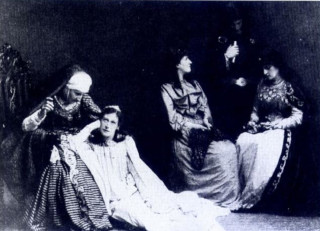
The first production of the Irish Literary Theatre, The Countess Cathleen, is performed on May 8, 1899. Like many of William Butler Yeats’ plays, it is inspired by Irish folklore. In a time of famine, demons sent by Satan come to Ireland to buy the souls of the starving people. The saintly Cathleen disposes of her vast estates and wealth in order to feed the peasants, yet the demons thwart her at every turn. At last, she sacrifices her own soul to save those of the poor.
Yeats, Lady Gregory and Edward Martyn publish a “Manifesto for Irish Literary Theatre” in 1897, in which they proclaim their intention of establishing a national theatre for Ireland. The Irish Literary Theatre is founded by Yeats, Lady Gregory, Martyn and George Moore in Dublin in 1899. It proposes to give performances in Dublin of Irish plays by Irish authors.
In 1899 Lady Gregory secures a temporary licence for a play to be given at the Antient Concert Rooms in Great Brunswick Street (now Pearse Street) in Dublin and so enables the Irish Literary Theatre to give its first production. The play chosen is The Countess Cathleen by Yeats. It is done by a very efficient London company that includes May Whitty (Dame May Webster) and Ben Webster. The next production given is Martyn’s play The Heather Field.
In the following year the Irish Literary Theatre produces three plays at the Gaiety Theatre in Dublin: Maeve by Edward Martyn, The Last Feast of Fianna by Alice Milligan and The Bending of the Bough by George Moore. The Bending of the Bough is staged during the Second Boer War which begins on October 11, 1899.
The Irish Literary Theatre project lasts until 1901, when it collapses due to lack of funding.
The use of non-Irish actors in these productions is perceived to be a failure, and a new group of Irish players is put together by the brothers William and Frank Fay, among others. These go on to form the Irish National Theatre Society, which leads to the founding of the Abbey Theatre in Dublin in 1904.
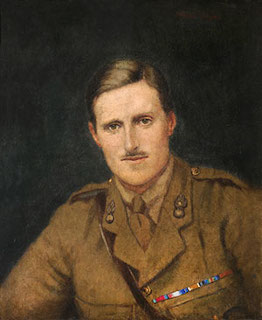
Compton-Smith was born in 1889 in South Kensington, London. After finishing school, he decides not to follow the family tradition of studying law. He actually wants to become an artist, but his father insists that he join the army. He studies at the Royal Military College at Sandhurst and during World War I his regiment is sent to France. In 1917 he is wounded at the Battle of Arras, but he continues to fight on. He is awarded the Distinguished Service Order (DSO). In 1919 he is sent to serve in Ireland during the Irish War of Independence.
In 1919 Compton-Smith is commander of the British Army base at Ballyvonane, near Buttevant, but he is also an intelligence officer. As an officer he also sometimes presides over courts martial. In January 1921, for instance, three IRA volunteers are tried by him for involvement in the ambush at Shinanagh, near Charleville, and he sentences them each to six months.
February 1921 is a bad time for the IRA in County Cork. They suffer major losses at the ambushes at Clonmult and Mourne Abbey, and several volunteers are taken prisoner, four of whom are sentenced to death. The IRA believes that these death sentences might be commuted if a British officer is held as a hostage. This leads to the capture of Compton-Smith. On April 16, 1921, he travels to Blarney, supposedly on a sketching trip but actually to meet a nurse in Victoria Barracks with whom he is having an affair. The IRA has spies in Victoria Barracks who likely tip off the IRA that Compton-Smith is coming to Blarney. A squad led by Frank Busteed easily capture him after he gets off the train.
Busteed then meets with Jackie O’Leary, the IRA battalion commander. It is decided that Donoughmore is the perfect place to keep a hostage, because parts of the parish are remote and the IRA is strong there.
On April 18, under the cover of darkness, Compton-Smith is transferred by car to Knockane House, an abandoned big house in Donoughmore. The following night he is moved again, this time by pony and trap, to Barrahaurin, a remote townland in the Boggeragh Mountains. He is kept there for the last eleven days of his life, on the small farm of Jack and Mary Moynihan. He is held prisoner in a shed, always under guard. Every evening he is brought into the house, where he eats and stays at the fireside. He and his guards have conversations about history and politics.
The four IRA prisoners are executed on April 28, 1921. On April 30, O’Leary informs Compton-Smith that he is going to be executed. He then writes a final letter to his wife. He tells her that he will die with her name on his lips and her face before his eyes and that he will “die like an Englishman and a soldier.” He also writes a letter to his regiment and one to Lt. General Strickland.
After finishing his letters, Compton-Smith is led up into Barrahaurin bog behind the Moynihan house, to a place where his grave had already been dug and is given a final cigarette. In his witness statement Maurice Brew writes, “When removed to the place of execution he placed his cigarette case in his breast pocket of his tunic … He then lighted a cigarette and said that when he dropped the cigarette it could be taken as a signal by the execution squad to open fire.”
It is not until late May, following the discovery of the cache of letters in a Dublin raid, that the Compton-Smith family is informed of his death. His father, William, then starts a campaign to find his son’s body. He wrote letters to MPs and to the British Army, seeking information and help. He also writes to Erskine Childers but gets no reply. He offers a reward of £500 for information, but only The Irish Times agrees to print his advertisement.
In November 1921 a cousin of Compton-Smith’s wife, Gladys, meets Michael Collins in London and asks him for help in finding the body. Correspondence between Collins and the Compton-Smith family suggests that Collins is trying to help in 1922, but he fails to get any results before he is assassinated at Béal na Bláth later that same year.
On March 3, 1926, Compton-Smith’s grave is discovered by the Gardaí. The newspapers report that the remains, because of the conditions of the bog, “were not so badly decomposed as to render identification impossible.” The body is brought to Collins Barracks in Cork. On March 5 the Gardaí send a telegram to the Compton-Smiths, informing them that the body has been located.
The reburial of Compton-Smith is carried out with great dignity on March 19, 1926. The Irish Army escorts the coffin from Collins Barracks to Penrose Quay, where British forces from Spike Island take the coffin on board a boat. While the boat travels down the River Lee, the Irish Army’s guard of honour presents arms and sounds the “Last Post.” The British then bring the coffin to Carlisle Fort, near Whitegate, where it was buried in the in the British Military Cemetery with full military honours.
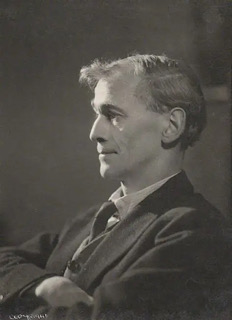
Lynd is born to Robert John Lynd, a Presbyterian minister, and Sarah Rentoul Lynd, the second of seven children. His paternal great-grandfather emigrated from Scotland to Ireland. He is educated at Royal Belfast Academical Institution and Queen’s University Belfast. His father serves a term as Presbyterian Church Moderator, but he is just one of a long line of Presbyterian clergy in the family.
Lynd marries the writer Sylvia Dryhurst on April 21, 1909. They meet at Gaelic League meetings in London. Their daughters Máire and Sigle become close friends of Isaiah Berlin. Sigle’s son, born in 1941, is artist Tim Wheeler. In March 1924, they move to what is to be their long-term married home, the elegant Regency house of 5 Keats Grove in the leafy suburb of Hampstead in northwest London. The house had been lived in by various members of Sylvia’s family.
The Lynds are literary hosts, in the group including J. B. Priestley. They are on good terms also with Hugh Walpole. Priestley, Walpole and Sylvia Lynd are founding committee members of the Book Society. Irish guests include James Joyce and James Stephens. On one occasion reported by Victor Gollancz in Reminiscences of Affection, Joyce intones Anna Livia Plurabelle to his own piano accompaniment. Joyce and his wife Nora Barnacle hold their wedding lunch at the Lynds’ house after getting married at Hampstead Town Hall on July 4, 1931.
Lynd uses the pseudonym Y.Y. in writing for the New Statesman. According to C. H. Rolph‘s Kingsley, Lynd’s weekly essay, which runs from 1913 to 1945, is “irreplaceable.” In 1941, editor Kingsley Martin decides to alternate it with pieces by James Bridie on Ireland, but the experiment is not at all a success.
Lynd’s political views are at a certain point radicalised by his experience of how Ulster and Home Rule develop in the 1912–1914 period. He is appalled at the threat of the use of violence to deliver Ulster from Home Rule and the later decision to postpone the implementation of the Third Home Rule Bill. He later writes, “Then came August 1914 and England began a war for the freedom of small nations by postponing the freedom of the only small nation in Europe which it was within her power to liberate with the stroke of a pen.”
Lynd becomes fluent in the Irish language and is a Gaelic League member. As a Sinn Féin activist, he uses the name Robiard Ó Flionn/Roibeard Ua Flionn. He dies in Hampstead, London on October 6, 1949. He is buried in Belfast City Cemetery.
Noonan is the illegitimate son of Samuel Croker, a senior member of the Royal Irish Constabulary. He is baptised and raised a Roman Catholic by his mother Mary Noonan. His father, who is not Catholic, has his own family, but attempts to provide for Robert until his death in 1875.
By 1875 Noonan is living in London. When he is sixteen, he shows signs of a radical political consciousness. He leaves his family declaring he “would not live on the family income derived largely from absentee landlordism.” It is around this time he changes his surname to his mother’s maiden name.
In 1890, Noonan is a sign writer living in Queen’s Road, Everton, Liverpool. On June 10, 1890, he appears at Liverpool County Intermediate Sessions court at County Sessions House, Islington, Liverpool on charges of housebreaking and larceny. He is found guilty and given a six-month prison sentence.
By 1891, Noonan has moved to Cape Town, South Africa, where he is a painter and decorator. He marries in 1891, but the marriage is an unhappy one, with his wife having numerous affairs after the birth of their daughter, Kathleen. They divorce in 1895, and Noonan acquires all the property, including their house in an affluent suburb of Cape Town.
Noonan and his daughter move to Johannesburg, where he secures a well-paying job with a construction company. It is here that he learns the ways of the industry he would later write about in his novel, although Noonan’s actual circumstances vary greatly from the proletarian characters of the book. After becoming Secretary of the Transvaal Federated Building Trades Council, he is able to send his daughter to an exclusive convent school and also to employ a black manservant called Sixpence.
In 1897, Noonan leads a successful protest against the employment of black skilled labour. During 1898, he becomes a member of the Transvaal Executive Committee of the Centennial of 1798 Association, which commemorates the revolutionary nationalistSociety of United Irishmen. As a 1798 Association member, he helps form the Irish Brigades, an anti-British force that fights alongside the Boers in the Second Boer War. At this point, accounts of his life differ. Some assert he takes up arms and is interned by the British until the end of the war, when he returns to Britain. Others say he leaves South Africa just before hostilities began in October 1899.
In any event, around the turn of the century, Noonan ends up in Hastings, Sussex. Here, he finds work as a sign writer, but at much lower wages and in far poorer conditions than he had experienced in South Africa. He has to take part-time jobs in addition to his full-time position.
Influenced by the Marxist-influenced ideas of designer and socialist William Morris, he joins the Social Democratic Federation in 1906. The next year, after a dispute with his employer, he loses his job. Despite the demand for his skills, his health begins to deteriorate, and he eventually develops tuberculosis. Unemployed and unable to remain politically active, he starts writing, something he hopes will earn enough money to keep him from the workhouse.
He writes under the pen name Robert Tressell as he fears the socialist views expressed in the book will have him blacklisted. He completes The Ragged-Trousered Philanthropists in 1910, but the 1,600-page hand-written manuscript is rejected by three publishing houses. The rejections severely depress him, and his daughter has to save the manuscript from being burned.
Unhappy with his life in Britain, Noonan decides that he and Kathleen should emigrate to Canada. However, he only reaches Liverpool when he is admitted to the Royal Liverpool Infirmary, where he dies of pulmonary tuberculosis on February 3, 1911, at the age of 40. He is buried in a pauper’s grave at Liverpool Parochial Cemetery, later known as Walton Park Cemetery. The location of the grave is not rediscovered until 1970. Twelve other people are buried in the same plot. The plot is now marked although the land is no longer used as a cemetery and is now used by Rice Lane City Farm.
Kathleen mentions her father’s novel to a friend, writer Jessie Pope, who recommends it to her publisher. In April 1914, the publisher purchases the rights to the book for £25, and it appears in Britain, Canada and the United States later that year, in the Soviet Union in 1920, and in Germany in 1925. The version as originally published is heavily abridged by Pope, with much of the socialist ideology removed.
The original manuscript is subsequently located by F. C. Ball and, after he raises funds to acquire and reassemble the original version, an unabridged edition is published in 1955.
In 1991, On a Friday sign a six-album record contract with EMI and changes their name to Radiohead. They find early success with their 1992 single “Creep“. Their third album, OK Computer (1997), propels them to international fame and is often acclaimed as one of the best albums of all time. O’Brien becomes depressed during the extensive OK Computer tour. After the tour, he returns to Oxford and falls further into depression.
Radiohead’s next albums, Kid A (2000) and Amnesiac (2001), are recorded simultaneously and mark a dramatic change in sound, incorporating influences from electronic music, classical music, jazz and krautrock. O’Brien keeps an online diary of Radiohead’s progress during the recording and initially struggles with the band’s change in direction. At the suggestion of Michael Brook, creator of the Infinite Guitar, he begins using sustain units, which allow guitar notes to be sustained infinitely. He combines these with looping and delay effects to create synthesiser-like sounds. By 2011, Radiohead has sold more than 30 million albums worldwide.
O’Brien lives in London with his wife, Susan Kobrin, who worked for Amnesty International. The couple have a son, Salvador, born in January 2004, and a daughter, Oona, born in 2006. He is a cricket fan and supports Manchester United Football Club. Around 2000, he gives up alcohol and takes up meditation. In 2011, he and his family move to Brazil and live for a year on a farm near Ubatuba. In 2020, he announces that he believes he has contracted COVID-19 but is recovering in isolation.
Margretta Bowen, self-taught Irish artist best known as Gretta Bowen, dies in Belfast, Northern Ireland on April 8 1981. She starts painting late in life, around 1950, after her sons Arthur and George Campbell are already established as artists.
Born in Dublin in January 1880, Bowen lives most of her life in Belfast. She is married to Matthew Campbell, a veteran of the Second Boer War. They have three sons, Arthur, George and Stanley, who all go on to be highly talented artists, with George becoming particularly successful. After her husband death in 1925 she runs a laundrette and takes in lodgers to make ends meet.
Bowen comes to art late in her life. A few weeks before her seventieth birthday she finds paints left behind by her son Arthur and begins to experiment, apparently inspired to some extent by her sons. She uses her maiden name to apparently avoid any obvious connection with them.
Bowen clearly attracts notice early on despite her late start. In 1959, just five years after she takes up painting, she is given a solo exhibition by the Council for Encouragement of Music and the Arts, which continues to support her work when it subsequently becomes the Arts Council of Great Britain. An extensive and admiring review appears in The Times.
Bowen’s work is shown at the Royal Hibernian Academy (RHA), the Irish Exhibition of Living Art and the Oireachtas. She also holds one-person exhibitions at the Hendriks Gallery, the Bell Gallery and the Tom Caldwell Gallery. In 1979, at the age of 99, her works gain international fame. She exhibits at the first International Exhibition of Naïve Art in London.
Bowen dies at the age of 101 in Belfast on April 8, 1981.
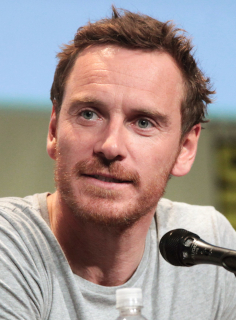
Fassbender’s mother, Adele, is from Larne, County Antrim, while his father, Josef Fassbender, is German. According to Fassbender family lore, his mother is the great-grand-niece of Michael Collins, the Irish leader during the Irish War of Independence. When he is two years old, his parents move to Killarney, County Kerry, where they run the West End House, a restaurant where his father works as a chef. His parents move to Kerry as they want their children to grow up in the countryside rather than the industrial backdrop of their previous residence in Germany. He is raised Catholic and serves as an altar boy at the church his family attends. He has an older sister, Catherine, who is a neuropsychologist.
Fassbender attends Fossa National School and St. Brendan’s College, both in Killarney. He decides that he wants to be an actor at age 17 when he is cast in a play by Donal Courtney. At 19, he moves to London to study at the Drama Centre London, a constituent school of Central Saint Martins. In 1999, he drops out of the Drama Centre and tours with the Oxford Stage Company to perform the play Three Sisters. Before he finds work as an actor, he works as a bartender and postman. Other jobs include labour work, market research for the Royal Mail and working for Dell computers.
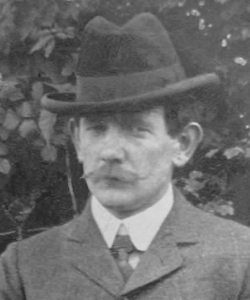
Fahy is born in Kinvara, County Galway, on September 29, 1854 into a family of seventeen, eight of whom survive. His father, Thomas, comes from the Burren area and his mother, Celia Marlborough, is born near Gort, County Galway.
In 1896, Fahy becomes president of the emerging Conradh na Gaeilge (Gaelic League) in London, a position he holds until 1908. He is also a long time member of the London Irish Literary Society. Described as a small, brisk man, his enthusiasm and energy knows no bounds. His most memorable poems and songs include “The Ould Plaid Shawl,” “The Queen of Connemara,” the original “Galway Bay,” and “The Tide Full In.” His publications include The Child’s Irish Song Book (1881), The Irish Reciter (1882), Irish History in Rhyme (1882) and Irish Songs and Poems (1887).
Fahy retires from the Civil Service at the age of 65. He dies at the age of 81 on April 1, 1935.
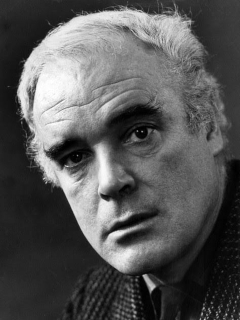
McGee is born into a middle-class family at 2 Edward Street in Armagh. The eldest of five children, he is educated at St. Patrick’s Grammar School, Armagh. He changes the spelling of his surname to Magee when he begins performing, most likely to avoid confusion with another actor.
Magee’s first stage experience in Ireland is with Anew McMaster’s touring company, performing the works of William Shakespeare. It is here that he first works with Pinter. He is then brought to London by Tyrone Guthrie for a series of Irish plays. He meets Beckett in 1957 and soon records passages from the novel Molloy and the short story From an Abandoned Work for BBC Radio. Impressed by “the cracked quality of Magee’s distinctly Irish voice,” Beckett requests copies of the tapes and writes Krapp’s Last Tape especially for the actor. First produced at the Royal Court Theatre in London on October 28, 1958, the play stars Magee and is directed by Donald McWhinnie. A televised version is later broadcast by BBC Two on November 29, 1972.
In 1964, Magee joins the Royal Shakespeare Company, after Pinter, directing his own play, The Birthday Party, specifically requests him for the role of McCann. In 1965 he appears in Peter Weiss‘s Marat/Sade, and when the play transfers to Broadway he wins a Tony Award. He also appears in the 1966 RSC production of Staircase opposite Paul Scofield.
Magee’s early film roles include Joseph Losey‘s The Criminal (1960) and The Servant (1963), the latter an adaptation scripted by Pinter. He also appears as Surgeon-Major James Henry Reynolds in Zulu (1964), Séance on a Wet Afternoon (1964), Anzio (1968), and in the film versions of Marat/Sade (1967) and The Birthday Party (1968). He is perhaps best known for his role as the victimised writer Frank Alexander, who tortures Alex DeLarge with Ludwig van Beethoven‘s music, in Stanley Kubrick’s film A Clockwork Orange (1971). His other role for Kubrick is as Redmond Barry’s mentor, the Chevalier de Balibari, in Barry Lyndon (1975).
Patrick McGee dies of a heart attack at his flat in Fulham, London on August 14, 1982, at the age of 60, according to obituaries in The Herald and The New York Times. On July 29, 2017, a blue plaque is unveiled in Edward Street, Armagh to mark Patrick McGee’s birthplace.
A charter incorporates Derry as the city of Londonderry on March 29, 1613 and also creates the new county of Londonderry. Despite the official name, the city is more usually known as simply Derry, which is an anglicisation of the Old IrishDaire, which in modern Irish is spelled Doire, and translates as “oak-grove/oak-wood.” The name derives from the settlement’s earliest references, Daire Calgaich (“oak-grove of Calgach”). The name is changed from Derry in 1613 during the Plantation of Ulster to reflect the establishment of the city by the London guilds.
Ulster is finally brought under the control of Elizabeth I’s government at the beginning of the 17th century following a long struggle between the Tudor monarchy and the Gaelic chieftains. This follows the defeat of the chieftains at the Siege of Kinsale in 1601 after a war lasting nine years. Although the Gaelic chieftains are allowed to remain on their land, their positions have been weakened. A group of them leave Ireland for the continent in 1607, never to return. The “Flight of the Earls”, as it is known, is seen as treason by James I’s government and their lands are confiscated. This important event opens the way for James I to further increase his control over Ulster by settling tens of thousands of settlers from England, Scotland and Wales on the confiscated lands.
Surveying and planning for the plantation take place during 1608 and 1609 and the plantation proper begins in 1610. The towns of Derry and Coleraine, as well as much of the lands that are to become County Londonderry, are granted to the City of London Corporation, which is charged with planting them.
The Society of the Governor and Assistants, London, of the New Plantation in Ulster, within the realm of Ireland, known after the Restoration as the Irish Society, is formed in 1609 by the City of London, to manage the estates which it has been obliged very reluctantly to take on. The Irish Society takes charge of the overall management of the Irish estates, with direct control of the new city of Derry and of the town of Coleraine.
The City of Londonlivery companies are required to take on estates in the surrounding County of Londonderry. The Great Twelve livery companies bear the heaviest financial burden. The county is divided among them into twelve “proportions,” distributed by the drawing of lots. The Great Twelve are in turn supported by a number of minor companies, so that thirty livery companies in all have Irish estates derived from their participation in James I’s scheme for the plantation of Ulster.
However, the first phase of the existence of the Irish Society is short-lived. The Great Parchment Book is compiled in the late 1630s when Charles I claims the estates as forfeit after a politically motivated case in Star Chamber rules that the Londoners have not fulfilled their obligations of plantation.
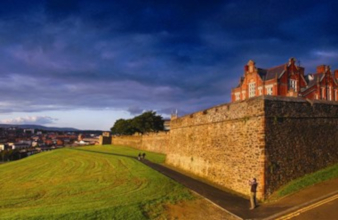
The City of Londonderry is very much a product of the plantation and plays a pivotal role in safeguarding the plantation. Its walls, which are still intact today, repulse sieges in 1641, 1649 and 1689.
By the end of the 17th century, Ulster, which had been the most Gaelic part of Ireland, has become the most “British.” The plantation creates Ulster we know today with its socio-economic base, its religious and political diversity, and its shared heritage.




 seamus dubhghaill