seamus dubhghaill

Promoting Irish Culture and History from Little Rock, Arkansas, USA


Leave a comment

Birth of Robert Erskine Childers, Writer & Fenian

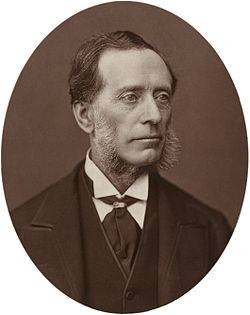
Robert Erskine Childers, British writer universally known as Erskine Childers and whose mother is from County Clare, is born on June 25, 1870, in Mayfair, London, England. His works include the influential novel The Riddle of the Sands. He is the second son of Robert Caesar Childers, a translator and oriental scholar from an ecclesiastical family, and Anna Mary Henrietta, née Barton, from an Anglo-Irish landowning family of Glendalough House, Annamoe, County Wicklow. He is also the cousin of Hugh Childers and Robert Barton, and the father of the fourth President of Ireland, Erskine Hamilton Childers.

Childers is raised at the home of family members at Glendalough, County Wicklow. At the recommendation of his grandfather, Canon Charles Childers, he is sent to Haileybury College. There he wins an exhibition to Trinity College, Cambridge, where he studies the classical tripos and then law. He distinguishes himself as the editor of Cambridge Review, the university magazine.

Childers’s first published work is some light detective stories he contributes to the Cambridge Review while he is editor. His first book is In the Ranks of the C. I. V., an account of his experiences in the Boer War, but he writes it without any thought of publication.

After serving in the British army during the Boer War he becomes an Irish nationalist. In 1914, Childers smuggles a cargo of 900 Mauser Model 1871 rifles and 29,000 black powder cartridges to the Irish Volunteers movement at the fishing village of Howth, County Dublin on his yacht, Asgard.

Though he serves as the principal secretary to Michael Collins and Arthur Griffith at the Anglo-Irish Treaty negotiations, Childers opposes the treaty, supporting the anti-treaty forces during the Irish Civil War. Childers is captured with a pistol by Free Staters in November 1922 shortly after the Free State has passed legislation making such possession a capital offence. Ironically, the revolver Childers possesses is a gift from former comrade Michael Collins, who led the Free State until his death in an ambush three months earlier.

Childers is put on trial by a military court on the charge of possessing a small Spanish-made Gaztanaga Destroyer .32 calibre semi-automatic pistol on his person in violation of the Emergency Powers Resolution. Childers is convicted by the military court and sentenced to death on November 20, 1922.

While his appeal against the sentence is still pending, Childers is executed on November 24, 1922, by firing squad at the Beggar’s Bush Barracks in Dublin. Before his execution he shakes hands with each member of the firing squad. He also obtains a promise from his then 16-year-old son, the future President Erskine Hamilton Childers, to seek out and shake the hand of every man who has signed his death sentence. His final words, spoken to the firing squad, are, “Take a step or two forward, lads, it will be easier that way.”

Robert Erskine Childers is buried at Beggar’s Bush Barracks until 1923, when his body is exhumed and reburied in the republican plot at Glasnevin Cemetery, Dublin.


Leave a comment

Birth of Novelist Annie French Hector

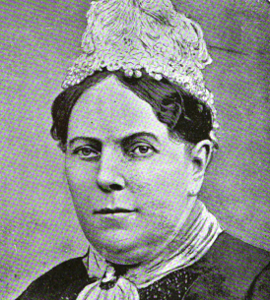
Annie French Hector, a popular 19th-century novelist who writes under the pen name “Mrs. Alexander,” is born in Dublin on June 23, 1825.

Hector is the only child of Robert French, a Dublin solicitor. Her family claims to be descended from Irish gentry, the French family of Roscommon and Lord Annaly. On the paternal side, she is related to the poet Charles Wolfe and on her mother’s side, to the Shakespearian scholar, Edmund Malone. Her father loses his money in 1844 and moves first to Liverpool before settling in London.

Hector marries the explorer and archaeologist Alexander Hector in 1858 and together they have four children. She writes several novels during her early life, the first being Kate Vernon in 1854. However, her husband disapproves of her writing so she remains unpublished in his lifetime.

After Alexander Hector’s death in 1875, she uses his first name as her pseudonym and publishes over forty novels as “Mrs. Alexander,” many published by George and Richard Bentley. Among her books, all of which enjoy a wide popularity in the United States, are The Wooing O’t (1873), Ralph Wilton’s Weird (1875), Her Dearest Foe (1876), The Freres (1882), A Golden Autumn (1897), A Winning Hazard (1897), and Kitty Costello (1902).

Hector’s final novel, Kitty Costello, which presents an Irish girl’s introduction to English life and has autobiographic touches, is written when she is 77 years old and is barely completed at her death. A witty, clever talker, of quick sympathies and social instincts, Hector is in many ways abler and broader-minded than is shown in her writings. She dies in London, after suffering from neuritis for ten years, on July 10, 1902, and is buried in Kensal Green Cemetery.


Leave a comment

Assassination of Field Marshal Sir Henry Hughes Wilson

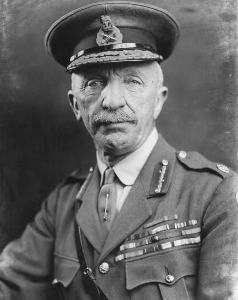
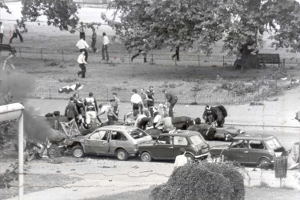
Field Marshal Sir Henry Hughes Wilson is shot and killed by two Irish Republican Army (IRA) men in London on June 22, 1922.

Wilson is born in County Longford and a long-time opponent of the Irish Home Rule movement. He joins the British army in 1884 and sees action during the Boer War. He is assigned to British army headquarters during the infamous Curragh incident and supports the near-mutiny of British officers who refuse to lead troops against Ulster opponents of home rule. He serves in France during the World War I and, when the war ends, continues his staunch support of the Unionist cause while serving as Chief of General Staff. He is a strong supporter of the coercion tactics of the British in Ireland during the Irish War of Independence, even suggesting that the leaders of Sinn Féin be executed. He leaves the army when David Lloyd George decides not to renew his term as chief of staff and is elected Member of Parliament (MP) for North Down as a Conservative in 1922. In Parliament, he urges even stronger coercion methods than those then being carried out by the Black and Tans.

On June 22, 1922, two London-based volunteers of the Irish Republican Army, Reginald Dunne and Joseph O’Sullivan, assassinate Wilson outside his house at 36 Eaton Place at approximately 2:20 PM. He is in full uniform as he is returning from unveiling the Great Eastern Railway War Memorial at Liverpool Street station at 1:00 PM. He has six wounds, two of them fatal wounds to the chest.

Stories later circulate that the first shot misses but rather than taking shelter in the house, he draws his sword and advances on his attackers, who are able to shoot and kill him. These stories often stress that he dies a martyr. His housemaid testifies that she found his drawn sword lying by his side. These details do not feature in the witness accounts by Reginald Dunne, which is smuggled out of prison, the inquest testimony of one of two road menders working nearby, and the taxi driver who had just dropped Wilson off. One of the road mender’s accounts, as published in the Daily Mail, mentions Wilson turning on his attackers with the words “you cowardly swine!” but this is believed to be a possible embellishment by the newspaper.

Two police officers and a chauffeur are also shot as the men attempt to avoid capture. They are then surrounded by a crowd and arrested by other policemen after a struggle. Dunne and O’Sullivan are convicted of murder and hanged on August 10, 1922. On the day Wilson’s killers were hanged, Currygrane, the family homesite in Ballinalee, County Longford is burned to the ground, possibly as a reprisal although possibly as an unrelated part of the unrest in that county.

Wilson’s widow blames the government for his death and is only persuaded to allow government representation at the funeral on the grounds that not to do so would be disrespectful to the King. Wilson’s funeral is a public affair attended by David Lloyd George and the cabinet, Ferdinand Foch, Robert Nivelle and Maxime Weygand from France as well as many of his former army colleagues including John French, Nevil Macready, Douglas Haig and William Robertson. He is buried in the crypt of St. Paul’s Cathedral in London.


Leave a comment

Heroic Act of Charles Davis Lucas Earns First Victoria Cross

Charles Davis Lucas, a 20-year-old mate on the HMS Hecla in the Royal Navy, hurls a Russian shell, its fuse still burning, from the deck of his ship on June 21, 1854, during the Crimean War. For this action, he becomes the first recipient of the Victoria Cross in 1857.

Lucas is born in Druminargal House, Poyntzpass, County Armagh, on February 19, 1834. He enlists in the Royal Navy in 1848 at the age of 13, serves aboard HMS Vengeance, and sees action in the Second Anglo-Burmese War of 1852–53 aboard the frigate HMS Fox at Rangoon, Pegu, and Dalla. By age 20, he has become a mate.

On June 21, 1854, in the Baltic Sea, HMS Hecla, along with two other ships, is bombarding Bomarsund, a fort in the Åland Islands off Finland. The fire is returned from the fort, and, at the height of the action, a live shell lands on HMS Hecla‘s upper deck with its fuse still hissing. All hands are ordered to fling themselves flat on the deck, but Lucas with great presence of mind runs forward and hurls the shell into the sea where it explodes with a tremendous roar before it hits the water. Thanks to Lucas’s action no one on board is killed or seriously wounded by the shell and, accordingly, he is immediately promoted to lieutenant by his commanding officer. His act of bravery is the first to be rewarded with the Victoria Cross.

His later career includes service on HMS Calcutta, HMS Powerful, HMS Cressy, HMS Edinburgh, HMS Liffey and HMS Indus. He is promoted to commander in 1862 and commands the experimental armoured gunboat HMS Vixen in 1867. He is promoted to captain in 1867, before retiring on October 1, 1873. He is later promoted to rear admiral on the retired list in 1885. During his career he receives the India General Service Medal with the bar Pegu 1852, the Baltic Medal 1854–55, and the Royal Humane Society Lifesaving Medal.

In 1879 he marries Frances Russell Hall, daughter of Admiral William Hutcheon Hall, who had been captain of HMS Hecla in 1854. The couple has three daughters together. Lucas serves for a time as Justice of the Peace for both Kent and Argyllshire, and dies in Great Culverden, Kent on August 7, 1914. He is buried at St. Lawrence Church, Mereworth, Maidstone, Kent.

Lucas’s campaign medals, including his Victoria Cross, are displayed at the National Maritime Museum in Greenwich, London. They are not the original medals, which were left on a train and never recovered. Replacement copies were made, though the reverse of the Victoria Cross copy is uninscribed.


Leave a comment

Birth of Andy Irvine, Musician & Singer-Songwriter

Andrew Kennedy Irvine, known as Andy Irvine, Irish folk musician and singer-songwriter, is born on June 14, 1942 in St. John’s Wood, London, England to an Irish mother from Lisburn, County Antrim, and a Scottish father from Glasgow. He is a founding member of popular bands Sweeney’s Men, Planxty, Patrick Street, Mozaik, LAPD and Usher’s Island. He plays the mandolin, mandola, bouzouki, harmonica and hurdy-gurdy.

Irvine has been influential in folk music for over five decades, during which he records a large repertoire of songs and tunes he assembles from books, old recordings and folk-song collectors rooted in the Irish, English, Scottish, Eastern European, Australian and American old-time and folk traditions. He sets these songs to new music and also writes songs about his personal experiences or the lives and struggles of his heroes, including Tom Barker, Michael Davitt, Mother Jones, Douglas Mawson, Raoul Wallenberg, and Emiliano Zapata.

Imbued with a sense of social justice, Irvine often selects or writes songs that are based on historical events and presented from the victim’s perspective. Some of these songs chronicle the abject living and working conditions imposed on groups of people such as the emigrants, the brutalized migrant workers, the exploited textile strikers or coalminers. Other songs recall the archetypal experiences of single individuals – the woman seduced by an unfaithful man or disowned by her father, the destitute young man ostracized or murdered on the order of his sweetheart’s rich father, the down-on-his-luck farmer or the unemployed worker, the young man inveigled by the army’s recruiting sergeant, the scapegoats. Irvine’s songs also denounce worker deaths and industrial diseases, and lament the plight of hunted animals. His repertoire includes humorous songs, but also bittersweet ones of unrequited love, or of lovers cruelly separated or dramatically reunited. He also sings about famous racehorses, men or women masquerading in various disguises, a fantastical fox preying on young maidens, and the violent lives of outlaws.

As a child actor, Irvine hones his performing talent from an early age and learns the classical guitar. He switches to folk music after discovering Woody Guthrie, also adopting the latter’s other instruments, the harmonica and mandolin. While extending Guthrie’s guitar picking technique to the mandolin, he further develops his playing of this instrument and, later, of the mandola and the bouzouki, into a decorative, harmonic style and embraces the modes and rhythms of Bulgarian folk music. Along with Johnny Moynihan and Dónal Lunny, Irvine is one of the pioneers who adapts the Greek bouzouki into an Irish instrument. He contributes to advancing the design of his instruments in cooperation with English luthier Stefan Sobell, and he occasionally plays a hurdy-gurdy made for him in 1972 by Peter Abnett, another English luthier.

Although touring mainly as a soloist, Irvine has also enjoyed great success in pursuing collaborations through many projects that have influenced contemporary folk music. He continues to tour and perform extensively in Ireland, Great Britain, Europe, North and South America, Japan, Australia and New Zealand.


Leave a comment

Birth of Bob Crowley, Theatre Designer & Director

Bob Crowley, scenic and costume theatre designer and theatre director, is born in Cork, County Cork on June 10, 1952. He is the brother of director John Crowley.

Crowley trains at the Bristol Old Vic Theatre School in Bristol, England. He designs over twenty productions for the Royal National Theatre in London including Ghetto, The Madness of George III, Carousel and The History Boys. He also designs numerous productions for the Royal Shakespeare Company including The Plantagenets, for which he wins a Laurence Olivier Award for Best Set Design, and Les Liaisons Dangereuses, which later has a successful run in London, followed by a transfer to Broadway. Opera productions include the critically acclaimed production of The Magic Flute directed by Nicholas Hytner, with whom Crowley frequently collaborates, for the English National Opera and La traviata for the Royal Opera House.

Crowley has received multiple Tony Award nominations, and has won seven times, for designing the Broadway productions of Carousel (1994), Aida (2000), The History Boys (2006), Mary Poppins (2007), The Coast of Utopia (2007), Once (2012) and An American in Paris (2015). He receives three other Tony Award nominations in 2015, two for his costumes on The Audience and An American in Paris and one for his scenic designs for Skylight. He is a recipient of the Laurence Olivier Award for Best Set Design and a three-time recipient of the Drama Desk Award for Outstanding Set Design.

Crowley designs set and costume for Mary Poppins, which plays in both the West End theatre and on Broadway. He designs and directs the Phil Collins musical Tarzan. He is the set and costume designer for Andrew Lloyd Webber‘s Love Never Dies, and the costume designer of the 2008-2009 version of The Little Mermaid.


Leave a comment

Birth of Brian Coffey, Poet & Publisher

Brian Coffey, Irish poet and publisher, is born in Dún LaoghaireCounty Dublin on June 8, 1905. His work is informed by his Catholicism and by his background in science and philosophy, and his connection to surrealism. For these reasons, he is seen as being closer to an intellectual European Catholic tradition than to mainstream Irish Catholic culture.

Coffey attends the Mount St. Benedict boarding school in GoreyCounty Wexford from 1917 to 1919 and then Clongowes Wood College, in ClaneCounty Kildare from 1919 until 1922. In 1923, he goes to France to study for the Bachelor’s degree in Classical Studies at the Institution St. Vincent, SenlisOise. While still at college, Coffey begins writing poetry. He publishes his first poems in University College Dublin‘s The National Student under the pseudonym Coeuvre.

In the early 1930s, Coffey moves to Paris where he studies Physical Chemistry under Jean Baptiste Perrin, who won the Nobel Prize for Physics in 1926. He completes these studies in 1933, and his Three Poems is printed in Paris by Jeanette Monnier that same year. In 1934 he enters the Institut Catholique de Paris to work with the noted French philosopher Jacques Maritain, taking his licentiate examination in 1936. He then moves to London for a time and contributes reviews and a poem to T.S. Eliot‘s The Criterion magazine. He returns to Paris in 1937 as an exchange student to work on his doctoral thesis on the idea of order in the work of Thomas Aquinas. In 1938, Coffey’s second volume of poetry, Third Person, is published by George Reavey‘s Europa Press.

During the war, Coffey teaches in schools in London and Yorkshire, leaving his young family in Dublin. After the war, he returns to Paris and completes his doctoral thesis. The family then moves so that Coffey can take up a teaching post at the Jesuit Saint Louis University.

By the early 1950s, Coffey becomes uncomfortable for a number of reasons, including the nature of his work, his distance from Ireland and the pressures that inevitably come to bear on an academic who has previously associated with well-known left-wing writers in Paris. For these reasons, he resigns in 1952.

In 1952, Coffey returns to live in London and, from 1973, Southampton. He begins again to publish his poetry and translations, mainly of French poetry. The first work in English to appear after this period of silence is Missouri Sequence, apparently begun in St. Louis but first appearing in the University Review, later known as the Irish University Review, in 1962.

Over the next decade or so, he publishes regularly in the University Review. He also sets up his own publishing enterprise, Advent Press, which publishes work by himself and by younger writers he wants to support.

Brian Coffey dies at the age of 89 on April 14, 1995, and is buried in Southampton, England.


Leave a comment

The Siege of Limerick

Henry IretonOliver Cromwell’s son-in-law, lays siege to Limerick city on June 4, 1651. During the Irish Confederate Wars, Limerick is one of the last fortified cities held by an alliance of Irish Confederate Catholics and English Royalists against the forces of the Parliament of England.

By 1650, the Irish Confederates and their English Royalist allies have been driven out of eastern Ireland by the Cromwellian conquest of Ireland. They occupy a defensive position behind the River Shannon, of which Limerick is the southern stronghold. Oliver Cromwell himself leaves Ireland in May 1650, delegating his command of the English Parliamentarian forces to Henry Ireton. Ireton moves his forces north from Munster to besiege Limerick in October of that year. However, the weather is increasingly wet and cold and Ireton is forced to abandon the siege before the onset of winter.

Ireton returns on June 4, 1651 with 8,000 men, 28 siege artillery pieces and 4 mortars. He summons Hugh Dubh O’Neill, the Irish commander of Limerick to surrender, but is refused. The siege is on.

Limerick in 1651 is split into two sections, English town and Irish town, which are separated by the Abbey River. English town, which contains the citadel of King John’s Castle, is encircled by water, the Abbey River on three sides and the River Shannon on the other, in what is known as King’s Island. Thomond bridge is only one bridge onto the island and is fortified with bastioned earthworks. Irish town is more vulnerable, but is also more heavily fortified. Its medieval walls have been buttressed by 20 feet of earth, making it difficult to knock a breach in them. In addition, Irish town has a series of bastions along its walls, mounted with cannon which cover its approaches. The biggest of these bastions are at St. John’s Gate and Mungret gate. The garrison of the city is 2,000 strong and composed mainly of veterans from the Confederate’s Ulster army, commanded by Hugh Dubh O’Neill, who had distinguished themselves at the siege of Clonmel the previous year.

Because Limerick is very well fortified, Ireton does not risk an assault on its walls. Instead he secures the approaches to the city, cuts off its supplies and builds artillery earthworks to bombard the defenders. His troops take the fort at Thomond bridge, but the Irish destroy the bridge itself, denying the Parliamentarians land access to English town. Ireton then tries an amphibious attack on the city, a storming party attacking the city in small boats. They are initially successful, but O’Neill’s men counterattack and beat them off.

After this attack fails, Ireton resolves to starve the city into submission and builds two forts known as Ireton’s fort and Cromwell’s fort on nearby Singland Hill. An Irish attempt to relieve the city from the south is routed at the battle of Knocknaclashy. O’Neill’s only hope is now to hold out until bad weather and hunger force Ireton to raise the siege. To this end, O’Neill tries to send the town’s old men, women and children out of the city so that his supplies will last a little longer. However, Ireton’s men kill forty of these civilians and send the rest back into Limerick.

O’Neill comes under pressure from the town’s mayor and civilian population to surrender. The town’s garrison and civilians suffer terribly from hunger and disease, especially an outbreak of plague. In addition, Ireton finds a weak point in the defences of Irish town, and knocks a breach in them, opening the prospect of an all out assault.

Eventually in October 1651, six months after the siege started, part of Limerick’s garrison mutinies and turns some cannon inwards, threatening to fire on O’Neill’s men unless they surrender. Hugh Dubh O’Neill surrenders Limerick on October 27. The inhabitants lives and property are respected, but they are warned that they could be evicted in the future. The garrison is allowed to march to Galway, which is still holding out, but has to leave their weapons behind.

The lives of the civilian and military leaders of Limerick are excepted from the terms of surrender. A Catholic Bishop Terence Albert O’Brien, an Alderman and the English Royalist officer Colonel Fennell are hanged. O’Neill is also sentenced to death, but is reprieved by the Parliamentarian commander Edmund Ludlow and imprisoned instead in London. Former mayor Dominic Fanning is drawn, quartered, and decapitated, with his head mounted over St. John’s Gate.

Over 2,000 English Parliamentary soldiers die at Limerick, mostly from disease. Among them is Henry Ireton, who dies a month after the fall of the city. About 700 of the Irish garrison and an estimated 5,000 citizens die.

(Pictured: The Treaty Stone on which the treaty of Limerick may have been signed in 1691)


Leave a comment

Death of Barry Edward O’Meara, Physician to Napoleon

Barry Edward O’Meara, Irish surgeon and founding member of the Reform Club, dies in London on June 3, 1836.

Born in Ireland, O’Meara joins the British navy in 1808, after he has been dismissed from the army for assisting in a duel. In July 1815 he is serving on the HMS Bellerophon when Napoleon surrenders on board.

His knowledge of Italian impresses Napoleon and he requests O’Meara’s services on St. Helena. O’Meara remains on St. Helena as Napoleon’s personal physician until 1818, when his refusal to spy on the Emperor for the British governor of the island causes him to be dismissed from that post.

On his return to London, O’Meara publishes Napoleon in Exile, or A Voice From St. Helena (1822) a book which charges Sir Hudson Lowe with mistreating the former emperor and created no small sensation on its appearance. Less known are his secret letters he sends clandestinely from St. Helena to a clerk at the Admiralty in London. These letters shed a unique light on Napoleon’s state of mind as a captive and the causes of his complaints against Sir Hudson Lowe and the British government.

O’Meara is also the physician who performs the very first medical operation on Napoleon by extracting a wisdom tooth in the autumn of 1817.

O’Meara also becomes involved in politics, helping to found the Reform Club. O’Meara dies on June 3, 1836, from complications after catching a cold while attending one of Daniel O’Connell‘s political rallies.


Leave a comment

Birth of Illustrator Hugh Thomson

Hugh Thomsonillustrator, is born on Kingsgate Street, ColeraineCounty Londonderry on June 1, 1860. He is best known for his pen-and-ink illustrations of works by authors such as Jane AustenCharles Dickens, and J. M. Barrie.

Thomson is born to tea merchant John Thomson (1822–1894) and shopkeeper Catherine (née Andrews). He is the eldest of their three surviving children. Although he has no formal artistic training, as a young boy he often fills his schoolbooks with drawings of horses, dogs, and ships. He attends Coleraine Model School, but leaves at the age of fourteen to work as a clerk at E. Gribbon & Sons, Linen Manufacturers. Several years later his artistic talents are discovered, and in 1877 he is hired by printing and publishing company Marcus Ward & Co.

On December 29, 1884 Thomson marries Jessie Naismith Miller in Belfast. Soon afterwards they move back to London for Thomson’s career. They have one son together, John, born in 1886.

In 1911, he and his family move to Sidcup, hoping to improve their “ever delicate health.” Thomson’s correspondence reflects the fact that he misses being close to the National Gallery and the museums where he usually compiles research for his illustrations. During World War I, demand for Thomson’s work decreases to a few propaganda pamphlets and some commissions from friends. By 1917, Thomson has fallen on financial hardship and he has to take a job with the Board of Trade, where he works until 1919.

Hugh Thomson dies of heart disease at his home at 8 Patten Road in Wandsworth Common, London, on May 7, 1920.