McCarthy is educated in Cork. He begins his career as a journalist at the age of 18 in Cork. From 1853 to 1859 he is in Liverpool, on the staff of the Northern Daily Times. In March 1855, he marries Charlotte Ailman. In 1860 he moves to London, as parliamentary reporter to the Morning Star, of which he becomes editor in 1864. He gives up his post in 1868 and, following a lecturing tour in the United States, joins the staff of The Daily News as leader-writer in 1870. In this capacity he becomes one of the most useful and respected upholders of the liberal politics of the time. He lectures again in America in 1870–71 and in 1886–87.
At the 1886 United Kingdom general election, McCarthy is returned unopposed in North Longford, but also stands in Londonderry City, where he is declared the loser to the Irish Unionist Alliance candidate by the narrow margin of 1778 votes to 1781. However, the result is later overturned on petition and McCarthy opts to sit for Londonderry City. During the divorce controversy surrounding Charles Stewart Parnell in November 1890, the British Prime MinisterWilliam Ewart Gladstone expresses a warning, given to McCarthy as intermediary, that if Parnell retains leadership of the Irish Parliamentary Party, it will mean the loss of the next election, the end of their alliance and Home Rule. When the annual party leadership election meeting is called later that month, the threat is somehow not conveyed to the members, who re-elect Parnell leader of the Party.
After a further historical meeting of the Irish Party MPs in early December, Parnell refuses to retire and the Party divides. McCarthy becomes chairman of the Anti-Parnellite group, the Irish National Federation, for a year in 1891–92. His nationalism is of a temperate and orderly kind, and though his personal distinction singles him out for the chairmanship during the party dissensions of this period, he is in no active sense the political leader.
It is claimed that McCarthy’s true vocation is literature. His earliest publications are novels, some of which, such as A Fair Saxon (1873), Dear Lady Disdain (1875), Miss Misanthrope (1878), and Donna Quixote (1879), attain considerable popularity. His most important work is his History of Our Own Times, which treats of the period between Queen Victoria‘s accession and her Diamond Jubilee. He begins a History of the Four Georges (1884–1901) and the latter half is written by his son, Justin Huntly McCarthy.
Justin McCarthy dies at the age of 81 in Folkestone, Kent, England on April 24, 1912.
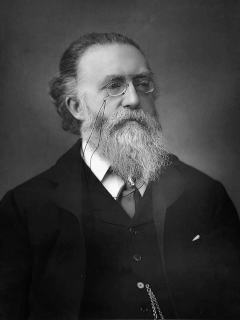
(Pictured: Portrait style photograph of Irish politician Justin McCarthy, taken in 1891 by Herbert Rose Barraud)
O’Kelly is born James Kelly in Mobhill, Loughrea, County Galway, youngest of seven (or possibly eight) children of Michael Kelly, corn merchant, and his wife, Catherine Fitzgerald. His date of birth is uncertain. Some commentators believe he is the James Kelly whose birth was registered on November 16, 1875, but relatives claim this was a sibling and namesake who died prematurely. His death certificate implies he was born in 1878, and family members maintained he was born in 1880.
Loughrea is at the centre of the bitterly fought plan of campaign agitation on the Clanricarde estate from the late 1880s. Many tenants in the town and surrounding rural districts are evicted for non-payment of rent, and Lord Clanricarde resists reinstatement until the estate is purchased by special legislation shortly before World War I. According to one source, the O’Kellys are themselves evicted during the Plan of Campaign, though they seem to retain a degree of financial stability. A widespread perception that nationalist politicians had exploited the evicted tenants contributes to the relative strength of Parnellism in the area, and the early appearance of Sinn Féin. This background inspires such works as O’Kelly’s 1917 play, The Parnellite.
While growing up in Loughrea, O’Kelly is profoundly influenced by contact with older relatives and country folk from whom he learns some Irish and the folklore/storytelling tradition that shapes many of his stories. The example of his mother and friendship with the local Carmelite fathers, whom he serves as an altar boy, gives him a strong commitment to Catholicism. This coexists in his work with an Ibsenite-Parnellite insistence on individual defiance of conformity, and a gentle exaltation of the sensitive dreamer isolated from the life around him. The mixture is sometimes uneasy. His observations on domestic violence, the sexual exploitation of servant girls by hypocritically pious employers, and prejudice against children born outside marriage or raised in the workhouse are unobtrusive but biting. His play, The Bribe (1913), gives a devastating depiction of the social and economic pressures which induce a small-town shopkeeper and poor law guardian to accept a bribe to appoint an underqualified dispensary doctor, with disastrous results. The corrupt and snobbish doctor is called Power O’Connor, an unsubtle hit at the nationalist MP, T. P. O’Connor. This element of social observation distinguishes him from the more symbolist city-born Daniel Corkery, to whom he is often compared. Much of his writing is recognisably set in Loughrea.
O’Kelly begins working as a journalist on local papers, including the Midland Tribune, the Tuam News, and the Connacht Leader. He becomes editor of The Southern Star, based in Skibbereen, County Cork, in 1903, and is said to be the youngest newspaper editor in Ireland at the time. He moves to Naas, County Kildare, in 1906, as editor of the Leinster Leader. Here he lives in a house by the canal, which provides the inspiration for his linked series of short stories, The Golden Barque, along with his father, a nephew, and his brother Michael. Already a contributor to The United Irishman published by Arthur Griffith, and later its successor, Sinn Féin, he is active in the Naas Sinn Féin club and makes regular weekend visits to Dublin, where Griffith introduces him to Dublin literary circles. Here his closest friends are James Stephens, whose influence is visible in the more whimsical and fantastic elements of O’Kelly’s work, and Seumas O’Sullivan, who recalls O’Kelly as a man of remarkable gentleness and integrity.
O’Kelly’s journalistic career is accompanied by his development as a writer, publishing stories in a variety of outlets, including the Irish Rosary and the Irish Packet. From 1908 he has several plays produced by the Theatre of Ireland, a nationalist-oriented rival to the Abbey Theatre. Lustre (1913), written jointly with Casimir Markievicz, later becomes the basis for a Soviet film.
Around 1911, O’Kelly suffers a severe attack of rheumatic fever, which leaves him with a chronic heart condition and a strong sense of mortality. He continues to write extensively and with increasing skill. He becomes editor of Dublin’s The Saturday Evening Post in 1912 and moves to Dublin, where he lives in Drumcondra. At this time he is an occasional contributor to The Manchester Guardian, turning down a permanent job on that paper. He leaves the Post in 1915 because of continuing ill-health and is offered the editorship of The Sunday Freeman but has to retire after two weeks. He then returns to Naas. At this time his play Driftwood, commissioned by Annie Horniman, is produced in Manchester and London.
When O’Kelly’s brother is interned after the Easter Rising, he resumes the editorship of the Leinster Leader until his brother’s release at Christmas 1916. He also contributes topical articles to the Sunday Independent. His literary reputation continues to increase with a short story collection, Waysiders (1917), and his best-regarded full-length novel, The Lady of Deerpark (1917), a melancholy story about the last heiress of a declining Catholic gentry family. Another novel, Wet Clay (1922), is published posthumously and is the story of the tense relationship between a “returned Yank” and his small-farmer cousins, which shows deeply unresolved ambivalence about the nature and prospects of Irish rural society after the Land War.
When Griffith and many other Sinn Féin activists are arrested and imprisoned in May 1918, O’Kelly returns to Dublin to edit the Sinn Féin paper Nationality. During the days after the Armistice of November 11, 1918, a crowd of soldiers and women whose husbands are serving in the British Army attack the paper’s premises, which are also the headquarters of Sinn Féin. As a result of these attacks O’Kelly suffers a cerebral haemorrhage which leads to his death on November 14, 1918.
O’Kelly’s funeral turns into a major political demonstration and his status as a nationalist martyr leads to the posthumous publication of many of his works. These include the novella, The Weaver’s Grave (1920), generally regarded as his masterpiece. It has been reprinted regularly and translated into several languages. A 1961 Radio Éireann adaptation by Micheal Ó hAodha wins the Prix Italia. The twenty-fifth and fiftieth anniversaries of his death see various commemorations in his honour and a short-lived Seumas O’Kelly Society is founded in 1968. O’Kelly never marries but is said to have cherished a hopeless passion for the actress and nationalist activist, Máire Níc Shiubhlaigh, for whom he writes the play The Shuiler’s Child (1909).
(From: “O’Kelly, Seumas” by Patrick Maume, Dictionary of Irish Biography, http://www.dib.ie, October 2009)
Mathew is born on July 10, 1830, at Lehenagh House, County Cork, eldest son of Charles Mathew, gentleman, of Lehenagh House and Castlelake, County Tipperary, and his wife Mary, daughter of James Hackett of Cork. He is of a Roman Catholic family and his uncle is Fr. Theobald Mathew, the temperance movement campaigner. His initial education is at a private school in Cork. He enters Trinity College Dublin (TCD) in July 1845, graduating BA (1850) as a gold medalist and senior moderator. In Hilary term 1850 he is admitted to the King’s Inns in Dublin. He moves to London, entering Lincoln’s Inn on June 1, 1851, and is called to the English bar in Hilary term 1854.
Mathew is a founding member of the Hardwicke Society, a legal debating society, and builds up a substantial practice as a junior barrister, being much in demand as counsel for jury cases in the Guildhall sittings. Despite being highly regarded by his peers, a certain lack of confidence holds him back and even when vacancies arise, he does not apply to be made a Queen’s Counsel (QC). In 1873, however, he represents the treasury as a junior counsel in the prosecution of the Tichborne claimant, Arthur Orton, in one of the most celebrated legal cases of the day. He is the only counsel for the treasury who does not get into heated arguments in court with Orton’s leading council, Dr. Edward Vaughan Hyde Kenealy.
Mathew possesses an encyclopedic knowledge of legal procedure and in 1881 is made a bencher at Lincoln’s Inn and awarded an honorary doctorate by TCD. Although still only a junior counsel he is appointed a judge in the Queen’s Bench Division in March 1881 and knighted. After the return to office of the Liberal Party in August 1892 he becomes chairman of the commission established to investigate the state of evicted tenants in Ireland. His appointment is perhaps unfortunate, as he is a home ruler in politics and the home rule MPJohn Dillon is his son-in-law. When the commission begins its hearings on November 7, 1892, he announces that he will not allow witnesses to be cross-examined. This provokes protests from Edward Carson, who had recently been replaced as solicitor general for Ireland. Counsel is ordered to withdraw and eventually two members of the commission resign, while the landlords refuse to cooperate with the proceedings. Despite severe criticism, many of the commission’s recommendations are incorporated in the Wyndham Land Purchase Act of 1903.
Throughout his legal career, Mathew argues for the establishment of a separate commercial court and eventually succeeds in convincing the other members of the bench and also Lord Russell of Killowen, who is appointed Lord Chief Justice in 1894, that such a court be established. As a result of this, he is appointed as the first judge of the Commercial Court when it is set up in 1895. In 1901 he is made a privy councilor and appointed judge in the Court of Appeal.
On December 6, 1905, Mathew is seized with a paralytic stroke at the Athenaeum Club in London, and his resignation is announced on the following day. On November 9, 1908, he dies at his London home, 46 Queen’s Gate Gardens. His remains are returned to Ireland, where they are interred in St. Joseph’s Cemetery, Cork.
Mathew marries Elizabeth Blackmore, eldest daughter of the Rev. Edwin Biron, JP and vicar of Lympne near Hythe, Kent, in December 1861. They have two sons and three daughters. His eldest daughter, Elizabeth Mathew, marries John Dillon. A portrait of Sir James Charles Mathew, by Frank Holl, is in the possession of the family. In 1896 a cartoon portrait of him by ‘Spy’ appears in Vanity Fair.
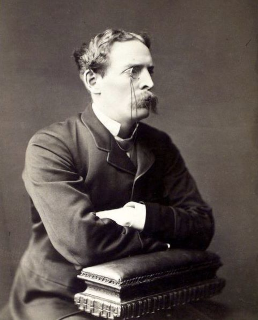
(From: “Mathew, Sir James Charles” by David Murphy, Dictionary of Irish Biography, http://www.dib.ie | Pictured: Sir James Charles Mathew by Alexander Bassano, half-plate glass negative, 1883, National Portrait Gallery, London)
O’Donnell is born in an army barracks in Devon, England, where his father, Sergeant Bernard MacDonald, is stationed. His mother, Mary Kain, is a native of Ballybane, close to Galway city. He is educated at the Erasmus Smith School in Galway, Coláiste Iognáid (the “Jes”), and later enrolls in Queen’s College Galway, where he studies English literature, history and political economy. While a student at the college, he acquires a considerable reputation as an orator, and is a frequent contributor to meetings of the college’s Literary and Debating Society, of which he becomes vice-auditor for the 1864–65 session.
Even in his student days, O’Donnell seems to be quick to voice his opinions, and revells in controversy. In November 1866, addressing the Literary and Debating Society on the question “Was the character of Warren Hastings as Governor-General of India praiseworthy?” he causes uproar by denouncing “the principle and the system which have lain at the root of the international and intercolonial policy of England, from the days when Elizabeth, the Infamous, chartered for profit two of the first ships which opened the African slave trade.” His remarks cause the chairman of the meeting, Professor Thomas Moffett, to prevent him from continuing his speech, stating that “such an epithet ought not to be applied to any predecessor of our present gracious Queen.” O’Donnell regards such action as an unwarranted restriction on his freedom of speech, and in a letter published in the local press gives an early example of his high-flown literary style:
“I hold that Debating Societies are the nurseries of independent thought, and the training schools of sober criticism. I believe in the power and impartiality of an enlightened studenthood … I have followed the mind of Austin. I have sat at the feet of Cairnes. I have drunk of the philosophy of Mill. I claim for Judicial Science, for Economic Science, for the Philosophy of History, a place in the discussions of our society, I pity, and I scorn the formidable confederacy of fools who dare not call a spade a spade.”
This incident, combined with the reluctance of the society to prevent O’Donnell from addressing its meetings, eventually leads to the suspension of the society from the Queen’s College and its temporary migration to rooms in the city of Galway.
O’Donnell graduates from the Queen’s College with an M.A. degree in 1868, winning several gold medals for his academic performance. By this stage, he has begun to style himself ‘Frank Hugh O’Donnell,’ believing himself to be a descendant of Hugh O’Donnell, 2nd Earl of Tyrconnell.
Leaving Galway, O’Donnell moves to London, where he embarks on a career in journalism, following his college contemporary T. P. O’Connor. O’Connor’s knowledge of modern European languages has helped him to establish himself as a correspondent on European affairs, and he assists O’Donnell in developing a similar reputation. He spends a brief period on the staff of The Morning Post.
In the 1874 United Kingdom general election, O’Donnell is elected Member of Parliament (MP) for Galway Borough but is unseated by the courts in what appears to be a politically inspired judgment which uses certain unsavoury campaigning tactics in which O’Donnell had indulged as its basis. He is succeeded in the seat by his election agent, Dr. Michael Francis Ward, who is himself succeeded in 1880 by T. P. O’Connor in an unusual succession, all three having been either auditor or vice-auditor of the Queen’s College Literary and Debating Society in the same era.
In 1875, O’Donnell is a founding member of the Constitutional Society of India, a group promoting political autonomy for India. In 1877, he secures a more permanent election to the House of Commons of the United Kingdom as MP for Dungarvan. He holds the seat until 1885, when the constituency is abolished. He strikes a colourful and controversial figure in parliament and becomes renowned for his declamatory speech-making. He is a prominent obstructionist and claims credit for inventing the tactic of obstructionism which is to yield such results for the Home Rule League under Charles Stewart Parnell. Indeed, he sees himself as a natural leader and becomes disillusioned when Parnell is selected in May 1880 to succeed William Shaw as leader of the Irish Parliamentary Party. He calls the British ‘Imperial pirates’ and inaugurates the Constitutional Society of India. Its aim is Home Rule for India, “Mr. O’Donnell’s grand passion in politics was a confederation of all the discontented races of the Empire under the lead of the Irish party. He once brought down some scores of dusky students of all the races and creeds of Hindustan to the House of Commons.”
Parnell refuses to let O’Donnell be nominated in 1885. He leaves the Irish Parliamentary Party and conventional politics, but not its general aims of promoting home rule and tenant farmers’ rights. His last and perhaps most important contribution to the fortunes of the party is the libel case he launches against The Times in 1888 over the series “Parnellism and Crime.” Though the case is lost, it results in the establishment of the Parnell Commission which exonerates Parnell from condoning the Phoenix Park Murders and exposes the Pigott Forgeries.
In his later years O’Donnell begins investigating misconduct by both the British Civil Service and the Roman Catholic church in Ireland. His Paraguay on Shannon (1908) is an amusing but serious critique of unethical practices by the Catholic clergy in local politics, education, and their involvement in the Congested Districts Board for Ireland that is financed by Parliament in order to improve the depressed economy of western Ireland. Parliament believes that by improving the living standards of the Irish peasant class, they can “kill Home Rule with kindness.”
After careful investigation, O’Donnell accuses members of the Catholic clergy of illegally diverting Government money earmarked for economic development into new Cathedrals, parish churches, and other ecclesiastical building projects. He argues that the British Government needs to provide better oversight of how the Congested Districts Board’s funds are being used. He believes that “in Ireland material ruin has accompanied clerical despotism.” His hostility to the Church draws the ire of Catholic historians who systematically undermine his credibility.
Ernest Belfort Bax writes that O’Donnell’s “matter is better than his manner.”
O’Donnell dies a bachelor in London on November 2, 1916, and is buried in Glasnevin Cemetery, Dublin.
Two hundred passengers are lost in the shipwrecks of the brigs Trevor and Nonpareil on October 20, 1775. Among the casualties are The Hononorable Major Francis Caulfield, Member of Parliament (MP) for Charlemont, his wife, and daughters. Also lost is John French, Member for Roscommon County.
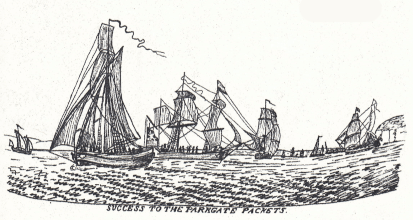
On Thursday, October 19, 1775, the brig Trevor, with Captain William Totty at the helm, and the brig Nonpareil, with Capatin Samuel Davies, sail from Parkgate for Dublin. That evening, as the vessels are near Holyhead, the wind shifts about from the south southwest to the west, and so violent a hurricane arises that they cannot carry any sail, but are obliged to lie to, and drive before the wind. In this situation, the Trevor drives upon the banks near the Lancashire shore and is totally lost.
Everyone on board perishes, except Samuel Fairclough, a mariner, who miraculously saves his life by leaping aboard another vessel named the Charming Molly, under Captain Joseph Holloway, which is transporting coal from Chester to Newry. The Charming Molly accidentally runs afoul of the Trevor and carries away the Trevor‘s foretopmast and, at the instant the two vessels come together, Fairclough makes his leap. He was the only survivor of the 30 to 40 passengers and crew aboard the Trevor.
Captain Holloway states that his vessel and the Trevor came together at some distance from the coast. They parted at the time Fairclough jumped across, and the Trevor subsequently went to pieces. A great many chests, boxes, some of which are broken, and quantities of East India goods are strewn along the shore, all wet with salt water. These items are in the custody of Mrs. Hesketh, Lady of the Manor of this coast, secured by Mr. Standen of Rossall Hall. The East India goods had arrived by land from London. The cargo and coins aboard the Trevor are estimated to be worth £15,000.
The Charming Mary runs ashore at Blackpool with most of her sails carried away, but otherwise with little damage.
The Nonpareil is lost in the storm between Parkgate and Dublin, driven on shore near Hoyle-sands and lost. There are no survivors. The wife of Captain Davies states that her husband sailed from Parkgate with very low spirits as he did not like the appearance of the weather. He is pressured to put to sea, which he does, and is turned back twice, but gets off on the third attempt, and is never seen again.
Between them, the Trevor and the Nonpareil reportedly carry nearly 200 passengers, the majority being on the Nonpareil. They carry cargo valued at £15,000.
On Tuesday evening, October 24, the Collector of the port of Chester receives the melancholy account of the loss of the Trevor by a letter from the Collector of Poulton, in Lancashire. This is immediately communicated to the Merchants, who are concerned in shipping the cargo, and they set out as soon as possible to give assistance and to secure each part of the cargo as might come ashore.
The merchants from Chester reach Poulton late on Wednesday night, October 25. The following morning, they set out along the shore from Blackpool, where the Charming Mary is stranded. The greatest part of the hull of the Trevor lay scattered along the shore at a great distance. On their arrival at Rossall Hall, about six miles from Blackpool, they have the satisfaction to find that Mr. Standen, who is Steward of the Manor of Bold Fleetwood Hesketh, now a minor and son to the deceased Fleetwood Hesketh, on whose estate the wreck is taken up, has taken all possible care of everything that can be saved from plunderers.
Three years later, O’Brien withdraws the Young Irelanders from the association. In January 1847, with Thomas Francis Meagher, he founds the Irish Confederation, although he continues to preach reconciliation until O’Connell’s death in May 1847. He is active in seeking relief from the hardships of the famine. In March 1848, he speaks out in favour of a National Guard and tries to incite a national rebellion. He is tried for sedition on May 15, 1848 but is not convicted.
On July 29, 1848, O’Brien and other Young Irelanders lead landlords and tenants in a rising in three counties, with an almost bloodless battle against police at Ballingarry, County Tipperary. In O’Brien’s subsequent trial, the jury finds him guilty of high treason. He is sentenced to be hanged, drawn, and quartered. Petitions for clemency are signed by 70,000 people in Ireland and 10,000 people in England. In Dublin on June 5, 1849, the sentences of O’Brien and other members of the Irish Confederation are commuted to transportation for life to Van Diemen’s Land (Tasmania in present-day Australia).
O’Brien attempts to escape from Maria Island off Tasmania, but is betrayed by the captain of the schooner hired for the escape. He is sent to Port Arthur where he meets up with John Mitchel.
O’Brien is a founding member of the Ossianic Society, which is founded in Dublin on St. Patrick’s Day 1853, whose aim is to further the interests of the Irish language and to publish and translate literature relating to the Fianna. He writes to his son Edward from Van Diemen’s Land, urging him to learn the Irish language. He himself studies the language and uses an Irish-language Bible, and presents to the Royal Irish Academy Irish-language manuscripts he has collected.
In 1854, after five years in Tasmania, O’Brien is released on the condition he never returns to Ireland. He settles in Brussels. In May 1856, he is granted an unconditional pardon and returns to Ireland that July. He contributes to The Nation newspaper, but plays no further part in politics.
In 1864 he visits England and Wales, with the view of rallying his failing health, but no improvement takes place and he dies in Bangor, Gwynedd, Wales on June 18, 1864.
In 1783 FitzGerald visits the West Indies before returning to Ireland, where his brother, William FitzGerald, 2nd Duke of Leinster, has procured Edward’s election to the Irish Parliament as an MP for Athy, a seat he holds until 1790. In Parliament he acts with the small Opposition Irish Patriot Party group led by Henry Grattan but takes no prominent part in debate. In the spring of 1786, he takes the then unusual step for a young nobleman of entering the Military College, Woolwich, after which he makes a tour through Spain in 1787. Dejected by unrequited love for his cousin Georgina Lennox, he sails for New Brunswick to join the 54th Regiment with the rank of Major.
In April 1789, guided by compass, FitzGerald traverses the country with a brother officer from Fredericton, New Brunswick to Quebec, falling in with Indians by the way, with whom he fraternizes. He accomplishes the journey in twenty-six days and establishes a shorter practicable route than that hitherto followed. The route crosses the extremely rugged and heavily forested northern part of the present state of Maine. In a subsequent expedition he is formally adopted at Detroit by the Bear clan of the Mohawk with the name “Eghnidal,” and makes his way down the Mississippi River to New Orleans, whence he returns to England.
Finding that his brother has procured his election for Kildare County, a seat he holds from 1790 to 1798, and desiring to maintain political independence, FitzGerald refuses the command of an expedition against Cádiz offered him by William Pitt the Younger and devotes himself for the next few years to the pleasures of society and to his parliamentary duties. He is on terms of intimacy with his first cousin Charles Fox, with Richard Sheridan and other leading Whigs. According to Thomas Moore, FitzGerald is only one of numerous suitors of Sheridan’s first wife, Elizabeth, whose attentions are received with favour. She conceives a child by him, a baby girl who is born on March 30, 1792.
His Whig connections, together with his transatlantic experiences, predisposed FitzGerald to sympathize with the doctrines of the French Revolution, which he embraces enthusiastically when he visits Paris in October 1792. He lodges with Thomas Paine and listens to the debates in the Convention. While in Paris, he becomes enamoured of a young girl named Pamela whom he chances to see at the theatre, and who has a striking likeness to Elizabeth Sheridan. On December 27, 1792, he and Pamela are married at Tournai, one of the witnesses being Louis Philippe, afterwards King of the French. In January 1793 the couple reaches Dublin.
Ireland is by then seething with dissent which is finding a focus in the increasingly popular and revolutionary Society of the United Irishmen, which has been forced underground by the outbreak of war between France and Britain in 1793. FitzGerald, fresh from the gallery of the Convention in Paris, returns to his seat in the Irish Parliament and immediately springs to their defence. Within a week of his return, he is ordered into custody and required to apologise at the bar of the House of Commons for violently denouncing in the House a government proclamation which Grattan had approved for the suppression of the United-Irish attempt to revive the Irish Volunteer movement with a “National Guard.” However, it is not until 1796 that he joins the United Irishmen, who by now have given up as hopeless the path of constitutional reform and whose aim, after the recall of Lord Fitzwilliam in 1795, is nothing less than the establishment of an independent Irish republic.
In May 1796 Theobald Wolfe Tone is in Paris endeavouring to obtain French assistance for an insurrection in Ireland. In the same month, FitzGerald and his friend Arthur O’Connor proceed to Hamburg, where they open negotiations with the Directory through Reinhard, French minister to the Hanseatic towns. The Duke of York, meeting Pamela at Devonshire House on her way through London with her husband, tells her that his plans are known and advises that he should not go abroad. The proceedings of the conspirators at Hamburg are made known to the government in London by an informer, Samuel Turner. The result of the Hamburg negotiations is Louis Lazare Hoche‘s abortive expedition to Bantry Bay in December 1796.
In September 1797 the Government learns from the informer Leonard McNally that FitzGerald is among those directing the conspiracy of the United Irishmen, which is now quickly maturing. Thomas Reynolds, converted from a conspirator to an informer, keeps the authorities posted in what is going on, though lack of evidence produced in court delays the arrest of the ringleaders. But on March 12, 1798, Reynolds’ information leads to the seizure of a number of conspirators at the house of Oliver Bond. FitzGerald, warned by Reynolds, is not among them.
As a fellow member of the Ascendancy class, the Government are anxious to make an exception for FitzGerald, avoiding the embarrassing and dangerous consequences of his subversive activities. They communicate their willingness to spare him from the normal fate meted out to traitors. FitzGerald however refuses to desert others who cannot escape, and whom he has himself led into danger. On March 30 the government proclamation of martial law authorising the military to act as they see fit to crush the United Irishmen leads to a campaign of vicious brutality in several parts of the country.
FitzGerald’s social position makes him the most important United Irish leader still at liberty. On May 9 a reward of £1,000 is offered by Dublin Castle for his apprehension. Since the arrests at Bond’s house, he has been in hiding. The date for the rising is finally fixed for May 23 and FitzGerald awaits the day hidden by Mary Moore above her family’s inn in Thomas Street, Dublin.
Tipped off that the house is going to be raided, Moore turns to Francis Magan, a Catholicbarrister and trusted sympathiser, who agrees to hide Fitzgerald. Making its way to Magan’s house on May 18, Fitzgerald’s party is challenged by Major Henry Sirr and a company of Dumbarton Fencibles. Moore escapes with Fitzgerald and takes him back to Thomas Street to the house of Nicholas Murphy.
Moore explains to Magan what had happened and, unbeknownst to her, Magan informs Dublin Castle. The Moore house is raided that day. Mary, running to warn the Leinster Directory meeting nearby in James’s Gate, receives a bayonet cut across the shoulders. That same evening Sirr storms Murphy’s house where FitzGerald is in bed suffering from a fever. Alerted by the commotion, he jumps out of bed and, ignoring the pleas of the arresting officers to surrender peacefully, he stabs one and mortally wounds the other with a dagger in a desperate attempt to escape. He is secured only after Major Sirr shoots him in the shoulder.
FitzGerald is conveyed to New Prison, Dublin where he is denied proper medical treatment. After a brief detention in Dublin Castle he is taken to Newgate Prison, Dublin where his wound, which has become infected, becomes mortally inflamed. His wife, whom the government probably has enough evidence to convict of treason, has fled the country, never to see her husband again, but FitzGerald’s brother Henry and his aunt Lady Louisa Conolly are allowed to see him in his last moments. He dies at the age of 34 on June 4, 1798, as the rebellion rages outside. He is buried the next day in the cemetery of St. Werburgh’s Church, Dublin. An Act of Attainder confiscating his property is passed as 38 Geo. 3 c. 77 but is eventually repealed in 1819.
William Conolly, Irish politician, Commissioner of Revenue, lawyer and landowner also known as Speaker Conolly, resigns as Speaker of the Irish House of Commons on October 13, 1729, on grounds of ill health. Sir Ralph Gore is elected unanimously in his place. His name is spelled Conolly rather than the more familiar Connolly, derived ultimately from the Gaelic surname “Ó Conghalaigh.”
Conolly is born on April 9, 1662, in Ballyshannon, County Donegal, the son of an innkeeper, Patrick Conolly. His father is a native of County Monaghan, and a descendant of the Ó Conghalaigh clan of Airgíalla, who settles in County Donegal, embraces the Anglican Church, and has children William, Patrick, Hugh, Phelim and Thady. His father sets aside enough money that he is able to send Conolly to Dublin to study law. He qualifies as an attorney in 1685, aged twenty-three.
Conolly practises as a lawyer in Dublin and in 1694 he marries Katherine Conyngham, daughter of General Sir Albert Conyngham. The Conynghams are an Ulster Scots family who are originally from Mountcharles in County Donegal. The family later settles at Slane Castle in County Meath in the 1780s, where the Conynghams still reside. They have no children, and on Katherine’s death in 1752 the estates are inherited by William James Conolly, his nephew by his brother Patrick.
Conolly makes his fortune from land transfers, following the confiscations by the Crown of lands belonging to supporters of King James II, in the wake of the Glorious Revolution and the accession of William III and Mary II in 1688–91, known as the “Williamite War in Ireland.” About 600,000 Irish acres are confiscated to be sold to pay for the costs of the war, nearly 5% of the land area of Ireland. Conolly is the largest individual buyer, in particular buying 3,300 acres in County Meath that had been assigned to the Earl of Albemarle.
Conolly builds the first winged Palladian house in Ireland, Castletown House in Celbridge, County Kildare, starting in 1722, and specifies that every part of it has to be made from Irish materials. His Dublin townhouse is on Capel Street, then the most fashionable part of the city. He also commissions the former Customs House (now the site of the Clarence Hotel) and the Irish Houses of Parliament, the world’s first building specifically designed as a bicameral parliament.
Conolly is the most important of the “Undertakers,” the managers of Government business in the Irish House of Commons, in the early 18th century. He is associated with the moderate faction of Whigs and is opposed by the Brodrick faction from Cork. He is a Member of Parliament for Donegal Borough from 1692 to 1703 and subsequently for Londonderry County until his death in 1729. In 1703 and 1713, he is also elected for Newtown Limavady and in 1727 for Ballyshannon but chooses each time not to sit.
Conolly is Speaker of the Irish House of Commons and a Commissioner of the Revenue from 1715 to his death in 1729. He is re-elected as Speaker of the House of Commons in the first session of George II‘s parliament and continues to serve until he collapses in the Commons on September 26, 1729. He is eventually persuaded to resign the Speaker’s chair on October 13, and he dies at his house in Capel Street, Dublin, on October 30. He is buried in Celbridge following a spectacular public funeral, which sees the beginnings of the custom of mourners wearing linen scarves to promote the Irish linen industry.
On his death, the Archbishop of Armagh, Hugh Boulter, estimates Conolly’s income in 1729 at £17,000 p.a. His widow Katherine continues to live in style at Castletown until her death in 1752. She builds the Wonderful Barn and the Conolly Folly in the 1740s. Then their estates pass briefly to William’s nephew William junior, and then on to his great-nephew Thomas Conolly M.P., known as “Squire Tom,” who is married to Lady Louisa Conolly.
A pub in Celbridge, The Speaker’s Bar, is named in his memory. There is also a pub in Firhouse, Dublin, called The Speaker Conolly named after him.
John Asgill, eccentric English writer and newly elected Member of Parliament (MP) for Enniscorthy, is expelled from the Irish parliament on October 11, 1703, on account of a pamphlet he published in Dublin in 1698, arguing that man may pass into eternal life without dying. The pamphlet is burned by the common hangman and he spends much of the rest of his life in prison in England for blasphemy or for matters arising from land speculation in Ireland.
John Asgill is born at Hanley Castle, Worcestershire, England, on March 25, 1659, the son of Edward and Hester Asgill. Little is known of his early life but in 1686 he becomes a student at the Middle Temple and is called to the bar in 1692. He founds the first land bank in 1695 with Nicholas Barbon, which, after proving to be a profitable venture, merges with the land bank of John Briscoe in 1696. However, after profits drop, the bank closes in 1699. He is then elected that year as Member of Parliament for Bramber.
In 1700 Asgill publishes An Argument Proving, that … Man may be Translated, a pamphlet aiming to prove that death is not obligatory upon Christians. Within days of its publication, he leaves England to travel to Ireland, where he hopes to profit from the Williamite confiscation, acting on behalf of individuals affected by the 1699 resumption act. He is reasonably successful but is unable to gain the profits that he had anticipated. He becomes involved in lengthy litigation with the estate of the Jacobite Nicholas Browne, which continues until the early 1730s.
In an attempt to further his interests Asgill enters the Irish House of Commons in 1703, representing Enniscorthy. His Irish parliamentary career is to be short. On September 25, the first day of the session, his pamphlet on death is discussed and voted “wicked and blasphemous” and ordered to be burned by the common hangman. He is allowed to make a personal defence of his work on October 11, but this proves insufficient. He is expelled and the Commons order that “he be forever hereafter incapable of being chosen, returned or sitting a member of any succeeding parliament in this kingdom.”
While in Ireland Asgill is re-elected to the English House of Commons for Bramber in 1702 and so returns to England. On June 12, 1707 he is arrested and imprisoned at Fleet Prison for debt. He claims parliamentary immunity as a member of a current parliament despite the confusion whether the last English parliament and the first Parliament of Great Britain are the same body, and in December the House of Commons agrees. Nevertheless, two days after ordering his release from prison, he is expelled from the Commons both for his religious views and because he is a declared bankrupt.
Asgill falls on hard times and spends the rest of his life imprisoned in the Fleet or within the bounds of the King’s Bench but his zeal as a pamphleteer continues unabated.
Asgill dies on November 10, 1738, in the parish of Southwark, and is survived by his sister Martha.
Guinness is born on November 10, 1847 at St. Anne’s, Clontarf, County Dublin, the youngest of three sons of Sir Benjamin Lee Guinness, brewer, of Dublin, and Elizabeth, third daughter of Edward Guinness of Dublin. He is not sent to public school but is taught at home by a private tutor before entering Trinity College Dublin, where he takes his degree in 1870. His father dies in 1868, leaving him a share in the brewery, and he takes over management of the business with his brother Arthur, who in 1876 sells his shares, making Edward sole proprietor.
Guinness is also prominent in municipal life, holding the offices of Sheriff of Dublin City in 1876 and High Sheriff of the County of Dublin in 1885, the year in which he is created a baronet. He is a brilliantly effective businessman, with close attention to detail and a focus solely on the brewery, to the extent of remaining independent from the rest of the brewing trade. In 1888 he bluntly tells the Country Brewers’ Association, “I have always declined to identify myself with any trade question, or to take any side in a controversy on the liquor question, and to this I must adhere.” In 1886 Guinness is floated as a public company, a superbly successful venture with applications for shares exceeding £100 million, and Edward remains as chairman until 1890, although his formal retirement in that year brings little reduction in his involvement with the company, and he continues to make the final decision on many minor matters as well as all major questions of policy.
Socially innovative, with a concern for the welfare of employees, from as early as 1870 Guinness establishes a free dispensary for his workforce and makes provisions for pension and other allowances – acts of social reform that are remarkable for the time. To mark his retirement in 1890 he places in trust £250,000 to be expended in the erection of working-class housing in London and Dublin. Both funds are administered from London until 1903, when the Dublin fund is amalgamated by the Iveagh Trust act with other schemes carried out in Dublin by Edward, who had been raised to the peerage of the United Kingdom in 1891 as Baron Iveagh of Iveagh, County Down. The funds, which increase considerably from the original amount, are thereafter managed entirely in Dublin as a separate undertaking under the name of the Iveagh Trust, still in existence in the early twenty-first century.
As one of the pioneers of the voluntary housing movement Guinness is essentially carrying on the tradition of “merchant prince and city father” established by his father and shared by his brother. Wealthy, ambitious, and resolutely unionist, he gives generous financial support to the Irish Unionist Alliance, and is also public-spirited, religious, and devoted to duty. Acknowledging that the Iveagh Trust is essentially ameliorative, he believes that major social change will only be achieved if numerous other wealthy people follow his example. He insists that gifts of money from the fund are permissible only to assist individuals to improve their condition “without placing them in the position of being the recipients of a bounty.” Numerous other philanthropic donations follow, including another £250,000 for slum clearance in the Bull Alley district of Dublin; various contributions to Dublin hospitals, particularly in 1903 and 1911 on the occasion of royal visits; and in 1907 the opening of the Iveagh Markets, situated in the Francis Street and Patrick Street areas of Dublin, are made possible with his financial backing. Generous contributions are also made to Trinity College Dublin, of which he is elected chancellor in 1908, and he donates land in Iveagh Gardens to University College Dublin (UCD).
In 1905 Guinness is raised to a viscountcy and in September 1909 the nationalist corporation of Dublin presents him with an address of thanks for his many gifts, and even discusses the possibility of offering him the lord mayoralty of the city, which he declines owing to his political affiliations. By this time he lives chiefly in England, having bought Elveden Hall in Suffolk, where he frequently entertains royalty. He also purchases Lord Kensington’s London estate and makes many donations to medical research societies in England, and in conjunction with Sir Ernest Cassel he founds the London Radium Institute, as well as donates £250,000 to the Laster Institute of Tropical Medicine for the endowment of bacteriological research.
In 1919 Guinness is elevated to an earldom and in 1925 purchases the remainder of the Kenwood estate to the north of Hampstead Heath and arranges for it to become public property, ensuring the estate will not be sold for building purposes, and also bequeaths to the nation a valuable collection of art for use in the gallery at the same location. As well as being elected a fellow of the Royal Society, he is awarded honorary doctorates from the University of Dublin and the University of Aberdeen.
In 1873, Guinness marries his third cousin Adelaide Maud, nicknamed “Dodo.” She is descended from the banking line of Guinnesses, and is the daughter of Richard Samuel Guinness, barrister and MP, and his wife Katherine, a daughter of Sir Charles Jenkinson. They have three sons, the eldest of whom, Rupert Edward Cecil Lee, succeeds his father as 2nd Earl of Iveagh.
Guinness dies at his London home in Grosvenor Place on October 7, 1927, and is buried at Elveden, Suffolk. He leaves an estate valued at £11 million.







 seamus dubhghaill