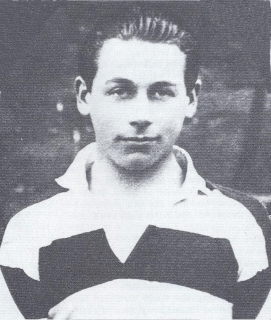
Barry is the fourth of seven children born to Thomas Barry, dairyman, and Mary Barry (née Dowling), both originally from northeast County Carlow. His father dies of heart disease on February 8, 1908, at the age of 56. His mother then moves the family to the family’s farm at Tombeagh, Hacketstown, County Carlow, while retaining the family’s townhouse on Fleet Street. As a child he goes to the National School in Rathvilly. In 1915, he is sent to live in Dublin and attends the O’Connell Schools for three months, before enrolling in the Preparatory Grade at St. Mary’s College, Rathmines, in September 1915. He remains at that school until May 31, 1916, when it is closed by its clerical sponsors. With the closure of St. Mary’s College, he transfers to Belvedere College, a Jesuit school in Dublin. He joins the Irish Volunteers, the forerunner of the IRA, while still at Belvedere College, and enters University College Dublin (UCD) in 1919 to study medicine.
As a member of 1st Battalion, Dublin Brigade of the Irish Volunteers, he takes part in a successful raid for arms on the military post in King’s Inns, Dublin, on June 1, 1920. Within only six minutes the raiders secure rifles, light machine guns, and large quantities of ammunition, and depart the site with no casualties. He also takes part in an abortive attempt to burn Aughavanagh House, Aughrim, County Wicklow in July 1920, and an attack on a British ration party in Church Street, Dublin, on September 20, with the aim of seizing arms. The final operation fails. Gunfire breaks out, three soldiers of around Barry’s own age are killed or fatally wounded, and he becomes the first Volunteer to be captured in an armed attack since 1916.
During interrogation, Barry is threatened with a bayonet and is mistreated. A general court-martial on October 20, which he refuses to recognise, condemns him to death for murdering the three soldiers, although one of the bullets taken from Private Marshall Whitehead’s body is a .45 calibre, while all witnesses state that Barry was armed with a .38 Mauser Parabellum. Despite widespread appeals on grounds of both clemency and expediency, the cabinet in London and officials in Dublin decide separately against a reprieve, probably because of its likely effect on the morale of soldiers and police.
On October 28, the Irish Bulletin, the official propaganda newspaper produced by Dáil Éireann‘s Department of Publicity, publishes Barry’s statement alleging torture. The headline reads English Military Government Torture a Prisoner of War and are about to Hang him. The Irish Bulletin declares Barry to be a prisoner of war, suggesting a conflict of principles is at the heart of the conflict. The British do not recognise a war and treat all killings by the Irish Republican Army (IRA) as murder. The public learns on this day that the date of execution has been fixed for November 1.
He was hanged in Mountjoy Prison, Dublin, on November 1, after hearing two Masses in his cell. The timing of the execution, only seven days after the death by hunger strike of Terence MacSwiney, the republican Lord Mayor of Cork, brings public opinion to a fever-pitch. He is buried in unconsecrated ground on the jail property. His comrade and fellow student Frank Flood is buried alongside him four months later. A plain cross marks their graves and those of Patrick Moran, Thomas Whelan, Thomas Traynor, Patrick Doyle, Thomas Bryan, Bernard Ryan, Edmond Foley and Patrick Maher who are hanged in the same prison before the Anglo-Irish Treaty of July 1921 which ends hostilities between Irish republicans and the British. The graves go unidentified until 1934. They become known as the Forgotten Ten by republicans campaigning for the bodies to be reburied with honour and proper rites. On October 14, 2001, the remains of the ten men are given a state funeral and moved from Mountjoy Prison to be re-interred at Glasnevin Cemetery in Dublin.
Barry is the first person to be tried and executed for a capital offence under the Restoration of Order in Ireland Act 1920, passed twelve weeks earlier. Together with his youth, this makes him a republican martyr celebrated in many ballads and verses. The best-known, set to a tune popular with British servicemen, is recorded by the American singer Paul Robeson, among others. A memorial stained-glass window by Richard King of the Harry Clarke Studio is later installed in the former UCD council chamber (afterward called the Kevin Barry Room), Earlsfort Terrace, Dublin.
Hayes sends a plan for the invasion of Northern Ireland by German troops to Germany in April 1940. This plan later becomes known as Plan Kathleen. He is also known to have met with German agent Hermann Görtz on May 21, 1940, in Dublin shortly after the latter’s parachuting into Ireland on May 5, 1940, as part of Operation Mainau. He is known to have asked Görtz for money and arms to wage a campaign in Northern Ireland, although shortly after this meeting the original Plan Kathleen is discovered. The discovery of the plan leads to the acceleration of joint British and Irish military planning for a German invasion known as Plan W.
Another meeting on August 15, 1940, on Rathgar Road, Dublin, organised by Hayes and attended by senior IRA men Paddy McGrath, Tom Harte and Tom Hunt, is also raided by the Garda Síochána.
On June 30, 1941, Northern-based IRA men kidnap Hayes, accusing him of being a spy. By his own account, he is tortured and “court-martialed” for “treason” by his comrades, and would have been executed, but he buys himself time composing an enormously long confession. He manages to escape on September 8, 1941, and hands himself in to the Garda for protection.
The Officer Commanding (O/C) of the IRA Northern Command, Seán McCaughey, is convicted on September 18, 1941, of the kidnapping. After a long hunger and thirst strike in Portlaoise Prison, he dies on May 11, 1946.
Hayes is later sentenced to five years’ imprisonment by the Special Criminal Court on account of his IRA activities.
Within IRA circles, Hayes is still considered a traitor and an informer. One of the main allegations against him is that he informed the Garda Síochána about IRA arms dumps in Wexford. However, this is later blamed on a Wexford man named Michael Deveraux, an officer of the Wexford Battalion of the IRA who is subsequently abducted and executed by an IRA squad in County Tipperary on Hayes’ orders. George Plant, a Protestant IRA veteran, is later executed in Portlaoise Prison for Devereux’s murder.
After his release, Hayes resumes his clerical position at Wexford County Council. He dies in Enniscorthy on December 28, 1974.
Moving to Dublin by September 1916, MacDonagh is headmaster for a time of Patrick Pearse‘s St. Enda’s School, the bilingual school where his brother Thomas had formerly served on the staff under Pearse, which had reopened after the rising in Cullenswood House, Oakley Road, Rathmines. By 1918 he is in private practice as an income tax recovery expert. He later quips that by recovering thousands of pounds annually for clients, he has done greater harm to the British government than any other Irishman. He is also partner by 1919 in an insurance brokerage with fellow Sinn FéinTDWilliam Cosgrave. Following Cosgrave’s departure, the firm trades from 1920 as MacDonagh & Boland, with offices first on Dame Street, and latterly on College Green.
MacDonagh’s prominence in the post-1916 reorganisation of Sinn Féin commences at the April 19, 1917, convention of advanced nationalists summoned by George Noble Plunkett after his parliamentary by-election victory. MacDonagh makes a resounding speech ratifying Plunkett’s determination not only to abstain from attendance at Westminster, but also to affirm the principles of the republican Easter Week proclamation rather than the dual-monarchy programme of Sinn Féin under Arthur Griffith. After campaigning vigorously on behalf of the successful by-election candidacy of Éamon de Valera in East Clare, he is arrested on August 30 and sentenced to six-months’ imprisonment for making a seditious speech. He joins in the hunger strike of republican prisoners seeking prisoner-of-war status in Mountjoy Gaol, on which Thomas Ashe dies on September 25 after enduring forcible feeding. Released with the other surviving strikers, he is a principal witness at the emotional inquest into the circumstances of Ashe’s death.
Elected to the Sinn Féin executive at the October 1917 ardfheis, at which the party adopts a republican constitution, MacDonagh is alternately rearrested and released on several occasions under the “cat-and-mouse act,” enduring further hunger strikes in both Belfast and Dundalk jails, before serving out in its entirety the original six-month sentence (1917–18). After deportation to England and while incarcerated in Reading Gaol, he is returned unopposed in the 1918 United Kingdom general election in Ireland as Sinn Féin candidate in North Tipperary and is released in time to attend the second session of the first Dáil Éireann on April 10, 1919. With the Dáil driven underground in September 1919 after its proscription, he protests against the infrequency of sessions, querying whether “private members [were] to abstain from Dublin as well as Westminster.”
Elected in January 1920 to both Dublin Corporation and Rathmines town council, MacDonagh concentrates his political energies on local government until appointment in January 1921 as acting Dáil Minister for Labour, and director of the Belfast boycott. Exercising effective authority over the labour department because of the imprisonment of the minister, Constance Markievicz, he seeks to define a comprehensive industrial and economic strategy and establishes a labour commission to formulate proposals. The resultant radical plan for supplanting capitalist ownership by developing cooperative and distributive industrial structures is ignored by his cabinet colleagues. His organisation and enforcement of the Belfast boycott – a response to the anti-Catholic rioting of July 1920, and expulsion of workers from jobs and families from homes – is relentless and efficient. He appoints a team of boycott organisers and local boycott committees empowered to impose fines and to seize goods, and blacklists firms that are facilitating circumvention of the boycott by trans-shipment of Belfast goods through non-boycotted northern towns or through British ports.
Throughout the Irish War of Independence MacDonagh is constantly on the run, usually under disguise as a priest, and is imprisoned for a time in Mountjoy Gaol in 1920. One of four Sinn Féin candidates returned unopposed to the Second Dáil for Tipperary Mid, North, and South, after a cabinet reorganisation in August 1921 following the truce, he remains as boycott director but is removed from the Labour Department. Bitterly opposed to the Anglo–Irish Treaty, in the Dáil debates he responds to Griffith’s assertion that the agreement is indeed a treaty concluded between two sovereign nations by asking why the pro-Treatyites are conducting the sovereign Irish nation into the British empire, and whether they are doing so “with their heads up or their hands up.”
Manager of the anti-Treaty bulletin Poblacht na hÉireann, in the 1922 Irish general election MacDonagh is returned on the first count to the third seat in his constituency. Arrested soon after the outbreak of the Irish Civil War, he escapes from Portobello military barracks. Rearrested on September 30 and imprisoned in Mountjoy Gaol, he falls seriously ill with acute appendicitis but refuses to sign the required form to secure release for medical treatment because it implicitly recognises the legitimacy of the Free State government. Transferred at length to the Mater Misericordiae private nursing home, he undergoes an operation, but two days later, having developed peritonitis, he dies on December 25, 1922. He is buried in Glasnevin Cemetery.
A small, supple man with alert blue eyes, MacDonagh wielded a swift and stinging tongue in debate. It is said that he indulged his caustic wit more for the delight in the bon mot than for the bitterness of the invective. Genial in company, with a store of amusing anecdote, he was celebrated for hearty humour even in the face of hardship and danger. On a prison sickbed days before his death, he referred to another inmate, bald-headed like himself, “who wears his hair like mine.” In 1913, he married Margaret O’Toole of Dublin. They had one daughter and two sons. They resided in Rathmines, first at 86 Moyne Road, before moving during 1922 to 9 Palmerston Road.
(From: “MacDonagh, Joseph” by Lawrence William White, Dictionary of Irish Biography, http://www.dib.ie, October 2009)
Gregory becomes involved in republican politics, joining Sinn Féin and the Irish Republican Army (IRA) in 1964. In UCD he helps found the UCD Republican Club, despite pressure from college authorities, and becomes involved with the Dublin Housing Action Committee. Within the party he is a supporter of Wicklow Republican Seamus Costello. Costello, who is a member of Wicklow County Council, emphasises involvement in local politics and is an opponent of abstentionism. Gregory sides with the Officials in the 1970 split within Sinn Féin. Despite having a promising future within the party, he resigns in 1972 citing frustration with ideological infighting in the party. Later, Costello, who had been expelled by Official Sinn Féin, approaches him and asks him to join his new party, the Irish Republican Socialist Party. He leaves the party after Costello’s assassination in 1977. He is briefly associated with the Socialist Labour Party.
Gregory contests the 1979 local elections for Dublin City Council as a “Dublin Community Independent” candidate. At the February 1982 general election, he is elected to Dáil Éireann as an Independent TD. On his election he immediately achieves national prominence through the famous “Gregory Deal,” which he negotiates with Fianna Fáil leader Charles Haughey. In return for supporting Haughey as Taoiseach, he is guaranteed a massive cash injection for his inner-city Dublin constituency, an area beset by poverty and neglect.
Although Gregory is reviled in certain quarters for effectively holding a government to ransom, his uncompromising commitment to the poor is widely admired. Fianna Fáil loses power at the November 1982 general election, and many of the promises made in the Gregory Deal are not implemented by the incoming Fine Gael–Labour Party coalition.
Gregory is involved in the 1980s in tackling Dublin’s growing drug problem. Heroin had largely been introduced to Dublin by the Dunne criminal group, based in Crumlin, in the late 1970s. In 1982 a report reveals that 10% of 15- to 24-year-olds have used heroin at least once in the north inner city. The spread of heroin use also leads to a sharp increase in petty crime. He confronts the government’s handling of the problem as well as senior Gardaí, for what he sees as their inadequate response to the problem. He co-ordinates with the Concerned Parents Against Drugs group in 1986, who protest and highlight the activities of local drug dealers and defend the group against accusations by government Ministers Michael Noonan and Barry Desmond that it is a front for the Provisional IRA. He believes that the solution to the problem is multi-faceted and works on a number of policy level efforts across policing, service co-ordination and rehabilitation of addicts. In 1995 in an article in The Irish Times, he proposes what would later become the Criminal Assets Bureau, which is set up in 1996, catalysed by the death of journalistVeronica Guerin. His role in its development is later acknowledged by then Minister for JusticeNora Owen.
Gregory also advocates for Dublin’s street traders. After attending a sit-down protest with Sinn Féin Councillor Christy Burke, and future Labour Party TD Joe Costello on Dublin’s O’Connell Street in defence of a street trader, he, Burke and four others are arrested and charged with obstruction and threatening behaviour. He spends two weeks in Mountjoy Prison after refusing to sign a bond to keep the peace.
Gregory remains a TD from 1982 and, although he never holds a government position, remains one of the country’s most recognised Dáil deputies. He always refuses to wear a tie in the Dáil chamber stating that many of his constituents could not afford them.
Gregory dies on January 2, 2009, following a long battle with cancer. Following his death, tributes pour in from politicians from every party, recognising his contribution to Dublin’s north inner city. During his funeral, politicians from the Labour Party, Fianna Fáil and Fine Gael are told that although they speak highly of Gregory following his death, during his time in the Dáil he had been excluded by many of them and that they were not to use his funeral as a “photo opportunity.” He is buried on January 7, with the Socialist Party‘s Joe Higgins delivering the graveside oration.
Whelan is the sixth of thirteen children born to farmer John Whelan and Bridget Price. He attends national school at Beleek and Clifden, before leaving school at the age of 15 to work on his father’s farm. He moves to Dublin at the age of 18, where he finds work as a railway man, and joins the Irish Volunteers as a member of ‘A’ Company, 3rd Battalion, Dublin Brigade. He lives at Barrow Street, Ringsend, Dublin, and works at a train depot.
Whelan is arrested on November 23, 1920, and, on February 1, 1921, is charged with the shooting death of Captain G.T. Baggallay, an army prosecutor who had been a member of courts that sentenced Volunteers to death under the Restoration of Order in Ireland Act on Bloody Sunday (1920).
Whelan is defended at his court-martial by Michael Noyk, through whom he protests his innocence of the charges. As in the case of Patrick Moran, there is eyewitness evidence that Whelan had been at Mass at the time the shooting had taken place.
The prosecution casts doubt on the reliability of the eyewitnesses, arguing that as Catholics they are not neutral. The defence complains that it is unfair to suggest the witnesses “were prepared to come up and perjure themselves on behalf of the prisoner” because “they belonged to a certain class and might hold certain political opinions.”
The military court does, however, trust the evidence of an army officer who lives in the same house as Baggallay and who has identified Whelan as the man covering him with a revolver during the raid. There is also testimony by a soldier who had passed by the house when he heard shots fired. This witness says he saw Whelan outside, attempting to start his motorcycle. Whelan is found guilty of murder and sentenced to death.
In Mountjoy Prison, Whelan is imprisoned with the writer and activist Ernie O’Malley, who describes him as “… smooth-faced, quiet and brown eyed with wavy hair; he smiled quietly and steadily. His voice was soft and when he laughed with the others one knew that the fibre was not as hard and that there was a shade of wistfulness about him.”
Whelan is quoted just before being hanged, “Give the boys my love. Tell them to follow on and never surrender. Tell them I am proud to die for Ireland.”
Whelan is hanged at 6:00 a.m. along with Patrick Moran, the first of six men to be executed in pairs that day. A crowd estimated at 40,000 gathers outside the prison to pray as the executions take place. His mother, Bridget, sees him before his execution and waits outside with the praying crowd holding candles. She tells a reporter that she had left her son “so happy and cheerful you would almost imagine he was going to see a football match.” He is 22 years old at the time of his death.
Following the Two for One policy that decrees the assassination of two members of the Royal Irish Constabulary (RIC) in retaliation for every executed Irish Volunteer, the Irish Republican Army (IRA) in Whelan’s native Clifden ambushes and fatally shoots RIC Constables Charles Reynolds and Thomas Sweeney at Eddie King’s Corner on March 16, 1921. In response to the RIC’s request for assistance over the wireless, a trainload of Black and Tans arrive in Clifden from Galway in the early hours of Saint Patrick’s Day, March 17, 1921, and proceed to “burn, plunder and murder.” During what is now called “The Burning of Clifden,” the Black and Tans kill one local civilian (John McDonnell), seriously injure another, burn down fourteen houses, and damaged several others.
Whelan is one of a group of men hanged in Mountjoy Prison in the period 1920-1921 who are commonly referred to as the Forgotten Ten. In 2001, he and the other nine, including Kevin Barry, are exhumed from their graves in Mountjoy Prison and given a full state funeral. He is now buried in Glasnevin Cemetery, Dublin. An annual commemoration is still held in Clifden in his honor.
(Pictured: Patrick Moran (left) and Thomas Whelan (right) before their executions, Mountjoy Prison, Dublin, March 14, 1921, courtesy of Kilmainham Gaol Museum.)
Whitty is born in on January 7, 1904, in Newbawn, County Wexford. He is a Volunteer in the IRA, who serves in the South Wexford Brigade during the Irish War of Independence. After the signing of the 1921 Anglo-Irish Treaty, he joins the Anti-Treaty side in the Irish Civil War.
In late October 1922, Whitty is arrested (although never charged or convicted of any crime) in a roundup of dissidents. He is initially interned by Irish Free State troops at Wexford Prison and from there is transferred to the Curragh Camp. It has been asserted that his arrest was in revenge for the actions of his brothers who are deeply involved with the IRA. The authorities are unable to locate his brothers, so he is arrested instead.
While at the Curragh Camp, Whitty decides to independently start a hunger strike and dies as a result on August 2, 1923, at the Curragh Camp hospital. At the time, hunger strikes are not an official policy of the IRA and are not directed by its General Headquarters. Instead, each hunger striker makes an individual decision to strike. Due to the newly formed Irish Free State government’s news embargo on conditions in prisons at the time, very little is published on Whitty’s motivations and the circumstances of his hunger strike and death, including the number of days of his strike.
Earlier, the high-profile hunger strike deaths of Thomas Ashe, president of the Irish Republican Brotherhood (IRB) in 1917 and Terence MacSwiney, Lord Mayor of Cork in 1920, bring international attention to the Republicans’ cause. The Irish Government’s news embargo prevents the embarrassment of having to publicly announce the death by hunger strike of a 19-year-old internee. From 1922, hunger strikes are of value only when a government is likely to be embarrassed sufficiently by the death of a prisoner.
With the ending of the 1923 Irish Hunger Strikes in late November 1923, the news embargo is relaxed. The November 20, 1923 death of Denny Barry from County Cork and the November 22, 1923 death of Andy O’Sullivan from County Cavan are widely reported in the media, while Whitty’s earlier death in August remains largely unreported.
After Whitty’s non-sanctioned hunger strike and death, Michael Kilroy, the Officer Commanding (OC) of IRA prisoners in Mountjoy Prison announces that 300 men will go on hunger strike on October 13, 1923. By late 1923, thousands of Irish republican prisoners are on hunger strike in multiple prisons and internment camps across Ireland. The mass hunger strikes of October/November 1923 see around 8,000 of the 12,000 Anti-Treaty republican prisoners on hunger strikes in Irish prisons, protesting internment without charge/trial, poor prison conditions and demanding immediate release of all political prisoners. Previously, the Irish Free State government had passed a motion outlawing the release of prisoners on hunger strike.
With the death of Whitty and two other recent Irish republican hunger strikers, Michael Fitzgerald (died October 17, 1920) and Joe Murphy (died October 25, 1920) and the large numbers of Irish republican prisoners on hunger strike, the Irish Free State Government sends a delegation to speak with IRA leadership in late October 1923. On November 23, 1923, the day after Andy O’Sullivan’s death, the hunger strike is called off, eventually setting off a release program for many of the prisoners, although some are not released until as late as 1932. The mass hunger strike of 1923 lasts for 41 days and met with little success.
Whitty is buried at Ballymore Cemetery. Killinick, County Wexford. The inscription on his grave reads: “In Memory of Joseph Whitty, Connolly St, Wexford. South Wexford Brigade who died for Ireland 2nd August 1923.”
The Sinn Féin Cumann (Association) in Wexford is named after Joe Whitty. The annual Joe Whitty Commemoration is held each year on Easter Saturday evening in Ballymore, County Wexford.
MacEoin is born Vincent O’Rahilly McGuone to Malachy McGuone, owner of the Central Hotel in Pomeroy and a wine and spirit merchant, and Catherine (née Fox). He has three siblings. Both of his parents are nationalists, and name all their children after leaders of the Easter Rising in 1916. Under the First Dáil in 1918, his father is appointed a judge. This results in him being interned on the prison ship Argenta on Larne Lough from 1922 to 1923. The family moves to Dublin after his release. His father dies in 1933, which leads to his wife running a workingmen’s café in East Essex Street. The family later lives on Marlborough Road, Donnybrook.
MacEoin attends boarding school at Blackrock College and is then articled to the architectural practice of Vincent Kelly in Merrion Square. As an active republican, he lives in a house on Northumberland Road from late 1939 to May 1940 where he helps in the production and distribution of an Irish Republican Army (IRA) weekly newspaper, War News. The IRA is banned by the Irish government in 1936, and its bombing campaign in Britain in 1939 is viewed by the government as a threat to Irish neutrality. MacEoin is among a group of republicans arrested in June 1940 and imprisoned in Arbour Hill Prison for a year. Once released, he is rearrested and interned at the Curragh for three years. He is sentenced to 3-months imprisonment in October 1943 for possession of incriminating documents. He is also charged with possession of ammunition, but testifies he was given the rounds against his will and never appears to have engaged in any violence. During his internment, he is taught the Irish language by Máirtín Ó Cadhain and is exposed to the socialist views of his fellow inmates. It is at this time that he adopts the Irish form of his name, Uinseann MacEoin.
While imprisoned in the 1940s, MacEoin continues his studies by correspondence and qualifies as an architect in 1945 at University College Dublin (UCD). His designs for a memorial garden in 1946 to those who died during the Irish War of Independence are commended. In 1959, he designs the site in Ballyseedy, County Kerry, for a monument by Yann Goulet commemorating those killed in the Irish Civil War and members of the IRA from Kerry who died. In 1948, he qualifies in town planning and takes up a position with Michael Scott‘s architectural practice. He works for a short time with Dublin Corporation, with their housing department, before establishing his own practice in 1955.
During the 1950s, MacEoin is a contributing editor on interior design in Hugh McLaughlin‘s magazine Creation, becoming editor of Irish Architect and Contractor in 1955. He enters into a partnership with Aidan Kelly in 1969 as MacEoin Kelly and Associates. In the early 1970s, he designs a shopping and housing development outside Dundalk, called Ard Easmuinn. Throughout the 1960s and 1970s, he continues as an influential architectural journalist, founding and editing Build from 1965 to 1969, and later Plan. His company, Pomeroy Press, publishes Plan along with other serials such as Stream and Field. He writes a large proportion of the copy in these periodicals, much under his own name, but he also uses pseudonyms, in particular in Plan as “Michael O’Brien.” He writes about his strong views on social housing, national infrastructure, and foreign and slum landlords, often libelously.
Despite his republican and socialist views, MacEoin is a staunch advocate for the preservation of Georgian Dublin, and campaigns for their preservation. On this topic, he writes letters to newspapers, takes part in television and radio discussions, writes comment pieces and editorials, speaks at public hearings, and takes part in direct protests such as sit-ins in buildings including those on Baggot Street, Pembroke Street, Hume Street, and Molesworth Street. He is also an active member of the Irish Georgian Society, and he campaigns actively against the road widening schemes in Dublin the 1970s and 1980s.
MacEoin and his wife purchase five Georgian houses on Mountjoy Square and three on Henrietta Street in the 1960s, all almost derelict. They refurbish them and lease them out, under the company name Luke Gardiner Ltd. He renames the 5 Henrietta Street property James Bryson House. His architectural practice moves into one of the Mountjoy Square houses. Along with fellow campaigners, Mariga Guinness and Deirdre Kelly, this demonstrates that these buildings can be salvaged and are not the dangerous structures other architects and developers claim them to be. He also purchases and saves Heath House, near Portlaoise, County Laois, living there toward the end of his life. He offers free conservation and architectural advice to community groups and is a volunteer on the renovation works on projects including Tailors’ Hall.
MacEoin remains politically active, joining Clann na Poblachta, the Wolfe Tone Societies (WTS), the Dublin Civic Group, the Northern Ireland Civil Rights Association (NICRA) and the Irish Anti-Apartheid Movement. To what extent he is involved in republican or IRA activities after 1945 is not clear. However, in March 1963, he is called a witness to a case in Scotland involving a Glasgowbookmaker by the name of Samuel Docherty and the Royal Bank of Scotland. Docherty claims the bank owes him £50,000. MacEoin testifies that in February 1962 he had travelled with £50,000 in cash from Dublin to lodge to Docherty’s account in the Royal Bank of Scotland in Belfast, as a loan. When asked about the origin of this large sum of money, he states it was supplied by another person but does not divulge that person’s name. This immediately triggers the court’s suspicions, and the judge warns MacEoin he will be contempt of court if he does not name the supplier of the money. He is placed in police custody for the day, and eventually he agrees to give the name in writing in confidence to the judge. The judge ultimately rules that Docherty is guilty of attempted fraud and perjury and that MacEoin’s involvement reeks of criminality. However, no further action is ever brought forward against Docherty or MacEoin.
In Sinn Féin‘s 1971 Éire Nua social and economic programme, MacEoin writes the chapter on “Planning,” and attends meetings in Monaghan in the early 1970s on the Dáil Uladh, a parliament for the 9-county Ulster province. In 1981, during the republican hunger strikes, one of his Mountyjoy Square houses is used as the national headquarters of the National H-Block Committee. Following the 1986 Sinn Féin split, he supports Republican Sinn Féin. He is a founding member of the Constitutional Rights Campaign in 1987, a group which aims to protect the rights of Irish citizens in the European Economic Community (EEC), having campaigned against Ireland joining the EEC in the early 1970s. In 1978, he is sentenced to two weeks in Mountjoy Prison for non-payment of a fine issued for not having a television licence. He had refused to buy one to protest the lack of Irish language programming.
As an environmentalist, MacEoin opposes private car ownership, and advocates for cycleways and the redevelopment of the railway lines. He writes about the “greenhouse effect” as early as 1969. As a hill walker and mountaineer, he claims to be the first Irishman to register successful climbs of all 284 Scottish peaks, known as the Munros, in 1987. He also climbs in the Alps and the Pyrenees.
MacEoin writes three books on his memories, and those of his former comrades: Survivors (1980), on the lives of leading Irish republicans, Harry (1986), a part biography part autobiography of Harry White, and The IRA in the twilight years 1923–48 (1997). He also publishes a novel, Sybil: a tale of innocence (1992) with his publishing house, Argenta, under the name Eoin O’Rahilly. He also interviews and records dozens of Republicans as part of his research for his books. These recordings are later converted into a digital oral history archive held in trust by the Irish Defence Forces.
MacEoin marries Margaret Russell in 1956 in Navan, County Meath. They have a daughter and two sons.
MacEoin dies in a nursing home in Shankill, Dublin, on December 21, 2007. His estate at the time of his death is valued at over €3 million. His son, Nuada, takes over his father’s architectural practice.
On April 23, 1921, District Inspector Potter is captured by the 3rd (South) Tipperary Brigade, IRA, following the Hyland’s Cross Ambush. This occurs near Curraghcloney, close to the village of Ballylooby. The ambush party is initially made up of a combination of the 1st and 2nd Flying Columns of the 3rd Tipperary Brigade. This is the largest force assembled to date by the Tipperary IRA in anticipation of a major battle. However, the convoy of military lorries that is expected never materialises. Dan Breen and Con Moloney return to battalion headquarters, while Seán Hogan‘s Column withdraws northward in the direction of the Galtee Mountains.
As Dinny Lacey‘s (No.1) Column prepares to leave toward the south, a small party of British soldiers accompanying two horse-drawn carts unexpectedly approaches from Clogheen and are immediately fired upon. Amid some confusion Lacey’s scattered men withdraw southward toward the Knockmealdown Mountains. One British soldier, Frank Edward Conday, is fatally wounded and two others from the relieving party are wounded. Reports that army lorries are burned during the exchange may have been abandoned by the relieving soldiers sent from Clogheen.
By chance, Potter, who is returning by car from police duties at Ballyporeen, drives into a section of the withdrawing No.1 Column. Although in mufti, he is recognised by one of the IRA volunteers and taken prisoner. As part of a new strategy, he is held as a hostage for the safe release of Thomas Traynor, an IRA volunteer (and father of ten young children), then under sentence of death at Mountjoy Gaol. The IRA offers to release Potter in exchange for Traynor’s release, however, Traynor is executed. Traynor has since been honoured by the Irish state as one of “The Forgotten Ten.”
The Column, under sporadic fire from soldiers alerted at the nearby Clogheen barracks, follow the contours of the mountains to the village of Newcastle. Losing their pursuers, they stay for a period of time at the townland of Glasha. Here Potter is detained in an out-building of a farm which is regularly used by the IRA as a safe house. From there the party is guided into the Nire Valley by a contingent of local Waterford Volunteers and on to the Comeragh Mountains.
Accounts from Rathgormack, County Waterford, suggest that Potter is kept for at least one night at a nearby ringfort before being taken down the hill to a field then owned by Powers of Munsboro, where he meets his ultimate fate. At 7:00 p.m., on April 27, following news of Traynor’s execution by hanging, he is shot to death and hastily buried in a shallow grave on the banks of the River Clodiagh. A diary he kept during his period of captivity and some personal effects and farewell letters are returned anonymously to his wife, Lilias. This is the first confirmation she has that he had been killed. The artifacts are later lost when his son’s ship is torpedoed in 1942, during World War II.
On May 18, three weeks after Potter’s death, a notice of officially sanctioned military reprisals appears in local newspapers.
During the Truce, by arrangement through specially appointed Liaison Officers, Potter’s body is disinterred by the IRA and conveyed to Clonmel where it is returned to his widow. Two days later his body is brought to Cahir and buried with full military honours at the Church of Ireland cemetery at Kilcommon, 4 kilometres south of the town. The funeral is presided over by Bishop Miller of Waterford and attended by the Band of the Royal Lincolnshire Regiment, the locally stationed Royal Field Artillery and officers and men of the RIC, takes place in the afternoon of August 30, 1921.
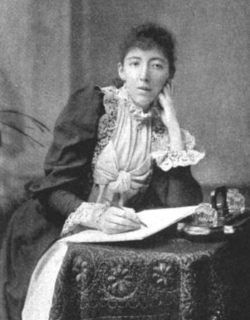
MacMahon, who is educated at home, is also literary. From the 1890s she begins contributing to periodicals such as the New Ireland Review, for which she writes on local history. Her first novel, A New Note, appears in 1894 and over the next thirty-five years she is prolific, publishing over twenty novels as well as making numerous contributions to magazines, and several to BBC radio programmes. She is unmarried and writing is her main source of income, but during World War I she works as a civil servant in various government departments including War, Trade, and the newly created Intelligence department. Afterward she lives in Brockenhurst, Hampshire, England, and converts at some stage to Catholicism.
MacMahon’s novels are romances. Typical of them is An Honorable Estate (1898), which features an English heiress marrying an impoverished Irish clergyman in a fit of pique, only to fall in love with him. They are undemanding but entertaining and occasionally ironic, with clever social commentary. Irish Book Lover, a quarterly review of Irish literature and bibliography, commends The Job (1914) for its insightful and sympathetic characterisation. It is an account of a baronet‘s struggle to improve his Irish estate despite the fecklessness of the inhabitants. Ireland is a frequent setting for her stories. Her view of it verges on the sentimental, and she often features eccentric but ultimately good-hearted country people.
However, MacMahon’s last book, Wind of Dawn (1927), is a more profound, interesting study. Set during the Irish War of Independence and the truce, it looks at the complexities within Irish society and the differences in attitude between the Anglo- and native Irish. Rich in characters, it features a naive English girl in love with Ireland, a papist-hating domestic servant, and an ascendancy grande dame who finds England monotonous but is adamant that her children will be educated there and will not acquire a brogue. Unlike MacMahon’s other books, it is not a romance and ends in tragedy and then acceptance for the coming change of regime. It reads like a lesser novel by Elizabeth Bowen and resembles in theme and argument, though not in quality, The Last September (1929), which it predates. Unfortunately, she is not inspired to go further in this line. She writes no more and retires on a government civil pension.
By the time of her death on April 19, 1956, MacMahon has fallen into complete obscurity, and surprisingly, given the quantity and relative merit of her work, she has no entry to date in any of the numerous anthologies of Irish or women writers.
Born in Blackwater Street off Grosvenor Road in west Belfast in 1916, White is one of ten children (five sons and five daughters) of Billy White, water technician with Belfast Corporation, and his wife Kathleen (née McKane). As a boy he sings in the choir of Clonard Monastery. He plays in a céilí band as a teenager and is a lifelong aficionado of Irish music and plays the banjo and other string instruments (often smuggling guns in their cases). As a young man he is also an active member of Granuaile GAA club, playing hurling and Gaelic football.
White works as a plumber and joins the Irish Republican Army (IRA) at an early age, being imprisoned several times during the 1930s. He travels to England to take part in the IRA’s “S-Plan” bombing campaign of 1939 to 1940, then returns to Dublin to pass his bomb-making skills on to new recruits, including Brendan Behan. He then returns to England to become the IRA’s Manchester Operations Officer but, after a bomb he is working on goes off in the flat he is renting, he flees to Glasgow, then back to Ireland.
Shortly after returning to Ireland, White is arrested while giving a lecture on explosives in County Offaly and is interned at the Curragh Camp. The republican prisoners are split into two groups, one led by Pearse Kelly, and the other by Liam Leddy. White is unhappy with the situation and refuses to take sides. Shortly after his arrival, IRA Chief of StaffSeán McCool is also interned, and is concerned that the locations of many of the IRA’s arms caches are known only to him. McCool asks him to get the information to the new leadership by “signing out,” declaring that he is no longer involved with a paramilitary group. He refuses as doing so would be breaking IRA orders, but McCool persists, suggesting that he could resign from the army before signing out, thereby not contravening IRA rules. Once released, he immediately rejoins the IRA and passes on the information. He is also made IRA Quartermaster General by Chief of StaffCharlie Kerins. However, he is suspected of involvement in the killing of a police officer, Dinny O’Brien – something which he always denies – and has to go on the run.
In October 1942, White and a comrade are cornered in a house. Here the details are unclear. Tim Pat Coogan claims that White is in a house in Donnycarney in County Dublin with Maurice O’Neill (executed in Mountjoy Prison on November 12, 1942), while Danny Morrison claims that White is at a wedding reception in Cavan with Paddy Dermody. Both agree that there is a shoot-out in which one officer is killed, enabling White to escape, but he falls down a railway embankment and hides for two days before emerging, hoping that the police hunt is over. In Coogan’s version, he catches a bus to Dublin, covered in blood and mud; while, according to Morrison, he is assisted by a sympathetic soldier who helps him recover and cycles to Dublin with him. They agree that he reaches a safe house once in the capital. Morrison claims that the Donnycarney shootout occurs four months later and that White travels north, rather than returning to Dublin a second time.
On arrival in the north, White is made Officer Commanding of the IRA Northern Command. Kerins is arrested in Dublin in June 1944 and later tried for murder and hanged. White becomes the only member of the IRA leadership still free. A wanted man, he travels around until work is arranged for him by supporters in Altaghoney, County Londonderry, Northern Ireland. There, he works as a handyman and barber and sets up a dance band, also managing to acquire some explosives from a local Royal Ulster Constabulary (RUC) officer who wants rocks cleared from his field. For at least part of his time in Altaghoney, he serves as the IRA Chief of Staff.
White is finally captured and tried in October 1946 and is handed over to the Irish authorities. He is sentenced to death, but this is reduced to twelve years’ imprisonment on appeal, a defence in which his former comrade Seán MacBride is involved. He is actually released early in 1948 following a change in government which leaves Mac Bride in a ministerial post.
Following his release, White remains active in the IRA, but in a less high-profile way, as he is married and settles in Dublin. He supports the Provisional IRA following its split in 1970 and is involved in smuggling weapons across the border.
White publishes his autobiography in 1985, actually ghostwritten by Uinseann MacEoin. Entitled Harry, it attracts press attention for naming the IRA members who killed Kevin O’Higgins, names which Peadar O’Donnell separately confirms. White’s nephew, Danny Morrison, becomes a prominent Irish republican from the 1970s onward.