Mairead Corrigan and Betty Williams, the founders of Women for Peace, which later becomes the Community of Peace People, are awarded the Nobel Peace Prize on September 17, 1976, “for the courageous efforts in founding a movement to put an end to the violent conflict in Northern Ireland.”
In August 1976, three innocent children are killed in a shooting incident in Belfast. Betty Williams, a housewife and secretary, witnesses the tragedy. She decides to launch an appeal against the meaningless use of violence in the conflict between Protestants and Catholics in Northern Ireland. She is joined by the dead children’s aunt, Mairead Corrigan, a Northern Irish secretary, and together they found the peace organization the Community of Peace People.
Williams has a Protestant father and Catholic mother, a family background from which she derives religious tolerance and a breadth of vision that motivates her to work for peace. Early in the 1970s she joins an anti-violence campaign headed by a Protestant priest, before she throws herself with full force into grass-root activities for the Peace People. By setting up local peace groups comprised of former opponents who undertake confidence-building measures, they hope to set a peace process in motion from below.
The Northern Irish peace movement disintegrates in the course of 1978. This is due both to internal disagreements and to the spreading of malicious rumors by Catholic and Protestant extremists.
After Corrigan’s sister loses three children in the shooting incident in Belfast, she is promptly contacted by Williams, and they agree to found a peace organization to bring an end to the bitter conflict between Catholics and Protestants in Northern Ireland.
Corrigan grows up in a poor family in Belfast. In addition to her office job, she devotes a great deal of time in her youth to charity work in the Catholic organization Legion of Mary. That gives her a good basis on which to develop the nonviolent strategy of the Community of Peace People, which brings together thousands of people in protest marches and confidence-building measures among the grass roots in 1976 and 1977.
Corrigan does not give up hope even when the Peace People lose nearly all their support in the late 1970s. She keeps up her local peace work with admirable strength.
Maguire continues her involvement in the organization to this day and serves as the group’s honorary president. The organization has since taken on a more global agenda, addressing an array of social and political issues from around the world.
Williams resigns from the Peace People in 1980. She dies in Belfast on March 17, 2020, Saint Patrick’s Day, at the age of 76.
The move forces the Government of the United Kingdom to either again suspend the assembly, with rule of Northern Ireland returning to London, or call new elections.
The UUP, the largest Protestant party, are angry over lack of progress on the decommissioning of weapons by the Irish Republican Army (IRA). UUP leader David Trimble (pictured), who has already quit as the assembly’s leader, says his party has spent eighteen months in the government with representatives of Sinn Féin, the republican political party, without the IRA putting its weapons beyond use.
“We have sustained an inclusive executive for eighteen months. For eighteen months we have demonstrated every day our willingness to make progress in terms of this institution and politics in Northern Ireland,” says Trimble, who shared the 1998 Nobel Peace Prize with Catholic moderate leader John Hume. “And for those eighteen months the republican movement have done nothing, nothing at all to reciprocate the sacrifice and risks we have made.”
Trimble later tells CNN the move is a “last resort,” adding: “It’s still up to the IRA. They can still save the situation by doing what they promised to do eighteen months ago. I wish they would.” He adds, “I resigned on the 1st of July. That was a clear indication to the IRA if they hadn’t seen it beforehand of the need to do something. We have been remarkably patient over the last few months — waiting, waiting, waiting. I don’t particularly welcome the resumption of direct rule from London but that will come about quite soon if the IRA don’t move.”
Trimble says the situation is helped, however, because “it removes from office the two Sinn Féin ministers who are there. They will be out of office, and it should be quite clear to them and quite clear to their electorate that they have brought about a crisis by their failure to keep their promises.”
Trimble says the main nationalist newspaper in Northern Ireland has called on the IRA to start the process of disarming and lays the blame clearly on them. “It’s not just unionists who are pointing the finger and saying ‘you’ve let us down’ — it is also nationalists.” Trimble adds that although his move is clearly a step back, he hopes it will soon be a case of “two steps forward.”
There is speculation earlier in the week that the IRA leadership is on the brink of an historic move on weapons. It had been hoped the IRA could agree with disarmament officials to seal one or more of its hidden arms dumps with concrete. The IRA has already allowed foreign diplomats to visit a few arms dumps in secret. These weapons are the first likely candidates for decommissioning as required in Northern Ireland’s 1998 Good Friday Agreement.
It is now up to the Northern Ireland minister, John Reid, to decide whether to order a short suspension of the assembly or to dissolve it, returning to direct rule from London, and call new elections. The assembly cannot survive without the participation of either the Ulster Unionists or the largest Catholic-supported party, Hume’s Social Democratic and Labour Party (SDLP).
CNN’s European political editor Robin Oakley says the move by the Ulster Unionists means Northern Ireland is facing another crisis after a summer of disappointment and an upsurge of cross-community violence. He says the danger of calling new elections is that there is evidence from the general election earlier in the year of an increase in support for hardline parties.
There is increased support for Sinn Féin, the republican political party, and the Democratic Unionists, who are opposed to the peace agreement forged in Northern Ireland in 1998.
Trimble agrees in November 1999 to form a four-party government that includes Sinn Féin on condition that IRA disarmament follows. Since then, Trimble has battled hard-liners, inside and outside his party, to keep the coalition intact while the IRA makes little movement on the issue.
Britain has stripped power from the executive three times – first for an indefinite period in February 2000 when it appeared likely that Trimble would be ousted as a leader. The Ulster Unionists resume power-sharing after the IRA says it intends to begin putting its weapons “completely and verifiably beyond use.” But the assembly is then suspended twice for 24-hour periods over the summer after Trimble quit as first minister.
(From: “Unionists quit N. Ireland assembly,” CNN.com, October 18, 2001)
In 1970, McKeown becomes a reporter for The Irish Times, then later works for The Irish Press, as their Belfast correspondent. Given his experience of reporting on the emergence of The Troubles, he supports the 1976 creation of “Women for Peace,” a Northern Ireland-based movement, by Betty Williams and Mairead Corrigan. When his involvement becomes more widely known, the movement changes its name to “Community of Peace People,” or simply “Peace People.” After the events of 1976-77, he finds it difficult to return to full-time journalism.
Although McKeown becomes known as a thoughtful and calm presence in the leadership of the organisation, his criticisms of the reluctance of church authorities to speak out on sectarian issues causes some tensions. Corrigan and Williams win the 1976 Nobel Peace Prize, but he is not made a party to it. However, the Ford Foundation makes a grant to the group, which includes a salary for him, enabling him to become full-time editor of Peace by Peace, the group’s newspaper, also completing a year as editor of Fortnight in 1977.
McKeown, Corrigan and Williams all step down from the leadership posts in 1978, although he continues to edit Peace by Peace. His articles bring him into conflict with the group’s new leadership, while financial disagreements massively reduce the group’s membership. Ultimately, his belief that the group should call for special status for paramilitary prisoners leads to a split, with Williams and her leading supporter, Peter McLachlan, resigning in February 1980. He can no longer survive on the group’s salary, nor can he find work as a journalist, so he retrains as a typesetter.
In 1984, McKeown publishes his autobiography, The Passion of Peace. This is almost immediately withdrawn following a claim that it libels a journalist, although it is later reissued with an additional note.
In addition to his activism and his work in journalism, McKeown is deeply involved in the Belfast theater scene. He serves in a number of offices, including executive secretary and chairman, at the city’s renowned Lyric Theatre.
McKeown dies peacefully at his home in Belfast on September 1, 2019, following a battle with cancer.
Hume does not complete his clerical studies but does obtain an M.A. degree in French and history from the college in 1958. He then returns home to his native Derry, where he becomes a teacher at his alma mater, St. Columb’s College. He is a founding member of the Credit Union movement in the city and is chair of the University for Derry Committee in 1965, an unsuccessful fight to have Northern Ireland’s second university established in Derry in the mid-1960s.
Hume becomes the youngest ever President of the Irish League of Credit Unions at age 27. He serves in the role from 1964 to 1968. He once says that “all the things I’ve been doing, it’s the thing I’m proudest of because no movement has done more good for the people of Ireland, north and south, than the credit union movement.”
Hume becomes a leading figure in the civil rights movement in the late 1960s along with people such as Hugh Logue. He is a prominent figure in the Derry Citizens’ Action Committee. The DCAC is set up in the wake of the October 5, 1968, march through Derry which had caused much attention to be drawn towards the situation in Northern Ireland. The purpose of the DCAC is to make use of the publicity surrounding recent events to bring to light grievances in Derry that had been suppressed by the Unionist Government for years. The DCAC, unlike the Northern Ireland Civil Rights Association (NICRA), is aimed specifically at a local campaign, improving the situation in Derry for everyone, and maintaining a peaceful stance. The committee also has a Stewards Association that is there to prevent any violence at marches or sit-downs.
In October 1971, Hume joins four Westminster MPs in a 48-hour hunger strike to protest at the internment without trial of hundreds of suspected Irish republicans. State papers that have been released under the 30-year rule that an Irish diplomat eight years later in 1979 believes Hume supported the return of internment.
Hume is directly involved in secret talks with the British government and Sinn Féin, in an effort to bring Sinn Féin to the discussion table openly. The talks are speculated to lead directly to the Anglo-Irish Agreement in 1985.
The vast majority of unionists reject the agreement and stage a massive and peaceful public rally in Belfast City Centre to demonstrate their distaste. Many Republicans and nationalists also reject it, as they see it as not going far enough. Hume, however, continues dialogue with both governments and Sinn Féin. The “Hume–Adams process” eventually delivers the 1994 Irish Republican Army (IRA) ceasefire which ultimately provides the relatively peaceful backdrop against which the Good Friday agreement is brokered.
In 2015, Hume is diagnosed with Alzheimer’s disease, of which he had first displayed symptoms in the late 1990s. He dies in the early hours of August 3, 2020, at a nursing home in Derry, at the age of 83. On his death, former Labour Party leader and prime ministerTony Blair says, “John Hume was a political titan; a visionary who refused to believe the future had to be the same as the past.” The Dalai Lama says on Twitter, “John Hume’s deep conviction in the power of dialogue and negotiations to resolve conflict was unwavering… It was his leadership and his faith in the power of negotiations that enabled the 1998 Good Friday Agreement to be reached. His steady persistence set an example for us all to follow.”
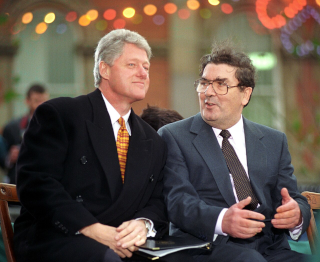
(Pictured: John Hume with U.S. President Bill Clinton in 1995)
A rally of twelve to fifteen thousand Peace People from both north and south takes place at the new bridge over the River Boyne at Drogheda, County Louth, on December 5, 1976. In general, the Peace People’s goals are the dissolution of the Irish Republican Army (IRA) and an end to violence in Northern Ireland. The implicit goals of the Peace People rallies are delegitimization of violence, increasing solidarity, and gaining momentum for peace.
In the 1960s, Northern Ireland begins a period of ethno-political conflict called the Troubles. Through a series of social and political injustices, Northern Ireland has become a religiously divided society between historically mainland Protestants and Irish Catholics. Furthermore, the Irish people have become a fragmented body over a range of issues, identities, circumstances and loyalties. The conflict between Protestants and Catholics spills over into violence, marked by riots and targeted killings between the groups beginning in 1968. In addition, paramilitary groups, including the prominent IRA, launch attacks to advance their political agendas.
The violence continues to escalate. On August 10, 1976, Anne Maguire and her children are walking along Finaghy Road North in Belfast. Suddenly, a Ford Cortina slams into them. The car is being driven by Danny Lennon, who moments before had been shot dead by pursuing soldiers. The mother is the only survivor. The collision kills three of her four children, Joanne (8), John (2), and Andrew (6 months). Joanne and Andrew die instantly while John is injured critically.
The next day, immediately following John’s death, fifty women from the Republican neighborhoods of Andersonstown and Stewartstown protest Republican violence by marching with baby carriages. That evening, Mairead Corrigan, Anne Maguire’s sister, appears on television pleading for an end to the violence. She becomes the first leader of the Peace People to speak publicly.
However, she was not the only one to initiate action. As soon as she hears Mairead speak on the television, Betty Williams begins petitioning door-to-door for an end to sectarian violence. She garners 6,000 signatures of support within a few days. This support leads directly into the first unofficial action of the Peace People. On 14 August, only four days after the incident, 10,000 women, both Protestant and Catholic, march with banners along Finaghy Road North, the place of the children’s death, to Milltown Cemetery, their burial site. This march mostly includes women along with a few public figures and men. The marchers proceed in almost utter silence, only broken by short bouts of singing from the nuns in the crowd and verbal and physical attacks by Republican opposition.
The following day, the three who become leaders of the Peace People – Mairead Corrigan, Betty Williams, and journalist Ciaran McKeown – come together for their first official meeting. During these initial meetings they establish the ideological basis of nonviolence and goals for the campaign. The essential goals for the movement are the dissolution of the IRA and an end to the violence in Northern Ireland. The goals of the campaign implicit in their declaration are awareness, solidarity, and momentum. Peace People’s declaration:
“We have a simple message to the world from this movement for Peace. We want to live and love and build a just and peaceful society. We want for our children, as we want for ourselves, our lives at home, at work, and at play to be lives of joy and peace. We recognise that to build such a society demands dedication, hard work, and courage. We recognise that there are many problems in our society which are a source of conflict and violence. We recognise that every bullet fired, and every exploding bomb make that work more difficult. We reject the use of the bomb and the bullet and all the techniques of violence. We dedicate ourselves to working with our neighbours, near and far, day in and day out, to build that peaceful society in which the tragedies we have known are a bad memory and a continuing warning.”
During the four-month campaign, Peace People and partners organize and participate in 26 marches in Northern Ireland, Britain, and the Republic of Ireland. In order to organize these marches effectively they establish their main headquarters in Belfast.
After the initial Finaghy Road March, the Peace People, both Protestants and Catholics, rally in Ormeau Park on August 21. The official Declaration of the Peace People is first read at this rally, the largest rally of the entire campaign. The group numbers over 50,000. The rally even includes some activists from the Republic of Ireland, most notably Judy Hayes from the Glencree Centre of Reconciliation near Dublin. After the rally, she and her colleagues return to the south to organize solidarity demonstrations.
In the few days before the next march, the organization “Women Together” request Peace People to call off the march, disapproving of Catholics and Protestants participating in a joint march. The Peace People are not dissuaded. The next Saturday, 27,000 people march along Shankill Road, the loyalist/Protestant neighborhood.
In the next three months, Peace People organize and participate in a rally every Saturday; some weeks even have two. Some of the most notable marches include the Derry/Londonderry double-march, the Falls march, the London march, and the Boyne march.
The Saturday following the Shankill march marks the Derry/Londonderry double-march. At this march, Catholics march on one side of the River Foyle and Protestants on the other. The groups meet on the Craigavon Bridge. Simultaneously, 50,000 people march in solidarity in Dublin.
On October 23, marchers meet in the Falls, Belfast, in the pouring rain on the same Northumberland street corner where the Shankill March had started. The Falls Road rally is memorable for the fear and violence that ensues. During this rally Sinn Féin supporters throw stones and bottles at the marchers. The attackers escalate the violence as the marchers near Falls Park. The marchers are informed by others that more attackers await them at the entrance to the park, inciting fear within the body of the rally. The leaders decide that this is an important moment of conflict in the rally and that they must push on. They continue verbally encouraging the marchers through the cloud of bottles, bricks, and stones.
The leaders plan to escalate the campaign momentum for the last two major symbolic rallies in London and Boyne, Drogheda. A week before the rallies, on November 20-21, they plan a membership drive. Over 105,000 people sign within two days.
The symbolic week of the culminating rallies begins on November 27 at the glamorous London Rally. They begin to march at Hyde Park, cut through Westminster Abbey, and end at Trafalgar Square. Some groups sing “Troops Out,” and others resound with civil rights songs.
On December 5, Peace People holds its final march of the campaign, along the River Boyne. The Northern and Southern Ireland contingents met at the Peace Bridge. This is an important point in the legacy of the Peace People movement. Now that the enthusiastic rallies are over, the people are responsible for the tedious local work and continuing the momentum and solidarity that the rallies have inspired. The shape of the Peace People is changing.
After the planned marches are over, the rally portion of the campaign fades and the Peace People take a new shape. Corrigan, Williams, and McKeown stop planning marches, but continue to be involved in action that takes the form of conferences and traveling overseas. However, the leaders begin doing more separated work. Ciaran McKeown increases his focus on radical political restructuring.
In 1977, Betty Williams and Mairead Corrigan receive the Nobel Peace Prize. Issues regarding the use of the monetary award impact the two leaders’ relationships in an irreconcilable manner.
Due to the fact that many people, unlike McKeown, are less interested in the political side of the equation, the People continue actions along the lines of rallies and social work. Actions continue through the People’s initiative in the form of Peace Committees that each does separate work in local areas.
The Peace People makes a substantial impact. They help to de-legitimize violence, increase solidarity across sectarian lines, and develop momentum for peace. Although the violence does not fully subside until 1998 with the negotiation of political change, Ireland sees in 1976 one of its most dramatic decreases in political violence, accompanying the Peace People’s marches and rallies. The campaign dramatizes how tired the people are of bloodshed, their desperate desire for peace, and the clear possibility of alternatives.
(From: “Peace People march against violence in Northern Ireland, 1976” by Hannah Lehmann, Global Nonviolent Action Database, https://nvdatabase.swarthmore.edu/, 2011 | Pictured: The Peace People organisation rally in Drogheda, County Louth, December 5, 1976)
Williams’s father works as a butcher and her mother is a housewife. She receives her primary education from St. Teresa Primary School in Belfast and attends St. Dominic’s Grammar School for Girls for her secondary school studies. Upon completing her formal education, she takes up a job of office receptionist.
Rare for the time in Northern Ireland, Williams’s father is Protestant and her mother is Catholic, a family background from which she later says she derived religious tolerance and a breadth of vision that motivated her to work for peace. Early in the 1970s she joins an anti-violence campaign headed by a Protestant priest. She credits this experience for preparing her to eventually found her own peace movement, which focuses on creating peace groups composed of former opponents, practicing confidence-building measures, and the development of a grassroots peace process.
Williams is drawn into the public arena after witnessing the death of three children on August 10, 1976, when they are hit by a car whose driver, an Irish Republican Army (IRA) paramilitary named Danny Lennon, had been fatally shot in return fire by a soldier of the King’s Own Royal Border Regiment. As she turns the corner to her home, she sees the three Maguire children crushed by the swerving car and rushes to help. Their mother, Anne Maguire, who is with the children, dies by suicide in January 1980.
Williams is so moved by the incident that within two days of the tragic event, she obtains 6,000 signatures on a petition for peace and gains wide media attention. With Mairead Corrigan, she co-founds the Women for Peace which, with Ciaran McKeown, later becomes the Community of Peace People.
Williams soon organises a peace march to the graves of the slain children, which is attended by 10,000 Protestant and Catholic women. However, the peaceful march is violently disrupted by members of the IRA, who accuse them of being “dupes of the British.” The following week, she leads another march in Ormeau Park that concludes successfully without incident – this time with 20,000 participants.
In recognition of her efforts for peace, Williams, together with Corrigan, become joint recipients of the Nobel Peace Prize for 1976.
The Peace Prize money is divided equally between Williams and Corrigan. Williams keeeps her share of the money, stating that her intention is to use it to promote peace beyond Ireland, but faces criticism for her decision. She and Corrigan have no contact after 1976. In 1978, Williams breaks off links with the Peace People movement and becomes instead an activist for peace in other areas around the world.
Williams receives the People’s Peace Prize of Norway in 1976, the Golden Plate Award of the American Academy of Achievement in 1977, the Schweitzer Medallion for Courage, the Martin Luther King, Jr. Award, the Eleanor Roosevelt Award in 1984, and the Frank Foundation Child Care International Oliver Award. In 1995, she is awarded the Rotary International “Paul Harris Fellowship” and the Together for Peace Building Award.
At the 2006 Earth Dialogues forum in Brisbane, Williams tells an audience of schoolchildren during a speech on Iraq War casualties that “Right now, I would like to kill George W. Bush.” From September 17 to 20, 2007, she gives a series of lectures in Southern California. On September 18, she presents a lecture to the academic community of Orange County entitled “Peace in the World Is Everybody’s Business” and on September 20 she gives a lecture to 2,232 members of the general public, including 1,100 high school sophomores, at Soka University of America. In 2010, she gives a lecture at WE DayToronto, a WE Charity event that empowers students to be active within their communities, and worldwide.
Speaking at the University of Bradford before an audience of 200 in March 2011, Williams warns that young Muslim women on campus are vulnerable to attacks from angry family members, while the university does little to help protect them. “If you had someone on this campus these young women could go to say, ‘I am frightened’ – if you are not doing that here, you are dehumanising them by not helping these young women, don’t you think?”
At the time she receives the Nobel Prize, Williams works as a receptionist and is raising her two children with her first husband Ralph Williams. This marriage is dissolved in 1981. She marries businessman James Perkins in December 1982 and they live in Florida in the United States.
In 2004, Williams returns to live in Northern Ireland. She dies on March 17, 2020, at the age of 76 in Belfast.
MacBride has nevertheless had a violent past. He is born in Paris on January 26, 1904, the son of Major John MacBride and Maud Gonne. His father is executed by the British in the Irish struggle for liberation from Great Britain. He is only 15 years old when he lies about his age to join the Irish Volunteers, which fight as part of the Irish Republican Army (IRA). He takes part in the concluding battles against the British in the Irish War of Independence before the Irish Republic is founded in 1921, and in the Irish Civil War that follows. He backs Éamon de Valera in the latter’s refusal to accept Northern Ireland‘s continuing union with England. In the 1930s, he breaks with the IRA and qualifies in law. He defends IRA prisoners in Irish prisons who had been condemned to death.
In addition to the Nobel Peace Prize, MacBride also receives the Lenin Peace Prize for 1975–1976, the Golden Plate Award of the American Academy of Achievement in 1978, and the UNESCO Silver Medal for Service in 1980.
MacBride dies in Dublin on January 15, 1988, eleven days before his 84th birthday. He is buried in Glasnevin Cemetery in a grave with his mother and his wife, who died in 1976.
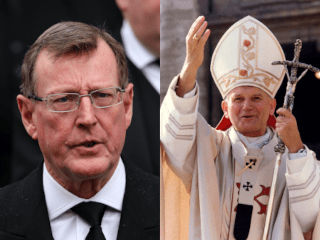
David Trimble becomes the first Ulster Unionist leader to meet a Pope when his historic meeting with John Paul II takes place in Rome on April 21, 1999. The meeting is widely welcomed as a sign that old prejudices are ending but Trimble is hotly criticised by both Protestants and Catholics in his Upper Bann constituency.
The First Minister is one of 54 Nobel Peace Prizelaureates who meets Pope John Paul II briefly at the Vatican, as part of a two-day trip organised by former Russian leader Mikhail Gorbachev. The Nobel Prize winners meet the Pope as a group and are then introduced and shake hands individually. There is a group photograph but no filming of the event. Careful stage-management ensures there are no public photographs of the two men close together.
A spokesman for Trimble says the UUP leader told the Pope he hopes this will be the year when peace will be secured in Northern Ireland. The Pope recalls his visit to Ireland and says murder cannot be condoned or called by another name.
Although the meeting is welcomed on both sides of the North divide, it does little to enhance Trimble’s standing in Upper Bann, particularly in troubled Portadown. In Portadown’s loyalist estates, there is open hostility toward Trimble. Many residents accusing their MP of “putting his personal status above the interests of his constituents.” The response is typified by one angry woman who says, “The loyalist people of this town and Drumcree, put David Trimble into office. Now he has turned his back on us. That’s a fatal mistake, this town and Drumcree will now destroy Trimble.”
“It’s unbelievable that this meeting is actually taking place,” says Orangeman Ivor Young. “It totally contradicts the oath that David Trimble took when he joined the Orange Order. We all knew Trimble was a traitor, this latest escapade puts the final nail in his political coffin here in Upper Bann. There is no way that he will ever be elected here again.”
Trimble also comes in for further criticism from Portadown Orange District, whose Drumcree protest has continued for the past 288 days. David Jones, the District’s press officer says that the people of Portadown once again see their local MP on “a world stage,” instead of being involved locally. “There are a lot of people around Portadown who aren’t very impressed that David Trimble has gone off to meet the Pope and hasn’t got more involved in trying to get the situation here solved,” says Jones.
On Portadown’s Garvaghy Road, Catholics are also critical of Trimble’s visit to Rome. “It’s amazing how he can travel to Rome to meet and talk to strangers,” says one nationalist resident, “yet he can’t be bothered to travel less than 30 miles to meet us, to talk about the serious issues that confront this community. After all we are as much his constituents as are the loyalists in this town.”
The meeting is the first time that the First Minister of Northern Ireland or the head of the Ulster Unionist Party has met the Pope in Rome. It also represents a rare appearance by an Orangeman at the heart of the Roman Catholic Church. Trimble and his entourage meet the Pope in the sumptuous surroundings of the Consistory Hall, the same room where the Cardinals of the Church gather to advise the Pope.
Earlier in the morning Trimble says in an interview with the Vatican radio that besides giving an update on developments in Northern Ireland, he wishes to “express to his Holiness the Pope that he and the Church will do what it can to persuade the paramilitaries to commit themselves irrevocably to peaceful means.”
On April 19, 2003, Bono, the lead singer of the Irish rock band U2, surpasses competition from British Prime MinisterTony Blair and French PresidentJacques Chirac to become Europe’s greatest hero. Already laden down with similar honours, he is picked by online voters from a list of 36 other Europeans compiled by the prestigious Time magazine.
Bono’s work for the starving starts with Band Aid in 1984 but develops over the years into a crusade lobbying world leaders and trying to reduce Third World debt.
“There are potentially another ten Afghanistans in Africa, and it is cheaper by a factor of 100 to prevent the fires from happening than to put them out. Look, I know how absurd it is to have a rock star talk about debt relief or HIV/AIDS in Africa. But if not me, who?” Bono says.
Caoimhe Butterly, a 24-year-old from Dublin, is also nominated by Time editors for her role as a peace activist, which resulted in her being shot at by Israeli troops. “I don’t really think the concept of heroes is helpful, but if my inclusion helps highlight the cause of people struggling against oppression, then it’s of some good,” Butterly says. She expects to go to Iraq in the near future “to further the struggle against oppression.”
The third Irish person on the list is 58-year-old Christina Noble whose torrid childhood leads her to work on behalf of impoverished street children in Asia. She survives tuberculosis, hunger, homelessness, beatings, molestation by relatives, institutionalisation and a gang rape. She starts her foundation‘s work in Vietnam in 1989 and Mongolia in 1997.
In Vietnam, where she is known fondly as Mama Tina, her foundation has 50 projects providing education, food and clean water for children. “We’re tools. We help a little. You don’t need brains or brawn to do that. You just need the heart of a survivor,” Noble says.
MacBride is born in Paris on January 26, 1904. He is the son of Major John MacBride and Maud Gonne. After his father’s execution for his participation in the Easter Rising of 1916, MacBride is sent to school at Mount St. Benedict’s, Gorey, County Wexford in Ireland. In 1919, at the age of 15, he joins the Irish Volunteers, which fights as part of the Irish Republican Army, and takes part in the Irish War of Independence. He is imprisoned by the Irish Free State but is released in 1924 and resumes his IRA activities. He returns to Dublin in 1927 and becomes the Director of Intelligence of the IRA.
Toward the end of the 1920s, after many supporters have left the IRA to join Fianna Fáil, some members start pushing for a more left-wing agenda. After the IRA Army Council votes down the idea, MacBride launches a new movement, Saor Éire (“Free Ireland”), in 1931. Although it is a non-military organisation, Saor Éire is declared unlawful along with the IRA, Cumann na mBan, and nine other organizations.
In 1936, MacBride becomes Chief of Staff of the IRA after Moss Twomey is sent to prison for three years. At the time, the movement is in a state of disarray, with conflicts between several factions and personalities. In 1937, he is called to the bar and then resigns from the IRA when the Constitution of Ireland is enacted later that year. As a barrister, he frequently defends IRA political prisoners, but is not unsuccessful in stopping the execution of Charlie Kerins in 1944 who is convicted of killing Garda Detective Dennis O’Brien in 1942. In 1946, during the inquest into the death of Seán McCaughey, he embarrasses the authorities by forcing them to admit that the conditions in Portlaoise Prison are inhumane.
In 1946, MacBride founds the republican/socialist party Clann na Poblachta, hoping it would replace Fianna Fáil as Ireland’s major political party. In October 1947, he wins a seat in Dáil Éireann at a by-election in the Dublin County constituency. However, at the 1948 Irish general election Clann na Poblachta wins only ten seats.
Clann na Poblachta is reduced to only two seats after the 1951 Irish general election. MacBride keeps his seat and is re-elected again at the 1954 Irish general election. Opposing the internment of IRA suspects during the Border Campaign (1956–62), he contests both the 1957 and 1961 Irish general elections but fails to be elected both times. He then retires from politics but continues practicing as a barrister. He expresses interest in running as an independent candidate in the 1983 Irish presidential election, but does not receive sufficient backing and ultimately does not enter the contest.
Throughout the 1950s, 1960s, and 1970s, MacBride works tirelessly for human rights worldwide. He is a founding member of Amnesty International and serves as its International chairman from 1961 until 1975. During the 1980s, he initiates the Appeal by Lawyers against Nuclear War which is jointly sponsored by the International Peace Bureau and the International Progress Organization.
MacBride is awarded the Nobel Peace Prize in 1974 as a man who “mobilised the conscience of the world in the fight against injustice.” He later receives the Lenin Peace Prize (1975–76) and the UNESCO Silver Medal for Service (1980).
In his later years, MacBride lives in his mother’s home, Roebuck House, that served as a meeting place for many years for Irish nationalists, as well as in the Parisian arrondissement where he grew up with his mother, and enjoyed strolling along boyhood paths. In 1978, he receives the Golden Plate Award of the American Academy of Achievement.
MacBride dies in Dublin on January 15, 1988, just eleven days shy of his 84th birthday. He is buried in a simple grave in Glasnevin Cemetery, Dublin, with his mother, and wife who died in 1976.






 seamus dubhghaill