seamus dubhghaill

Promoting Irish Culture and History from Little Rock, Arkansas, USA


2 Comments

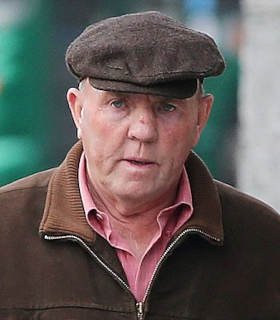
Birth of Irish Republican Thomas “Slab” Murphy

Thomas Murphy, Irish republican also known as “Slab” and believed to be a former Chief of Staff of the Provisional Irish Republican Army, is born on August 26, 1949. His farm straddles County Armagh and County Louth on the border between Northern Ireland and the Republic of Ireland. One of three brothers, he is a lifelong bachelor who lives on the Louth side of his farm prior to his imprisonment in February 2016 following a tax evasion conviction.

Murphy is allegedly involved with the South Armagh Brigade of the IRA before being elected Chief of Staff by the IRA Army Council. Toby Harnden, ex-correspondent for The Daily Telegraph, names him as planning the Warrenpoint ambush of 1979, in which 18 British soldiers are killed. He is also allegedly implicated in the Mullaghmore bombing the same day, which kills four people, including two children and Louis Mountbatten, 1st Earl Mountbatten of Burma. He is involved in smuggling huge stockpiles of weapons from Libya in the 1980s and is a member of the Army Council that decides to end its first ceasefire with the 1996 Docklands bombing in London that kills two men.

Accused by The Sunday Times of directing an IRA bombing campaign in Britain, in 1987 Murphy unsuccessfully sues the paper for libel in Dublin. The original verdict is overturned by the court of appeal because of omissions in the judge’s summing up and there is a retrial, which he also loses. At the retrial, both Sean O’Callaghan and Eamon Collins, former members of the Provisional Irish Republican Army, testify against Murphy, as do members of the Gardaí, Irish customs officials, British Army and local TD Brendan McGahon. Collins, who had also written a book about his experiences, Killing Rage, is beaten and killed by having a spike driven through his face near his home in Newry eight months later. In 1998, a Dublin court dismisses Murphy’s case after a high-profile trial, during which Murphy states that he has “never been a member of the IRA, no way” and claims not to know where the Maze prison is located. The jury rules, however, that he is an IRA commander and a smuggler.

The Sunday Times subsequently publishes statements given by Adrian Hopkins, the skipper who ferries weapons from Libya to the IRA, to the French authorities who intercept the fifth and final Eksund shipment. Hopkins details how Murphy met a named Libyan agent in Greece, paid for the weapons to be imported, and helped unload them when they arrived in Ireland. According to A Secret History of the IRA by Ed Moloney, Murphy has been the IRA Army Council’s chief of staff since 1997. Toby Harnden’s Bandit Country: The IRA & South Armagh also details Murphy’s IRA involvement.

On September 20, 2016, the BBC‘s Spotlight airs a programme in which an alleged British spy who had infiltrated the IRA claims that in 2006, Murphy had demanded the killing of Denis Donaldson, an IRA member and British informer, in order to maintain discipline. The BBC says it had tried to contact Murphy but had received no reply. He has yet to respond to the allegation. On September 23, 2016, the Donaldson family’s solicitor says that the allegation is “absolute nonsense.”

In October 2005, officers of the British Assets Recovery Agency and the Irish Criminal Assets Bureau carry out raids on a number of businesses in Manchester and Dundalk. It is extensively reported in the media that the investigation is aimed at damaging the suspected multi-million-pound empire of Murphy, who according to the BBC’s Underworld Rich List, has accumulated up to £40 million through smuggling oil, cigarettes, grain and pigs, as well as through silent or partial ownership in legitimate businesses and in property.

A large, purpose-built underground chamber that Gardaí believes the IRA used for interrogation is discovered close to Murphy’s home.

In his first-ever press release, issued on October 12, 2005, Murphy denies he owned any property and denies that he had any links with co-accused Cheshire businessman Dermot Craven. Furthermore, he claims that he had to sell property to cover his legal fees after his failed libel case against The Sunday Times, and that he made a living from farming.

On March 9, 2006, police, soldiers and customs officials from both sides of the Irish border launch a large dawn raid on Murphy’s house and several other buildings in the border region. Three persons are arrested by the Gardaí but are released three days later. A fleet of tankers, computers, documents, two shotguns, more than 30,000 cigarettes and the equivalent of 800,000 euros in sterling bank notes, euro bank notes and cheques are seized. Four diesel laundering facilities attached to a major network of storage tanks, some of which are underground, are also found. The Irish Criminal Assets Bureau later obtains seizure orders to take possession of euro cash and cheques and sterling cash and cheques, together worth around one million Euros.

Sinn Féin President Gerry Adams makes a public statement in support of Murphy following the March 2006 raids. Under political and media pressure over allegations of the IRA’s continued presence in South Armagh, Adams says, “Tom Murphy is not a criminal. He’s a good republican and I read his statement after the Manchester raids, and I believe what he says and also and very importantly he is a key supporter of Sinn Féin’s peace strategy and has been for a very long time.” He adds, “I want to deal with what is an effort to portray Tom Murphy as a criminal, as a bandit, as a gang boss, as someone who is exploiting the republican struggle for his own ends, as a multimillionaire. There is no evidence to support any of that.”

Commenting in Armagh on Murphy’s imprisonment for tax fraud, Arlene Foster, First Minister of Northern Ireland says, “Whilst some people refer to Murphy as a ‘good republican’ the people of this area know him to be a criminal.”

Murphy is arrested in Dundalk, County Louth, on November 7, 2007, by detectives from the Criminal Assets Bureau, on charges relating to alleged revenue offences. The following day, he is charged with tax evasion under the Tax Consolidation Act. He is later released on his own bail of €20,000 with an independent surety of €50,000.

On October 17, 2008, in an agreed legal settlement, Murphy and his brothers pay over £1 million in assets and cash to the authorities in Britain and the Republic in settlement of a global crime and fraud investigation relating to proceeds of crime associated with smuggling and money laundering. After an investigation involving the Irish Criminal Assets Bureau and the UK’s Serious Organised Crime Agency, more than 625,000 euros (£487, 000) in cash and cheques is confiscated by the Republic’s courts, while nine properties in North West England worth £445,000 are confiscated by British courts. Murphy is still fighting a claim in the Republic’s courts for tax evasion, relating to non-completion of tax returns for eight years from 1996. On April 26, 2010, he is further remanded on bail.

In 2011, there are claims that Murphy had become disillusioned with the Northern Ireland peace process and that he had fallen out with Sinn Féin. However, there is no evidence to support he is sympathetic to any dissident republican groups. In March 2013, the Garda and the Police Service of Northern Ireland (PSNI), along with members of the Irish Customs Authority and HM Revenue and Customs (HMRC), raid his farm on the Louth-Armagh border. The Sunday World reports that two hours prior to the raid, at approximately 4:00 a.m., fire is seen coming from Murphy’s yard. There are serious concerns within the Garda and PSNI that a mole may have tipped off Murphy about the raid hours earlier as laptops, computer disks and a large amount of documentation is destroyed in the fires. As a result, an internal Garda investigation takes place.

On December 17, 2015, Murphy is found guilty on nine charges of tax evasion by a three-judge, non-jury Special Criminal Court trial sitting in Dublin, lasting nine weeks. He is tried under anti-terrorist legislation due to the belief by the Director of Public Prosecutions (DPP) that there would not be a fair trial because of the potential of the intimidation of prosecution witnesses and jurors, and the security surrounding the trial.

Murphy is found guilty on all charges of failing to furnish tax returns on his income as a “cattle farmer” between 1996 and 2004. He is prosecuted following a 14-year-long Criminal Assets Bureau investigation, which during a raid of his property uncovers bags with more than €250,000 and more than £111,000 sterling in cash, along with documents, diaries and ledgers. He is remanded on bail until early 2016 for sentencing.

On February 26, 2016, Murphy is sentenced to 18 months in prison. None of the jail term is suspended. Following sentencing, he is immediately transferred from court to Ireland’s highest-security prison, Portlaoise Prison, reserved for terrorists, dissident republicans and serious gangland criminals, under a heavily armed Garda and Irish Army escort due to security concerns.

Murphy appeals the conviction in November 2016. His lawyer, John Kearney, claims that the tax Murphy had not paid had in fact been paid by his brother, Patrick. The Court of Appeal dismisses the appeal on all grounds in January 2017.

In January 2017, and scheduled for release in April 2018, Murphy is moved from Midlands Prison in Portlaoise to the Loughan House low-security prison in County Cavan.


Leave a comment

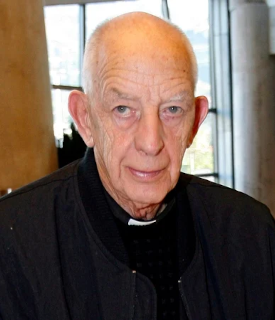
Birth of Fr. Alec Reid, Facilitator in the Northern Ireland Peace Process

Alexander Reid CSsR, Irish Catholic priest noted for his facilitator role in the Northern Ireland peace process, is born in Dublin on August 5, 1931. BBC journalist Peter Taylor subsequently describes Reid’s role as “absolutely critical” to the success of the peace process.

Reid is raised in Nenagh, County Tipperary, from the age of six following the death of his father. He studies English, history and philosophy at University College Galway.

Reid is professed as a Redemptorist in 1950 and ordained a priest seven years later. For the next four years, he gives Parish Missions in Limerick, Dundalk and Galway (Esker), before moving to Clonard Monastery in Belfast, where he spends almost the next forty years. The Redemptorist Monastery at Clonard stands on the interface between the Catholic nationalist Falls Road and the Protestant loyalist Shankill Road areas of west Belfast.

In the late 1980s, Reid facilitates a series of meetings between Gerry Adams and John Hume, in an effort to establish a “Pan-Nationalist front” to enable a move toward renouncing violence in favour of negotiation. Reid, himself a staunch nationalist who favours a united Ireland and the withdrawal of British forces from Northern Ireland, then acts as their contact person with the Irish Government in Dublin from a 1987 meeting with Charles Haughey up to the signing of the Good Friday Agreement in 1998. In this role, which is not public knowledge at the time, he holds meetings with various Taoisigh, and particularly with Martin Mansergh, advisor to various Fianna Fáil leaders. After the eventual success of the peace negotiations, Gerry Adams says, “there would not be a peace process at this time without [Father Reid’s] diligent doggedness and his refusal to give up.”

In 1988 in Belfast, Reid delivers the last rites to two British Army corporals, David Howes and Derek Wood of the Royal Corps of Signals, who are killed by the Provisional Irish Republican Army (IRA) – an event known as the corporals killings – after they drive into the funeral cortège of IRA member Kevin Brady, who had been killed in the Milltown Cemetery attack. A photograph of his involvement in that incident becomes one of the starkest and most enduring images of the Troubles. Unknown until years later, he is carrying a letter from Sinn Féin President Gerry Adams to Social Democratic and Labour Party (SDLP) leader John Hume outlining Adams’ suggestions for a political solution to the Troubles. Adams later tells the BBC in 2019 that Reid also advised U.S Ambassador to Ireland Jean Kennedy Smith during the peace process, stating “He was talking to her on the side and she was talking to her brother Teddy.”

After he moves to Dublin, Reid is involved in peace efforts in the Basque Country. In January 2003, he is awarded the Sabino Arana 2002 “World Mirror” prize, by the Sabino Arana Foundation in Bilbao, in recognition of his efforts at promoting peace and reconciliation. He and a Methodist minister, the Rev. Harold Good, announce that the IRA has decommissioned their arms at a news conference in September 2005.

Reid is involved in controversy in November 2005 when he makes comments during a meeting in Fitzroy Presbyterian Church concerning the Unionist community in Northern Ireland. When the loyalist activist Willie Frazer makes remarks that Catholics had butchered Protestants during the Troubles, Reid angrily responds, “You don’t want to hear the truth. The reality is that the nationalist community in Northern Ireland were treated almost like animals by the unionist community. They were not treated like human beings. They were treated like the Nazis treated the Jews.” Reid later apologises, saying his remarks had been made in the heat of the moment. In an interview with CNN, he says that “The IRA were, if you like, a violent response to the suppression of human rights.”

Reid dies in a Dublin hospital on November 22, 2013. He is survived by two sisters and an aunt, and is buried in Milltown Cemetery, Belfast.


Leave a comment

IRA Issues Apology for Killing Non-Combatants

On July 16, 2002, An Phoblacht (English: “The Republic”) receives a statement from Irish Republican Army (IRA) leadership which includes an apology for the killing of “non-combatants.” Secretary of State for Northern Ireland, John Reid, welcomes the gesture as one of unprecedented strength.

The full text of the IRA’s statement of apology:

“Sunday 21 July marks the 30th anniversary of an IRA operation in Belfast in 1972 which resulted in nine people being killed and many more injured.

While it was not our intention to injure or kill non-combatants, the reality is that on this and on a number of other occasions, that was the consequence of our actions.

It is therefore appropriate on the anniversary of this tragic event, that we address all of the deaths and injuries of non-combatants caused by us.

We offer our sincere apologies and condolences to their families.

There have been fatalities amongst combatants on all sides. We also acknowledge the grief and pain of their relatives.

The future will not be found in denying collective failures and mistakes or closing minds and hearts to the plight of those who have been hurt. That includes all of the victims of the conflict, combatants and non-combatants.

It will not be achieved by creating a hierarchy of victims in which some are deemed more or less worthy than others.

The process of conflict resolution requires the equal acknowledgement of the grief and loss of others. On this anniversary, we are endeavouring to fulfil this responsibility to those we have hurt.

The IRA is committed unequivocally to the search for freedom, justice and peace in Ireland.

We remain totally committed to the peace process and to dealing with the challenges and difficulties which this presents. This includes the acceptance of past mistakes and of the hurt and pain we have caused to others.”

P O’Neill, Irish Republican Publicity Bureau, Dublin.

Note: The Provisional IRA issues all its public statements under the pseudonym “P. O’Neill” of the “Irish Republican Publicity Bureau, Dublin.” Dáithí Ó Conaill, the IRA’s director of publicity, came up with the name. According to Danny Morrison, the pseudonym “S. O’Neill” was used during the 1940s.


Leave a comment

Birth of Anthony McIntyre, Former IRA Volunteer, Writer & Historian

Anthony McIntyre, a former Provisional Irish Republican Army volunteer, writer and historian, is born on June 27, 1957.

McIntyre is imprisoned for murder for 18 years in Long Kesh Detention Centre, spending four of those years on the dirty protest. Following his release from prison in 1992, he completes a PhD in political science at Queen’s University Belfast and leaves the republican movement in 1998 to work as a journalist and researcher. A collection of his journalism is published as a book in 2008, Good Friday: The Death of Irish Republicanism.

McIntyre is involved with the Boston College oral history project on the Troubles entitled the Belfast Project, conducting interviews with former Provisional IRA members who, like himself, had become disillusioned with the direction the republican movement had taken, such as Brendan Hughes and Dolours Price, and former Ulster loyalist paramilitaries such as David Ervine. The interviews are the basis for the book Voices from the Grave: Two Men’s War in Ireland by Ed Moloney.

In 2011, McIntyre becomes embroiled in controversy when transcripts of the interviews, held by Boston College, are subpoenaed by the Police Service of Northern Ireland (PSNI) in relation to an investigation of the 1972 abduction and killing of Jean McConville. In March 2014, the PSNI announces that it is seeking to question McIntyre over newly released Belfast Project recordings, specifically in reference to the alleged role of Gerry Adams in the kidnapping and murder of Jean McConville.

McIntyre is a prominent critic of modern-day Sinn Féin and its leadership. He has spoken at Republican Sinn Féin party events. He is a co-founder of The Blanket, a journal which casts a critical eye on the Northern Ireland peace process.


Leave a comment

Death of Patrick Mayhew, British Barrister, Politician & Northern Ireland Secretary

Patrick Barnabas Burke Mayhew, Baron Mayhew of Twysden, PC, QC, DL, British barrister, politician and Secretary of State for Northern Ireland, who serves during a critical period in the Northern Ireland peace process, dies at his home in Kent, England, on June 25, 2016. He is a key figure in the December 1993 Downing Street Declaration which leads to the Provisional Irish Republican Army (IRA) ceasefire on August 31, 1994

Mayhew is born on September 11, 1929. His father, George Mayhew, is a decorated army officer turned oil executive. His mother, Sheila Roche, descendant of members of the Anglo-Irish Protestant ascendancy, is a relative of James Roche, 3rd Baron Fermoy, an Irish National Federation MP for East Kerry. Through his father, Mayhew is descended from the Victorian social commentator Henry Mayhew. He is educated at Tonbridge School, an all boys public school in Tonbridge, Kent.

Mayhew then serves as an officer in the 4th/7th Royal Dragoon Guards, studies law at Balliol College, Oxford, and is president of the Oxford University Conservative Association (OUCA) and of the Oxford Union. He is called to the Bar by the Middle Temple in 1955.

In 1963, Mayhew marries The Rev. Jean Gurney, and they have four sons.

Mayhew contests Dulwich at the 1970 United Kingdom general election, but the incumbent Labour Party member, Samuel Silkin, beats him by 895 votes. He is Member of Parliament (MP) for Tunbridge Wells from its creation at the February 1974 United Kingdom general election, standing down at the 1997 United Kingdom general election.

Mayhew is Under Secretary of Employment from 1979 to 1981, then Minister of State at the Home Office from 1981 to 1983. After this, he serves as Solicitor General for England and Wales from 1983 to 1987, and then Attorney General for England and Wales and simultaneously Attorney General for Northern Ireland from 1987 to 1992.

Mayhew is Secretary of State for Northern Ireland from 1992 to 1997, the longest anyone has served in this office.

Mayhew is one of only five Ministers (Tony Newton, Kenneth Clarke, Malcolm Rifkind and Lynda Chalker are the others) to serve throughout the whole 18 years of the premiership of Margaret Thatcher and John Major. This represents the longest uninterrupted Ministerial service in Britain since Henry John Temple, 3rd Viscount Palmerston, in the early 19th century.

Mayhew is knighted in 1983. On June 1997, he is given a life peerage as Baron Mayhew of Twysden, of Kilndown in the County of Kent. He retires from the House of Lords on June 1, 2015.

Mayhew suffers from cancer and Parkinson’s disease in his later years. He dies at the age of 86 on June 25, 2016, in his home in Kent.

Mayhew’s son, The Honourable Henry Mayhew, appears in the fourth episode of the series The Secret History Of Our Streets, discussing life in the Portland Road, Notting Hill, London. Another son, Tristram, co-founds the outdoor adventure company Go Ape. His son Jerome is the Conservative Party MP for the constituency of Broadland in Norfolk since December 2019.


2 Comments

The 32 County Sovereignty Movement Launches Major Recruitment Campaign

The 32 County Sovereignty Movement, often abbreviated to 32CSM or 32csm, an Irish republican group that is founded by Bernadette Sands McKevitt, launches a major recruitment campaign in west Belfast on April 17, 1999.

The objectives of the 32CSM are:

  • The restoration of Irish national sovereignty.
  • To seek to achieve unity among the Irish people on the issue of restoring national sovereignty and to promote the revolutionary ideals of republicanism and to this end involve itself in resisting all forms of colonialism and imperialism.
  • To seek the immediate and unconditional release of all Irish republican prisoners throughout the world.

The 32CSM does not contest elections but acts as a pressure group, with branches, or cumainn, organised throughout the traditional counties of Ireland. It has been described as the “political wing” of the now defunct Real Irish Republican Army (Real IRA or RIRA), but this is denied by both organisations. The group originates in a split from Sinn Féin over the Mitchell Principles.

The organisation is founded on December 7, 1997, at a meeting of like-minded Irish republicans in the Dublin suburb of Finglas. Those present are opposed to the direction taken by Sinn Féin and other mainstream republican groups in the Northern Ireland peace process, which eventually leads to the Good Friday Agreement, also known as the Belfast Agreement, the following year. The same division in the republican movement leads to the paramilitary group now known as the Real IRA breaking away from the Provisional Irish Republican Army at around the same time.

Most of the 32CSM’s founders had been members of Sinn Féin, with some having been expelled from the party for challenging the leadership’s direction, while others felt they had not been properly able to air their concerns within Sinn Féin at the direction its leadership had taken. Bernadette Sands McKevitt, wife of Michael McKevitt and a sister of hunger striker Bobby Sands, is a prominent member of the group until a split in the organisation.

The name refers to the 32 counties of Ireland which were created during the Lordship of Ireland and Kingdom of Ireland. With the partition of Ireland in 1920–22, twenty-six of these counties form the Irish Free State which is abolished in 1937 and is now known as Ireland since 1949. The remaining six counties of Northern Ireland remain part of the United Kingdom. Founder Bernadette Sands McKevitt says in a 1998 interview with The Mirror that people did not fight for “peace” – “they fought for independence” – and that the organisation reaffirms to the republican position in the 1919 Irish Declaration of Independence.

Before the referendums on the 1998 Good Friday Agreement, the 32CSM lodges a legal submission with the United Nations challenging British sovereignty in Ireland. The referendums are opposed by the 32CSM but are supported by 71% of voters in Northern Ireland and by 94% in the Republic of Ireland. It is reported in February 2000 that the group had established a “branch” in Kilburn, London.

In November 2005, the 32CSM launches a political initiative titled Irish Democracy, A Framework for Unity.

On May 24, 2014, Gary Donnelly, a member of the 32CSM, is elected to the Derry and Strabane super council. In July 2014, a delegation from the 32CSM travels to Canada to take part in a six-day speaking tour. On arrival the delegation is detained and refused entry into Canada.

The 32CSM has protested against what it calls “internment by remand” in both jurisdictions in Ireland. Other protests include ones against former Democratic Unionist Party (DUP) leader Ian Paisley in Cobh, County Cork, against former British Prime Minister John Major being given the Keys to Cork city, against a visit to the Republic of Ireland by Police Service of Northern Ireland (PSNI) head Sir Hugh Orde, and against the Israeli occupation of Palestine and Anglo-American occupation of Iraq.

In 2015, the 32CSM organises a demonstration in Dundee, Scotland, in solidarity with the men convicted of shooting Constable Stephen Carroll, the first police officer to be killed in Northern Ireland since the formation of the PSNI. The organisation says the “Craigavon Two” are innocent and are victims of a miscarriage of justice.

The 32CSM also operates outside of the island of Ireland to some extent. The Gaughan/Stagg Cumann covers England, Scotland and Wales, and has an active relationship of mutual promotion with a minority of British left-wing groups and anti-fascist organisations. The James Larkin Republican Flute Band in Liverpool and the West of Scotland Band Alliance, the largest section of which is the Glasgow-based Parkhead Republican Flute Band, are also supporters of the 32CSM. As of 2014, the 32CSM’s alleged paramilitary wing, the Real IRA, is reported to still be involved in attempts to perpetrate bombings in Britain as part of the dissident Irish republican campaign, which has been ongoing since 1998.

The 32CSM is currently considered a foreign terrorist organization (FTO) in the United States, because it is considered to be inseparable from the Real IRA, which is designated as an FTO. At a briefing in 2001, a spokesman for the U.S. Department of State states that “evidence provided by both the British and Irish governments and open-source materials demonstrate clearly that the individuals who created the Real IRA also established these two entities to serve as the public face of the Real IRA. These alias organizations engage in propaganda and fundraising on behalf of and in collaboration with the Real IRA.” The U.S. Department of State’s designation makes it illegal for Americans to provide material support to the Real IRA, requires U.S. financial institutions to block the group’s assets and denies alleged Real IRA members travel visas into the United States.


Leave a comment

The Corporals Killings

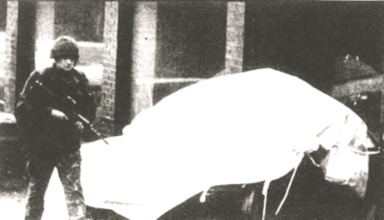
British Army corporals Derek Wood and David Howes are killed by the Provisional Irish Republican Army (IRA) on March 19, 1988, in Belfast, Northern Ireland, in what becomes known as the corporals killings. The soldiers, wearing civilian clothes, both armed with Browning Hi-Power pistols and in a silver Volkswagen Passat hatchback, drive into the funeral procession for IRA member Kevin Brady.

The Brady funeral is making its way along the Andersonstown Road toward Milltown Cemetery when the corporals’ car appears from the opposite direction. The car drives straight towards the front of the funeral, which is headed by several black taxis. It drives past a Sinn Féin steward who signals it to turn. Mourners at the funeral say they believed they were under attack from Ulster loyalists, as three days earlier, loyalist Michael Stone had attacked an IRA funeral and killed three people. The car then mounts a pavement, scattering mourners, and turns into a small side road. When this road is blocked, it then reverses at speed, ending up within the funeral procession. Corporal Wood attempts to drive the car out of the procession but his exit route is blocked by a black taxi.

An angry crowd surrounds the car, smashes the windows and attempts to drag the soldiers out. Wood produces a Browning Hi-Power 9mm handgun. He climbs partly out of a window and fires a shot in the air, which briefly scatters the crowd. The crowd then surges back, with some of them attacking the car with a wheel-brace and a stepladder snatched from a photographer. The corporals are eventually pulled from the car and punched and kicked to the ground.

The attack is witnessed by the media and passersby. Journalist Mary Holland recalls seeing one of the men being dragged past a group of journalists. “He didn’t cry out; just looked at us with terrified eyes, as though we were all enemies in a foreign country who wouldn’t have understood what language he was speaking if he called out for help.”

The men are taken to nearby Casement Park sports ground, just opposite. Here they are beaten, stripped to their underpants and socks, and searched by a small group of men. The BBC and The Independent write that the men were “tortured.” A search reveals that the men are British soldiers. Their captors find a military ID on Howes which is marked “Herford,” the site of a British military base in Germany, but it is believed they misread it as “Hereford,” the headquarters of the Special Air Service (SAS).

Redemptorist priest Father Alec Reid, who plays a significant part in the peace process leading to the 1998 Good Friday Agreement, intervenes and attempts to save the soldiers, and asks people to call an ambulance. “I got down between the two of them and I had my arm around this one and I was holding this one up by the shoulder….They were so disciplined, they just lay there totally still and I decided to myself they were soldiers. There was a helicopter circling overhead and I don’t know why they didn’t do something, radio to the police or soldiers to come up, because there were these two of their own soldiers.”

One of the captors warns Father Reid not to interfere and orders two men to take him away.

The two soldiers are placed in a taxi and driven fewer than 200 yards to a waste ground near Penny Lane (South Link), just off the main Andersonstown Road. There they are taken out of the vehicle and shot dead. Wood is shot six times and Howes is shot five times. Each also has multiple injuries to other parts of their bodies. The perpetrators quickly leave the scene. Father Reid hears the shots and rushes to the waste ground. He believes one of the soldiers is still breathing and attempts to give him mouth-to-mouth resuscitation. Upon realizing that the soldiers are dead, he gives them the last rites. According to photographer David Cairns, although photographers have their films taken by the IRA, he is able to keep his by quickly leaving the area after taking a photograph of Reid kneeling beside the almost naked body of Howes, administering the last rites. Cairns’ photograph is later named one of the best pictures of the past 50 years by Life magazine.

The whole incident is filmed by a British Army helicopter hovering overhead. An unnamed soldier of the Royal Scots says his eight-man patrol is nearby and sees the attack on the corporals’ car but are told not to intervene. Soldiers and police arrive on the scene three minutes after the corporals had been shot. A British Army spokesman says the army did not respond immediately because they needed time to assess the situation and were wary of being ambushed by the IRA. The large funeral procession also prevents them getting to the scene quickly.

Shortly after, the IRA releases a statement:

“The Belfast Brigade, IRA, claims responsibility for the execution of two SAS members who launched an attack on the funeral cortege of our comrade volunteer Kevin Brady. The SAS unit was initially apprehended by the people lining the route in the belief that armed loyalists were attacking them and they were removed from the immediate vicinity. Our volunteers forcibly removed the two men from the crowd and, after clearly ascertaining their identities from equipment and documentation, we executed them.”

Two men, Alex Murphy and Harry Maguire, are sentenced to life imprisonment for murder, but are released in 1998 under the terms of the Good Friday Agreement. Several other men receive lesser sentences for their part in the corporals killings.

(Pictured: Catholic priest Father Alec Reid administers the last rights to Corporal David Howes, one of two British soldiers brutally beaten and murdered in Belfast)


1 Comment

Gerry Adams & Hillary Clinton Meet in New York City

On March 16, 2015, the eve of Saint Patrick’s Day, two ascendant politicians—one from Ireland, one from the United States—meet in a ballroom at the Essex House, in New York City. Hillary Clinton is there to be inducted into the Irish America Hall of Fame, in recognition of her “outstanding leadership” in bringing peace to Northern Ireland during the 1990s, when her husband was president of the United States. Gerry Adams, the president of the Irish Republican political party Sinn Féin, is there because for many Americans he is a living symbol of that peace. One of the architects of the Good Friday Agreement, which brought an end to the decades-long conflict in Northern Ireland that is known as the Troubles, he is very popular in the United States and makes regular trips here to raise funds for his party. According to a report in The Irish Times, Sinn Féin has raised twelve million dollars in the United States over the prior two decades, from construction companies, labor unions, and movie stars like Anjelica Huston and Martin Sheen.

Adams, however, remains a polarizing figure in Ireland. Though he is a longtime figurehead of the Republican movement, he insists that he was never a member of the Irish Republican Army (IRA) and that he played no role in the violence of the Troubles. Some people in Ireland do not actually believe this story, and, in recent years leading up to this meeting, some of his former compatriots in the Republican movement have said that he authorized a series of wartime atrocities, including the murder and secret burial of Jean McConville, a mother of ten. Adams denies these claims, and generally derides those who ask questions about his past as political foes with an agenda or opponents of the peace process.

“I remember very well when the request came, back in 1993, that my husband approve a visa for Gerry Adams,” Clinton told the crowd at the Essex House. Bill Clinton granted the visa, which was a controversial move at the time, because of Adams’s alleged association with the IRA, but also a crucial moment in the peace process, because it helped cement Adams’s transformation from a revolutionary to a statesman. “Absent that first step, that first risk, we might not have had the momentum to move forward, to get to the Good Friday accords and all that has followed,” Clinton said.

There is no way of knowing whether Clinton, dressed in Kelly green, felt any distaste at the prospect of sharing a table with Adams. There is some thirty-five million Irish Americans, a great many of whom regard Adams as a kind of Nelson Mandela, and no prospective presidential candidate can decline a Saint Patrick’s Day invitation. And to be sure, the IRA is not alone in standing accused of atrocities during the Troubles. Loyalist paramilitary groups and British government forces also perpetrated war crimes for which they have not been brought to account. But Clinton does indicate, obliquely, that the transition in Northern Ireland is not entirely complete. “There is still work to be done,” Clinton acknowledges. “You cannot bring peace and security to people just by signing an agreement.” The question for the people of Northern Ireland, and for Adams’s supporters in the United States, is whether you can bring enduring peace and security without some reckoning—by all parties in the conflict—with the crimes of the past.

(From: “Gerry Adams and Hillary Clinton in New York” by Patrick Radden Keefe, The New Yorker, http://www.new yorker.com, March 17, 2015 | Photo: Hillary Clinton at a previous meeting with Gerry Adams at the State Department in 2009. Photograph by Mark Wilson/Getty)


Leave a comment

Mary Lou McDonald Ratified as Leader of Sinn Féin

Mary Lou McDonald is ratified as the new president of Sinn Féin at a special party Ardfheis on February 10, 2018. Approximately 2,000 party delegates gather for the meeting in Dublin. After almost 35 years, Gerry Adams officially steps down as party leader, a role he has held since November 1983.

McDonald takes the helm with a sweeping speech that touches on everything from abortion to Brexit and promises a united Ireland “in our time.”

McDonald, 48, is the first woman to lead the party, and the first Sinn Féin leader with no direct connection to Ireland’s period of violence known as the Troubles. “We must only agree that the past is never again repeated,” she says. “On other things, we can agree to disagree. The poet Maya Angelou put it well: ‘History, despite its wrenching pain, cannot be unlived. But if faced with courage, need not be lived again.’”

McDonald takes over for Adams, a divisive politician who was the face of the Irish republican movement as it shifted from violence to peace. The end of Adams’ tenure marks a new era for the party, which wants to unite the United Kingdom’s Northern Ireland with the Republic of Ireland to the south.

Adams, who announced in November 2017 he was stepping down after almost 35 years, was the key figure in the peace process that saw the signing of the 1998 Good Friday Agreement and the formation of a power sharing government between Northern Ireland’s pro-British and republican factions. But many believe Sinn Féin’s popularity among voters has been hindered by the presence of leaders linked to the Troubles, which killed over 3,600 people.

McDonald immediately puts her own stamp on the future, trying to infuse new energy into the movement that has lawmakers on both sides of the Irish border. But she also focuses on Sinn Féin’s founding principle: a united Ireland. “We are the generation of republicans who will see the rising of the moon,” she says. “Sinn Féin in government, both North and South. Irish unity in our time.”

McDonald also lays out her positions on the key issues of the day.

On the United Kingdom’s upcoming departure from the European Union, or Brexit, she says Sinn Féin will not accept any deal that reinstates border controls between Northern Ireland and the Republic. Brexit represents a threat to the prosperity of Ireland as a whole.

“Ireland will not be the collateral damage in the political games and antics of Tories in London,” she says, referring to the Conservative Party of British Prime Minister Theresa May.

McDonald also says the party will campaign for women’s right to an abortion in Ireland’s upcoming referendum on the issue and says she is committed to reaching an agreement that will restore Northern Ireland’s power sharing government on the basis of “respect and integrity for all.”

Northern Ireland’s last government collapsed more than a year earlier amid a corruption scandal.

(From: “Mary Lou McDonald takes over as Sinn Féin party leader” by Danica Kirka, AP News, apnews.com, February 10, 2018)


Leave a comment

Birth of Garret FitzGerald, Eighth Taoiseach of Ireland

Garret Desmond FitzGerald, Fine Gael politician, economist and barrister who serves twice as Taoiseach (1981 to 1982 and 1982 to 1987), is born into a very politically active family in Ballsbridge, Dublin on February 9, 1926, during the infancy of the Irish Free State. He serves as Senator for the Industrial and Commercial Panel from 1965 to 1969, a Teachta Dála (TD) from 1969 to 1992, Minister for Foreign Affairs from 1973 to 1977, Leader of Fine Gael from 1977 to 1987 and twice Leader of the Opposition between 1977 and 1982.

FitzGerald’s father, Desmond FitzGerald, is the Free State’s first Minister for External Affairs. He is educated at the Jesuit Belvedere College, University College Dublin and King’s Inns, Dublin, and qualifies as a barrister. Instead of practicing law, however, in 1959 he becomes an economics lecturer in the department of political economy at University College, Dublin, and a journalist.

FitzGerald joins Fine Gael, attaching himself to the liberal wing of the party. and in 1969 is elected to Dáil Éireann, the lower house of the Oireachtas, the Irish parliament. He later gives up his university lectureship to become Minister for Foreign Affairs in the coalition government of Liam Cosgrave (1973–1977). When the coalition government is resoundingly defeated in the 1977 Irish general election, Cosgrave yields leadership of Fine Gael to FitzGerald. In his new role as Leader of the Opposition and party leader, he proceeds to modernize and strengthen the party at the grass roots. He briefly loses power in 1982 when political instability triggers two snap elections.

By the time of the 1981 Irish general election, Fine Gael has a party machine that can easily match Fianna Fáil. The party wins 65 seats and forms a minority coalition government with the Labour Party and the support of a number of Independent TDs. FitzGerald is elected Taoiseach on June 30, 1981. To the surprise of many FitzGerald excludes Richie Ryan, Richard Burke and Tom O’Donnell, former Fine Gael stalwarts, from the cabinet.

In his prime ministry, FitzGerald pushes for liberalization of Irish laws on divorce, abortion, and contraception and also strives to build bridges to the Protestants in Northern Ireland. In 1985, during his second term, he and British Prime Minister Margaret Thatcher sign the Anglo-Irish (Hillsborough) Agreement, giving Ireland a consultative role in the governing of Northern Ireland. After his party loses in the 1987 Irish general election, he resigns as its leader and subsequently retires in 1992.

On May 5, 2011, it is reported that FitzGerald is seriously ill in a Dublin hospital. Newly elected Fine Gael Taoiseach Enda Kenny sends his regards and calls him an “institution.” On May 6 he is put on a ventilator. On May 19, after suffering from pneumonia, he dies at the Mater Private Hospital in Dublin at the age of 85.

In a statement, Irish President Mary McAleese hails FitzGerald as “a man steeped in the history of the State who constantly strove to make Ireland a better place for all its people.” Taoiseach Enda Kenny pays homage to “a truly remarkable man who made a truly remarkable contribution to Ireland.” Henry Kissinger, the former United States Secretary of State, who serves as an opposite number to FitzGerald in the 1970s, recalls “an intelligent and amusing man who was dedicated to his country.”

FitzGerald’s death occurs on the third day of Queen Elizabeth II‘s state visit to the Republic of Ireland, an event designed to mark the completion of the Northern Ireland peace process that had been “built on the foundations” of FitzGerald’s Anglo-Irish Agreement with Margaret Thatcher in 1985. In a personal message, the Queen offers her sympathies and says she is “saddened” to learn of FitzGerald’s death.

On his visit to Dublin, United States President Barack Obama offers condolences on FitzGerald’s death. He speaks of him as “someone who believed in the power of education; someone who believed in the potential of youth; most of all, someone who believed in the potential of peace and who lived to see that peace realised.”

FitzGerald is buried at Shanganagh Cemetery in Shankill, Dublin.

FitzGerald is the author of a number of books, including Planning in Ireland (1968), Towards a New Ireland (1972), Unequal Partners (1979), All in a Life: An Autobiography (1991), and Reflections on the Irish State (2003).