While working in Belfast and Inishowen in 1931, Quinn is promoted to the post of deacon. In 1961, he is appointed professor of Biblical Greek at Trinity College and begins work on a new translation of the New Testament. He also translates the Book of Psalms and the Prayer Book of the Church of Ireland into Irish, as well as several Spanish works. Although it is unusual in his lifetime for Protestants to hold leading positions in the Irish language movement, Quinn is for a time President of Oireachtas na Gaeilge. He is made a canon of St. Patrick’s Cathedral in 1966, before retiring from the ministry in 1971.
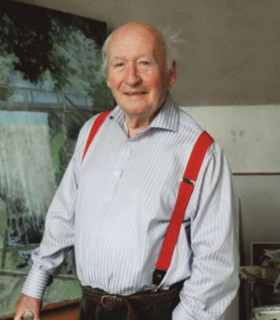
Terence Philip “T.P.” Flanagan, one of the finest landscape painters of his generation, passes away in Belfast on February 23, 2011, at the age of eighty. For more than 60 years he shapes the face of landscape painting in Northern Ireland and is known internationally for his rural scenes of his native County Fermanagh and County Sligo. With his stunning watercolours and intricate brush strokes, he is described as one of the most successful artists of his generation. PoetSeamus Heaney, who dedicates his 1969 poem Bogland to Flanagan, pays tribute saying “he was a teacher and a friend whose work held a deep personal significance.”
Flanagan is born in Enniskillen, County Fermanagh in 1929. When he is in his late teens, he learns the art of watercolour painting from the famous local portraitist and landscape artist Kathleen Bridle. Later, he paints her portrait, which now hangs in the Ulster Museum, and interviews her in a film of her life and art, which is produced shortly before her death in 1989.
After his time with Bridle, Flanagan attends Belfast College of Art from 1949-1953. The following year he joins the teaching staff at St. Mary’s College of Education, where he remains for 28 years, eventually becoming Head of the Art Department.
Flanagan spends the majority of his painting career in Ireland, but his landscapes have received wide attention and his work has been recognised both in Ireland and abroad. His first solo exhibition is held at the Council for the Encouragement of Music and the Arts (CEMA), Belfast in 1961. He also shows regularly at the Hendriks Gallery in Dublin and at the Tom Caldwell Gallery in Belfast during the 1970s and 1980s. He participates in many group exhibitions, including “Four Ulster Painters” at the Arnolfini gallery in Bristol (1965), “Two Irish Painters” (with Colin Middleton) at the Herbert Art Gallery & Museum, Coventry, (1968) and is represented in “The Gordon Lambert Collection Exhibitions” held at the Hugh Lane Gallery, Dublin (1972) and the Ulster Museum (1976). In addition, he exhibits at the Royal Hibernian Academy (RHA) in Dublin and at the Royal Ulster Academy Of Arts (RUA) in Belfast.
Abroad, Flanagan’s works are exhibited at the Armstrong Gallery, New York (1986) and the Concept Gallery, Pittsburgh. A retrospective of his painting from the period 1967-1977 is held at the Arts Council of Northern Ireland in 1977. In 1995, the Ulster Museum stages a major retrospective of his paintings (1945-1995). Other retrospectives are held at the Hugh Lane Gallery in Dublin and the Stadsmusueum, Gothenberg, Sweden. His paintings are also included in the show “A Century of Irish Painting” organized by the Hugh Lane Gallery which tours Japanese museums in 1995.
As an artist, Flanagan works in oils as well as his preferred watercolours, although by rapid application of the paint with minimal overworking, even his oils manage to retain the luminous colouring of the watercolourist. He specializes in landscape painting within his native County Fermanagh and the adjoining County Sligo, his methods being ideally suited to capturing the soft atmospheric light of Ireland’s northwest.
Flanagan is elected associate of the RUA in 1960, a full member in 1964, and President 1978-82. During his long career, he receives numerous commissions and other awards for his works, which are represented in the collections of The Arts Councils of Ireland & Northern Ireland, the Ulster Museum, the Hugh Lane Municipal Gallery, Dublin, Irish Museum of Modern Art, and the National Self-Portrait Collection, Limerick.
Flanagan dies suddenly on February 23, 2011. His funeral takes place at St. Brigid’s Church in south Belfast and is buried at St. Michaels’ Church in Enniskillen.
The auction record for a work by T.P. Flanagan is set in 2009, when his landscape painting, entitled Castlecoole From Lough Coole, is sold at Christie’s, London, for £20,000.
(From Encyclopedia of Visual Artists In Ireland, visual-arts-cork.com)
Jordan is educated at St. Paul’s College, Raheny. Later, Jordan attends University College Dublin, where he studies Irish history and English literature. He is raised a Catholic and is quite religious during the early stages of his life. Regarding his current beliefs, he states that “God is the greatest imaginary being of all time. Along with Einstein‘s General Theory of Relativity, the invention of God is probably the greatest creation of human thought.”
When John Boorman is filming Excalibur in Ireland, he recruits Jordan as a “creative associate.” A year later Boorman is executive producer on Jordan’s first feature, Angel, a tale of a musician caught up in the Troubles, starring Stephen Rea who subsequently appears in almost all of Jordan’s films to date. During the 1980s, he directs films that win him acclaim, including The Company of Wolves and Mona Lisa, both made in England. The Company of Wolves becomes a cult favorite.
As a writer/director, Jordan has a highly idiosyncratic body of work, ranging from mainstream hits like Interview with the Vampire to commercial failures like We’re No Angels to a variety of more personal, low-budget arthouse pictures. He is also the driving force behind the cable TV series The Borgias.
Unconventional sexual relationships are a recurring theme in Jordan’s work, and he often finds a sympathetic side to characters that audiences would traditionally consider deviant or downright horrifying. His film The Miracle, for instance, follows two characters who struggle to resist a strong, incestuous attraction, while The Crying Game makes complicated, likable characters out of an IRA volunteer and a transgender woman. Interview with the Vampire, like the Anne Rice book it is based on, focuses on the intense, intimate interpersonal relationship of two undead men who murder humans nightly, accompanied by an equally lusty vampire woman who is eternally trapped in the body of a little girl. While Lestat (Tom Cruise) is depicted in an attractive but villainous manner, his partner Louis (Brad Pitt) and the child vampire Claudia (Kirsten Dunst) are meant to capture the audience’s sympathy despite their predatory nature.
In addition to the unusual sexuality of Jordan’s films, he frequently returns to the Troubles of Northern Ireland. The Crying Game and Breakfast on Pluto both concern a transgender character, both concern the Troubles, and both feature frequent Jordan leading man Stephen Rea. The two films, however, are very different, with The Crying Game being a realistic thriller/romance and Breakfast on Pluto a much more episodic, stylized, darkly comic biography. Jordan also frequently tells stories about children or young people, such as The Miracle and The Butcher Boy. While his pictures are most often grounded in reality, he occasionally directs more fantastic or dreamlike films, such as The Company of Wolves, High Spirits, Interview with the Vampire, and In Dreams.
The critical success of Jordan’s early pictures leads him to Hollywood, where he directs High Spirits and We’re No Angels. Both are critical and financial disasters. He later returns home to make the more personal The Crying Game, which is nominated for six Academy Awards. Jordan wins the Academy Award for Best Original Screenplay for the film. Its unexpected success leads him back to American studio filmmaking, where he directs Interview with the Vampire. He also directs the crime drama The Brave One starring Jodie Foster.
Phil Coulter, musician, songwriter and record producer, is born in Derry, County Londonderry, Northern Ireland on February 19, 1942. He is one of the most eclectic and accomplished arranger/musicians to emerge from Ireland during the 1960s.
Coulter spends his secondary school years at St. Columb’s College. He later studies music and French at the Queen’s University Belfast. During his time at Queen’s he takes up songwriting, composing the hit Foolin’ Time for the Capitol Showband. His talents are swiftly captured by leading entrepreneur Phil Solomon. Initially working with such showbands as the Cadets and Pacific, he continues to compose for the Capitol Showband and even pens their 1965 Eurovision Song Contest entry, Walking the Streets in the Rain. In the meantime, Coulter works on Solomon’s other acts, including Twinkle, who enjoys a major UK hit with the Coulter-arranged Terry. He also contributes to Them’s song catalogue, with the driving I Can Only Give You Everything.
After leaving the Solomon stable in 1967, Coulter, now based in London, forms a partnership with Bill Martin, which becomes one of the most successful of its era. The duo is particularly known for their ability to produce instantly memorable pop hits, and achieve international fame after penning Sandie Shaw’s 1967 Eurovision Song Contest winner, Puppet on a String. They barely miss repeating that feat the following year with Cliff Richard’s stomping Congratulations.
Coulter subsequently leads his own country to victory in the contest by arranging Dana’s 1970 winner, All Kinds of Everything. That same year, Coulter/Martin are commissioned to write Back Home, the official song for the England national football team, which proves a lengthy UK number 1. As well as his pop outings, which include writing My Boy and an album’s worth of material for Richard Harris, he maintains his connection with the Irish folk scene, via his work with another of Solomon’s acts, The Dubliners. He also produces three albums for the groundbreaking Planxty and works with The Fureys.
After his partnership with Martin ends in the late 1970s, Coulter specializes in orchestral recordings, which prove hugely successful in Irish communities. Albums such as Classic Tranquillity and Sea Of Tranquillity (both 1984), Words And Music (1989), American Tranquillity (1994), Celtic Horizons (1996), and collaborations with flautist James Galway and Roma Downey, also enjoy major international success, and Coulter is a regular fixture in the upper regions of the U.S. New Age album chart.
Coulter’s production credits during the 1990s include work for Sinéad O’Connor and Boyzone. His lengthy career, as producer, arranger, songwriter and performer, is all the more remarkable for encompassing such contrasting musical areas from folk and orchestral to straightforward Tin Pan Alley pop.
Despite his successes, Coulter suffers several family tragedies. His son is born with Down syndrome and dies at the age of three. The song Scorn Not His Simplicity is written in his memory. His brother also dies tragically in a drowning incident in Ireland, which briefly causes him to retreat from the music business. He records the anthemic Home From The Sea with the Lifeboat Chorus as a tribute.
Finucane is born into a Roman Catholic family on the Falls Road, Belfast on March 21, 1949. At the start of the Troubles, his family is forced out of their home. He graduates from Trinity College, Dublin in 1973. He comes to prominence due to successfully challenging the British government in several important human rights cases during the 1980s.
Finucane is shot fourteen times and killed at his home in Fortwilliam Drive, north Belfast, by Ken Barrett and another masked man using a Browning Hi-Power 9mm pistol and a .38 revolver respectively. The two gunmen knock down the front door with a sledgehammer and enter the kitchen where Finucane has been having a Sunday meal with his family. They immediately open fire and shoot him twice, knocking him to the floor. Then while standing over him, the leading gunman fires twelve bullets into his face at close range. Finucane’s wife Geraldine is slightly wounded in the shooting attack which their three children witness as they hide underneath the table.
The Royal Ulster Constabulary (RUC) immediately launches an investigation into the killing. The investigation, led by Detective Superintendent Alan Simpson, runs for six weeks and he later states that from the beginning, there had been a noticeable lack of intelligence coming from the other agencies regarding the killing. Finucane’s killing is widely suspected by human rights groups to have been perpetrated in collusion with officers of the RUC and, in 2003, the British GovernmentStevens Report states that the killing is indeed carried out with the collusion of police in Northern Ireland.
In September 2004, an Ulster Defence Association (UDA) member, and at the time of the murder a paid informant for the Royal Ulster Constabulary, Ken Barrett, pleads guilty to Finucane’s murder.
The Ulster Defence Association/Ulster Freedom Fighters (UDA/UFF) claim they killed Finucane because he was a high-ranking officer in the Irish Republican Army (IRA). Police at his inquest say they have no evidence to support this claim. Finucane had represented republicans in many high-profile cases, but he had also represented loyalists. Several members of his family have republican links, but the family strongly denies Finucane is a member of the IRA. Informer Sean O’Callaghan claims that he attended an IRA finance meeting alongside Finucane and Gerry Adams in Letterkenny in 1980. However, both Finucane and Adams have consistently denied being IRA members.
In Finucane’s case, both the RUC and the Stevens Report find that he is not a member of the IRA. Republicans strongly criticise the claims made by O’Callaghan in his book The Informer and subsequent newspaper articles. One Republican source says O’Callaghan “…has been forced to overstate his former importance in the IRA and to make increasingly outlandish accusations against individual republicans.”
In 2011 British Prime MinisterDavid Cameron meets with Finucane’s family and admits the collusion, although no member of the British security services has yet been prosecuted.
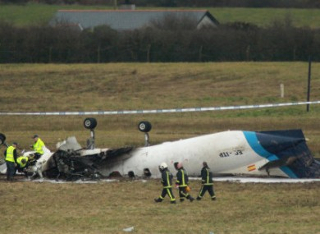
Manx2 Flight 7100 (NM7100/FLT400C), a scheduled commercial flight from George Best Belfast City Airport in Belfast, Northern Ireland, to Cork Airport in Cork, County Cork, crashes on February 10, 2011 on its third attempt to land at Cork Airport, which is experiencing dense fog at the time. The aircraft is carrying ten passengers and two crew. Six people, including both pilots, perish in the crash. Six passengers survive, four receiving serious injuries, while two are described as walking wounded.
After two aborted landing attempts, the flight crew enters a holding pattern and maintains an altitude of 3,000 feet. During the hold the flight crew requests weather conditions for Waterford Airport which are below minima. The flight crew nominates Shannon Airport as their alternate and requests the latest weather. Again the weather there is below minima. Weather for Dublin Airport is passed on to the flight crew and is also below minima. Cork Approach informs the flight crew about weather conditions at Kerry Airport which are “good” with 10 km visibility. The decision is made to make a third attempt at Cork Airport.
The approach is continued beyond the Outer Marker (OM), the commander takes over operation of the Power Levers. Descent is continued below the Decision Height (DH). A significant reduction in power and significant roll to the left follows, just below 100 feet, a third go-around is called by the commander which the co-pilot acknowledges. Coincident with the application of go-around power by the commander, control of the aircraft is lost. The aircraft rolls rapidly to the right beyond the vertical which brings the right wingtip into contact with the runway surface. The aircraft continues to roll and impacts the runway inverted. The stall warning sounds continuously during the final seven seconds of the Cockpit Voice Recorder (CVR) recording.
At 09:50:34 following both initial impacts the aircraft continues inverted for an additional 207 yards and comes to a rest in soft ground to the right of the runway. During this time the Emergency Locator Transmitter (ELT) begins to sound in the control tower at Cork Airport. Post impact fires ensue in both engines and from fuel leaking from the outboard right fuel tank. The fires are put out by the Airfield Fire Service (AFS) before they reach the fuselage. A witness inside the airport terminal building states that the fog is so thick that the crashed aircraft could not be seen. The Airport Fire Service extinguish both post impact fires within ten minutes of the accident and begin to remove the casualties from the wreckage. The injured are taken to Cork University Hospital for treatment. As a result of the accident, Cork Airport is closed until the evening of February 11 and all flights are diverted.
The final report on the incident is sent to the bereaved families and the six survivors over a week in advance of its official release on January 28, 2014, almost three years after the crash. The report states that the probable cause of the accident is loss of control during an attempted go-around below decision height in instrument meteorological conditions. It notes that there is an inappropriate pairing of flight crews, inadequate command training and checking and inadequate oversight of the chartered operation by the operator and the operator’s state as contributory factors in the accident.
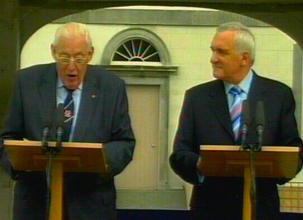
Ahern and Paisley discuss political and economic developments in Northern Ireland and increasing cross-Border co-operation. The Taoiseach says he is honoured to visit the north Antrim heartland of the Democratic Unionist Party (DUP) leader.
“I do not believe even a year back it could have been envisaged we would have been together here,” Ahern says. “It is an honour to be here with the First Minister to talk about progress.”
Paisley jokes that Ahern and his entourage had held a prayer meeting in their helicopter hoping that they would not be pelted with snowballs by him, a reference to his famous protest when former Taoiseach Seán Lemass visited Stormont in 1965.
When asked about welcoming the Fianna Fáil leader to his constituency Paisley quips, “What I am saying is he is in under my control. This is a good day for work. It is a good day for our province. It is a good day for the whole of Ireland because we need help from outside. We cannot live on our own.”
Ahern and Paisley meet again the following week at the Dublin Chamber of Commerce AGM dinner where Paisley has been invited to be a guest speaker.
The engagement is the latest visit to the Republic by the DUP leader since the Assembly was restored in Stormont the previous May. The Taoiseach invites Paisley to the historic Battle of the Boyne battle site in County Louth in July where the DUP leader presents a 17th-century musket to Ahern.
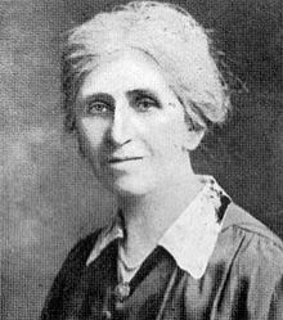
Knowles’ early interest in botany is encouraged by her father, William James Knowles, himself an amateur scientist who takes Matilda and her sister to meetings of the Belfast Naturalists’ Field Club. This is where she first meets Robert Lloyd Praeger who continues to be a lifelong influence. In 1895 she is introduced to the Derry botanist Mary Leebody and together they work on a supplement to Samuel Alexander Stewart‘s and Thomas Hughes Corey‘s 1888 book the Flora of the North-east of Ireland.
Knowles then volunteers to help with the crowdsourcing of material about the plants of County Tyrone. While completing this work Knowles publishes her own first paper about Tyrone’s flowering plants in 1897. She eventually sends in over 500 examples that are considered for inclusion in the Irish Topographical Botany, which Praeger publishes in 1901.
In 1902, after attending the Royal College of Science for Ireland for a year, Knowles is appointed a temporary assistant in the then Botanical Section of the National Science and Art Museum. She works closely with Professor Thomas Johnson to continue the development of the Herbarium collection. She also co-authors with him the Hand List of Irish Flowering Plants and Ferns (1910).
One of Knowles’ first works is The Maritime and Marine Lichens of Howth, which the Royal Dublin Society publishes in 1913. Knowles had gathered the knowledge and experience to do this while diligently assisting with a survey of Clare Island as suggested by Praeger. This novel survey involves not only Irish but also several European scientists including prominent UK lichenologist, Annie Lorrain Smith. This is claimed as the most extensive piece of field work at the time. As a result, Knowles is able to create a foundation for her later specialism in lichens.
Knowles publishes more than thirty scientific papers on a wide range of botanical subjects between 1897 and 1933. It is while studying the lichens of Howth that she discovers how lichens by the shore grow in distinct tidal zones that can be distinguished by their colour: black, orange and grey.
Her major work is The Lichens of Ireland which adds over 100 species of lichen to the Irish List and records the distribution of the eight hundred species identified in Ireland. She achieves this task with the collaboration of thirty other natural scientists. It is published in 1929 and includes twenty lichens that had previously not been identified as Irish.
Professor Thomas Johnson retires in 1923, allowing Knowles to take over curatorship, working with Margaret Buchanan. As she becomes older Knowles’ hearing begins to fail such that she has to rely on an ear trumpet. Despite her deafness she still attends meetings. She cares for and adds to the National Museum Herbarium collection although never gets the credit she deserves. In 1933 she plans to retire but pneumonia ends her life before she ends her career. Knowles dies in Dublin on April 27, 1933.
Knowles is honoured with a commemorative plaque by the Irish National Committee for Science and Engineering in October 2014 to mark the 150th anniversary of her birth.
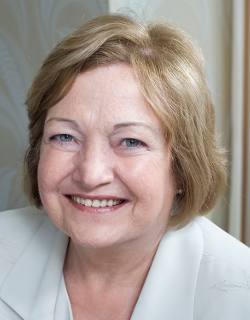
Although Maguire from a young age earns her living as a secretary, she also is from her youth a member of the Legion of Mary, a lay Catholic welfare organization, and through it she becomes deeply involved in voluntary social work among children and teenagers in various Catholic neighbourhoods of Belfast. She is stirred to act against the growing violence in Northern Ireland after witnessing in August 1976 an incident in which a car being driven by an Irish Republican Army (IRA) terrorist goes out of control when the IRA man is shot by British troops. The car strikes and kills three children of Maguire’s sister.
Within days each woman publicly denounces the violence and calls for mass opposition to it. Marches of Catholic and Protestant women, numbering in the thousands, are organized, and shortly afterward the Peace People is founded based on the conviction that genuine reconciliation and prevention of future violence are possible, primarily through the integration of schools, residential areas, and athletic clubs. The organization publishes a biweekly paper, Peace by Peace, and provides a bus service to and from Belfast’s jails for families of prisoners.
In October 2012, Maguire travels to New York City to serve on the Russell Tribunal on Israel/Palestine alongside writer Alice Walker, activist Angela Davis, former Congresswoman Cynthia McKinney, and Pink Floyd’s Roger Waters. The Russell Tribunal’s findings and conclusions challenge governments and civil society to have courage and act by implementing sanctions, thereby refusing to be silent and complicit in the face of Israel ’s violation of International Laws.
In March 2018, Maguire and two Nobel peace laureates, Shirin Ebadi and Tawakkol Karman, visit rohingya camps in Cox’s Bazar and share opinion on the crisis. After returning to Dhaka, they discuss the Rohingya crisis with members of the civil society of Bangladesh.
Maguire is a proponent of the belief that violence is a disease that humans develop but are not born with. She believes humankind is moving away from a mindset of violence and war and evolving to a higher consciousness of nonviolence and love. Among the figures she considers spiritual prophets in this regard are Jesus, Francis of Assisi, Mahatma Gandhi, Abdul Ghaffār Khān, Fr. John L. McKenzie, and Martin Luther King, Jr. She professes to reject violence in all its forms.
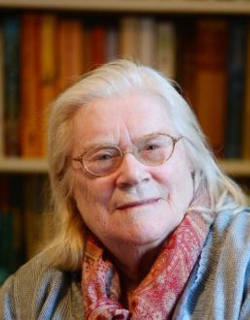
Jennifer Prudence Johnston, Irish novelist whose works deal with political and cultural tensions in Ireland with an emphasis on the problems of the Anglo-Irish people, is born in Dublin on January 12, 1930. Rich in dialogue, Johnston’s novels often concern interpersonal relationships and the difficult transition from childhood to adulthood.
Johnston’s first published book, The Captains and the Kings (1972), is actually written after The Gates (1973). Both novels feature the Anglo-Irish setting of a decaying manor house. Johnston’s third novel, How Many Miles to Babylon? (1974), concerns the complex and tragic friendship of two young men who are sentenced to death during World War I. Shadows on Our Skin (1977) and The Railway Station Man (1984) focus on violence in Northern Ireland, and The Old Jest (1979 and filmed as The Dawning, 1988) and Fool’s Sanctuary (1987) are set during the emergence of modern Ireland in the 1920s. The protagonist of The Christmas Tree (1981) attempts to salvage her troubled life before it is cut short by leukemia.
Johnston’s other novels include The Invisible Worm (1991), The Illusionist (1995), Two Moons (1998), This Is Not a Novel (2002), and Foolish Mortals (2007). She also writes short stories and plays, such as Three Monologues: Twinkletoes, Mustn’t Forget High Noon, Christine (1995) and The Desert Lullaby: A Play in Two Acts (1996).
Johnston marries a fellow student at Trinity College, Ian Smyth in 1951. She is a mother of four and currently lives near Dublin. She is also a member of Aosdána.




 seamus dubhghaill