seamus dubhghaill

Promoting Irish Culture and History from Little Rock, Arkansas, USA


Leave a comment

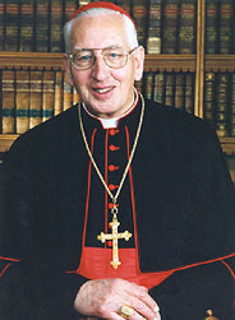
Birth of Cahal Daly, Archbishop of Armagh

Cahal Brendan Daly KGCHS, a Roman Catholic cardinaltheologian and writer, is born Charles Brendan Daly on October 1, 1917, in Ballybraddin, Loughguile, a village near Ballymoney in County Antrim.

Daly serves as the Catholic Primate of All Ireland and Archbishop of Armagh from late 1990 to 1996, the oldest man to take up this role in nearly 200 years. He is later created a Cardinal-Priest of San Patrizio by Pope John Paul II in the papal consistory of June 28, 1991.

Daly is the third child of seven born to Charles Daly and Susan Connolly. His father is a primary school teacher originally from KeadueCounty Roscommon, and his mother a native of Antrim. He is educated at St. Patrick’s National School in Loughguile, and then as a boarder in St. Malachy’s CollegeBelfast, in 1930. The writer Brian Moore is a near contemporary.

Daly studies Classics at Queen’s University Belfast (QUB). He earns his BA with Honours and also the Henry Medal in Latin Studies in 1937 and completes his MA the following year. He enters St. Patrick’s College, Maynooth and is ordained to the priesthood on June 22, 1941. He continues studies in theology in Maynooth, from where he obtains a doctorate in divinity (DD) in 1944. His first appointment is as Classics Master in St. Malachy’s College (1944–45).

In 1945, Daly is appointed Lecturer in Scholastic Philosophy at Queen’s University, Belfast, retaining the post for 21 years. In the academic year 1952–53 QUB grants him sabbatical leave, which he spends studying at the Catholic University of Paris where he receives a licentiate in philosophy. He returns to France at many points, particularly for holidays. He persists with his studies well into his retirement. He is a popular figure with the university and fondly remembered by his students. He is named a Canon of the Cathedral Chapter of Diocese of Down and Connor in 1966.

Daly is a peritus, or theological expert, at the Second Vatican Council (1962–65) to Bishop William Philbin during the first session of the Council and to Cardinal William Conway for the rest of the council. He dedicates himself to scholarship for 30 years, and publishes several books seeking to bring about understanding between the warring factions in Northern Ireland.

Daly is appointed Reader in Scholastic Philosophy at QUB in 1963, a post he holds until 1967, when he is appointed Bishop of Ardagh and Clonmacnoise on May 26.

Daly converts his forename Charles into Cahal ahead of his episcopal consecration in St. Mel’s CathedralLongford, on July 16, 1967, from Cardinal William Conway, with Archbishop Giuseppe Sensi and Bishop Neil Farren serving as co-consecrators.

Daly spends 15 years as bishop in Longford and is diligent about parish visitation and confirmations gradually assume a greater national profile. From 1974 onward, he devotes himself especially to ecumenical activities for the Pontifical Council for Promoting Christian Unity. His pastoral letter to Protestants, written in 1979, pleads for Christian unity.

Daly succeeded William Philbin as the 30th Bishop of Down and Connor when he is installed as bishop of his native diocese at a ceremony in St. Peter’s Cathedral, Belfast, on October 17, 1982.

On November 6, 1990, Daly is appointed Archbishop of Armagh and, as such, Primate of All Ireland. His age makes him an unexpected occupant of the post. Despite this it is requested that he stay in the role for three years before usual age of episcopal retirement at 75. Cardinal Daly takes a notably harder line against the Irish Republican Army (IRA) than his predecessor, Cardinal Tomás Ó Fiaich.

Daly is respectful of Protestant rights and opposes integrated education of Catholics and Protestants. This policy is criticised by those who see segregated education as one of the causes of sectarianism in Northern Ireland, but is seen by the Catholic clergy as important for passing on their faith to future generations. He is utterly orthodox in opposing divorce, contraception, abortion, the ordination of women and any idea of dropping clerical celibacy.

Daly is heckled by the audience on live television during a broadcast of The Late Late Show on RTÉ One on the topic of pedophilia in the 1990s. After his retirement in 1996, he makes no public statement on the issue.

Daly retires as Archbishop of Armagh on his 79th birthday, October 1, 1996, and subsequently suffers ill health. Although it is announced that he will attend the funeral of Pope John Paul II, he stays home on the advice of his doctors. His age makes him ineligible to participate in the 2005 conclave that elects Pope Benedict XVI.

Daly is admitted to the coronary unit of Belfast City Hospital on December 28, 2009. His health has already been declining, leading to prayers being ordered for him. He dies in hospital in Belfast on December 31, 2009, aged 92. His family are at his bedside at the time. His death brings to an end a two-year period during which Ireland has, for the first time in its history, three living Cardinals.

Daly lay in state in Belfast and then his remains are taken to Armagh. Pope Benedict XVI pays tribute at this stage. Large numbers of people travel from as far as County Westmeath to attend Mass at Armagh on January 4, at which Monsignor Liam McEntaggart, the former parish priest of Coalisland, says, “When the history of peace making in Ireland comes to be written, the contribution of Cardinal Daly will be accorded a high place.” Monsignor McEntaggart himself dies on August 22, 2010, aged 81, less than eight months after Cardinal Daly’s passing.

Daly’s funeral is held on January 5, 2010, and is attended by the president Mary McAleese and Taoiseach Brian Cowen. Daly is buried in the grounds of St. Patrick’s Roman Catholic Cathedral, Armagh, next to his three predecessors in the see, Cardinals Ó Fiaich, Conway and D’Alton.


Leave a comment

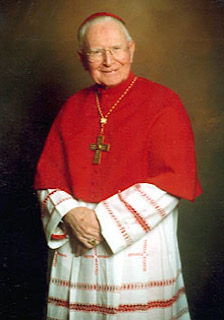
Birth of John D’Alton, Cardinal of the Roman Catholic Church

John Francis D’Alton, Irish Cardinal of the Roman Catholic Church who serves as Archbishop of Armagh and thus Primate of All Ireland from 1946 until his death, is born in Claremorris, County Mayo, on October 11, 1882. He is elevated to the cardinalate in 1953.

D’Alton is born to Joseph D’Alton and his wife Mary Brennan, at the height of the Land Wars in Ireland. He is baptised four days later, on October 15, 1882, with Michael and Mary Brennan acting as his godparents. His mother has a daughter, Mollie Brennan, from a previous marriage, she remarries again after the Cardinal’s father dies in 1883.

D’Alton obtains an extensive education at Blackrock College, Holy Cross College in Drumcondra, University College Dublin (UCD) and the Irish College in Rome. He is a contemporary of Éamon de Valera, whom he befriends at Blackrock College. In his first year in Blackrock, de Valera beats D’Alton in two subjects – Maths, which he later goes on to teach, and Religion.

D’Alton is ordained to the priesthood on April 18, 1908, for service in the Archdiocese of Dublin. He undertakes further postgraduate studies in Rome from 1908 to 1910, gaining a Doctor of Divinity and is appointed to teach Ancient Classics, Latin, and Greek at St. Patrick’s College, Maynooth.

D’Alton occupies important roles at the National Seminary and is successively Professor of Ancient Classics (1912), Greek (1922), Vice-President (1934), and President (1936). He is raised to the rank of Monsignor on June 27, 1938.

On April 25, 1942, D’Alton is appointed coadjutor bishop of Meath and titular bishop of Binda. He receives his episcopal consecration on the following June 29 from Cardinal Joseph MacRory, with Bishops Edward Mulhern and William MacNeely serving as co-consecrators, in the chapel of St. Patrick’s College. He succeeds Thomas Mulvany as Bishop of Meath on June 16, 1943.

D’Alton is named Archbishop of Armagh and thus Primate of All Ireland on June 13, 1946, and is created Cardinal Priest of Sant’ Agata de’ Goti in Rome by Pope Pius XII in the consistory of January 12, 1953. As a cardinal elector in the 1958 papal conclave, he gives a hint of the difficulties involved in that papal conclave and achieving unanimity in the voting.

D’Alton is a member of the Central Preparatory Commission of the Second Vatican Council but lives long enough to attend only the Council’s first session in 1962.

One highlight of D’Alton’s time in Armagh is the Patrician Year Celebrations in 1961, marked by the Irish Catholic hierarchy as the 1,500th anniversary of the death of Saint Patrick and as such an opportunity to promote the “spiritual empire” created by the Irish Catholic church in the wider anglophone world. He writes a pastoral letter to mark the occasion.

Cardinal D’Alton is seen to be more ecumenical in outlook than other members of the Irish hierarchy. He tries to broker talks between the Irish Free State and the United Kingdom to ease the tensions between both countries, even going so far as to address the situation regarding the Irish ports, but to little avail.

In 1952, D’Alton becomes the first individual from the Republic of Ireland to receive an honorary degree from Queen’s University Belfast (QUB), when he is conferred with a Doctorate in Literature. He already possesses a Doctor of Divinity, so this degree is a recognition of his earlier works such as Horace and His Age: A Study in Historical Background (1917), Roman Literary Theory and Criticism: A Study in Tendencies (1931), and Selections from St. John Chrysostom (1940).

D’Alton dies from a heart attack in Dublin at age 80 on February 1, 1963, and is buried on the grounds of St. Patrick’s Cathedral, Armagh. He is succeeded by his auxiliary bishop, William Conway.

In D’Alton’s hometown of Claremorris, the Dalton Inn Hotel and Dalton Street (formerly Church Street) are named after him. A plaque commemorating him is unveiled at the Dalton Inn Hotel on September 28, 2023. Plans to canonise him have been discussed.


Leave a comment

Execution of Oliver Plunkett, Catholic Archbishop of Armagh

Oliver Plunkett (Irish: Oilibhéar Pluincéid), Catholic Archbishop of Armagh and Primate of All Ireland who is the last victim of the Popish Plot, is executed in Tyburn, London, England, on July 1, 1681. He is beatified in 1920 and canonised in 1975, thus becoming the first new Irish saint in almost seven hundred years.

Plunkett is born on November 1, 1625 (earlier biographers give his date of birth as November 1, 1629, but 1625 has been the consensus since the 1930s) in Loughcrew, County Meath, to well-to-do parents with Hiberno-Norman ancestors. A grandson of James Plunket, 8th Baron Killeen (c. 1542-1595), he is related by birth to a number of landed families, such as the recently ennobled Earls of Roscommon, as well as the long-established Earls of Fingall, Lords Louth, and Lords Dunsany. Until his sixteenth year, his education is entrusted to his cousin Patrick Plunkett, Abbot of St. Mary’s, Dublin, and brother of Luke Plunket, 1st Earl of Fingall, who later becomes successively Bishop of Ardagh and of Meath.

As an aspirant to the priesthood, Plunkett sets out for Rome in 1647, under the care of Father Pierfrancesco Scarampi of the Roman Oratory. At this time the Irish Confederate Wars are raging in Ireland. These are essentially conflicts between native Irish Catholics, English and Irish Anglicans and Nonconformists. Scarampi is the Papal envoy to the Catholic movement known as the Confederation of Ireland. Many of Plunkett’s relatives are involved in this organisation.

Plunkett is admitted to the Pontifical Irish College in Rome and proves to be an able pupil. He is ordained a priest in 1654 and deputed by the Irish bishops to act as their representative in Rome. Meanwhile, the Cromwellian conquest of Ireland (1649–53) had defeated the Catholic cause in Ireland. In the aftermath the public practice of Catholicism is banned, and Catholic clergy are executed. As a result, it is impossible for Plunkett to return to Ireland for many years. He petitions to remain in Rome and, in 1657, becomes a professor of theology. Throughout the period of the Commonwealth and the first years of Charles II‘s reign, he successfully pleads the cause of the Irish Catholic Church and also serves as theological professor at the College of Propaganda Fide. At the Congregation of Propaganda Fide on July 9, 1669, he is appointed Archbishop of Armagh, the Irish primatial see, and is consecrated on November 30 at Ghent by the Bishop of Ghent, Eugeen-Albert, count d’Allamont. He eventually sets foot on Irish soil again on March 7, 1670, as the Stuart Restoration of 1660 had begun on a basis of toleration. The pallium is granted him in the Consistory of July 28, 1670.

After arriving back in Ireland, Plunkett tackles drunkenness among the clergy, writing, “Let us remove this defect from an Irish priest, and he will be a saint.” The Penal Laws had been relaxed in line with the Declaration of Breda in 1660 and he is able to establish a Jesuit College in Drogheda in 1670. A year later 150 students attend the college, no fewer than 40 of whom are Protestant, making this college the first integrated school in Ireland. His ministry is a successful one and he is said to have confirmed 48,000 Catholics over a four-year period. The government in Dublin, especially under the Lord Lieutenant of Ireland, James Butler, 1st Duke of Ormond (the Protestant son of Catholic parents), extend a generous measure of toleration to the Catholic hierarchy until the mid-1670s.

On the enactment of the Test Act in 1673, to which Plunkett does not agree for doctrinal reasons, the college is closed and demolished. He goes into hiding, travelling only in disguise, and refuses a government edict to register at a seaport to await passage into exile. For the next few years, he is largely left in peace since the Dublin government, except when put under pressure from the English government in London, prefer to leave the Catholic bishops alone.

In 1678 the so-called Popish Plot, concocted in England by clergyman Titus Oates, leads to further anti-Catholic action. Archbishop of Dublin Peter Talbot is arrested, and Plunkett again goes into hiding. Despite being on the run and with a price on his head, he refuses to leave his flock. He is arrested in Dublin on December 6, 1679, and imprisoned in Dublin Castle, where he gives absolution to the dying Talbot. He is tried at Dundalk for conspiring against the state by allegedly plotting to bring 20,000 French soldiers into the country, and for levying a tax on his clergy to support 70,000 men for rebellion. Though this is unproven, some in government circles are worried about the possibility that a repetition of the Irish Rebellion of 1641 is being planned and, in any case, this is a convenient excuse for proceeding against Plunkett.

Plunkett is found guilty of high treason in June 1681 “for promoting the Roman faith,” and is condemned to death. Numerous pleas for mercy are made but Charles II, although himself a reputed crypto-Catholic, thinks it too politically dangerous to spare Plunkett.

Plunkett is hanged, drawn and quartered at Tyburn on July 1, 1681, the last Catholic martyr to die in England. His body is initially buried in two tin boxes, next to five Jesuits who had died previously, in the courtyard of St. Giles in the Fields church. The remains are exhumed in 1683 and moved to the Benedictine monastery at Lamspringe, near Hildesheim in Germany. The head is brought to Rome, and from there to Armagh, and eventually to Drogheda where since June 29, 1921, it has rested in St. Peter’s Roman Catholic Church. Most of the body is brought to Downside Abbey, England, where the major part is located today, with some parts remaining at Lamspringe. On the occasion of his canonization in 1975 his casket is opened, and some parts of his body given to the St. Peter’s Church in Drogheda.


Leave a comment

Death of Cardinal John Joseph Glennon

Cardinal John Joseph Glennon, prelate of the Roman Catholic Church, dies on March 9, 1946, in Dublin. He serves as Archbishop of St. Louis from 1903 until his death. He is elevated to the cardinalate in 1946.

Glennon is born on June 14, 1862, in Kinnegad, County Westmeath, to Matthew and Catherine (née Rafferty) Glennon. After graduating from St. Finian’s College, he enters All Hallows College near Dublin in 1878. He accepts an invitation from Bishop John Joseph Hogan in 1882 to join the newly erected Diocese of Kansas City in the United States. After arriving in Missouri in 1883, he is ordained to the priesthood by Bishop Hogan on December 20, 1884.

Glennon is then assigned to St. Patrick’s Church in Kansas City and, briefly returning to Europe, furthers his studies at the University of Bonn in Germany. Upon his return to Kansas City, he becomes rector of the Cathedral of the Immaculate Conception. He is later made vicar general (1892) and apostolic administrator (1894) for the diocese.

On March 14, 1896, Glennon is appointed Coadjutor Bishop of Kansas City and Titular Bishop of Pinara by Pope Leo XIII. He receives his episcopal consecration on the following June 29 from Archbishop John Joseph Kain, with Bishops Maurice Francis Burke and John Joseph Hennessy serving as co-consecrators. At age 34, he becomes one of the youngest bishops in the world.

Glennon is named Coadjutor Archbishop of St. Louis on April 27, 1903. He succeeds Archbishop Kain as the fourth Archbishop of St. Louis upon the latter’s death on October 13 of that year. Realizing the Cathedral of St. Louis can no longer accommodate its growing congregation, he quickly begins raising funds for a new cathedral, the cornerstone of which is later laid on October 18, 1908.

Glennon opens the new Kenrick Seminary in 1915, followed by the minor seminary in Shrewsbury. He delivers the eulogy at the funeral of Cardinal James Gibbons and is appointed an Assistant at the Pontifical Throne on June 28, 1921. He opposes British rule in Ireland and supports the leaders of the Easter Rising. He is an outspoken opponent of divorce, condemns gambling games, and prohibits dancing and drinking at church-sponsored events. He sometimes throws the opening ball for the St. Louis Cardinals, but does not play any sports himself, once saying, “I once tried golf, but I so disfigured the scenery that I never played again, in fear of public indignation and reprisal.”[2]

Despite a rather popular tenure, as Archbishop of St. Louis Glennon opposes racial integration in the city’s Catholic schools, colleges, and universities. During the early 1940s, many local priests, especially Jesuits, challenge the segregationist policies at the city’s Catholic schools. The St. Louis chapter of the Midwest Clergy Conference on Negro Welfare, formed locally in 1938, pushes the all-female Webster College to integrate first. However, in 1943, Glennon blocks the enrollment of a young black woman at the college by speaking privately with the Kentucky-based superior of the Sisters of Loretto, which staffs the college. When approached directly by pro-integration priests, he calls the integration plan a “Jesuit ploy,” and quickly transfers one of the complaining priests away from his mission at an African American parish.

The Pittsburgh Courier, an African American newspaper with national circulation, discovers Glennon’s intervention and runs a front-page feature on the Webster incident. In response, Father Claude Heithaus, professor of Classical Archaeology at the Catholic Saint Louis University, delivers an angry sermon accusing his own institution of immoral behavior in its segregation policies. Saint Louis University begins admitting African American students that summer when its president, Father Patrick Holloran, manages to secure approval from the reluctant Archbishop Glennon. Nevertheless, St. Louis maintains one of the largest numbers of African American parishes and schools in the country.

On Christmas Eve 1945, it is announced that the 83-year-old Glennon will be elevated to the College of Cardinals. He originally thinks himself too old to make the journey to Rome, but eventually joins fellow Cardinals-elect Francis Spellman and Thomas Tien Ken-sin on their flight, during which time he contracts a cold from which he does not recover. Pope Pius XII creates him Cardinal Priest of San Clemente al Laterano in the consistory of February 18, 1946.

During the return trip to the United States, Glennon stops in his native Ireland, where he is received by President Seán T. O’Kelly and Taoiseach Éamon de Valera. While in Dublin, he is diagnosed with uremic poisoning and dies on March 9, 1946, ending a 42-year tenure as Archbishop. The Cardinal’s body is returned to St. Louis and then buried at the Cathedral.

Glennon is the namesake of the community of Glennonville, Missouri. The only diocesan hospital for children, Cardinal Glennon Children’s Hospital, affiliated with Saint Louis University Hospital, is created in his name.

(Pictured: Cardinal John J. Glennon, photo by the St. Louis Dispatch)


Leave a comment

Death of Cardinal Michael Logue

Michael Logue, Irish prelate of the Roman Catholic Church, dies in Armagh, County Armagh, Northern Ireland on November 19, 1924. He serves as Archbishop of Armagh and Primate of All Ireland from 1887 until his death. He is created a cardinal in 1893.

Logue is born in Kilmacrennan, County Donegal in the west of Ulster on October 1, 1840. He is the son of Michael Logue, a blacksmith, and Catherine Durning. From 1857 to 1866, he studies at Maynooth College, where his intelligence earns him the nickname the “Northern Star.” Before his ordination to the priesthood, he is assigned by the Irish bishops as the chair of both theology and belles-lettres at the Irish College in Paris in 1866. He is ordained priest in December of that year.

Logue remains on the faculty of the Irish College until 1874, when he returns to Donegal as administrator of a parish in Letterkenny. In 1876, he joins the staff of Maynooth College as professor of Dogmatic Theology and Irish language, as well as the post of dean.

On May 13, 1879, Logue is appointed Bishop of Raphoe by Pope Leo XIII. He receives his episcopal consecration on the following July 20 from Archbishop Daniel McGettigan, with Bishops James Donnelly and Francis Kelly serving as co-consecrators, at the pro-cathedral of Raphoe. He is involved in fundraising to help people during the 1879 Irish famine, which, due to major donations of food and government intervention never develops into a major famine. He takes advantage of the Intermediate Act of 1878 to enlarge the Catholic high school in Letterkenny. He is also heavily involved in the Irish temperance movement to discourage the consumption of alcohol.

On April 18, 1887, Logue is appointed Coadjutor Archbishop of the Archdiocese of Armagh and Titular Archbishop of Anazarbus. Upon the death of Archbishop MacGettigan, he succeeds him as Archbishop of Armagh, and thus Primate of All Ireland, on December 3 of that year. He is created Cardinal-Priest of Santa Maria della Pace by Pope Leo XIII in the papal consistory of January 19, 1893.

Logue thus becomes the first archbishop of Armagh to be elevated to the College of Cardinals. He participates in the 1903, 1914, and 1922 conclaves that elect popes Pius X, Benedict XV, and Pius XI respectively. He takes over the completion of the Victorian gothic St. Patrick’s Cathedral in Armagh. The new cathedral, which towers over Armagh, is dedicated on July 24, 1904.

Logue publicly supports the principle of Irish Home Rule throughout his long reign in both Raphoe and Armagh, though he is often wary of the motives of individual politicians articulating that political position. He maintains a loyal attitude to the British Crown during World War I, and on June 19, 1917, when numbers of the younger clergy are beginning to take part in the Sinn Féin agitation, he issues an “instruction” calling attention to the teaching of the Roman Catholic Church as to the obedience due to legitimate authority, warning the clergy against belonging to “dangerous associations,” and reminding priests that it is strictly forbidden by the statutes of the National Synod to speak of political or kindred affairs in the church.

In 1918, however, Logue places himself at the head of the opposition to the extension of the Military Service Act of 1916 to Ireland, in the midst of the Conscription Crisis of 1918. Bishops assess that priests are permitted to denounce conscription on the grounds that the question is not political but moral. He also involves himself in politics for the 1918 Irish general election, when he arranges an electoral pact between the Irish Parliamentary Party and Sinn Féin in three constituencies in Ulster and chooses a Sinn Féin candidate in South Fermanagh – the imprisoned Republican, Seán O’Mahony.

Logue opposes the campaign of murder against the police and military begun in 1919, and in his Lenten pastoral of 1921 he vigorously denounces murder by whomsoever committed. This is accompanied by an almost equally vigorous attack on the methods and policy of the government. He endorses the Anglo-Irish Treaty in 1921.

In 1921, the death of Cardinal James Gibbons makes Logue archpriest (protoprete) of the College of Cardinals. He is more politically conservative than Archbishop of Dublin William Joseph Walsh, which creates tension between Armagh and Dublin. In earlier life he was a keen student of nature and an excellent yachtsman.

Cardinal Michael Logue dies in Ara Coeli, the residence of the archbishop, on November 19, 1924, and is buried in a cemetery in the grounds of St. Patrick’s Cathedral, Armagh.


Leave a comment

Desmond Connell Created Cardinal-Priest by John Paul II

desmond-connell

Desmond Connell is created Cardinal-Priest by Pope John Paul II at the Consistory in Rome on February 21, 2001. He becomes the first Archbishop of Dublin in over 100 years to be installed as a Cardinal. A large Irish contingent from Church and State, along with family and friends of the Cardinal, attend the installation which for the first time takes place at the front of the entrance to St. Peter’s Basilica.

Connell is born in Dublin on March 24, 1926. He is educated at St. Peter’s National School, Phibsborough and the Jesuit Fathers’ second level school, Belvedere College, and studies for the priesthood at Holy Cross College. He later studies Arts at University College Dublin (UCD) and graduates with a BA in 1946 and is awarded an MA the following year. Between 1947 and 1951, he studies theology at St. Patrick’s College, Maynooth for a Bachelor of Divinity.

Connell is ordained priest by Archbishop John Charles McQuaid on May 19, 1951. He takes up a teaching post at the Department of Metaphysics at the University College Dublin. He is appointed Professor of General Metaphysics in 1972 and in 1983 becomes the Dean of the Faculty of Philosophy and Sociology. The College’s Department of Metaphysics is abolished after his departure.

Connell is appointed Archbishop of Dublin by the Holy See in early 1988. He is consecrated at St. Mary’s Pro-Cathedral, Dublin on March 6, 1988. He is created Cardinal-Priest by Pope John Paul II at the Consistory in Rome on February 21, 2001, with the Titulus S. Silvestri in Capite. Archbishops of Armagh, who hold the higher title of Primate of All Ireland, are more frequently appointed Cardinal than Archbishops of Dublin. The last Archbishop of Dublin to have been a cardinal is Cardinal Edward MacCabe, who was appointed in 1882.

On April 26, 2004, Connell retires as archbishop, handing the diocese to the coadjutor bishop, Diarmuid Martin. All bishops submit their resignation to the Pope on their 75th birthday. Connell’s is accepted shortly after his 78th birthday.

Connell is one of the cardinal electors who participates in the 2005 papal conclave that selects Pope Benedict XVI. Connell is considered quite close to Pope Benedict, both theologically and personally, both having served together on a number of congregations. He attends the 50th International Eucharistic Congress in Dublin in June 2012 and concelebrates at the Statio Orbis Mass in Croke Park.

It is Connell’s failure, when Archbishop of Dublin in 1988–2004, to address adequately the abuse scandals in Dublin that lead the Vatican to assign Archbishop Martin as his replacement in the country’s largest diocese. The Murphy Report finds that Connell had handled the affair “badly” as he was “slow to recognise the seriousness of the situation.” It does praise him for making the archdiocesan records available to the authorities in 2002 and for his 1995 actions in giving the authorities the names of 17 priests who had been accused of abuse, although it says the list is incomplete as complaints were made against at least 28 priests in the archdiocese.

From 1988 Connell also continues to insure his archdiocese against liability from complainants, while claiming to the Murphy Commission that the archdiocese is “on a learning curve” in regard to child abuse. He arranges for compensation payments to be made from a “Stewardship Trust” that is kept secret from the archdiocese’s parishioners until 2003. In 1996 he refuses to help a victim of Paul McGennis and does not pass on what he knows about McGennis to her, or to the police. He apologises for this in 2002.

Desmond Connell dies in Dublin at the age of 90 on February 21, 2017, exactly sixteen years after his creation as Cardinal.