Emmett is born in the Hammond’s Marsh area of Cork, County Cork, on April 24, 1764, the son of Dr. Robert Emmet from County Tipperary (later to become State Physician of Ireland) and Elizabeth Mason of County Kerry, both of whose portraits are today displayed at Cork’s Crawford Art Gallery. He is the elder brother of Robert Emmet, who is executed for leading the Irish Rebellion of 1803, becoming one of Ireland’s most famous republican martyrs. His sister, Mary Anne Holmes, holds similar political beliefs.
Emmet is a man of liberal political sympathies and becomes involved with a campaign to extend the democratic franchise for the Irish Parliament and to end discrimination against Catholics. He is called to the Irish bar in 1790 and quickly obtains a practice, principally as counsel for prisoners charged with political offenses. He also becomes the legal adviser of the Society of the United Irishmen.
When the Dublin Corporation issues a declaration of support of the Protestant Ascendancy in 1792, the response of the United Irishmen is their nonsectarian manifesto which is largely drawn up by Emmet. In 1795 he formally takes the oath of the United Irishmen, becoming secretary in the same year and a member of the executive in 1797. As by this time the United Irishmen had been declared illegal and driven underground, any efforts at peaceful reform of government and Catholic emancipation in Ireland are abandoned as futile, and their goal is now the creation of a non-sectarian Irish republic, independent from Britain and to be achieved by armed rebellion. Although Emmet supports this policy, he believes that the rebellion should not commence until French aid has arrived, differing from more radical members such as Lord Edward FitzGerald.
British intelligence infiltrates the United Irishmen and manages to arrest most of their leaders on the eve of the rebellion. Though not among those taken at the house of Oliver Bond on March 12, 1798, Emmet is arrested about the same time and is one of the leaders imprisoned initially at Kilmainham Gaol and later in Scotland at Fort George until 1802. Upon his release he goes to Brussels where he is visited by his brother Robert in October 1802 and is informed of the preparations for a fresh rising in Ireland in conjunction with French aid. However, at that stage France and Britain are briefly at peace, and the Emmets’ pleas for help are turned down by Napoleon.
Emmet receives news of the failure of his brother’s rising in July 1803 in Paris, where he is in communication with Napoleon. He then emigrates to the United States and joins the New York bar where he obtains a lucrative practice.
After the death of Matthias B. Hildreth, Emmet is appointed New York State Attorney General in August 1812 but is removed from office in February 1813 when the opposing Federalist Party obtains a majority in the Council of Appointment.
Charles Jervas, Irish portrait painter, translator, and art collector of the early 18th century, dies at his home at Cleveland Court, London, on November 2, 1739.
Born in Shinrone, County Offaly, around 1675, Jervas is one of seven children (five sons and two daughters) of John Jervas of Clonlisk, Shinrone, and his wife Elizabeth, daughter of Captain John Baldwin, High Sheriff of County Offaly, of Shinrone. He studies in London as an assistant under Sir Godfrey Kneller between 1694 and 1695.
After selling a series of small copies of the Raphael Cartoons around 1698 to Dr. George Clarke of All Souls College, Oxford, the following year, he travels to Paris and Rome (while financially supported by Clarke and others) remaining there for most of the decade before returning to London in 1709 where he finds success as a portrait painter.
Painting portraits of the city’s intellectuals, among them such personal friends as Jonathan Swift and the poet Alexander Pope, both of which are now in the National Portrait Gallery, London, Jervas becomes a popular artist often referred to in the works of literary figures of the period.
Jervas gives painting lessons to Pope at his house in Cleveland Court, St. James’s, which Pope mentions in his poem, To Belinda on the Rape of the Lock, written in 1713 and published in 1717 in Poems on Several Occasions.
Pope’s verse Epistle to Mr. Jervas, written around 1715, is published in the 1716 edition of John Dryden‘s 1695 translation of Fresnoy’s Art of Painting (Charles Alphonse du Fresnoy‘s De arte graphica, 1668). In it, Pope refers to Jervas’s skill as an artist:
O, lasting as those colours may they shine, Free as they stroke, yet faultless as thy line; New graces yearly like thy works display, Soft without weakness, without glaring gay!
With his growing reputation, Jervas succeeds Kneller as Principal Painter in Ordinary to King George I in 1723, and subsequently King George II. In 1727 he marries Penelope Hume, a wealthy widow with a supposed fortune of £20,000, and moves to Hampton, London. He continues to live in London until his death on November 2, 1739.
Jervas’s translation of Miguel de Cervantes‘s novel Don Quixote, published posthumously in 1742 as being made by Charles “Jarvis” due to a printer’s error, has since come to be known as “the Jarvis translation.” He is first to provide an introduction to the novel including a critical analysis of previous translations of Don Quixote. It has been highly praised as the most accurate translation of the novel up to that time, but also strongly criticised for being stiff and humourless, although it goes through many printings during the 19th century.
As principal portraitist to the King of England, Jervas is known for his vanity and luck, as mentioned in the Imperial Biographical Dictionary, “He married a widow with $20,000; and his natural self-conceit was greatly encouraged by his intimate friend [Alexander] Pope, who has written an epistle full of silly flattery.”
According to one account, after comparing a painting he had copied from Titian, Jervas is said to have stated, “Poor little Tit, how he would starve!”
Upon being told that Jervas had set up a carriage with four horses, Godfrey Kneller replies, “Ach, mein Gott, if his horses do not draw better than he does, he will never get to his journey’s end.”
Hone is born in Fitzwilliam Place, Dublin on October 26, 1831. He is the son of Brindley Hone, a merchant and director of the Midland Great Western Railway.
Though a member of a very artistic family, Hone’s initial training is as an engineer at Trinity College Dublin followed by a brief period of work for the Irish Railway before going to Paris in 1853 to study painting. He first studies under Adolphe Yvon, the French military painter, and later Thomas Couture, who is one of the earliest exponents of realism and from whom he learns principles which influence his work throughout his career.
Most of Hone’s later paintings are landscapes, very often enlivened with animals and occasionally with figures. In France he is influenced by the painter Gustav Courbet who is taking a new and quite revolutionary realistic approach. His closest painting tips are, however, from another French impressionist, Jean-Baptiste-Camille Corot. He becomes a close friend of one of Corot’s followers at the Barbizon school of landscape painting. At Barbizon he learns to appreciate colour, texture and tone in the landscape and applies it in strong and confident brushworks to the painting of Irish subjects on his return. In Paris he also works closely with artist Édouard Brandon, also a follower of Corot.
Hone’s paintings which are completed in France have many similarities to those that he completes at his country farm in County Dublin, but the finish is perhaps more polished and professional in the later Irish works.
From 1876, except for four years, Hone exhibits at the Royal Hibernian Academy (RHA). He is elected a full member in 1880 and in 1894 becomes Professor of Painting. His exhibition with John Butler Yeats in 1901 is one of the turning points for the history of Irish art as it is their paintings which convince Sir Hugh Lane that Dublin should have a gallery of modern art.
Nathaniel Hone dies in Dublin on October 14, 1917. After his death his widow bequeaths the contents of his studio to the National Gallery of Ireland. He rarely dates his work, so it is difficult to establish chronology. The similarity of many of his motifs and subjects often make it difficult to tell whether a view is Irish or French. Equally it is difficult to chart his developments on stylistic grounds alone.
(Pictured: Nathaniel Hone, the younger, self-portrait as an old man)
Leventhal is born Abraham Jacob Leventhal in Lower Clanbrassil Street, Dublin, on May 9, 1896. His parents are Moses (Maurice) Leventhal and Rosa (née Levenberg). His father is a draper, and his mother is a poet. She is a Zionist, who is a founding member of the Women’s Zionist Society. He lives in the “Little Jerusalem” area of Dublin, the area around the South Circular Road, in his youth. He attends Wesley College, Dublin, and then Trinity College Dublin (TCD) to study modern languages. He edits the TCD student magazine in 1918. It is in TCD that he acquires the nickname “Con,” an allusion to his father’s job as a “Continental” agent. He joins the first Zionist commission and travels to Palestine after World War I and helps to found the newspaper Palestine Weekly. He is then invited to join the Jewish National Fund‘s London office and begins working on the Zionist Review. He returns to Dublin to complete his degree in 1920, and in 1921 travels to Paris where he meets James Joyce.
Leventhal marries Gertrude Zlotover in October 1922. He works with his father-in-law, Joseph Zlotover, at the family furniture business on Mary Street for a time. After, he starts a number of unsuccessful businesses of his own, including the Irish Book Shop on Dawson Street from 1924 to 1925. It is possibly his business failures that inspire the idea of the TCD Students Appointment Association, which would give students pragmatic business skills. TCD accepts this proposal and employes him as the first administrator.
Leventhal completes a PhD in contemporary French literature, and in 1932 is appointed to the staff of the French department at TCD. He replaces his friend Samuel Beckett. During his time in TCD, he is an assistant editor to Hermathena, to which he also contributes his translations of French poetry. He is associated with a number of progressive cultural movements in Dublin of the 1920s and 1930s. He is a regular attendee at meetings held to promote Jewish culture and nationalism and lectures this group on Joyce. Through his interest in Joyce, he becomes an associate of Seumas O’Sullivan, and The Dublin Magazine. When the printers refuse to set his review of Ulysses in 1923 for The Dublin Magazine, he is moved to found his own magazine, The Klaxon, in response to the censorship. The only issue of the magazine publishes a shortened version of the review under the pseudonym “Lawrence K. Emery.” He is also associated with Francis Stuart‘s Tomorrow magazine. He is also interested in drama and is a member of the avant-garde Dublin Drama League, occasionally performing with them. Among his close friends are Daisy Bannard Cogley, Micheál Mac Liammóir, and Lennox Robinson. From 1943 to 1958 his column, “Dramatic commentary”, is published in The Dublin Magazine. He is also published in The Irish Times, The Irish Press, The Listener, Westminster Weekly, Financial Times, and International Herald Tribune. He is a regular contributor to Radio Éireann and BBC broadcasts.
Leventhal begins a long-term relationship with Ethna MacCarthy, marrying her after the death of his first wife in 1956. She dies in 1959. He retires from TCD in 1963 and moves to Paris, where he becomes Beckett’s literary assistant. He lives on Boulevard du Montparnasse with his partner Marion Leigh.
Leventhal dies of cancer in Paris on October 3, 1979. There are two known portraits of Leventhal, one by John Russell (1920) and a second by Avigdor Arikha. The Leventhal Scholarship at TCD is founded in his memory. TCD and the Harry Ransom Center hold papers relating to Leventhal.
William Corbet, an Anglo-Irish soldier in the service of France, is born in Ballythomas, County Cork, on August 17, 1779. In September 1798, he accompanies James Napper Tandy in an aborted French mission to Ireland in support of the United Irish insurrection. After two years of incarceration, he escapes from Ireland and serves in the campaigns of Napoleon reaching the rank of colonel. In 1831, under the July Monarchy, he is employed in the Morea expedition to Greece. He returns to France in 1837, retiring with the rank of Major-General.
Corbet is born into a branch of the Corbet family, an Anglo-Irish Protestant family. In 1798, as a member of the Society of United Irishmen, he is expelled from Trinity College Dublin with Robert Emmet and others for treasonable activities and goes instead to Paris. In September of the same year, he joins a French military force under James Napper Tandy with the rank of Captain and sails from Dunkirk with arms and ammunition for Ireland. The expedition has to turn back following the defeat of General Jean Joseph Amable Humbert and arriving in Hamburg they are handed over to the British authorities and taken to Ireland, where they are imprisoned in Kilmainham Gaol.
Corbet escapes in 1803 and returns to France. He is appointed professor of English at the military college of Saint-Cyr. Later that year he becomes a captain in the Irish Legion. Following the death of his brother Thomas (who was also in the Legion) in a duel with another officer, he is transferred to the 70th Regiment of the line, where he serves in André Masséna‘s expedition to Portugal, and distinguishes himself in the retreat from Torres Vedras and the Battle of Sabugal. After the Battle of Salamanca, he is appointed chef de bataillon of the 47th regiment and serves until 1813 when he is summoned to Germany to join the staff of MarshalAuguste de Marmont. He serves at the battles of Lützen, Bautzen, Dresden and others and is made a commander of the Legion of Honour. In December 1814, he is naturalised as a French citizen. In 1815, after the abdication of Napoleon, he is promoted to colonel and chief of staff to General Louis-Marie-Celeste d’Aumont at Caen.
In 1837, Corbet returns to France where, with the rank of Major-General, he is commander in the region of Calvados. He dies at Saint-Denis on August 12, 1842.
The Irish novelist Maria Edgeworth bases the main theme of her novel Ormond on Corbet’s 1803 escape from Kilmainham Gaol.
Henry is born Emily Grace Mitchell at Kirktown St. Fergus, near Peterhead, Aberdeenshire, Scotland, on February 10, 1868. She is the ninth of ten children of the Rev. John Mitchell and Jane Mitchell (née Gardner). Lord Byron is a cousin of her maternal grandmother. She is educated at home, spending time at the family’s home in Piccadilly, where she experiences London society. After the death of her father, and the reduced circumstances she finds herself in, she leaves home in 1895 to pursue a career as an artist. The first record of her work being exhibited is with the Aberdeen Artists Society in 1896 and 1898. These paintings have not been traced since. In 1899, she leaves Scotland for the continent, visiting Holland and Belgium, studying at the Blanc‐Guerrins Academy in Brussels. She goes on to attend the Delacluze Academy in Paris. While in Paris, she meets Paul Henry, an Irish artist. The couple marries in September 1903 in London.
The Henrys live at a few different residences outside London until 1910. A small number of her works are known from this time, such as The Girl in White, which is in the collections of the Hugh Lane Gallery. This piece shows the influence of fellow artist James Abbott McNeill Whistler, whom she meets in Paris through her husband. The couple travels to Achill Island for the first time in 1910, intending to stay two-weeks, but going on to live there until 1919. During this time, she paints numerous night scenes, including Achill Cottages (Hugh Lane Gallery). One of her well-known works is Top of the Hill, on display in the Limerick City Gallery of Art, which shows a group of island women. The period spent on the island places a strain on the Henrys marriage, as she is not as happy living there.
The couple returns to Dublin in 1919 and are founding members of the Society of Dublin Painters in 1920 alongside Letitia Marion Hamilton, Mary Swanzy, and Jack Butler Yeats. The Society offers an outlet for younger Irish artists to exhibit. Five of Henry’s works are featured at the Irish Exhibition in Paris in 1922, and at a similar exhibition in Brussels in 1930.
Around 1920, Henry has a romantic association with Stephen Gwynn who is an important political, cultural and literary figure from the lost world of late-nineteenth and early-twentieth century Ireland. During this period, she travels with Gwynn in France and Italy and later paints a number of portraits of him. Invariably, during this time, the Henrys’ marriage continues to have problems, with the couple breaking up in 1924. Her affair with Gwynn, who she depicts in two known oil paintings including The Orange Man (Limerick City Gallery of Art) and Portrait of a Man, which depicts a much more distinguished Gwynn in later life, contribute to the breakup. The couple legally separates in 1930.
Henry develops her own style through the 1920s and 1930s, spending time in France and Italy. From 1924 to 1925, she studies with André Lhote, a cubist painter who also works with Mainie Jellett, Evie Hone, and Mary Swanzy. She goes on to display little of his influence in her work. She paints in Venice and in the environs of the Italian lakes, painting with the fauvist style, with free brushwork and vibrant colours. She also experiments with expressionism, which can be seen in Spring in Winter. Upon the outbreak of World War II, she returns to Ireland. She does not have a permanent residence during this period, instead stayed with friends or living in hotels. She also experiences periods of melancholy during these later years, though she continues to exhibit. Her work is regularly displayed at the Royal Hibernian Academy (RHA), and she has solo shows at the Waddington and Dawson galleries. She is made an honorary member of the RHA in 1949.
Henry dies in Dublin on August 11, 1953, and is buried at Mount Jerome Cemetery. During her career, and for a number of years after her death, she is largely overshadowed by her husband, sometimes being referred to as “Mrs. Paul Henry.” She is even omitted from Paul Henry’s two-volume autobiography. Her body of work is re-examined in the 1970s, which leads to wider public recognition and her inclusion in a number of exhibitions such as The Paintings of Paul and Grace Henry at the Hugh Lane Gallery in 1991. She is deemed to be a much bolder painter than her husband, incorporating more elements of the modernist movement, as evident in The Long Grey Road of Disting (1915). Her popularity has been growing since her rediscovery.
(Pictured: “Road to Destiny,” oil on board by Grace Henry)
Dunphy grows up in Drumcondra, Dublin, in what he describes as “a one-room tenement flat [with] no electricity, no hot water.” He attends Saint Patrick’s National School, Drumcondra. In 1958, he gets a one-year government scholarship to Sandymount High School but has to work as a messenger at the tweed clothing shop Kevin and Howlin.
A promising footballer, Dunphy leaves Dublin while still a teenager to join Manchester United as an apprentice. He does not break into the first team at United, and subsequently leaves to play for York City, Millwall, Charlton Athletic, Reading and Shamrock Rovers. It is at Millwall that he makes the most impact. He is considered an intelligent and skillful player in the side’s midfield. He is a member of “The Class of ’71,” the Millwall side that fails by just one point to gain promotion to the Football League First Division.
Dunphy accompanies Johnny Giles back to Ireland to join Shamrock Rovers in 1977. Giles wants to make the club Ireland’s first full-time professional club and hopes to make Rovers into a force in European football by developing talented young players at home who would otherwise go to clubs in England. Dunphy is originally intended to be in charge of youth development. However, despite an FAI Cup winners medal in 1978, his only medal in senior football, and two appearances in the UEFA Cup Winners’ Cup, he becomes disillusioned with the Irish game and drops out of football altogether to concentrate on a career in journalism.
Since the 1980s, Dunphy has written a number of books. His first and most widely praised book is Only a Game? The Diary of a Professional Footballer, which is an autobiographical account of his days playing for Millwall. Written in diary form, it records events from the dressing room of his 1973–74 season, which begins well for him at Millwall but subsequently ends in disillusionment: after being substituted in an October 27, 1973, home loss to eventual league winners Middlesbrough, he does not play another game all season, the club finishing mid-table.
In 1985, rock band U2 and manager Paul McGuinness commission Dunphy to write the story of their origins, formation, early years and the time leading up to their highly successful album The Joshua Tree. His book Unforgettable Fire – Past, Present, and Future – The Definitive Biography of U2 is published in 1988. It receives some favourable reviews, but critics close to the band speak of many inaccuracies. A verbal war erupts in the press during which he calls lead singer Bono a “pompous git.”
Dunphy also writes a biography of long-serving Manchester United manager Matt Busby and in 2002 ghost writes the autobiography of Republic of Ireland and Manchester United player Roy Keane.
Since the mid-1980s, Dunphy has regularly appeared as an analyst during football coverage on Raidió Teilifís Éireann (RTÉ). Since RTÉ acquired the rights to show English football, he has been a regular contributor to Premier Soccer Saturday. He also contributes to analysis of UEFA Champions League games and, in international football, RTÉ’s coverage of FIFA World Cups, UEFA European Football Championships and qualifying matches involving the Republic of Ireland national football team.
In 2001, Dunphy becomes the first male host of the quiz show The Weakest Link, which airs on TV3, for just one series. In 2003, he is hired again by TV3 to host their new Friday night chat show, entitled The Dunphy Show. Pitted head-to-head with RTÉ’s long-running flagship programme, The Late Late Show, Dunphy’s show loses what is a highly publicised “ratings war,” and is cancelled before its original run concludes.
Dunphy is the first presenter of a made-for-mobile television show on the 3 mobile network in Ireland. His rants and “Spoofer of the Week” are watched by thousands of 3 Mobile customers. The shows are awarded “Best Entertainment Show” at Ireland’s Digital Media Awards. He admits he never uses a mobile himself but enjoys filming for a mobile audience from his living room in Ranelagh.
In July 2018, Dunphy announces that he is leaving RTÉ after 40 years with the broadcaster, and that he intends to focus on his podcastThe Stand with Eamon Dunphy.
Dunphy has also has a prominent radio career with several stations, including Today FM, Newstalk and RTÉ Radio 1. He is the original host in 1997 of the popular current affairs show The Last Word on Today FM. In September 2004, he takes over The Breakfast Show slot on the Dublin radio station Newstalk 106 from David McWilliams. The show tries to court controversy and listeners in equal measure. He fails to attract the large listenership predicted, with only a few additional thousand tuning in. He announces in June 2006 his intention to leave Newstalk 106, citing an inability to sustain the demands of an early morning schedule. After his departure from Newstalk 106, he confirms he is suffering from a viral illness from which he later recovers.
In July 2006, RTÉ announces that Dunphy will present a new weekly programme as part of the new RTÉ Radio 1 autumn schedule.
Dunphy rejoins Newstalk but leaves again in 2011 “due to interference from management and a push to put a more positive spin on the news.” On his last show he accuses his boss, Denis O’Brien, of “hating journalism.” He quits after Sam Smyth is sacked from Today FM (also owned by O’Brien) and says management at Newstalk is trying to remove “dissenting voices” like Constantin Gurdgiev from the airwaves.
Dunphy is a daily Mass-goer until he is preparing for marriage to his first wife, Sandra from Salford, when he is 21. He is Catholic and she is Protestant. The priest instructing them for marriage disapproves strongly of the mixed couple, saying that he should not marry her because she is “not a proper person.” Dunphy’s observance is already weakening but he quits his daily Mass-going at this point. He and Sandra have two children, a boy and a girl, and he is now a grandfather. His first marriage ends, and he moves to Castletownshend in County Cork for two years in the early 1990s. He lives with another partner, Inge, before meeting his second wife, RTÉ commissioning editor Jane Gogan, in the Horseshoe Bar in Dublin in 1992. They marry at the Unitarian Church on St. Stephen’s Green on September 24, 2009.
In an interview with An Phoblacht, Dunphy, who had previously written highly critical articles on the Provisional IRA and Sinn Féin, states that he is now a Sinn Féin supporter and declares he had voted for them in the 2011 Irish general election. He describes their representatives as “incredibly hard-working and incredibly intelligent.”
Dunphy publishes his autobiography entitled The Rocky Road in October 2013.
Today, Dunphy generally resides at his home near Ranelagh in Dublin. He also owns a holiday home in Deauville, France.
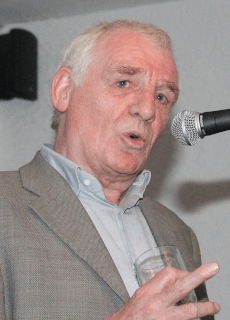
(Pictured: Éamon Dunphy at the Sinn Féin Summer School, 2013)
Charles Brady, American-born painter who spends most of his life in Ireland, dies in Dublin on August 1, 1997.
Brady is born on July 27, 1926, in New York City, the son of Arthur Brady, an industrial hardware merchant. He is best known for small-scale paintings of still life and landscape. At the end of World War II, while serving with the United States Navy, he suffers an accident which results in his discharge. As a result of this, he has the opportunity of pursuing further study. In 1948, he enrolls at the Art Students League of New York. Founded in 1875 and distinguished by its progressive approach to art education, it is one of the most important art schools in the United States in the early twentieth century.
Initially, Brady studies design and fashion before studying fine art under John Groth and Morris Kantor. In 1949, he becomes Groth’s assistant. In 1950, his work is included in the exhibition “American Painting 1950,” held at the Metropolitan Museum of Art, New York, where he is employed as a guard at the time. Around this time, he meets artists associated with abstract expressionism such as Franz Kline, Willem de Kooning, and Jackson Pollock, and exhibits with them in exhibitions such as the “9th Street Show” (1951). Four years later, his first solo exhibition is held at the Urban Gallery, New York. By this time, his father, mother, and a younger brother have all died. In 1956 he decides to leave New York and spend some time in Ireland.
On his arrival, Brady bases himself in Lismore, County Waterford, where the landscapes he begins to paint are in contrast to the abstract style he had developed in New York. In May 1956, he joins his aunt and uncle on a tour that include London and Paris. He remains in Ireland until early in 1958 and during this time becomes acquainted with such figures as Camille Souter, Frank Morris and Desmond McAvock. Though he spends the next year in the United States, he soon decides to return to Ireland. In 1959 he is living in Dublin, where, along with artists such as Noel Sheridan and Patrick Pye, he is involved in founding the Independent Artists group. His work is included in the group’s first exhibition in 1960.
Also in 1960, Brady marries Eelagh Noonan, and the couple go to live in Spain. On their return to Ireland in 1961, they settle in Dún Laoghaire, where he begins to produce still lifes of objects such as envelopes and boxes painted in muted tones. Though figurative, the painterly quality of these works and the way in which they assert the flat nature of the picture plane suggest something of his experience of postwar American abstract art. Soft, hazy light, another key characteristic of his work, can also be seen in his paintings of Sandymount Strand, which might be compared with the work of Nathaniel Hone the Younger, whose work Brady had seen on his first trip to Ireland. He also works in other media, producing lithographs and, from the mid-1980s, small bronzes of such mundane objects as discarded bus tickets.
From 1976 to 1983 Brady lectures in painting at the National College of Art and Design. In 1981 he becomes a member of Aosdána and in 1994 he is elected an honorary member of the Royal Hibernian Academy (RHA). He exhibits regularly in Ireland at venues such as the RHA. He receives a number of awards including the P. J. Carroll award at the Irish Exhibition of Living Art as well as the Douglas Hyde Gold Medal and the landscape award at the Oireachtas exhibitions of 1973 and 1989 respectively.
(From: “Brady, Charles” by Rebecca Minch, Dictionary of Irish Biography, http://www.dib.ie, October 2009 | Pictured: “Charles Brady, 1967,” oil on board by Koert Delmonte)
Hamilton is the daughter of Charles Robert Hamilton and Louisa Caroline Elizabeth Brooke. She attends Alexandra College. She and her sister Eva are great-granddaughters of the artist Marianne-Caroline Hamilton, and cousins of watercolouristRose Maynard Barton. The sisters’ father can only afford one dowry, so the sisters remain unmarried, with their artistic careers helping to support the household. Both she and her sister study at the Dublin Metropolitan School of Art under William Orpen. She studies enameling there also, winning a silver medal in 1912 by both the School and the Board of Education National Commission. Her work shows elements of Art Nouveau, foreshadowing her later modernist leanings. She also studies in Belgium with Frank Brangwyn and the Slade School of Fine Art.
Hamilton first exhibits in 1902 and goes go on to become a prolific painter of the Irish countryside, exhibiting more than 200 paintings at the Royal Hibernian Academy (RHA). Both sisters travel widely in Europe, with Letitia being influenced by modern European artistic trends of the early 20th-century. She is internationally exhibited, Royal Academy of Arts, Burlington Gallery and Kensington Art Gallery in London, in Scotland, and Paris. Her exposure to impressionism comes from studying with Anne St. John Partridge in France. Her style matures in the 1920s. That year, she is one of the founding members of the Society of Dublin Painters, along with Paul Henry, Grace Henry, Mary Swanzy, and Jack Butler Yeats. It is around this time that she changes her signature from MH (May Hamilton) to LMH, reflecting her full name. She works on small oil sketches, which later develop into finished works. Her style is rapid, with loose, fluid brush strokes. In the early 1920s, she travels to Venice, painting on a gondola studio loaned to her by artist and friend Ada Longfield. The works from this trip are considered among her best, with her exploring light effects, pastel shades, and strong outlines. She later employs these elements into her works on Irish landscapes.
Hamilton becomes a member of the Royal Hibernian Academy in 1943. In 1948, she becomes the last person to win a bronze medal at the art competitions at the London Olympic Games. She serves as president of the Society of Dublin Painters in the late 1950s. Despite her failing eyesight later in life, she continues to paint, mounting her final exhibition in 1963, a year before her death at the age of 86 in Dublin on August 11, 1964. She is also a committee member of the Water Colour Society of Ireland.
Adebari arrives in Dublin with his wife and two children in 2000. After he converts from Islam to Christianity, he flees Nigeria in 2000, and makes a claim for asylum on the grounds of religious persecution. His application is rejected because of a lack of evidence that he had personally suffered persecution. He does however gain automatic residency when his wife gives birth to a son in Ireland shortly after their arrival.
Adebari and his family settle in County Laois. He completes his master’s degree in intercultural studies at Dublin City University (DCU) and sets up a firm called Optimum Point Consultancy.
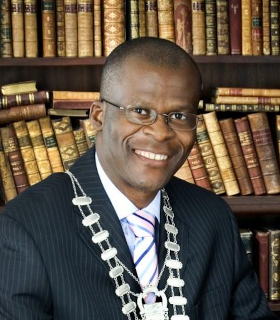
In 2004, Adebari is elected as a town councilor in local elections. On June 27, 2007, at the age of 43, he is elected mayor of the 9-member Portlaoise Town Council, by a vote of six to three and with support from Fine Gael, Sinn Féin and an Independent councilor. At a meeting attended by officials from the Nigerian, South African, and the United States embassies, the new mayor is quoted as saying his election is proof that “Ireland is not just a country of a thousand welcomes, but it is a country of equal opportunity.” In the 2009 local elections he is re-elected to the town council and also to Laois County Council for the Portlaoise electoral area.
In 2007, Adebari denies claims that he was a train operator in London who worked out of the Queen’s Park station on the Bakerloo line. Multiple London Underground employees, including Paddy Clarke, a retired tube driver from County Louth, state that Adebari worked as a train driver in London during the late 1990s before moving to Ireland. Clarke states, “at the very least fifty drivers and six or more managers will remember him. His photograph and signature are on file with London Underground’s personnel office which were used in the issue of his free travel-pass and identity card.” Adebari asserts he traveled to Ireland directly from Nigeria via Paris, and never worked or lived in London at any time.




 seamus dubhghaill