The mid-19th-century is a difficult time for the Irish. Under British subjugation, and amidst the vice-grip of the Great Famine, Ireland and its people are in desperate need for optimism, and something to bring the nation together.
News of the recent French Revolution has reached Irish ears and there is a growing belief that the path to independence is an achievable one.
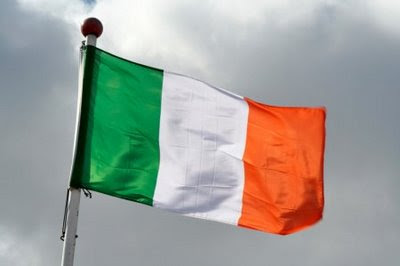
During a trip to Paris with an Irish delegation sent to congratulate the French republicans on their successful revolution, Meagher is inspired to create a design for the Irish tricolour, similar to the French flag, with the help of a small group of French women sympathetic to the Irish cause.
The new flag has green, white and orange stripes – the colours symbolising the unification of two traditions into one nation – Catholics (green) and Protestants (orange). Few realise however, that Meagher’s original flag has the orange stripe closest to the staff, a design now used by Ivory Coast.
As Meagher outlines later, “The white in the centre signifies a lasting truce between Orange and Green and I trust that beneath its folds the hands of Irish Protestants and Irish Catholics may be clasped in generous and heroic brotherhood.”
At a meeting in Waterford on March 7, 1848, Meagher first publicly unveils the flag from a second-floor window of the Wolfe Tone Club as he addresses a gathered crowd on the street below who are present to celebrate another revolution that has just taken place in France.
From March of that year the Irish tricolour appears side-by-side with the French tricolour at meetings held all over the country.
On April 14 and 15, the flag is paraded around the country. Political journalistJohn Mitchel says at the time, “I hope to see that flag one day waving, as our national banner.”
During this time, support for Meagher’s design grows, and following the events of the 1916 Easter Rising, it is resurrected by the Irish Volunteers and later by Sinn Féin and is unofficially adopted as the flag of Ireland. With the green stripe closest to the staff, Meagher’s tricolour becomes the official flag of the 26 counties of the Irish Republic.
In 1937, the design achieves constitutional status as the official Irish flag.
Until recently, display of the tricolour flag is illegal in the six occupied counties of Northern Ireland.
(From: “On this day in 1848: Ireland’s new flag is shown to public for first time” by Harry Brent, The Irish Post, http://www.irishpost.com, April 15, 2021)
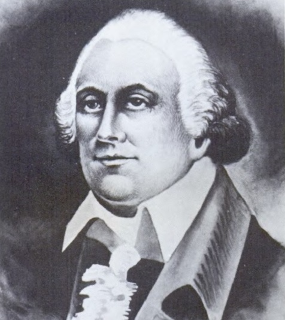
Moylan is born to a Catholic family in Cork, County Cork, in 1737. His father, John Moylan, is a well-to-do merchant in Shandon, County Cork. His older brother Francis becomes Bishop of Cork. His family sends him to be educated in Paris. He then works in Lisbon for three years in the family shipping firm. He settles in Philadelphia in 1768 to organize his own firm. He is one of the organizers of the Friendly Sons of St. Patrick, an Irish American fraternal organization, and serves as its first president.
Moylan joins the American Continental Army in 1775 and upon the recommendation of John Dickinson, is appointed Muster-Master General on August 11, 1775. His brother John acts as United States Clothier General during the war. His experience in the shipping industry affords the United States a well-qualified ship outfitter, who helps fit out the first ships of the Continental Navy. On March 5, 1776, he becomes secretary to General George Washington with the rank of lieutenant colonel. He is appointed Quartermaster General in the American Continental Army on June 5, 1776, succeeding Thomas Mifflin. He resigns from this office on September 28, 1776. However, he continues to serve as a volunteer of General Washington’s staff through December 1776.
In January 1776, Moylan writes a letter using the term “United States of America,” the earliest known use of that phrase.
Moylan then raises a troop of light dragoons, the 4th Continental Light Dragoons, also known as Moylan’s Horse, on January 3, 1777, at Philadelphia, and is appointed colonel in the Continental Army on January 5. The regiment is be noted for taking the field in captured British red coats. However, they see action in green coats at the Battle of Brandywine on September 11, 1777, and the Battle of Germantown on October 4, 1777, and end the year by protecting the Cantonment at Valley Forge. He succeeds General Casimir Pulaski as Commander of the Cavalry in March 1778. Moylan’s Horse sees action at the Battle of Monmouth on June 28, 1778.
In the campaign of 1779 Moylan and the 4th Dragoons are stationed at Pound Ridge, New York, and see action when the British raid Norwalk, Connecticut, on July 11, 1779. He and the 4th Dragoons take part in the Battle of Springfield in New Jersey, on June 23, 1780, and General Anthony Wayne‘s expedition at Bull’s Ferry, New Jersey, on July 20, 1780. He commands his Dragoons at the Siege of Yorktown in October 1781, after which he is to take the cavalry to the Southern Campaign. However, his failing health causes him to leave the field and return to Philadelphia, where he constantly appeals to the Continental Congress to man, equip and maintain the Continental Dragoon Regiments.
Moylan is married to Mary Ricketts Van Horne on September 12, 1778, and has two daughters, Elizabeth Catherine, and Maria. His two sons die as children. He dies in Philadelphia on April 11, 1811, and is buried there in the churchyard at St. Mary’s Roman Catholic Church.
Mhac an tSaoi is influenced by her stays in the Dingle Peninsula in County Kerry with her uncle, Monsignor De Brún, at his parish of Dún Chaoin. Monsignor de Brún, similarly to his sister, is a distinguished linguist and Celticist, the literary translator of Homer, Dante Alighieri, Sophocles, and Jean Racine into Modern Irish, “and one of the most distinguished literary figures of his time.”
Mhac an tSaoi studies Modern Languages and Celtic Studies at UCD, before going to further research at the Dublin Institute for Advanced Studies and at the University of Paris. She writes the famous work of Christian poetry in Munster Irish, Oíche Nollag (“Christmas Eve”), when she is only 15-years of age.
Mhac an tSaoi spends two years studying in post-war Paris (1945–47) before joining the Irish diplomatic service and is working at the Irish embassy in Madrid when she commits herself to writing poetry in Irish following her discovery of the works of Federico García Lorca.
She remains a prolific poet and is credited, along with Seán Ó Ríordáin and Máirtín Ó Direáin, with reintroducing literary modernism into Irish literature in the Irish language, where it had been dormant since the 1916 execution of Patrick Pearse, in the years and decades following World War II. Her poetry draws on the vernacular spoken by the native Irish speakers of the Munster Gaeltacht of West Kerry during the first half of the twentieth century. Formally, she draws on the song metres of the oral tradition and on older models from the earlier literary tradition. In later work, she explores looser verse forms but continues to draw on the remembered dialect of Dún Chaoin and on a scholarly knowledge of the older literature.
Mhac an tSaoi is elected to Aosdána in 1996 but resigns in 1997 after Francis Stuart is elevated to the position of Saoi. She had voted against Stuart because of his role as an Abwehr spy and in radio propaganda broadcasts from Nazi Germany aimed at neutral Ireland during World War II.
In 2001, she publishes an award-winning novel A Bhean Óg Ón… about the relationship between the 17th-century County Kerry poet and Irish clan chief Piaras Feiritéar and Meg Russell, the woman for whom he composed some of the greatest works of love poetry ever written in the Irish language.
Her poems Jack and An Bhean Óg Ón are both featured on the Leaving Certificate Irish course, at both Higher and Ordinary Levels, from 2006 to 2010. Her literary translation of Rainer Maria Rilke‘s Duino Elegies from Austrian German into the Irish language is published in 2013.
Mhac an tSaoi marries Irish politician, writer, and historian Conor Cruise O’Brien in a Roman Catholic wedding Mass in Dublin in 1962. This makes her the stepmother to O’Brien’s children from his 1939 civil marriage. Her mother is deeply embarrassed by the exposure of the relationship and staunchly opposes the match, as she has long been a close friend of O’Brien’s Presbyterian first wife. Despite their subsequent marriage, the exposure of their extramarital relationship ends Mhac an tSaoi’s diplomatic and civil service career. They later adopted two children, Patrick and Margaret.
She then lives with her husband in New York City, where he becomes a professor at New York University (NYU) after the Congo Crisis destroys O’Brien’s diplomatic career. He is long blamed by the United Nations for the escalation of the Congo Crisis.
Solomons is born to Maurice Solomons and poet Rosa Jane Jacobs. Her father is an optician whose practice in 19 Nassau Street, Dublin, is mentioned in Ulysses. Her father is also the Vice-Consul of Austria-Hungary. The Solomons family, who came to Dublin from England in 1824, are one of the oldest continuous lines of Jews in Ireland.
Solomons grandmother, Rosa Jacobs Solomons, who is born in Kingston upon Hull in England, is the author of a book called Facts and Fancies (Dublin 1883). Her brother, Bethel Solomons, a renowned physician, a master of the Rotunda Hospital and Irish international rugby player, is mentioned in Finnegans Wake. Her brother Edwin is a stockbroker and prominent member of the Dublin Jewish community. Her younger sister Sophie is a trained opera singer. A portrait of Sophie, by her cousin the printmaker Louise Jacobs, survives in the Estella Solomons archives in the Library of Trinity College Dublin (TCD).
In 1898, at the age of 16, Solomons enters the Dublin Metropolitan School of Art where she wins a significant prize. Her classmates include future Irish artists including Mary Swanzy, Eva Hamilton and William J. Leech. She also attends the Chelsea School of Art from 1903 to 1906. A visit to the tercentenary exhibition of the work of Rembrandt in Amsterdam in 1903 impacts her creative practice and possibly influences her adoption of printmaking as her principal vehicle of expression. She studies under two of Ireland’s leading artists, Walter Osborne, who is another major influence, and William Orpen. With her friends Cissie Beckett (aunt of Samuel Beckett) and Beatrice Elvery, she goes to study in Paris at Académie Colarossi. On her return she exhibits in Leinster Hall, Molesworth Street, with contemporaries such as Beatrice Elvery, Eva Hamilton and Grace Gifford. Her work is also included in joint exhibitions with other artists at Mills Hall and the Arlington Gallery, London. She also exhibits at her Great Brunswick Street studio in December 1926.
Solomons illustrates Padraic Colum‘s The Road Round Ireland (1926) and DL Kelleher’s The Glamour of Dublin in 1928. Originally published after the devastation of the 1916 Easter Rising, the later edition features eight views of familiar locations in the city centre including Merchant’s Arch and King’s Inns. Her etching “A Georgian Doorway” is included in Katherine MacCormack’s Leabhar Ultuin in 1920. This publication features illustrations by several prominent Irish artists and is sold in aid of the new Saint Ultan’s Children’s Hospital in Charlemont Street, Dublin, that had been founded by two prominent members of Cumann na mBan, Dr. Kathleen Lynn and Madeleine ffrench-Mullen.
Solomons is elected an associate of the Royal Hibernian Academy (RHA) in July 1925, but it is not until 1966 that she is elected an honorary member. Her work is included in the Academy’s annual members’ exhibition every year for sixty years.
Solomons is married to poet and publisher Seumas O’Sullivan, whose birth name is James Sullivan Starkey. Her parents oppose the relationship as O’Sullivan is not of the Jewish faith. They marry in 1925, when she is 43 and he 46, after her parents have died. She collaborates with her husband on The Dublin Magazine (1923–58), the renowned literary and art journal, of which O’Sullivan is editor for 35 years. She provides vital financial support to the magazine, particularly in sourcing advertising, which is difficult in the tough economic climate of the new Free State. She is helped in this endeavour by poet and writer, Kathleen Goodfellow, a lifelong friend. When Solomons and O’Sullivan are looking to move from their house in Rathfarnham because of a damp problem, Goodfellow offers them the house beside her own on Morehampton Road for a nominal rent. Two of Solomons’ portraits of Goodfellow are in the Model Arts and Niland Gallery in Sligo.
Solomons joins the Ranelagh branch of Cumann na mBan at the same time as Goodfellow. They are taught first aid, drilling and signaling by Phyllis Ryan. She is active before and during the Irish War of Independence. She conceals ammunition in the family vegetable garden before delivering it to a Sinn Féin agent. Her studio at Great Brunswick Street is used as a safe house by republicanvolunteers. During this time, she paints the portraits of a number of revolutionaries, some of which she has to later destroy to avoid incriminating them. Her work includes a portrait of Frank Aiken when we was chief of staff of the Irish Republican Army (IRA).
Solomons takes up a teaching position at Bolton Street College, Dublin. In 1939, she organises an exhibition in Dublin to help refugee artists from Europe.
Solomons dies on November 2, 1968, and is buried in Woodtown Cemetery, Rathfarnham. Her friend Kathleen Goodfellow gifts the Morehampton Road Wildlife Sanctuary, where Solomons liked to paint, to An Taisce. Two plaques have subsequently been erected there, one in memory of Solomons and one for Goodfellow.
Some of Solomons works are held in the Niland Collection, at The Model gallery in Sligo and in the National Gallery of Ireland. Her archives, which include artwork and photographs (and prints by Louise Jacobs), and the archives of The Dublin Magazine are in the Library of Trinity College Dublin.
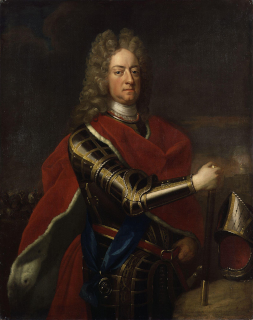
Butler succeeds to the title at the age of fifteen and was educated at the University of Oxford, taking the degree of LL.D. in 1677. In 1678, he is commissioned as a captain in Colonel Thomas Dongan‘s regiment, which is disbanded before he takes up his post.
In 1692, Butler is created Earl of Newcastle in County Limerick in the Jacobite peerage of Ireland. In France he is named Colonel of the 2nd Queen’s Regiment of Irish Horse in the service of that country and serves with distinction in various battles of the War of the Spanish Succession, also becoming a Lieutenant-General in the Spanish army. He is at the Siege of Roses in 1693, and in 1694 is a Brigadier attached to the army of Germany. He serves in Italy and other parts of Continental Europe from 1701 to 1703, sharing all the fortunes of the Irish Brigade. He later serves in the French army as a Lieutenant-General. He is created Brigadier of Cavalry in 1694.
Butler dies at the age of eighty-eight in Paris on June 18, 1740, and is buried at St. Paul’s there. John C. O’Callaghan writes in Irish Brigades in the Service of France (Glasgow, 1870): “The successive claimants of the title of Galmoy were officers in France down to the Revolution; in whose armies, as well as in others, various gentlemen have honourably represented a name, of which the illustrious General Lafayette is related to have said, in the war for the independence of the United States of America, that ‘whenever he wanted anything well done, he got a Butler to do it.'”
Notwithstanding the attainder, the viscountcy is assumed by his nephew, James Butler of the Irish Brigade in France, the son of the Viscount’s brother, Richard Butler of Galmoye.
Murray is born in Macroom, County Cork on January 17, 1873, the seventh of the eleven children of Cornelius Murray and Honora Murray (née Kelleher). He is educated at St. Patrick’s Teacher Training College in Drumcondra, Dublin. He works as a schoolteacher and in 1900 is appointed headmaster of the national school in Rathduff, County Cork. His first play, The Wheel of Fortune, is produced in 1909 by the Little Theatre in Cork, a theatre he co-founded with Daniel Corkery, Con O’Leary and Terence MacSwiney. The play is revised and renamed Sovereign Love in 1913. In 1915, he moves to Dublin as headmaster of the Model Schools at Inchicore, where he remains until his retirement from teaching in 1932.
Murray’s play Birthright is performed in the Abbey Theatre in 1910 and establishes him as a writer of force. In all, he writes fifteen plays, all of which are produced by the Abbey. His two most highly regarded works are Maurice Harte (1912) and Autumn Fire (1924). Both of these and Birthright are performed in New York City on Broadway, with Autumn Fire having a run of 71 performances. He also writes an autobiographical novel Spring Horizon (1937).
It has been stated both by A. DeGiacomo and by R. Allen Cave that, in the Art competitions at the 1924 Summer Olympics in Paris, France, Murray is awarded a bronze medal for his play Birthright. However, according to the official record for the games, although Murray is a participant in the literature category with this play and also with Maurice Harte, he does not win a medal.
In his later years, Murray holds a number of significant positions: director of the Authors’ Guild of Ireland, vice-president of the Irish Academy of Letters and president of the Irish Playwrights’ Association. He is awarded an honorary Doctor of Letters (D.Litt.) by the National University of Ireland in 1949. He dies on March 7, 1959, at his home on Sandymount Strand, Ballsbridge, Dublin, of viral pneumonia, his wife having predeceased him by fifteen years. His extensive papers, containing scripts of almost all of his fifteen plays, correspondence, clippings, reviews, and other material, are held in the National Library of Ireland (NLI).
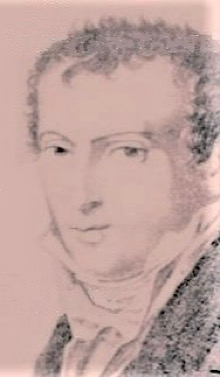
Madden is born at Wormwood Gate, Dublin, on August 22, 1798, to Edward Madden, a silk manufacturer, and his wife Elizabeth (née Corey). His father marries twice and fathers twenty-one children.
In 1828, Madden marries Harriet Elmslie, daughter of John Elmslie of Jamaica, a slave-owner. He then practises medicine in Mayfair, London, for the next five years.
Madden becomes a recruit to the abolitionist cause. The transatlantic slave trade has been illegal in the British Empire since 1807, but slavery itself remains legal.
From 1833, Madden is employed in the British civil service, first as a justice of the peace in Jamaica, where he is one of six Special Magistrates sent to oversee the eventual liberation of Jamaica’s slave population, according to the terms of the Slavery Abolition Act 1833. From 1835 he is Superintendent of the freed Africans in Havana, Cuba. In 1839 he leaves Cuba for New York, where he provides important evidence for the defense of the former slaves who had taken over the slave ship La Amistad.
In 1840 Madden becomes Her Majesty’s Special Commissioner of Inquiry into the British Settlements on the West Coast of Africa. His task is to investigate how the slave trade is continuing to operate on the west coast of Africa, despite the shipping of African slaves across the Atlantic Ocean now being illegal. He finds that London-based merchants (including WhigMPMatthew Forster) are actively helping the slave traders, and that crudely disguised forms of slavery exist in all the coast settlements. He particularly condemns the actions of George Maclean, the Governor of Gold Coast.
In 1847 Madden becomes the Colonial Secretary of Western Australia and arrives in the colony in 1848. After receiving news of their oldest son’s death back in Ireland, he and Harriet return to Dublin in 1849. In 1850 he is named secretary of the Office for Loan Funds in Dublin.
Madden also campaigns against slavery in Cuba, speaking to the General Anti-Slavery Convention in London on the topic of slavery in Cuba.
Madden dies at his home in Booterstown, just south of Dublin, on February 5, 1886, and is interred in Donnybrook Cemetery.
Besides several travel diaries (Travels in Turkey, Egypt etc. in 1824–27, 1829, and others (1833)), his works include the historically significant book The United Irishmen, their lives and times (1842-1860, 11 Vols.), which contains numerous details on the Irish Rebellion of 1798, including testimonies collected from veteran rebels and from family members of deceased United Irishmen.
The Irish American Athletic Club, an amateur athletic organization based in Queens, New York, is established on January 30, 1898, originally as the Greater New York Irish Athletic Association. They shorten the name to the Irish American Athletic Club a few years later. They purchase a plot of land in what is then called Laurel Hill, Long Island, near Calvary Cemetery, Queens, and build a state-of-the-art athletic facility on what is farmland. The stadium, called Celtic Park, formally reopens after renovations on May 9, 1901, and until the facility is sold for housing in 1930, some of the greatest American athletes train or compete on Celtic Park’s track and field. The Irish American Athletic Club adopts a winged fist adorned with American flags and shamrocks as their emblem, with the Irish Gaelic motto “Láim Láidir Abú” or “A strong hand will be victorious,” and are often referred to as the “Winged Fists.” At one time they have clubs in Boston, Chicago, San Francisco and Yonkers, New York.
The Irish American Athletic Club is predominantly composed of Irish-born and first generation Irish American athletes, but many of the athletes who compete for the Winged Fist organization are neither.
The Irish American Athletic Club wins the Amateur Athletic Union national outdoor track and field team championship titles in 1904, 1906, 1907, 1908, 1910, 1911, 1912, 1913, 1914 and 1916. They also win the national indoor track and field team championship titles in 1906, 1908, 1909, 1911, 1913, 1914 and 1915. Individual athletes of the IAAC win 81 national outdoor championships titles and 36 individual national indoor championship titles.
In 1912–13, 1913–14, 1914–15 and 1916–17 the Irish American Athletic Club has a team, the New York Irish-Americans, represented in the American Amateur Hockey League. The team is coached by James C. “Jimmy” O’Brien and has on its roster for various seasons future NHL players Tom McCarthy and Moylan McDonnell. John McGrath and Patsy Séguin also play for the club.
Before the largest crowd that has ever assembled to see a track meet in the United States, on September 9, 1916, the Irish American Athletic Club defeats the New York Athletic Club at the Amateur Athletic Union’s National Championships, by a score of 38 to 27. Before a crowd of 30,000 spectators at Newark, New Jersey‘s Weequahic Park, the Irish American Athletic Club wins what is to be their last national championship title. The club disbands a year later when the United States becomes a combatant in World War I.
Brigid GanlyHRHA, Irish painter and sculptor, is born Rosaleen Brigid O’Brien on January 29, 1909, in Dublin.
Ganly is one of five children born to Dermod O’Brien and his wife Mabel Smiley. Her father is a painter. His grandfather is the Irish republicanWilliam Smith O’Brien. She grows up in Country Limerick at a farm in Cahirmoyle until the family moves to Fitzwilliam Square in Dublin. She goes on to attend the Metropolitan School of Art where she has the opportunity to study under Patrick Tuohy, Seán Keating and Oliver Sheppard. She is a talented sculptor and wins several awards, including the Taylor scholarship in 1929, for her allegorical male nude, Pity. She spends time in Paris in 1951 where she trains with André Lhote. She travels to Greece where Lhote continues to influence her work.
Ganly also studies painting in the Royal Hibernian Academy School where she has Margaret Clarke and Seán O’Sullivan as teachers. She is made an associate of the Royal Hibernian Academy in 1928 and becomes a member in 1935, though in 1969 she resigns her membership in protest at the lack of young artists being given the opportunity to exhibit. In 1972 she is made an honorary member and returns.
Ganly is a representational artist and while known as a portrait artist, she also paints landscapes, interiors and may be best known for her still lifes. Some of her best works are portraits of her husband, her sister Ethel, her father, and her friend Sheila Pim. She illustrates the book-jackets of Pym’s works. She has many exhibitions, with the RHA and the Water Colour Society of Ireland. There is a retrospective of her life in 1998 in the Hugh Lane Gallery and her works are in the collections there. She is also in the collections of the Waterford Municipal Gallery, Crawford Art Gallery, Cork and in The National Self-Portrait Collection of Ireland. She is part of the 2014 exhibition “Irish Women Artists: 1870-1970.”
Ganly’s sister-in-law is Kitty Wilmer O’Brien with whom she often exhibits. She marries Andrew Ganly, a dental surgeon and writer, in 1936. He dies in 1982. They have two children, Eoghan and Phillida.
Davidson is the sixth of ten children of clerk of petty session, Edward Ellice Davidson, and Lucy Rising Davidson (née Doe). Her mother dies in 1888, and it is presumed that she receives a private education but as the family are not affluent, the details are unclear. She goes on to attend the Dublin Metropolitan School of Art (DMSA) from 1895 to 1905. While at the DMSA, she wins prizes in 1895 and 1896 and is awarded a scholarship and free studentship at the Royal Dublin Society (RDS) in 1897, the same year her father dies. She completes her studies in 1905. In the early 1910s, she is living in Rathmines and spends some time in England and Wales.
Davidson is commissioned by Switzer’s department store on Grafton Street to draw costumes in 1899. In 1909, her painting After Rain is exhibited by the Dublin Sketching Club, with her continuing to show work there until 1920. She exhibits The Bonfire with the Water Colour Society of Ireland in 1912, becoming a committee member in 1934 and continuing to exhibit with them until 1954. In 1914, she is one of the artists included in a sale of paintings to aid Belgian refugees. She is first exhibited at the Royal Hibernian Academy (RHA) in 1914, with The Student. Her painting exhibited by the RHA in 1916, The Harbour, St. Ives, demonstrates an influence from Stanhope Forbes and the Newlyn School, with a bright palette and contrasting illumination, which become characteristic of her work. She illustrates C. H. Bretherton’s collection of humorous poems and recollections about London Zoo, A Zoovenir (1919).
Davidson holds a joint exhibition with Mainie Jellett in 1920, at Mill’s Hall, Merrion Row, Dublin. Jellett produces a pencil portrait of Davison (pictured above), which shows her in a straw hat she frequently wears. The RHA exhibits Davidson’s oil painting, The Flax Pullers, in 1921. This work shows an influence from Paul Henry and French Impressionism in her use of colour-blocking. In the early 1920s, she travels to Switzerland, Belgium, and France, producing works such as Fish Market, Bruges. She lives in Paris in the late 1920s, exhibiting at the Salon de la Societé Nationale in 1924 and 1930. She places a self-portrait in her depiction of a peasant gathering, The Country Races. Reproductions of her drawing of Leinster House and Christ Church Cathedral by Bulmer Hobson are included in A Book of Dublin (1929). Her landscape, Low Tide, Wicklow, which is exhibited at the RHA in 1934, and Boats at Wicklow, Dusk show her ability to depict reflections in water. She continues to paint scenes of rural life, including Cottages – Keel, Achill, which shows an influence from Jack Butler Yeats in her use of space and colour. The fact that her family is not wealthy likely influences her choice of poorer people as her subjects, depicting them in a sympathetic manner. Her work is part of the painting event in the art competitions at the 1928 Summer Olympics.
Davidson’s paintings are exhibited at the Contemporary Picture Galleries, Dublin in 1930, alongside Yeats, Evie Hone, and Harry Kernoff. She is a member of the Picture Hire Club, 24 Molesworth Street, Dublin from 1941 to 1942, and is a frequent contributor to the Munster Fine Arts Club. Her work is exhibited at the Salon des Beaux Arts, Paris, the Royal Academy of Arts, London, and in Amsterdam. A large number of her works from the 1930s show the Irish-speaking area of Galway, Claddagh, such as Night in Claddagh, exhibited with the RHA in 1933. Her Irish landscapes, such as Claddagh Cottages, are included in the Oireachtas Art Exhibitions from 1932 to 1946. From around 1934, she is a member of the Society of Dublin Painters, exhibiting with them from 1939 to 1954. She influences the Society’s move toward the avant-garde in the 1940s. She is elected associate to the RHA in 1940 and continues to exhibit there until her death. Her 1946 work, Gorta, shows influence from Zola, Rilke, Dostoyevsky and Picasso.
Davidson teaches drawing at her studio at 1 Earlsfort Terrace, Dublin. Her pupils include Bea Orpen, Anne Yeats, and Mo Irwin. She also is a teacher at a number of Dublin schools, such as Belgrave school, Rathmines, Wesley College, St. Stephen’s Green, and Castle Park School, Dalkey. She travels to Abbeyleix, County Laois, once a week to teach at Glenbawn boarding school.
As well as painting, Davidson writes a number of plays, short stories, and monologues under a pseudonym, “Ulick Burke.” In 1927, a collection of her poems and Donegal rhymes is published. In 1931, Hilton Edwards directs her stage play Bride, at the Gate Theatre. Her short story, Her Only Son, is published in The Bell under a pseudonym in 1942. In 1935, she is a founder-member of the Torch Theatre, Dublin. She designs scenery, and is the co-director with Hugh Hyland in 1936, under the stage name “Jennifer Maude.”
Davidson dies at her home at 4 Wilton Terrace, Dublin on March 29, 1954. She is buried in an unmarked grave in Mount Jerome Cemetery. The National Gallery of Ireland (NGI) holds her 1938 portrait of Yeats, as well as her crayon drawing of Sarah Purser. She is a regular attendee at Purser’s “Second Tuesdays” gatherings. The Abbey Theatre holds her portrait of Joseph Holloway. She bequeaths The Golden Shawl to the Hugh Lane Gallery, which is a large self-portrait. Two of her works are included in the NGI’s 1987 exhibition, Irish Women Artists from the Eighteenth Century to the Present Day.