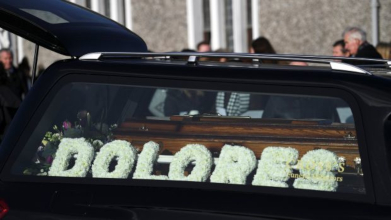
The funeral cortege arrives at the church in Glencullen at 11:00 AM and is met by an honour guard from the Coast Guard and other rescue services. Captain Fitpatrick’s parents, four siblings, her young son Fionn, and other family members accompany the coffin into the church.
In his homily, Parish Priest Fr. Andrew O’Sullivan says St. Patrick’s church has seen many sad and tragic funerals but few as sad and sorrowful as this one. He pays tribute to the Fitzpatrick family and says they and the community have lost a loved and valued member. He adds that the congregations’ thoughts are with Captain Fitzpatrick’s three crew members who have yet to be found.
Fr. O’Sullivan says the family takes comfort from the fact that Dara had lived life to the fullest. Mourners hear that as well as being a loving mother, Dara was an avid traveler, cook and animal lover.
Poor weather conditions off the west coast of Ireland hamper the search for the three missing crew members and the wreckage of the Coast Guard helicopter R116. On March 22, the wreckage of the main part of the helicopter is detected by underwater cameras about 60 metres off Blackrock Island. The body of co-pilot Captain Mark Duffy is found in the cockpit section of the wreckage. A helmet and lifejacket belonging to one of the two missing crewmen is discovered on a beach on the Mullet Peninsula on September 30, 2017.
(From: Captain Dara Fitzpatrick remembered during funeral service, RTÉ.ie, the website of Raidió Teilifís Éireann, Ireland’s National Public Service Broadcaster, March 18, 2017)
Gifford is the second youngest of 12 children born to Frederick Gifford, a solicitor and a Roman Catholic, and Isabella Julia Burton Gifford, a Protestant. The boys are baptised as Catholics and the girls as Protestant, but effectively the children are all raised as Protestants with the girls attending Alexandra College in Earlsfort Terrace.
Gifford returns to Dublin in 1908 and, with great difficulty, tries to earn a living as a caricaturist, publishing her cartoons in The Shanachie, Irish Life, Meadowstreet and The Irish Review, which is edited from 1913 by Joseph Plunkett. She considers emigrating but gives up the idea. Nora Dryhurst, a journalist from London, brings her to the opening of the new bilingual school Scoil Éanna in Ranelagh, Dublin. It is here that she meets Plunkett for the first time. He is a friend of her brother-in-law, another of the future leaders of the 1916 Easter Rising, Thomas MacDonagh, who is married to her sister Muriel.
Gifford’s growing interest in the Roman Catholic religion leads to the deepening of Gifford and Plunkett’s relationship as she begins to discuss Catholic mystical ideas with him. Plunkett proposes to her in 1915, and she accepts and takes formal instruction in Catholic doctrine. She is received into the Catholic Church in April 1916. The couple plans to marry on Easter Sunday that year, in a double wedding with his sister and her fiancé.
After the Rising, Gifford’s brother-in-law Thomas MacDonagh is shot with Patrick Pearse and Thomas Clarke by firing squad on May 3. That day, she hears that Plunkett is to be shot at dawn. She purchases a ring in a jeweler’s shop in Dublin and, with the help of a priest, persuades the military authorities to allow them to marry. She and Joseph are married on the night of May 3 in the chapel of Kilmainham Gaol, a few hours before he is executed.
Grace Plunkett decides to devote herself through her art to the promotion of Sinn Féin policies and resumes her commercial work to earn a living. She is elected to the Sinn Féin executive in 1917.
During the Irish Civil War, Plunkett is arrested with many others in February 1923 and interned at Kilmainham Gaol for three months. She paints pictures on the walls of her cell, including one of the Blessed Virgin and the Christ Child. She is released in May 1923.
When the Civil War ends, Plunkett has no home of her own and little money. Like many Anti-Treaty Republicans, she is the target of social ostracism and has difficulty finding work. Her talent as an artist is her only real asset and her cartoons are published in various newspapers and magazines. She moves from one apartment to another and eats in the city-centre restaurants but has no wish to remarry. Her material circumstances improve in 1932 when she receives a Civil List pension from Éamon de Valera‘s Fianna Fáil government. She lives for many years in a flat in Nassau Street with a balcony overlooking the sports ground of Trinity College.
Plunkett’s in-laws refuse to honour her husband’s will, in which he leaves everything to his widow. Legally, the will is invalid because there is only one witness, rather than the required two, and the marriage takes place after the will is made, automatically revoking it. For years she receives nothing, so she begins legal proceedings against her in-laws in 1934. The Count and Countess Plunkett settle out of court, and she is paid £700, plus costs.
At around this time Plunkett joins the Old Dublin Society, where she meets the noted Irish harpsichord maker Cathal Gannon. When Cathal marries, she gives him and his wife Margaret a present of two single beds and a picture. From the late 1940s onwards, her health declines. In 1950 she is brought to St. Vincent’s Hospital. She convalesces in a nursing home, which she does not like, mainly because it restricts her freedom.
Grace Gifford Plunkett dies suddenly on December 13, 1955, in her apartment in South Richmond Street, Portobello. Her body is removed to St. Kevin’s Church, Harrington Street and among the attendees at her funeral is PresidentSeán T. O’Kelly. She is buried with full military honours close to the republican plot in Glasnevin Cemetery.
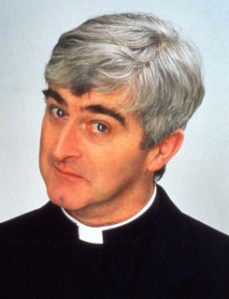
Morgan is born in Dublin on March 31, 1952. Educated at Oatlands College, Stillorgan, and University College, Dublin (UCD), Morgan comes to prominence as part of the team behind the highly successful RTÉ television show The Live Mike. Morgan makes his debut in the media on the Morning Ireland radio show produced by Gene Martin. Between 1979 and 1982 Morgan, who has been a teacher at St. Michael’s College, Ailesbury Road, plays a range of comic characters who appear between segments of the show, including Father Trendy, an unctuous trying-to-be-cool Catholic priest given to drawing ludicrous parallels with non-religious life in two-minute ‘chats’ to camera.
Morgan’s success as Father Trendy and other characters leads him to leave teaching and become a full-time comedian.
Morgan’s biggest Irish broadcasting success occurs in the late 1980s on the Saturday morning radio comedy show Scrap Saturday, which mocks Ireland’s political, business, and media establishment. The show’s treatment of the relationship between the ever-controversial TaoiseachCharles Haughey and his press secretary P.J. Mara prove particularly popular. When RTÉ axes the show in the early 1990s a national outcry ensues. Morgan lashes the decision, calling it “a shameless act of broadcasting cowardice and political subservience.”
Already a celebrity in Ireland, Morgan’s big break comes in Channel 4‘s Irish sitcom Father Ted, which runs for three series from April 21, 1995, until May 1, 1998. Writers Graham Linehan and Arthur Mathews audition many actors for the title role, but Morgan’s enthusiasm wins him the part.
Father Ted centres on three disparate characters. Father Ted Crilly, played by Morgan, lives a frustrated life trapped on the fictional Craggy Island. Irish TV comedy actor Frank Kelly plays Father Jack Hackett, a foul-mouthed and apparently brain-damaged alcoholic, while child-minded Father Dougal McGuire is played by comedian Ardal O’Hanlon. The three priests are looked after by their housekeeper, Mrs. Doyle, played by Pauline McLynn, with whom Morgan had worked on Scrap Saturday. Father Ted enjoys widespread popularity and critical acclaim. In 1998, the show wins a BAFTA award for the best comedy, Morgan wins a BAFTA for best actor, and McLynn is named best actress.
On February 28, 1998, one day after recording the last episode of Father Ted, Morgan has a heart attack while hosting a dinner party at his home in southwest London. He is rushed to hospital but dies soon afterwards. Morgan’s Requiem Mass in St. Therese’s Church in Mount Merrion, south Dublin, is attended by the President of IrelandMary McAleese, her predecessor, Mary Robinson, and by political and church leaders, many of whom had been the targets of his humour in Scrap Saturday. He is cremated at Glasnevin Cemetery and his ashes are buried in the family plot in Deansgrange Cemetery.
Born in Boherbee, County Kerry on January 15, 1926, McEllistrim is the son of the Fianna Fáil politician and Irish War of Independence veteran, Tom McEllistrim. He succeeds his father when he is elected to Dáil Éireann as a Fianna Fáil Teachta Dála (TD) for the Kerry North constituency at the 1969 general election. At the 1977 general election he is elected along with his running mate Kit Ahern. This is the first time that Fianna Fáil wins two seats in the three seat Kerry North constituency. McEllistrim, who is given much credit for this feat, is disappointed not to receive a promotion to a Minister of State.
McEllistrim becomes disillusioned with the Taoiseach and party leader Jack Lynch from then and begins to believe that Charles Haughey is the right candidate for the party leadership. He believes that Lynch is about to retire and is particularly uncomfortable at the thought of George Colley succeeding Lynch. Like his father before him he believes Colley is not right for the role of leader of the party. He is particularly vocal with regard to party policy towards Northern Ireland and, as he sees it, Lynch’s apparent lack of sympathy towards the northern nationalist community.
McEllistrim is a member of the so-called “gang of five” along with Seán Doherty, Mark Killilea Jnr, Jackie Fahey and Albert Reynolds who start a lobbying campaign in favour of Haughey on the backbenches of the party. After Lynch loses two by-elections in his native County Cork he resigns as party leader in December 1979. The leadership contest is called two days later and is a two-way race between Haughey and Colley. Haughey wins the leadership contest by a decisive margin and McEllistrim is rewarded by being appointed Minister of State at the Department of Finance with special responsibility for the Office of Public Works. He serves as a Minister of State again in 1982, this time at the Department of Fisheries and Forestry.
McKenna makes his film debut in the IRA–Nazi drama The Night Fighters (1960) and from this uncredited beginning he moves up to tenth billing in The Siege of Sidney Street (1960). His next major movie is Girl with Green Eyes (1964), by which time he has also started a successful television career, making his TV debut in Espionage (1963) and over the next few years appears in several more TV shows. His versatility enables him to play three characters in The Avengers (1961). He is also featured in such well-regarded shows as Adam Adamant Lives! (1966), Dixon of Dock Green (1955) and The Saint (1962).
McKenna dies on February 13, 2011, at the Royal Free Hospital in Hampstead, London, at the age of 81 following a long period of illness. He is buried alongside his wife at Teampall Cheallaigh Cemetery in his native County Cavan.
Following his death, tributes are paid by President of IrelandMary McAleese, Prince Charles, and Ireland’s Minister for Tourism, Culture and SportMary Hanafin, who says that McKenna was “one of a great generation whose talents on the screen and stage both at home and abroad gave us all great pride in his accomplishments.” In County Cavan, he is commemorated by the T. P. McKenna Drama Scholarships (VEC) and the T. P. McKenna Perpetual Trophy presented as part of the Millrace Annual Drama Festival.
Hundreds of people gather at the rural church to say goodbye to a singer renowned for her distinctive voice. The Cranberries enjoyed huge success in the 1990s with tracks including “Zombie” and “Linger.” O’Riordan, who was also a member of alternative rock group D.A.R.K., had been working on a new studio album with The Cranberries in the months before her death. Her boyfriend and fellow D.A.R.K. band member Olé Koretsky is among the mourners. Her three children – Taylor, Molly and Dakota – join the singer’s mother Eileen, her sister Angela and brothers Terence, Brendan, Donal, Joseph and PJ in the small parish church. Her former husband Don Burton is also in attendance.
At the outset of the mass, symbols associated with O’Riordan’s life are brought to the altar. Her niece Eileen and a long-time friend bring forward a guitar and a platinum disc award. A picture of Our Lady of Dolours, after whom Dolores is named, is placed at the altar, as is a book of poetry.
In his homily, Canon Liam McNamara recalls meeting the young O’Riordan in 1989 when she was singing and playing the keyboard in the church. “She did have a unique respect for everybody,” he said. “Coupled with that respect, her kind, loving and generous heart made her a source of great hope to the Church, during its stormy years. For that we sincerely thank her from our hearts.”
During Communion, O’Riordan’s version of the hymn “Panis Angelicus” is played in the church. Archbishop of Cashel and EmlyKieran O’Reilly says, “Since we heard of the sudden death of Dolores O’Riordan, many hearts in Ireland and around the world are heavy with sadness on hearing the news.”
“Indeed, the great outpouring of sympathy and love for Dolores which we have seen since her death is a witness and a tribute to her great musical talent and very special voice by her many fans and lovers of music. “Dolores put her God-given talents at the service of others.”
Archbishop O’Reilly hails O’Riordan’s voice as “unique, far reaching and distinctly Irish. Her gifts have resonated in the lives of many and will continue to do so as her music and her songs will continue to be played and listened to.”
At the close of the service, The Cranberries’ song “When You’re Gone” rings around the church as the singer’s coffin is carried to the adjacent Caherelly Cemetery for a private burial service. Mourners break into a spontaneous round of applause.
On Monday evening, tea light candles light the streets as family and close friends accompany O’Riordan’s remains to the church from Cross’s Funeral Home in Ballyneety. President of IrelandMichael D. Higgins pays his condolences to the singer’s family earlier in the day and signs a book of condolence. “It was very important to pay tribute to the contribution Dolores made,” says Higgins. “It is so moving, so profoundly sad, that somebody so young is taken from us. She was a star that shone bright from the very beginning,” he adds.
(From: “Voice of Dolores O’Riordan fills church at her funeral,” The Irish Times, January 23, 2018)
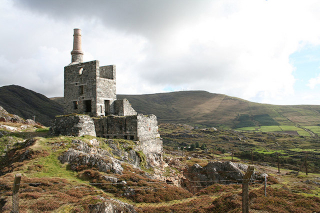
On January 7, 2000, experts underline the important heritage value of a 19th Century relic that stands on the site of a disused copper mine. A conservation appeal is launched to safeguard a unique engine house at a mountain mine in the Beara peninsula. A rare surviving symbol of Cornish type mining technology, the structure is the primary surviving embodiment of a once thriving copper mining industry in Allihies, County Cork.
The industrial mines in Allihies date back to 1812, when they are first opened by John Puxley. Mining activity reaches its peak there in 1845, when the mines employ around 1,600 people, after which the mines suffer with the local area during the Great Famine. The mines are operational until 1962, when they are finally closed. Large Cornish engine houses are constructed around the mining site, ruins of which survive today. These are used to pump out water to allow for deeper mining, and to transport miners and equipment down shafts that go below sea level. The site still contains a number of engine houses, mining shafts and a church. These are constructed by and for the Cornish miners who are brought to the area in the 1800s to mine copper ore. Once the mine becomes unprofitable, many of the miners emigrate to Butte, Montana.
The Allihies Copper Mine Museum (ACMM) is housed in a renovated Methodist church dating from 1845. It is officially opened by PresidentMary McAleese on September 13, 2007, after ten years of work by the Allihies Mines Co-op, a group that is formed to preserve the history of the area and mining heritage in the Allihies area, supported by the Mining Heritage Trust of Ireland.
The exhibitions cover all aspects of the history of copper mining in the area, from prehistoric times all the way up to the nineteenth century and the Industrial Revolution. The displays also cover the local geology and the social history of the mining heritage. The collections contain examples of mining equipment and tools from the various eras of activity. The exhibition space is also used to display artworks, with local artists such as Charles Tyrrell, Cormac Boydell, Rachel Parry and Tim Goulding exhibiting there.
(Pictured: Engine House, Allihies by John Gibson, view of the 1862 house for the 36″-cylinder beam engine that powered the man-engine and winder on Mountain Mine)
Childers is educated at Gresham’s School, Holt, and the University of Cambridge, hence his striking British upper-class accent. On November 24, 1922, when he is sixteen, his father, Robert Erskine Childers, is executed by the new Irish Free State on politically inspired charges of gun-possession. The pistol he had been found with had been given to him by Michael Collins. Before his execution, in a spirit of reconciliation, the elder Childers obtains a promise from his son to seek out and shake the hand of every man who had signed his death warrant.
Following his father’s funeral, he returns to Gresham’s, then two years later he goes on to Trinity College, Cambridge. He returns to Ireland in 1932 and becomes advertising manager of The Irish Press, the newly founded newspaper owned by the family of Éamon de Valera.
Childers is nominated as the presidential candidate of Fianna Fáil at the behest of de Valera, who pressures Jack Lynch in the selection of the presidential candidate. He is a controversial nominee, owing not only to his British birth and upbringing but to his Protestantism. However, on the campaign trail his personal popularity proved enormous, and in a political upset at the 1973 Irish presidential election, he is elected the fourth President of Ireland on May 30, 1973, defeating Tom O’Higgins by 635,867 (52%) votes to 578,771 (48%). He becomes the second Protestant to hold the office, the first being Douglas Hyde (1938–1945).
Prevented from transforming the presidency as he desires, Childers instead throws his energy into a busy schedule of official visits and speeches, which is physically taxing.
The British monarch and the Republic of Ireland‘s head of state chat and pose together at Hillsborough Castle, outside Belfast, for an occasion that would have provoked hostility within Northern Ireland’s Protestant majority just a few years earlier. But their trouble-free meeting becomes inevitable once Ireland dropped its territorial claim to Northern Ireland as part of the landmark Good Friday Agreement peace accord of 1998. The visit also fuels speculation the queen could soon make her first official visit to the neighboring Republic of Ireland, where the Irish Republican Army assassinated Lord Louis Mountbatten, the uncle of her husband, Prince Philip, Duke of Edinburgh.
No British monarch has visited the territory of the modern-day Republic of Ireland since George V visited Dublin in 1911, a decade before the island’s partition into a mostly Protestant north that remains within the United Kingdom, and a predominantly Catholic rest of Ireland that gradually gains full independence from Britain.
Camera crews are allowed to film the moment, but not record the sound, when McAleese shakes the queen’s hand at the start of a 20-minute meeting, their fourth since 1998. Previous meetings occurred at Buckingham Palace and on a World War I battlefield site. McAleese later calls it “a very special day for Anglo-Irish relationships” that brings forward the day when the queen will visit the Irish Republic.
McAleese, a Belfast-born Catholic, had made scores of visits to Northern Ireland since being elected to the Irish Republic’s largely symbolic presidency in 1997. As part of her presidential theme of “building bridges,” she regularly invites Protestant groups to her official Dublin mansion and has built impressive diplomatic contacts with northern Protestants.
Before McAleese’s arrival, visits north by an Irish president were rare events that drew public protests from Protestants, who demanded that Ireland remove its territorial claim from its 1937 constitution. The republic’s voters overwhelmingly supported this in a May 1998 referendum, an action completed in December 1999.
The queen has avoided traveling to the Irish Republic, in part, because of security fears following the IRA assassination of Mountbatten in August 1979. He, his daughter-in-law and two teenage boys are killed when the IRA blows up his private boat near his castle in County Sligo. However, Prince Philip and their son, Prince Charles, make several visits to the Irish Republic in the decade following the IRA’s 1994 cease-fire.
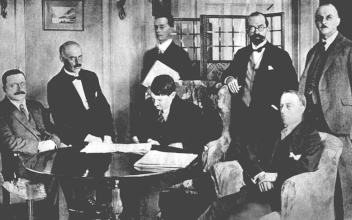
The Anglo-Irish Treaty, commonly known as The Treaty and officially the Articles of Agreement for a Treaty Between Great Britain and Ireland, is signed in the early morning hours of December 6, 1921 by representatives of the Irish government appointed by PresidentÉamon de Valera and those negotiating for the government of the United Kingdom of Great Britain and Ireland, ending the Irish War of Independence against Great Britain. It is then, and remains, one of the most debated moments in Irish history.
The Treaty provides for the establishment of the Irish Free State within a year as a self-governing dominion within the “community of nations known as the British Empire“, a status “the same as that of the Dominion of Canada.” It also provides Northern Ireland, which had been created by the Government of Ireland Act 1920, an option to opt out of the Irish Free State, which it exercises.
The agreement is signed in London by representatives of the British government, which includes Winston Churchill and Prime MinisterDavid Lloyd George, who are old masters at the game of politics, and by representatives of the Irish Republic including Michael Collins and Arthur Griffith, who have nowhere near the political acumen of the British delegation. De Valera, a shrewd, experienced politician, may have been the only man in all of Ireland who might have matched them, but he refuses to join the negotiations.
The Irish representatives have plenipotentiary status acting on behalf of the Irish Republic, though the British government declines to recognise that status. As required by its terms, the Treaty is approved by “a meeting” of the members elected to sit in the House of Commons of Southern Ireland and separately by the British Parliament. In reality, Dáil Éireann, the legislative assembly for the de facto Irish Republic, first debates then approves the treaty. Members then proceed with the “meeting.” Though the Treaty is narrowly approved, the split leads to the Irish Civil War, which is won by the pro-treaty side.
The Irish Free State as contemplated by the Treaty comes into existence when its constitution becomes law on December 6, 1922 by a royal proclamation.
(Pictured: Michael Collins signs the Anglo-Irish Treaty on December 6, 1921)






 The
The 
