seamus dubhghaill

Promoting Irish Culture and History from Little Rock, Arkansas, USA


Leave a comment

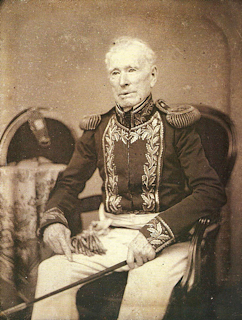
Birth of William Brown, Commander in the Argentine Navy

William Brown, Irish sailor, merchant, and naval commander who serves in the Argentine Navy during the wars of the early 19th century, is born on June 22, 1777, in Foxford, County Mayo. He is also known in Spanish as Guillermo Brown or Almirante Brown.

Comparatively little is known of his early life, and it has been suggested that he was illegitimate and took his mother’s surname and that his father’s surname was actually Gannon. He emigrates with his father to Baltimore, Maryland, in 1793, eventually settling in Philadelphia, Pennsylvania. A short time after their arrival, the friend who had invited them and offered them food and hospitality dies of yellow fever. Several days later, his father also succumbs to the same disease.

One morning, while Brown is wandering along the banks of the Delaware River, he meets the captain of a ship then moored in port. The captain inquires if he wants employment and Brown agrees. The captain engages him as a cabin boy, thereby setting him on the naval promotion ladder, where he works his way to the captaincy of a merchant ship. After ten years at sea, where he develops his skills as a sailor and reaches the rank of captain, Brown is press-ganged into a Royal Navy warship. British impressment of American sailors is one of the primary issues leading to the War of 1812.

During the Napoleonic Wars, Brown escapes the ship he is serving on, a galley, and scuttles the vessel. However, the French do not believe he had assisted them and imprison him in Lorient. On being transferred to Metz, he escapes, disguised in a French officer’s uniform. However, he is recaptured and is imprisoned in the fortress of Verdun. In 1809, he escapes from there in the company of a British Army officer named Clutchwell, and eventually reaches German territory.

Returning to England, Brown renounces his maritime career and on July 29, 1809, he marries Elizabeth Chitty, daughter of an English shipping magnate, in Kent. As he is a Catholic and she a Protestant, they agree to raise their sons as Catholics and their daughters as Protestants. Despite lengthy periods of enforced separation, they have nine children. He leaves the same year for the Río de la Plata on board Belmond and sets himself up as a merchant in Montevideo, Uruguay.

Late in 1811 Brown settles in Buenos Aires just as a criollo rebellion against Spanish colonial rule in Argentina is gaining strength. By April 1812, he is developing a coastal shipping business in fruit and hides. As the Spanish naval blockade of 1812–14 begins to choke trade, he is first commissioned by the patriot government as a privateer licensed to raid Spanish merchantmen, and then, on March 1, 1814, invited to take charge of a small rebel naval squadron to contest Spanish control of the Río de la Plata estuary. Leading a fleet of nineteen ships, he fixes with great speed on a set of wartime naval routines and signaling methods, and organises a system of discipline, founding the navy on principles that pay exceptional attention to the welfare of ordinary seamen.

In early March 1814, Brown shows personal courage and incisive skill in outwitting and defeating a more powerful Spanish force near Martín García Island, thereby dividing the Spanish blockade. A Spanish attempt in May 1814 to break his blockade of Montevideo is decisively crushed by him and his makeshift navy, and the Spanish strongholds on the Atlantic coast collapse, ending open war. In 1815 and 1816, however, he carries out skirmishing raids on military and commercial targets belonging to Spanish South American possessions, until detained by a British colonial governor in Barbados in July 1816 for alleged infringements of international rules of trade.

Illness, and a tortuous but ultimately successful appeal process, take up most of 1817–18, but when Brown returns to Argentina in October 1818, political enemies set in motion a prosecution for alleged disobedience of orders. Cashiered in August 1819, then restored in rank but forced to retire, he attempts suicide the following month. Convalescence and resumption of his trading concern occupies him for several years.

A repentant government renews Brown’s command of the navy in December 1825, when war breaks out with Brazil. Though vastly outnumbered by the Brazilian fleet, he shows audacity and great finesse in a number of successful engagements in the Plate estuary in 1826, roving up the Brazilian coast on occasion to create great confusion. In February 1827, he triumphs in a series of actions known as the Battle of Juncal. After another year of commercial privateering against the Brazilian merchant fleet, he is one of two delegates selected to sign peace terms with Brazil in October 1828.

Retiring from active service that month, Brown tries to remain neutral as civil war erupts in Argentina, but reluctantly accepts the post of governor of Buenos Aires under General Juan Lavalle from December 1828 to May 1829, when he resigns in disgust at government excesses. During 1829–37 he holds aloof from the despotic government of Juan Manuel de Rosas. After French and British encroachments on the region in the later 1830s, he offers to take charge of the navy again to protect national independence and is available to defend Argentine interests when war breaks out with a French-backed Uruguay in early 1841. Though exasperated by a long and “stupid war,” he blockades the Uruguayan navy effectively until French and British fleets intervene in July 1845 with overwhelming force to capture his squadron and bring the war to an end.

Idolised by the Argentinian population for his high-principled and humane advocacy of independent democracy, Brown passes his last years trading and farming a country estate. In late 1847, he journeys to Ireland, hoping to find relations in Mayo, and is shocked by the hunger and destitution of the Great Famine.

Brown dies on March 3, 1857, at his home in Buenos Aires and is buried with full military honours. The Argentine government issues a comuniqué: “With a life of permanent service to the national wars that our homeland has fought since its independence, William Brown symbolized the naval glory of the Argentine Republic.” During his burial, General Bartolomé Mitre famously says: “Brown in his lifetime, standing on the quarterdeck of his ship, was worth a fleet to us.” His grave is currently located in the La Recoleta Cemetery in Buenos Aires.

Leave a comment

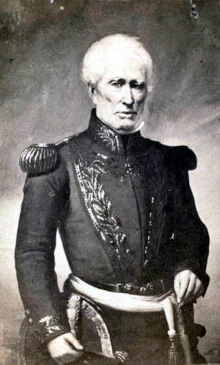
Death of William Brown, Commander in the Argentine Navy

William Brown, Irish sailor, merchant, and naval commander who serves in the Argentine Navy during the wars of the early 19th century, dies in Buenos Aires, Argentina, on March 3, 1857. He is also known in Spanish as Guillermo Brown or Almirante Brown.

Brown is born on June 22, 1777, in Foxford, County Mayo. Comparatively little is known of his early life, and it has been suggested that he was illegitimate and took his mother’s surname and that his father’s surname was actually Gannon. He emigrates with his father to Baltimore, Maryland, in 1793, eventually settling in Philadelphia, Pennsylvania. A short time after their arrival, the friend who had invited them and offered them food and hospitality dies of yellow fever. Several days later, his father also succumbs to the same disease.

One morning, while Brown is wandering along the banks of the Delaware River, he meets the captain of a ship then moored in port. The captain inquires if he wants employment and Brown agrees. The captain engages him as a cabin boy, thereby setting him on the naval promotion ladder, where he works his way to the captaincy of a merchant ship. After ten years at sea, where he develops his skills as a sailor and reaches the rank of captain, Brown is press-ganged into a Royal Navy warship. British impressment of American sailors is one of the primary issues leading to the War of 1812.

During the Napoleonic Wars, Brown escapes the ship he is serving on, a galley, and scuttles the vessel. However, the French do not believe he had assisted them and imprison him in Lorient. On being transferred to Metz, he escapes, disguised in a French officer’s uniform. However, he is recaptured and is imprisoned in the fortress of Verdun. In 1809, he escapes from there in the company of a British Army officer named Clutchwell, and eventually reaches German territory.

Returning to England, Brown renounces his maritime career and on July 29, 1809, he marries Elizabeth Chitty, daughter of an English shipping magnate, in Kent. As he is a Catholic and she a Protestant, they agree to raise their sons as Catholics and their daughters as Protestants. Despite lengthy periods of enforced separation, they have nine children. He leaves the same year for the Río de la Plata on board Belmond and sets himself up as a merchant in Montevideo, Uruguay.

Late in 1811 Brown settles in Buenos Aires just as a criollo rebellion against Spanish colonial rule in Argentina is gaining strength. By April 1812, he is developing a coastal shipping business in fruit and hides. As the Spanish naval blockade of 1812–14 begins to choke trade, he is first commissioned by the patriot government as a privateer licensed to raid Spanish merchantmen, and then, on March 1, 1814, invited to take charge of a small rebel naval squadron to contest Spanish control of the Río de la Plata estuary. Leading a fleet of nineteen ships, he fixes with great speed on a set of wartime naval routines and signaling methods, and organises a system of discipline, founding the navy on principles that pay exceptional attention to the welfare of ordinary seamen.

In early March 1814, Brown shows personal courage and incisive skill in outwitting and defeating a more powerful Spanish force near Martín García Island, thereby dividing the Spanish blockade. A Spanish attempt in May 1814 to break his blockade of Montevideo is decisively crushed by him and his makeshift navy, and the Spanish strongholds on the Atlantic coast collapse, ending open war. In 1815 and 1816, however, he carries out skirmishing raids on military and commercial targets belonging to Spanish South American possessions, until detained by a British colonial governor in Barbados in July 1816 for alleged infringements of international rules of trade.

Illness, and a tortuous but ultimately successful appeal process, take up most of 1817–18, but when Brown returns to Argentina in October 1818, political enemies set in motion a prosecution for alleged disobedience of orders. Cashiered in August 1819, then restored in rank but forced to retire, he attempts suicide the following month. Convalescence and resumption of his trading concern occupies him for several years.

A repentant government renews Brown’s command of the navy in December 1825, when war breaks out with Brazil. Though vastly outnumbered by the Brazilian fleet, he shows audacity and great finesse in a number of successful engagements in the Plate estuary in 1826, roving up the Brazilian coast on occasion to create great confusion. In February 1827, he triumphs in a series of actions known as the Battle of Juncal. After another year of commercial privateering against the Brazilian merchant fleet, he is one of two delegates selected to sign peace terms with Brazil in October 1828.

Retiring from active service that month, Brown tries to remain neutral as civil war erupts in Argentina, but reluctantly accepts the post of governor of Buenos Aires under General Juan Lavalle from December 1828 to May 1829, when he resigns in disgust at government excesses. During 1829–37 he holds aloof from the despotic government of Juan Manuel de Rosas. After French and British encroachments on the region in the later 1830s, he offers to take charge of the navy again to protect national independence and is available to defend Argentine interests when war breaks out with a French-backed Uruguay in early 1841. Though exasperated by a long and “stupid war,” he blockades the Uruguayan navy effectively until French and British fleets intervene in July 1845 with overwhelming force to capture his squadron and bring the war to an end.

Idolised by the Argentinian population for his high-principled and humane advocacy of independent democracy, Brown passes his last years trading and farming a country estate. In late 1847, he journeys to Ireland, hoping to find relations in Mayo, and is shocked by the hunger and destitution of the Great Famine.

Brown dies on March 3, 1857, at his home in Buenos Aires and is buried with full military honours. The Argentine government issues a comuniqué: “With a life of permanent service to the national wars that our homeland has fought since its independence, William Brown symbolized the naval glory of the Argentine Republic.” During his burial, General Bartolomé Mitre famously says: “Brown in his lifetime, standing on the quarterdeck of his ship, was worth a fleet to us.” His grave is currently located in the La Recoleta Cemetery in Buenos Aires.


Leave a comment

Birth of Sir Edward Carson, Politician, Barrister & Judge

Edward Henry Carson, Baron Carson, Irish unionist politician, barrister and judge, known as the “uncrowned king of Ulster,” is born on February 9, 1854, at 4 Harcourt Street, in Dublin. He serves as the Attorney General and Solicitor General for England, Wales and Ireland as well as the First Lord of the Admiralty for the British Royal Navy.

Although Carson is to become the champion of the northern province, he is born into a Protestant family in southern Ireland. He is educated at Portarlington School, Wesley College, Dublin, and Trinity College Dublin, where he reads law and is an active member of the College Historical Society. He graduates BA and MA.

From 1877, early in his Irish legal career, he comes to mistrust the Irish nationalists. As senior Crown prosecutor, he sternly enforces the Criminal Law and Procedure (Ireland) Act 1887, securing numerous convictions for violence against Irish estates owned by English absentee landlords. He is appointed Solicitor-General for Ireland and elected to the British House of Commons in 1892, is called to the English bar at Middle Temple on April 21, 1893, and serves as Solicitor General for England and Wales from 1900 to 1905. During these years he achieves his greatest success as a barrister. In 1895, his cross-examination of Oscar Wilde largely secures the Irish writer’s conviction for homosexuality.

On February 21, 1910, Carson accepts the parliamentary leadership of the anti-Home Rule Irish Unionists and, forfeiting his chance to lead the British Conservative Party, devotes himself entirely to the Ulster cause. His dislike of southern Irish separatism is reinforced by his belief that the heavy industry of Belfast is necessary to the economic survival of Ireland. The Liberal government (1908–16) under H. H. Asquith, which in 1912 decides to prepare a Home Rule bill, cannot overcome the effect of his extra-parliamentary opposition. The Solemn League and Covenant of resistance to Home Rule, signed by Carson and other leaders in Belfast on September 28, 1912, and afterward by thousands of Ulstermen, is followed by his establishment of a provisional government in Belfast in September 1913. Early in that year he recruits a private Ulster army, the Ulster Volunteer Force, that openly drills for fighting in the event that the Home Rule Bill is enacted. In preparation for a full-scale civil war, he successfully organizes the landing of a large supply of weapons from Germany at Larne, County Antrim, on April 24, 1914. The British government, however, begins to make concessions to Ulster unionists, and on the outbreak of World War I he agrees to a compromise whereby the Home Rule Bill is enacted but its operation suspended until the end of the war on the understanding that Ulster’s exclusion will then be reconsidered.

Appointed Attorney General for England in Asquith’s wartime coalition ministry on May 25, 1915, Carson resigns on October 19 because of his dissatisfaction with the conduct of the war. In David Lloyd George’s coalition ministry (1916–22) he is First Lord of the Admiralty from December 10, 1916, to July 17, 1917, and then a member of the war cabinet as minister without portfolio until January 21, 1918.

Disillusioned by the Government of Ireland Act 1920 that partitions Ireland and establishes what is essentially a Home Rule parliament in Belfast, Carson declines an invitation to head the Northern Ireland government and resigns as Ulster Unionist Party leader in February 1921. Accepting a life peerage, he serves from 1921 to 1929 as Lord of Appeal in Ordinary and takes the title Baron Carson of Duncairn.

Carson retires in October 1929. In July 1932, during his last visit to Northern Ireland, he witnesses the unveiling of a large statue of himself in front of Parliament Buildings at Stormont. The statue is sculpted by Leonard Stanford Merrifield, cast in bronze and placed upon a plinth. The inscription on the base reads “By the loyalists of Ulster as an expression of their love and admiration for its subject.” It is unveiled by James Craig, 1st Viscount Craigavon, in the presence of more than 40,000 people.

Carson lives at Cleve Court, a Queen Anne house near Minster-in-Thanet in the Isle of Thanet, Kent, bought in 1921. It is here that he dies peacefully on October 22, 1935. A warship brings his body to Belfast for the funeral. Thousands of shipworkers stop work and bow their heads as HMS Broke steams slowly up Belfast Lough, with his flag-draped coffin sitting on the quarterdeck. Britain gives him a state funeral on Saturday, October 26, 1935, which takes place in Belfast’s St. Anne’s Cathedral. He remains the only person to have been buried there. From a silver bowl, soil from each of the six counties of Northern Ireland is scattered onto his coffin, which had earlier been covered by the Union Jack. At his funeral service the choir sings his own favourite hymn, “I Vow to Thee, My Country.”


Leave a comment

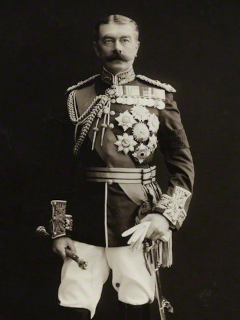
Death of Horatio Herbert Kitchener, 1st Earl Kitchener

Horatio Herbert Kitchener, 1st Earl Kitchener, Irish-born senior British Army officer and colonial administrator, drowns in the sinking of the HMS Hampshire west of Orkney, Scotland, on June 5, 1916. He wins notoriety for his imperial campaigns, especially his scorched earth policy against the Boers, his expansion of Lord Robertsinternment camps during the Second Boer War and his central role in the early part of World War I.

Kitchener is born in Ballylongford near Listowel, County Kerry, son of army officer Henry Horatio Kitchener and Frances Anne Chevallier, daughter of John Chevallier, a priest, of Aspall Hall, and his third wife, Elizabeth. The family moves to Switzerland when he is young, where he is educated at Montreux, then at the Royal Military Academy, Woolwich. He joins a French field ambulance unit in the Franco-Prussian War but is returned to England after he comes down with pneumonia.

Kitchener is credited in 1898 for winning the Battle of Omdurman and securing control of the Sudan for which he is made Baron Kitchener of Khartoum. As Chief of Staff (1900–1902) in the Second Boer War he plays a key role in Lord Roberts’ conquest of the Boer Republics, then succeeds Roberts as commander-in-chief, by which time Boer forces have taken to guerrilla warfare and British forces imprison Boer civilians in concentration camps. His term as Commander-in-Chief (1902–09) of the Army in India sees him quarrel with another eminent proconsul, the Viceroy Lord Curzon, who eventually resigns. He then returns to Egypt as British Agent and Consul General.

In 1914, at the start of World War I, Kitchener becomes Secretary of State for War, a Cabinet Minister. One of the few to foresee a long war, lasting for at least three years, and with the authority to act effectively on that perception, he organises the largest volunteer army that Britain had ever seen, and oversees a significant expansion of materials production to fight on the Western Front. Despite having warned of the difficulty of provisioning for a long war, he is blamed for the shortage of shells in the spring of 1915, one of the events leading to the formation of a coalition government and is stripped of his control over munitions and strategy.

On June 5, 1916, Kitchener is making his way to Russia on HMS Hampshire to attend negotiations with Tsar Nicholas II. At the last minute, Admiral Sir John Jellicoe changes the HMS Hampshire‘s route on the basis of a misreading of the weather forecast and ignoring (or not being aware of) recent intelligence and sightings of German U-boat activity in the vicinity of the amended route. Shortly before 7:30 PM the same day, steaming for the Russian port of Arkhangelsk during a Force 9 gale, HMS Hampshire strikes a mine laid by the newly launched German U-boat U-75 and sinks 1.5 miles west of the Orkney. Only twelve men survive. Amongst the dead are Kitchener and all ten members of his entourage. He is seen standing on the quarterdeck during the approximately twenty minutes that it takes the ship to sink. His body is never recovered.