seamus dubhghaill

Promoting Irish Culture and History from Little Rock, Arkansas, USA


Leave a comment

The Brookeborough Royal Ulster Constabulary Barracks Attack

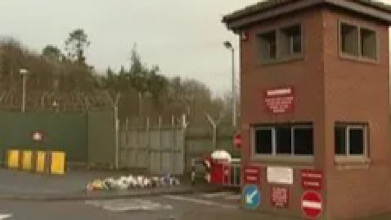
An Irish Republican Army (IRA) unit attacks Brookeborough Royal Ulster Constabulary (RUC) barracks on January 1, 1957, in one of the most famous incidents of the IRA’s Operation Harvest (Border campaign). Two IRA men are killed as they attack Brookeborough police station in County Fermanagh. The attack is a military disaster for the IRA, but it proves a major propaganda coup.

The two dead men, Seán South and Fergal O’Hanlon, are hailed as republican martyrs. Their funerals are attended by thousands of people and their lives immortalised in republican ballads.

The Brookeborough raid is the central action in the IRA’s border campaign of 1956-62, yet it is over and done within a matter of minutes. The aim is to unite Ireland by setting up “liberated zones” in Northern Ireland and overthrowing the Stormont government. The campaign is preceded by a series of raids carried out by republican splinter group Saor Uladh. An attack on Rosslea police station in County Fermanagh in November 1955 results in the death of Saor Uladh member Connie Green.

Royal Ulster Constabulary (RUC) officer Gordon Knowles finds himself on the sharp end of the assault as the republicans blow the front wall from the barracks. “I was blown right across the guard room,” he says. “The only thing I felt was like somebody hitting me in the back and that was the bullet going in through the left-hand side of the spine, round the back of the spine and lodging one inch from the back. They shone a torch in my face and said: ‘Oh, let’s go, he’s had it.'”

Knowles is lucky to be alive as medical staff discover thirteen bullet holes in his body. He recovers to resume his police career and still carries bullet splinters in his body to this day.

The Brookeborough raid, involving fourteen IRA men, is planned along identical lines to the Rosslea attack, with very different results. The IRA aims to explode a bomb in front of the police station and to seize RUC weapons.

Just two days previously, the police suffer their first death of the border campaign when Constable John Scally is killed in an attack on Derrylin barracks, another County Fermanagh border station.

Ahead of the Brookeborough attack, the men gather at the County Monaghan family home of Fergal O’Hanlon, who takes part in the raid. O’Hanlon’s sister Pádraigín Uí Mhurchadha describes the scene. “I remember Fergal, on the night, saying to my mother ‘These men, give them a good meal because there are faces here tonight you won’t see again.’ Now it turned out that he happened to be one of the men that she would not see again.”

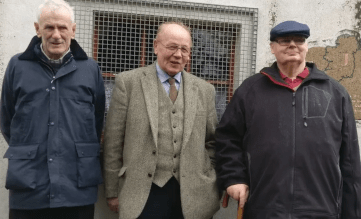
The BBC has recently spoken to three of the IRA men involved the raid.

Micheal Kelly, now in his 80s, has never given an interview before about his role in the attack. “The objective was to attack the barracks, take their guns from them and if necessary, if we had the time and space, to actually destroy the barracks,” he says.

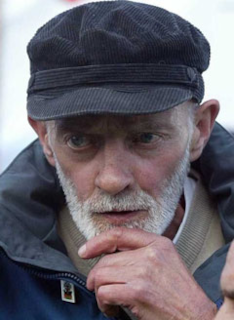
Phil O’Donoghue is also part of the IRA unit. Today, he is honorary president of the 32 County Sovereignty Movement, which is believed to be closely aligned to the Real IRA. He insists the Brookeborough operation was about taking arms rather than killing police officers. “We had strict orders – under no circumstances were we to take on the B Specials (Ulster Special Constabulary) or RUC. We were, if at all possible, to try and take their weapons but we were not in any way to attack them.”

The IRA men arrive in Brookeborough in a stolen tipper lorry, but the driver is unfamiliar with the village and stops in the wrong place. Paddy O’Regan, from Dublin, is in the back of the lorry. His job is to assist Seán South in operating a Bren light machine gun. “When the truck actually stopped, and I got up off the floor and looked over the side of the truck I was looking into a shop – no sign of a barracks.” It is the first in a series of errors – the bomb placed by the station door fails to explode.

Barry Flynn, who has written a history of the border campaign, says he saw Brookeborough as a kind of tragic fiasco. “It became like the Keystone Cops,” he says. “There were a number of grenades thrown at the police station when they found it. One bounced back underneath the lorry and actually damaged the lorry very badly.”

RUC Sgt. Kenneth Cordner is quick to react to the attack. The truck is eventually parked up close to the barracks, allowing Sgt. Cordner a clear field of fire from an upstairs window. Using a Sten sub-machine gun, he opens up with deadly effect on the IRA men below.

Paddy O’Regan is wounded in the ensuing firefight. “We started to return fire on the barracks,” he says. “And after a while I looked down and I saw Seán South lying flat on his face and I felt two thumps in my hip. I knew I was wounded but it didn’t hurt particularly bad. It’s just like somebody hit you a couple of digs and it was just my hips started going numb.”

The order is given to withdraw, according to ex-IRA man Micheal Kelly. “Fergal, the last thing I heard him say, ‘Oh, my legs, oh, my legs!’ He was shot in the legs and bled to death. Seán South, I would say, was dead at this stage.”

The attackers flee across the border leaving the two dead men at a remote farm building where they are found by police.

Bobbie Hanvey is a well-known broadcaster and photographer. In 1957 he is just twelve years old and living across the road from the Brookeborough barracks. He remembers hiding under a bed with two of his friends as the attack unfolded. “The bedroom lit up – it was like daylight with the flames coming out of the guns. That image and the sounds of those guns and that experience has stayed with me to the present day – I’ll never forget it.”

Historian Barry Flynn explains that the Brookeborough raid is also a symbolic moment for the republican movement. The lives of the dead IRA men are subsequently remembered in two famous ballads, “Seán South from Garryowen” and the “Patriot Game.”

“People were writing the songs and, regardless of what was going to happen in the rest of the campaign, the names of Seán South and Fergal O’Hanlon were there forever as the martyrs of Brookeborough”, says Flynn.

The border campaign never again reaches the intensity of the Brookeborough incident, but police officers and IRA men continue to die. The IRA calls a ceasefire in 1962. By then it is clear that its strategy for overthrowing the Stormont government has failed.

(From: “Brookeborough: Failed IRA attack and republican legend” by Robin Sheeran and Bernadette Allen, BBC News NI, http://www.bbc.com, February 22, 2019 | Pictured: Ex-IRA men Micheal Kelly, Phil O’Donoghue and Paddy O’Regan who have a role in the Brookeborough raid)


Leave a comment

Death of Fr. Des Wilson, Irish Catholic Priest & Church Dissident

Father Des Wilson, Irish Catholic priest and church dissident who in the course of the Northern Ireland Troubles embraces ideas and practice associated, internationally, with liberation theology, dies in his native Belfast on November 5, 2019. He believes the Word of God can never be silent in the face of oppression, injustice and suffering. He seeks to apply the ideas of liberation theology to the North, supporting and empowering marginalised communities, and acting as a voice for the voiceless.

Wilson is born in Belfast on July 8, 1925, the youngest of five sons to William Wilson, a publican and native of County Cavan, and his wife Emma (née McAvoy), a native of south County Down. He spends his earliest years above his father’s pub in Belfast, before the family moves to a house in the suburbs.

Wilson attends primary school locally, then receives secondary education at St. Malachy’s College. During his time there Belfast is blitzed in April and May 1941. Almost 1,000 are killed. The carnage he sees is a factor in his deciding on the priesthood.

After secondary school Wilson enters the seminary at St. Malachy’s, while studying English and Philosophy at Queen’s University Belfast. He proceeds to St. Patrick’s College, Maynooth, being ordained on June 19, 1949, for the Diocese of Down and Connor.

After ordination Wilson serves as chaplain in Belfast’s Mater Infirmorum Hospital, then spends 15 years in St. Malachy’s as spiritual director. Former pupils remember him as fair, and able to play jazz excellently on the organ.

Wilson lives out his beliefs, spending half a century in Belfast’s Ballymurphy estate, among the North’s most deprived, and one of the areas which suffers worst from the Troubles. There he plays a role in community development, establishing projects to provide employment in the area. He suffers, finding himself for years outside the official Catholic Church.

Wilson plays a significant role in providing adult education. He wants an education that does not just provide qualifications and open career paths but is psychologically liberating.

Life changes in 1966 when Wilson is moved to St. John’s Parish in West Belfast as a curate. Having come from a comfortable background in Ballymurphy, he is shocked by the poverty, the poor housing and the treatment of women. Unusual for a priest at the time, he moves into a terraced house in the estate. He finds the Catholic Church unable to respond to the multiple problems people are facing. That inability worsens as the Troubles erupt.

Wilson’s personal probity is so recognised that he is accepted as a mediator in feuds between the Provisional Irish Republican Army and Official Irish Republican Army in the 1970s and is able to broker permanent peace. He also helps bring about the ceasefires in the 1990s.

Wilson does not shirk unpopular stances. In the 1970s he refuses to condemn the Irish Republican Army (IRA). Later he says the conviction of former Real Irish Republican Army leader Michael McKevitt for directing terrorism is unsafe. He also publicly visits and supports a Ballymurphy couple which has a very bitter falling out with Sinn Féin, leading to a picket on their home.

By 1975 relations with his bishop has broken down and Wilson resigns but continues ministering in Ballymurphy. Forbidden to say Mass in a church, his pay cut off, he says Mass in his house. He suffers hardship, living from savings, some earnings from writing, broadcasting and lecturing, and help from Quaker and Presbyterian friends. By the early 1980s his Ballymurphy home becomes too small for the many classes he organises. His classes are rehoused and expanded as the Conway Education Centre in a vacant mill. He is able to offer a range of vocational and non-vocational courses with almost 1,000 students. In the mid-1980s his relationship with the Dioceses of Down and Connor is re-established, and he is allowed to continue his ministry.

Personally, Wilson has great gifts of head and heart and is incapable of rancour. A strong belief is that it is important to share food to talk, as happened in Biblical times. Thus, a lunch would last an afternoon.

Wilson dies on November 5, 2019, in Belfast. Instead of wreaths, he asks mourners to donate to the Ballymurphy Massacre Memorial Garden. The garden is dedicated to the victims of the Ballymurphy massacre of August 1971, which saw the killing in the district of eleven civilians by soldiers of the 1st Battalion, Parachute Regiment. The victims include Fr. Hugh Mullan, who had been a student of Wilson’s at St. Malachy’s. He was shot while going to the aid of a wounded man.

Following a Requiem Mass at Corpus Christi Church in Ballymurphy, Wilson is buried in Milltown Cemetery. Senior Sinn Féin politicians Gerry Adams and Michelle O’Neill are among those who take turns carrying his coffin.

(From: “Fr Des Wilson obituary: Priest who fought oppression and injustice in North,” The Irish Times, http://www.irishtimes.com, December 7, 2019)


Leave a comment

The Provisional IRA Resumes the August 1994 Ceasefire

On July 19, 1997, the Provisional Irish Republican Army (Provisional IRA) resumes a ceasefire to end their 25-year campaign to end British rule in Northern Ireland.

The Provisional IRA, officially known as the Irish Republican Army (Irish: Óglaigh na hÉireann) and informally as the Provos, is an Irish republican paramilitary force that seeks to end British rule in Northern Ireland, facilitate Irish reunification and bring about an independent republic encompassing all of Ireland. It is the most active republican paramilitary group during the Troubles. It argues that the all-island Irish Republic continues to exist, and it sees itself as that state’s army, the sole legitimate successor to the original IRA from the Irish War of Independence (1919-21). It is designated a terrorist organisation in the United Kingdom and an unlawful organisation in the Republic of Ireland, both of whose authority it rejects.

The Provisional IRA emerges in December 1969, due to a split within the previous incarnation of the IRA and the broader Irish republican movement. It is initially the minority faction in the split compared to the Official IRA but becomes the dominant faction by 1972. The Troubles begin shortly before when a largely Catholic, nonviolent civil rights campaign is met with violence from both Ulster loyalists and the Royal Ulster Constabulary (RUC), culminating in the August 1969 riots and deployment of British soldiers. The IRA initially focuses on defence of Catholic areas, but it begins an offensive campaign in 1970 that is aided by external sources, including Irish diaspora communities within the Anglosphere, and the Palestine Liberation Organization (PLO) and Libyan leader Muammar Gaddafi. It uses guerrilla tactics against the British Army and RUC in both rural and urban areas and carries out a bombing campaign in Northern Ireland and England against military, political and economic targets, and British military targets in mainland Europe. They also target civilian contractors to the British security forces. The IRA’s armed campaign, primarily in Northern Ireland but also in England and mainland Europe, kills over 1,700 people, including roughly 1,000 members of the British security forces and 500–644 civilians.

The Provisional IRA declares a final ceasefire on July 19, 1997, after which its political wing, Sinn Féin, is admitted into multi-party peace talks on the future of Northern Ireland. These talks result in the 1998 Good Friday Agreement. In 2005, the IRA formally ends its armed campaign and decommissions its weapons under the supervision of the Independent International Commission on Decommissioning. Several splinter groups have been formed as a result of splits within the IRA, including the Continuity IRA, which is still active in the dissident Irish republican campaign, and the Real IRA.

The Provisional IRA issues the following statement to news media on the morning of July 19, 1997:

“On August 31, 1994, the leadership of Oglaigh na hEireann (Gaelic for Irish Republican Army) announced a complete cessation of military operations as our contribution to the search for a lasting peace.

After 17 months of cessation, in which the British government and the (pro-British Protestant) unionists blocked any possibility of real or inclusive negotiations, we reluctantly abandoned the cessation.

The Irish Republican Army is committed to ending British rule in Ireland.

It is the root cause of division and conflict in our country. We want a permanent peace and therefore we are prepared to enhance the search for a democratic peace settlement through real and inclusive negotiations.

So, having assessed the current political situation, the leadership of Oglaigh na hEireann are announcing a complete cessation of military operations from 12 o’clock midday on Sunday the 20th, July 1997.

We have ordered the unequivocal restoration of the ceasefire of August 1994. All IRA units have been instructed accordingly.”


Leave a comment

Death of Brian Keenan, Member of the Army Council of the Provisional IRA

Brian Keenan, a member of the Army Council of the Provisional Irish Republican Army (IRA), dies on May 21, 2008, at Cullyhanna, County Armagh, Northern Ireland, following a battle with colorectal cancer. He receives an 18-year prison sentence in 1980 for conspiring to cause explosions and plays a key role in the Northern Ireland peace process.

The son of a member of the Royal Air Force (RAF), Keenan is born on July 17, 1941, in Swatragh, County Londonderry, Northern Ireland, before his family moves to Belfast. As a teenager, he moves to England to find work, for a time working as a television repairman in partnership with his brother in Corby, Northamptonshire. During this time, he comes to the attention of the police when he damages a cigarette machine, which leads to police having his fingerprints on file. He returns to Northern Ireland when the Troubles begin and starts working at the Grundig factory in the Finaghy area of Belfast where he acquires a reputation as a radical due to his involvement in factory trade union activities.

Despite his family having no history of republicanism, Keenan joins the Provisional Irish Republican Army in 1970 or 1971, and by August 1971 is the quartermaster of the Belfast Brigade. He is an active IRA member, planning bombings in Belfast and travelling abroad to make political contacts and arrange arms smuggling, acquiring contacts in East Germany, Libya, Lebanon and Syria. In 1972, he travels to Tripoli to meet with Libyan leader Muammar Gaddafi in order to acquire arms and finance from his government. In early 1973 he takes over responsibility for control of the IRA’s bombing campaign in England and also becomes IRA Quartermaster General. In late 1973, he is the linchpin of the kidnap of his former employer at Grundig, director Thomas Niedermayer.

In early 1974, Keenan plans to break Gerry Adams and Ivor Bell out of Long Kesh using a helicopter, in a method similar to Seamus Twomey‘s escape from Mountjoy Prison in October 1973, but the plan is vetoed by Billy McKee. He is arrested in the Republic of Ireland in mid-1974 and sentenced to twelve months imprisonment for IRA membership. On March 17, 1975, he is shot and wounded while attempting to lead a mass escape from Portlaoise Prison. While being held in Long Kesh, Gerry Adams helps to devise a blueprint for the reorganisation of the IRA, which includes the use of covert cells and the establishment of a Southern Command and Northern Command. As the architects of the blueprint, Adams, Bell and Brendan Hughes, are still imprisoned, Martin McGuinness and Keenan tour the country trying to convince the IRA Army Council and middle leadership of the benefits of the restructuring plan, with one IRA member remarking “Keenan was a roving ambassador for Adams.” The proposal is accepted after Keenan wins support from the South Derry Brigade, East Tyrone Brigade and South Armagh Brigade, with one IRA member saying, “Keenan was really the John the Baptist to Adams’ Christ.”

In December 1975, members of an IRA unit based in London are arrested following the six-day Balcombe Street siege. The IRA unit had been active in England since late 1974 carrying out a series of bombings, and a few months after his release from prison Keenan visits the unit in Crouch Hill, London, to give it further instructions. In follow-up raids after the siege, police discover crossword puzzles in his handwriting and his fingerprints on a list of bomb parts. A warrant is issued for his arrest.

Garda Síochána informer Sean O’Callaghan claims that Keenan recommended IRA Chief of Staff Seamus Twomey to authorise an attack on Ulster Protestants in retaliation to an increase in sectarian attacks on Catholic civilians by Protestant loyalist paramilitaries, such as the killing of three Catholics in a gun and bomb attack by the Ulster Volunteer Force (UVF) on Donnelly’s Bar in Silverbridge, County Armagh on December 19, 1975. According to O’Callaghan “Keenan believed that the only way, in his words, to put the nonsense out of the Prods [Protestants] was to just hit back much harder and more savagely than them.” Soon after the sectarian Kingsmill massacre occurs, when ten Protestant men returning home from their work are ordered out of a minibus they are travelling in and executed en masse with a machine gun on January 5, 1976.

Keenan is arrested on the basis of the 1975 warrant near Banbridge on March 20, 1979, when the Royal Ulster Constabulary (RUC) stopped two cars travelling north on the main road from Dublin to Belfast and is extradited to England to face charges relating to the Balcombe Street Gang‘s campaign in England. His capture is a blow to the IRA, in particular as he was carrying an address book listing his contacts including Palestinian activists in the United Kingdom. The IRA responds by dispatching Bobby Storey and three other members to break Keenan out of prison using a helicopter, but all four are arrested and remanded to Brixton Prison. Keenan stands trial at the Old Bailey in London in June 1980 defended by Michael Mansfield and is accused of organising the IRA’s bombings in England and being implicated in the deaths of eight people including Ross McWhirter and Gordon Hamilton Fairley. He is sentenced to eighteen years imprisonment after being found guilty on June 25, 1980.

Keenan continues to support Gerry Adams while in prison. In August 1982 Adams is granted permission by the IRA’s Army Council to stand in a forthcoming election to the Northern Ireland Assembly, having been refused permission at a meeting the previous month. In a letter sent from Leicester Prison, Keenan writes that he “emphatically” supports the move and endorses the Army Council’s decision.

Keenan is released from prison in June 1993 and by 1996 is one of seven members of the IRA’s Army Council. Following the events after the IRA’s ceasefire of August 1994, he is openly critical of Gerry Adams and the “tactical use of armed struggle,” or TUAS, strategy employed by the republican movement. After the Northern Ireland peace process becomes deadlocked over the issue of the IRA decommissiong its arms, he and the other members of the Army Council authorise the Docklands bombing which kills two people and marks the end of the IRA’s eighteen-month ceasefire in February 1996.

Keenan outlines the IRA’s public position in May 1996 at a ceremony in memory of hunger striker Seán McCaughey at Milltown Cemetery, where he states, “The IRA will not be defeated…Republicans will have our victory…Do not be confused about decommissioning. The only thing the Republican movement will accept is the decommissioning of the British state in this country.” In the same speech he accuses the British of “double-dealing” and denounces the Irish government as “spineless.”

On February 25, 2001, Keenan addresses a republican rally in Creggan, County Armagh, saying that republicans should not fear “this phase” of “the revolution” collapsing should the Good Friday Agreement fail. He confirms his continued commitment to the Armalite and ballot box strategy, saying that both political negotiations and violence are “legitimate forms of revolution” and that both “have to be prosecuted to the utmost.” He goes on to say, “The revolution can never be over until we have British imperialism where it belongs—in the dustbin of history,” a message aimed at preventing rank-and-file IRA activists defecting to the dissident Real IRA.

Keenan plays a key role in the peace process, acting as the IRA’s go-between with the Independent International Commission on Decommissioning (IICD). Gerry Adams remarks, “There wouldn’t be a peace process if it wasn’t for Brian Keenan.” Keenan resigns from his position on the Army Council in 2005 due to ill-health, and is replaced by Bernard Fox, who had taken part in the 1981 Irish hunger strike. On May 6, 2007, he is guest speaker at a rally in Cappagh, County Tyrone, to commemorate the 20th anniversary of the deaths of the so-called “Loughgall Martyrs,” eight members of the IRA East Tyrone Brigade killed by the Special Air Service (SAS) in 1987.

In July 2002, Keenan is diagnosed as suffering from terminal colorectal cancer. It is alleged by the Irish Independent and The Daily Telegraph that Keenan succeeded Thomas “Slab” Murphy as Chief of Staff of the Provisional IRA at some point between the late 1990s and the mid-2000s before he relinquished the role to deal with his poor health caused by cancer.

Keenan’s last years are spent living with his wife in Cullyhanna, County Armagh, where he dies of cancer on May 21, 2008. He is an atheist and receives a secular funeral, representing a major republican show of strength.


Leave a comment

Founding of the 32 County Sovereignty Movement

The 32 County Sovereignty Movement, often abbreviated to 32CSM or 32csm, is an Irish republican group founded by Bernadette Sands McKevitt on December 7, 1997, at a meeting of like-minded Irish republicans in Finglas, Dublin. It does not contest elections but acts as an advocacy group, with branches or cumainn organised throughout the traditional counties of Ireland.

The 32CSM has been described as the “political wing” of the now defunct Real Irish Republican Army (RIRA), but this is denied by both organisations. The group originates in a split from Sinn Féin over the Mitchell Principles.

Those present at the initial meeting are opposed to the direction taken by Sinn Féin and other mainstream republican groups in the Northern Ireland peace process, which leads to the Belfast Agreement (also known as the Good Friday Agreement) the following year. The same division in the republican movement leads to the paramilitary group now known as the Real IRA breaking away from the Provisional Irish Republican Army at around the same time.

Most of the 32CSM’s founders had been members of Sinn Féin. Some had been expelled from the party for challenging the leadership’s direction, while others felt they had not been properly able to air their concerns within Sinn Féin at the direction its leadership had taken. Bernadette Sands McKevitt, wife of Michael McKevitt and a sister of hunger striker Bobby Sands, is a prominent member of the group until a split in the organisation.

The name refers to the 32 counties of Ireland which are created during the Lordship and Kingdom of Ireland. With the partition of Ireland in 1920–22, twenty-six of these counties form the Irish Free State which is abolished in 1937 and is now known as Ireland since 1949. The remaining six counties of Northern Ireland remain part of the United Kingdom. Founder Bernadette Sands McKevitt says in a 1998 interview with the Irish Mirror that people did not fight for “peace” – “they fought for independence” – and that the organisation reaffirms to the republican position in the 1919 Irish Declaration of Independence.

Before the referendums on the 1998 Good Friday Agreement, the 32CSM lodges a legal submission with the United Nations challenging British sovereignty in Ireland. The referendums are opposed by the 32CSM but are supported by 71% of voters in Northern Ireland and by 94% in the Republic of Ireland. It is reported in February 2000 that the group established a “branch” in Kilburn, London.

In November 2005, the 32CSM launches a political initiative titled Irish Democracy, A Framework for Unity.

On May 24, 2014, Gary Donnelly, a member of the 32CSM, is elected to the Derry City and Strabane District Council. In July 2014, a delegation from the 32CSM travels to Canada to take part in a six-day speaking tour. On arrival the delegation is detained and refused entry into Canada.

The 32CSM has protested against what it calls “internment by remand” in both jurisdictions in Ireland. Other protests include ones against former Democratic Unionist Party (DUP) leader Ian Paisley in Cobh, County Cork, against former British Prime Minister John Major being given the Keys to Cork city, against a visit to the Republic of Ireland by Police Service of Northern Ireland (PSNI) head Sir Hugh Orde, and against the Israeli occupation of Palestine and Anglo-American occupation of Iraq.

In 2015, the 32CSM organises a demonstration in Dundee, Scotland, in solidarity with the men convicted of shooting Constable Stephen Carroll, the first police officer to be killed in Northern Ireland since the formation of the PSNI. The organisation says the “Craigavon Two” are innocent and have been victims of a miscarriage of justice.

The group is currently considered a Foreign Terrorist Organization (FTO) in the United States, because the group is considered to be inseparable from the Real IRA, which is designated as an FTO. At a briefing in 2001, a spokesman for the U.S. Department of State states that “evidence provided by both the British and Irish governments and open-source materials demonstrate clearly that the individuals who created the Real IRA also established these two entities to serve as the public face of the Real IRA. These alias organizations engage in propaganda and fundraising on behalf of and in collaboration with the Real IRA.” The U.S. Department of State’s designation makes it illegal for Americans to provide material support to the Real IRA, requires U.S. financial institutions to block the group’s assets and denies alleged Real IRA members visas into the U.S.

The 32CSM also operates outside of the island of Ireland to some extent. The Gaughan/Stagg Cumann covers England, Scotland and Wales, and has an active relationship of mutual promotion with a minority of British left-wing groups and anti-fascist organisations. The James Larkin Republican Flute Band in Liverpool, and the West of Scotland Band Alliance, the largest section of which is the Glasgow-based Parkhead Republican Flute Band, are also supporters of the 32CSM. As of 2014, the 32CSM’s alleged paramilitary wing, the Real IRA, is reported to have been still involved in attempts to perpetrate bombings in Britain as part of the Dissident Irish Republican campaign, which has been ongoing since 1998.


Leave a comment

Birth of Irish Republican Colm Murphy

Colm Murphy, Irish republican who is the first person to be convicted in connection with the Omagh bombing, but whose conviction is overturned on appeal, is born on August 18, 1952, in Belleeks, County Armagh, Northern Ireland.

Murphy is an active Irish republican paramilitary from his late teens. In March 1972, he is arrested in Dundalk regarding an assault and is sentenced to two years in prison after the Garda Síochána find a loaded revolver in his car. He is imprisoned in the Curragh Camp but escapes in October 1972 and is not recaptured until May 1973. In June 1976, he is imprisoned again, receiving a three-year sentence for firearms offences and a one-year sentence for Provisional Irish Republican Army membership, both sentences to run concurrently. In July 1983, he is arrested in the United States after attempting to buy a consignment of M60 machine guns to be shipped to Ireland for use by the Irish National Liberation Army (INLA). He receives a five-year prison sentence but returns to Ireland in December 1985 after being released early.

In the late 1980s, Murphy begins investing in property and forms a company named Emerald Enterprises in 1990. He purchases the Emerald Bar public house in Dundalk for IR£100,000, and it later becomes a meeting place for dissident republicans. Other investments included 30 acres of land in Drogheda bought for IR£52,000 in 1995, and his company wins contracts for an IR£11 million development at Dublin City University (DCU) and the multi-million-pound International Financial Services Centre in the Dublin Docklands.

Murphy is arrested by the Gardaí on February 21, 1999, for questioning under anti-terrorist legislation. On February 24, he becomes the first person to be charged in connection with the Omagh bombing, when he appears before Dublin‘s Special Criminal Court and is charged with conspiring to cause an explosion under the terms of Ireland’s Offences Against the State Act, between August 13-16, 1998. He is also charged with membership in an illegal organisation, the Real Irish Republican Army (RIRA).

On October 10, 2000, the BBC television show Panorama names Murphy as one of four people connected with the Omagh bombing, along with Seamus Daly and Liam Campbell. In 2001, he undertakes legal action against the BBC and Daily Mail publishers Associated Newspapers for contempt of court. The action against Associated Newspapers is settled on July 31, 2001, and the newspaper releases a statement saying Murphy is entitled to be presumed innocent of the charges against him until proven guilty.

Murphy’s trial begins at Special Criminal Court in Dublin on October 12, 2001. The court hears that Murphy had supplied two mobile phones which were used during the bombing. One witness, Murphy’s second cousin, retracts his evidence and the judge calls the conduct of two detectives outrageous, saying they had persistently lied under cross-examination. Despite this, on January 22, 2002, he is convicted of conspiring to cause the Omagh bombing, and on January 25 is sentenced to 14 years imprisonment with the judge describing him as a long-time republican extremist.

On January 21, 2005, Murphy’s conviction is overturned and a new trial ordered, due to the invasion of Murphy’s presumption of innocence, and alteration of Gardaí interview notes and evidence presented by two officers. A week later, his legal case against the BBC is resolved, with the BBC issuing a statement that Murphy “was fully entitled to maintain his innocence of the charges against him and to test the evidence against him at his trial.”

On October 23, 2006, two Gardaí officers are found not guilty of perjuring themselves during Murphy’s trial. On May 23, 2007, it is announced that Murphy is suffering from short-term memory loss resulting from a car accident in 1988. His lawyers attempt to prevent a retrial taking place, on the grounds that his condition interferes with his right to a fair hearing. The Court of Criminal Appeal is scheduled to hear his case again in October 2008. Following a retrial held in January 2010, he is acquitted on February 24, 2010.

In 2009, Murphy is one of four men found by a civil court to be liable for the Omagh bombing in a case taken by relatives of the victims. On July 7, 2011, in Belfast High Court, Lord Justice Malachy Higgins directs a retrial of the civil claims against Murphy. He questions evidence surrounding emails from U.S. undercover agent David Rupert while overturning the judgment on Murphy. The paucity of the email evidence, the lack of consistency in the emails or at least ambiguity, the possibility of initials referring to someone other than Murphy and the fact that they refer on occasions to double hearsay considerably weaken the emails as evidence, he says. Following a civil retrial on March 20, 2013, Murphy and Seamus Daly are found liable for involvement in the bombing.

Murphy dies peacefully of degenerative lung disease at the age of 70 on April 18, 2023, at Our Lady of Lourdes Hospital in Drogheda, County Louth.


Leave a comment

Charles, the Prince of Wales, Visits Omagh

Charles, the Prince of Wales, visits Omagh, County Tyrone, Northern Ireland, on May 5, 1999, and meets with relatives of those killed in the August 15, 1998 car bombing and some of the young people who were injured.

The prince has a private meeting with a group of those injured and bereaved in the August attack on the Northern Ireland market town, which left 29 dead. It fulfills a promise he made to the people of the town when he visited it three days after the bombing by the Real Irish Republican Army (IRA).

After his meeting with residents at the offices of Omagh District Council, the prince says, “I was determined to come back today to see how all of you were faring after all the terrible things you have had to go through.”

Referring to the IRA assassination of his uncle, Lord Mountbatten, he says, “Having experienced myself a relative who was blown to smithereens, I can well understand how these poor people must feel.” He adds that there is enormous concern and care across the world, and many who have given generously to the Omagh Fund, which organisers say has topped £4.5m.

Before visiting the site of the bombing and the regeneration scheme, the prince says the rebuilding plans are bringing “new life, new meaning and new hope back to this really remarkable community.”

“It always was a remarkable community, it still is. You set a wonderful example to many other communities, not only in Northern Ireland but in other parts of the world who also have suffered so traumatically,” the prince says.

Speaking about his visit to Soho following the Admiral Duncan pub bombing by neo-Nazi David Copeland the previous Friday (April 30, 1999), he adds, “I am sure your experiences will be of enormous help to those people in London who have shared with you yet another tragedy in another horrible bombing.”

Marion Radford, who was injured in the Omagh bombing and whose 16-year-old son Alan died, says, “Visits like this help, just to know people care. I found this helpful, I found him a very nice person, he does care and was a sympathetic listener.”

(From: “UK Prince returns to Omagh,” BBC News, http://www.bbc.news.com, May 5, 1999)


2 Comments

The 32 County Sovereignty Movement Launches Major Recruitment Campaign

The 32 County Sovereignty Movement, often abbreviated to 32CSM or 32csm, an Irish republican group that is founded by Bernadette Sands McKevitt, launches a major recruitment campaign in west Belfast on April 17, 1999.

The objectives of the 32CSM are:

  • The restoration of Irish national sovereignty.
  • To seek to achieve unity among the Irish people on the issue of restoring national sovereignty and to promote the revolutionary ideals of republicanism and to this end involve itself in resisting all forms of colonialism and imperialism.
  • To seek the immediate and unconditional release of all Irish republican prisoners throughout the world.

The 32CSM does not contest elections but acts as a pressure group, with branches, or cumainn, organised throughout the traditional counties of Ireland. It has been described as the “political wing” of the now defunct Real Irish Republican Army (Real IRA or RIRA), but this is denied by both organisations. The group originates in a split from Sinn Féin over the Mitchell Principles.

The organisation is founded on December 7, 1997, at a meeting of like-minded Irish republicans in the Dublin suburb of Finglas. Those present are opposed to the direction taken by Sinn Féin and other mainstream republican groups in the Northern Ireland peace process, which eventually leads to the Good Friday Agreement, also known as the Belfast Agreement, the following year. The same division in the republican movement leads to the paramilitary group now known as the Real IRA breaking away from the Provisional Irish Republican Army at around the same time.

Most of the 32CSM’s founders had been members of Sinn Féin, with some having been expelled from the party for challenging the leadership’s direction, while others felt they had not been properly able to air their concerns within Sinn Féin at the direction its leadership had taken. Bernadette Sands McKevitt, wife of Michael McKevitt and a sister of hunger striker Bobby Sands, is a prominent member of the group until a split in the organisation.

The name refers to the 32 counties of Ireland which were created during the Lordship of Ireland and Kingdom of Ireland. With the partition of Ireland in 1920–22, twenty-six of these counties form the Irish Free State which is abolished in 1937 and is now known as Ireland since 1949. The remaining six counties of Northern Ireland remain part of the United Kingdom. Founder Bernadette Sands McKevitt says in a 1998 interview with The Mirror that people did not fight for “peace” – “they fought for independence” – and that the organisation reaffirms to the republican position in the 1919 Irish Declaration of Independence.

Before the referendums on the 1998 Good Friday Agreement, the 32CSM lodges a legal submission with the United Nations challenging British sovereignty in Ireland. The referendums are opposed by the 32CSM but are supported by 71% of voters in Northern Ireland and by 94% in the Republic of Ireland. It is reported in February 2000 that the group had established a “branch” in Kilburn, London.

In November 2005, the 32CSM launches a political initiative titled Irish Democracy, A Framework for Unity.

On May 24, 2014, Gary Donnelly, a member of the 32CSM, is elected to the Derry and Strabane super council. In July 2014, a delegation from the 32CSM travels to Canada to take part in a six-day speaking tour. On arrival the delegation is detained and refused entry into Canada.

The 32CSM has protested against what it calls “internment by remand” in both jurisdictions in Ireland. Other protests include ones against former Democratic Unionist Party (DUP) leader Ian Paisley in Cobh, County Cork, against former British Prime Minister John Major being given the Keys to Cork city, against a visit to the Republic of Ireland by Police Service of Northern Ireland (PSNI) head Sir Hugh Orde, and against the Israeli occupation of Palestine and Anglo-American occupation of Iraq.

In 2015, the 32CSM organises a demonstration in Dundee, Scotland, in solidarity with the men convicted of shooting Constable Stephen Carroll, the first police officer to be killed in Northern Ireland since the formation of the PSNI. The organisation says the “Craigavon Two” are innocent and are victims of a miscarriage of justice.

The 32CSM also operates outside of the island of Ireland to some extent. The Gaughan/Stagg Cumann covers England, Scotland and Wales, and has an active relationship of mutual promotion with a minority of British left-wing groups and anti-fascist organisations. The James Larkin Republican Flute Band in Liverpool and the West of Scotland Band Alliance, the largest section of which is the Glasgow-based Parkhead Republican Flute Band, are also supporters of the 32CSM. As of 2014, the 32CSM’s alleged paramilitary wing, the Real IRA, is reported to still be involved in attempts to perpetrate bombings in Britain as part of the dissident Irish republican campaign, which has been ongoing since 1998.

The 32CSM is currently considered a foreign terrorist organization (FTO) in the United States, because it is considered to be inseparable from the Real IRA, which is designated as an FTO. At a briefing in 2001, a spokesman for the U.S. Department of State states that “evidence provided by both the British and Irish governments and open-source materials demonstrate clearly that the individuals who created the Real IRA also established these two entities to serve as the public face of the Real IRA. These alias organizations engage in propaganda and fundraising on behalf of and in collaboration with the Real IRA.” The U.S. Department of State’s designation makes it illegal for Americans to provide material support to the Real IRA, requires U.S. financial institutions to block the group’s assets and denies alleged Real IRA members travel visas into the United States.


1 Comment

The Mahon’s Hotel Bombing

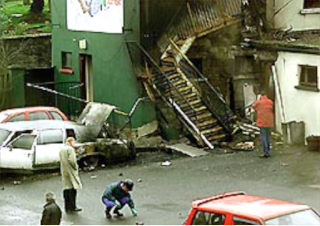
A Continuity Irish Republican Army (IRA) bomb explodes at Mahon’s Hotel in Irvinestown, County Fermanagh, Northern Ireland, on February 6, 2000, less than 24 hours before the Ulster Unionist Party’s Ken McGuinness is due to visit. The Continuity IRA is the only republican organisation which has not called a ceasefire.

The bombing follows repeated warnings from senior police officers on both sides of the Northern Ireland border that republican dissidents continue to pose a threat. Both the Continuity IRA and Real IRA have been recruiting and rearming in preparation for a campaign to wreck the Northern Ireland peace process.

The splinter republican organisation is behind a bomb attack on the Killyhevlin Hotel in Enniskillen in July 1996. The attack follows a week-long marching stand-off at Drumcree.

In September 1997, it places at bomb in Markethill, in County Armagh, just 24 hours after Sinn Féin joins the political negotiations which lead to the Good Friday Agreement.

In January 1998, a Continuity IRA bomb wrecks a club in County Fermanagh. The explosion coincides with a series of loyalist attacks, which follow the murder of the Portadown Loyalist Volunteer Force (LVF) leader Billy Wright.

The latest explosion in Irvinestown comes in a week when the new political institutions are facing suspension because of the stalemate over paramilitary arms decommissioning. This attack by the Continuity IRA looks deliberately timed to add to the peace process’s troubles.

BBC Northern Ireland political editor Stephen Grimason says the bomb will not help the current situation. “We are hearing an argument reinforced from unionists that if these things are left lying around then people will use them,” he says. “So the anti-agreement unionists will be using this as a weapon. But I would have thought it will harden the attitudes of the Ulster Unionist Council and the Ulster Unionist executive, meeting tonight on the issue of weapons,” he adds.

Grimason adds that unionists in general will want to hear about the forensics of the bomb and if there was a Semtex booster charge used. “They will use that as another means of saying that this is all the IRA,” he says. But he adds that there will be those who will see this as a move against Sinn Féin President Gerry Adams because it removes the room for manoeuvre that he has.

BBC Northern Ireland chief security correspondent Brian Rowan says the bomb contained one to two kilos of high explosive, but that the security forces had not yet revealed what type it is. He says the bomb had the appearance of the Continuity IRA which in “times of trouble made more trouble.” He adds, “They would see this as a reminder that they are still out there and as a reminder to other republicans that there is an alternative to the mainstream IRA, and to the peace process strategy. It is about damaging a process that this organisation very much opposes, a process in which they believe republicans principles have been sold out.”

Rowan says security sources believe in some areas the Real IRA, Continuity IRA and the more mainstream Irish National Liberation Army (INLA) co-operate in attacks. INLA prisoners have been released under the Good Friday Agreement early prisoner release scheme, following the INLA’s ceasefire declaration.

“In the Fermanagh area security forces believe the Continuity IRA is operating alone and there is a pattern of activity over a period of years. There is nothing to suggest it was any other group.” He says there is nothing coming from republicans or security sources at this time to suggest that the IRA has any intention of actual decommissioning in the “immediate period ahead.”

(From: “Bombing follows dissident pattern,” BBC News, http://www.news.bbc.co.uk, February 7, 2000 | Photo: RUC forensic experts examine the scene of the bomb attack at Mahons Hotel in Irvinestown, Northern Ireland, Associated Press)


Leave a comment

The Murder of IRA Volunteer Eamon Collins

Eamon Collins, member of the Provisional Irish Republican Army (IRA) in the late 1970s and early 1980s, is beaten and stabbed to death by an unidentified assailant(s) in the early morning hours of January 27, 1999, in Newry, County Down, Northern Ireland.

Collins is born in 1954 in Camlough, County Armagh, Northern Ireland, the son of Brian Collins, a farmer, livestock trader, and cattle smuggler, and Kathleen Collins (née Cumiskey). His extended family has no history of political involvement, though his upbringing is fervently Catholic and nationalist. He leaves secondary school at age 16 and briefly works as a clerk in the Ministry of Defence in London. He returns home for family reasons and resumes his education in 1971 through a scholarship to St. Colman’s College, Newry, County Down. In 1973 he goes to Queen’s University Belfast (QUB) to study law.

Collins develops ultra-leftist political beliefs in his late teens and supports the Northern Ireland civil rights movement but retains reservations about the use of violence. He is further radicalised by being beaten up by soldiers searching his family’s farm at Easter 1974 and by the downfall of the power sharing executive. He loses interest in his studies, leaves QUB in 1976 without completing his degree, and drifts for two years, joining an anarchist collective in Belfast. He comes back into contact with the republican movement through the blanket protest by Long Kesh inmates; he had known hunger striker Raymond McCreesh as a teenager. In 1978 he joins the customs service in Newry and begins to pass information to the IRA, which he joins in 1979. He is central to IRA recruitment and intelligence in Newry and south Down. Without firing a shot himself he facilitates at least five murders, including that of a customs colleague.

In 1982 Collins marries and the couple has four children. By 1984 he has developed doubts about his activities. He antagonises the Belfast leadership, which is moving towards political engagement and away from the all-out revolutionary violence that he favours, and while he admires the hardline South Armagh IRA for its military professionalism, he regards its members as political primitives. On February 28, 1985, he is arrested after an IRA mortar attack in which nine Royal Ulster Constabulary (RUC) members are killed. He breaks down after six days of interrogation and is recruited as a “supergrass,” but retracts his evidence a fortnight later and is held on remand on the basis of his confessions.

In January–February 1987 Collins is tried for murder but acquitted after the judge rules his statements inadmissible. He completes an Open University degree while awaiting trial. After his release he is ostracised and is interrogated by the IRA, which in July 1987 orders him to leave Northern Ireland. He engages in youth work in Dublin from 1987 to 1990, taking a diploma in community work at Maynooth. His wife and children remain in Newry and he visits them regularly in defiance of the expulsion order. In 1990 he returns to live in Newry and teaches at the Ulster People’s College in Belfast. From 1992–94 he is a community worker in Edinburgh. His wife and children continue to live on the Barcroft Park estate in Newry.

In 1994 Collins returns permanently to Northern Ireland after securing a job at a youth club in Armagh. In April 1995 he describes his career in a television documentary, admitting the murders for which he had been tried. In 1997 he publishes a memoir, Killing Rage, a powerful account of life as a paramilitary, although it is not entirely reliable. After the 1995 documentary he experiences verbal and physical harassment. This intensifies after May 1998 when he testifies for The Sunday Times in a libel action by Thomas Murphy, whom the paper accuses of being a leading IRA member. Four months after Murphy loses the case, the family farmhouse in Camlough, which Collins is renovating, is burned down. After the Omagh bombing he publishes several articles denouncing the Real IRA, several of whose activists he had recruited into the IRA from the Irish National Liberation Army (INLA) in the early 1980s. Graffiti regularly appears outside his home in Newry denouncing him as a British agent.

Early in the morning of January 27, 1999, Collins paints out the latest graffiti, and is walking his dogs near the Barcroft Park Estate in Newry along a quiet stretch of country lane at Doran’s Hill, just within sight of Sliabh gCuircin (Camlough Mountain). His body also bears marks of having been struck by a car moving at speed. The subsequent police investigation and Coroner’s Inquest comments upon the extremity of weaponed violence to Collins’ head and face used during the attack.

Rumoured reasons behind the murder are that Collins had returned to Northern Ireland in breach of the IRA’s banning order, and further he had detailed IRA activities and publicly criticized in the media a multiplicity of Irish Republican paramilitary splinter groups that had appeared after the Provisional IRA’s 1994 ceasefire, and that he had testified in court against Murphy. Gerry Adams states the murder was “regrettable,” but adds that Collins had “many enemies in many places.”

After a traditional Irish wake, with a closed coffin necessitated due to the damage to his face, and a funeral service at St. Catherine’s Dominican Church in Newry, Collins’ body is buried at the city’s Monkshill Cemetery, not far from the grave of Albert White, a Catholic former Royal Ulster Constabulary Inspector, whose assassination he helped to organise in 1982.

In January 2014 the Police Service of Northern Ireland (PSNI) releases a statement that a re-examination of the evidence from the scene of the 1999 murder had revealed new DNA material of a potential perpetrator’s presence, and makes a public appeal for information, detailing the involvement of a specific car model, a white coloured Hyundai Pony, and a compass pommel that had broken off a hunting knife during the attack and had been left behind at the scene. In February 2014 detectives from the Serious Crime Branch arrest a 59-year-old man at an address in Newry in relation to the murder, but he is subsequently released without charge. In September 2014 the police arrest three men, aged 56, 55 and 42, in County Armagh in relation to inquiries into the murder, all of whom are subsequently released without charges after questioning. In January 2019 the police release a statement regarding the murder that one of the assailants had been seriously injured by an accidentally sustained knife wound during the attack, and had left traces of his own blood at the scene, and that recent scientific advances in DNA evidence had increased the possibility of his identification. In May 2019, three men aged 60 to 62 are arrested and questioned, but then released unconditionally.