seamus dubhghaill

Promoting Irish Culture and History from Little Rock, Arkansas, USA


Leave a comment

Birth of D. D. Sheehan, Nationalist Politician & Labour Leader

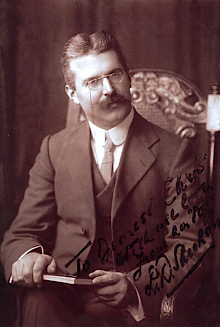
Daniel Desmond (‘D. D.’) Sheehan, Irish nationalist, politicianlabour leader, journalistbarrister and author, is born on May 28, 1873, at Dromtariffe, Kanturk, County Cork.

The eldest of the three sons and one daughter of Daniel Sheehan, tenant farmer, and his wife, Ellen (née Fitzgerald). He is educated at the local primary school. In his book Ireland since Parnell (1921) he states that witnessing the ragged poverty of labourers’ and smallholders’ children who attended the school made him determined to do something for the poor. The family’s Fenian tradition and his parents’ eviction from their holding in 1880 form his early years. At the age of sixteen he becomes a schoolteacher.

In 1890, Sheehan takes up journalism, serving as correspondent of the Kerry Sentinel and special correspondent of the Cork Daily Herald in Killarney. He also becomes correspondence secretary to the Kanturk trade and labour council, which campaigns on behalf of agricultural labourers. He manages to get reports of meetings into the Cork papers, and this helps the rapid spread of the association, which in 1890 becomes the Irish Democratic Trade and Labour Federation, under the leadership of Michael Davitt. It is, however, fatally disrupted by the Parnell split. While Sheehan continues to admire Davitt, and despite the pre-split Irish party leadership having opposed the federation as a threat to Charles Stewart Parnell‘s leadership, he becomes a Parnellite, and always remembers his only meeting with Parnell at Tralee, when the chief is presented with a loyal address (drafted by Sheehan) from his Killarney supporters. After Parnell’s death and the defeat of the Second Home Rule Bill, he temporarily drops out of Irish politics.

Following his marriage on February 6, 1894, to Mary Pauline O’Connor of Tralee, Sheehan joins the staff of the Glasgow Observer in pursuit of journalistic experience, then becomes editor of the Catholic News in Preston, Lancashire. In 1898, he returns to Ireland and works on various papers, including the Cork Constitution, before serving as editor of the Skibbereen-based Cork County Southern Star (1899–1901), where his Parnellism brings him into conflict with the Bishop of Ross, Denis Kelly. He expresses sympathy for the newly founded United Irish League (UIL), established by William O’Brien in Connacht with the dual aim of representing western smallholders and using a new land agitation as a vehicle for Irish Party reunion. He does not, however, join the UIL himself.

In August 1894, the Clonmel solicitor J. J. O’Shee, anti-Parnellite MP for West Waterford from 1895, forms the Irish Land and Labour Association (ILLA) to agitate on behalf of agricultural labourers and small tenant farmers. Its appearance reflects the breakdown of the centralised party discipline which had existed before the Parnell split, and recognition that the land war’s prime beneficiaries had been large and middle-sized tenant farmers rather than the nation as a whole. On returning from Britain in 1898, Sheehan throws himself into organising the ILLA and becomes its president. In 1900 there are 100 branches, mostly in Cork, Tipperary, and Limerick. The Irish Party leadership look on this organisation with some suspicion.

At the 1900 United Kingdom general election in Ireland Sheehan seeks the Irish Parliamentary Party (IPP) nomination for South Cork but was defeated by Edward Barry. After the death of Dr Charles Tanner, however, he succeeds in obtaining the IPP nomination for the constituency of Mid Cork, despite the party leadership’s attempts to deny recognition to ILLA branches in order to hand the nomination to its favoured candidate. Sheehan is elected unopposed on May 17, 1901. At the age of 28, he is the youngest Irish member of parliament. Although he has been admitted to the party, his position as a labour representative and his perceived independent base make him something of an outsider.

From October 1904 Sheehan allies himself with O’Brien, writing regularly for the latter’s weekly a The Irish People. Redmondites accuse him of opportunism, but he always maintains that his personal inclination as an old Parnellite has been towards John Redmond and that his support for O’Brien derives from the older man’s willingness from 1904 to identify himself with the labourers’ campaign. Although their alliance originally likely contains elements of expediency, Sheehan and O’Brien develop a deep personal friendship.

Sheehan’s support for O’Brien leads to a split in the ILLA in 1906, with Tipperary and Waterford branches following O’Shee and Redmond, and Sheehan retaining the support of his Cork base and of some branches in Limerick and Kerry. He serves on the Cork advisory committee which represents tenant interests in land purchase negotiations under the Wyndham Land Act. It’s policy of “conference plus business” combines an offer to negotiate with willing landlords and a threat of agitation against those unwilling to give satisfactory terms. His faction of the ILLA becomes the basis for the grassroots organisation of O’Brien’s followers, and sporadic attempts, financed by O’Brien, are made to spread it outside its Munster base. Both factions of the ILLA claim credit for the passage of the 1906 and 1911 Labourers’ (Ireland) Acts which provide for the allocation of cottages and smallholdings to labourers. In Cork and some other parts of Munster these buildings become popularly known as “Sheehan’s cottages,” a term which long outlives Sheehan’s political career. He also helps to bring about the creation of a “model village” at Tower, near Blarney, the result of cooperation between the local ILLA branch and the rural district council.

At the 1906 general election the Redmond leadership attempts to avoid an open split by allowing O’Brien’s supporters to return unopposed. However, the continuing conflict between the two factions rapidly leads to a formal break. Shortly after the election Sheehan is excluded from the IPP, and thereby deprived of the parliamentary stipend paid to MPs with insufficient resources to maintain themselves. With the support of O’Brien and the small group of O’Brienite MPs, he maintains that the party has no right to exclude an elected MP willing to take the party pledge. After resigning his seat to which he was re-elected without opposition on December 31, 1906, he demands readmission to the party and mounts an unsuccessful lawsuit demanding payment of the stipend. He is subsequently supported from the proceeds of collections outside church gates on Sundays.

Sheehan and the other O’Brienite MPs are readmitted to the party in 1908 as part of an attempt at general reconciliation after the disruptions following the rejection of the Irish Council Bill. Dissensions rapidly reappear over Augustine Birrell‘s 1909 land act, which the O’Brienites see as wriggling out of the financial responsibilities accepted by the British government in the Wyndham land act and as sabotaging land purchase, since landlords will not accept the terms offered. Sheehan’s section of the ILLA is denied official recognition and thereby prevented from sending delegates to a party convention called to consider the bill. At the convention, groups of “heavies”recruited from Joseph Devlin‘s Ancient Order of Hibernians (AOH) exclude delegates with Cork accents, while O’Brienite speakers are howled down. This leads to the formation in March 1909 of the All-for-Ireland League (AFIL), a body based on the existing O’Brienite organisation and advocating O’Brien’s policy of gradually implementing home rule through step-by-step cooperation with moderate unionist supporters of devolution. Although O’Brien’s temporary retirement for health reasons in April 1909 leads to the suspension of the AFIL, it is revived in response to an attempted purge of the O’Brienite MPs by the leadership and by O’Brien’s reappearance in response to the January 1910 general election. Sheehan writes regularly for its paper, the Cork Free Press.

In the general election the O’Brienites hold their seats while two Cork Redmondites are displaced. Sheehan is re-elected for Mid Cork, defeating the Redmondite W. G. Fallon in a campaign marked by widespread rioting and impassioned clerical denunciations of Sheehan. Fallon subsequently attempts to get up a “red scare” against the ILLA. The Cork ILLA later splits over Sheehan’s slightly erratic leadership. While the split is initially personality-driven, the breakaway faction, led by Patrick Bradley and centred in east Cork, moves back toward alignment with Redmond. At the December 1910 election the AFIL consolidates its position in Cork, but is defeated everywhere else. Sheehan retains his Mid Cork seat against a local candidate but is defeated in a simultaneous contest in East Limerick. He is also defeated when he stands for Cork County Council in June 1911, though the AFIL wins control of that body.

Sheehan studies law at University College Cork (UCC) (1908–09), where he is an exhibitioner and prizeman, and at King’s Inns, where he graduated with honours. He is called to the bar in 1911 and practised on the Munster circuit. In 1913–14 he is active in the AFIL’s attempts to avert partition by trying to recruit sections of British political opinion in favour of a conference between the parties. He becomes vice-chairman of the Imperial Federation League. This receives considerable attention among the British political classes but contributes to the decline of the AFIL’s electoral base. The policy of conciliation has been driven to a considerable extent by the belief that it is the only way of achieving home rule. The abolition of the House of Lords’ veto and the introduction of the third home rule bill by the Asquith government undercuts this argument and increases Redmond’s prestige, while AFIL denunciations of Redmondism are seen as driven by personal resentment and playing into the hands of unionists. The decision of the AFIL MPs to abstain from supporting the bill on its final passage through the House of Commons in 1914 as a protest against the prospect of a partition-based compromise is represented by Redmondites as a vote against home rule itself and contributed to AFIL loss of Cork County Council in June 1914.

On the outbreak of World War I, Sheehan supports O’Brien in calling for Irish enlistment for foreign service. In November 1914, at the age of forty-two, he enlists himself and is gazetted as a lieutenant in the Royal Munster Fusiliers. It is claimed that he is almost single-handedly responsible for raising the 9th (service) battalion of this regiment. Three of his sons also enlist. Two of his sons are killed in action with the Royal Flying Corps, and a daughter is disabled by injuries received in an air raid while serving as a nurse. In the spring and summer of 1915 he organises and leads recruiting campaigns in Cork, Limerick, and Clare. This is part of a nationwide drive for recruits, aimed in particular at the farming community, which reflects the realisation that the war is going to last much longer than expected.

In 1915, Sheehan is promoted to the rank of captain and serves with his battalion on the Loos-en-Gohelle salient and at the Battle of the Somme, contributing a series of articles from the trenches to the London Daily Express. Various ailments, including deafness caused by shellfire, and hospitalisation necessitate his transfer to the 3rd Royal Munster Fusiliers (Reserve) Battalion, and he resigns his commission on January 13, 1918, due to ill health. In April 1918 he speaks at Westminster against the bill extending conscription to Ireland, threatening to resist it by force. One of his last parliamentary speeches (in October 1918) is in support of a bill providing land grants for Irish ex-servicemen. With the growth of Sinn Féin and the virtual demise of the AFIL, his position in Cork grows increasingly untenable. The Sheehan family faces intimidation and are obliged to leave their home on the Victoria Road for London, where he has secured the Labour Party nomination for the LimehouseStepney division of the East End, later represented by Clement Attlee.

Sheehan is unsuccessful in the 1918 United Kingdom general election, and is obliged to leave politics after a financially disastrous involvement in an Achill Island mining company leads to his bankruptcy. Unable to practise at the bar because of the hearing loss caused by his war service, he returns to journalism and becomes editor and publisher of The Stadium, a daily newspaper for sportsmen. In 1921, shortly before the Anglo-Irish truce, he publishes Ireland since Parnell, a history of recent events heavily dependent on the writings of O’Brien but incorporating some personal reminiscences. It concludes by blaming the outbreak of the IRA guerrilla campaign on provocation by Crown forces, denouncing reprisals, and pleading for British recognition of Dáil Éireann and dominion home rule for an undivided Ireland.

Sheehan moves to Dublin in 1926 after hearing that the threats against him have been lifted. His wife, who has never fully recovered from the stresses and bereavements she has experienced since 1914, dies soon afterward. Sheehan himself becomes managing editor of Irish Press and Publicity Services and, in 1928, publisher and editor of the South Dublin Chronicle. The paper gives critical support to the Irish Labour Party, publishes campaigning articles on slum conditions, and advocates housing reform. In September 1930, he is an unsuccessful Labour candidate for Dublin County Council. In the 1930s, as his health deteriorates further, he works as coordinator for the ex-servicemen’s group the Old Comrades’ Association, editing both northern and southern editions of its annual journal. In 1942, he offers himself to Richard Mulcahy as a Fine Gael candidate for Cork South-East, but is turned down. He dies on November 28, 1948, while visiting his daughter at Queen Anne Street, London. Both he and his wife are buried in Glasnevin Cemetery.

(From: “Sheehan, Daniel Desmond (‘D. D.’)” by Patrick Maume, Dictionary of Irish Biography, http://www.dib.ie, October 2009)


Leave a comment

The Tunnel Trench Assault at the Battle of Cambrai

At dawn on the morning of November 20, 1917, the 16th (Irish) Division of the British Army assaults an area of the German lines known as “Tunnel Trench,” named for an elaborate tunnel system that runs along it. The attack is meant as a diversion for the main attack, about eight miles to the southeast at Cambrai, France, where six infantry and two cavalry divisions of the British Expeditionary Force, with additional support from fourteen squadrons of the Royal Flying Corps, join the British Tank Corps in a surprise attack on the German lines.

By autumn 1917, three years into World War I, continuous shelling and lack of drainage has transformed the Ypres Salient, on the Western Front, into a waterlogged quagmire. In Ireland, meanwhile, a month earlier, Eamon de Valera becomes president of Sinn Féin and decides to push for an independent Irish republic. Despite the growing political turmoil at home, in France, on firm ground near the town of Cambrai, the British Army’s 16th (Irish) Division again proves to be formidable adversaries for the Germans.

According to the divisional historian, at Cambrai, the “swift and successful operation by 16th Division was a model of attack with a limited objective.” In addition to securing 3,000 yards of trench, 635 prisoners are captured from the German army’s 470th and 471st Regiments and 330 German bodies are counted in the trenches. More importantly, though, the mayhem caused by the diversionary assault contributes greatly to the initial success of the Cambrai offensive, though the offensive eventually sputters, dragging the war into 1918.

Cambrai becomes the field of operations when the British Commander-in-Chief, Field Marshal Douglas Haig, recognising that it is impossible to launch further military operations in the Ypres sector, seeks a new battlefield where he hopes success can be achieved before year’s end. Lieutenant Colonel John Fuller of the Tank Corps and General Julian Byng, commander of the Third Army, recommend that a massed assault by 400 tanks should be mounted across the firm, chalky ground to the southwest of Cambrai. Haig adopts this proposal, confident that the tanks can punch a hole through the mighty Hindenburg Line and allow his underused Cavalry Divisions to break through to the enemy rear.

In order to create maximum confusion among the Germans, Sir Aylmer Haldane, commander of VI Corps, is ordered to stage a diversionary attack. The area selected for the assault is about eight miles to the northwest of Cambrai, where the British line passes through the villages of Bullecourt and Fontaine-lès-Croisilles. The units select to make this subsidiary attack are 3rd Army and 16th (Irish) Division.

The defences of the Hindenburg Line opposite VI Corps positions consists of Tunnel Trench, a heavily defended front-line trench, with a second, or support trench, some 300 yards behind. The whole area is scattered with concrete machine gun forts, or Mebus, similar to those that had decimated the 16th (Irish) Division at the Battle of Langemarck three months earlier.

Tunnel Trench is so called because it has a tunnel 30 or 40 feet below ground along its entire length, with staircase access from the upper level every 25 yards. The entire tunnel has electric lighting, and side chambers provide storage space for bunks, food, and ammunition. Demolition charges are set that can be triggered from the German rear in order to prevent the defences from falling into British hands.

The 16th (Irish) Division, attacking on a three-brigade front, is assigned the task of capturing a 2,000-yard section of the trench network. On the right flank of the Irishmen, 3rd Division’s 9th Brigade is detailed to capture an additional 800 yards. One unusual feature of the attack is that there is to be no preliminary bombardment as surprise is the key to the success of the operation. Once the assault begins, however, 16th (Irish) Division’s artillery, reinforced with guns from the 34th Division, is to open a creeping barrage upon the German positions.

The morning of the advance, November 20, is overcast, with low visibility. At 6:20 a.m., the Divisional 18 pounder-field guns open fire, and the leading assault companies spring from their jump-off positions. At the same time, Stokes mortars begin to lay a smoke barrage upon the German trenches in imitation of a gas attack. This deception proves successful, as many German troops don cumbersome gas masks and retreat to the underground safety of the tunnel, thus leaving the exposed portion of the trench undefended.

On the left flank, the attack of the 49th Brigade is launched by 2nd Royal Irish Regiment and 7/8th Royal Irish Fusiliers. They quickly cross the 200 yards of no-man’s-land and reach the enemy frontline just as the barrage lifts. Resistance above ground is minimal, and storming parties began the task of flushing the Germans from the tunnel with Mills bombs and bayonets.

Once the tunnel is secure, sappers, acting on information obtained by 7th Leinster Regiment’s intelligence officer, cut the leads connecting the demolition charges. Supporting companies then press on to capture Tunnel Support Trench, while Divisional support units rapidly wire and made secure the new defensive front in anticipation of German counterattacks.

Only on the extreme left flank does 49th Brigade encounter any serious opposition. In this sector, Company “B” of the 7/8th Royal Irish Fusiliers suffers heavy losses inflicted by concentrated machine gun fire from Mebus Flora. Nearly one-hour elapses before resistance from this strong point can be overcome.

In the centre, 10th and 2nd Royal Dublin Fusiliers head the attack of the 48th Brigade. The advance here is so rapid that the Irish find many Germans still wearing gas masks and unable to fight. Two more Mebus, Juno and Minerva, are stormed and many more prisoners taken, particularly by 10th Royal Dublin Fusiliers which captures 170 Germans.

Leading the attack on the right flank is 6th Connaught Rangers and 1st Royal Munster Fusiliers, both of which belong to the 47th “Irish Brigade.”

After capturing their assigned section of Tunnel Trench, two companies of Rangers press forward to assault the strong points known as Mars and Jove. The Division had learned from the disastrous frontal attack made at Langemarck, and so the Rangers work around to the rear before pressing home with the bayonet.

Unfortunately, 3rd Division fails in its attempt to capture the trench network immediately to the right of 16th (Irish) Division, and the flank of the Connaught Rangers is thus exposed to a savage counterattack. The Rangers ferociously engage the Germans and use captured “potato masher” grenades brought up from the tunnel to great effect. Eventually, overwhelming numbers begin to tell, and “A” Company is forced to yield Jove and fall back upon “B” Company, which is holding Mars.

These two isolated companies doggedly hold their ground for several hours. The situation only improves when the Divisional pioneer battalion, the 11th Hampshire Regiment, digs a communication trench across the fire-swept no-man’s-land, thereby allowing the support companies of the Rangers to come to the aid of their comrades. The front is finally stabilised three days later when 7th Leinster Regiment recaptures and consolidates Jove and successfully assaults the untaken section of Tunnel Trench.

On the first day of the Battle of Cambrai, General Byng’s eight attacking Divisions achieve complete surprise and pierce the Hindenburg Line, driving the Germans back four miles toward Cambrai itself. Having captured 8,000 prisoners and 100 guns for the loss of only 5,000 British casualties, it is small wonder that church bells are sounded in celebration in Britain for the first time during the war.

Unfortunately, Byng lacks sufficient reserves to exploit, or consolidate his success, and German counterattacks, launched by some 20 Divisions, recover most of the lost ground. Although the battle ultimately ends in failure for the British, the willingness to employ new weaponry and tactics at Cambrai and during the diversionary assault upon Tunnel Trench, points the way to the final victory in 1918.

Although the capture of Tunnel Trench contributes greatly to the early success at Cambrai, it proves costly as VI Corps suffers 805 casualties. Most of these occur close to Jove Mebus, where the Connaught Rangers had engaged the enemy in hand-to-hand combat.

Perhaps an idea of the ferocious nature of this form of trench warfare can be gleaned from Father William Doyle, chaplain of the 8th Royal Irish Fusiliers, who once remarks, “We should have had more prisoners, only a hot-blooded Irishman is a dangerous customer when he gets behind a bayonet and wants to let daylight through everybody.”

(From: “Tunnel Trench: 16th (Irish) Division Clears the Way at Cambrai,” by Kieron Punch, posted by The Wild Geese, http://www.thewildgeese.irish, January 18, 2013 | Pictured: Troops from the Royal Irish Regiment about to go into action at Cambrai)


Leave a comment

Founding of the Auxiliaries Division of the Royal Irish Constabulary

The Auxiliary Division, generally known as the Auxiliaries or Auxies, a paramilitary unit of the Royal Irish Constabulary (RIC) during the Irish War of Independence (1919-21), is founded on July 27, 1920, by Major-General Henry Hugh Tudor. It is made up of former British Army officers, most of whom come from Great Britain and had fought in World War I.

In September 1919, the Commander-in-Chief, Ireland, Sir Frederick Shaw, suggests that the police force in Ireland be expanded via the recruitment of a special force of volunteer British ex-servicemen. During a Cabinet meeting on May 11, 1920, the Secretary of State for War, Winston Churchill, suggests the formation of a “Special Emergency Gendarmerie, which would become a branch of the Royal Irish Constabulary.” Churchill’s proposal is referred to a committee chaired by General Sir Nevil Macready, Commander-in-Chief of the British forces in Ireland. Macready’s committee rejects Churchill’s proposal, but it is revived two months later, in July, by the Police Adviser to the Dublin Castle administration in Ireland, Major-General Henry Hugh Tudor. In a memo dated July 6, 1920, Tudor justifies the scheme on the grounds that it will take too long to reinforce the Royal Irish Constabulary (RIC) with ordinary recruits. Tudor’s new “Auxiliary Force” is to be strictly temporary with its members enlisting for a year. Their pay is to be £7 per week (twice what a constable is paid), plus a sergeant’s allowances, and are to be known as “Temporary Cadets.” At that time, one of high unemployment, a London advertisement for ex-officers to manage coffee stalls at two pounds ten shillings a week receives five thousand applicants.

The Auxiliary Division is recruited in Great Britain from among ex-officers who had served in World War I, especially those who had served in the British Army (including the Royal Flying Corps). Most recruits are from Britain, although some are from Ireland, and others come from other parts of the British Empire. Many have been highly decorated in the war and three, James Leach, James Johnson, and George Onions, have been awarded the Victoria Cross (VC). Enlisted men who had been commissioned as officers during the war often find it difficult to adjust to their loss of status and pay in civilian life, and some historians have concluded that the Auxiliary Division recruited large numbers of these “temporary gentlemen.”

Piaras Béaslaí, a former senior member of the Irish Republican Army (IRA) who supports the Anglo-Irish Treaty, while paying tribute to the bravery of the Auxiliaries, notes that the force is not composed exclusively of ex-officers but contains “criminal elements,” some of whom robbed people on the streets of Dublin and in their homes.

Recruiting began in July 1920, and by November 1921, the division is 1,900 strong. The Auxiliaries are nominally part of the RIC, but actually operate more or less independently in rural areas. Divided into companies, each about one hundred strong, heavily armed and highly mobile, they operate in ten counties, mostly in the south and west, where IRA activity is greatest. They wear either RIC uniforms or their old army uniforms with appropriate police badges, along with distinctive tam o’ shanter caps. They are commanded by Brigadier-General Frank Percy Crozier.

The elite ex-officer division proves to be much more effective than the Black and Tans especially in the key area of gathering intelligence. Auxiliary companies are intended as mobile striking and raiding forces, and they score some notable successes against the IRA. On November 20, the night before Bloody Sunday, they capture Dick McKee and Peadar Clancy, the commandant and vice-commandant of the IRA’s Dublin Brigade, and murder them in Dublin Castle. That same night, they catch Liam Pilkington, commandant of the Sligo IRA, in a separate raid. A month later, in December, they catch Ernie O’Malley completely by surprise in County Kilkenny. He is reading in his room when a Temporary Cadet opens the door and walks in. “He was as unexpected as death,” says O’Malley. In his memoirs, the commandant of the Clare IRA, Michael Brennan, describes how the Auxiliaries nearly capture him three nights in a row.

IRA commanders become concerned about the morale of their units as to many Volunteers the Auxiliaries seem to be “super fighters and all but invincible.” Those victories which are won over the Auxiliaries are among the most celebrated in the Irish War of Independence. On November 28, 1920, for example, a platoon of Auxiliaries is ambushed and wiped out in the Kilmichael Ambush by Tom Barry and the 3rd Cork Brigade. A little more than two months later, on February 2, 1921, another platoon of Auxiliaries is ambushed by Seán Mac Eoin and the North Longford Flying Column in the Clonfin Ambush. On March 19, 1921, the 3rd Cork Brigade of the IRA defeats a large-scale attempt by the British Army and Auxiliary Division to encircle and trap them at Crossbarry. On April 15, 1921, Captain Roy Mackinnon, commanding officer of H Company of the Auxiliary Division, is assassinated by the Kerry IRA.

Successes require reliable intelligence and raids often bring no result — or sometimes worse. In one case, they arrest a Castle official, Law Adviser W. E. Wylie, by mistake. In another, more notorious case, on April 19, 1921, they raid the Shannon Hotel in Castleconnell, County Limerick, on a tip that there are suspicious characters drinking therein. The “suspicious characters” turn out to be three off-duty members of the RIC. Both sides mistake the other for insurgents and open fire. Three people, an RIC man, an Auxiliary Cadet and a civilian, are killed in the shootout that follows.

The Auxiliary Division is disbanded along with the RIC in 1922. Although the 1921 Anglo-Irish Treaty requires the Irish Free State to assume responsibility for the pensions of RIC members, the Auxiliaries are explicitly excluded from this provision. Following their disbandment, many of its former personnel join the Palestine Police Force in the British-controlled territory.

The anti-insurgency activities of the Auxiliaries Division have become interchangeable with those conducted by the Black and Tans, leading to many atrocities committed by them being attributed to the Black and Tans. Nevertheless, both British units remain equally reviled in Ireland.

The Auxiliaries are featured in historical drama films like Michael Collins, The Last September, and The Wind That Shakes the Barley.

(Pictured: Cap badge design for F Company of the Auxiliary Division of the Royal Irish Constabulary)


Leave a comment

Death of “Mick” Mannock, British-Irish Flying Ace

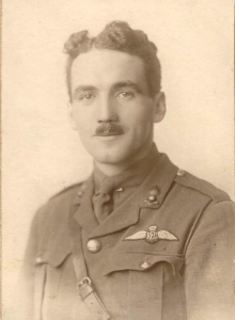
Edward Corringham “Mick” Mannock VC, DSO & Two Bars, MC & Bar, a British-Irish flying ace who serves in the Royal Flying Corps (RFC) and Royal Air Force (RAF) during World War I, is killed on July 26, 1918, when his plane crashes behind German lines. He is a pioneer of fighter aircraft tactics in aerial warfare. At the time of his death, he has amassed 61 aerial victories, making him the fifth highest scoring pilot of the war. He is among the most decorated men in the British Armed Forces. He is honoured with the Military Cross (MC) twice, is one of the rare three-time recipients of the Distinguished Service Order (DSO) and is posthumously awarded the Victoria Cross (VC).

Mannock was born on May 24, 1887, to an English father, Edward Mannock, and an Irish mother, Julia Sullivan. His father serves in the British Army and in 1893, deeply in debt and exasperated with civilian life, he re-enlists, and the family moves to Meerut, India when he is five years old. In his early years, he is sickly and develops several ailments. Soon after arriving in Asia, he contracts malaria, narrowly avoiding death. Upon his return to England, he becomes a fervent supporter of Irish nationalism and the Irish Home Rule movement but becomes a member of the Independent Labour Party (ILP).

In 1914, Mannock is working as a telephone engineer in Turkey. After the Ottoman Empire‘s entry into the war on the side of the Central Powers he is interned. Poorly fed and cared for, his health rapidly declines in prison. Dysentery racks his intestines, and he is confined to a small cell. Turkish authorities repatriate him to Britain believing him to be unfit for war service. He recovers and joins the Royal Engineers (RE) and then the Royal Army Medical Corps (RAMC). He moves services again and in 1916 joins Royal Flying Corps (RFC). After completing his training, he is assigned to No. 40 Squadron RFC. He goes into combat on the Western Front, participating in three separate combat tours. After a slow start he begins to prove himself as an exceptional pilot, scoring his first victory on May 7, 1917.

By February 1918, Mannock has achieved sixteen victories and is appointed a Flight Commander in No. 74 Squadron. He amasses thirty-six more victories from April 12 — June 17, 1918. After returning from leave he is appointed commanding officer of No. 85 Squadron in July 1918, and scores nine more victories that month.

On July 26, Major Mannock offers to help a new arrival, Lt. Donald C. Inglis from New Zealand, obtain his first victory. After shooting down an enemy LVG two-seater behind the German front-line, Mannock is believed to have dived to the crash site to view the wreckage, seemingly breaking one of the unwritten rules of fellow pilots about the hazards of flying low into ground fire. In consequence, while crossing the trenches the fighters are met with a massive volley of ground fire. The engine of his aircraft is hit and immediately catches fire, and shortly thereafter the plane crashes behind German lines. His body is believed to have been found, though this is unproven, about 250 yards (250m) from the wreck of his plane, perhaps thrown, perhaps jumped. The body shows no gunshot wounds although he had vowed to shoot himself if shot down in flames.

The exact cause of Mannock’s death remains uncertain. A year later, after intensive lobbying by Ira Jones and many of his former comrades, he is awarded the Victoria Cross (VC).

Mannock’s body is not subsequently recovered by the Commonwealth War Graves Commission (CWGC), so officially he has no known grave. His name is commemorated on the Arras Flying Services Memorial to the missing at the Faubourg d’Amiens CWGC Cemetery in Arras, France. There is also a memorial plaque in his honour in Canterbury Cathedral.

Mannock’s name is listed on the Wellingborough War Memorial with the other fallen men from the town and the local Air Training Corps (ATC) unit bears his name – 378 (Mannock) Squadron. Additionally, Mannock Road, a residential street in Wellingborough, is named after him.

On June 24, 1988, a plaque is unveiled at 183 Mill Road, Wellingborough, by top scoring World War II British fighter pilot Air Vice-Marshal Johnnie Johnson. Mannock had lived at that address prior to the war after being befriended by the Eyles family.


Leave a comment

Death of Thomas Falcon Hazell, World War I Fighter Pilot

Thomas Falcon Hazell, fighter pilot with the Royal Flying Corps and later the Royal Air Force during World War I, dies in Newport, County Mayo, on September 4, 1946. He scores 43 victories in 1917–18 making him the fifth most successful British “flying ace” of the war, the third most successful Irish-born pilot behind Edward Mannock and George McElroy, and the only pilot to survive the war from both groups.

Hazell is born in Roundstone, County Galway, on August 7, 1892. Upon the outbreak of the war in August 1914, he volunteers for service as a private with the South Irish Horse. On October 10 he is commissioned as second lieutenant in the 7th Battalion, Royal Inniskilling Fusiliers. As part of the 49th Brigade in the 16th (Irish) Division, the 7th Inniskillings are initially based at Tipperary, where he is promoted to lieutenant on June 4, 1915. The regiment lands in France in February 1916.

Soon afterwards Hazell transfers to the Royal Flying Corps. In April and May he is assigned to No. 5 Reserve Squadron, based at Castle Bromwich. He is appointed a flying officer on June 5 and survives a severe crash before completing his training. He eventually joins No. 1 Squadron on the Western Front. Flying Nieuport 17 Scouts, he shoots down 20 enemy aircraft between March and August 1917, being appointed a flight commander with the acting rank of captain on May 25, and is awarded the Military Cross on July 26.

After serving as an instructor at the Central Flying School in 1918, Hazell takes command of “A” Flight, No. 24 Squadron, flying the S.E.5a. On August 22, 1918, he shoots down an observation balloon despite its escort of seven Fokker D.VIIs. The escort is led by German ace Ernst Udet, who attacks and riddles Hazell’s petrol tank, propeller, and two longerons with bullets. In spite of this Hazell fights his way back, eyes full of petrol, and lands safely. Udet thinks he has forced the British pilot to crash and actually claims him as his 60th victory. Hazell finishes the war with 43 confirmed kills, the top British surviving ace of the war (excluding Dominion airmen). He is twice awarded the Distinguished Flying Cross. On June 11, 1927, he returns to the RAF Depot at Uxbridge and is placed on the retired list on July 20, 1927, at his own request.

In 1944, at the age of 52, Hazell becomes the commander of “D” Company, 24th (Tettenhall) Battalion, South Staffordshire Home Guard during the later part of World War II.

Hazell dies in Newport, County Mayo, on September 4, 1946, and is buried at the Burrishoole Church of Ireland Cemetery there. In 2014 his grave, which had been largely forgotten and neglected, is restored, repaired, and re-dedicated in a ceremony on August 4, 2014, the 100th anniversary of the declaration of World War I


3 Comments

Death of Captain George McElroy, World War I Fighter Pilot

Captain George Edward Henry McElroy MC & Two Bars, DFC & Bar, a leading Irish fighter pilot of the Royal Flying Corps and Royal Air Force during World War I, is killed by ground fire on July 31, 1918, while flying over enemy lines. He is credited with 47 aerial victories.

McElroy is born on May 14, 1893, at Donnybrook, County Dublin, to Samuel and Ellen McElroy. He enlists promptly at the start of World War I in August 1914 and is shipped out to France two months later. He is serving as a corporal in the Motor Cyclist Section of the Royal Engineers when he is first commissioned as a second lieutenant on May 9, 1915. While serving in the Royal Irish Regiment he is severely affected by mustard gas and is sent home to recuperate. He is in Dublin in April 1916, during the Easter Rising, and is ordered to help quell the insurrection. He refuses to fire upon his fellow Irishmen and is transferred to a southerly garrison away from home.

On June 1, 1916, McElroy relinquishes his commission in the Royal Irish Regiment when awarded a cadetship at the Royal Military Academy, Woolwich, from which he graduates on February 28, 1917, and is commissioned as a second lieutenant in the Royal Garrison Artillery.

McElroy is promptly seconded to the Royal Flying Corps, being trained as a pilot at the Central Flying School at Upavon Aerodrome and appointed a flying officer on June 28. On July 27 his commission is backdated to February 9, 1916, and he is promoted to lieutenant on August 9. On August 15 he joins No. 40 Squadron RFC, where he benefits from mentoring by Edward “Mick” Mannock. He originally flies a Nieuport 17, but with no success in battle. By the year’s end he is flying Royal Aircraft Factory S.E.5s and claims his first victory on December 28.

An extremely aggressive dogfighter who ignores often overwhelming odds, McElroy’s score soon grows rapidly. He shoots down two German aircraft in January 1918, and by February 18 has run his string up to 11. At this point, he is appointed a flight commander with the temporary rank of captain and transferred to No. 24 Squadron RFC. He continues to steadily accrue victories by ones and twos. By March 26, when he is awarded the Military Cross, he is up to 18 “kills.” On April 1, the Army’s Royal Flying Corps (RFC) and the Royal Naval Air Service (RNAS) are merged to form the Royal Air Force, and his squadron becomes No. 24 Squadron RAF. He is injured in a landing accident on April 7 when he brushes a treetop while landing. By then he has run his score to 27. While he is sidelined with his injury, on April 22, he is awarded a bar to his Military Cross. Following his convalescence, he returns to No. 40 Squadron in June, scoring three times, on June 26, June 28, and June 30. The latter two triumphs are observation balloons and run his tally to 30.

In July, McElroy adds to his score almost daily, a third balloon busting on July 1, followed by one of the most triumphant months in the history of fighter aviation, adding 17 victims during the month. His run of success is threatened on July 20 by a vibrating engine that entails breaking off an attack on a German two-seater and a rough emergency landing that leaves him with scratches and bruises. There is a farewell luncheon that day for his friend Gwilym Hugh “Noisy” Lewis. Their mutual friend “Mick” Mannock pulls McElroy aside to warn him about the hazards of following a German victim down within range of ground fire.

On July 26, “Mick” Mannock is killed by ground fire. Ironically, on that same day, “McIrish” McElroy receives the second Bar to his Military Cross. He is one of only ten airmen to receive the second Bar.

McElroy’s continues apparent disregard for his own safety when flying and fighting can have only one end. On July 31, 1918, he reports destroying a Hannover C for his 47th victory. He then sets out again. He fails to return from this flight and is posted missing. Later it is learned that he had been killed by ground fire. He is 25 years old.

McElroy receives the Distinguished Flying Cross posthumously on August 3, citing his shooting down 35 aeroplanes and three observation balloons. The Bar would arrive still later, on September 21, and would laud his low-level attacks. In summary, he shoots down four enemy aircraft in flames and destroys 23 others, one of which he shares destroyed with other pilots. He drives down 16 enemy aircraft “out of control” and out of the fight. In one of those cases, it is a shared success. He also destroys three balloons.

McElroy is interred in Plot I.C.1 at the Laventie Military Cemetery in La Gorgue, northern France.


Leave a comment

Death of David Lord, RAF Officer & Victoria Cross Recipient

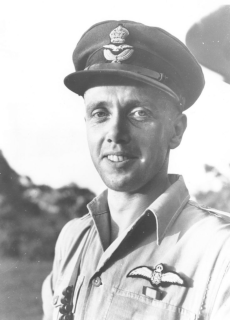
David Samuel Anthony Lord, VC, DFC, recipient of the Victoria Cross, the highest award for gallantry in the face of the enemy that can be awarded to British and Commonwealth forces, is killed at Arnhem, Netherlands, on September 19, 1944, during World War II. A transport pilot in the Royal Air Force, he receives the award posthumously for his actions during the Battle of Arnhem while flying resupply missions in support of British paratroopers.

Lord is born on October 18, 1913, in Cork, County Cork, one of three sons of Samuel (a warrant officer in the Royal Welsh Fusiliers) and Mary Lord (née Miller). One of his brothers dies in infancy.

After World War I the family is posted to British India and Lord attends Lucknow Convent School. On his father’s retirement from the Army the family moves to Wrexham and then he is a pupil at St. Mary’s College, Aberystwyth, and then the University of Wales. Later, he attends the English College, Valladolid, Spain, to study for the priesthood. Deciding that it was not the career for him, he returns to Wrexham, before moving to London in the mid-1930s to work as a freelance writer.

Lord enlists in the Royal Air Force on August 6, 1936. After reaching the rank of corporal in August 1938, he applies to undertake pilot training, which he begins in October 1938. Successfully gaining his pilot’s wings, he becomes a sergeant pilot in April 1939, and is posted to No. 31 Squadron RAF, based in Lahore, India. He later flies the Vickers Type 264 Valentia biplane transport. In 1941, No. 31 Squadron is the first unit to receive the Douglas DC-2 which is followed by both the Douglas DC-3 and Dakota C-47 Skytrain transports. That year he is promoted to flight sergeant and then warrant officer. He flies in North Africa, supporting troops in Libya and Egypt for four months, before being posted back to India. Commissioned as a pilot officer in May 1942, he flies supply missions over Burma, for which he is mentioned in despatches.

Lord is awarded the Distinguished Flying Cross in July 1943, receiving the award at Buckingham Palace, and is promoted to flight lieutenant shortly afterwards. By January 1944, he has joined No. 271 Squadron RAF, based at RAF Down Ampney, Gloucestershire, and begins training as part of preparations for the invasion of Europe. On D-Day, he carries paratroopers into France and his aircraft was hit by flak, returning to base without flaps.

The Battle of Arnhem is part of Operation Market Garden, an attempt to secure a string of bridges through the Netherlands. At Arnhem, the British 1st Airborne Division and Polish 1st Independent Parachute Brigade are tasked with securing bridges across the Lower Rhine, the final objectives of the operation. However, the airborne forces that drop on September 17 are not aware that the 9th SS and 10th SS Panzer divisions are also near Arnhem for rest and refit. Their presence adds a substantial number of Panzergrenadiers, tanks and self-propelled guns to the German defences and the Allies suffer heavily in the ensuing battle. Only a small force manages to hold one end of the Arnhem road bridge before being overrun on September 21. The rest of the division becomes trapped in a small pocket west of the bridge and has to be evacuated on September 25. The Allies fail to cross the Rhine, which remains under German control until Allied offensives in March 1945.

Lord is 30 years old, and a flight lieutenant serving with No. 271 Squadron, Royal Air Force during World War II when he is awarded the Victoria Cross. On September 19, 1944, during the Battle of Arnhem in the Netherlands, the British 1st Airborne Division is in desperate need of supplies. His Dakota III “KG374” encounters intense enemy anti-aircraft fire and is hit twice, with one engine burning. He manages to drop his supplies, but at the end of the run finds that there are two containers remaining. Although he knows that one of his wings might collapse at any moment, he nevertheless makes a second run to drop the last supplies, then orders his crew to bail out. A few seconds later, the Dakota crashes in flames with its pilot and six crew members.

Only the navigator, Flying Officer Harold King, survives, becoming a prisoner of war. It is only on his release in mid-1945, as well as the release of several paratroops from the 10th Parachute Battalion, that the story of Lord’s action becomes known. He is awarded a posthumous Victoria Cross.

After Arnhem is liberated in April 1945, Grave Registration Units of the British 2nd Army move into the area and began to locate the Allied dead. Lord is buried alongside his crew in the Arnhem Oosterbeek War Cemetery. There are many plaques in memory of him, including one at Wrexham Cathedral in Wales.

Several aircraft have carried tributes to Lord. Between 1993 and 1998, the RAF Battle of Britain Memorial Flight‘s Dakota, serial “ZA947”, is painted in the colours of Lord’s aircraft during the Arnhem battle and bears the same code letters: YS-DM. Between 1973 and 2005, the Dakota displayed at RAF Museum Cosford is similarly painted and coded to represent Lord’s aircraft. From 1966 until its disbandment in 2005, No. 10 Squadron RAF is equipped with Vickers VC-10s, each of which is named after a Royal Air Force or Royal Flying Corps VC recipient. Aircraft serial number ‘XR810’ is named David Lord VC.

Lord’s Victoria Cross is presented to his parents at Buckingham Palace in December 1945. In 1997, his Victoria Cross, along with his other decorations and medals, are sold at auction by Spinks to Lord Ashcroft. As of 2014, the medal group is on display at the Imperial War Museum.


Leave a comment

Birth of Fighter Pilot George Edward Henry McElroy

Captain George Edward Henry McElroy, a leading Irish-born fighter pilot of the Royal Flying Corps and Royal Air Force during World War I, is born at DonnybrookCounty Dublin, on May 14, 1893. He is credited with 47 aerial victories.

McElroy enlists promptly at the start of World War I in August 1914 and is shipped out to France two months later. He is serving as a corporal in the Motor Cyclist Section of the Royal Engineers when he is first commissioned as a second lieutenant on May 9, 1915. While serving in the Royal Irish Regiment he is severely affected by mustard gas and is sent home to recuperate. He is in Dublin in April 1916, during the Easter Rising, and is ordered to help quell the insurrection. McElroy refuses to fire upon his fellow Irishmen and is transferred to a southerly garrison away from home.

On June 1, 1916, McElroy relinquishes his commission in the Royal Irish Regiment when awarded a cadetship at the Royal Military Academy, Woolwich, from which he graduates on February 28, 1917, and is commissioned as a second lieutenant in the Royal Garrison Artillery.

McElroy is promptly seconded to the Royal Flying Corps, being trained as a pilot at the Central Flying School at Upavon, and is appointed a flying officer on June 28. On July 27 his commission is backdated to February 9, 1916, and he is promoted to lieutenant on August 9. On August 15 he joins No. 40 Squadron RFC, where he benefits from mentoring by Edward “Mick” Mannock. He originally flies a Nieuport 17, but with no success in battle. By the year’s end McElroy is flying Royal Aircraft Factory S.E.5s and claims his first victory on December 28.

An extremely aggressive dogfighter who ignores often overwhelming odds, McElroy’s score soon grows rapidly. He shoots down two German aircraft in January 1918, and by February 18 has run his string up to eleven. At that point, he is appointed a flight commander with the temporary rank of captain and transferred to No. 24 Squadron RFC. He continues to steadily accrue victories by ones and twos. By March 26, when he is awarded the Military Cross, he is up to 18 “kills.” On April 1, the Army’s Royal Flying Corps (RFC) and the Royal Naval Air Service (RNAS) are merged to form the Royal Air Force, and his squadron becomes No. 24 Squadron RAF. McElroy is injured in a landing accident on April 7 when he brushes a treetop while landing. By then he has run his score to 27. While he is sidelined with his injury, on April 22, he is awarded a bar to his Military Cross. Following his convalescence, McElroy returns to No. 40 Squadron in June, scoring three times, on the 26th, 28th, and 30th. The latter two triumphs are observation balloons. That runs his tally to thirty.

In July, he adds to his score almost daily, a third balloon busting on the 1st, followed by one of the most triumphant months in the history of fighter aviation, adding 17 victims during the month. His run of success is threatened on the 20th by a vibrating engine that entails breaking off an attack on a German two-seater and a rough emergency landing that leaves him with scratches and bruises. There is a farewell luncheon that day for his friend Gwilym Hugh “Noisy” Lewis. Their mutual friend Edward “Mick” Mannock pulls McElroy aside to warn him about the hazards of following a German victim down within range of ground fire.

On July 26, Mannock is killed by ground fire. Ironically, on that same day, “McIrish” McElroy receives the second Bar to his Military Cross. He is one of only ten airmen to receive the second Bar.

McElroy’s continues apparent disregard for his own safety when flying and fighting can have only one end. On July 31, 1918, he reports destroying a Hannoversche Waggonfabrik C for his 47th victory. He then sets out again. He fails to return from this flight and is posted missing. Later it is learned that McElroy has been killed by ground fire. He is 25 years old. McElroy is interred in Plot I.C.1 at the Laventie Military Cemetery in La Gorgue, northern France.

McElroy receives the Distinguished Flying Cross posthumously on August 3, citing his shooting down 35 aeroplanes and three observation balloons. The Bar arrives still later, on September 21, and lauds his low-level attacks. In summary, he shoots down four enemy aircraft in flames and destroys 23 others, one of which he shares with other pilots. He drives down 16 enemy aircraft “out of control” and out of the fight. He also destroys three balloons.


3 Comments

Birth of Flying Ace Thomas Falcon Hazell

thomas-falcon-hazell

Thomas Falcon Hazell, fighter pilot with the Royal Flying Corps and later the Royal Air Force during World War I, is born in Roundstone, County Galway, on August 7, 1892. Hazell scores 43 victories in 1917–1918 making him the fifth most successful British “flying ace” of the war, the third most successful Irish-born pilot behind Edward Mannock and George McElroy, and the only pilot to survive the war from both groups.

Upon the outbreak of the war in August 1914, Hazell volunteers for service as a private with the South Irish Horse. On October 10 he is commissioned as second lieutenant in the 7th Battalion, Royal Inniskilling Fusiliers. As part of the 49th Brigade in the 16th (Irish) Division, the 7th Inniskillings are initially based at Tipperary, where Hazell is promoted to lieutenant on June 4, 1915. The regiment lands in France in February 1916.

Soon afterwards Hazell transfers to the Royal Flying Corps. In April and May he is assigned to No. 5 Reserve Squadron, based at Castle Bromwich. He is appointed a flying officer on June 5 and survives a severe crash before completing his training. He eventually joins No. 1 Squadron on the Western Front. Flying Nieuport 17 Scouts, he shoots down 20 enemy aircraft between March and August 1917, being appointed a flight commander with the acting rank of captain on May 25, and is awarded the Military Cross on July 26.

After serving as an instructor at the Central Flying School in 1918, he takes command of “A” Flight, No. 24 Squadron, flying the S.E.5a. On August 22, 1918, Hazell shoots down an observation balloon despite its escort of seven Fokker D.VIIs. The escort is led by German ace Ernst Udet, who attacks and riddles Hazell’s petrol tank, propeller, and two longerons with bullets. In spite of this Hazell fights his way back, eyes full of petrol, and lands safely. Udet thinks he has forced the British pilot to crash and actually claims him as his 60th victory. Hazell finishes the war with 43 confirmed kills, the top British surviving ace of the war (excluding Dominion airmen). Hazell is twice awarded the Distinguished Flying Cross. On June 11, 1927, he returns to the RAF Depot at Uxbridge and is placed on the retired list on July 20, 1927, at his own request.

In 1944, at the age of 52, Hazell becomes the commander of “D” Company, 24th (Tettenhall) Battalion, South Staffordshire Home Guard during the later part of World War II.

Hazell dies in Newport, County Mayo, on September 4, 1946, and is buried at the Burrishoole Church of Ireland Cemetery there. In 2014 his grave, which had been largely forgotten and neglected, is restored, repaired, and re-dedicated in a ceremony on August 4, 2014, the 100th anniversary of the declaration of World War I.