seamus dubhghaill

Promoting Irish Culture and History from Little Rock, Arkansas, USA


Leave a comment

Death of Painter William Dermod O’Brien

William Dermod O’Brien, Irish painter commonly known as Dermod O’Brien, dies in Dublin on October 3, 1945. Most of his paintings are landscapes and portraits. His work is part of the painting event in the art competition at the 1928 Summer Olympics in Amsterdam, Netherlands.

O’Brien is born on June 10, 1865, at Mount Trenchard House near Foynes in County Limerick, the son of Edward William O’Brien and Hon. Mary Spring Rice, granddaughter of Thomas Spring Rice, 1st Baron Monteagle of Brandon. For a time after his mother’s death, he is raised by his aunt Charlotte Grace O’Brien, along with his sisters, Nelly and Lucy. His father subsequently remarries in 1880. He is educated at Harrow School and Trinity College, Cambridge.

O’Brien marries Mabel Emmeline Smyly, daughter of Sir Philip Crampton Smyly, on March 8, 1902. Together they have five children. His son Brendan, a surgeon in Dublin, marries artist Kitty Wilmer O’Brien. His daughter Rosaleen Brigid becomes an artist, also known as Brigid Ganly after her marriage to Andrew Ganly. Another artistic relative is Geraldine O’Brien.

Unlike many of his Irish contemporaries, after graduating from Cambridge O’Brien does not study art in Dublin, opting instead to travel to Paris, where he studies the paintings at the Louvre. In 1887, he visits galleries in Italy and then enrolls at the Royal Academy of Fine Arts in Antwerp, Belgium. At the Academy he is a fellow student of Walter Osborne. He leaves Antwerp in 1891 and returns to Paris, where he studies at Académie Julian. He relocates to London in 1893 and then Dublin in 1901.

O’Brien is designated an associate of the Royal Hibernian Academy in 1906, a member in 1907, and is later president between 1910 and 1945. He is made an honorary member of the Royal Academy of Arts, London in 1912.

O’Brien holds the office of High Sheriff of County Limerick in 1916 and serves as Deputy Lieutenant of County Limerick. He serves in the Artists Rifles during World War I.

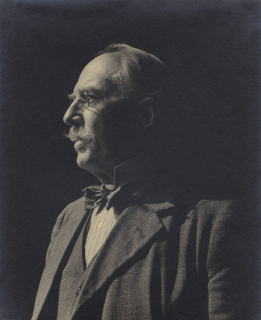
(Pictured: Dermod O’Brien by Howard Coster, print, late 1930s, given to the National Portrait Gallery, London by the estate of Howard Coster, 1978)


Leave a comment

Death of Sculptor Seamus Murphy

Seamus Murphy, Irish sculptor and stone carver best known for designing the Church of the Annunciation, Blackpool, Cork, dies in Cork, County Cork, on October 2, 1975.

Murphy is born near Mallow, County Cork on July 15, 1907, the son of James Murphy, a railway employee, and Margaret Sheehan of Little Island, County Cork. He attends Saint Patrick’s School on Gardiner’s Hill. In 1921 he enrolls as a part-time student at the Crawford School of Art, Emmet Place, Cork. In 1922 he finds work as an apprentice stone-carver at John Aloysius O’Connell’s Art Marble Works, Watercourse Road, Blackpool. There he specialises in architectural and foliage carving while continuing his studies at Crawford by night.

Murphy studies at the Académie Colarossi and at the Académie de la Grande Chaumière in Paris in 1932-1933 where he is befriended by the Irish American sculptor Andrew O’Connor. He opens his studio/workshop on Watercourse Road, Blackpool, Cork in 1934.

He is elected associate of the Royal Hibernian Academy in 1944, elected a full member in 1954, and appointed Royal Hibernian Academy Professor of Sculpture in 1964.

Also in 1944, he marries Maighread Higgins, daughter of the Cork sculptor Joseph Higgins, and they go on to have three children – the knitwear designer Bebhinn Marten, the novelist Orla Murphy and the painter and De Dannan member Colm Murphy.

Murphy designs the Church of the Annunciation on Great William O’Brien Street in Blackpool, Cork, for William Dwyer in 1945. The stonework in the church is mostly by Murphy himself. It is officially dedicated on October 7, 1945.

Seamus Murphy dies in Cork on October 2, 1975. He is buried in Rathcooney, County Cork.

Examples of Murphy’s unique carvings of statues, gravestones, monuments and plaques can be seen around Cork and Ireland, including a signed panel of the four evangelists outside the entrance of the church of Our Lady and Saint John in Carrigaline, County Cork.


Leave a comment

Death of Landscape Artist Dairine Vanston

Dairine (Doreen) Vanston, Irish landscape artist who works in a Cubist style, dies in Enniskerry, County Wicklow on July 12, 1988.

Vanston is born in Dublin on October 19, 1903. She is the daughter of solicitor John S. B. Vanston, and sculptor Lilla Vanston (née Coffey). She attends Alexandra College, going on to study at Goldsmith’s College, London under Roger Bissière. She then goes to Paris to the Académie Ranson, being sent there following the advice of Paul Henry. While in Paris she meets Guillermo Padilla, a Costa Rican law student at the University of Paris. They marry in 1926 and she takes the name Vanston de Padilla. The couple lives for a time in Italy, before moving to San José, Costa Rica. The marriage breaks down in the early 1930s, at which point she returns to Paris with her son and studies with André Lhote. She is living in France at the outbreak of World War II with Jankel Adler, but is able to escape to London in 1940, and later to Dublin.

Vanston’s time in Paris leaves a lasting impression on her work, including use of primary colours and a strong Cubist influence. She belongs to what critic Brian Fallon calls the “Franco-Irish generation of painters who looked to Paris,” along with Mainie Jellett, Evie Hone, and Norah McGuinness. Her time spent living in Costa Rica in the late 1920s and early 1930s imbues her work with tropical and highly toned colours. In Dublin in 1935, she exhibits 17 paintings, largely Costa Rican landscapes, at Daniel Egan’s gallery on St. Stephen’s Green. This is the closest thing to a solo show she would mount, with this show also featuring Grace Henry, Cecil Ffrench Salkeld, and Edward Gribbon.

Meeting the English artist Basil Rakoczi, who is also living in Dublin during World War II, leads Vanston to become associated with The White Stag group. In November 1941, she exhibits for the first time at a group show with 24 other artists, including Patrick Scott. One work that is shown at this exhibition is the painting Keel dance hall, which demonstrates that she spends time in the west of Ireland. The most important event staged by the group is the Exhibition of subjective art, which takes place at 6 Lower Baggot St. in January 1944. The Dublin Magazine notes her work at this show as the most effective of the experimental vanguard. This work, Dying animal, is a Cubist work with semi-representation forms rendered in bold colours. In 1945, her work is featured in a White Stag exhibition in London of young Irish painters at the Arcade gallery, Old Bond St.

In 1947, Vanston spends almost a year in Costa Rica where she paints primarily in watercolours. Apart from this period, she lives and works in Dublin, living at 3 Mount Street Crescent near St. Stephen’s Church. At the inaugural Irish Exhibition of Living Art in 1943, she exhibits five works. At the first Exhibition of Independent Artists in 1960, of which she is a founder, she exhibits three landscapes and a work entitled War. She largely exhibits with the Independent Artists, the Irish Exhibition of Living Art, and the Oireachtas na Gaeilge, and does not exhibit with the Royal Hibernian Academy. Later in life, she exhibits with the Figurative Image exhibitions in Dublin, and is amongst the first painters chosen for Aosdána. A number of her works are featured in the 1987 exhibition, Irish women artists, from the eighteenth century to the present arranged by the National Gallery of Ireland and The Douglas Hyde Gallery.

Vanston dies on July 12, 1988, in a nursing home in Enniskerry, County Wicklow. Her work is greatly admired, but has received little by way of critical attention, which may have been to do with her slow rate of output. A number of her works have proved difficult to trace. She was a private person, even refusing to cooperate with the Taylor Galleries in the 1980s when they wanted to mount a retrospective of her work. The National Self-Portrait Collection in Limerick holds a work by Vanston.

(Pictured: “Landscape with Lake and Hills” (1964), oil on paper (monotype) by Dairine Vanston)


Leave a comment

Death of Anne Butler Yeats, Painter, Costume & Stage Designer

Anne Butler Yeats, Irish painter, costume and stage designer, dies in Dublin on July 4, 2001.

Born in Dublin on February 26, 1919, Yeats is the daughter of the poet William Butler Yeats and Georgie Hyde-Lees, a niece of the painter Jack B. Yeats, and of Lily Yeats and of Elizabeth Corbet Yeats. Her aunts are associated with the Arts and Crafts movement in Ireland and are associated with the Dun Emer Press, Cuala Press, and Dun Emer industries. Her brother Michael Yeats is a politician. She is known as “feathers” by her family. Her birth is commemorated by her father with the poem “A Prayer for My Daughter.” She spends her first three years between Ballylee, County Galway and Oxford before her family moves to 82 Merrion Square, Dublin in 1922.

Yeats is very sick as a child, spending three years in two different hospitals. She then goes to the Pension Henriette, a boarding school in Villars-sur-Bex, Switzerland from 1928–1930. In 1923 her Aunt Elizabeth “Lolly” gives her brush drawing lessons which aids her in winning first prize in the RDS National Art competition for children under eight years old in 1925 and 1926.

Yeats trains in the Royal Hibernian Academy school from 1933 to 1936 and works as a stage designer with the Abbey Theatre in Dublin. In 1936, at the age of 16, she is hired by the Abbey Theatre as assistant to Tanya Moiseiwitsch. She studies for four months at the School of Theatrical Design in Paris with Paul Colin in 1937. At 18, she begins her costume career on sets with Ria Mooney‘s company. At the Abbey, she designs the sets and costumes for revivals of W.B. Yeats’ plays The Resurrection and On Baile’s Strand (1938).

In 1938 Yeats designs the first production of W.B. Yeats’ play Purgatory, which is her most successful achievement. Purgatory is the last play that W.B Yeats sees on stage, and when it is performed it is a full house. When working on Purgatory, Hugh Hunt wants to have a moon on the back cloth of the production but Yeats refuses. “If she does not win, she is going to say that she doesn’t wish to have her name on the programme as a designer of the setting.” This could be the main reason why her name is not on many productions that she works on. She also designs the first play of her uncle Jack Yeats to receive professional production, Harlequin’s Positions.

In 1939 Yeats is promoted to head of design at the Abbey until her departure in May 1941. In 1939 it is commented that her designs are “getting arty” and not in keeping with the style of the Abbey. One of her last designs is her father’s last play, The Death of Cuchulain, for the Lyric Theatre on the Abbey stage, in 1949. She designs and stage-manages for the Peacock Theatre, the Cork Opera House, the Olympia Theatre, the Gaiety Theatre, the Austin Clarke Lyric Theatre, the Abbey Theatre and Players’ Theatre.

Among the work Yeats is credited with in the Abbey Theatre, she is also recorded as having worked on five productions in the Peacock Theatre with the Theatre Company: Alarm Among the Clerks (1937), The Phoenix (1937), Harlequin’s Positions (1939), The Wild Cat (1940), and Cavaliero (The Life of a Hawk) (1948).

Yeats chooses to move towards painting full-time beginning a brief study at the Dublin Metropolitan School of Art in 1941. She experiments with watercolour and wax. She has a touching naive expressionist style and is interested in representing domestic humanity. She designs many of the covers for the books of Irish-language publisher Sáirséal agus Dill over a twenty-year period from 1958. She does illustrations for books by Denis Devlin, Thomas Kinsella and Louis MacNeice, and works with many young designers, such as Louis le Brocquy.

Yeats dies at the age of 82 in Dublin on July 4, 2001. She is buried near her brother, Michael Butler Yeats, at Shanganagh Cemetery in Shankill, County Dublin.

The Royal Hibernian Academy holds a retrospective of her work in 1995, as does the National Gallery of Ireland in 2002. She donates her collection of Jack B. Yeats’ sketch books to the National Gallery of Ireland, leading to the creation of the Yeats Museum within the Gallery. Her brother, Michael, in turn, donates her sketchbooks to the Museum.

(Pictured: “Gossip & Scandal,” 1943 oil on canvas, by Anne Butler Yeats)


Leave a comment

Birth of Architect George Coppinger Ashlin

George Coppinger Ashlin, Irish architect particularly noted for his work on churches and cathedrals, is born in County Cork on May 28, 1837. He becomes President of the Royal Institute of the Architects of Ireland.

Ashlin is the son of J. M. Ashlin, J.P. He receives his early education at the Collège de St. Servais in Liège, Belgium. He later enrolls at St. Mary’s College, Oscott (1851-55) where he is subsequently a pupil of Edward Welby Pugin. It is during this time that he develops an interest in architecture. By 1858, he enters the Royal Academy Schools, London.

When Pugin receives the commission for SS Peter and Paul’s, Carey’s Lane, Cork, in 1859, he makes Ashlin a partner with responsibility for their Irish work. This partnership lasts until late 1868. In 1861 they open their office at St. Stephen’s Green, Dublin. The practice is primarily ecclesiastical, designing some 25 religious buildings. Their churches and Cathedrals are mainly located in the counties of Wexford, Cork and Kerry, and are all of similar design. By far the most important commission undertaken by this partnership is the building of St. Colman’s Cathedral, Cobh for Bishop William Keane.

In 1867 Ashlin marries Mary Pugin (1844-1933), sister of Edward Welby Pugin and daughter of Augustus Welby Pugin, the Gothic revivalist. Their only daughter, Miriam, is born ten years later.

The partnership with Pugin is dissolved in 1870. Thereafter Ashlin practises in his own right, branching out to cover the entire island nation. His works of this period include Ballycotten (1901), Ballybunion (1892), Church of the Most Holy Rosary, Midleton (1893) and the Munster & Leinster Bank, both of Midleton, and finally Kildare (1898).

Ashlin is a member of the Royal Hibernian Academy and Fellow of the Royal Institute of British Architects.

George Coppinger Ashlin dies at the age of 84 on December 10, 1921. He is buried at Glasnevin Cemetery in Dublin.


Leave a comment

Death of Northern Irish Artist Basil Blackshaw

Basil Blackshaw, Northern Irish artist, dies at the age of 83 on May 2, 2016. He is best known for his paintings of dogs, horses, landscapes and people and is regarded as one of the country’s most talented artists.

Blackshaw is born in 1932 in Glengormley, County Antrim, Northern Ireland and raised in Boardmills in Lisburn, County Down. He attends Methodist College Belfast and studies at Belfast College of Art (1948–1951). In 1951 he is awarded a scholarship to study in Paris by the Committee for the Encouragement of Music and the Arts.

Blackshaw’s home and studio is in County Antrim by Lough Neagh. He becomes well known for his country scenes including landscapes, farm buildings and horses, painted in an expressionist style.

Blackshaw is initially acclaimed for his mastery of traditional approaches to painting. He continues to develop as an artist, becoming most highly regarded for his very loose gestural application of paint and a very distinctive and subtle use of colour. His paintings of such sports as horse racing and boxing make him particularly popular, but he is also a talented portrait painter.

Blackshaw’s paintings are often figurative in form, but with a non-naturalistic palette which re-balances the composition in an expressionist, even abstract, way. His themes are very Irish and often rural; greyhounds, Irish Travellers, and the landscape. He also produces portraits and designs posters for Derry‘s Field Day Theatre Company.

The Arts Council of Northern Ireland organises a major retrospective of Blackshaw’s work in 1995, which travels from Belfast to Dublin, Cork and many galleries in the United States. In 2001 he receives the GlenDimplex Award for a Sustained Contribution to the Visual Arts in Ireland. The Ulster Museum holds a major exhibition of his work in 2002 and a major book is published by Eamonn Mallie on the artist in 2003.

For a 2005 exhibition at the Fenton Gallery in Cork, Blackshaw works exclusively over a period of 20 months creating a dramatic collection of fifteen new paintings. His choice of arguably mundane subjects, The Studio Door, Car, Wall, Six Trees, express both an engagement with tradition and a watchful detachment.

In 2006 Blackshaw’s work is exhibited at the Irish College in Paris (French: Centre Culturel Irlandais).

Blackshaw is elected as an associate of The Royal Ulster Academy of Arts in 1977 and elected an Academician in 1981. Dublin’s Royal Hibernian Academy describes him as “one of Ireland’s greatest artists” who was “lauded by the art world and his fellow painters.”

Basil Blackshaw dies on May 2, 2016. Father to well-known artist Anya Waterworth, he is buried in a wicker coffin in a humanist funeral, the ceremony ending to Bob Dylan‘s “Mr. Tambourine Man” at Roselawn Cemetery on the outskirts of Belfast. More than 100 mourners come to pay their respects. Among them are artists Jack Pakenham and Neil Shawcross, actor Stephen Rea and boxing legend Barry McGuigan.


Leave a comment

Birth of Sculptor Oliver Sheppard

Oliver Sheppard RHA, Irish sculptor most famous for his 1911 bronze statue of the mythical Cúchulainn dying in battle, is born at Old Town, Cookstown, County Tyrone on April 10, 1865. His work is also part of the art competitions at the 1924 Summer Olympics and the 1928 Summer Olympics.

Sheppard is born to Simpson Sheppard, a sculptor, and Ellen White, of Ormond Quay, Dublin.

Sheppard is based in Dublin for almost all of his life, having travelled widely across Europe. He and his wife Rosie have several children. They live at Howth and 30 Pembroke Road in central Dublin. She dies in 1931.

Sheppard’s main influence is the Frenchman Édouard Lantéri who teaches him at the Royal College of Art in London, and then at the Dublin Metropolitan School of Art in Dublin (now the National College of Art and Design), where he later becomes a lecturer.

From 1902 to 1937 Sheppard teaches sculpture at the Dublin Metropolitan School of Art, which is renamed the National College of Art in 1936. His annual stipend is £250 but for this he only has to lecture on three mornings per week, allowing him plenty of time for work on commissioned projects. One of his most famous students is the sculptor Kathleen Cox.

As a prominent sculptor Sheppard is a member of the Royal Hibernian Academy, the Royal Dublin Society, and is made a governor of the National Gallery of Ireland from 1925–41. He also exhibits works at European exhibitions during his lifetime, occasionally winning prizes.

Sheppard is generally critical of the low standards of sculpture in Ireland, saying, “For the last sixty years or so thousands of figures and groups have been executed in Dublin for ecclesiastical purposes, and, with one or two exceptions…was not up to a reasonable standard. The making of a work of art hardly entered into it at all. The sculptor, well trained and properly encouraged, should collaborate with the architect.”

In 1890–1910 Sheppard is a part of the Celtic Revival movement, and, from his works such as Inis Fáil, is admired by his student William Pearse. Through him he meets his brother, Patrick Pearse, who later helps launch the Easter Rising in 1916. While most of the Revival’s artists are writers, playwrights and poets, Sheppard can claim to be the main sculptor working on themes similar to theirs.

Sheppard is in the minority of Irish Protestants who support independence, starting with support for the Irish Parliamentary Party in the 1880s, when he is an art student. After the Irish War of Independence (1919–21) he says, “They thought me too old to fight but I have tried to help in other ways. My politics are simple. I have always thought that this country should be a free country.” His opinions are not overly dogmatic, considering his work on the war memorials in 1920.

In the mid-1920s the first series of Irish Free State coinage is planned and is finally launched in 1928. Sheppard is one of the designers short-listed but his designs are not accepted.

Sheppard dies in Dublin on September 14, 1941.

(Pictured: “The Dying Cúchulainn,” sculpture by Oliver Sheppard, now at the General Post Office (GPO) in Dublin)


Leave a comment

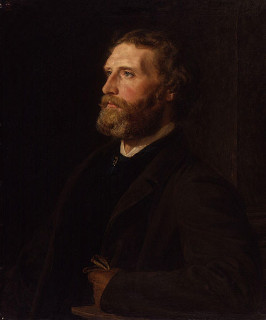
Birth of Irish Painter Sir Frederic William Burton RHA

Irish painter Sir Frederic William Burton RHA is born in County Wicklow on April 8, 1816. The third son of Samuel Frederick Burton and his wife Hanna Mallett, he is taken by his parents to live in County Clare on the west coast of Ireland at the age of six. The old Burton seat is Clifden House, Corofin, County Clare, which is built around the middle of the eighteenth century. The artist’s grandparents were Major Edward William Burton, Clifden, who was High Sheriff of Clare in 1799, and his wife, Jane Blood of nearby Roxton, County Clare. In his youth he has strong sympathy with the Young Ireland movement.

Educated in Dublin, Burton is elected an associate of the Royal Hibernian Academy at the age of twenty-one and an academician two years later. In 1842 he begins to exhibit at the Royal Academy. A visit to Germany and Bavaria in 1842 is the first of a long series of trips to various parts of Europe, which give him a profound knowledge of the works of the Old Masters. From 1851 he spends seven years working as a painter in the service of Maximilian II of Bavaria.

Burton works with George Petrie on archaeological sketches and is on the council of the Royal Irish Academy and the Archaeological Society of Ireland. He is elected an associate of the Royal Society of Painters in Watercolours in 1855, and a full member in the following year. He resigns in 1870 and is reelected as an honorary member in 1886.

In 1874 Burton is appointed the third director of the National Gallery, London, in succession to Sir William Boxall RA. In June 1874, he obtains a special grant to acquire the art collection of Alexander Barker, which includes Piero della Francesca‘s Nativity and Sandro Botticelli‘s Venus and Mars. In 1876 a bequest of 94 paintings, mainly by Dutch artists but also including works by Antonio del Pollaiuolo, Dieric Bouts and Canaletto, is made by the British haberdasher Wynne Ellis. Also, in this year an extension to the Gallery by Edward Middleton Barry is completed.

During the twenty years that Burton holds this post he is responsible for many important purchases, among them Leonardo da Vinci‘s Virgin of the Rocks, Raphael‘s Ansidei Madonna, Anthony van Dyck‘s Equestrian portrait of Charles I, Hans Holbein the Younger‘s Ambassadors, and the Admiral Pulido Pareja, by Diego Velázquez (this subsequently attributed to Velázquez’s assistant Juan Bautista Martínez del Mazo). He also adds to the noted series of Early Italian pictures in the gallery. The number of acquisitions made to the collection during his period of office exceeds 500.

Burton’s best-known watercolours, The Aran Fisherman’s Drowned Child (1841) and The Meeting on Turret Stairs (1864) are in the National Gallery of Ireland. The Meeting on Turret Stairs is voted by the Irish public as Ireland’s favourite painting in 2012 from among ten works shortlisted by critics. A knighthood is conferred on him in 1884, and the degree of LL.D. of Dublin in 1889.

Burton dies in Kensington, West End of London on March 16, 1900, and is buried in Mount Jerome Cemetery, Dublin.

(Pictured: “Sir Frederic William Burton,” painting by Henry Tanworth Wells (died 1903), given to the National Portrait Gallery, London in 1913)


Leave a comment

Birth of Mary Swanzy, Landscape & Genre Artist

Mary Swanzy, Irish landscape and genre artist, is born in Dublin on February 15, 1882. Noted for her eclectic style, she paints in many styles including cubism, futurism, fauvism, and orphism, she is one of Ireland’s first abstract painters.

Swanzy is the second of three daughters of Sir Henry Rosborough Swanzy, an eye surgeon, and his wife Mary (née Denham). She attends Alexandra College, Earlsfort Terrace, a finishing school at the Lycée in Versailles, France, and a day school in Freiburg, Germany. This education means that she is fluent in French and German. She goes on to take art classes at Mary Manning‘s studio, under the direction of John Butler Yeats. Manning encourages her to study modelling with John Hughes at the Dublin Metropolitan School of Art.

Living within walking distance of the National Gallery of Ireland, she spends a lot of time studying and copying the great masters. Her first exhibition is with the Royal Hibernian Academy (RHA) in 1905 with Portrait of a child, continuing to exhibit portraits every year until 1910. In 1905 she goes to Paris and works at the Académie Delécluse, an atelier-style art school. She goes on to attend the studio of Antonio de La Gándara in 1906 and takes classes at Académie de la Grande Chaumière and Académie Colarossi. While in Paris she is exposed to the works of Gauguin, Matisse, and Picasso, which make a lasting impression on her.

On her return to Dublin, Swanzy paints portraits and genre scenes and holds her first show at Mill’s Hall, Merrion Row in 1913. She holds another show there in 1919, where she exhibits nearly 50 pieces. This exhibition is reviewed by Sarah Purser who notes the lack of melancholy and light optimism in Swanzy’s Irish landscapes. Swanzy paints in a number of styles, often reflecting the major art developments in Paris.

After the deaths of her parents, she is financially independent and can travel, spending her time between Dublin and Saint-Tropez during World War I while continuing to paint. She also exhibits with the Société des Artistes Indépendants in 1914 and 1916, being elected to the committee in 1920. While visiting her sister who is involved with the Protestant relief mission in Yugoslavia and Czechoslovakia, she paints landscapes, village life, and peasant scenes. These works are shown in the autumn of 1921 in the Dublin Painters’ Gallery with six other artists including Jack Butler Yeats, Paul Henry, and Clare Marsh with whom she shares a studio.

Swanzy begins to travel to more exotic countries from the 1920s, Honolulu around 1923, and later Samoa. As a result, she paints local tropical flowers, trees, and native women, with a palette and style similar to that of Fauvism. She stays for a time in Santa Barbara, California, working in a local studio and exhibiting some of her Samoan work at the Santa Barbara Arts Club Gallery. She returns to Ireland in February 1925 and exhibits three of her Samoan paints at the RHA, and 14 at her one-woman show in the Galerie Bernheim-Jeune, Paris in October 1925. Gertrude Stein writes her to congratulate her on her Paris exhibition.

In the mid 1920s Swanzy settles in Blackheath, London, making regular trips to Dublin and abroad. In 1932 Purser holds an exhibition of Swanzy’s work for invited guests in her house. At this time her painting is influenced by orphism and is reviewed positively. Her work becomes more allegorical in later years, with The message in the Hugh Lane Gallery demonstrating this. During World War II she stays with her sister in Coolock for three years. In 1943, she holds a one-woman show at the Dublin Painters’ Gallery, and is also featured at the first Irish Exhibition of Living Art. She is exhibited at St. George’s Gallery, London in 1946 along with Henry Moore, Marc Chagall, and William Scott.

Swanzy is made an honorary member of the RHA in 1949, showing with them in 1950 and 1951. She does not exhibit in Ireland for a number of years, but the Hugh Lane Gallery holds a major retrospective of her work in 1968. Following this she holds two one-woman shows at the Dawson Gallery in 1974 and 1976. In 1975 she is featured at the Cork ROSC art exhibition and resumes showing with the RHA. She continues to paint until her death at her home in London on July 7, 1978.

In 1982 the Taylor Galleries holds an exhibition to mark the centenary of Swanzy’s birth. More recently she is featured in the Irish Museum of Modern Art (IMMA) 2013 exhibition Analysing Cubism. From October 2018-February 2019, also in IMMA, she is the subject of the solo exhibition Mary Swanzy Voyages.

(Pictured: Sunlit Landscape, oil-on-canvas, by Mary Swanzy)


Leave a comment

Death of Artist Harry Aaron Kernoff

Harry Aaron Kernoff, Irish artist in oils and woodcuts, dies in Dublin on December 25, 1974. Of London/Russian extraction, he is primarily remembered for his sympathetic interest in Dublin and its people. He depicts street and pub scenes, as well as Dublin landmarks with sympathy and understanding. This is particularly evident in his woodcuts.

Born in London on January 10, 1900 to a Russian Jewish father and Spanish mother, Kernoff moves to Dublin in 1914 and becomes a leading figure in Irish modernism. While working as an apprentice in his father’s furniture business, which leads to his woodcuts, he takes night classes at the Dublin Metropolitan School of Art. There, in 1923, he wins the Taylor scholarship and goes on to exhibit at the Royal Hibernian Academy (RHA) every year from 1926. He is elected RHA in 1936.

Influenced by Seán Keating, he paints the Irish landscape, genre scenes, and portraits. His work is part of the painting event in the art competition at the 1928 Summer Olympics in Amsterdam. In 1930, he visits the Soviet Union as part of an Irish delegation from the friends of Soviet Russia led by Hanna Sheehy-Skeffington. While visiting, he is influenced by the Association of Artists of Revolutionary Russia.

Kernoff is famously associated with Davy Byrne’s pub. His paintings and woodcuts of Davy Byrne’s pub are documents of his friendship with the original owner. While living in his adopted Dublin Jewish community he produces picture illustrations of his local scenes for a neighbourhood writer and friend, Nick Harris, for his book called Dublin’s Little Jerusalem.

Outside Kernoff’s home in Dublin, where he lives with two unmarried sisters, there is a long-standing sign in the front garden which says “Descendants of the Abravanels.” The Abravanel (or Abrabanel) family is one of the most famous Sephardic Jewish families in history, noted for their large quotas of rabbis, scholars, and members of a variety of scientific and artistic fields, dating from about the 13th century in Lisbon. The emergence of the famous philosopher and scholar Don Isaac Abravanel in the middle of the 16th century brings his works to greater universal recognition.

Kernoff spends the vast majority of his life unappreciated and makes little or nothing from his paintings until a few years before his death, when he begins to be appreciated by contemporary critics. He never marries.