seamus dubhghaill

Promoting Irish Culture and History from Little Rock, Arkansas, USA


Leave a comment

Death of Emily Lawless, Irish Novelist & Poet

The Honourable Emily Lawless, Irish novelist and poet from County Kildare, dies at Gomshall, a village in the borough of Guildford in Surrey, England, on October 19, 1913. According to Betty Webb Brewer, writing in 1983 for the journal of the Irish American Cultural Institute, Éire/Ireland, “An unflagging unionist, she recognised the rich literary potential in the native tradition and wrote novels with peasant heroes and heroines, Lawless depicted with equal sympathy the Anglo-Irish landholders.”

Lawless is born at Lyons Demesne below Lyons Hill, Ardclough, County Kildare. Her grandfather is Valentine Lawless, 2nd Baron Cloncurry, a member of the Society of United Irishmen and son of a convert from Catholicism to the Church of Ireland. Her father is Edward Lawless, 3rd Baron Cloncurry, thus giving her the title of “The Honourable.” In contrast, her brother Edward Lawless is a landowner with strong Unionist opinions, a policy of not employing Roman Catholics in any position in his household, and chairman of the Property Defence Association set up in 1880 to oppose the Irish National Land League and “uphold the rights of property against organised combination to defraud.” The prominent Anglo-Irish unionist and later nationalist, Home Rule politician Horace Plunkett is a cousin. Lord Castletown, Bernard FitzPatrick, 2nd Baron Castletown is also a cousin. It is widely believed that she is a lesbian and that Lady Sarah Spencer, dedicatee of A Garden Diary (1901) is her lover.

Lawless spends part of her childhood with the Kirwans of Castle Hackett, County Galway, her mother’s family, and draws on West of Ireland themes for many of her works. She occasionally writes under the pen name “Edith Lytton.”

Lawless writes nineteen works of fiction, biography, history, nature studies and poetry, many of which are widely read at the time. She is most famous today for her Wild Geese poems (1902).

Some critics identify a theme of noble landlord and noble peasant in her fourth book, Hurrish, a Land War story set in The Burren of County Clare which is read by William Ewart Gladstone and said to have influenced his policy. It deals with the theme of Irish hostility to English law. In the course of the book a landlord is assassinated, and Hurrish’s mother, Bridget, refuses to identify the murderer, a dull-witted brutal neighbour. The book is criticised by Irish-Ireland journals for its “grossly exaggerated violence,” it’s embarrassing dialect, staid characters.

Her reputation is damaged by William Butler Yeats who accuses her in a critique of having “an imperfect sympathy with the Celtic nature” and for adopting “theory invented by political journalists and forensic historians.” Despite this, Yeats includes her novels With Essex in Ireland (1890) and Maelcho (1894) in his list of the best Irish novels.

Emily Lawless dies at Gomshall, Surrey, on October 19, 1913. Her papers are preserved in Marsh’s Library in Dublin.

2 Comments

First Irish Convict Ship Arrives in Botany Bay

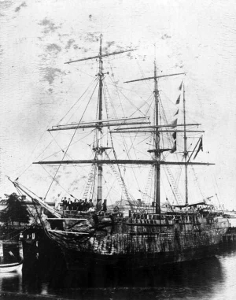
The Queen, the first ship delivering Irish convicts, arrives at the penal settlement of Botany Bay in New South Wales, Australia on September 26, 1791. About 30% of all Australians are of Irish birth or descent. Many emigrated freely but many are descended from convicts transported there in the early years of the colony.

Britain has a policy of transportation. Up until the American Revolution most are sent to the American colonies or the West Indies. By the 1780s, Britain badly needs prison space. Petty criminals are housed on overcrowded prison ships anchored on the River Thames. In 1786, the government decides to start a prison settlement in the new colony at Botany Bay.

The transportation is arranged by a private company and those convicts who arrive there are actually the lucky ones, as conditions on the journey are horrendous and many die en route. The organisers of the transportation ships operate on a contract basis. They are paid a certain amount per head and the less provisions they give the prisoners the more profit they make.

The first two fleets of convict ships sail from England. The first ship to sail directly from Ireland is the Queen, which leaves Cork in April 1791 and joins the third fleet sailing from England. On board are 133 male convicts, 22 females and three children. The youngest on the ship is two-week-old Margaret, daughter of convict Sarah Brennan. The youngest convicts are 11-year-old David Fay and 12-year-old James Blake, convicted for stealing a pair of buckles. The oldest convict is 64-year-old Patrick Fitzgerald from Dublin, who is sentenced to seven years for stealing clothes. Seven men and one woman die on the voyage and within a year, half the men who had sailed on the Queen are dead. Young James Blake dies within a few months of landing.

The last convict ship sails from Ireland to Australia in 1853 and over the course of 60 years, 30,000 men and 9,000 women are transported for a minimum of seven years. While a good number of them are patriots and rebels – United Irishmen and Young Irelanders – the majority are transported for petty crimes.

Transportation continues for more than 60 years and is followed by assisted emigration. More than 100,000 travel on assisted passage during the 1850s alone. Some are assisted on their journey by charitable organisations in an effort to relieve distress. The last transportation ship, the Phoebe Dunbar, sails from Dún Laoghaire in 1853, bound for Perth.


Leave a comment

Execution of Robert Emmet, Irish Nationalist & Republican

Robert Emmet, Irish nationalist and Republican, orator and rebel leader, is hung, drawn, and quartered in Dublin on September 20, 1803, following his conviction for high treason.

Emmet is born at 109 St. Stephen’s Green, in Dublin on March 4, 1778, the youngest son of Dr. Robert Emmet, a court physician, and his wife, Elizabeth Mason. He attends Oswald’s school, in Dopping’s-court, off Golden-lane and enters Trinity College, Dublin in October 1793, at the age of fifteen. He becomes secretary of a secret United Irish Committee in college and is expelled in April 1798 as a result. That same year he flees to France to avoid the many British arrests of nationalists that are taking place in Ireland.

After the 1798 rising, Emmet is involved in reorganising the defeated Society of United Irishmen. In April 1799 a warrant is issued for his arrest. He escapes and soon after travels to the continent in the hope of securing French military aid. His efforts are unsuccessful, as Napoleon is concentrating his efforts on invading England.

Emmet returns to Ireland in October 1802 and, along with fellow revolutionaries Thomas Russell and James Hope, begins preparations for another uprising in March of the following year. A premature explosion at one of Emmet’s arms depots forces him to advance the date of the rising before the authorities’ suspicions are aroused.

Emmet is unable to secure the help of Michael Dwyer‘s Wicklow rebels. Many rebels from Kildare turn back due to the scarcity of firearms they had been promised, but the rising proceeds in Dublin on the evening of July 23, 1803. Failing to seize Dublin Castle, which is lightly defended, the rising amounts to a large-scale disturbance in the Thomas Street area. He sees a dragoon pulled from his horse and piked to death, the sight of which prompts him to call off the rising to avoid further bloodshed, but he has no control over of his followers. Sporadic clashes continue into the night until finally quelled by British military forces.

Emmet flees into hiding but is captured on August 25 and taken to Dublin Castle, then removed to Kilmainham Gaol. He is tried for treason on September 19. The Crown repairs the weaknesses in its case by secretly buying the assistance of Emmet’s defence attorney, Leonard McNally, for £200 and a pension. McNally’s assistant Peter Burrowes cannot be bought, and he pleads the case as best he can. Emmet is found guilty of high treason.

Chief Justice John Toler, 1st Earl of Norbury sentences Emmet to be hanged, drawn and quartered, as is customary for conviction of treason. The following day, September 20, Emmet is executed in Thomas Street near St. Catherine’s Church. He is hanged and beheaded once dead. As family members and friends of Emmet had also been arrested, including some who had nothing to do with the rebellion, no one comes forward to claim his remains out of fear of arrest.

Emmet’s remains are first delivered to Newgate Prison and then back to Kilmainham Gaol, where the jailer is under instructions that if no one claims them, they are to be buried in a nearby hospital’s burial grounds. A later search there finds no remains. It is speculated that Emmet’s remains were secretly removed from the site and reinterred in St. Michan’s Church, a Dublin church with strong United Irish associations, though it is never confirmed. It is later suspected that they are buried secretly in the vault of a Dublin Anglican church. When the vault is inspected in the 1950s a headless corpse was found, suspected of being Emmet’s, but cannot be identified. Widely accepted is the theory that Emmet’s remains were transferred to St. Peter’s Church in Aungier St. under cover of the burial of his sister, Mary Anne Holmes, in 1804. In the 1980s the church is deconsecrated, and all the coffins are removed from the vaults. The church has since been demolished.


Leave a comment

Death of Samuel Nielson, Society of United Irishmen Founder Member

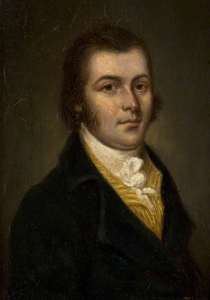
Samuel Neilson, one of the founder members of the Society of United Irishmen and the founder of its newspaper the Northern Star, dies in Poughkeepsie, New York on August 29, 1803.

Neilson is born in Ballyroney, County Down, the son of Presbyterian minister Alexander, and Agnes Neilson. He is educated locally. He is the second son in a family of eight sons and five daughters. At the age of 16, he is apprenticed to his elder brother, John, in the business of woolen drapery in Belfast. Eight years later he establishes his own business.

Despite his commercial success, Neilson is naturally drawn to politics and is early on a member of the reformist Irish Volunteers movement. In 1791, inspired by the French Revolution, he suggests to Henry Joy McCracken the idea of a political society of Irishmen of every religious persuasion. He establishes the Society of United Irishmen in Belfast. The following year he launches the newspaper of the United Irishmen, the Northern Star, which effectively throws away his fortune. As its editor he is a high-profile target for the authorities and is prosecuted for libel several times, being twice imprisoned between 1796 and 1798.

Along with several other state prisoners, Neilson is released in February 1798 following several petitions by influential friends, on grounds of bad health. Upon release he immediately involves himself in the United Irishmen aligning with the radicals among the leadership who are pressing for immediate rebellion and oppose the moderates who wish to wait for French assistance before acting.

The United Irishmen are however, severely penetrated by informants who keep Dublin Castle abreast of their plans and discussions. In March 1798, information of a meeting of the United Irish executive at the house of Oliver Bond leads to the arrest of most of the leadership, leaving Neilson and Lord Edward FitzGerald as the only figures of national importance still at liberty. They decide to press ahead as soon as possible and settled on May 23 as the date for the rebellion to begin.

As the date looms closer, the authorities go into overdrive to sweep up the rump leadership and on May 18 Lord Edward is betrayed in his hiding place and critically wounded while resisting capture. Neilson, now with responsibility for finalising plans for the looming rebellion, decides that Fitzgerald is too valuable to do without, and decides to try and rescue him from Newgate Prison in Dublin. Wary of confiding his plans too early for fear of betrayal, Neilson goes on a reconnaissance of the prison but is spotted by chance by one of his former jailers and after a fierce struggle, he is overpowered and dragged into the prison.

Neilson is indicted for high treason and held in Kilmainham Gaol with other state prisoners for the duration of the doomed rebellion outside. After the execution of Oliver Bond, and the brothers John and Henry Sheares, Neilson and the remaining prisoners agree to provide the authorities with details of the organisation of the United Irishmen, plans for the rebellion, etc. in return for exile.

Following the suppression of the rebellion, Neilson is transferred to Fort George in Inverness-shire, Scotland, and in 1802 he is deported to the Netherlands. From there he makes his way to the United States, arriving in December 1802, and settling in Poughkeepsie, New York.  He has little time to enjoy his liberty before his sudden death on August 29, 1803, of yellow fever, or possibly a stroke.

Nielson is not idle during his short life in America as he completes plans to start a new evening newspaper in Poughkeepsie and also has plans in the works to establish a version of the Society of United Irishmen in the United States. Since his death, his remains have been moved to three different cemeteries before coming to rest in the Poughkeepsie Rural Cemetery in 1880.

(Photograph: (c) National Museums Northern Ireland; Supplied by The Public Catalogue Foundation)


1 Comment

Death of James Napper Tandy, Irish Revolutionary

James Napper Tandy, Irish revolutionary and member of the Society of United Irishmen, dies in Bordeaux, France on August 24, 1803.

A Dublin Protestant and the son of an ironmonger, Tandy is baptised in St. Audoen’s Church on February 16, 1739. He attends the Quaker boarding school in Ballitore, County Kildare. He starts life as a small tradesman. Turning to politics, he becomes a member of Dublin Corporation and is popular for his denunciation of municipal corruption and his proposal of a boycott of English goods in Ireland in retaliation for the restrictions imposed by the government on Irish commerce.

Tandy and John Binns persuade Dublin Corporation to condemn by resolution William Pitt the Younger‘s amended commercial resolutions in 1785. He becomes a member of the Whig club founded by Henry Grattan, and he actively co-operates with Theobald Wolfe Tone in founding the Society of United Irishmen in 1791, of which he becomes the first secretary.

Sympathy with the French Revolution is rapidly spreading in Ireland. A meeting of some 6,000 people in Belfast votes a congratulatory address to the French nation in July 1791. In the following year, Tandy takes a leading part in organising a new military association in Ireland modelled after the French National Guard. Tandy also, with the purpose of bringing about a fusion between the Defenders and the United Irishmen, took the oath of the Defenders, a Roman Catholic society whose agrarian and political violence had been increasing for several years.

Tandy is about to be tried in 1793 for distributing a seditious pamphlet in County Louth when the government discovers he has taken the oath of the Defenders. Being threatened with prosecution for this step, and also for libel, he takes refuge by changing his Dublin address often until he flees to the United States in 1795, where he remains until 1798. In February 1798 he goes to Paris, where a number of Irish refugees are assembled and planning rebellion in Ireland to be supported by a French invasion but quarrelling among themselves over tactics.

Tandy accepts the offer of a corvette, the HMS Anacreon, from the French government and sails from Dunkirk accompanied by a few United Irishmen, a small force of men and a considerable quantity of arms and ammunition for distribution in Ireland. He arrives at the isle of Arranmore, off the coast of County Donegal, on September 16, 1798.

Tandy takes possession of the village of Rutland, where he hoists an Irish flag and issues a proclamation. He soon discovers that the French expedition of General Jean Joseph Amable Humbert to aid the Irish rebellion has failed. He sails his vessel around the north of Scotland to avoid the British fleet. He reaches Bergen in safety having brought with him a British ship captured along the way. Tandy then made his way with three or four companions to the free port of Hamburg but a peremptory demand from the British government to detain the fugitives was acceded to despite a counter-threat from the French Directory. In 1799 HMS Xenophon, under Commander George Sayer, brings Tandy and some of his associates back to England as state prisoners.

On February 12, 1800, Tandy is put on trial at Dublin and is acquitted. He remains in prison in Lifford Gaol in County Donegal until April 1801, when he is tried for the treasonable landing on Rutland Island. He pleads guilty and is sentenced to death although he is reprieved and allowed to go to France.

In France, where his release is regarded as a French diplomatic victory, he is received, in March 1802, as a person of distinction. When he dies on August 24, 1803, in Bordeaux, his funeral is attended by the military and an immense number of civilians. James Napper Tandy is buried in his family’s burial crypt, St. Mary’s churchyard, Julianstown, County Meath. His fame is perpetuated in the Irish ballad The Wearing of the Green.


Leave a comment

Birth of Richard Robert Madden, Historian & Abolitionist

Richard Robert Madden, Irish doctor, writer, abolitionist and historian of the Society of United Irishmen, is born on August 22, 1798. He takes an active role in trying to impose anti-slavery rules in Jamaica on behalf of the British government.

Madden is born at Wormwood Gate, Dublin to Edward Madden, a silk manufacturer, and his wife Elizabeth (née Corey). His father has married twice and fathered twenty-one children. Luckily for young Richard his father is still affluent enough by the time he is reaching adolescence to afford him a top-quality education. This means private schools and a medical apprenticeship in Athboy, County Meath. He studies medicine in Paris, Italy, and St. George’s Hospital, London. While in Naples he becomes acquainted with Marguerite Gardiner, Countess of Blessington and her circle.

In 1828 Madden marries Harriet Elmslie, herself coincidentally the youngest of twenty-one children. Born in Marylebone in 1801 and baptised there into the Church of England, she is the last child of John Elmslie, a Scot who owns hundreds of slaves on his plantations in Jamaica, and his wife Jane Wallace. Both Harriet’s parents are of Quaker stock, but while living in Cuba she converts to Roman Catholicism. On marriage, Madden stops travelling and practises medicine for five years.

Eventually he realises that he needs to contribute to the abolitionist cause. The slave trade has been illegal in the empire since 1807, but slaves still exist. Abolishing slavery is a popular cause, and it is obvious that the trading of slaves is still in progress, and many are not actively involved but they are complicit with the activity.

Madden is employed in the British civil service from 1833, first as a justice of the peace in Jamaica, where he is one of six Special Magistrates sent to oversee the eventual liberation of Jamaica’s slave population, according to the terms of the Slavery Abolition Act 1833. From 1835 he is Superintendent of the freed Africans in Havana. His son, Thomas More Madden, who later becomes a surgeon and writer, is born there. In 1839 he becomes the investigating officer into the slave trade on the west coast of Africa and, in 1847, the secretary for the West Australian colonies. He returns to Dublin and in 1850 is named secretary of the Office for Loan Funds in Dublin.

Richard Madden dies at his home in Booterstown, just south of Dublin, on February 5, 1886, and is interred in Donnybrook Cemetery.


Leave a comment

Execution of the Sheares Brothers

Brothers John and Henry Sheares, both Irish lawyers and members of the Society of United Irishmen, are executed in Dublin on July 14, 1798 during the Irish Rebellion of 1798.

The Sheares brothers are the sons of Henry Sheares, a liberal banker from County Cork who also sits in the Irish Parliament for the Borough of Clonakilty. Henry attends Trinity College, Dublin, buys an officer’s commission and then studies as a lawyer, being called to the bar as a barrister in 1790. John qualifies as a barrister in 1788.

In 1792 the brothers go to Paris and are swept away by the popular enthusiasms of the French Revolution. They meet leaders such as Jacques Pierre Brissot and Jean-Marie Roland, both of whom are to be executed in 1793. In particular they witness the introduction of the guillotine, on which 1,400 are to die in 1792. On the boat from France to England they meet Daniel O’Connell, then a student, who is disgusted by the increasingly bloodthirsty nature of the revolution. O’Connell remains an advocate of non-violence thereafter.

The brothers join the United Irish movement upon their return to Dublin in January 1793, when it is still legal, and John begins to write articles for the Press, a nationalist paper. However, France declares war on Britain, and by extension on Ireland, in February 1793. The Society’s initial aims of securing Catholic emancipation and universal suffrage are unsuccessful, amounting to the administration’s 1793 Relief Act. Its stance becomes more radical, and in turn the Irish administration fears a group inspired by France, banning it in 1794.

The Sheares brothers principally organise the movement in Cork, while continuing with their legal careers. A Mr. Conway, one of their keenest members in Cork, informs the administration of their activities. During 1793 the brothers also join the Dublin Society of the United Irishmen, where another spy, Thomas Collins, passes on their names. Their other two less famous brothers enlist in the British army and are killed in action. On the arrest of most of the United Irish “Directory” members in March 1798, John is chosen as a replacement on the approach to the outbreak of rebellion. His main act at this point is to decide on the date – May 23.

The Directory fatally stays in Dublin, where the United Irish have less support. Already quietly betrayed by Conway and Collins, John also befriends Captain Warnesford Armstrong from County Down, who claims to be a busy member of the party there. John never verifies this, and Armstrong informs the authorities of the brothers’ whereabouts, also appearing as a witness in the ensuing trial. They are arrested on May 21 and indicted on June 26.

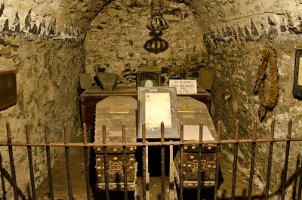
Inevitably the brothers are tried on July 12, as the rebellion is at its height, and are hanged, drawn and quartered two days later outside Newgate Prison. Their lawyer is John Philpot Curran who, with Sir Jonah Barrington, obtain a stay of execution in the hope that Henry will recant, but the brothers are already dead. They are buried at Dublin’s St. Michan’s Church. Visitors are brought to their coffins on a tour of St. Michan’s vaults.

(Pictured: The coffins of the Sheares brothers in the crypt of St. Michan’s Church)


2 Comments

The Battle of Foulksmills

During the Irish Rebellion of 1798, the Battle of Foulksmills, known locally as the Battle of Horetown and also known as the Battle of Goff’s Bridge, takes place on June 20, 1798 between advancing British forces seeking to stamp out the rebellion in County Wexford and a rebel army assembled to oppose them.

By June 19 the threat of the United Irish rebellion spreading outside County Wexford had been largely contained and Crown forces were positioned to move against rebel held territory. A force of about 1,500 men under Sir John Moore move out of New Ross toward Wexford as part of an overall encirclement operation in conjunction with General Gerard Lake‘s forces moving from the north.

Moore’s force is to link up and combine with the isolated garrison holding Duncannon before moving deeper into County Wexford, but after waiting several hours with no sign of their arrival, Moore decides to press ahead to the village of Taghmon alone. Upon nearing Goff’s Bridge at Foulkesmill, his scouts report a rapidly moving rebel force of some 5,000 moving along the road with the intent to give battle. Moore despatches a force of riflemen from the 60th Regiment to hold the bridge until artillery can be brought up in support.

The rebels however, led by Father Philip Roche, spot this move and move away from the road to the high ground on the left intending to outflank Moore’s force. The 60th are forced to engage the rebels on the roads, fields and forests of the area and the rebel flanking move briefly threatens to overturn Moore’s left. Moore has to personally rally his fleeing troops to hold the line and lead them in a successful counter-attack. As more troops begin to arrive the rebels are flushed out of their concealed positions, allowing the artillery to be brought into play and the rebels’ move is foiled. The rebels are gradually pushed back field by field but are able to withdraw the bulk of their force safely.

The road to Wexford is opened and the town recaptured by the Crown the next day but during this battle followers of rebel captain Thomas Dixon massacre up to 100 loyalist prisoners at Wexford bridge.

Casualties are estimated at 500 on the rebel side and 100 of the military.


Leave a comment

The Battle of Ballynahinch

The Battle of Ballynahinch is fought outside Ballynahinch, County Down, on June 12, 1798, during the Irish Rebellion of 1798 between British forces led by Major-General George Nugent and the local United Irishmen led by Henry Munro.

Munro is a Lisburn linen merchant and Presbyterian United Irishman who has no military experience but has taken over command of the Down organisation following the arrest on June 5 of the designated leader, Rev. William Steel Dickson. Upon hearing of the victory at Saintfield on June 9, Munro joins the rebel camp there and then moves to Ednavady Hill, Ballynahinch to join the thousands who have gathered in support of the rebellion. The response of the British garrisons is to converge on Ballynahinch from Belfast and Downpatrick in two columns accompanied by several pieces of cannon.

The battle begins on the night of June 12 when two hills to the left and right of Ballynahinch are occupied by the British who pound the town with their cannon. During a pause when night falls, some rebel officers are said to have pressed Munro for a night attack but he refuses on the grounds that it is unchivalrous. As a consequence many disillusioned rebels slip away during the night.

As dawn breaks the battle recommences with the rebels attacked from two sides and although achieving some initial success, confusion in the rebel army sees the United Irishmen retreat in chaos, pursued by regrouping British forces who quickly take advantage by turning retreat into massacre. Initial reports claim four hundred rebels are killed, while British losses are around forty.

Munro escapes the field of battle but is betrayed by a farmer who he has paid to conceal him and is hanged in front of his own house in Lisburn on June 16. Ballynahinch is sacked by the victorious military after the battle with sixty-three houses being burned down. Cavalry scours the surrounding countryside for rebels, raiding homes and killing indiscriminately, the 22nd Dragoons being guilty of some of the worst atrocities. The most famous victim is Betsy Gray, a young female rebel who, with her two brothers, is slaughtered in the post-battle massacre, ensuring her place in legend to this day.

Because of his family’s involvement in this event, Robert Stewart, the future Lord Castlereagh, is made Chief Secretary for Ireland.


Leave a comment

Death of John O’Mahony, Founder of the Fenian Brotherhood

john-omahony

John Francis O’Mahony, Gaelic scholar and the founding member of the Fenian Brotherhood in the United States, sister organisation to the Irish Republican Brotherhood, dies in New York City on February 7, 1877.

O’Mahony is born in 1816 in Kilbeheny, County Limerick. His father and uncle were members of the Society of United Irishmen and took part in the Irish Rebellion of 1798. On the death of an elder brother, he inherits a property which yields £300 per annum. He enters Trinity College, Dublin, where he studies Sanskrit, Hebrew, and Irish. He becomes an accomplished Gaelic scholar, and later teaches Greek and Latin, and contributes articles to Irish and French journals. He leaves Trinity without getting a degree.

In 1843, O’Mahony joins Daniel O’Connell‘s movement for the Repeal of the Acts of Union 1800, but quickly becomes dissatisfied with the lack of progress and joins the Young Ireland movement which William Smith O’Brien leads and takes part in the failed Young Ireland Rebellion of 1848. His participation in the rebellion obligates him to leave Ireland, and he settles for a time in Paris, where he lives in great poverty. In 1854, he joins John Mitchel in New York City, and takes part in the Emigrant Aid Association, the Emmet Monument Association, and other Irish organisations.

In 1857, O’Mahony publishes History of Ireland, by Geoffrey Keating, D. D., translated from the Original Gaelic, and Copiously Annotated (New York, 1857). O’Mahony’s notes are copied from John O’Donovan‘s translations of Annals of the Four Masters, and it is on this ground that Hodges & Smith procures an injunction against the sale of the book in the United Kingdom. The mental strain to which O’Mahony is subjected in the preparation of this work, which brings him no pecuniary gain, affects his reasoning and he is removed by his friends for a short time to a lunatic asylum.

In 1860, O’Mahony organises the Fenian Brotherhood, also known as the Irish Republican Brotherhood. The object of the association is to secure the freedom of Ireland. The name is probably derived from O’Mahony’s Gaelic studies, the Fenians having been a military body in pagan Ireland, celebrated in the songs of Ossian. The organisation of the new society is completed at conventions that are held in Chicago in 1864 and in Cincinnati in January 1865.

At the time of the Cincinnati convention, O’Mahony holds the rank of colonel of the 69th Regiment of New York State Militia, recruited mainly from the ranks of the Brotherhood, which has also furnished a large proportion of Thomas Francis Meagher‘s Irish Brigade, Michael Corcoran‘s legion, and Irish regiments engaged in the American Civil War. The rapid growth in membership of the Fenian Brotherhood renders it impossible for O’Mahony to retain the colonelcy of the 69th regiment, which he has held for some time. He resigns in order to give all his attention to the spread of Fenianism.

The close of the civil war in the spring of 1865 gives a great impetus to the Fenians, owing to the number of Irish American soldiers that are disbanded and anxious to see service elsewhere. Money pours into the Fenian exchequer. Many differences occur between O’Mahony and James Stephens and the Central Council relative to the policy to be pursued for the attainment of their object, but O’Mahony remains president of the organisation for several years. He does not take any part personally in the attempted insurrection in Ireland or in the raids on Canada, although his advice counts for much in these enterprises.

He devotes the last years of his life to literary pursuits, but suffers from ill health, and he has a hard struggle to secure the bare means for subsistence. However, visionary may have been his objectives, he is honest, and although thousands have passed through his hands, he is often at a loss for a dollar. When his poverty is discovered, he declines to receive assistance in any form. He dies in New York City on February 7, 1877, and soon after his death his remains are returned to Ireland and interred with the honors of a public funeral in Glasnevin Cemetery in Dublin.