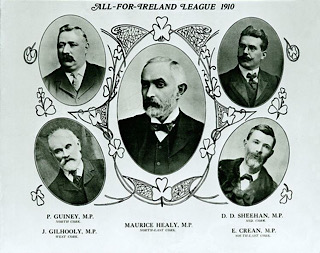
Guiney is the eldest son of Timothy Guiney, a shopkeeper and later clerk of Kanturkpoor law union, and Ellen Carver. He is educated at St. Patrick’s Monastery, Mountrath, County Laois. He serves three terms of imprisonment for activity in the Land War and later Plan of Campaign movement during the 1880s under the Coercion Act. He becomes a farmer and serves as councillor for Newmarket and on the Cork County Council (1908–11) as well as Chair of Newmarket Agricultural Society, Newmarket Gaelic League and Newmarket Old-Age Pensions Committee.
(Pictured: All-for-Ireland League group portrait of five of its Members of Parliament, in the “Cork Free Press”, 30 July 1910. These are: Patrick Guiney (North Cork), James Gilhooly (West Cork), Maurice Healy (North-east Cork), D. D. Sheehan (Mid Cork), and Eugene Crean (South-east Cork))
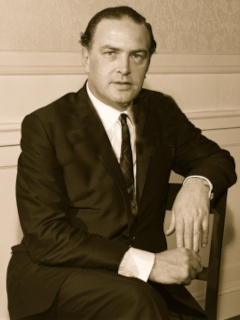
O’Malley is born on January 18, 1921, in Limerick, one of eight surviving children of Joseph O’Malley, civil engineer, and his wife, Mary “Cis” (née Tooher). Born into a wealthy middle-class family, he is educated by the Jesuits at Crescent College and later at Clongowes Wood College, County Kildare. He later studies at University College Galway (UCG), where he is conferred with a degree in civil engineering in 1943. He later returns to Limerick, where he works as an engineer before becoming involved in politics.
O’Malley plays rugby at provincial level for Munster, Leinster and Connacht and at club level for Bohemians and Shannon RFC. His chances at an international career are ruined by the suspension of international fixtures during World War II. It is at a rugby match in Tralee that he first meets Dr. Hilda Moriarty, who he goes on to marry in August 1947.
Although O’Malley runs as a Fianna Fáil candidate, he is born into a politically active family who supports Cumann na nGaedheal until a falling-out with the party in the early 1930s. He first becomes involved in local politics as a member of Limerick Corporation. He becomes Mayor of Limerick in 1961, the third O’Malley brother to hold the office (Desmond from 1941-43 and Michael from 1948-49). He is a strong electoral performer, topping the poll in every general election he runs in.
O’Malley is first elected to Dáil Éireann as a Fianna Fáil TD for Limerick East at the 1954 Irish general election. Fianna Fáil is not returned to government on that occasion. He spends the rest of the decade on the backbenches. However, his party is returned to power in 1957. Two years later, the modernising process begins when Seán Lemass takes over from Éamon de Valera as Taoiseach. Lemass introduces younger cabinet ministers, as the old guard who has served the party since its foundation in 1926 begin to retire.
In 1961, O’Malley joins the government as Parliamentary Secretary to the Minister for Finance. He is part of a new, brasher style of politician that emerges in the 1960s, sometimes nicknamed “the men in the mohair suits.” It is expected that this generation of politician, born after the Irish Civil War, will be a modernising force in post-de Valera Ireland.
Although his sporting background is in rugby and swimming, it is association football which O’Malley gets involved in at a leadership level, becoming President of the Football Association of Ireland despite never having played the sport.
Following Fianna Fáil’s retention of power in the 1965 Irish general election, O’Malley joins the cabinet as Minister for Health. He spends just over a year in this position before he is appointed Minister for Education, a position in which he displays renowned dynamism. Having succeeded Patrick Hillery, another dynamic young minister, he resolves to act swiftly to introduce the recommendations of an official report on education.
As Minister for Education, O’Malley extends the school transport scheme and commissions the building of new non-denominational comprehensive and community schools in areas where they are needed. He introduces Regional Technical Colleges (RTCs), now called Institutes of Technology, in areas where there is no third level college. The best example of this policy is the University of Limerick, originally an Institute of Higher Education, where O’Malley is credited with taking the steps to ensure that it becomes a university. His plan to merge Trinity College Dublin and University College Dublin arouses huge controversy, and is not successful, despite being supported by his cabinet colleague Brian Lenihan. Access to third-level education is also extended, the old scholarship system being replaced by a system of means-tested grants that give easier access to students without well-off parents.
Mid-twentieth century Ireland experiences significant emigration, especially to the neighbouring United Kingdom where, in addition to employment opportunities, there is a better state provision of education and healthcare. Social change in Ireland and policies intending to correct this deficit are often met with strong resistance, such as Noël Browne‘s proposed Mother and Child Scheme. As a former Health Minister, O’Malley has first-hand experience of running the department which had attempted to introduce this scheme and understood the processes that caused it to fail, such as resistance from Department of Finance and John Charles McQuaid. This influences his strategy in presenting the free-education proposal.
Shortly after O’Malley is appointed, he announces that from 1969 all education up to Intermediate Certificate level will be without cost, and free buses will bring students in rural areas to their nearest school, seemingly making this decision without consulting other ministers. However, he does discuss it with Lemass. Jack Lynch, who, as Minister for Finance, has to find the money to pay for the programme, is not consulted and is dismayed at the announcement.
By announcing the decision first to journalists and on a Saturday (during a month when the Dáil is in recess), the positive public reaction tempers resistance to the idea before the next cabinet meeting. O’Malley’s proposals are hugely popular with the public, and it is impossible for the government to go back on his word.
Some Irish commentators consider that O’Malley’s extension of education, changing Ireland from a land where the majority are schooled only to the age of 14 to a country with universal secondary-school education, indirectly leads to the Celtic Tiger boom of the 1990s-2000s when it is followed for some years by an extension of free education to primary degree level in university, a scheme that is launched in 1996 by the Labour Party and axed in 2009 by Fianna Fáil’s Batt O’Keeffe.
In 1967, O’Malley appoints Justice Eileen Kennedy to chair a committee to carry out a survey and report on the reformatory and industrial school systems. The report, which is published in 1970, is considered ground-breaking in many areas and comes to be known as the Kennedy Report. The Report makes recommendations about a number of matters, including the Magdalene laundries, in relation to which they are not acted upon. The report recommends the closure of a number of reformatories, including the latterly infamous reformatory at Daingean, County Offaly.
O’Malley’s reforms make him one of the most popular members of the government. He is affectionately known as “the School Man” for his work in education. His sudden death in Limerick on March 10, 1968, before his vision for the education system is completed, comes as a shock to the public. He is buried with a full Irish state funeral.
Following O’Malley’s death, his widow, Hilda O’Malley, does not run in the subsequent by-election for the seat he has left vacant. It is won narrowly by their nephew Desmond O’Malley. Hilda seeks the Fianna Fáil nomination for the 1969 Irish general election, but Fianna Fáil gives the party nomination to Desmond, as the sitting TD. Hilda runs as an Independent candidate in that election. After what proves a bitter campaign against her nephew, she fails to get the fourth seat in Limerick East by just 200 votes.
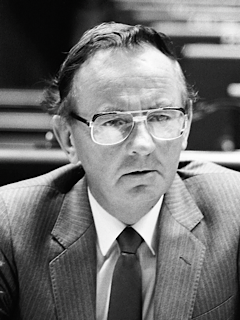
After qualifying, Ryan works for several solicitors’ firms before establishing a private practice in Dame Street in Dublin, in which he remains an active partner until appointed to ministerial office in 1973.
In opposition, Ryan serves as Fine Gael Spokesperson on Health and Social Welfare (1966–70) and on Foreign Affairs and Northern Ireland (1970–73). During this period he is involved in several important pro bono legal cases, including the 1963 challenge in the High Court, and then, on appeal, in the Supreme Court of Ireland in 1964, by Gladys Ryan (no relation) on the constitutionality of the fluoridation of the water supply. While the court rules against Gladys Ryan, the case remains a landmark, for it establishes the right to privacy under the Constitution of Ireland (or, perhaps more precisely, the right to bodily integrity under Article 40.3.1.). The case also raises a legal controversy, owing to the introduction by Justice Kenny of the concept of unenumerated rights. Other notable cases involving Ryan include a challenge to the rules governing the drafting of constituency boundaries, and an unsuccessful attempt to randomise the order of candidates on ballot papers (owing to a preponderance of TDs with surnames from the first part of the alphabet).
Fine Gael comes to power in a coalition with the Labour Party in 1973, and Ryan becomes Minister for Finance. He presides over a tough four years in the National Coalition under Liam Cosgrave, during the 1970s oil crisis when, in common with most Western economies, Ireland faces a significant recession. He is variously lampooned as “Richie Ruin” on the Irish satire show Hall’s Pictorial Weekly, and as “Red Richie” for his government’s introduction of a wealth tax. Following the 1977 Irish general election Fine Gael is out of power, and he once again becomes Spokesperson on Foreign Affairs.
On being appointed to the European Court of Auditors in 1986, he resigns his seat and is succeeded by Chris O’Malley. He serves as a member of the Court of Auditors from 1986 to 1994, being replaced by Barry Desmond. After retirement, he continues in several roles, including as a Commissioner of Irish Lights (until 2004) and a time as Chairman of the Irish Red Cross in 1998.
Ryan is the father of the economist and academic Cillian Ryan. He dies in Dublin at the age of 90 on March 17, 2019. He is buried at Newlands Cross Cemetery and Crematorium in Dublin.
Johnson is born on May 17, 1872, in Liverpool, England. He works on the docks for an Irish fish merchant, spending much of his time in Dunmore East and Kinsale. It is this way that he picks up ideas about socialism and Irish nationalism, joining a Liverpool branch of the Independent Labour Party in 1893. In 1900 he starts work as a commercial traveller, then moves in 1903 with his family to Belfast where he becomes involved in trade union and labour politics.
In 1907, Johnson helps James Larkin organise a strike in the port, but has to watch in dismay as the strike, which begins with remarkable solidarity between labour, Orange, and nationalist supporters, collapses in sectarian rioting. At various times he is the president, treasurer and secretary of the Irish Trades Union Congress (ITUC) which is, at the time, also the Labour Party in Ireland, until officially founded in 1912 by James Connolly and James Larkin. Johnson becomes Vice-President of the ITUC in 1913, and President in 1915.
Johnson sympathizes with the Irish Volunteers, many of whom are sacked from their jobs, for illegal activities. During the Easter Rising, he notes in his diary that people in Ireland paid little heed to the fate of the defeated revolutionaries. He succeeds as leader of the Labour Party from 1917, when the party does not contest the 1918 Irish general election. When the British government tries to enforce conscription in Ireland in 1918, he leads a successful strike in conjunction with other members of the Irish anti-conscription movement.
Johnson is later elected a TD for Dublin County to the Third Dáil at the 1922 Irish general election and remains leader of the Labour Party until 1927. As such, he is Leader of the Opposition in the Dáil of the Irish Free State, as the anti-treaty faction of Sinn Féin refuses to recognise the Dáil as constituted. He issues a statement of support for the Government of the 4th Dáil when the Irish Army Mutiny threatens civilian control in March 1924.
Johnson is the only Leader of the Labour Party who serves as Leader of the Opposition in the Dáil. He loses his Dáil seat at the September 1927 Irish general election, and the following year he is elected to Seanad Éireann, where he serves until the Seanad’s abolition in 1936.
In 1896 he meets Marie Tregay, then a teacher in St. Multose’s National school, outside Kinsale. A native of Cornwall, she has advanced political views. They marry in 1898 in Liverpool. Their only son, Frederick Johnson, is born in 1899, and becomes a well-known actor. Johnson dies on January 17, 1963, at 49 Mount Prospect Avenue, Clontarf, Dublin.
Each summer, Labour Youth holds the “Tom Johnson Summer School” to host panel discussions, debates and workshops.
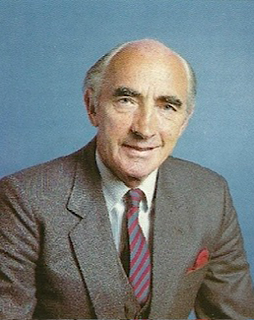
A snappy dresser who earns the nickname “the yellow rose of Finglas,” Tunney is sometimes seen as pompous, a perception possibly attributable to his acting background, which once leads to an audition at Dublin’s Abbey Theatre.
In 1963 Tunney joins Fianna Fáil, and stands for the party at the 1965 Irish general election but is not elected. He is elected to Dáil Éireann as a Fianna Fáil TD for the Dublin North-West constituency at the 1969 Irish general election. He serves continuously in the Dáil until losing his seat at the 1992 Irish general election, having been a TD for Dublin Finglas from 1977 to 1981 when Dublin constituencies are reconfigured as 3-seaters, before being returned for Dublin North-West in 1981.
During this period Tunney serves as Parliamentary Secretary to the Minister for Education (after 1978, Minister of State at the Department of Education) in three governments. He serves as Leas-Ceann Comhairle of Dáil Éireann from 1981 to 1982, and from 1987 to 1993. He is also chair of the Fianna Fáil parliamentary party for ten years. He is a member of Dublin City Council, and serves as Lord Mayor of Dublin from 1984 to 1985.
Following Tunney’s death, TaoiseachBertie Ahern describes him as “a parliamentarian and a gentleman who was passionately committed to serving his country.” Ahern adds, “he was not only a man of substance but one of style. From the flower that was always in his buttonhole to the elegance of his language in both Irish and English he had a commanding and stylish presence.”
Fine Gael leader Michael Noonan says Tunney had gained “the widespread affection and respect of colleagues of all political parties.”
Leader of the Labour PartyRuairi Quinn describes Tunney as a “thoughtful and courteous colleague” who carried out his duties with “fairness but also with wit and style.”
Bowman works mostly as a freelance journalist. He co-presents a radio show, The Rude Awakening, on Dublin’s FM104 with Scott Williams, George Hellis and Margaret Callanan for two years between 1993 and 1994 before joining the Sunday Independent newspaper as a columnist. He later presents television programmes on RTÉ, such as the quiz show Dodge the Question.
Bowman dies in a fall at his home on Fitzgerald Street in Harold’s Cross, Dublin, on March 6, 2000. He is found lying in the kitchen near the foot of the stairs. His death is believed to be the result of a fall down the stairs or from a stool, which is found nearby. He is buried in Glasnevin Cemetery, Glasnevin, County Dublin. Tributes are paid to him by party political leaders. He is survived by his parents, his sister Emma, his brothers Abie and Daniel and his only son Saul Philbin Bowman.
TaoiseachBertie Ahern says that he is deeply saddened on learning the news of Bowman’s death. His thoughts and prayers he says are with his family at this very sad time.
The leader of the Labour Party, Ruairi QuinnTD, expresses his shock and sadness on hearing of the death. He says that Bowman was without doubt one of the bright lights of Irish journalism. He extends his deepest sympathies to Bowman’s son, Saul, and to his parents John and Eimer.
The Fine Gael leader, John Bruton, says that few people he knew brought a smile to the face of anyone they met more readily. He says that his infectious good humour and iconoclastic attitude to life conveyed itself to all with whom he came into contact. He adds that Bowman will be missed for many years to come.
The editor of the Sunday Independent, Aengus Fanning, says that Bowman was one of the most brilliant journalists of his generation.
O’Connell is selected by Fine Gael for the 2016 Irish general election to “recapture” their seat in Dublin Bay South from Lucinda Creighton, who had left the party in 2013 over her objection to the party’s position on abortion and in 2015 founded Renua, an anti-abortion party. During the campaign, O’Connell called Creighton’s anti-abortion views “incredibly sanctimonious” and suggests that Creighton is an “out of touch career politician” whose views on abortion are borne out of a lack of connection with the real world. The Irish Independent refers to these comments as O’Connell “tearing strips off” of Creighton. In the election, O’Connell is elected, while Creighton loses her seat.
In her time in the Dáil, O’Connell campaigns in favour of abortion rights as well as pushing for more funding for healthcare services in Ireland.
In October 2016, O’Connell responds to comments by the Archbishop of DublinDiarmuid Martin that TDs should remember their faith when legislating for abortion in Ireland by stating, “I don’t see why the archbishop’s views are in any way relevant. I don’t see why Archbishop Martin should be getting involved in women’s health issues. It is the same as asking my four-year-old. They [the Church] are entitled to their opinion, but I don’t put any weight in them. I don’t see what involvement the Catholic Church should have in women’s health issues”.
In November 2017, O’Connell confronts Barry Walsh, a member of Fine Gael’s executive council, with a dossier of tweets documenting that he repeatedly and frequently derogates women politicians, often calling them bitches, including fellow members of Fine Gael. After the leader of Fine Gael and TaoiseachLeo Varadkar comments that Walsh should resign, he does so.
O’Connell loses her seat at the 2020 Irish general election, placing 5th in the 4-seat constituency. In an August 2020 interview, she attributes her loss, in part, to being the running mate of the Minister for Housing, Eoghan Murphy, in an election fought over an ongoing housing crisis in Ireland.
On May 7, 2021, O’Connell declares she will not seek to be the Fine Gael candidate for the 2021 Dublin Bay South by-election. She suggests she will not be able to win a party selection again due to her relationship with the Fine Gael leadership souring in the meantime, partially because of her vocal support of Simon Coveney over Leo Varadkar in the 2017 Fine Gael leadership election. She also suggests many local Fine Gael branch members in Dublin South Bay regard her as an outsider and a “parachute candidate” due to the fact she is originally from County Westmeath, and have turned against her over this. The Phoenix offers the view that O’Connell would not be nominated because she has turned the Fine Gael leadership against her while lobbying for her sister, Mary Newman Julian, to be the party’s candidate in a 2018 Seanad by-election. In particular, a meeting between her and Simon Coveney in which her expectations are read as entitled is cited as hurting her relationships. Fine Gael’s candidate in the by-election is James Geoghegan, who had previously left the party to join Lucinda Creighton in Renua, but returns to Fine Gael after that party collapsed. He loses the by-election to Labour‘s Ivana Bacik, a senator for Dublin University and veteran pro-choice campaigner.
In October 2024, O’Connell leaves Fine Gael to contest the next general election in Dublin Bay South as an independent candidate. She fails to be elected or to achieve the one-quarter of the quota necessary to recoup her election expenses.
O’Connell states her family, the Newmans, have been “involved in Fine Gael since the 1960s,” starting when her maternal grandfather ran for Fine Gael as a councillor. Her father, Michael Newman, is also a Fine Gael councillor while Fine Gael minister Patrick Cooney is considered a family friend. O’Connell states that growing up, she and her family were greatly influenced by the progressive politics of Fine Gael leader Garret FitzGerald. Her sister, Mary Newman Julian, is also active in politics and contests elections for the Dáil in Tipperary and for Seanad Éireann, while another sister, Theresa Newman, works for a period as O’Connell’s political adviser in Leinster House. Her brother-in-law, Hugh O’Connell, is a prominent political journalist and editor who has worked for several Irish publications.
In 2018, during debates in the Dáil regarding abortion, O’Connell discloses personal details of a traumatic pregnancy she herself had experienced. During the pregnancy, she is told her child has only a 10% chance of survival. This prompts her to consider terminating the pregnancy. Ultimately, she decides to continue the pregnancy. The child is born with organs outside of the body but survives the birth. She cites the difficult decisions made during that pregnancy as having greatly informed her views on abortion.
Ireland formally applies for European Economic Committee (EEC) membership in July 1961. Ó Móráin, as Minister for Lands and the Gaeltacht, delivers a widely reported address to the Castlebar Chamber of Commerce in 1962. In the speech, he argues that Ireland is “ready to subscribe to the political aims of the EEC” and that Ireland does not want to be seen as “committed” to its policy of neutrality. In the ensuing controversy, he and Lemass deny that there is any suggestion Ireland might or should abandon neutrality. Outside the country, foreign governments see this episode as a deliberately provoked debate to evaluate the government’s domestic room for manoeuvre on neutrality.
Ó Móráin is appointed Minister for Justice by Taoiseach Jack Lynch in 1968. It is in this role that he is most remembered. While he is still Minister, the Arms Crisis in Ireland erupts in 1970. This political scandal sees Government ministers Charles Haughey and Neil Blaney dismissed by the Taoiseach for alleged involvement in a conspiracy to smuggle arms to the Irish Republican Army (IRA) in Northern Ireland. Ó Móráin continually suffers from ill health, which is accentuated by his alcoholism. When the Arms Crisis erupts, Lynch comes to see him in a hospital in Galway and asks for his resignation. Ó Móráin is a witness at the subsequent Arms Trial. He testifies that he had passed on Garda intelligence reports about the involvement of ministers with the IRA to the Taoiseach before the arms were seized at Dublin Airport. Hus evidence at the trial has been described as “erratic.”
Ó Móráin loses his Dáil seat at the 1973 Irish general election and retires from politics. He dies at his home in Sutton, Dublin, in on May 6, 1983. With a Fianna Fáil guard of honour, he is buried in Castlebar. With his wife, Madge, he has one daughter, Sorcha, and two sons, John, and Michael, who dies in a road accident in 1972.
Macardle is born in Dundalk, County Louth, on March 7, 1889, into a wealthy brewing family famous for producing Macardle’s Ale. Her father, Sir Thomas Callan Macardle, is a Catholic who supports John Redmond and the Irish Home Rule movement, while her mother, Lucy “Minnie” Macardle, comes from an English Anglican background and is politically a unionist. Lucy converts to Catholicism upon her marriage to Thomas. Macardle and her siblings are raised as Catholics, but Lucy, who is politically isolated in Ireland, “inculcated in her children an idealised view of England and an enthusiasm for the British empire“. She receives her secondary education in Alexandra College, Dublin—a school under the management of the Church of Ireland—and later attends University College Dublin (UCD). Upon graduating, she returns to teach English at Alexandra where she had first encountered Irish nationalism as a student. This is further developed by her first experiences of Dublin’s slums, which “convinced her that an autonomous Ireland might be better able to look after its own affairs” than the Dublin Castle administration could.
Between 1914 and 1916, Macardle lives and works in Stratford-upon-Avon in Warwickshire, England. There, her encounters with upper-class English people who express anti-Irish sentiment and support keeping Ireland in the British Empire by force further weakens her Anglophilia. Upon the outbreak of World War I, she supports the Allies, as does the rest of her family. Her father leads the County Louth recruiting committee while two of her brothers volunteer for the British Army. Her brother, Lieutenant Kenneth Callan Macardle, is killed at the Battle of the Somme, while another brother, Major John Ross Macardle, survives the war and earns the Military Cross. While Macardle is a student, the Easter Rising occurs, an experience credited for a further divergence of her views regarding republicanism and her family.
On January 19, 1919, Macardle is in the public gallery for the inaugural meeting of the First Dáil and witnesses it declare unilateral independence from the United Kingdom, which is ultimately the catalyst for the Irish War of Independence.
By 1919 Macardle has befriended Maud Gonne MacBride, the widow of the 1916 Easter Rising participant John MacBride, and together the two work at the Irish White Cross, attending to those injured in the war. It is during this period she also becomes a propagandist for the nationalist side.
Following the signing of the Anglo-Irish Treaty in December 1921, Macardle takes the anti-treaty side in the ensuing Irish Civil War. Alongside Gonne MacBride and Despard, she helps found the Women Prisoners’ Defence League, which campaigns and advocates for republicans imprisoned by the newly established Irish Free State government. It is also during this same time that she begins working alongside Erskine Childers in writing for anti-treaty publications An Phoblacht and Irish Freedom.
In October 1922, Despard, Gonne MacBride and Macardle are speaking at a protest on O’Connell Street, Dublin against the arrest of Mary MacSwiney, a sitting Teachta Dála, by the Free State when Free State authorities move to break it up. Rioting follows and Free State forces open fire, resulting in 14 people being seriously wounded while hundreds of others are harmed in the subsequent stampede to flee. Following the event, Macardle announces she is going to pursue support of the Anti-treaty side full-time in a letter to Alexandra College, which ultimately leads to her dismissal on November 15, 1922. In the following days Macardle is captured and imprisoned by the Free State government and subsequently serves time in both Mountjoy Prison and Kilmainham Gaol, with Rosamond Jacob as her cellmate. During one point at her time in Kilmainham, Macardle is beaten unconscious by male wardens. She becomes close friends with Jacob and shares a flat with her in Rathmines later in the 1920s.
The Irish Civil War concludes in the spring of 1923, and Macardle is released from prison on May 9.
Following the Irish Civil War, Macardle remains active in Sinn Féin and is drawn into the camp of its leader Éamon de Valera and his wife Sinéad. She travels alongside the de Valeras as they tour the country and she is a frequent visitor to their home. As the trust between Macardle and de Valera develops, de Valera asks her to travel to County Kerry to investigate and document what later becomes known as the Ballyseedy massacre of March 1923, in which a number of unarmed republican prisoners are reportedly killed in reprisals. She obliges, and by May 1924 she has compiled a report that is released under the title of The Tragedies of Kerry.” Immediately upon the release of the report, the Minister for DefenceRichard Mulcahy sets up an inquiry in June 1924 to carry out a separate investigation by the government. However, the government’s inquiry comes to the conclusion there had been no wrongdoing committed. Her book The Tragedies of Kerry remains in print and is the first journalistic historical account of the Irish Civil War from those on the republican side detailing Ballyseedy, Countess Bridge and various other incidents that occur in Kerry during this time.
In 1926, Éamon de Valera resigns as President of Sinn Féin and walks out of the party following a vote against his motion that members of the party should end their policy of abstentionism against Dáil Éireann. De Valera and his supporters, including Macardle, form the new political party Fianna Fáil in May 1926, with Macardle immediately elected to the party’s National Executive|Ard Chomhairle, one of six female members out of twelve on the original party National Executive, the others being Hanna Sheehy-Skeffington, Kathleen Clarke, Countess Constance Markievicz and Linda Kearns. Macardle is made the party’s director of publicity. However, she resigns from Fianna Fáil in 1927 when the new party endorses taking their seats in Dáil Eireann. Nevertheless, her views remain relatively pro-Fianna Fáil and pro-de Valera.
Macardle recounts her civil war experiences in Earthbound: Nine Stories of Ireland (1924). She continues as a playwright for the next two decades. In her dramatic writing, she uses the pseudonymMargaret Callan. In many of her plays a domineering female character is always present. This is thought to be symbolic of her own relationship with her own mother. Her parents’ marriage had broken up as her mother returned to England and her father raised the children with servants in Cambrickville and they were sent away for school. This female character holds back the growth and development of the younger female character in Dorothy’s plays and writings.
By 1931, Macardle takes up work as a writer for The Irish Press, which is owned by de Valera and leans heavily toward supporting Fianna Fáil and Irish republicanism in general. In addition to being a theatre and literary critic for the paper, she also occasionally writes pieces of investigative journalism such as reports on Dublin’s slums. In the mid-1930s she also becomes a broadcaster for the newly created national radio station Radio Éireann.
In 1937, Macardle writes and publishes the work by which she is best known, The Irish Republic, an in-depth account of the history of Ireland between 1919 until 1923. Because of the book, political opponents and some modern historians consider her to have been a hagiographer toward de Valera’s political views. In 1939 she admits, “I am a propagandist, unrepentant and unashamed.” Overall, however, the book is well-received, with reviews ranging from “glowing” to measured praise. She is widely praised for her research, thorough documentation, range of sources and narration of dramatic events, alongside reservations about the book’s political slant. The book is reprinted several times, most recently in 2005. Éamon de Valera considers The Irish Republic the only authoritative account of the period from 1916 to 1926, and the book is widely used by de Valera and Fianna Fáil over the years and by history and political students. She spends seven years writing the book in a cottage in Delgany, County Wicklow, and it is a day-by-day account of the history of the events in Ireland from 1919 to 1923 recorded in painstaking detail together with voluminous source material.
In 1937, de Valera’s Fianna Fáil government is able to create a new Constitution of Ireland following a successful referendum. However, there is widespread criticism of the new Constitution from women, particularly republican women, as the language of the new Constitution emphasises that a woman’s place should be in the home. Macardle is among them, deploring what she sees as the reduced status of women in this new Constitution. Furthermore, she notes that the new Constitution drops the commitment of the 1916 Proclamation of the Irish Republic to guarantee equal rights and opportunities “without distinction of sex” and writes to de Valera questioning how anyone “with advanced views on the rights of women” can support it. DeValera also finds her criticising compulsory Irish language teaching in schools.
While working as a journalist with the League of Nations in the late 1930s, Macardle acquires a considerable affinity with the plight of Czechoslovakia being pressed to make territorial concessions to Nazi Germany. Believing that “Hitler‘s war should be everybody’s war,” she disagrees with de Valera’s policy of neutrality. She goes to work for the BBC in London, develops her fiction and, in the war’s aftermath, campaigns for refugee children – a crisis described in her book Children of Europe (1949). In 1951, she becomes the first president of the Irish Society of Civil Liberties.
Macardle dies of cancer on December 23, 1958, in a hospital in Drogheda, at the age of 69. Though she is somewhat disillusioned with the new Irish State, she leaves the royalties from The Irish Republic to her close friend Éamon de Valera, who had written the foreword to the book. De Valera visits her when she is dying. She is accorded a state funeral, with de Valera giving the oration. She is buried in Sutton, Dublin.
Dwyer runs a off-licence/grocery shop in Rathmines and is a member of the Rathmines Urban Council. He marries Marie Molloy in 1914, they have no children. He is a member of the Peace Committee of ten men which sit in May 1922 and bring about the agreement between Michael Collins and Éamon de Valera.
On December 20, 1922, Dwyer is shot dead in his shop at 5 Rathmines Road, Dublin, by anti-Treaty IRA Volunteer Robert Bonfield. At about 4:50 p.m., Dwyer is talking to a customer when a young man enters the shop. Addressing Dwyer, the young man asks “Are you Mr. O’Dwyer?” Dwyer replies yes and the young man says that he has a note for him. The young man reaches into the pocket of his overcoat a draws a revolver. He fires twice at Dwyer at point-blank range and he dies instantly. The customer and a shop assistant give chase but are unable to catch the assassin. Two republicans, Frank Lawlor and the actual assassin, Robert Bonfield, are later killed by Free State forces in revenge for the shooting of Dwyer.



 seamus dubhghaill