The first recorded “Twelfth of July” sectarian riots erupt in Belfast on July 12, 1813 as clashes break out between Orange marchers and Irish nationalists. Several Orangemen open fire on a crowd in Hercules Street, killing two Protestants and wounding four other people.
On and around the Twelfth, large parades are held by the Orange Order and Ulster loyalist marching bands, streets are bedecked with British flags and bunting, and large towering bonfires are lit. Today the Twelfth is mainly celebrated in Ulster, especially in Northern Ireland where it is a public holiday, but smaller celebrations are held in other parts of the world where Orange lodges have been established. The Twelfth involves thousands of participants and spectators.
In Ulster, where about half the population is from a Protestant background and half from a Catholic background, the Twelfth has been accompanied by violence since its beginning. Orange marches through Irish Catholic and Irish nationalist neighbourhoods are usually met with opposition from residents, who see the Orange Order and its marches as sectarian, triumphalist and supremacist. This sometimes leads to violence.
The Order is also politically a unionist/loyalist organisation. Violence related to the Twelfth in Northern Ireland escalates during the 30-year ethno-political conflict known as the Troubles. The Drumcree conflict is the most well-known dispute involving Orange marches.
Attempts have recently been made to downplay the political aspects of the marches and present the Twelfth as a cultural, family-friendly event at which tourists are welcome. The majority of events pass off peacefully, however, there is a small contingency who occasionally stir up trouble.
When July 12 falls on a Sunday, as it does this year, the parades are held on the following day instead.
A statement is read out from Dublin after the previous night’s meeting of the executive of the Northern Republican Clubs, a political movement allied to the IRA. It states, “The overwhelming desire of the great majority of all the people of the north is for an end to military actions by all sides.”
It goes on to say that a suspension of activities will be a chance to prevent all-out civil war in Ulster. The group insists it will continue a campaign of civil disobedience and the political struggle until its demands are met, namely:
The Royal Ulster Constabulary (RUC) and British Army are the first to benefit from such a ceasefire as they have been the primary targets of the IRA. Residents of Belfast in particular have been worn down by the four-year campaign of violence and this news is very welcome there.
Father Hugh O’Neill, who leads a Londonderry peace movement, says, “Please God, everyone will now sit down and begin to talk.”
The British government had begun raising yeomanry forces from the local Irish population in 1796. The force, composed of both Catholics and Protestants, was raised to help defend against a possible French invasion of Ireland and to aid in the policing of the country. The Society of United Irishmen have long threatened a rebellion in Ireland, which finally occurs in late May 1798. Major uprisings of the rebellion only occur in Ulster, Wicklow and Wexford, a county in the province of Leinster. For several months prior to May 1798, Wicklow and many other areas of the country have been subject to martial law which had been imposed in an effort to prevent the long threatened rebellion.
The campaign extends against the military itself as some corps of yeomen and militia, especially those with Catholic members, are suspected as United Irish infiltrators who have joined to get training and arms. Several days after the outbreak of the rebellion, the yeomanry and militia at Dunlavin are called out on parade and informed by their commanding officer that he has information on the identities of those in the corps who are affiliated with the United Irishmen among them. The British do not actually have such information, but twenty-eight fall for their bluff and come forward in hopes of receiving clemency.
Those who come forward are immediately arrested and imprisoned while several are subjected to flogging in an effort to extract information about the rebels plans and organization. Those who are outed as affiliates of the United Irishmen are imprisoned in the Market House of Dunlavin, while the British officers decide what to do with them.
The following day, Captain William Ryves of the Rathsallagh yeomanry has his horse shot from under him by rebels while on patrol. Ryves rides to Dunlavin the next day and brings eight suspected rebels imprisoned by his corps with him. There he meets with Captain Saunders of the Saunders-grove yeomanry. It is decided that their prisoners, a total of 36 men, should be put to death. On May 26, Market Day, the 36 are taken to the green, lined up and shot in front of the townspeople, including, in some cases, their own families.
The firing squad returns to the Market House where others are flogged or hanged. Before the bodies of the shot men are removed, soldiers’ wives loot them of valuables. The bodies are either removed for burial by their families or interred in a common grave at Tournant cemetery. One man survives, despite grievous wounds, and lives to “an advanced age.” Two more men, either hanging or about to be, are saved by the intervention of a “respectable Protestant” and escape.
One loyalist account details the events leading up to the execution differently. According to this account, Captain Ryves, a yeomanry commander at Dunlavin, receives word that a large number of rebels are set to attack Dunlavin and he observes that many Protestant houses have been set on fire in the surrounding countryside. Under the circumstances, he expects that the rebels’ intention is a pogrom of Protestants and loyalists in the town and its environs. A foray by the troops into the countryside fails and the garrison’s officers are aware that they are outnumbered by the prisoners held in the Market House.
The executions appear to have been motivated by simple revenge and intimidation, rather than fear of the prisoners and the ongoing rebellion. Though the public exhibition may have been designed to intimidate and discourage rebels in the immediate area from taking to the field, news of the executions, as well as those at Carnew spread rapidly and play a part in the rapid mobilization of rebels in northern County Wexford over the next few days.
The story of Dunlavin Green is quickly commemorated in the famous ballad “Dunlavin Green,” which tells the story from the view of a sympathetic local eyewitness. In 1998, a commemorative stone was installed in St. Nicholas of Myra Roman Catholic church, adjacent to the green.
Whiteside grows up on Shankill Road, and because of his aggressive, physical playing style he is later nicknamed the “Shankill Skinhead” by Manchester United supporters. The family later moves to 10 Danube Street. He remains relatively unscathed by The Troubles as his Protestant parents keep a firm watch on their children to ensure that they do not stray far from home and that none of them become involved with Ulster loyalism. At around seven years of age, he joins the Boys’ Brigade, and quickly shows his natural talent for football, scoring ten goals in a game against boys almost twice his age. He is educated at Cairnmartin High School and becomes famous in the Shankill area as a footballing prodigy by the age of eleven.
Whiteside is said to have been discovered by Ipswich Town scout Jim Rodgers, who is told by manager Bobby Robson to wait until Whiteside grows older. Instead, it is Manchester United’s 80-year-old Ulster scout Bob Bishop, who previously unearthed Belfast-born George Best and Sammy McIlroy for the club, who first offers him a trial at an English club. He finds that he has been offered schoolboy terms at the club during a school trip to the United States, on which he and his classmates meet PresidentJimmy Carter in the Oval Office, a rare and extraordinary occasion for children from a disadvantaged background.
Whiteside signs professional forms in 1982 at the age of 17 and quickly becomes a key member of the Manchester United club. He scores 68 goals in 278 league and cup appearances for the club over the next seven years, picking up two FA Cup winners medals in 1983 and 1985, as well as playing in the 1982 FA Youth Cup final, the 1983 League Cup final, and the FA Charity Shield in 1983.
Whiteside remains with United until July 1989, when he is sold to Everton F.C. for £600,000. However intense running sessions run by coach Mick Lyons take their toll on his right knee, and on September 20, 1990, he takes a knock in a practice match, which requires him to have another operation on his right knee. After the return of Howard Kendall as manager in November 1990, he manages to appear in a few reserve team games, but this only delays the inevitable, and he is forced to retire from the game at the age of 26 in June 1991.
Upon retirement, Whiteside studies to become a podiatrist, graduating with a degree from the University of Salford, and serves Northwich Victoria F.C. as their assistant manager/physio from October 1991 until March 1992. He quits the role as he does not enjoy the amount of time spent travelling between games. He instead became an after-dinner speaker and also works for the Professional Footballers’ Association, while taking a postgraduate course at Manchester Metropolitan University. He later takes up private practice as a podiatrist in Manchester. Since 1994, he has also worked at the corporate hospitality department at Old Trafford. In 2003, he releases a book entitled My Memories of Manchester United. With the help of writer Rob Bagchi, he releases his autobiography entitled Determined in August 2007, published by Headline Publishing Group, and with a foreword by actor James Nesbitt.
Whiteside holds records as the youngest player to take part in a World Cup, the youngest player to score in a League Cup and FA Cup final, and the youngest player to score a senior goal for Manchester United. Winning 38 caps for Northern Ireland, he plays at the 1982 and 1986 World Cups and also helps his country to win the last ever British Home Championship in 1983–1984.
Lynd is born to Robert John Lynd, a Presbyterian minister, and Sarah Rentoul Lynd, the second of seven children. His paternal great-grandfather emigrated from Scotland to Ireland. He is educated at Royal Belfast Academical Institution and Queen’s University Belfast. His father serves a term as Presbyterian Church Moderator, but he is just one of a long line of Presbyterian clergy in the family.
Lynd marries the writer Sylvia Dryhurst on April 21, 1909. They meet at Gaelic League meetings in London. Their daughters Máire and Sigle become close friends of Isaiah Berlin. Sigle’s son, born in 1941, is artist Tim Wheeler. In March 1924, they move to what is to be their long-term married home, the elegant Regency house of 5 Keats Grove in the leafy suburb of Hampstead in northwest London. The house had been lived in by various members of Sylvia’s family.
The Lynds are literary hosts, in the group including J. B. Priestley. They are on good terms also with Hugh Walpole. Priestley, Walpole and Sylvia Lynd are founding committee members of the Book Society. Irish guests include James Joyce and James Stephens. On one occasion reported by Victor Gollancz in Reminiscences of Affection, Joyce intones Anna Livia Plurabelle to his own piano accompaniment. Joyce and his wife Nora Barnacle hold their wedding lunch at the Lynds’ house after getting married at Hampstead Town Hall on July 4, 1931.
Lynd uses the pseudonym Y.Y. in writing for the New Statesman. According to C. H. Rolph‘s Kingsley, Lynd’s weekly essay, which runs from 1913 to 1945, is “irreplaceable.” In 1941, editor Kingsley Martin decides to alternate it with pieces by James Bridie on Ireland, but the experiment is not at all a success.
Lynd’s political views are at a certain point radicalised by his experience of how Ulster and Home Rule develop in the 1912–1914 period. He is appalled at the threat of the use of violence to deliver Ulster from Home Rule and the later decision to postpone the implementation of the Third Home Rule Bill. He later writes, “Then came August 1914 and England began a war for the freedom of small nations by postponing the freedom of the only small nation in Europe which it was within her power to liberate with the stroke of a pen.”
Lynd becomes fluent in the Irish language and is a Gaelic League member. As a Sinn Féin activist, he uses the name Robiard Ó Flionn/Roibeard Ua Flionn. He dies in Hampstead, London on October 6, 1949. He is buried in Belfast City Cemetery.
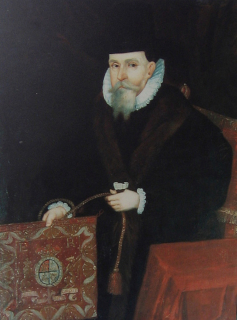
Loftus is born in 1533, the second son of a monastic bailiff, Edward Loftus, in the heart of the English Yorkshire Dales. He embraces the Protestant faith early in his development. He is an undergraduate at Trinity College, Cambridge, where he reportedly attracts the notice of the young Queen Elizabeth, as much by his physique as through the power of his intellect. Although this encounter may never have happened, Loftus certainly meets with the Queen more than once, and she becomes his patron for the rest of her reign. At Cambridge Loftus takes holy orders as a Catholic priest and is appointed rector of Outwell St. Clement in Norfolk. He comes to the attention of the Catholic Queen Mary, who names him vicar of Gedney, Lincolnshire. On Elizabeth’s accession in 1558 he declares himself Anglican.
Loftus makes the acquaintance of the Queen’s favourite Thomas Radclyffe, 3rd Earl of Sussex and serves as his chaplain in Ireland in 1560. In 1561 he becomes chaplain to Alexander Craike, Bishop of Kildare and Dean of St. Patrick’s Cathedral in Dublin. Later that year he is appointed rector of Painstown in Meath and evidently earns a reputation as a learned and discreet advisor to the English authorities in Dublin. In 1563, he is consecrated Archbishop of Armagh at the unprecedented age of 28 by Hugh Curwen, Archbishop of Dublin.
Following a clash with Shane O’Neill, the real power in Ulster during these years, he comes to Dublin in 1564. To supplement the meager income of his troubled archbishopric he is temporarily appointed to the Deanery of St. Patrick’s Cathedral by the queen in the following year. He is also appointed president of the new commission for ecclesiastical causes. This leads to a serious quarrel with the highly respected Bishop of Meath, Hugh Brady.
In 1567 Loftus, having lobbied successfully for the removal of Hugh Curwen, who becomes Bishop of Oxford, and having defeated the rival claims of the Bishop of Meath, is appointed Archbishop of Dublin, where the queen expects him to carry out reforms in the Church. On several occasions he temporarily carries out the functions of Lord Keeper of the Great Seal, and in August 1581 he is appointed Lord Chancellor of Ireland after an involved dispute with Nicholas White, Master of the Rolls in Ireland. He is constantly occupied in attempts to improve his financial position by obtaining additional preferment and is subject to repeated accusations of corruption in public office.
In 1582 Loftus acquires land and builds a castle at Rathfarnham, which he inhabits from 1585. In 1569–1570 the divisions in Irish politics take on a religious tinge with the First Desmond Rebellion in Munster and Pope Pius V‘s 1570 papal bullRegnans in Excelsis. The bull questions Elizabeth’s authority and thereafter Roman Catholics are suspected of disloyalty by the official class unless they are discreet.
Loftus takes a leading part in the execution of Dermot O’Hurley, Archbishop of Cashel. When O’Hurley refuses to give information, Francis Walsingham suggests he should be tortured. Although the Irish judges repeatedly decide that there is no case against O’Hurley, on June 19, 1584, Loftus and Sir Henry Wallop write to Walsingham “We gave warrant to the knight-marshal to do execution upon him, which accordingly was performed, and thereby the realm rid of a most pestilent member.”
Between 1584 and 1591 Loftus has a series of clashes with Sir John Perrot on the location of an Irish University. Perrot wants to use St. Patrick’s Cathedral, Dublin as the site of the new University, which Loftus seeks to preserve as the principal place of Protestant worship in Dublin, as well as a valuable source of income for himself. The archbishop wins the argument with the help of his patron, Queen Elizabeth I, and Trinity College, Dublin is founded at its current location, named after his old college at Cambridge, leaving the Cathedral unaffected. Loftus is named as its first Provost in 1593.
The issue of religious and political rivalry continues during the two Desmond Rebellions (1569–83) and the Nine Years’ War (1594–1603), both of which overlap with the Anglo-Spanish War (1585–1604), during which some rebellious Irish nobles are helped by the Papacy and by Elizabeth’s arch-enemy Philip II of Spain. Due to the unsettled state of the country Protestantism makes little progress, unlike in Celtic Scotland and Wales at that time. It comes to be associated with military conquest and is therefore hated by many. The political-religious overlap is personified by Loftus, who serves as Archbishop and as Lord Chancellor of Ireland. An unlikely alliance forms between Gaelic Irish families and the Norman “Old English“, who had been enemies for centuries but who now mostly remain Roman Catholic.
Adam Loftus dies in Dublin on April 5, 1605, and is interred in the building he had helped to preserve for future generations, while many of his portraits hang today within the walls of the University which he helped found. Having buried his wife Jane (Purdon) and two sons (of their 20 children) in the family vault at St. Patrick’s, Loftus dies at his Episcopal Palace in Kevin Street “worn out with age” and joins his family in the same vault. His zeal and efficiency are commended by James I upon the king’s accession.
A charter incorporates Derry as the city of Londonderry on March 29, 1613 and also creates the new county of Londonderry. Despite the official name, the city is more usually known as simply Derry, which is an anglicisation of the Old IrishDaire, which in modern Irish is spelled Doire, and translates as “oak-grove/oak-wood.” The name derives from the settlement’s earliest references, Daire Calgaich (“oak-grove of Calgach”). The name is changed from Derry in 1613 during the Plantation of Ulster to reflect the establishment of the city by the London guilds.
Ulster is finally brought under the control of Elizabeth I’s government at the beginning of the 17th century following a long struggle between the Tudor monarchy and the Gaelic chieftains. This follows the defeat of the chieftains at the Siege of Kinsale in 1601 after a war lasting nine years. Although the Gaelic chieftains are allowed to remain on their land, their positions have been weakened. A group of them leave Ireland for the continent in 1607, never to return. The “Flight of the Earls”, as it is known, is seen as treason by James I’s government and their lands are confiscated. This important event opens the way for James I to further increase his control over Ulster by settling tens of thousands of settlers from England, Scotland and Wales on the confiscated lands.
Surveying and planning for the plantation take place during 1608 and 1609 and the plantation proper begins in 1610. The towns of Derry and Coleraine, as well as much of the lands that are to become County Londonderry, are granted to the City of London Corporation, which is charged with planting them.
The Society of the Governor and Assistants, London, of the New Plantation in Ulster, within the realm of Ireland, known after the Restoration as the Irish Society, is formed in 1609 by the City of London, to manage the estates which it has been obliged very reluctantly to take on. The Irish Society takes charge of the overall management of the Irish estates, with direct control of the new city of Derry and of the town of Coleraine.
The City of Londonlivery companies are required to take on estates in the surrounding County of Londonderry. The Great Twelve livery companies bear the heaviest financial burden. The county is divided among them into twelve “proportions,” distributed by the drawing of lots. The Great Twelve are in turn supported by a number of minor companies, so that thirty livery companies in all have Irish estates derived from their participation in James I’s scheme for the plantation of Ulster.
However, the first phase of the existence of the Irish Society is short-lived. The Great Parchment Book is compiled in the late 1630s when Charles I claims the estates as forfeit after a politically motivated case in Star Chamber rules that the Londoners have not fulfilled their obligations of plantation.
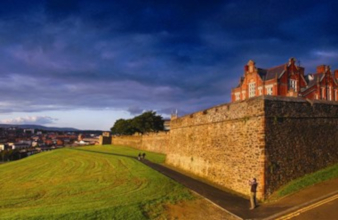
The City of Londonderry is very much a product of the plantation and plays a pivotal role in safeguarding the plantation. Its walls, which are still intact today, repulse sieges in 1641, 1649 and 1689.
By the end of the 17th century, Ulster, which had been the most Gaelic part of Ireland, has become the most “British.” The plantation creates Ulster we know today with its socio-economic base, its religious and political diversity, and its shared heritage.
As Prime Minister, O’Neill introduces economic reforms to stimulate industrial growth and employment, with mixed results. He also tries narrowing the divide between Protestants and Catholics. He does this with important gestures, like visiting Catholic schools and expressing condolences on the death of Pope John XXIII.
When the civil rights movement erupts in the late 1960s, O’Neill offers a package of reforms and concessions, including changes to the allocation of housing. These proposals, however, anger staunch Unionists and fail to satisfy many Republicans.
In December 1969, O’Neill appears on Northern Ireland television and makes an impassioned plea for unity, warning that “Ulster stands at the crossroads.” His government is reelected in February 1969, though O’Neill himself is almost voted out of his own seat.
With the situation worsening, O’Neill is further embarrassed by Loyalist attempts to sabotage Belfast’s water supply. Fast losing the confidence of his own party, he resigns the prime ministership in April 1969. He remains in the parliament until January 1970.
O’Neill is made Baron O’Neill of the Maine and spends the last decade of his life in Britain’s House of Lords. He dies of cancer on June 12, 1990.
Immediately after leaving the British Army Falls writes a history of one of the Divisions that he had served with during the war, entitled The History of the 36th (Ulster) Division, which is published in 1922.
Falls holds the post of Chichele Professor of Military History at All Souls College, Oxford from 1946 to 1953. From the late 1940s through to the end of his life in the early 1970s he is a productive writer of military histories, publishing in-depth detailed studies as well as general works for the commercial market, his final two titles being published posthumously.
The historian Sir Michael Howard later describes Falls’ work The History of the 36th (Ulster) Division (1922) as “containing some of the finest descriptions of conditions on the Western Front to be found anywhere in the literature of the war.”
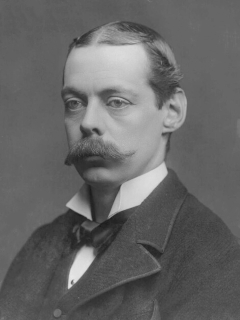
The Conservative Party in Ulster launches an anti-Home Rule campaign in February 1886. It joins with the Orange Order to organise a huge political rally which is addressed by Lord Churchill.
Protestants in Ulster are very concerned about the prospect of Irish Home Rule. They fear that an Irish parliament will put rural agricultural interests before the needs of the industrial North-East. They believe a Dublin parliament will introduce tariffs which will damage industries in the north. They also fear that they will be discriminated against because of their religion, outnumbered in a Dublin parliament by Catholic representatives.
Churchill has shown disdain for Ulster Unionists up until this time, in private at least, telling Lord Salisbury, “these foul Ulster Tories have always ruined our party,” but as 1886 begins he sees an opportunity to exploit their fears for political gain. He decides that should Prime MinisterWilliam Gladstone “went for Home Rule (for Ireland), the Orange Card would be the one to play. Please God may it turn out the ace of trumps and not the two.” This quote leads one to believe he has few real convictions regarding the issue.
“Ulster will fight, and Ulster will be right,” Lord Churchill proclaims to a crowd before he even arrives at Ulster Hall.
Lord Churchill gives a rousing speech at the rally. During his speech, he plays on Protestant fears of Dublin “Catholic” rule and encourages Ulster Protestants to organize against Home Rule, so it does not come upon them “as a thief in the night.” As a result, the Ulster Protestants begin to form paramilitary drilling units.
Churchill achieves a short-term political gain by his playing of the Orange Card, but his most lasting legacy is the unfounded fear of Irish Catholics that he helps to implant in the minds of Ulster Protestants, a tragedy for both traditions on the island. Those fears remain evident over a century later.

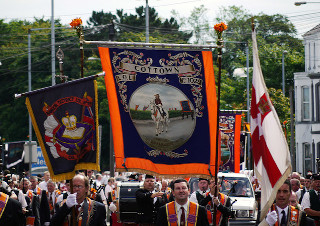 The first recorded “Twelfth of July” sectarian riots erupt in Belfast on July 12, 1813 as clashes break out between Orange marchers and Irish nationalists. Several Orangemen open fire on a crowd in Hercules Street, killing two Protestants and wounding four other people.
 The
The  The
The 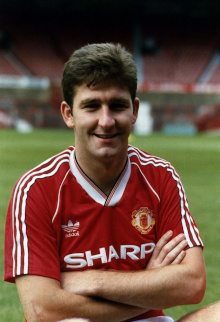


 seamus dubhghaill