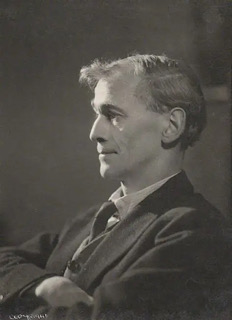
Lynd is born to Robert John Lynd, a Presbyterian minister, and Sarah Rentoul Lynd, the second of seven children. His paternal great-grandfather emigrated from Scotland to Ireland. He is educated at Royal Belfast Academical Institution and Queen’s University Belfast. His father serves a term as Presbyterian Church Moderator, but he is just one of a long line of Presbyterian clergy in the family.
Lynd marries the writer Sylvia Dryhurst on April 21, 1909. They meet at Gaelic League meetings in London. Their daughters Máire and Sigle become close friends of Isaiah Berlin. Sigle’s son, born in 1941, is artist Tim Wheeler. In March 1924, they move to what is to be their long-term married home, the elegant Regency house of 5 Keats Grove in the leafy suburb of Hampstead in northwest London. The house had been lived in by various members of Sylvia’s family.
The Lynds are literary hosts, in the group including J. B. Priestley. They are on good terms also with Hugh Walpole. Priestley, Walpole and Sylvia Lynd are founding committee members of the Book Society. Irish guests include James Joyce and James Stephens. On one occasion reported by Victor Gollancz in Reminiscences of Affection, Joyce intones Anna Livia Plurabelle to his own piano accompaniment. Joyce and his wife Nora Barnacle hold their wedding lunch at the Lynds’ house after getting married at Hampstead Town Hall on July 4, 1931.
Lynd uses the pseudonym Y.Y. in writing for the New Statesman. According to C. H. Rolph‘s Kingsley, Lynd’s weekly essay, which runs from 1913 to 1945, is “irreplaceable.” In 1941, editor Kingsley Martin decides to alternate it with pieces by James Bridie on Ireland, but the experiment is not at all a success.
Lynd’s political views are at a certain point radicalised by his experience of how Ulster and Home Rule develop in the 1912–1914 period. He is appalled at the threat of the use of violence to deliver Ulster from Home Rule and the later decision to postpone the implementation of the Third Home Rule Bill. He later writes, “Then came August 1914 and England began a war for the freedom of small nations by postponing the freedom of the only small nation in Europe which it was within her power to liberate with the stroke of a pen.”
Lynd becomes fluent in the Irish language and is a Gaelic League member. As a Sinn Féin activist, he uses the name Robiard Ó Flionn/Roibeard Ua Flionn. He dies in Hampstead, London on October 6, 1949. He is buried in Belfast City Cemetery.
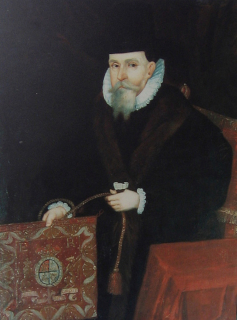
Loftus is born in 1533, the second son of a monastic bailiff, Edward Loftus, in the heart of the English Yorkshire Dales. He embraces the Protestant faith early in his development. He is an undergraduate at Trinity College, Cambridge, where he reportedly attracts the notice of the young Queen Elizabeth, as much by his physique as through the power of his intellect. Although this encounter may never have happened, Loftus certainly meets with the Queen more than once, and she becomes his patron for the rest of her reign. At Cambridge Loftus takes holy orders as a Catholic priest and is appointed rector of Outwell St. Clement in Norfolk. He comes to the attention of the Catholic Queen Mary, who names him vicar of Gedney, Lincolnshire. On Elizabeth’s accession in 1558 he declares himself Anglican.
Loftus makes the acquaintance of the Queen’s favourite Thomas Radclyffe, 3rd Earl of Sussex and serves as his chaplain in Ireland in 1560. In 1561 he becomes chaplain to Alexander Craike, Bishop of Kildare and Dean of St. Patrick’s Cathedral in Dublin. Later that year he is appointed rector of Painstown in Meath and evidently earns a reputation as a learned and discreet advisor to the English authorities in Dublin. In 1563, he is consecrated Archbishop of Armagh at the unprecedented age of 28 by Hugh Curwen, Archbishop of Dublin.
Following a clash with Shane O’Neill, the real power in Ulster during these years, he comes to Dublin in 1564. To supplement the meager income of his troubled archbishopric he is temporarily appointed to the Deanery of St. Patrick’s Cathedral by the queen in the following year. He is also appointed president of the new commission for ecclesiastical causes. This leads to a serious quarrel with the highly respected Bishop of Meath, Hugh Brady.
In 1567 Loftus, having lobbied successfully for the removal of Hugh Curwen, who becomes Bishop of Oxford, and having defeated the rival claims of the Bishop of Meath, is appointed Archbishop of Dublin, where the queen expects him to carry out reforms in the Church. On several occasions he temporarily carries out the functions of Lord Keeper of the Great Seal, and in August 1581 he is appointed Lord Chancellor of Ireland after an involved dispute with Nicholas White, Master of the Rolls in Ireland. He is constantly occupied in attempts to improve his financial position by obtaining additional preferment and is subject to repeated accusations of corruption in public office.
In 1582 Loftus acquires land and builds a castle at Rathfarnham, which he inhabits from 1585. In 1569–1570 the divisions in Irish politics take on a religious tinge with the First Desmond Rebellion in Munster and Pope Pius V‘s 1570 papal bullRegnans in Excelsis. The bull questions Elizabeth’s authority and thereafter Roman Catholics are suspected of disloyalty by the official class unless they are discreet.
Loftus takes a leading part in the execution of Dermot O’Hurley, Archbishop of Cashel. When O’Hurley refuses to give information, Francis Walsingham suggests he should be tortured. Although the Irish judges repeatedly decide that there is no case against O’Hurley, on June 19, 1584, Loftus and Sir Henry Wallop write to Walsingham “We gave warrant to the knight-marshal to do execution upon him, which accordingly was performed, and thereby the realm rid of a most pestilent member.”
Between 1584 and 1591 Loftus has a series of clashes with Sir John Perrot on the location of an Irish University. Perrot wants to use St. Patrick’s Cathedral, Dublin as the site of the new University, which Loftus seeks to preserve as the principal place of Protestant worship in Dublin, as well as a valuable source of income for himself. The archbishop wins the argument with the help of his patron, Queen Elizabeth I, and Trinity College, Dublin is founded at its current location, named after his old college at Cambridge, leaving the Cathedral unaffected. Loftus is named as its first Provost in 1593.
The issue of religious and political rivalry continues during the two Desmond Rebellions (1569–83) and the Nine Years’ War (1594–1603), both of which overlap with the Anglo-Spanish War (1585–1604), during which some rebellious Irish nobles are helped by the Papacy and by Elizabeth’s arch-enemy Philip II of Spain. Due to the unsettled state of the country Protestantism makes little progress, unlike in Celtic Scotland and Wales at that time. It comes to be associated with military conquest and is therefore hated by many. The political-religious overlap is personified by Loftus, who serves as Archbishop and as Lord Chancellor of Ireland. An unlikely alliance forms between Gaelic Irish families and the Norman “Old English“, who had been enemies for centuries but who now mostly remain Roman Catholic.
Adam Loftus dies in Dublin on April 5, 1605, and is interred in the building he had helped to preserve for future generations, while many of his portraits hang today within the walls of the University which he helped found. Having buried his wife Jane (Purdon) and two sons (of their 20 children) in the family vault at St. Patrick’s, Loftus dies at his Episcopal Palace in Kevin Street “worn out with age” and joins his family in the same vault. His zeal and efficiency are commended by James I upon the king’s accession.
A charter incorporates Derry as the city of Londonderry on March 29, 1613 and also creates the new county of Londonderry. Despite the official name, the city is more usually known as simply Derry, which is an anglicisation of the Old IrishDaire, which in modern Irish is spelled Doire, and translates as “oak-grove/oak-wood.” The name derives from the settlement’s earliest references, Daire Calgaich (“oak-grove of Calgach”). The name is changed from Derry in 1613 during the Plantation of Ulster to reflect the establishment of the city by the London guilds.
Ulster is finally brought under the control of Elizabeth I’s government at the beginning of the 17th century following a long struggle between the Tudor monarchy and the Gaelic chieftains. This follows the defeat of the chieftains at the Siege of Kinsale in 1601 after a war lasting nine years. Although the Gaelic chieftains are allowed to remain on their land, their positions have been weakened. A group of them leave Ireland for the continent in 1607, never to return. The “Flight of the Earls”, as it is known, is seen as treason by James I’s government and their lands are confiscated. This important event opens the way for James I to further increase his control over Ulster by settling tens of thousands of settlers from England, Scotland and Wales on the confiscated lands.
Surveying and planning for the plantation take place during 1608 and 1609 and the plantation proper begins in 1610. The towns of Derry and Coleraine, as well as much of the lands that are to become County Londonderry, are granted to the City of London Corporation, which is charged with planting them.
The Society of the Governor and Assistants, London, of the New Plantation in Ulster, within the realm of Ireland, known after the Restoration as the Irish Society, is formed in 1609 by the City of London, to manage the estates which it has been obliged very reluctantly to take on. The Irish Society takes charge of the overall management of the Irish estates, with direct control of the new city of Derry and of the town of Coleraine.
The City of Londonlivery companies are required to take on estates in the surrounding County of Londonderry. The Great Twelve livery companies bear the heaviest financial burden. The county is divided among them into twelve “proportions,” distributed by the drawing of lots. The Great Twelve are in turn supported by a number of minor companies, so that thirty livery companies in all have Irish estates derived from their participation in James I’s scheme for the plantation of Ulster.
However, the first phase of the existence of the Irish Society is short-lived. The Great Parchment Book is compiled in the late 1630s when Charles I claims the estates as forfeit after a politically motivated case in Star Chamber rules that the Londoners have not fulfilled their obligations of plantation.
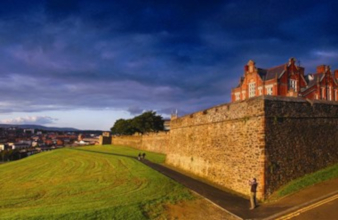
The City of Londonderry is very much a product of the plantation and plays a pivotal role in safeguarding the plantation. Its walls, which are still intact today, repulse sieges in 1641, 1649 and 1689.
By the end of the 17th century, Ulster, which had been the most Gaelic part of Ireland, has become the most “British.” The plantation creates Ulster we know today with its socio-economic base, its religious and political diversity, and its shared heritage.
As Prime Minister, O’Neill introduces economic reforms to stimulate industrial growth and employment, with mixed results. He also tries narrowing the divide between Protestants and Catholics. He does this with important gestures, like visiting Catholic schools and expressing condolences on the death of Pope John XXIII.
When the civil rights movement erupts in the late 1960s, O’Neill offers a package of reforms and concessions, including changes to the allocation of housing. These proposals, however, anger staunch Unionists and fail to satisfy many Republicans.
In December 1969, O’Neill appears on Northern Ireland television and makes an impassioned plea for unity, warning that “Ulster stands at the crossroads.” His government is reelected in February 1969, though O’Neill himself is almost voted out of his own seat.
With the situation worsening, O’Neill is further embarrassed by Loyalist attempts to sabotage Belfast’s water supply. Fast losing the confidence of his own party, he resigns the prime ministership in April 1969. He remains in the parliament until January 1970.
O’Neill is made Baron O’Neill of the Maine and spends the last decade of his life in Britain’s House of Lords. He dies of cancer on June 12, 1990.
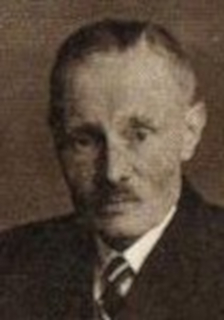
Immediately after leaving the British Army Falls writes a history of one of the Divisions that he had served with during the war, entitled The History of the 36th (Ulster) Division, which is published in 1922.
Falls holds the post of Chichele Professor of Military History at All Souls College, Oxford from 1946 to 1953. From the late 1940s through to the end of his life in the early 1970s he is a productive writer of military histories, publishing in-depth detailed studies as well as general works for the commercial market, his final two titles being published posthumously.
The historian Sir Michael Howard later describes Falls’ work The History of the 36th (Ulster) Division (1922) as “containing some of the finest descriptions of conditions on the Western Front to be found anywhere in the literature of the war.”
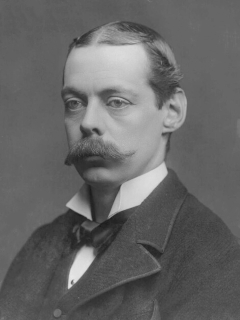
The Conservative Party in Ulster launches an anti-Home Rule campaign in February 1886. It joins with the Orange Order to organise a huge political rally which is addressed by Lord Churchill.
Protestants in Ulster are very concerned about the prospect of Irish Home Rule. They fear that an Irish parliament will put rural agricultural interests before the needs of the industrial North-East. They believe a Dublin parliament will introduce tariffs which will damage industries in the north. They also fear that they will be discriminated against because of their religion, outnumbered in a Dublin parliament by Catholic representatives.
Churchill has shown disdain for Ulster Unionists up until this time, in private at least, telling Lord Salisbury, “these foul Ulster Tories have always ruined our party,” but as 1886 begins he sees an opportunity to exploit their fears for political gain. He decides that should Prime MinisterWilliam Gladstone “went for Home Rule (for Ireland), the Orange Card would be the one to play. Please God may it turn out the ace of trumps and not the two.” This quote leads one to believe he has few real convictions regarding the issue.
“Ulster will fight, and Ulster will be right,” Lord Churchill proclaims to a crowd before he even arrives at Ulster Hall.
Lord Churchill gives a rousing speech at the rally. During his speech, he plays on Protestant fears of Dublin “Catholic” rule and encourages Ulster Protestants to organize against Home Rule, so it does not come upon them “as a thief in the night.” As a result, the Ulster Protestants begin to form paramilitary drilling units.
Churchill achieves a short-term political gain by his playing of the Orange Card, but his most lasting legacy is the unfounded fear of Irish Catholics that he helps to implant in the minds of Ulster Protestants, a tragedy for both traditions on the island. Those fears remain evident over a century later.
The Irish general election is that part of the 1918 United Kingdom general election which takes place in Ireland. The election is now seen as a key moment in modern Irish history because it sees the overwhelming defeat of the moderate nationalistIrish Parliamentary Party (IPP), which had dominated the Irish political landscape since the 1880s, and a landslide victory for the radical Sinn Féin party. The party had never stood in a general election but had won six seats in by-elections in 1917–1918. Sinn Féin vows in its manifesto to establish an independent Irish Republic. In Ulster, however, the Unionist Party is the most successful party.
The election is held in the aftermath of World War I, the Easter Rising and the Conscription Crisis. It is the first general election to be held after the Representation of the People Act 1918. It is thus the first election in which women over the age of 30, and all men over the age of 21, can vote. Previously, all women and most working-class men had been excluded from voting.
In the aftermath of the elections, Sinn Féin’s elected members refuse to attend the British Parliament in Westminster. Instead, they form a parliament in Dublin, the First Dáil Éireann, which declares Irish independence as a republic. The Irish War of Independence is conducted under this revolutionary government which seeks international recognition and sets about the process of state-building.
The IFA’s first decisions are to elect its first President, Major Spencer Chichester, and to form an annual challenge cup competition similar to the FA Cup and Scottish Cup competitions, called the Irish Cup. Two years later, Ireland plays its first international against England, losing 13–0, which remains a record for both teams, a record win for England and a record loss for Ireland.
Shortly after the partition of Ireland in 1921, the Football Association of Ireland (FAI) is established as a rival association to regulate the game in what is to become the Irish Free State. The immediate cause of the split lay in a bitter dispute over the venue for the replay of an Irish Cup match in 1921 involving Glentoran F.C. of Belfast and Shelbourne F.C. of Dublin. When the first cup match is drawn in Belfast, because of the Irish War of Independence, the IFA reneges on a promise to play the replay in Dublin and schedules the rematch again for Belfast. Shelbourne refuses to comply and forfeits the Cup.
Such is the anger over the issue that the Leinster Football Association breaks away from the IFA and forms its own national association. Those behind the FAI believe that football should be regulated by a federation based in the Irish Free State’s capital, Dublin. They also accuse the IFA of neglecting the development of the game in the South. The IFA’s supporters argue that the federation should be based where the game is primarily played – namely Ulster, and its principal city Belfast.
Both associations claim to represent the whole of the island, each competing internationally under the name “Ireland” and selecting players from both the rival national leagues, which also split at this time. Interventions by FIFA give the FAI de jure organising rights over the 26 counties of the Republic, with the IFA restricted to Northern Ireland. From the 1950s onwards, the IFA no longer claims it is the association for the whole of Ireland.
In 1960, the association moves to its present location on Windsor Avenue in south Belfast, in a building once occupied by Thomas Andrews. The IFA continues to regulate the game in Northern Ireland, and all results obtained by the Irish national side and records in the Irish Football League and the cup competition stand as Northern Irish records.
Abernethy’s father, also named John, a Presbyterian minister, accompanies Patrick Adair on a deputation from the general committee of Ulster presbyterians, who present a congratulatory address to William III in London in 1689, and obtain from the king a letter (November 9, 1689) recommending their case to Meinhardt Schomberg, 3rd Duke of Schomberg.
At the age of 13, Abernethy enters the University of Glasgow and, upon concluding his course there, goes on to the University of Edinburgh, where he soon moves in the most cultured circles. Returning home, he is licensed to preach from his Presbytery before he is twenty-one. In 1701 he is called to accept charge of an important congregation in Antrim. After an interval of two years, mostly spent in further study in Dublin, he is ordained there on August 8, 1703. He becomes a noted debater in the synods and assemblies of his church and a leading evangelist. He has been described as being at this time “the young minister of Antrim … a man of studious habits, heretical opinions, and remarkable ability.”
In 1712, he is devastated by the loss of his wife, Susannah Jordan. Five years later, he is invited to the congregation of Usher’s Quay, Dublin, and also to what is called the Old Congregation of Belfast. The synod assigns him to Dublin. After careful consideration he refuses and remains at Antrim. This refusal arouses disapproval and a controversy follows, with Abernethy standing firm for religious freedom and repudiating the ecclesiastical courts. The controversy and quarrel bear the name of the two camps in the conflict, the “Subscribers” and the “Non-subscribers.” Abernethy and his associates sow the seeds of the struggle (1821–1840) in which, under the leadership of Dr. Henry Cooke, the Arian and Socinian elements of the Presbyterian Church in Ireland are thrown out.
Much of what Abernethy contends for, and which the “Subscribers” oppose bitterly, is silently granted in the lapse of time. In 1726, the “Non-subscribers” are cut off, with due ban and solemnity, from the Presbyterian Church of Ireland. In 1730 he moves to Wood Street, Dublin. It is said of him that, although a “Non-subscriber,” he is a Trinitarian. However, Dr. Cooke states that Arianism “made very considerable progress under the patronage of high names, as Abernethy, the author of a very excellent work upon the Attributes, who gave it a great deal of eclat.”
In 1731 comes the greatest controversy in which Abernethy is involved. It is nominally about the Test Act, but actually on the entire question of tests and disabilities. His stand is against all laws that, upon account of mere differences of religious opinions and forms of worship, exclude men of integrity and ability from serving their country.
Abernethy is nearly a century in advance of his age. He has to reason with those who deny that a Roman Catholic or Dissenter can be a “man of integrity and ability.”
Hume, 61, the Catholic head of the Social Democratic and Labor Party, is cited by the Nobel Committee in Oslo for having been the “clearest and most consistent of Northern Ireland’s political leaders in his work for a peaceful solution.”
Trimble, 54, the Protestant leader of the Ulster Unionist Party, is honored for having demonstrated “great political courage when, at a critical stage in the process, he advocated solutions which led to the peace agreement.”
The accord, signed on April 10 and known as the Good Friday Agreement, gives the 1.7 million residents of Northern Ireland a respite from the sectarian violence that has claimed more than 3,200 lives in the previous 30 years. It also opens the possibility of lasting stability for the first time since the establishment of Northern Ireland with partition from Ireland in 1921.
Forging concessions from fiercely antagonistic populations, the accord seeks to balance the Protestant majority’s wish to remain part of Britain with Catholic desires to strengthen ties to the Republic of Ireland to the south. The committee, seeing in Northern Ireland’s two warring groups a dispute with notable similarities to violent tribal confrontations elsewhere, expresses the hope that the accord will serve “to inspire peaceful solutions to other religious, ethnic and national conflicts around the world.”
Adams, in New York on a fund-raising trip for Sinn Féin, welcomes the Oslo announcement and particularly praises Hume, who is widely seen as having helped persuade the IRA to adopt a cease-fire and having eased Sinn Féin’s entry into the talks. “Indeed, there would be no peace process but for his courage and vision,” Adams says, adding, “No one deserves this accolade more.” He also wishes Trimble well and says the prize imposes on everyone the responsibility to “push ahead through the speedy implementation of the agreement.”
In the unforgiving politics of Northern Ireland, the Unionist dissidents and members of other Protestant parties who do not join in the peace talks attack both Trimble and Hume. Ian Paisley Jr., son of the head of the Democratic Unionist Party, calls the Nobel Committee’s decision a “farce” and says of the winners, “These people have not delivered peace, and they are not peacemakers.”
Trimble says he is “slightly uncomfortable” with the award because so many other people have been involved beside him in reaching the settlement and much remains to be done to put it in place. “We know that while we have the makings of peace, it is not wholly secure yet,” he tells the BBC from Denver, where he is on an 11-city North American tour to spur foreign investment in Ulster. “I hope it does not turn out to be premature.”
Hume receives word of the prize at his home in Londonderry and terms it “an expression of the total endorsement of the work of very many people.” He adds, “This isn’t just an award to David Trimble and myself. It is an award to all the people in Northern Ireland.”
In Washington, D.C., President Clinton says “how very pleased” he is, “personally and as President, that the Nobel Prize Committee has rewarded the courage and the people of Northern Ireland by giving the Nobel Peace Prize to John Hume and to David Trimble.” He adds “a special word of thanks” to George Mitchell, who issues a statement praising Hume and Trimble as “fully deserving of this honor.”
The peace talks began in the summer of 1996. They eventually draw the participation of 8 of the 10 Northern Irish parties, with many of the men around the table convicted murderers and bombers who had emerged from prison with a commitment to peaceful resolution to what for nearly a century have been referred to wearily as “the Troubles.” The paramilitary groups had also made the tactical decision that violence would not secure their goals; a shared conviction that gives these talks a chance for success that past fitful attempts at settlement lacked.
The peace talks move in a desultory manner until Blair takes office in May 1997 and highlights the cause of peace in Northern Ireland as an early commitment. At his and Ahern’s urging, the IRA declares a cease-fire in July, and by September Sinn Féin is permitted to join the talks.
Blair also gives Trimble and Adams unprecedented access to 10 Downing Street, and the Ulster Protestants report that they obtained from Clinton the most sympathetic hearing they ever had from an American President, allaying their longtime suspicions of Washington’s bias in favor of the Catholic minority.
(From: “2 Ulster Peacemakers Win the Nobel Prize,” The New York Times, Warren Hoge, October 17, 1998)