seamus dubhghaill

Promoting Irish Culture and History from Little Rock, Arkansas, USA


Leave a comment

Founding of the Irish Socialist Republican Party

james-connolly

The Irish Socialist Republican Party, a small, but pivotal Irish political party, is founded on May 29, 1896, by James Connolly. Its aim is to establish an Irish workers’ republic. The party splits in 1904 following months of internal political rows.

The party is small throughout its existence. According to the ISRP historian David Lynch, the party never has more than 80 members. Upon its founding one journalist comments that the party has more syllables than members. Nevertheless, the ISRP is regarded by many Irish historians as a party of seminal importance in the early history of Irish socialism and republicanism. It is often described as the first socialist and republican party in Ireland, and the first organisation to espouse the ideology of socialist republicanism on the island. During its lifespan it only has one really active branch, the Dublin branch. There are several attempts to create branches in Cork, Belfast, Limerick, Naas, and even in northern England but they never come to much. The party establishes links with feminist and revolutionary Maud Gonne who approves of the party.

The party produces the first regular socialist paper in Ireland, the Workers’ Republic, runs candidates in local elections, represents Ireland at the Second International, and agitates over issues such as the Boer War and the commemorations of the Irish Rebellion of 1798. Politically the ISRP is before its time, putting the call for an independent “Republic” at the centre of its propaganda before Sinn Féin or other political organizations.

A public meeting held by the party is described in Irish socialist playwright Sean O’Casey‘s autobiography Drums under the Window.

Connolly, who is the full-time paid organiser for the party, subsequently leaves Ireland for the United States in 1903 following internal conflict. In fact, it seems that a combination of the petty infighting and his own poverty that causes Connolly to abandon Ireland (he returns in 1910). Connolly clashes with the party’s other leading light, E. W. Stewart, over trade union and electoral strategy. A small number of members around Stewart establish an anti-Connolly micro organisation called the Irish Socialist Labour Party. In 1904, this merges with the remains of the ISRP to form the Socialist Party of Ireland.


Leave a comment

Birth of Creighton Hale, Irish American Actor

creighton-hale

Creighton Hale, Irish American theatre, film, and television actor, is born Patrick Fitzgerald on May 24, 1882, in County Cork. His career extends more than a half-century, from the early 1900s to the end of the 1950s.

Hale is educated in Dublin and London, and later attends Ardingly College in Sussex. He immigrates to the United States in his early twenties, traveling with a troupe of actors. While starring in Charles Frohman‘s Broadway theatre production of Indian Summer, he is spotted by a representative of the Pathé film company. He eventually becomes known professionally as Creighton Hale, although the derivation of those names remains unknown. His first movie is The Exploits of Elaine in 1914. He stars in hit films such as Way Down East, Orphans of the Storm, and The Cat and the Canary.

Some believe that in 1923 Hale stars in an early pornographic “stag” film On the Beach (a.k.a. Getting His Goat and The Goat Man). In the film, three nude women agree to have sex with him, but only through a hole in a fence. Photographs of the scene clearly show that the man in the film is not Hale but is another actor who also wears glasses.

When talkies come about, Hale’s career declines. He makes several appearances in Hal Roach‘s Our Gang series including School’s Out, Big Ears and Free Wheeling, and also plays uncredited bits in major talking films such as Larceny, Inc., The Maltese Falcon, and Casablanca.

Hale’s two sons, Creighton Hale, Jr. and Robert Lowe Hale, from his first marriage to Victoire Lowe, are adopted by Lowe’s second husband, actor John Miljan. After his divorce, Hale marries Kathleen Bering in Los Angeles in 1931.

Creighton Hale dies in South Pasadena at the age of 83 on August 9, 1965. He is buried at Duncans Mills Cemetery in Duncan Mills, Sonoma County, California.


Leave a comment

Real IRA Designated Foreign Terrorist Organization

real-irish-republican-army

On May 16, 2001, the United States Department of State designates the Real Irish Republican Army, a splinter group of the Irish Republican Army (IRA) charged with killing 29 people in the August 1998 Omagh bombing, as a “foreign terrorist organisation,” a legal term that brings financial and other sanctions. Under U.S. law, any assets the Real IRA has in the United States are frozen, it is illegal to support the organization, and Real IRA members are not eligible for U.S. visas.

The Real IRA broke off from the main Irish Republican Army and its political wing Sinn Féin in 1998 to oppose the decision by Sinn Féin to support the Northern Ireland peace process and work to end 30 years of fighting in Northern Ireland.

As a result of the FTO designation many activities, including fund-raising, of the Real IRA or its two so-called “front groups” or “political pressure groups” — the “32 County Sovereignty Movement” and the “Irish Republican Prisoner Welfare Association” — are now illegal.

A senior State Department official notes that this is the first time a group with “heavy ties” to the United States, with sympathizers and supporters coming from the United States, has been designated as a terrorist organization. But, in the words of this official, the “British and Irish government publicly asked us to look into this.” The “rigorous” review, begun in the fall of 2000, included volumes of evidence and was an inner-agency process that required the signature of the Secretary of the Treasury, the Attorney General and the Secretary of State.

A second State Department official points out that Irish nationalists have typically received the most support from South Boston, New York City and Chicago, where there are heavy concentrations of Irish Americans.

According to the State Department Patterns of Global Terrorism report in 2000, the Real IRA was formed in February-March 1998, has between 150-200 hard-line members and is dedicated to removing British forces from Northern Ireland and unifying Ireland.

The State Department report goes on to accuse the Real IRA of carrying out the bombing of Hammersmith Bridge and a rocket attack against Secret Intelligence Service (MI-6) headquarters in London in 2000.

State Department officials say they absolutely anticipate the Real IRA to challenge the FTO designation in court. The designation comes as the Irish Republic prepares to prosecute Michael McKevitt, the Real IRA’s alleged leader.

Other designated FTOs include 29 organizations: the Abu Nidal Organization, the Abu Sayyaf group, the Palestinian Liberation Front, Al-Qaeda and Tupac Amaru Revolutionary Movement, to name a few.


Leave a comment

Birth of Gabriel Byrne, Actor, Director & Producer

gabriel-james-byrne

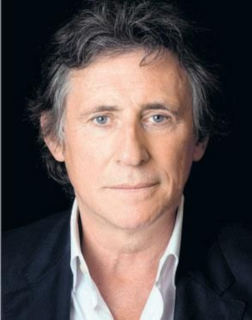
Gabriel James Byrne, internationally acclaimed actor, film director, film producer, writer, cultural ambassador and audiobook narrator, is born in Dublin on May 12, 1950.

Byrne is the first of six children. His father is a cooper and his mother a hospital worker. He is raised Catholic and educated by the Irish Christian Brothers. He spends five years of his childhood in a seminary training to be a Catholic priest. He later says, “I spent five years in the seminary, and I suppose it was assumed that you had a vocation. I have realized subsequently that I didn’t have one at all. I don’t believe in God. But I did believe at the time in this notion that you were being called.” He attends University College Dublin (UCD), where he studies archeology and linguistics, and becomes proficient in the Irish language. He plays football in Dublin with the Stella Maris Football Club.

Byrne works in archeology after he leaves UCD but maintains his love of his language, writing Draíocht (Magic), the first drama in Irish on Ireland’s national Irish television station, TG4, in 1996.

He discovers his acting ability as a young adult. Before that he works at several occupations which include being an archaeologist, a cook, a bullfighter, and a Spanish schoolteacher. He begins acting when he is 29 years old. He begins on stage at the Focus Theatre and the Abbey Theatre in Dublin, later joining the Royal Court Theatre and the Royal National Theatre in London.

Byrne comes to prominence on the final season of the Irish television show The Riordans, later starring in the spin-off series, Bracken. He makes his film début in 1981 as Lord Uther Pendragon in John Boorman‘s King Arthur epic, Excalibur.

Byrne does not visit the United States until he is 37 years old. In 1988, he married actress Ellen Barkin with whom he has two children. The couple separates amicably in 1993 and divorce in 1999.

In November 2004, Byrne is appointed a UNICEF Ireland Ambassador. In 2007 he is presented with the first of the newly created Volta awards at the 5th Jameson Dublin International Film Festival for his lifetime achievement in acting. He also receives the Honorary Patronage of the University Philosophical Society, of Trinity College Dublin on February 20, 2007. He is awarded an honorary degree in late 2007 by the National University of Ireland, Galway, in recognition of his “outstanding contribution to Irish and international film.”

Byrne is featured as therapist Dr. Paul Weston in the critically acclaimed HBO series In Treatment (2008). In his return to theater in 2008, Byrne appears as King Arthur in Alan Lerner and Frederick Loewe‘s Camelot with the New York Philharmonic which is featured in a PBS broadcast in the Live From Lincoln Center series in May of 2008.

Byrne currently resides in Manhattan, New York.

(From IMDb Mini Biography by Bernie Corrigan)


Leave a comment

Birth of James Shields, U.S. Politician & Army Officer

james-shields

James Shields, Irish American Democratic politician and United States Army officer, is born in Altmore, County Tyrone, in what is now Northern Ireland, on May 10, 1806. He is the only person in U.S. history to serve as a Senator for three different states. He represents Illinois from 1849 to 1855, in the 31st, 32nd, and 33rd Congresses, Minnesota from 1858 to 1859, in the 35th Congress, and Missouri in 1879, in the 45th Congress.

Born and initially educated in Ireland, Shields emigrates to the United States in 1826. He is briefly a sailor and spends time in Quebec before settling in Kaskaskia, Illinois, where he studies and practices law. In 1836, he is elected to the Illinois House of Representatives, and later as State Auditor. His work as auditor is criticized by a young Abraham Lincoln, who with his then fiancée, Mary Todd, publishes a series of inflammatory pseudonymous letters in a local paper. Shields challenges Lincoln to a duel, and the two nearly fight on September 22, 1842, before making peace and eventually becoming friends.

In 1845, Shields is appointed to the Supreme Court of Illinois, from which he resigns to become Commissioner of the U.S. General Land Office. At the outbreak of the Mexican–American War, he leaves the Land Office to take an appointment as brigadier general of volunteers. He serves with distinction and is twice wounded.

In 1848, Shields is appointed to and confirmed by the Senate as the first governor of the Oregon Territory, which he declines. After serving as Senator from Illinois, he moves to Minnesota and there founds the town of Shieldsville. He is then elected as Senator from Minnesota. He serves in the American Civil War and, at the Battle of Kernstown, his troops inflict the only tactical defeat of Stonewall Jackson in the war. He resigns his commission shortly thereafter. After moving multiple times, he settles in Missouri and serves again for three months in the Senate.

Shields dies unexpectedly in Ottumwa, Iowa on June 1, 1879, while on a lecture tour, after reportedly complaining of chest pains. His body is transferred to Carrollton, Missouri by train, where a funeral is held at the Catholic church, and his body escorted to St. Mary’s Cemetery by two companies of the Nineteenth Infantry, the Craig Rifles, and a twenty-piece brass band. His grave remains unmarked for 30 years, until the local government and the U.S. Congress fund a granite and bronze monument there in his honor.

A bronze statue of Shields is given by the State of Illinois to the United States Capitol in 1893 and represents the state in the National Statuary Hall. The statue is sculpted by Leonard Volk and dedicated in December 1893. Statues of Shields also stand in front of the Carroll County Court House in Carrollton, Missouri and on the grounds of the Minnesota State Capitol in Saint Paul.


Leave a comment

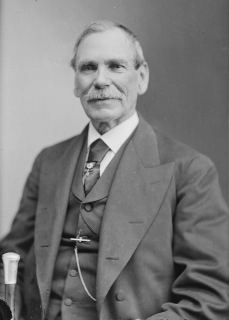
Birth of John MacBride

john-macbride

Major John MacBride, Irish republican executed by the British for his participation in the 1916 Easter Rising, is born in Westport, County Mayo on May 7, 1865.

MacBride is born to Patrick MacBride, a shopkeeper and trader, and the former Honoria Gill. He is educated at the Christian Brothers School in Westport and at St. Malachy’s College in Belfast. He studies medicine but gives it up and begins working with a chemist’s firm in Dublin.

MacBride joins the Irish Republican Brotherhood (IRB) and is associated with Michael Cusack in the early days of the Gaelic Athletic Association. He also joins the Celtic Literary Society through which he comes to know Arthur Griffith, who is to remain a friend and influence throughout his life. Beginning in 1893, he is termed a “dangerous nationalist” by the British government. In 1896, he travels to the United States on behalf of the IRB. Upon his return he emigrates to South Africa.

In the Second Boer War MacBride is instrumental in the raising of the Irish Transvaal Brigade and leads it into action against the British. When organised resistance collapses, he and the surviving members cross the border into Mozambique. After the war he marries Maud Gonne and they have a son, Seán MacBride, who is also to make a name for himself in Irish Politics. The marriage, however, is not a success and they go their separate ways. MacBride keeps up his associations with Republican activists but does not become personally involved other than making the odd speech in support of Ireland’s Cause.

After returning permanently from Paris to Dublin in 1905, MacBride joins other Irish nationalists in preparing for an Insurrection. Because he is so well known to the British, the leaders think it wise to keep him outside their secret military group planning a Rising. As a result, he happens to find himself in the midst of the Rising without notice.

MacBride is in Dublin early on Easter Monday morning, April 24, to meet his brother, Dr. Anthony MacBride, who is arriving from Westport to be married two days later. As MacBride walks up Grafton Street, he sees Thomas MacDonagh in uniform and leading his troops. He offers his services and is appointed second-in-command at the Jacob’s Biscuit Factory, which is occupied and held through Easter Week until the order to surrender is received. As he is dressed in civilian clothes rather than a military uniform, he could likely have escaped without too much difficulty but rather he decides to go with his comrades into captivity.

Tried by court martial under the Defence of the Realm Act, MacBride is found guilty and sentenced to death. He is executed on May 5, 1916, two days before his forty-eighth birthday. Facing the British firing squad, MacBride refuses to be blindfolded saying, “I have looked down the muzzles of too many guns in the South African war to fear death and now please carry out your sentence.”

John MacBride is buried in the cemetery at Arbour Hill Prison in Dublin.


Leave a comment

Birth of Margaret Anna Cusack, Founder of Poor Clares Convent

margaret-anne-cusack

Margaret Anna Cusack, founder of the first Poor Clares convent in the west of Ireland and a talented writer who publishes on the issues of social injustice, is born to an aristocratic family of English origin in Coolock, County Dublin on May 6, 1829. Her writings and actions focus on advocacy of women’s rights including equal pay, equal opportunity for education, and legal reform to give women control of their own property.

Cusack is raised in the Anglican church tradition until her conversion to Catholicism in 1858. She enters the Irish Poor Clare Sisters and is among the first group of Sisters sent to found the convent at Kenmare, County Kerry.

During the next 21 years, Cusack, now known as Sister Francis Clare, dedicates herself to writing. Her writings include a wide range of concerns including lives of the saints, local histories, biographies, books and pamphlets on social issues and letters to the press. As the “Nun of Kenmare” she writes on behalf of the liberation of women and children who are victims of oppression. Income from her books and from her famine relief fund is distributed throughout Ireland. While doing all she can to feed the hungry, at the same time she campaigns vigorously against the abuse of absentee landlords, lack of education for the poor and against a whole system of laws which degrade and oppress a section of society.

To broaden the scope of her work Cusack moves to Knock, County Mayo in 1881 with the idea of expanding the ministry of the Poor Clares. She starts an industrial school for young women and evening classes for daytime land-workers. Several women are attracted by this work and in 1884 she decides to found her own community, The Sisters of St. Joseph of Peace.

Continued conflict in Knock with Church leaders leads Cusack to seek support in England. Under Cardinal Henry Edward Manning and Bishop Edward Bagshawe, she receives approbation for the new religious order from Pope Leo XIII and the Congregation of the Sisters of St. Joseph of Peace is founded in January 1884, in the Diocese of Nottingham, England.

Later, Cusack travels to the United States to continue her work with immigrant Irish women but is immediately rebuked by Archbishop Michael Corrigan of New York. Just at that time, New Jersey stretches out a hand of welcome and encouragement as Bishop Winand Wigger of the Archdiocese of Newark invites her to establish homes for young Irish working women there. Within a few years, however, she claims that because of Archbishop Corrigan’s criticism of her among bishops throughout the United States, the work of her new community cannot continue as long as she remains with them.

Physically exhausted, sick and disillusioned with a patriarchal Church, Cusack withdraws from the Sisters of St. Joseph of Peace and leaves behind the sisters she so dearly loved. She eventually returns to her friends in the Church of England. In later years, she keeps in contact with the Sisters and expresses a loving concern for them. She dies on June 5, 1899, and is buried in the cemetery reserved for the Church of England at Leamington Spa, Warwickshire, England.

Cusack passes into obscurity for a long time until, as a result of the Second Vatican Council, religious orders are encouraged to review their roots and the intent of their founders. Since then, there have been a number a studies on Cusack, such as Philomena McCarthy’s The Nun of Kenmare: The True Facts. With the rediscovery of the life and times of Cusack, she has been hailed as a feminist and a social reformer ahead of her time.


Leave a comment

Death of Joe Heaney, Traditional Irish Singer

joe-heaney

Joe Heaney, traditional Irish singer also known as Joe Éinniú or Seosamh Ó hÉanaí, dies in Seattle, Washington on May 1, 1984. He spends most of his adult life abroad, living in England, Scotland and New York City, in the course of which he records hundreds of songs.

Heaney is born Carna, a remote village in the Irish-speaking district of Connemara, County Galway, along the west coast of Ireland on October 15, 1919. He starts singing at the age of five, but his shyness keeps him from singing in public until he is 20. He learns English at school in Carna. When he is 16 years old, he wins a scholarship to attend school in Dublin. While there he wins first and second prizes at a national singing competition. Most of his repertoire, estimated to exceed 500 songs, is learned while growing up in Carna.

In 1949, Heaney goes to London where he works on building sites and becomes involved in the folk-music scene. He records for the Topic Records and Gael Linn Records labels. He is married for six years until his wife dies of tuberculosis.

Heaney is recorded by Pádraic Ó Raghallaigh for Raidió Teilifís Éireann, and by Peter Kennedy for the BBC in 1959. The BBC recordings are assembled on a BBC LP, not commercially issued, as BBC LP 22570.

Heaney comes to the United States in 1965 at the invitation of the Newport Folk Festival. After singing at Newport, he decides to move to America and settles in New York City. From 1982 until 1984, Heaney is an artist-in-residence at the University of Washington in Seattle after previously having taught at Wesleyan University in Middletown, Connecticut.

Joe Heaney dies of emphysema in Seattle on May 1, 1984. The Joe Heaney Collection of the University of Washington Ethnomusicology Archives is established after his death. The Féile Chomórtha Joe Éinniú (Joe Heaney Commemorative Festival) is held every year in Carna. An Irish-language biography of him has been written by Liam Mac Con Iomaire, and a biography that discusses his work in the larger context of Ireland and the United States was published in 2011 by Sean Williams and Lillis Ó Laoire.


Leave a comment

Capture of Gustavus Conyngham, the Dunkirk Pirate

gustavus-conyngham

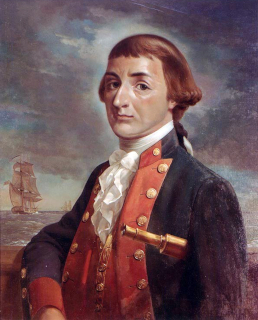
Irish-born United States Navy Captain Gustavus Conyngham, “The Dunkirk Pirate,” is captured by the British Royal Navy in the waters off New York on April 27, 1779.

Conyngham is born in County Donegal in 1747 and emigrated to British America in 1763 in search of a better life. He settles in Philadelphia in order to work for his cousin Redmond Conyngham in the shipping industry. When the American Revolutionary War begins in 1775, he immediately sailed to France to try to procure supplies needed for the war effort.

The British become aware of Conyngham’s plans and manage to maneuver him out of his ship with the help of the Dutch. After the loss of his ship, he heads back to France, hoping to connect with an ally to the United States. It is there he meets Benjamin Franklin, who helps him in his adventures many times in the future. They form a lasting relationship, and Conyngham eventually awards Franklin the nickname “the Philosopher” for his intellectual fortitude and resourcefulness. Franklin is entrusted with several commissions of the Continental Navy, and on March 1, 1777, Conyngham is appointed Captain of the lugger Surprise.

Conyngham scores a first victory that would warm the heart of any Irishmen, capturing the British merchant ship Prince of Orange on May 3, 1777. Later that year he is commissioned a captain in the Continental Navy and given command of the USS Revenge. He begins a series of highly successful raids into British waters from the port of Dunkirk, thus earning his sobriquet “The Dunkirk Pirate.”

In 1778 Conyngham sets sail for the West Indies and terrorizes British vessels there before finally returning to Philadelphia on February 21, 1779. He and his men had claimed 60 prize vessels in just 18 months. When he sets sail again his luck runs out and his ship is captured by the British vessel HMS Galatea on April 27, 1779. Conyngham was taken to prison in England and treated harshly by his British captors.

After two failed escape attempts, Conyngham tunnels his way out of Mill Prison in Plymouth and manages to make his way to the continent. He joins John Paul Jones on a cruise on the Alliance before returning to the United States. He is captured by the British again in March 1780 and spends another year in Mill Prison.

After the war Conyngham fails in his efforts to continue his naval career or to gain recognition from the United States Congress for his service during the war. He had lost the commission papers given to him by colonial representatives in Paris in 1777. It is said that he assists in the defense of Philadelphia against his old British foes during the War of 1812.

Gustavus Conyngham dies in Philadelphia seven years later on November 27, 1819. Nearly a century later, John Sanford Barnes, a retired navy captain and naval historian, acquires a cache of autographs and documents from a sale by Charavay of Paris. In the collection is Conyngham’s commission from Benjamin Franklin. Barnes publishes his discovery in September 1902, proving that the “Dunkirk Pirate” had never been a pirate at all, but one of the first heroes of the United States Navy.

(Pictured: Captain Gustavus Conyngham, Continental Navy. Painting by V. Zveg, 1976, based on a miniature by Louis Marie Sicardi. Courtesy of the U.S. Navy Art Collection, Washington, D.C. U.S. Naval Historical Center Photograph.)


1 Comment

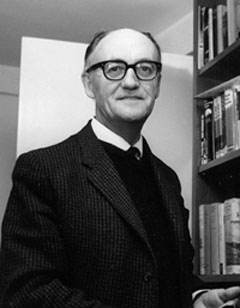
Death of Writer Walter Macken

Walter Macken, writer of short stories, novels and plays, dies at his home in the Gaeltacht village of Menlo, County Galway on April 22, 1967.

Macken is born at 18 St. Joseph’s Terrance in Galway, County Galway on May 3, 1915. His father, Walter Macken, Sr., formerly a carpenter, joins the British Army in 1915 and is killed in March of the following year at Saint-Éloi. The family therefore has to rely on lodgers and a small service pension to sustain them.

Macken attends the Presentation Convent for Infants from (1918-1921), St. Mary’s, a Diocesan College where they train people who want to become priests (1923-1924), and Patrician Brothers both Primary and Secondary (1921-1922 and 1924-1934), where he takes his Leaving Certificate. He is writing short stories, novels, and plays in exercise books from the age of eight and carries on these works well into his teens.

Macken is originally an actor, principally with the Taibhdhearc na Gaillimhe in Galway, where he meets his wife Peggy, and the Abbey Theatre in Dublin. He also plays lead roles on Broadway in M. J. Molloy‘s The King of Friday’s Men and his own play Home Is the Hero. The success of his third book, Rain on the Wind, winner of the Literary Guild award in the United States, enables him to focus his energies on writing.

Macken also acts in films, notably in Arthur Dreifuss‘ adaptation of Brendan Behan‘s The Quare Fellow. He is perhaps best known for his trilogy of Irish historical novels Seek the Fair LandThe Silent People, and The Scorching Wind.

His son Ultan Macken is a well-known journalist in the print and broadcast media of Ireland, and wrote a biography of his father, Walter Macken: Dreams on Paper.

Walter Macken dies of heart failure at the age of 51 in Menlo, County Galway, on April 22, 1967.