seamus dubhghaill

Promoting Irish Culture and History from Little Rock, Arkansas, USA


Leave a comment

Birth of Donagh MacDonagh, Playwright & Writer

donagh-macdonagh

Donagh MacDonagh, Irish writer, judge, presenter, broadcaster, and playwright, is born in Dublin on November 22, 1912. He is the son of Irish nationalist and poet Thomas MacDonagh.

MacDonagh is still a young child when his father is executed in 1916 for his part in the Easter Rising. Tragedy strikes again when his mother dies of a heart attack a year afterwards while swimming at Skerries to Lambay Island, County Dublin on July 9, 1917. He and his sister are then cared for by their maternal aunts, in particular Catherine Wilson.

His parents’ families then engage in a series of child custody lawsuits as the MacDonaghs are Roman Catholic and the Giffords are Protestant. In the climate of Ne Temere, the MacDonaghs are successful.

He and his sister Barbara, who later marries actor Liam Redmond, live briefly with their paternal aunt Eleanor Bingham in County Clare before being put into the custody of strangers until their late teens when they are taken in by Jack MacDonagh.

MacDonagh is educated at Belvedere College and University College Dublin (UCD) with contemporaries Cyril Cusack, Denis Devlin, Charles Donnelly, Brian O’Nolan, Niall Sheridan and Mervyn Wall. In 1935 he is called to the Bar and practises on the Western Circuit. In 1941 he is appointed a District Justice in County Mayo. To date, he remains the youngest person appointed as a judge in Ireland. He is Justice for the Dublin Metropolitan Courts at the time of his death.

MacDonagh publishes three volumes of poetry: Veterans and Other Poems (1941), The Hungry Grass (1947) and A Warning to Conquerors (1968). He also edits the Oxford Book of Irish Verse (1958) with Lennox Robinson. He also writes poetic dramas and ballad operas. One play, Happy As Larry, is translated into a number of languages. He has three other plays produced: God’s Gentry (1951), Lady Spider (1959) and Step in the Hollow, a piece of situation comedy nonsense.

MacDonagh also writes short stories. He publishes Twenty Poems with Niall Sheridan, stages the first Irish production of “Murder in the Cathedral” with Liam Redmond, later his brother-in-law, and is a popular broadcaster on Radio Éireann.

MacDonagh is married twice, to Maura Smyth and, following her death after she drowns in a bath whilst having an epileptic seizure, to her sister, Nuala Smyth. He has four children, Iseult and Breifne by Maura and Niall and Barbara by Nuala.

Donagh MacDonagh dies in Dublin on January 1, 1968, and is buried at Dean’s Grange Cemetery.


Leave a comment

Birth of Brian O’Nolan, Novelist & Playwright

brian-o-nolan

Brian O’Nolan, Irish novelist, playwright and satirist considered a major figure in twentieth century Irish literature, is born in Strabane, County Tyrone on October 5, 1911.

O’Nolan attends Blackrock College where he is taught English by President of the College, and future Archbishop, John Charles McQuaid. He also spends part of his schooling years in Synge Street Christian Brothers School. His novel The Hard Life is a semi-autobiographical depiction of his experience with the Christian Brothers.

O’Nolan writes prodigiously during his years as a student at University College, Dublin (UCD), where he is an active, and controversial, member of the well-known Literary and Historical Society. He contributes to the student magazine Comhthrom Féinne (Fair Play) under various guises, in particular the pseudonym Brother Barnabas. Significantly, he composes a story during this same period titled “Scenes in a Novel (probably posthumous) by Brother Barnabas”, which anticipates many of the ideas and themes later to be found in his novel At Swim-Two-Birds.

In 1934 O’Nolan and his student friends found a short-lived magazine called Blather. The writing here, though clearly bearing the marks of youthful bravado, again somewhat anticipates O’Nolan’s later work, in this case his Cruiskeen Lawn column as Myles na gCopaleen. Having studied the German language in Dublin, he may have spent at least parts of 1933 and 1934 in Germany, namely in Cologne and Bonn, although details are uncertain and contested.

A key feature of O’Nolan’s personal situation is his status as an Irish government civil servant, who, as a result of his father’s relatively early death, is obliged to support ten siblings, including an elder brother who is an unsuccessful writer. Given the desperate poverty of Ireland in the 1930s to 1960s, a job as a civil servant is considered prestigious, being both secure and pensionable with a reliable cash income in a largely agrarian economy. The Irish civil service is fairly strictly apolitical, prohibiting Civil Servants above the level of clerical officer from publicly expressing political views. This fact alone contributes to his use of pseudonyms, though he had started to create character-authors even in his pre-civil service writings. He rises to be quite senior, serving as private secretary to Seán T. O’Kelly and Seán McEntee.

Although O’Nolan is a well-known character in Dublin during his lifetime, relatively little is known about his personal life. On December 2, 1948, he marries Evelyn McDonnell, a typist in the Department of Local Government. On his marriage he moves from his parental home in Blackrock to nearby Merrion Street, living at several further locations in South Dublin before his death. The couple has no children.

O’Nolan is an alcoholic for much of his life and suffers from ill health in his later years. He suffers from throat cancer and dies from a heart attack in Dublin on the morning of April 1, 1966.


Leave a comment

Opening of the National Concert Hall

national-concert-hall-dublin

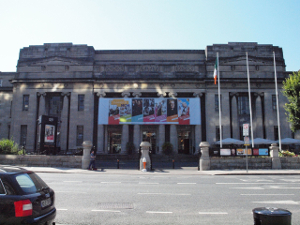
The National Concert Hall is opened in Dublin on September 9, 1981. It is a concert hall located on Earlsfort Terrace, close to St. Stephen’s Green, and is the principal national venue for classical music concerts in Ireland.

Originally built for the Dublin International Exhibition of Arts and Manufactures of 1865, the structure is converted into the central building of University College Dublin (UCD) at the foundation of the National University of Ireland in 1908. When UCD begins to relocate to a new campus at Belfield in the 1960s, part of the building is converted, and reopened as the National Concert Hall in 1981. Since then, the structure has been shared with UCD. In 2005 it is announced that UCD is to relocate all of its faculties to Belfield in the near term, allowing the NCH to develop a major expansion plan on the entire site, bringing it in line with international peers.

Today the National Concert Hall is one of Ireland’s National Cultural Institutions, under the aegis of the Irish Government‘s Department of Culture, Heritage and the Gaeltacht and, as such, is grant-aided by the Irish Government. The National Concert Hall is a statutory corporate body, with a management team, and a Government-appointed Board.

Although its facade is quite impressive, the venue’s architectural acoustics have been criticized. It is also unsuitable for large-scale opera stagings, lacking full stage facilities. Consequently, calls for a purpose-built venue are made from time to time.

Due to its central location, lunchtime concerts and recitals are common and attended by many workers from nearby office buildings. During the summer, outdoor recitals are given in the adjacent Iveagh Gardens. The resident orchestra is the RTÉ National Symphony Orchestra. Other regular performances are made from the rest of the RTÉ Performing Groups.

The National Concert Hall generally makes a small surplus, unlike most of Ireland’s National Cultural Institutions. This is despite the fact that although it has a high level of attendance, it has only a small public funding element, especially compared to the Abbey Theatre.


Leave a comment

Death of Actress Maureen Toal

maureen-toal

Maureen Toal, stage and television actress whose professional career lasts for more than sixty years, dies on August 24, 2012.

Toal is born in Fairview, Dublin on September 7, 1930. She begins performing at the Abbey Theatre in Dublin in 1946, when she is just sixteen years old. She becomes a fixture at the theater, portraying some of the strongest roles on the stage including Bessie Burgess in The Plough and the Stars and the Widow Quinn in The Playboy of the Western World. She also appears in several one woman shows, including Baglady, which is written by Irish playwright Frank McGuinness.

In 1952, Toal marries fellow Irish actor Milo O’Shea. They divorce in 1974.

Playwright John B. Keane writes the role of Mame Fadden in his play The Change in Mame Fadden specifically for Toal. Hugh Leonard also pens characters in his plays A Life and Great Big Blonde with the intention of casting Toal in the roles. Toal is best known to Irish television audiences for her role as Teasy McDaid on RTÉ One‘s Glenroe during the 1990s.

In 2010, Toal is awarded an honorary doctorate in literature at University College Dublin for which McGuinness delivers the citation, describing her as “our greatest actress.” He also praises her performances including Maggie in Arthur Miller‘s After the Fall and particularly her lead roles in his own plays, The Factory Girls and Baglady, where, he says, she tells the toughest of stories with devastating honesty. “Hers is the look out of which were fashioned the masks of comedy and tragedy.”

Maureen Toal dies in her sleep at her home in Sandycove, Dublin, on August 24, 2012, two weeks before her 82nd birthday. She is survived by her son, Colm O’Shea, two sisters, one brother, and three grandchildren.


Leave a comment

Death of Denis Devlin, Poet & Diplomat

denis-devlin

Denis Devlin, one of the major figures and influences of modern and modernist Irish poetry, dies in Dublin on August 21, 1959. Along with Samuel Beckett and Brian Coffey, he is one of the generation of Irish modernist poets to emerge at the end of the 1920s. He is also a career diplomat.

Devlin is born in Greenock, Scotland of Irish parents on April 15, 1908. His family returns to live in Dublin in 1918. He studies at Belvedere College and, from 1926, as a seminarian for the Roman Catholic priesthood at Clonliffe College. As part of his studies, he attends a degree course in modern languages at University College Dublin (UCD), where he meets and befriends Brian Coffey. Together they publish a joint collection, Poems, in 1930.

In 1927, Devlin abandons the priesthood and leaves Clonliffe College. He graduates from UCD with his BA in 1930 and spends that summer on the Blasket Islands to improve his spoken Irish. Between 1930 and 1933, he studies literature at Ludwig Maximilian University of Munich and the University of Paris, meeting, amongst others, Beckett and Thomas MacGreevy. He then returns to UCD to complete his MA thesis on Michael de Montaigne.

Devlin joins the Irish Diplomatic Service in 1935 and spends a number of years in Rome, New York and Washington, D.C. During this time, he meets the French poet Saint-John Perse, and the Americans Allen Tate and Robert Penn Warren. He goes on to publish a translation of Exile and Other Poems by Saint-John Perse, and Tate and Warren edit his posthumous Selected Poems.

Denis Devlin dies suddenly at the age of 51 in Dublin on August 21, 1959. Since his death, there have been two Collected Poems published; the first in 1964 is edited by Coffey and the second in 1989 by J.C.C. Mays.

Devlin’s personal papers are held in University College Dublin Archives.


Leave a comment

The Completion of the “Annals of the Four Masters”

annals-of-the-four-masters

The Annals of the Kingdom of Ireland or the Annals of the Four Masters, chronicles of medieval Irish history, are completed on August 10, 1636. The entries span from the Deluge, dated as 2,242 years after creation to 1616 AD.

The annals are mainly a compilation of earlier annals, although there is some original work, and are one of the principal Irish language sources for Irish history up to 1616. They are compiled between 1632 and 1636 at a Franciscan friary near the Drowes River in County Leitrim, on the border with County Donegal and County Sligo. The patron of the project is Fearghal Ó Gadhra, MP, a Gaelic lord in Coolavin, County Sligo. While many of the early chapters are essentially lists of names and dates, the later chapters, dealing with events of which the authors have first-hand accounts, are much more detailed.

The chief compiler of the annals is Brother Mícheál Ó Cléirigh from Ballyshannon, who is assisted by, among others, Cú Choigcríche Ó Cléirigh, Fearfeasa Ó Maol Chonaire and Peregrine Ó Duibhgeannain. Although only one of the authors, Mícheál Ó Cléirigh, is a Franciscan friar, they become known as “The Four Friars” or in the original Irish, Na Ceithre Máistrí. The Anglicized version of this is “The Four Masters,” the name that has become associated with the annals themselves.

Due to the criticisms by Irish historian Tuileagna Ó Maol Chonaire, the text is not published during the lifetime of any of the participants. The first substantial English translation (starting at 1171 AD) is published by Owen Connellan in 1846. The Connellan translation includes the annals from the eleventh to the seventeenth centuries. The only version to have a four-colour frontispiece, it includes a large folding map showing the location of families in Ireland. This edition, neglected for over 150 years, is republished in the early twenty-first century. The original Connellan translation is followed several years later by a full translation by the historian John O’Donovan. The translation is funded by a government grant of £1,000 obtained by the notable mathematician Sir William Rowan Hamilton while he is president of the Royal Irish Academy.

The reliability and usefulness of the Annals as a historical source has sometimes been questioned on the grounds that they are limited to accounts of the births, deaths and activities of the Gaelic nobility of Ireland and often ignore wider social trends or events. On the other hand, the Annals, as one of the few prose sources in Irish from this period, also provide a valuable insight into events such as the Desmond Rebellions and the Nine Years’ War from a Gaelic Irish perspective.

The early part of this work is based upon the Lebor Gabála Érenn. Today, most scholars regard the Lebor Gabála Érenn as primarily myth rather than history. It appears to be mostly based on medieval Christian pseudo-histories, but it also incorporates some of Ireland’s native pagan mythology. Scholars believe the goal of its writers was to provide an epic history for Ireland that could compare to that of the Israelites or the Romans, and which reconciled native myth with the Christian view of history.

The several manuscript copies are held at Trinity College, Dublin, the Royal Irish Academy, University College Dublin and the National Library of Ireland.

(Pictured: Illustration of “the four masters” by B. H. Holbrooke, 1846)


Leave a comment

Death of John Patrick Wilson, Fianna Fáil Politician

john-wilson

John Patrick Wilson, Fianna Fáil politician who serves as Tánaiste from 1990 to 1993, dies in Beaumont, Dublin on July 9, 2007, the day after his 84th birthday. He also serves as Minister for Defence and Minister for the Gaeltacht (1992-1993), Minister for the Marine (1989-1992), Minister for Tourism and Transport (1987-1989), Minister for Communications (March 1987), Minister for Posts and Telegraphs (March-December 1982), Minister for Education (1977-1981) and Teachta Dála (TD) for Cavan (1973-1992).

Wilson is born in Kilcogy, County Cavan on July 8, 1923. He is educated at St. Mel’s College in Longford, the University of London and the National University of Ireland. He graduates with a Master of Arts in Classics and a Higher Diploma in Education. He is a secondary school teacher at Saint Eunan’s College and Gonzaga College and also a university lecturer at University College, Dublin (UCD) before he becomes involved in politics. He is also a Gaelic footballer for Cavan GAA and wins two All-Ireland Senior Football Championship medals with the team, one in 1947 at the Polo Grounds in New York City. He is a member of the teachers’ trade union, the Association of Secondary Teachers Ireland and serves as president of the association.

Wilson is first elected to Dáil Éireann at the 1973 general election for the Cavan constituency, for Cavan–Monaghan in 1977 and at each subsequent election until his retirement after the dissolution of the 26th Dáil Éireann in 1992. He is succeeded as Fianna Fáil TD for Cavan-Monaghan by his special advisor, Brendan Smith, who goes on to serve as Minister for Agriculture, Fisheries and Food from 2008 to 2011. In 1977 Jack Lynch appoints Wilson to Cabinet as Minister for Education. He goes on to serve in each Fianna Fáil government until his retirement, serving in the governments of Jack Lynch, Charles Haughey and Albert Reynolds.

In 1990 Wilson challenges Brian Lenihan for the Fianna Fáil nomination for the 1990 presidential election. Lenihan wins the nomination but fails to be elected President and is also sacked from the government. Wilson is then appointed Tánaiste. He remains in the cabinet until retirement in 1993. Although the 26th Dáil Éireann is dissolved in December 1992, he serves in Government until the new government takes office.

Following his retirement from politics, Wilson is appointed the Commissioner of the Independent Commission for the Location of Victims’ Remains by Bertie Ahern. This position entails involvement with members of the Provisional Irish Republican Army (IRA) to assist in finding the bodies of the disappeared who were murdered by the Provisional IRA during The Troubles.

John Wilson dies at St. James Hospital, Dublin on July 9, 2007, one day after his 84th birthday. His funeral takes place at the Good Shepherd Church at Churchtown, Dublin. President Mary McAleese is one of a number of prominent figures among the mourners, while Taoiseach Bertie Ahern is represented by his Aide-de-Camp.


Leave a comment

Birth of Seán Doherty, Fianna Fáil Politician

sean-doherty

Seán Doherty, Fianna Fáil politician who serves as Cathaoirleach of Seanad Éireann from 1989 to 1992 and Minister for Justice from March 1982 to December 1982, is born on June 29, 1944, in Cootehall near Boyle, County Roscommon. He also serves as a Teachta Dála (TD) from 1977 to 1989 and 1992 to 2002 and is a Senator for the Administrative Panel from 1989 to 1992.

Doherty is educated at national level in County Leitrim and then at University College Dublin and King’s Inns. In 1965, he becomes a member of the Garda Síochána and serves as a detective in Sligo before joining the Special Detective Unit in Dublin in the early 1970s. In 1973, he takes a seat on the Roscommon County Council, which had been vacated after the death of his father.

After serving for four years on the Roscommon County Council, Doherty is elected as a Fianna Fáil TD for the Roscommon–Leitrim constituency at the 1977 general election.

In 1979, Doherty is a key member of the so-called “gang of five” which supports Charles Haughey‘s attempt to take over the leadership of the party. The other members are Albert Reynolds, Mark Killilea Jnr, Tom McEllistrim and Jackie Fahey. Haughey is successful in the Fianna Fáil leadership election and Doherty is rewarded by being appointed Minister of State at the Department of Justice from 1979 to 1981. In the short-lived 1982 Fianna Fáil government he enters the Cabinet as Minister for Justice. In this post he becomes involved in a series of controversies.

Doherty’s brother-in-law, Garda Thomas Nangle, is charged with assaulting James McGovern, a native of County Fermanagh, in a public house in December 1981. On September 27, 1982, hours before the case is due to be heard in District Court in the small village of Dowra, County Cavan, McGovern is arrested by the Special Branch of the Royal Ulster Constabulary (RUC) on the basis of entirely false Garda intelligence that he is involved in terrorism. The case against Nangle is dismissed because the principal witness, McGovern, fails to appear in court. The solicitor representing Nangle is Kevin Doherty, Seán Doherty’s brother. This questionable use of Garda/RUC Special Branch liaison, set up under the 1985 Hillsborough Anglo-Irish Agreement, prevents meetings between the Garda commissioner and the RUC chief constable for almost three years.

After Doherty leaves office it is revealed in The Irish Times that he ordered the tapping of three journalists home telephones. The newspaper also discloses that he has been interfering in the workings of the Garda and the administration of justice for both political and personal reasons. He immediately resigns from the party only to rejoin it in 1984.

At the 1989 general election his loses his seat in Dáil Éireann to the independent candidate Tom Foxe. He is also an unsuccessful candidate in the elections on the same day to the European Parliament, but he is later elected instead to the Seanad on the Administrative Panel and becomes the Cathaoirleach (Chairman) of the 19th Seanad.

In January 1992 the phone tapping scandal returns to haunt Fianna Fáil. Doherty announces in a television interview that he had shown transcripts of the conversations to Charles Haughey while Haughey was Taoiseach in 1982 although he had previously denied this. Haughey denies the claim also, but is forced to resign from the government, and then resigns as leader of Fianna Fáil. Doherty then regains his seat at the 1992 general election and holds it until his retirement at the 2002 general election.

Seán Doherty dies at Letterkenny General Hospital of a brain hemorrhage on June 7, 2005, while on a family holiday in County Donegal.


Leave a comment

Assassination of Activist Miriam Daly

miriam-daly

Miriam Daly, Irish republican activist and university lecturer, is assassinated by the loyalist Ulster Defence Association (UDA) on June 26, 1980.

Daly is born in the Curragh Irish Army camp, County Kildare in 1928. She grows up in Hatch Street, Dublin and attends Loreto College on St. Stephen’s Green and University College, Dublin, graduating in history. She goes on to teach economic history in UCD for some years before moving to Southampton University with her husband, Joseph Lee. Two years after her first husband dies, she marries James Daly and returns to Ireland with him in 1968. They both are appointed lecturers in Queen’s University Belfast.

Daly soon becomes an activist in the civil rights movement, particularly following the introduction of internment without trial by the Government of Northern Ireland. She is active in the Northern Ireland Civil Rights Association and the Northern Resistance Movement.

Daly is a militant member of the Prisoners’ Relatives Action Committee and the national Hunger Strike Committee. In that campaign, she works with Seamus Costello and soon joins him in the Irish Republican Socialist Party (IRSP) and the Irish National Liberation Army (INLA). After Costello is assassinated, she becomes chairperson, leading the party for two years. During this time, she and her husband are instrumental in opposing Sinn Féin‘s drift towards federalism.

On June 26, 1980, Daly is shot dead at her home in the Andersonstown area of west Belfast. At the time of her assassination, she is in charge of the IRSP prisoners’ welfare.

According to reports in The Irish Times, members of the Ulster Defence Association gain entry to her home with the intention of killing her husband, who is also a republican activist. Daly is captured and tied up while they wait for him to return home. However, he is in Dublin at the time and so does not arrive. After a considerable time, the UDA men decide to kill Daly instead. Muffling the sound of the gun with a cushion, they shoot her in the head and cut the phone lines before fleeing. Her body is discovered when her ten-year-old daughter arrives home from school.

Daly is buried in Swords, County Dublin. Mourners at her funeral, which features the firing of a volley of shots over her coffin, includes Seán Mac Stíofáin and Ruairí Ó Brádaigh. She is included as a volunteer on the INLA monument in Milltown Cemetery and is one of several commemorated by an IRSP mural on the Springfield Road, Belfast.


Leave a comment

Birth of Mary Lavin, Short Story Writer & Novelist

mary-josephine-lavin

Mary Josephine Lavin, noted Irish short story writer and novelist, is born in Walpole, Massachusetts on June 10, 1912. She is regarded as a pioneering female author in the traditionally male-dominated world of Irish letters. Her subject matter often deals explicitly with feminist issues and concerns as well as a deep Catholic faith.

Lavin is the only child born to Tom and Nora Lavin, an immigrant Irish couple. She attends primary school in East Walpole until the age of ten, when her mother decides to go back to Ireland. Initially, Mary and Nora live with Nora’s family in Athenry, County Galway. Afterwards, they purchase a house in Dublin, and Mary’s father comes back from the United States to join them.

Lavin attends Loreto College, a convent school in Dublin, before going on to study English and French at University College Dublin (UCD). She teaches French at Loreto College for a while. As a postgraduate student, she publishes her first short story, “Miss Holland,” which appears in the The Dublin Magazine in 1938. Tom Lavin then approaches Edward Plunkett, 18th Baron of Dunsany, the well-known Irish writer, on behalf of his daughter and asks him to read some of Mary’s unpublished work. Suitably impressed, Lord Dunsany becomes her literary mentor.

In 1943, Lavin publishes her first book, Tales from Bective Bridge, a volume of ten short stories about life in rural Ireland. It is a critical success and goes on to win the James Tait Black Memorial Prize for fiction. That same year, she marries William Walsh, a Dublin lawyer. Over the next decade, the couple has three daughters and moves to “abbey farm” which they purchase in County Meath and includes the land around Bective Abbey. Her literary career flourishes. She publishes several novels and collections of short stories during this period. Her first novel, The House in Clewe Street, is serialised in The Atlantic Monthly before its publication in book form in 1945.

In 1954, William Walsh dies. Lavin, her reputation as a major writer already well-established, is left to confront her responsibilities alone. She raises her three daughters and keeps the family farm going at the same time. She also manages to keep her literary career on track, continuing to publish short stories and winning several awards for her work, including the Katherine Mansfield Prize in 1961, Guggenheim Fellowships in 1959 and 1961, and an honorary doctorate from UCD in 1968. Some of her stories written during this period, dealing with the topic of widowhood, are acknowledged to be among her finest.

Lavin remarries in 1969. Michael Scott is an old friend from her student days in University College. He has been a Jesuit priest in Australia but has obtained release from his vows from Rome and returned to Ireland. The two remain together until Scott’s death in 1991.

In 1992, Lavin, by now retired, is elected Saoi by the members of Aosdána for achieving “singular and sustained distinction” in literature. Aosdána is an affiliation of creative artists in Ireland, and the title of Saoi one of the highest honours in Irish culture.

Mary Lavin dies at the age of 83 on March 25, 1996.