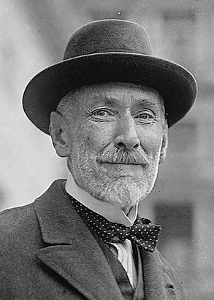
Threatened by lung trouble in 1879, Plunkett goes to the United States and spends ten years as a cattle rancher in the Bighorn Mountains of Wyoming. He returns to Ireland in 1889 and devotes himself to the agricultural cooperative movement, first organizing creameries and then, in 1894, the Irish Agricultural Organisation Society, a forerunner of similar societies in England, Wales, and Scotland. A moderate Unionist member of Parliament for South County Dublin from 1892 to 1900, he becomes vice president (1899–1907) of the new Department of Agriculture and Technical Instruction for Ireland, which he has been instrumental in creating.
Plunkett’s later experience convinces him of the need for the independence of an Ireland without partition inside the Commonwealth, and he fights strongly for this goal, as chairman of the Irish Convention (1917–18) and, in 1919, as founder of the Irish Dominion League and of the Plunkett Foundation for Cooperative Studies, an agricultural research and information centre. He is appointed to the first Senate of the Irish Free State (1922–23). His house in Dublin is bombed and burned during in the Irish Civil War and he lives in England thereafter. In 1924 the Plunkett Foundation also moves to England. In 1924 he presides over a conference in London on agricultural co-operation in the British Commonwealth and in 1925 he visits South Africa to help the movement there.
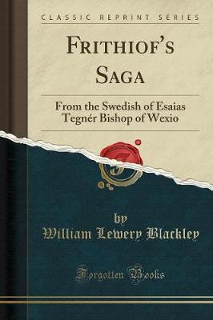
Blackley is the second son of Travers Robert Blackley of Ashtown Lodge, County Dublin and Eliza, daughter of Colonel Lewery, who is taken prisoner by the French at Verdun. His maternal grandfather is Travers Hartley, MP for Dublin (1776-1790) and governor of the Bank of Ireland.
In boyhood Blackley is sent with his brother John to a school at Brussels kept by Dr. Carl Martin Friedlander, a Polish political refugee, whose daughter, Amelia Jeanne Josephine, he subsequently marries on July 24, 1855. There he acquires proficiency in French, German, and other foreign languages. In 1847 he returns to Ireland, entered Trinity College, Dublin, graduating B.A. in 1850, M.A. in 1854, and takes holy orders. In 1854 he becomes curate of St. Peter’s, Southwark, but an attack of cholera compels his retirement from London. From 1855 to 1867 he has charge of two churches at Frensham, near Farnham, Surrey. He is rector of North Waltham, Hampshire (1867-1883), and King’s Somborne (1883-1889). In 1883 he is made honorary canon of Winchester.
Blackley, who is an energetic parish priest and is keenly interested in social questions, carefully elaborates a scheme for the cure of pauperism by a statutory enforcement of thrift which has far-reaching results at home and abroad. In November 1878 he contributes to the Nineteenth Century an essay entitled National Insurance a Cheap, Practical, and Popular Way of Preventing Pauperism, and thenceforth strenuously advocates a scheme of compulsory insurance, which the National Providence League, with the Earl of Shaftesbury as president, is formed in 1880 to carry into effect. At the same time he recommends temperance as a means of social regeneration. His views reach a wide public through his writings, which include How to teach Domestic Economy (1879), Collected Essays on the Prevention of Pauperism (1880), Social Economy Reading Book, adapted to the New Code (1881), Thrift and Independence; a Word for Working-men (1884).
Blackley’s scheme provides that all persons between eighteen and twenty should subscribe to a national fund, and should receive in return a week in time of sickness, and a week after the age of seventy. The plan is urged on the House of Lords by the Earl of Carnarvon in 1880, and is the subject of inquiry by a select committee of the House of Commons from 1885 to 1887. The majority of the boards of guardians in England and Wales support the proposals, but the commons’ committee, while acknowledging Blackley’s ingenuity and knowledge, reports adversely on administrative and actuarial grounds. At the same time the friendly societies, which Blackley has censured in his Thrift and Independence, regards the principle of compulsion as a menace to their own growth, and their historian and champion, the Rev. John Frome Wilkinson, sharply criticises Blackley’s plan in The Blackley National Providence Insurance Scheme; a Protest and Appeal (1887). Blackley’s plan, although rejected for the time, stimulates kindred movements in the colonies and in foreign countries, and leads directly to the adoption of old age pensions in England by legislation in 1908, while the national insurance scheme which receives parliamentary sanction in 1911 bears some trace of Blackley’s persistent agitation.
In 1887 Blackley, who is director of the Clergy Mutual Insurance Company, makes proposals to the church congress which lead to the formation of the “Clergy Pension Scheme” and of a society for ecclesiastical fire insurance. In the autumn of 1889 Blackley, whose active propagandism brings him constantly to London, becomes vicar of St. James the Less, Vauxhall Bridge Road. There he enlarges the schools and builds a parish hall and a vicarage.
William Lewery Blackley dies after a brief illness at 79 St. George’s Square, on July 25, 1902. Brasses are put up in Blackley’s memory in the churches of St. James the Less, North Waltham, and Frensham.
This involves helping to ship weapons to be used in an Irish uprising from Germany into Ireland. Together with Molly Childers, she raises £2,000 towards the purchase of 900 Mauser rifles from Germany, many of which are used in the 1916 Easter Rising. She sails on the Asgard to collect the guns and helps to unload them in Ireland.
Con Collins stays with Spring Rice regularly. She helps train local women as nurses to tend to wounded nationalists and acts as an IRA message carrier between Limerick and Dublin. Throughout this time, she maintains her aristocratic façade and society connections, inviting senior Liberal Party politicians to Mount Trenchard to pressure them to support Irish independence.
Spring Rice starts to suffer from tuberculosis in 1923, and dies unmarried in a sanatorium in Clwyd, Wales, on December 1, 1924. She is buried in Ireland, where her coffin is draped in the Irish tricolour and escorted by an IRA guard of honour.
(Pictured: Mary Ellen Spring-Rice and Molly Childers with the German guns on board Asgard, 1914.)
James (Joseph) Hanley, British novelist, short story writer, and playwright of Irish descent, is born in Kirkdale, Liverpool, Lancashire on September 3, 1897. He publishes his first novel, Drift, in 1930. The novels and short stories about seamen and their families that he writes in the 1930s and 1940s include Boy (1931), the subject of an obscenity trial. He comes from a seafaring family and spends two years at sea himself. After World War II there is less emphasis on the sea in his works. While frequently praised by critics, his novels do not sell well. In the late 1950s, 1960s, and early 1970s he writes plays, mainly for the BBC, for radio and then for television, and also for the theatre. He returns to the novel in the 1970s. His last novel, A Kingdom, is published in 1978, when he is 80 years old.
Hanley is born to a working class family. Both his parents are born in Ireland, his father Edward Hanley around 1865, in Dublin, and his mother, Bridget Roache, in Queenstown, County Cork, around 1867. Both are well established in Liverpool by 1891, when they are married. Hanley’s father works most of his life as a stoker, particularly on Cunard Line liners, and other relatives have also gone to sea. He grows up living close to the docks. He leaves school in the summer of 1910 and works for four years in an accountants’ office. Then early in 1915 at the age of 17, he goes to sea for the first time. Thus life at sea is a formative influence and much of his early writing is about seamen.
In April 1917, Hanley jumps ship in Saint John, New Brunswick, Canada, and shortly thereafter joins the Canadian Expeditionary Force in Fredericton, New Brunswick. He fights in France in the summer of 1918, but is invalided out shortly thereafter. After the war he works as a railway porter in Bootle and devotes himself to a prodiguous range of autodidactic, high cultural activities – learning the piano, regularly attending concerts, reading voraciously and, above all, writing. However, it is not until 1930 that his novel Drift is accepted.
Hanley moves from Liverpool to near Corwen, North Wales in 1931, where he meets Dorothy Enid “Timothy” Thomas, neé Heathcote, a descendant of Lincolnshire nobility. They live together and have a child, Liam Powys Hanley, in 1933, but do not marry until 1947. In July 1939, as World War II is approaching, he moves to London to write documentaries and plays for the BBC. He moves back to Wales during the early years of the war, settling in Llanfechain on the other side of the Berwyn range from Corwen. In 1963, the Hanleys move to North London to be close to their son.
In 1937 Hanley publishes an autobiographical work, Broken Water: An Autobiographical Excursion, and while this generally presents a true overall picture of his life, it is seriously flawed, incomplete and inaccurate. Chris Gostick describes it as “a teasing palimpsest of truth and imagination.”
Hanley’s brother is the novelist Gerald Hanley and his nephew is the American novelist and playwright William Hanley. Hanley’s wife also publishes three novels, as Timothy Hanley. She dies in 1980. James Hanley himself dies in London on November 11, 1985 and is buried in Llanfechain, Wales.
Ferguson is born in Belfast on March 10, 1810. He lives at a number of addresses, including Glenwhirry, where he acquires the love of nature that informs his later work. He is educated at the Belfast Academy and the Belfast Academical Institution and then moves to Dublin to study law at Trinity College, obtaining his bachelor’s degree in 1826 and his master’s degree in 1832.
Because his father has exhausted the family property, Ferguson is forced to support himself through his student years. He turns to writing and is a regular contributor to Blackwood’s Magazine by the age of 22. He is called to the bar in 1838, but continues to write and publish, both in Blackwood’s and in the newly established Dublin University Magazine.
In addition to his poetry, Ferguson contributes a number of articles on topics of Irish interest to antiquarian journals. In 1863, he travels in Brittany, Ireland, Wales, England, and Scotland to study megaliths and other archaeological sites. These studies are important to his major antiquarian work, Ogham Inscriptions in Ireland, Wales and Scotland, which is edited after his death by his widow and published in 1887.
His collected poems, Lays of the Western Gael is published in 1865, resulting in the award of a degree LL.D. honoris causa from Trinity College. He writes many of his poems in both Irish and English translations. In 1867, Ferguson retires from the bar to take up the newly created post of Deputy Keeper of the Public Records in Ireland. As reward for his services, he receives a knighthood in 1878.
Ferguson’s major work, the long poem Congal is published in 1872 and a third volume, Poems, in 1880. In 1882, he is elected President of the Royal Irish Academy, an organisation dedicated to the advancement of science, literature, and antiquarian studies. His house in North Great George’s St., Dublin, is open to everyone interested in art, literature or music.
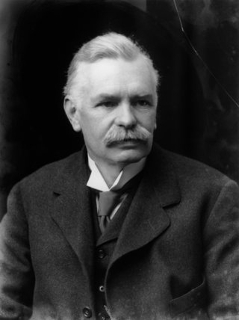
In 1879 Oldham becomes an assistant-superintendent with the Geological Survey of India (GSI), working in the Himalayas. He writes about 40 publications for the Survey on geological subjects including hot springs, the geology of the Son Valley and the structure of the Himalayas and the Indo-Gangetic plain. His most famous work is in seismology. His report on the 1897 Assam earthquake goes far beyond reports of previous earthquakes. It includes a description of the Chedrang fault, with uplift up to 35 feet and reported accelerations of the ground that have exceeded the Earth’s gravitational acceleration. His most important contribution to seismology is the first clear identification of the separate arrivals of P-waves, S-waves and surface waves on seismograms. Since these observations agree with theory for elastic waves, they show that the Earth can be treated as elastic in studies of seismic waves.
In 1903, Oldham resigns from the GSI due to ill health and returns to the United Kingdom, living in Kew and various parts of Wales. In 1906 he writes a paper analyzing seismic arrival times of various recorded earthquakes. He concludes that the earth has a core and estimates its radius to be less than 0.4 times the radius of the Earth.
In 1908 Oldham is awarded the Lyell Medal, in 1911 made a Fellow of the Royal Society and from 1920 to 1922 serves as the President of the Geological Society of London.
Richard Dixon Oldham dies at Llandrindod Wells in Wales on July 15, 1936.
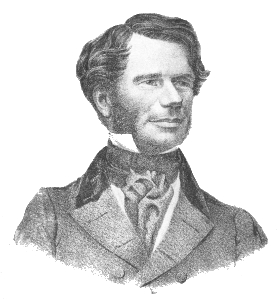
Although a Protestant country-gentleman, O’Brien supports Catholic emancipation while remaining a supporter of British-Irish union. In 1843, in protest against the imprisonment of Daniel O’Connell, he joins O’Connell’s anti-union Repeal Association.
Three years later, O’Brien withdraws the Young Irelanders from the association. In January 1847, with Thomas Francis Meagher, he founds the Irish Confederation, although he continues to preach reconciliation until O’Connell’s death in May 1847. He is active in seeking relief from the hardships of the famine. In March 1848, he speaks out in favour of a National Guard and tries to incite a national rebellion. He is tried for sedition on May 15, 1848, but is not convicted.
On July 29, 1848, O’Brien and other Young Irelanders lead landlords and tenants in a rising in three counties, with an almost bloodless battle against police at Ballingarry, County Tipperary. In O’Brien’s subsequent trial, the jury finds him guilty of high treason. He is sentenced to be hanged, drawn, and quartered. Petitions for clemency are signed by 70,000 people in Ireland and 10,000 people in England. In Dublin on June 5, 1849, the sentences of O’Brien and other members of the Irish Confederation are commuted to transportation for life to Van Diemen’s Land (Tasmania in present-day Australia).
O’Brien attempts to escape from Maria Island off Tasmania but is betrayed by the captain of the schooner hired for the escape. He is sent to Port Arthur where he meets up with John Mitchel.
O’Brien is a founding member of the Ossianic Society, which is founded in Dublin on St. Patrick’s Day 1853, whose aim is to further the interests of the Irish language and to publish and translate literature relating to the Fianna. He writes to his son Edward from Van Diemen’s Land, urging him to learn the Irish language. He himself studies the language and uses an Irish-language Bible and presents to the Royal Irish Academy Irish-language manuscripts he has collected.
In 1854, after five years in Tasmania, O’Brien is released on the condition he never returns to Ireland. He settles in Brussels. In May 1856, he is granted an unconditional pardon and returns to Ireland that July. He contributes to the Nation newspaper but plays no further part in politics.
In 1864 he visits England and Wales, with the view of rallying his failing health, but no improvement takes place, and he dies at Bangor, in Wales on June 16, 1864.
A statue of William Smith O’Brien stands in O’Connell Street, Dublin. Sculpted in Portland limestone, it is designed by Thomas Farrell and erected in D’Olier Street, Dublin, in 1870. It is moved to its present position in 1929.
Thomas Curtin is born at Ballyknockane, Mourne Abbey, County Cork, on March 20, 1884, the son of Patrick Curtin, a farmer, and Julia Sheehan. He attends Burnfort National School. In 1897 the family moves to Cork City, where he attends the North Monastery school.
Mac Curtain, as he later becomes known, is active in a number of cultural and political movements beginning around the turn of the 20th century. He joins the Blackpool, Cork branch of Conradh na Gaeilge, becoming its secretary in 1902. He has interests in music, poetry, history, archaeology and Irish history. He works in his early career as a clerk, and in his free time teaches Irish. In 1911 he joins Fianna Éireann and is a member of the Irish Volunteers.
He meets Elizabeth Walsh (Eibhlís Breathnach) at a Gaelic League meeting, and they marry on June 28, 1908. They have six children, five of whom survive into adulthood. The family lives over 40 Thomas Davis Street, where Mac Curtain runs a small clothing and rainwear factory.
In April 1916, at the outset of the Easter Rising, Mac Curtain commands a force of up to 1,000 men of the Irish Volunteers who assemble at various locations around County Cork. From the volunteer’s headquarters at Sheares Street in the city, Mac Curtain and his officers await orders from the volunteer leadership in Dublin, but conflicting instructions and confusion prevail and as a result the Cork volunteers never enter the fray. A tense stand-off develops when British forces surround the volunteer hall and continued for a week until a negotiated agreement leads to the surrender of the volunteers’ arms to the then Lord Mayor of Cork Thomas Butterfield on the understanding that they will be returned at a later date. This does not happen however, and Mac Curtain is jailed in Wakefield Prison, in the Frongoch internment camp in Wales, and in Reading Gaol. After the general amnesty of participants in the Rising 18 months later, Mac Curtain returns to active duty as a Commandant of what is now the Irish Republican Army.
By 1918 Mac Curtain is a brigade commander, the highest and most important rank in the IRA. During the Conscription Crisis of 1918, he actively encourages the hiring of the women of Cumann na mBan to cater for Volunteers. He is personally involved with Michael Collins‘ Squad that, along with a Cork battalion, attempt to assassinate Lord John French, whose car is missed as the convoy passes through the ambush positions. Despite the setback he remains brigadier of No.1 Cork when he is elected Lord Mayor. He is elected in the January 1920 council elections as the Sinn Féin councillor for NW Ward No. 3 of Cork and is chosen by his fellow councillors to be the Lord Mayor. He begins a process of political reform within the city.
In January 1919, the Irish War of Independence starts, and Mac Curtain becomes an officer in the IRA. On March 20, 1920, his 36th birthday, Mac Curtain is shot dead in front of his wife and son by a group of men with blackened faces, who are found to be members of the Auxilaries along with unknown members of the Royal Irish Constabulary (RIC) by the official inquest into the event. In the wake of the killing, which is in revenge for the shooting of a policeman, Mac Curtain’s house in Blackpool is ransacked.
The killing causes widespread public outrage. The coroner’s inquest passes a verdict of willful murder against British Prime MinisterDavid Lloyd George and against certain members of the RIC. Michael Collins later orders his squad of assassins to uncover and assassinate the police officers involved in the attack. RIC District Inspector Oswald Swanzy, who had ordered the attack, is fatally shot, with Mac Curtain’s own revolver, while leaving a Protestant church in Lisburn, County Antrim on August 22, 1920, sparking what is described by Tim Pat Coogan as a “pogrom” against the Catholic residents of the town.
Nano Reid, Irish landscape artist, figure painter and portraitist, is born in Drogheda, County Louth on March 1, 1900. An individual, expressionistic artist, Reid is acknowledged to be one of the finest Irish woman painters of twentieth-century visual art in Ireland. Her works are represented in many public collections throughout Ireland.
In 1920, Reid wins a scholarship to study fine art painting and drawing at the Dublin Metropolitan School of Art, now the National College of Art and Design, under Harry Clarke. At the time, she is, in the words of fellow student Hilda van Stockum, “a fierce redhead…uncompromising and looking for truth.” In 1925 she starts showing at the Royal Hibernian Academy (RHA), submitting a total of 42 canvases until the late 1960s.
In 1950, with Norah McGuinness, Reid represents Ireland at the Venice Biennale. This is followed by the Exhibition of Contemporary Irish Art in Aberystwyth, Wales (1953), and the Mostra Internazionale di Bianco e Nero in Lugano, Switzerland (1956), the Guggenheim International Award Exhibition in New York City (1960) and the Twelve Irish Painters show in New York City (1963). In 1974, the Arts Council and the Arts Council of Northern Ireland stage a major retrospective of Reid’s artworks.
Nano Reid dies in Drogheda in 1981. Retrospectives are held at Taylor Galleries in Dublin (1984), Droichead Arts Centre in Drogheda (1991), and at Linenhall Arts Centre in Castlebar, County Mayo (1999).
O’Brian is born Richard Patrick Russ, in Chalfont St. Peter, Buckinghamshire, to Charles Russ, an English physician of German descent, and Jessie Russ (née Goddard), an English woman of Irish descent. His literary career begins in his childhood with the publishing of his earliest works, including several short stories, the book Hussein, An Entertainment, and the short story collection Beasts Royal. The latter two bring him considerable critical praise especially considering his youth. He publishes his first novel, Caesar: The Life Story of a Panda Leopard, at the age of 15 with help from his father.
O’Brian is best known for his Aubrey–Maturin series of sea novels set in the Royal Navy during the Napoleonic Wars, and centered on the friendship of the English naval captain Jack Aubrey and the Irish–Catalan physician Stephen Maturin. The 20-novel series, the first of which is Master and Commander, is known for its well-researched and highly detailed portrayal of early 19th-century life, as well as its authentic and evocative language. A partially finished 21st novel in the series is published posthumously containing facing pages of handwriting and typescript.
O’Brian write a number of other novels and short stories, most of which were published before he achieves success with the Aubrey–Maturin series. He also translates works from French to English, and writes two biographies.
O’Brian’s major success as a writer comes late in life, when the Aubrey-Maturin series catches the eye of an American publisher. The series draws more readers and favourable reviews when the author is in his seventies. Near the end of his life, and in the same year he loses his beloved wife, British media reveals details of O’Brian’s early life, first marriage, and post-war change of name, causing distress to the very private author and to many of his readers at that time.
Between 1946 and 1949 O’Brian and his wife Mary live in Cwm Croesor, a remote valley in north Wales, where they initially rent a cottage from Clough Williams-Ellis. In 1949 they move to Collioure, a Catalan town in southern France. He and Mary remain together in Collioure until her death in 1998.
O’Brian dies on January 2, 2000 at Trinity College, Dublin where he had been living and working on his next book. His body is returned to Collioure, where he is buried next to his wife.




 seamus dubhghaill