seamus dubhghaill

Promoting Irish Culture and History from Little Rock, Arkansas, USA


Leave a comment

Death of Seán Francis Lemass, Taoiseach (1959-1966)

sean-francis-lemass

Seán Francis Lemass, one of the most prominent Irish politicians of the 20th century and Taoiseach from 1959 until 1966, dies at Mater Misericordiae University Hospital in Dublin on May 11, 1971, at the age of 71.

John Francis Lemass is born in Ballybrack, County Dublin before his family moves to Capel Street in Dublin city centre. He is the second of seven children born to John and Frances Lemass. Within the family his name soon changes to Jack and eventually, after 1916, he himself prefers to be called Seán. He is educated at O’Connell School where he was described as studious, with his two best subjects being history and mathematics.

As early as the age of sixteen, Lemass becomes a freedom fighter in the streets of Dublin, engaging in the 1916 Easter Rising, the Irish War of Independence, and the Irish Civil War, landing in jail again and again. He opposes the establishment of the Irish Free State as a dominion under the Anglo-Irish Treaty of 1921 and becomes a member of the headquarters staff of the Irish Republican Army in the civil war of 1922–1923.

Lemass is first elected as a Sinn Féin Teachta Dála (TD) for the Dublin South constituency in a by-election on November 18, 1924, and is returned at each election until the constituency is abolished in 1948, when he is re-elected for Dublin South–Central until his retirement in 1969.

He plays a key role in persuading Éamon de Valera to found a new republican party, Fianna Fáil, in 1926. After de Valera rises to the premiership in 1932, Lemass holds portfolios in all his cabinets for 21 of the next 27 years, notably as Minister for Industry and Commerce, Minister for Supplies, and Tánaiste (deputy prime minister).

When de Valera becomes President of Ireland in 1959, Lemass inherits the office of Taoiseach, serving in this position until 1966. Under him the country takes a more outward-looking approach, and he especially presses for Ireland’s entry into the European Economic Community (EEC), now the European Community embedded in the European Union, and for reconciliation with Northern Ireland.

Ill health forces Lemass to relinquish the leadership of his party in 1966 and he withdraws from politics altogether in 1969. He has been a heavy pipe smoker all his life, smoking almost a pound of tobacco a week in later life. At the time of his retirement, it is suspected that Lemass has cancer, but this is later disproved. In February 1971, while attending a rugby game at Lansdowne Road, he becomes ill, is rushed to hospital, and is told by his doctor that one of his lungs is about to collapse.

On Tuesday, May 11, 1971, Seán Lemass dies in Dublin’s Mater Misericordiae University Hospital. He is afforded a state funeral and is buried in Dean’s Grange Cemetery.

Lemass is widely regarded as the father of modern Ireland, primarily due to his efforts in facilitating industrial growth, bringing foreign direct investment into the country, and forging permanent links between Ireland and the European community. His greatest legacy, Ireland’s membership in the EEC, is not secured until 1973, after his death.

Leave a comment

Birth of Paul David Hewson, U2’s Bono

paul-hewson

Paul David Hewson, Irish singer-songwriter, musician, venture capitalist, businessman, and philanthropist known by his stage name Bono, is born in the Rotunda Hospital, Dublin, on May 10, 1960.

Bono, best known as the lead vocalist of the rock band U2, is raised in Dublin and attends Mount Temple Comprehensive School where he meets his future wife, Alison Stewart, as well as his future U2 bandmates – David “The Edge” Evans, Adam Clayton, and Larry Mullen, Jr.

Bono writes almost all U2 lyrics, frequently using religious, social, and political themes. During U2’s early years, his lyrics contribute to their rebellious and spiritual tone. As the band matures, his lyrics become inspired more by personal experiences shared with the other members. Bono wins numerous awards with U2, including twenty-two Grammy Awards and the 2003 Golden Globe Award for best original song, “The Hands That Built America,” for the film Gangs of New York.

In 2005, the U2 band members are inducted into the Rock and Roll Hall of Fame in their first year of eligibility. In November 2008, Rolling Stone magazine ranks Bono as the 32nd-greatest singer of all time.

In 1992, Bono, along with The Edge, purchase and refurbish Dublin’s two-star 70-bedroom Clarence Hotel, converting it into a five-star 49-bedroom hotel.

Bono is on the board of Elevation Partners, a private equity firm, which attempts to purchase Eidos Interactive in 2005 and has since gone on to invest in other entertainment businesses. Bono invests in the Forbes Media group in the United States through Elevation Partners. Elevation Partners becomes the first outsider to invest in the company, taking a minority stake in Forbes Media LLC, a new company encompassing the 89-year-old business which includes Forbes magazine, the Forbes.com website and other assets. The terms of the deal are not disclosed, but reports say the stake is worth about $250 million. The firm also owns a 1.5 percent stake in the social networking site Facebook, originally purchased for $210 million.

Bono is also widely known for his activism concerning Africa, for which he co-founds DATA, EDUN, the ONE Campaign and Product Red. He organises and plays in several benefit concerts and meets with influential politicians. Over the years, Bono is praised and criticised for his activism and involvement with U2.

In 2007, Bono is named in the UK‘s New Year Honours list as an honorary Knight Commander of the Order of the British Empire. On March 29, 2007, he is formally granted knighthood by Queen Elizabeth II of the United Kingdom for “his services to the music industry and for his humanitarian work.” He is also made a Commandeur of the French Ordre des Arts et des Lettres (Order of Arts and Letters). Together with Bill and Melinda Gates, Bono is named Time Person of the Year in 2005, among other awards and nominations.


Leave a comment

Execution of Thomas Kent

thomas-kent

Irish nationalist Thomas Kent is executed at Cork Detention Barracks on May 9, 1916. Kent’s story is one of the stranger episodes that happens after the rebellion in Dublin has been quelled. Unlike the Dublin rebels, Kent does not go out to fight. Rather the British come to him looking for trouble.

Kent is part of a prominent nationalist family who lives at Bawnard House, Castlelyons, County Cork. After spending some time in Boston, he returns to Ireland because of poor health. He is active in the Land League, Sinn Féin, and the Irish Republican Brotherhood. With the launch of the Irish Volunteers in 1913, he is prominent with another legendary Cork man, Terence MacSwiney, in organizing and training recruits.

The Kent family is prepared to take part in the Easter Rising but when the mobilisation order is countermanded by Eoin MacNeill, commander of the Irish Volunteers, on April 22, they stay at home. The rising nevertheless goes ahead in Dublin on Easter Monday. The Royal Irish Constabulary (RIC) is dispatched to arrest well-known sympathizers throughout the country including, but not limited to, known members of the Irish Republican Brotherhood, Sinn Féin, and the Irish Volunteers.

When the Kent residence is raided at 3:45 AM on May 2, the RIC is met with resistance from Thomas and his brothers Richard, David, and William. A gunfight lasts for four hours, during which RIC officer Head Constable William Rowe is killed and David Kent is seriously wounded. Eventually the Kents are forced to surrender, although Richard makes a last-minute dash for freedom and is fatally wounded.

Thomas and William are tried by court martial on May 4 on a charge of “armed rebellion.” William, who is not political, is found innocent, but Thomas is found guilty in the death of Constable Rowe and is sentenced to death. Before being led out for his execution, Kent says, “I have done my duty as a soldier of Ireland and in a few moments, I hope to see the face of God.” He is executed by firing squad in Cork in the early morning hours of May 9. David Kent is brought to Dublin where he is charged with the same offence, found guilty, and sentenced to death, but the sentence is commuted, and he is sentenced to five years penal servitude.

Apart from the singular case of Roger Casement, Thomas Kent is the only person outside of Dublin to be executed for his role in the events surrounding Easter Week. He is buried on the grounds of Cork Prison, formerly the Military Detention Barracks at the rear of Collins Barracks, Cork. The former army married quarters at the rear of Collins Barracks are named in his honour.

Taoiseach Enda Kenny offers a state funeral to the Kent family early in 2015 which they accept. Kent’s remains are exhumed from Cork prison in June 2015 after being buried for 99 years. The state funeral is held on September 18, 2015, at St. Nicholas’ Church in Castlelyons. Kent lay in state at Collins Barracks in Cork the day before. The requiem mass is attended by President Michael D. Higgins, with Enda Kenny delivering the graveside oration.


Leave a comment

Executions of Èamonn Ceannt, Michael Mallin, Seán Heuston, & Con Colbert

colbert-ceannt-mallin-heuston

Irish patriots Èamonn Ceannt, Michael Mallin, Seán Heuston, and Cornelius “Con” Colbert are executed by firing squad in the Stonebreakers Yard at Kilmainham Gaol on May 8, 1916, as the executions following the 1916 Easter Rising continue.

Éamonn Ceannt, one of the seven signatories of the Proclamation of the Irish Republic, is born in Ballymoe, Glenamaddy in County Galway in 1881. Prior to the Rising, Ceannt is an employee of the Dublin Corporation. He is a co-founder of the Irish Volunteers, partaking in the successful Howth gun-running operation of 1914. His involvement in republican activities is complemented by his interest in Irish culture, specifically Irish language and history, although he is also an accomplished uilleann piper. Ceannt is appointed Director of Communications of the Provisional Government and is Commandant of the Fourth Battalion of the Irish Volunteers, who are stationed at the South Dublin Union, now the site of St. James’s Hospital. Ceannt has about 100 men with him, including his second-in-command Cathal Brugha, and W.T. Cosgrave who goes on later to become Taoiseach. Ceannt and his men at the South Dublin Union take part in some of the fiercest fighting in the rebellion and hold out against far superior numbers of British troops.

Michael Mallin, a silk weaver by trade, is born in Dublin on December 1, 1874. Mallin is the Chief of Staff of the Irish Citizen Army (ICA), second in command only to James Connolly. He trains and drills the ICA and is the Commandant of the St. Stephen’s Green Royal College of Surgeons garrison during the Rising. Countess Markievicz is his second in command. This location sees less action than some of the other sites chosen by the rebels because the British concentrate their efforts on the most strategically important targets such as the General Post Office (GPO) and Four Courts. Mallin surrenders on April 30.

Seán Heuston, born in Dublin on February 21, 1891, is responsible for the organisation of Fianna Éireann in Limerick. Along with Con Colbert, Heuston is involved in the education of the schoolboys at Scoil Éanna, organising drill and musketry exercises. Heuston is the Officer Commanding of the Volunteers in the Mendicity Institution on the south side of Dublin. With 26 Volunteers under his command, they hold their position for two days. With his position becoming untenable against considerable numbers, and the building almost completely surrounded, Heuston sends a dispatch to Connolly informing him of their position. It is soon after sending this dispatch that Heuston decides to surrender. Heuston Railway Station in Dublin is named after him.

Con Colbert is born on October 19, 1888, at Monalena in Limerick, and is one of the younger generations of Irish republicans who take part in the Easter Rising. Prior to the Easter Rising he is an active member of the republican movement. He is one of the founding members of Fianna Éireann. A dedicated pioneer, Colbert is known not to drink or smoke. During the Rising, Colbert is the commander of a group of Volunteers stationed at Watkin’s Brewery on Ardee Street, and later at Jameson’s Distillery on Marrowbone Lane. They hold their position until receiving the order to surrender from Patrick Pearse.


Leave a comment

Birth of Irish Folk Singer Christy Moore

Christopher Andrew “Christy” Moore, Irish folk singer, songwriter, and guitarist, is born in Newbridge, County Kildare, on May 7, 1945.

After attending Newbridge College, Moore works as a bank employee and has a desire to express himself using traditional music. During a twelve-week bank strike in 1966, he goes to England, as do many striking officials, but he does not return when the strike is settled. Doing general labouring work, he frequents the folk clubs and the Irish music pubs where he meets Séamus Ennis, Margaret Barry, Luke Kelly, Martin Byrnes, and many other traditional musicians.

Moore’s first album, Paddy on the Road, a minor release of 500 copies, is recorded with Dominic Behan in 1969. In 1972, his first major release, Prosperous, brings him together with three musicians, Liam O’Flynn, Andy Irvine, and Dónal Lunny, who shortly thereafter form the Irish folk music band Planxty. For a short time, they called themselves “CLAD,” an acronym of their names, but soon decide on Planxty.

After leaving Planxty in 1975, Moore continues his solo career, reforming his old band on occasion. He also forms the band Moving Hearts with Lunny and five other musicians in 1980. In 1987, he appears on Gay Byrne‘s The Late Late Show performing with The Dubliners for their 25th anniversary. In 2000, he publishes his autobiography, One Voice.

Moore’s earlier years of heavy drinking, sleeping dysfunctional hours, continual traveling, and often eating takeout foods results in a decline in health and several operations. Moore’s battle with alcohol and subsequent heart operations takes their toll. At the end of the 1990s, Moore reduces his workload for medical reasons.

Moore releases his first new studio album in four years on April 17, 2009, entitled Listen, and promotes it through a series of live gigs. In December 2011, he releases the album, Folk Tale. His most recent album, Where I Come From, is released in November 2013 and features a new protest song called Arthur’s Day. The album peaks at No. 3 on the Irish album charts.

Moore is best known for his political and social commentary which reflects a left-wing, Irish republican perspective, despite the fact that his mother was a Fine Gael county councillor and parliamentary candidate in Kildare. He supports the republican H-Block protestors with the albums H-Block in 1978, the launch of which is raided by the police, and The Spirit of Freedom. He also records songs by hunger striker Bobby Sands, including Back Home in Derry. Moore ceases support of the military activities of the Irish Republican Army (IRA) in 1987 as a result of the Enniskillen bombing.

Political songs Moore has performed throughout his career include Mick Hanly’s On the Blanket about the protests of republican prisoners, Viva la Quinta Brigada about Irish volunteers who fought against the Fascists in the Spanish Civil War, and Minds Locked Shut about Bloody Sunday in Derry.

In 2007, Moore is named Ireland’s greatest living musician in RTÉ‘s People of the Year Awards.


Leave a comment

The Phoenix Park Murders

phoenix-park-murders

Lord Frederick Cavendish, newly appointed Chief Secretary for Ireland, and Thomas Henry Burke, the Permanent Undersecretary, are fatally stabbed in Phoenix Park, Dublin, on May 6, 1882 in what becomes known as the Phoenix Park Murders.

Cavendish, who is married to Lucy Cavendish, the niece of British Prime Minister William Ewart Gladstone, and has worked as Gladstone’s personal secretary, arrives in Ireland on the day he is murdered. Cavendish and Burke are attacked as they walk to the Viceregal Lodge, which is the out-of-season residence of the Lord Lieutenant of Ireland. Thomas Myles, resident surgeon at nearby Dr. Steevens’ Hospital, is summoned to render medical assistance to the victims. The then Lord Lieutenant, Lord Spencer, describes suddenly hearing screams, before witnessing a man running to the Lodge grounds shouting “Lord Frederick Cavendish and Mr. Burke are killed.” Responsibility for the assassinations is claimed by a small hitherto unheard-of Republican organisation called the Irish National Invincibles.

The hunt for the perpetrators is led by Superintendent John Mallon, a Catholic man from Armagh. Mallon has a pretty shrewd idea of who has committed the crime and suspects a number of former Fenian activists. A large number of suspects are arrested and kept in prison by claiming they are connected with other crimes. By playing one suspect against another, Mallon gets several of them to reveal what they know.

James Carey, leader of The Invincibles, Michael Kavanagh, and Joe Hanlon agree to testify against the others. Joe Brady, Michael Fagan, Thomas Caffrey, Dan Curley, and Tim Kelly are convicted of the murders and all are hanged by William Marwood in Kilmainham Gaol in Dublin between May 14 and June 9, 1883. Others, convicted as accessories to the crime, are sentenced to long prison terms. The getaway driver, James Fitzharris, is acquitted of murder but is retried as an accessory and convicted.

Only the case of Tim Kelly gives any real difficulty as he is only nineteen and generally said to look much younger. By referring to him as “a child” his defence counsel creates enough unease for two juries to disagree. He is found guilty only after an unprecedented third trial.

Charles Stewart Parnell makes a speech condemning the murders in 1882, which increases his already huge popularity in both Britain and Ireland. He has just enabled some reforms under the Kilmainham Treaty four days prior to the murders. Parnell’s reputation increases in Ireland, being seen as a more moderate reformer who would never excuse such tactics.

However, Parnell’s policy of allying his party to Gladstone’s Liberal Party in 1886 to enable Home Rule is also ultimately defeated by the murders. Gladstone’s Minister, Lord Hartington, is the elder brother of Lord Frederick Cavendish. Infuriated by the manner of his brother’s early death, Hartington splits with Gladstone on the Home Rule bills of 1886 and 1893 and leads the breakaway Liberal Unionist Association which allies itself to Lord Salisbury‘s conservative governments. In the ensuing 1886 general election, the Conservatives and Liberal Unionists sweep the board. This delays Home Rule by twenty-eight years, when the Third Irish Home Rule Bill is passed in 1914 but never effected.

In March 1887, The Times prints letters purportedly from Parnell claiming sympathy with the murderers and that his public denunciation of them was insincere. It emerges that the letters are forgeries written by journalist Richard Pigott. Parnell is personally vindicated by the Parnell Commission in 1888–89.


Leave a comment

Execution of John MacBride, Irish Republican

john-macbride

Major John McBride, Irish republican, is executed by firing squad in the Stonebreakers Yard at Kilmainham Gaol in Dublin on May 5, 1916, for his participation in the 1916 Easter Rising.

MacBride is born at The Quay, Westport, County Mayo, to Patrick MacBride, a shopkeeper and trader, and the former Honoria Gill. He is educated at the Christian Brothers School in Westport and at St. Malachy’s College in Belfast. He studies medicine but gives it up and begins working with a chemist’s firm in Dublin.

He joins the Irish Republican Brotherhood (IRB) and is associated with Michael Cusack in the early days of the Gaelic Athletic Association. He also joins the Celtic Literary Society through which he comes to know Arthur Griffith, who is to remain a friend and influence throughout his life. Beginning in 1893, MacBride is termed a “dangerous nationalist” by the British government. In 1896, he travels to the United States on behalf of the IRB. Upon his return he emigrates to South Africa.

In the Second Boer War MacBride is instrumental in the raising of the Irish Transvaal Brigade and leads it into action against the British. When organised resistance collapses, he and the surviving members cross the border into Mozambique. After the war he marries Maud Gonne and they have a son, Seán MacBride, who is also to make a name for himself in Irish Politics. The marriage, however, is not a success and they go their separate ways. MacBride keeps up his associations with Republican activists but does not become personally involved other than making the odd speech in support of Ireland’s Cause.

After returning permanently from Paris to Dublin in 1905, MacBride joins other Irish nationalists in preparing for an Insurrection. Because he is so well known to the British, the leaders think it wise to keep him outside their secret military group planning a Rising. As a result, he happens to find himself in the midst of the Rising without notice.

MacBride is in Dublin early on Easter Monday morning, April 24, to meet his brother, Dr. Anthony MacBride, who is arriving from Westport to be married two days later. As MacBride walks up Grafton Street, he sees Thomas MacDonagh in uniform and leading his troops. He offers his services and is appointed second-in-command at the Jacob’s Biscuit Factory, which is occupied and held through Easter Week until the order to surrender is received. As he is dressed in civilian clothes rather than a military uniform, he could likely have escaped without too much difficulty but rather he decides to go with his comrades into captivity.

Tried by court martial under the Defence of the Realm Act, MacBride is found guilty and sentenced to death. He is executed on May 5, 1916, two days before his forty-eighth birthday. Facing the British firing squad, MacBride refuses to be blindfolded saying, “I have looked down the muzzles of too many guns in the South African war to fear death and now please carry out your sentence.”

John MacBride is buried in the cemetery at Arbour Hill Prison in Dublin.


Leave a comment

Executions of Edward Daly, Michael O’Hanrahan, Joseph Mary Plunkett, & William Pearse

plunkett-daly-ohanrahan-pearse

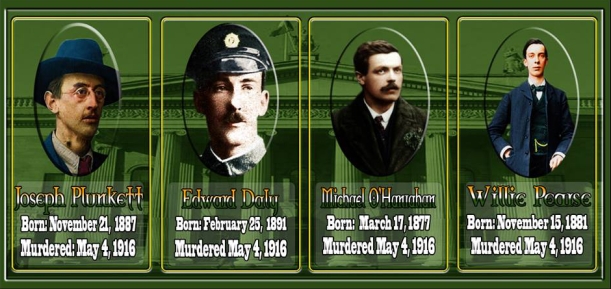
The executions of leaders and participants of the 1916 Easter Rising by the British continue as Edward Daly, Michael O’Hanrahan, Joseph Mary Plunkett, and William Pearse are executed by firing squad in the Stonebreakers Yard at Kilmainham Gaol in Dublin on May 4, 1916.

Edward Daly is born in Limerick in 1891 to a family that has a history of republican activity. His uncle, John Daly, had taken part in the rebellion of 1867. Edward Daly leads the First Battalion during the 1916 Easter Rising, which raids the Bridewell and Linenhall Barracks, eventually seizing control of the Four Courts. A close friend of Tom Clarke, their ties are made even stronger by the marriage of Clarke to Daly’s sister.

Michael O’Hanrahan is born in Wexford in 1877. As a young man, O’Hanrahan shows great promise as a writer, becoming heavily involved in the promotion of the Irish language. He founds the first Carlow branch of the Gaelic League, and publishes two novels, A Swordsman of the Brigade and When the Norman Came. Like many of the other executed leaders, he joins the Irish Volunteers from their inception and is second in command to Thomas MacDonagh at Jacob’s Biscuit Factory during the Rising, although this position is largely usurped by the arrival of John MacBride.

Joseph Mary Plunkett is born in Dublin in 1887, the son of a papal count. Plunkett is initially educated in England, though he returns to Ireland and graduates from University College Dublin in 1909. After his graduation, Plunkett spends two years traveling due to ill health, returning to Dublin in 1911. Plunkett shares Thomas MacDonagh’s enthusiasm for literature and is an editor of the Irish Review. Along with MacDonagh and Edward Martyn, he helps to establish an Irish national theatre. He joins the Irish Volunteers in 1913, subsequently gaining membership of the Irish Republican Brotherhood in 1914. Plunkett travels to Germany to meet Roger Casement in 1915. During the planning of the Rising, Plunkett is appointed Director of Military Operations, with overall responsibility for military strategy. Plunkett is stationed in the General Post Office during the Rising. Seven hours prior to his execution, Plunkett marries his sweetheart, Grace Gifford, in the prison chapel.

William “Willie” Pearse, the younger brother of Patrick, is born in Dublin in 1881. Willie shares his brother’s passion for an independent Ireland. He assists Patrick in running St. Enda’s School. The two brothers are extremely close and fight alongside each other in the General Post Office. He is not one of the planners of the revolt, nor is he one of its commanders. Willie is merely one of the soldiers involved with the Dublin actions. No other participant in Dublin whose actions or responsibilities are similar to Willie’s is executed in the days following the Rising, save perhaps John MacBride, whose earlier service with the Boers probably marks him for death. It seems likely that the sole reason Willie is executed by the British government is for the crime of being Patrick’s brother. It is repugnant British excesses such as this that soon reverse the Irish people’s initially negative opinion of the 1916 Easter Rising.


Leave a comment

Executions of Patrick Pearse, Thomas Clarke, & Thomas MacDonagh

pearse-clarke-mac-donagh

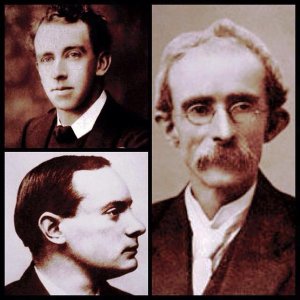
Patrick Pearse, Thomas Clarke, and Thomas MacDonagh are executed by firing squad in the Stonebreakers’ Yard at Kilmainham Gaol in Dublin on May 3, 1916. Pearse, Clarke, and MacDonagh are three of the seven signatories of the Proclamation of the Irish Republic.

Just three days after the end of the 1916 Easter Rising, the first military courts martial sits on May 2, 1916. Pearse, Clarke, and MacDonagh are immediately sentence to death. The three are taken that evening to the disused Kilmainham Gaol and are shot at dawn the following morning.

Patrick Pearse is born in Dublin in 1879, becoming interested in Irish cultural matters in his teenage years. In 1898, Pearse becomes a member of the Executive Commmittee of the Gaelic League. He graduates from the Royal University of Ireland in 1901 with a degree in Arts and Law. Pearse’s literary output is constant, and he publishes extensively in both Irish and English, becoming the editor of An Claidheamh Soluis, the newspaper of the Gaelic League. He is a keen believer in the value of education, and establishes two schools, Coláiste Éanna and Coláiste Íde, devoted to the education of Irish children through the Irish language.  Pearse is one of the founding members of the Irish Volunteers and the author of the Proclamation of the Irish Republic. He is Commander in Chief of the Irish forces and headquartered in the General Post Office (GPO) during the 1916 Easter Rising.

Thomas Clarke is born on the Isle of Wight in 1857, the son of a soldier in the British army. During his time in America as a young man, he joins Clan na Gael, later enduring fifteen years (1883-1898) of penal servitude for his role in a bombing campaign in London. In 1907, having returned from a second sojourn in America, his links with Clan na Gael in America copper-fastens his importance to the revolutionary movement in Ireland. He holds the post of Treasurer to the Irish Republican Brotherhood (IRB) and is a member of the Supreme Council from 1915. Clarke is the first signatory of the Proclamation of the Irish Republic through deference to his seniority. Clarke is also stationed at the GPO during Easter Week. Clarke tells his wife during his final night that he is relieved he is going to be executed because his greatest dread is that he would be sent back to prison.

Thomas MacDonagh is a native of Tipperary, born in 1878. He spends the early part of his career as a teacher. He moves to Dublin to study and is the first teacher on the staff at St. Enda’s School, the school he helps to found with Patrick Pearse. MacDonagh is well versed in literature, his enthusiasm and erudition earning him a position in the English department at University College Dublin. His play When the Dawn is Come is produced at the Abbey Theatre. He is appointed director of training for the Irish Volunteers in 1914, later joining the Irish Republican Brotherhood (IRB). MacDonagh is appointed to the IRB military committee in 1916. He is commander of the Second Battalion of Volunteers that occupies Jacob’s Biscuit Factory and surrounding houses during the Rising.

Immediately after the executions, Irish Parliamentary Party leader John Redmond warns British Prime Minister Herbert Asquith that “if any more executions take place in Ireland the position will become impossible for any constitutional party or leader.”

Asquith himself warns Sir John Maxwell that “anything like a large number of executions would…sow the seeds of lasting trouble in Ireland.”

These warnings fall upon deaf ears as thirteen additional executions take place in the following days.


Leave a comment

Birth of Sculptor John Edward Jones

john-edward-jones-busts

John Edward Jones, noted Irish civil engineer and sculptor in Dublin and London, is born in Dublin on May 2, 1806.

Jones is the son of miniature painter Edward Jones. Under the identity of “J. Jones,” architect, 7 Amiens Street, North Strand, Dublin, he exhibits several watercolors at the Royal Hibernian Academy in 1828 and 1829, including his View of the Town of Youghall, showing the proposed Chain Bridge (1828) and Design for a Viaduct (1829). He studies engineering under Alexander Nimmo and works for him on major engineering projects in Ireland including the building of the bridge at Waterford from 1829-1832, which he directs. He is listed as a civil engineer in Wilson’s Dublin Directory for the years 1833-35 with an office address at the Commercial Buildings, Dame Street. In 1839, he is awarded a Telford Medal in silver and 20 guineas for his paper and drawings on the sewage in Westminster.

In 1840, Jones ceases his engineering practice to become a sculptor in London, with considerable success, particularly in portrait busts of notables. Among his sitters are Queen Victoria, Albert, Prince Consort, Louis-Philippe, Napoleon III, the Duke of Cambridge, the Duke of Wellington, Lord Brougham, the Earl of Clarendon, Lord Palmerston, Daniel O’Connell, and Lord Gough. Among his few full-length statues is one of Sir R. Ferguson at Londonderry. He exhibits at the Royal Academy of Arts from 1854-1862.

Jones dies on July 25, 1862, while visiting Finglas, near Dublin, and is buried in Mount Jerome Cemetery.