seamus dubhghaill

Promoting Irish Culture and History from Little Rock, Arkansas, USA


Leave a comment

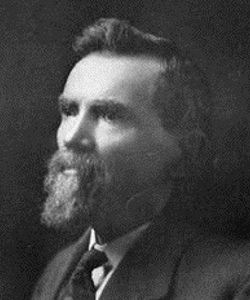
Birth of William Edward Hartpole Lecky, Historian & Theorist

William Edward Hartpole Lecky, Irish historian and political theorist, is born at Newtown Park, near Dublin, on March 26, 1838. His major work is an eight-volume History of England during the Eighteenth Century.

Lecky is educated at Kingstown, Armagh, at Cheltenham College, and at Trinity College, Dublin, where he graduates BA in 1859 and MA in 1863, and where he studies divinity with a view of becoming a priest in the Church of Ireland.

In 1860, Lecky publishes anonymously a small book entitled The Religious Tendencies of the Age, but upon leaving college he turns to historiography. In 1861 he publishes Leaders of Public Opinion in Ireland, containing brief sketches of Jonathan SwiftHenry FloodHenry Grattan, and Daniel O’Connell, originally anonymous and republished in 1871. The essay on Swift, rewritten and amplified, appears again in 1897 as an introduction to an edition of Swift’s works. Two surveys follow: A History of the Rise and Influence of Rationalism in Europe (2 vols., 1865), and A History of European Morals from Augustus to Charlemagne (2 vols., 1869). The latter arouses criticism, with its opening dissertation on “the natural history of morals.”

Lecky then concentrates on his major work, A History of England during the Eighteenth Century, Vols. i. and ii. which appear in 1878, and Vols. vii. and viii., which complete the work, in 1890. In the “cabinet” edition of 1892, in twelve volumes, A History of Ireland in the Eighteenth Century is separated out.

A volume of Poems (1891) is less successful. In 1896, he publishes two volumes entitled Democracy and Liberty, in which he considers modern democracy. The pessimistic conclusions at which he arrives provoked criticism both in the UK and the United States, which is renewed when he publishes in a new edition (1899) his low estimate of William Ewart Gladstone, then recently dead.

In The Map of Life (1899) Lecky discusses in a popular style ethical problems of everyday life. In 1903 he publishes a revised and enlarged edition of Leaders of Public Opinion in Ireland, in two volumes, with the essay on Swift omitted and that on O’Connell expanded into a complete biography. A critic of the methods by which the Act of Union is passed, Lecky, who grew up as a moderate Liberal, is opposed to Gladstone’s policy of Home Rule and, in 1895, he is returned to parliament as Unionist member for University of Dublin constituency in a by-election. In 1897, he is made a privy councillor, and among the coronation honours in 1902, he is nominated an original member of the new Order of Merit.

William Edward Hartpole Lecky dies in London on October 22, 1903.

Leave a comment

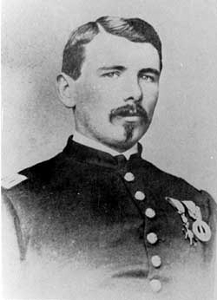
Birth of Myles Walter Keogh, Last Man Killed at the Battle of Little Big Horn

Myles Walter Keogh, soldier in the United States Army, is born in Orchard House in LeighlinbridgeCounty Carlow, on March 25, 1840. It is said by the Sioux that he is the last man killed at the Battle of Little Big Horn, where his horse is the only U.S. survivor.

Keogh attends the National School in Leighlinbridge and is long thought to have attended St. Patrick’s College in Carlow but that college has no record of his attendance. It is possible that he attends St. Mary’s Knockbeg College.

By 1860, a twenty-year-old Keogh volunteers, along with over one thousand of his countrymen, to rally to the defence of Pope Pius IX following a call to arms by the Catholic clergy in Ireland. By August 1860, Keogh is appointed second lieutenant of his unit in the Battalion of St. Patrick, Papal Army under the command of General Christophe Léon Louis Juchault de Lamoricière. Once the fighting is over and duties of the Pontifical Swiss Guard become more mundane, Keogh sees little purpose in remaining in Rome. In March 1862, with civil war raging in America, he resigns his commission in the Company of St. Patrick and sets out for New York City, arriving on April 2.

Keogh actively participates in several prominent American Civil War battles including the Shenandoah Valley, the Battle of Antietam, the Battle of Fredericksburg, and the Battle of Gettysburg.

Perhaps the strongest testimony to Keogh’s bravery and leadership ability comes at the Battle of the Little Bighorn, also known as Custer’s Last Stand, on June 25, 1876. The senior captain among the five companies wiped out with General George Armstrong Custer that day, and commanding one of two squadrons within the Custer detachment, Keogh dies in a “last stand” of his own, surrounded by the men of Company I. When the sun-blackened and dismembered dead are buried three days later, Keogh’s body is found at the center of a group of troopers. The slain officer is stripped but not mutilated, perhaps because of the “medicine” the Indians see in the Agnus Dei (“Lamb of God”) he wears on a chain about his neck or because many of Sitting Bull‘s warriors are believed to be Catholic. Keogh’s left knee has been shattered by a bullet that corresponds to a wound through the chest and flank of his horse, indicating that horse and rider may have fallen together prior to the last rally.

The badly injured animal is found on the fatal battlefield, and nursed back to health as the 7th Cavalry’s regimental mascot, which he remains until his death in 1890. This horse, Comanche, is considered the only U.S. military survivor of the battle, though several other badly wounded horses are found and destroyed at the scene. Keogh’s bloody gauntlet and the guidon of his Company I are recovered by the army three months after Little Bighorn at the Battle of Slim Buttes.

Originally buried on the battlefield, Keogh’s remains are disinterred and taken to Auburn, as he had requested in his will. He is buried at Fort Hill Cemetery on October 26, 1877, an occasion marked by citywide official mourning and an impressive military procession to the cemetery.

Tongue River Cantonment in southeastern Montana is renamed after him to be Fort Keogh. The fort is first commanded by Nelson A. Miles. The 55,000-acre fort is today an agricultural experiment station. Miles City, Montana is located two miles from the old fort.


Leave a comment

The Crash of Aer Lingus Flight 712

Aer Lingus Flight 712 crashes enroute from Cork to London on March 24, 1968 killing all 61 passengers and crew. The aircraft, a Vickers Viscount 803 named “St. Phelim,” crashes into the sea off Tuskar RockCounty Wexford. Although the investigation into the crash lasts two years, a cause is never determined. There has long been popular speculation that the aircraft was shot down by a British experimental missile. Aberporth in west Wales is at the time the most advanced British missile testing station.

The flight leaves Cork Airport at 10:32 AM for London. The flight proceeds normally until a call is heard with the probable contents “twelve thousand feet descending spinning rapidly.” There is no further communications with the aircraft and London ATC informs Shannon ATC that they have no radio contact with EI-AOM. London ATC requests Aer Lingus Flight EI 362, flying a Dublin to Bristol route, to search west of Strumble. This search at 500 feet in good visibility turns up nothing. At 11:25 AM a full alert is declared. By 12:36 PM there is a report of wreckage sighted at position 51°57′N, 06°10′W. Searching aircraft, however, find nothing and the report is cancelled. Aircraft and ships from the UK resume the search the following day and wreckage is sighted and bodies are recovered 6 nautical miles northeast of Tuskar Rock with more wreckage scattered an additional 6 nautical miles to the northwest.

Thirteen bodies are recovered over the next few days. Another body is recovered later. The main wreckage is located on the sea bed by trawling 1.72 nautical miles from Tuskar Rock at 39 fathoms.

In the years since the crash several witnesses have come forward with evidence to support the missile theory, including a crew member of the British ship HMS Penelope. He alleges that part of the wreckage was recovered by Penelope and removed to the UK.

An investigation report is produced in 1970, a review is undertaken between 1998 and 2000, and an independent study is commissioned in 2000.

However, in 2002 a review process conducted by the Air Accident Investigation Unit (AAIU) discloses that Aer Lingus paperwork relating to a routine maintenance inspection carried out on the aircraft in December 1967 is found to be missing in 1968. Moreover, a large body of research is done by the investigators after the accident, regarding the maintenance operating plan used for EI-AOM and defects on the aircraft found during analysis of the maintenance records. This research is not referred to in the 1970 report. A new board of investigation is set up by the Irish Government and finds that the crash is the consequence of a chain of events starting with a failure to the left tail-plane caused by metal fatigue, corrosion, flutter, or a bird strike, with the most likely cause being a flutter-induced fatigue failure of the elevator trim tab operating mechanism.

In March 2007 retired RAF Squadron Leader Eric Evers, who is previously chief flying instructor with the British military in RAF Little Rissington, makes a claim that the accident is in fact caused by a mid-air collision between the Aer Lingus Vickers Viscount and a French-built  Fouga Magister military aircraft which is training with the Irish Air Corps. Evers maintains that both the French and Irish authorities colluded in a subsequent cover-up, and the Magister wreckage may still be on the seabed. Evers claims have been largely disputed.

Aer Lingus still uses this flight number for a daily flight from Cork to London’s Heathrow Airport, contrary to airline convention of discontinuing a flight number following a crash. The route is operated with an aircraft from the Airbus A320 family.


Leave a comment

Birth of Merchant & Politician John Thomas Browne

John Thomas Browne, Irish-born merchant and politician, is born in BallylandersCounty Limerick, on March 23, 1845. He serves on the Houston City Council, serves two terms as Mayor of Houston, and serves three terms in the Texas House of Representatives.

Browne’s family emigrates to the United States in October 1851. His father dies not long after they arrive in New Orleans. In 1852, his mother relocates with her five children to HoustonTexas, to be closer to the family of her mother. Browne spends much of the 1850s on Spann Plantation in Washington County, Texas, at the behest of Father Gunnard, where he also receives an education. At age fourteen in 1859, he leaves the plantation and finds work hauling bricks in Madison County, Texas. He returns to Houston to first work as a baggage hauler, then performs messenger duties for Commercial and Southwestern Express Company before settling in at the Houston and Texas Central Railroad.

Browne joins the Confederacy, officially serving in Company A, 36 Texas Cavalry. He serves in Houston, detached from his unit, maintaining employment with the Houston and Texas Central Railroad, but in a new capacity as a fireman. He is briefly dispatched to the defense of Galveston, Texas. He is officially released from military duty in Houston on June 27, 1865.

Browne returns to messenger service in Houston after the Civil War. He works for Adams Express Company, then for Southern Express Company. He transitions into the grocery business first as a bookkeeper and clerk for H.P. Levy. Browne marries Mary Jane “Mollie” Bergin on September 13, 1871. They are the first marriage to be recorded at Annunciation Catholic Church. In 1872, Browne and Charles Bollfrass start a business as wholesale and retail grocers with $500 in capital. By the early 1890s, this grocery is amassing about $340,000 in annual sales. He is also a member of the Ancient Order of Hibernians and the Knights of Columbus.

Browne is elected to the Houston City Council, representing the Fifth Ward while chairing the Finance Committee in 1887. He runs for Mayor of Houston in 1892 and wins in a landslide. Browne’s first term as Mayor of Houston begins the same year as the Panic of 1893. He has campaigned on a platform of balancing the budget. The City of Houston runs budget deficits during Browne’s first term, but these deficits are proportionately lower than those in previous years. Browne had been an advocate for lowering municipal utility bills through municipal ownership of the utilities, however estimates for the City of Houston to build its own waterworks and electrical power plant go up to a range $500,000 to $900,000. Browne abandons this option while favoring a policy of dedicating all capital spending on street paving and sewerage. The Browne administration also hires a city planning expert to study demands based hypothetically on a population of 75,000.

Mayor Browne proposes converting the Houston Volunteer Firefighters to a professional department under municipal management. The City of Houston would have to buy existing equipment and horses from the volunteer department, but could lease firehouses and not be required to buy them. Houston City Council drafts an ordinance and passes it.

In April 1895, the Texas Supreme Court ruling in Higgins v. Bordages, “held that special assessment tax liens were unenforceable against urban homesteads.” The City of Houston imposes special tax levies for road and sewerage projects on owners of property abutting the sections of street being improved. The ruling effectively removes the only tool the city has for enforcing payment of the special assessments by homeowners. Road construction contractors stop all work because they fear the city will not pay them. Many homeowners stop paying their assessment bills.

To meet this immediate revenue crisis, the Browne administration devises a plan to issue $500,000 in municipal bonds to be sold over a three to four year period. The Labor Council opposes the bonding measure and organizes to defeat the measure when the referendum makes it to the ballot. The City of Houston has to find another way to compensate for $300,000 in uncollected taxes.

Browne represents Houston in the Texas House of Representatives from 1897 to 1899, and again in 1907.

John Thomas Browne dies August 19, 1941 died of pneumonia in Houston and is buried at Glenwood Cemetery.


Leave a comment

Birth of Artist Sarah Henrietta Purser

Sarah Henrietta Purser, Irish artist mainly noted for her work with stained-glass, is born on March 22, 1848, in Kingstown (now Dún Laoghaire) in County Dublin, and raised in DungarvanCounty Waterford. She is educated in Switzerland and afterwards studies at the Metropolitan School of Art in Dublin and in Paris at the Académie Julian.

Purser works mostly as a portraitist. She is also associated with the stained-glass movement, founding a stained-glass workshop, An Túr Gloine, in 1903. Some of her stained-glass work is commissioned from as far as New York City, including a window at Christ Church, Pelham dedicated to the memory of Katharine Temple Emmet and Richard Stockton Emmet, grandson of the Irish patriot, Thomas Addis Emmet. Through her talent and energy and owing to her friendship with the Gore-Booths, she is very successful in obtaining commissions, famously commenting, “I went through the British aristocracy like the measles.”

In 1977 Bruce Arnold noted, “some of her finest and most sensitive work was not strictly portraiture, for example, An Irish Idyll in the Ulster Museum, and Le Petit Déjeuner (in the National Gallery of Ireland).”

Sarah Purser becomes wealthy through astute investments, particularly in Guinness. She is very active in the art world in Dublin and is involved in the setting up of the Hugh Lane Municipal Gallery, persuading the Irish government to provide Charlemont House to house the gallery. In 1923 she becomes the first female member of the Royal Hibernian Academy.

Until her death she lives for years in Mespil House, a Georgian mansion with beautiful plaster ceilings on Mespil Road, on the banks of the Grand Canal. After her death in Dublin on August 7, 1943, it is demolished and is developed into apartments. She is buried in Mount Jerome Cemetery in Dublin.


Leave a comment

Birth of Physician & Writer William James MacNeven

William James MacNeven, Irish American physician and writer, is born on March 21, 1763, at Ballynahowna, near Aughrim, County Galway. One of the oldest obelisks in New York City is dedicated to him at St. Paul’s Chapel on Broadway while a second obelisk is dedicated to Thomas Emmet, a fellow United Irishman and Attorney General of New York. MacNeven’s monument features a lengthy inscription in Irish, one of the oldest existent dedications of this kind in the Americas.

The eldest of four sons, at the age of 12 MacNeven is sent by his uncle Baron MacNeven to receive his education abroad, for the penal laws render education impossible for Catholics in Ireland. This Baron MacNeven is William O’Kelly MacNeven, an Irish exile physician, who for his medical skill in her service has been created an Austrian noble by the Empress Maria Theresa. Young MacNeven makes his collegiate studies at Prague. His medical studies are made at Vienna where he is a pupil of Pestel and takes his degree in 1784. The same year he returns to Dublin to practise.

MacNeven becomes involved in the United Irishmen of the time, with such men as Lord Edward FitzGeraldThomas Addis Emmet, and his brother Robert Emmet. He is arrested in March 1798, and confined in Kilmainham Gaol, and afterwards in Fort George, Scotland, until 1802, when he is liberated and exiled. In 1803, he is in Paris seeking an interview with Napoleon Bonaparte in order to obtain French troops for Ireland. Disappointed in his mission, MacNeven comes to America, landing at New York on July 4, 1805.

In 1807, MacNeven delivers a course of lectures on clinical medicine in the recently established College of Physicians and Surgeons. Here in 1808, he receives the appointment of professor of midwifery. In 1810, at the reorganization of the school, he becomes the professor of chemistry, and in 1816 is appointed in addition to the chair of materia medica. In 1826 with six of his colleagues, he resigns his professorship because of a misunderstanding with the New York Board of Regents and accepts the chair of materia medica in Rutgers Medical College, a branch of the New Jersey institution of that name, established in New York as a rival to the College of Physicians and Surgeons. The school at once becomes popular because of its faculty, but after four years is closed by legislative enactment on account of interstate difficulties. The attempt to create a school independent of the regents results in a reorganization of the University of the State of New York.

MacNeven’s best known contribution to science is his “Exposition of the Atomic Theory” (New York, 1820), which is reprinted in the French Annales de Chimie. In 1821 he publishes with emendations an edition of Brande’s “Chemistry” (New York, 1829). Some of his purely literary works, his “Rambles through Switzerland” (Dublin, 1803), his “Pieces of Irish History” (New York, 1807), and his numerous political tracts attract wide attention. He is co-editor for many years of the “New York Medical and Philosophical Journal.”

William James MacNeven dies on July 13, 1841, at the age of 78 in New York City.


4 Comments

Birth of Cairbre, the Original MGM Lion

Cairbre, the original Leo the Lion mascot for the Hollywood film studio Metro-Goldwyn-Mayer (MGM), is born at the Dublin Zoo on March 20, 1919.

Cairbre is renamed Slats and is trained by Volney Phifer. Slats is used on all black-and-white MGM films between 1924 and 1928. The original logo is designed by Howard Dietz and used by the Goldwyn Pictures Corporation studio from 1916 to 1924. Goldwyn Pictures is ultimately absorbed into the partnership that forms MGM, and the first MGM film that uses the logo is He Who Gets Slapped (1924). Dietz states that he decided to use a lion as the company’s mascot as a tribute to his alma mater Columbia University, whose athletic teams’ nickname is The Lions. He further adds that Columbia’s fight song, “Roar, Lion, Roar“, inspired him to make the lion roar.

Ironically, unlike his successors, Slats does nothing but look around in the logo making him the only MGM lion not to roar, although it is rumored that Volney Phifer trains the lion to growl on cue, despite the fact that synchronized sound is not officially used in motion pictures until 1927.

Slats dies in 1936.


Leave a comment

Birth of William Allingham, Poet, Diarist, & Editor

William Allingham, Irish poet, diarist, and editor, is born on March 19, 1824, in the little port of BallyshannonCounty Donegal. He writes several volumes of lyric verse, and his poem “The Faeries” is much anthologised. However, he is better known for his posthumously published Diary, in which he records his lively encounters with Alfred TennysonThomas Carlyle, and other writers and artists. His wife, Helen Allingham, is a well-known watercolorist and illustrator.

Allingham is the son of the manager of a local bank who is of English descent. His younger brothers and sisters are Catherine (b. 1826), John (b. 1827), Jane (b. 1829), Edward (b. 1831; who lived only a few months), and a still-born brother (b. 1833). During his childhood his parents move twice within the town, where the boy enjoys the country sights and gardens, learns to paint, and listens to his mother’s piano playing. His mother dies when he is nine years old.

Allingham obtains a post in the custom house of his native town, and holds several similar posts in Ireland and England until 1870. It is during this period that Poems (1850), which includes his well-known poem “The Fairies,” and Day and Night Songs (1855) are published.  Lawrence Bloomfield in Ireland, his most ambitious though not his most successful work, a narrative poem illustrative of Irish social questions, appears in 1864. He also edits The Ballad Book for the Golden Treasury series in 1864, and Fifty Modern Poems in 1865.

In April 1870, Allingham retires from the customs service, moves to London and becomes sub-editor of Fraser’s Magazine, eventually becoming editor in succession to James Anthony Froude in June 1874, a post he holds until 1879. On August 22, 1874 he marries the illustrator, Helen Paterson, who is twenty-four years younger than him. His wife gives up her work as an illustrator and becomes well known under her married name as a water-colour painter. At first the couple lives in London, at 12 Trafalgar Square, Chelsea, near Allingham’s friend, Thomas Carlyle, and it is there that they have their first two children – Gerald Carlyle (b. November 1875) and Eva Margaret (b. February 1877). Allingham’s Songs, Poems and Ballads is published in 1877. In 1881, after the death of Carlyle, the Allinghams move to Sandhills near Witley in Surrey, where their third child, Henry William, is born in 1882. At this period Allingham publishes Evil May Day (1883), Blackberries (1884), and Irish Songs and Poems (1887).

In 1888, because of William’s declining health, they move back to the capital, to the heights of Hampstead village. However, on November 18, 1889, William Allingham dies at Hampstead. According to his wishes he is cremated. His ashes are interred at St. Anne’s church in his native Ballyshannon.

Posthumously Allingham’s Varieties in Prose is published in 1893. William Allingham A Diary, edited by Mrs. Helen Allingham and D. Radford, is published in 1907. It contains Allingham’s reminiscences of Alfred Tennyson, Thomas Carlyle, and other writers and artists.


Leave a comment

Birth of Snooker Champion Alex “Hurricane” Higgins

Alexander Gordon “Alex” Higgins, Northern Irish professional snooker player, who is remembered as one of the most iconic figures in the game, is born in Belfast on March 18, 1949. He is nicknamed “Hurricane Higgins” because of his fast play.

Higgins starts playing snooker at the age of eleven, often in the Jampot club in his native Sandy Row area of south Belfast and later in the YMCA in the nearby city centre. At age fourteen and weighing seven and a half stone (47.6 kg), he leaves for England and a career as a jockey. However, he never makes the grade because, in his youth, he drinks a lot of Guinness and eats a lot of chocolate, making him too heavy to ride competitively. He returns to Belfast and by 1965, at the age of sixteen, he has compiled his first maximum break. In 1968 he wins the All-Ireland and Northern Ireland Amateur Snooker Championships.

Higgins turns professional at the age of 22, winning the World Snooker Championship at his first attempt in 1972, against John Spencer winning 37–32. Higgins is then the youngest ever winner of the title, a record retained until Stephen Hendry‘s 1990 victory at the age of 21. In April 1976, Higgins reaches the final again and faces Ray Reardon. Higgins leads 11–9, but Reardon makes four centuries and seven breaks over 60 to pull away and win the title for the fifth time with the score of 27–16. Higgins is also the runner-up to Cliff Thorburn in 1980, losing 18–16, after being 9–5 up. Higgins wins the world title for a second time in 1982 after beating Reardon 18–15 (with a 135 total clearance in the final frame). It was an emotional as well as professional victory for him. Higgins would have been ranked No. 1 in the world rankings for the 1982-1983 season had he not forfeited ranking points following disciplinary action.

Throughout his career, Higgins wins 20 other titles, one of the most notable being the 1983 UK Championship. In the final he trails Steve Davis 0–7 before producing a famous comeback to win 16–15. He also wins the Masters twice, in 1978 and in 1981, beating Cliff Thorburn and Terry Griffiths in the finals respectively. Another notable victory is his final professional triumph in the 1989 Irish Masters at the age of 40 when he defeats a young Stephen Hendry, which becomes known as “The Hurricane’s Last Hurrah.”

Higgins comes to be known as the “People’s Champion” because of his popularity, and is often credited with having brought the game of snooker to a wider audience, contributing to its peak in popularity in the 1980s. He has a reputation as an unpredictable and difficult character. He is a heavy smoker, struggles with drinking and gambling, and admits to using cocaine and marijuana.

First diagnosed with throat cancer in 1998, Higgins is found dead in bed in his flat on July 24, 2010. The cause of death is a combination of malnutritionpneumonia, and a bronchial condition. Higgins’ funeral service is held in Belfast on August 2, 2010. He is cremated and his ashes are interred in Carnmoney Cemetery in NewtownabbeyCounty Antrim.


Leave a comment

Founding of the Ossianic Society

The Ossianic Society, an Irish literary society, is founded in Dublin on Saint Patrick’s Day 1853, taking its name from the poetic material associated with the ancient narrator Oisín.

Founding members include John O’Daly, William Elliot Hudson, John Edward PigotOwen ConnellanJohn Windele, and William Smith O’Brien. The antiquary Standish Hayes O’Grady is a principal member and later becomes its president. By 1860 the list of subscribers numbers 746, six volumes of Transactions are produced, and the preparations for further issues are extant when it ceases operations in 1863.

The group of Irish scholars emerge from competing societies, such as the Celtic Society and the Irish Archaeological Society, focusing on the translation of Irish literature from the “Fenian period of Irish history,” specifically, the mythological works of Oisín and the Fianna, and the promotion of the Irish language. The manifesto stipulates the membership be entirely composed of Irish scholars, the intent being to distinguish itself from similar societies that cater to Anglo-Irish interests and influence. Though such societies have credible scholars as steering members, the work produced is thought to be influenced by the local ascendancy and their royal (English) patrons.

The correspondence of members of the Society reveals a fractious relationship with other important figures of the time, Eugene O’Curry and those of the Royal Irish Academy, and are often frustrated in their attempts to access early manuscripts.