seamus dubhghaill

Promoting Irish Culture and History from Little Rock, Arkansas, USA


Leave a comment

The Headford Ambush

headford-ambush

The Headford Ambush is carried out by the Irish Republican Army (IRA) on March 21, 1921, during the Irish War of Independence. The battle lasts almost an hour and fourteen people are killed – nine British soldiers, two IRA volunteers and three civilians.

The guerrilla war in County Kerry escalates rapidly in the spring of 1921. The county is occupied by the British Army, Auxiliary Division and Black and Tans paramilitary police, as well as the Royal Irish Constabulary (RIC). For the previous several months they have been burning suspected Republicans’ property and shooting suspected IRA sympathisers. By early 1921, they have begun rounding up male inhabitants of nearby towns and villages and searching for IRA suspects.

On January 23, in response to the IRA’s assassination of RIC District Inspector Sullivan, 1,000 soldiers and armed police surround Ballymacelligott, arrest 240 men and march them to Tralee for questioning. British forces, especially the Auxiliaries, also carry out a number of reprisal shootings of local civilians. The IRA sets up full-time guerrilla units, known as flying columns, to avoid arrest and to assemble units capable of taking on British patrols. IRA GHQ in Dublin also sends an organizer, Andy Cooney, to Kerry to oversee the setting up of flying columns. On March 2, under Cooney’s direction, the 2nd Kerry Brigade sets up its own flying column under Dan Allman and Tom McEllistrim. On March 5, McEllistrim leads 20 volunteers from the column to a successful ambush at Clonbanin, in which they co-operate with Cork IRA units, killing four British soldiers including Brigadier General Hanway Robert Cumming. Buoyed by their success in Cork, the 2nd Kerry Brigade tries on a number of occasions to ambush British forces in Kerry itself.

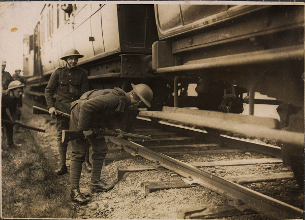
On March 21, an IRA party of the 2nd Kerry Brigade is billeted about four miles from the Headford railway junction when they hear that British troops are returning by train from Kenmare to Tralee. As the train does not go directly to Tralee, the British have to change trains at Headford, making them vulnerable to ambush. Allman, commanding 30 volunteers, reaches the junction only 12 minutes before the train, which is carrying 30 soldiers of the 1st Royal Fusiliers. The railway staff just has time to flee before the train pulls into the platform, where its passengers have to change trains for Tralee. Alongside the soldiers, the train is packed with cattle and pig farmers on their way back from the market in Kenmare. Most of the civilians have already got off when the British soldiers begin to disembark. Allman himself tries to disarm a Fusilier but shoots him when he resists. This is the signal for the IRA to open fire on the British troops.

One of the first British casualties is Lieutenant CE Adams DCM, who is shot dead when he appears at the carriage door, as are several other soldiers who are standing in front of the engine. The surviving British troops open fire from the train while those who have got off scramble underneath it for cover. In the ensuing close-quarter firefight, conducted at a range of just 20 yards, three civilians and two IRA volunteers, including Allman, are killed. Two-thirds of the British force is estimated to have been killed or wounded. Most of those killed are hit in the initial firing. Afterwards, the IRA gunmen have no direct field of fire into the troops who are hidden under the train.

MacEllistrim calls on the survivors to surrender and when they refuse, the IRA begins to move in to finish off those who keep shooting by throwing hand grenades under the train. Just as they are doing so, another train pulls into the junction carrying another party of British troops. The IRA column has used most of its ammunition and is forced to retreat, escaping toward the hills in the south.

(Pictured: British soldiers searching a train in County Kerry, 1921)


Leave a comment

The Assassination of Tomás Mac Curtain

Tomas-mac-curtain

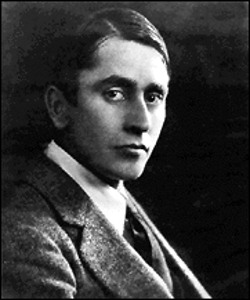
Tomás Mac Curtain, Sinn Féin Lord Mayor of Cork, is assassinated in Cork, County Cork on March 20, 1920, which is also his 36th birthday.

Thomas Curtin is born at Ballyknockane, Mourne Abbey, County Cork, on March 20, 1884, the son of Patrick Curtin, a farmer, and Julia Sheehan. He attends Burnfort National School. In 1897 the family moves to Cork City, where he attends the North Monastery school.

Mac Curtain, as he later becomes known, is active in a number of cultural and political movements beginning around the turn of the 20th century. He joins the Blackpool, Cork branch of Conradh na Gaeilge, becoming its secretary in 1902. He has interests in music, poetry, history, archaeology and Irish history. He works in his early career as a clerk, and in his free time teaches Irish. In 1911 he joins Fianna Éireann and is a member of the Irish Volunteers.

He meets Elizabeth Walsh (Eibhlís Breathnach) at a Gaelic League meeting, and they marry on June 28, 1908. They have six children, five of whom survive into adulthood. The family lives over 40 Thomas Davis Street, where Mac Curtain runs a small clothing and rainwear factory.

In April 1916, at the outset of the Easter Rising, Mac Curtain commands a force of up to 1,000 men of the Irish Volunteers who assemble at various locations around County Cork. From the volunteer’s headquarters at Sheares Street in the city, Mac Curtain and his officers await orders from the volunteer leadership in Dublin, but conflicting instructions and confusion prevail and as a result the Cork volunteers never enter the fray. A tense stand-off develops when British forces surround the volunteer hall and continued for a week until a negotiated agreement leads to the surrender of the volunteers’ arms to the then Lord Mayor of Cork Thomas Butterfield on the understanding that they will be returned at a later date. This does not happen however, and Mac Curtain is jailed in Wakefield Prison, in the Frongoch internment camp in Wales, and in Reading Gaol. After the general amnesty of participants in the Rising 18 months later, Mac Curtain returns to active duty as a Commandant of what is now the Irish Republican Army.

By 1918 Mac Curtain is a brigade commander, the highest and most important rank in the IRA. During the Conscription Crisis of 1918, he actively encourages the hiring of the women of Cumann na mBan to cater for Volunteers. He is personally involved with Michael CollinsSquad that, along with a Cork battalion, attempt to assassinate Lord John French, whose car is missed as the convoy passes through the ambush positions. Despite the setback he remains brigadier of No.1 Cork when he is elected Lord Mayor. He is elected in the January 1920 council elections as the Sinn Féin councillor for NW Ward No. 3 of Cork and is chosen by his fellow councillors to be the Lord Mayor. He begins a process of political reform within the city.

In January 1919, the Irish War of Independence starts, and Mac Curtain becomes an officer in the IRA. On March 20, 1920, his 36th birthday, Mac Curtain is shot dead in front of his wife and son by a group of men with blackened faces, who are found to be members of the Auxilaries along with unknown members of the Royal Irish Constabulary (RIC) by the official inquest into the event. In the wake of the killing, which is in revenge for the shooting of a policeman, Mac Curtain’s house in Blackpool is ransacked.

The killing causes widespread public outrage. The coroner’s inquest passes a verdict of willful murder against British Prime Minister David Lloyd George and against certain members of the RIC. Michael Collins later orders his squad of assassins to uncover and assassinate the police officers involved in the attack. RIC District Inspector Oswald Swanzy, who had ordered the attack, is fatally shot, with Mac Curtain’s own revolver, while leaving a Protestant church in Lisburn, County Antrim on August 22, 1920, sparking what is described by Tim Pat Coogan as a “pogrom” against the Catholic residents of the town.

Tomás Mac Curtain is buried in St. Finbarr’s Cemetery, Cork.


Leave a comment

The Crossbarry Ambush

SAMSUNG DIGITAL CAMERADuring the Irish War of Independence, Tom Barry and the West Cork Flying Column of the Irish Republican Army (IRA) rout a superior force from the Essex Regiment of the British Army at Crossbarry, County Cork on March 19, 1921.

A force of one hundred IRA members under the leadership of Barry are involved in a major skirmish with up to 1,000 British troops at Crossbarry. English intelligence has determined that Barry’s West Cork Brigade is based near Crossbarry and plans a major encirclement and assault. Poor planning and timing ensures that the British forces get separated before attacking Barry’s men. Barry is a brilliant guerrilla fighter and strategist who directs an attack against an initial force of approximately 140 men, before he orders his men to break out.

Charlie Hurley, one of the Brigade commanders who is injured during the Upton train ambush, is staying in a house with a pro-republican family, where he is recuperating from serious wounds he had received at Upton a month earlier. When he realises that he is surrounded by the British forces, he flees the house, as Tom Barry comments in his book, to reduce the danger to those in the house. He is shot dead by the pursuing troops. Barry remarks that Hurley “went to meet his death like a true Irishman.” A ballad exists that commemorates him. In addition, the Gaelic Athletic Association (GAA) grounds in Bandon, County Cork are named after him.

Reports as to casualties differ. The IRA claims that over thirty British are killed while official British figures are ten killed and six IRA men killed. Whatever the numbers, it is probably the largest single military engagement in the Irish War of Independence as the IRA knew major battles with British troops would be a disaster for them and rarely got involved in full frontal action. While the casualties may not seem that large, Crossbarry is a major morale victory for the IRA who had “defeated” a British force of over one thousand. Prime Minister David Lloyd George states that the Crossbarry and Kilmichael ambushes convinced him of the need for a truce and a treaty with the Irish rebels.

(Pictured: Crossbarry Ambush Memorial, Crossbarry, County Cork)


Leave a comment

The Funeral of Hugh Coveney

hugh-coveney

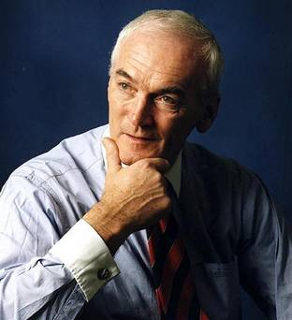
The funeral of Hugh Coveney, politician and former Lord Mayor of Cork, takes place at St. Michael’s Church in Blackrock, Cork on March 18, 1998.

Coveney is born into one of Cork‘s prosperous “merchant prince” families on July 20, 1935. He is educated at Christian Brothers College, Cork, Clongowes Wood College and the Royal Institute of Chartered Surveyors. He works as a chartered quantity surveyor before entering politics.

Coveney is interested in yachting throughout most of his adult life. His yacht Golden Apple of The Sun, designed by Cork-based designer Ron Holland, is a successful competitor in the Admiral’s Cup in the 1970s. A later 50-foot yacht, Golden Apple, is used by the family for the “Sail Chernobyl” project. The family sails around the world to raise €650,000 for Chernobyl Children’s Project International, a charity which offers assistance to children affected by the 1986 Chernobyl disaster.

Coveney is Lord Mayor of Cork from 1982 to 1983. He is first elected to Dáil Éireann as a Fine Gael Teachta Dála (TD) for Cork South–Central constituency at the 1981 general election. He loses his seat in the first general election of 1982 but regains it in the second election in the same year. He loses his seat again in the 1987 general election and does not contest the 1992 general election. He is elected to the Dáil again in 1994 in a by-election.

Coveney is first appointed to the Cabinet in 1994 under John Bruton. He is appointed Minister for Defence and Minister for the Marine. However, he is demoted to a junior ministry the following year after allegations of improper contact with businessmen.

In March 1998 it becomes publicly known that the Moriarty Tribunal has questioned Coveney about whether he had a secret offshore account with Ansbacher Bank, a bank which had become notorious for facilitating tax evasion. Ten days later, on March 13, 1998, Coveney visits his solicitor to change his will. The following day, he dies in a fall from a seaside cliff while out walking alone. His son, Simon Coveney, insists that his father had never held an Ansbacher account. It later emerges that Hugh Coveney had $175,000 on deposit in the secret Cayman Islands-based bank. The account was closed in 1979.

Simon Coveney is later elected to succeed his father in the resulting by-election on November 3, 1998.


Leave a comment

Birth of Artist & Illustrator Harry Clarke

harry-clarke

Henry Patrick (Harry) Clarke, Irish stained-glass artist and book illustrator, is born in Dublin on March 17, 1889. He is a leading figure in the Irish Arts and Crafts movement.

Clarke is the younger son and third child of Joshua Clarke and Brigid Clarke (née MacGonigal). Church decorator Joshua Clarke moves to Dublin from Leeds in 1877 and starts a decorating business, Joshua Clarke & Sons, which later incorporates a stained-glass division. Through his work with his father, Clarke is exposed to many schools of art but Art Nouveau in particular.

Clarke is educated at the Model School in Marlborough Street, Dublin and Belvedere College, which he leaves in 1905. After his mother’s death in 1903, he is apprenticed into his father’s studio and attends evening classes in the Metropolitan College of Art and Design. His The Consecration of St. Mel, Bishop of Longford, by St. Patrick wins the gold medal for stained glass work in the 1910 Board of Education National Competition. At the art school in Dublin, he meets fellow artist and teacher Margaret Crilley. They marry on October 31, 1914.

Clarke moves to London to seek work as a book illustrator. Picked up by London publisher George G. Harrap and Co., he starts with two commissions which are never completed. Difficulties with these projects makes Fairy Tales by Hans Christian Andersen his first printed work, in 1916. It includes 16 colour plates and more than 24 halftone illustrations. This is followed by illustrations for an edition of Edgar Allan Poe‘s Tales of Mystery and Imagination, the second version of which, published in 1923, makes his reputation as a book illustrator. His work can be compared to that of Aubrey Beardsley, Kay Nielsen, and Edmund Dulac. His final book, Selected Poems of Algernon Charles Swinburne, is published in 1928.

Clarke also continues to work in stained-glass, producing more than 130 windows. His glass is distinguished by the finesse of its drawing and his use of rich colours. He is especially fond of deep blues. His use of heavy lines in his black-and-white book illustrations echoes his glass techniques.

Clarke’s stained-glass work includes many religious windows, including the windows of the Honan Chapel in University College Cork. He also produces much secular stained glass such as a window illustrating John KeatsThe Eve of St. Agnes (now in the Hugh Lane Gallery in Dublin) and the Geneva Window, (now in the Wolfsonian Museum, Miami Beach, Florida). Perhaps his most seen works are the windows he creates for Bewley’s on Dublin’s Grafton Street.

Clarke is plagued with ill health, in particular respiratory problems. He is diagnosed with tuberculosis in 1929 and goes to a sanatorium in Davos, Switzerland. Fearing that he will die abroad, he begins his journey back to Dublin in 1931, but dies on this journey on January 6, 1931, in Chur where he is buried. A headstone is erected but local law requires that the family pledge to maintain the grave 15 years after the death. This is not explained to the Clarke family and Harry Clarke’s remains are disinterred in 1946 and reburied in a communal grave.


Leave a comment

Birth of William Reeves, Bishop of Down, Connor & Dromore

bishop-william-reeves

William Reeves, Irish antiquarian and the Church of Ireland Bishop of Down, Connor and Dromore from 1886 until his death, is born on March 16, 1815. He is the last private keeper of the Book of Armagh and at the time of his death is President of the Royal Irish Academy.

Reeves is born at Charleville, County Cork, the eldest child of Boles D’Arcy Reeves, an attorney, whose wife Mary is a daughter of Captain Jonathan Bruce Roberts, land agent to the Edmund Boyle, 8th Earl of Cork. This grandfather had fought at the Battle of Bunker’s Hill, and Reeves is born at his house in Charleville.

From 1823, Reeves is educated at the school of John Browne in Leeson Street, Dublin, and after that at a school kept by the Rev. Edward Geoghegan. In October 1830, he enters Trinity College, Dublin, where he quickly gains a prize for Hebrew. In his third year, he becomes a scholar and goes on to graduate BA in 1835. He proceeds to read medicine, wins the Berkeley Medal, and graduates MB in 1837. His object in taking his second degree is that he intends to become a clergyman and to practice the medical profession among the poor of his parish.

In 1838, Reeves is appointed Master of the diocesan school in Ballymena, County Antrim, and is ordained a deacon of Hillsborough, County Down. The following year, he is ordained a priest of the Church of Ireland at Derry.

In 1844, Reeves rediscovers the lost site of Nendrum Monastery when he visits Mahee Island in Strangford Lough, County Down, searching for churches recorded in 1306, and recognises the remains of a round tower. By 1845, he is corresponding with the Irish scholar John O’Donovan, and an archive of their letters between 1845 and 1860 is preserved at University College, Dublin. In July 1845, Reeves visits London.

Reeves resides in Ballymena from 1841 to 1858, when he is appointed vicar of Lusk following the success of his edition of Adomnán‘s Life of Saint Columba (1857), for which the Royal Irish Academy awards him their Cunningham Medal in 1858. In 1853, he purchases from the Brownlow family the important 9th-century manuscript known as the Book of Armagh, paying three hundred pounds for it. He sells the book for the same sum to Archbishop Beresford, who has agreed to present it to Trinity College, Dublin.

In 1875 Reeves is appointed Dean of Armagh, a position he holds until 1886 when he is appointed as Bishop of Down, Connor and Dromore. In 1891 he is elected as President of the Royal Irish Academy. As bishop, he resides at Conway House, Dunmurry, County Antrim, and signs his name “Wm. Down and Connor.”

William Reeves dies in Dublin on January 12, 1892, while still President of the Academy. At the time of his death, he is working on a diplomatic edition of the Book of Armagh, by then in the Trinity College Library. The work is completed by Dr. John Gwynn and published in 1913.


Leave a comment

First Performance of “She Stoops to Conquer”

she-stoops-to-conquer

She Stoops to Conquer, a comedy by the Anglo-Irish author Oliver Goldsmith, is first performed at Covent Garden Theatre, London on March 15, 1773, and is an immediate success. Lionel Brough is supposed to have played Tony Lumpkin 777 times. Lillie Langtry has her first big success in this play in 1881.

She Stoops to Conquer is a stage play in the form of a comedy of manners, which ridicules the manners of a certain segment of society, in this case the upper class. The play is also sometimes termed a drawing room comedy. The play uses farce, including many mix-ups, and satire to poke fun at the class-consciousness of eighteenth-century Englishmen and to satirize what Goldsmith calls the “weeping sentimental comedy so much in fashion at present.”

Most of the play takes place in the Hardcastle mansion in the English countryside, about sixty miles from London during the eighteenth century. The mansion is an old but comfortable dwelling that resembles an inn. A brief episode takes place at a nearby tavern, The Three Pigeons Alehouse.

She Stoops to Conquer is a favourite for study by English literature and theatre classes in the English-speaking world. It is one of the few plays from the 18th century to have retained its appeal and continues to be performed regularly. The play has been adapted into a film several times, including in 1914 and 1923. Initially the play was titled Mistakes of a Night and the events within the play take place in one long night. In 1778 John O’Keeffe wrote a loose sequel, Tony Lumpkin in Town.

Perhaps one of the most famous modern incarnations of She Stoops to Conquer is Peter Hall‘s version, staged in 1993 and starring Miriam Margolyes as Mrs. Hardcastle. The most famous TV production is the 1971 version featuring Ralph Richardson, Tom Courtenay, Juliet Mills and Brian Cox, with Trevor Peacock as Tony Lumpkin. It is shot on location near Ross-on-Wye, Herefordshire and is part of the BBC archive.

(Pictured: Kyrle Bellew and Eleanor Robson in a scene from She Stoops to Conquer in 1905)


Leave a comment

The Release of the Birmingham Six

birmingham-six

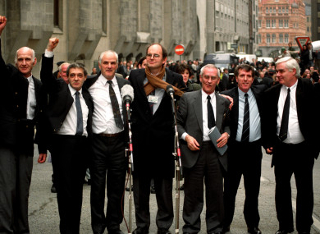
The Birmingham Six – Paddy Joe Hill, Hugh Callaghan, Richard McIlkenny, Gerry Hunter, Billy Power and Johnny Walker – are released from jail on March 14, 1991, after their convictions for the murder of 21 people in two pubs are quashed by the Court of Appeal.

The Birmingham pub bombings take place on November 21, 1974, and are attributed to the Provisional Irish Republican Army. Explosive devices are placed in two central Birmingham pubs – the Mulberry Bush at the foot of the Rotunda and the Tavern in the Town, a basement pub in New Street. Up until this point, the resulting explosions collectively are the most injurious attacks in Great Britain since World War II. Ten people at the Mulberry Bush and eleven at the Tavern in the Town are killed and 182 people are injured. A third device, outside a bank in Hagley Road, fails to detonate.

Five of the six are taken into custody on the evening of November 21. The men agree to be taken to Morecambe police station for forensic tests. The following morning, after the forensic tests and questioning at the hands of the Morecambe police, the men are transferred to the custody of West Midlands Serious Crime Squad police unit. Hugh Callaghan is taken into custody on the evening of November 22.

On May 12, 1975, the six men are charged with murder and conspiracy to cause explosions. The trial begins on June 9, 1975, at the Crown Court sitting at Lancaster Castle. After legal arguments the statements made in November are deemed admissible as evidence. The unreliability of these statements is later established. Forensic scientist Dr. Frank Skuse uses positive Griess test results to claim that Hill and Power had handled explosives. Callaghan, Hunter, McIlkenny and Walker all had tested negative. The jury finds the six men guilty of murder. On August 15, 1975, they are each sentenced to 21 life sentences.

In March 1976 their first application for leave to appeal is dismissed by the Court of Appeal. Their second full appeal, in 1991, is allowed. New evidence of police fabrication and suppression of evidence, the successful attacks on both the confessions and the 1975 forensic evidence causes the Crown to decide not to resist the appeals. The Court of Appeal states that “in the light of the fresh scientific evidence, which at least throws grave doubt on Dr. Skuse’s evidence, if it does not destroy it altogether, these convictions are both unsafe and unsatisfactory.” On March 14, 1991, the six walk free.

In 2001, a decade after their release, the six men are awarded compensation ranging from £840,000 to £1.2 million.

The success of the appeals and other miscarriages of justice cause the Home Secretary to set up a Royal Commission on Criminal Justice in 1991. The commission reports in 1993 and leads to the Criminal Appeal Act 1995 which establishes the Criminal Cases Review Commission in 1997. Superintendent George Reade and two other police officers are charged with perjury and conspiracy to pervert the course of justice but are never prosecuted. During the inquest into the bombings in 2016, Hill states that he knows the identities of three of the bombers who are still “free men” in Ireland.


Leave a comment

Initial Publication of “At Swim-Two-Birds”

at-swim-two-birds

At Swim-Two-Birds, a novel by Irish writer Brian O’Nolan writing under the pseudonym Flann O’Brien, is published on March 13, 1939. It is widely considered to be O’Brien’s masterpiece, and one of the most sophisticated examples of metafiction.

At Swim-Two-Birds is accepted for publication by Longman on the recommendation of Graham Greene, who is a reader for them at the time. It is published under the pseudonym of Flann O’Brien, a name O’Nolan had already used to write hoax letters to The Irish Times. O’Nolan suggests using “Flann O’Brien” as a penname during negotiation with Longman. The novel’s title derives from Snámh dá Én, a ford on the River Shannon, between Clonmacnoise and Shannonbridge, reportedly visited by the legendary King Sweeney, a character in the novel.

The book does not sell well after it is published. By the outbreak of World War II, it has sold scarcely more than 240 copies. In 1940, Longman’s London premises are destroyed during a bombing raid by the Luftwaffe and almost all the unsold copies are incinerated. The novel is republished by Pantheon Books in New York City in 1950, on the recommendation of James Johnson Sweeney, but sales remain low. In May 1959 Timothy O’Keeffe, while editorial director of the London publishing house MacGibbon & Kee, persuades O’Nolan to allow him to republish At Swim-Two-Birds. More recently, the novel is republished in the United States by Dalkey Archive Press.

The initial reviews for At Swim-Two-Birds are not enthusiastic. The Times Literary Supplement says that the book’s only notable feature is a “schoolboy brand of mild vulgarity.” The New Statesman complains that “long passages in imitation of the Joycean parody of the early Irish epic are devastatingly dull” and the Irish novelist Seán Ó Faoláin comments in John O’London’s Weekly that although the book had its moments, it “had a general odour of spilt Joyce all over it.”

However, most of the support for At Swim-Two-Birds comes not from newspaper reviewers but from writers. Dylan Thomas, in a remark that would be quoted on dust jackets in later editions of the book, says “This is just the book to give your sister – if she’s a loud, dirty, boozy girl.” Anthony Burgess considers it one of the ninety-nine greatest novels written between 1939 and 1984. Graham Greene’s enthusiastic reader’s report is instrumental in getting the book published in the first place.

Stephen Fry has declared At Swim-Two-Birds one of his favourite books. In 2011, the book is placed on Time‘s top 100 fiction books written in English since 1923.


Leave a comment

Assassination of Senator Billy Fox

senator-billy-fox

Billy Fox, Protestant Irish politician and a Fine Gael member of Dáil Éireann from 1969 to 1973, and of Seanad Éireann from 1973 until his death, is assassinated on March 12, 1974, by Irish Republican Army (IRA) gunmen who are carrying out a raid on his girlfriend’s farmhouse. Five members of the Provisional IRA are convicted of involvement in his murder.

Late on the night of Monday, March 11, 1974, about a dozen gunmen arrive at the home of Fox’s girlfriend, Marjorie Coulson. She lives there with her parents and brother, and Fox regularly visits on Monday evenings. The farmhouse is in the rural townland of Tircooney in County Monaghan, near the border with Northern Ireland. The gunmen search the farmhouse and demand the occupants hand over weapons. Shortly after midnight, as this is taking place, Fox drives down the laneway and is stopped by some of the gunmen who are outside. He runs but is shot and killed by a single gunshot through the upper torso. The gunmen then order everyone out of the house, set it on fire, and escape.

The next day, the Ulster Freedom Fighters claim that it had killed Fox because he had links to the Provisional IRA. The IRA issues a statement saying that it is not involved. However, shortly after the shooting, five men from County Monaghan are charged with Fox’s murder and IRA membership. They are convicted in May 1974 and sentenced to penal servitude for life. One of those convicted tells the court they had raided the farm because they received a tip-off that Ulster Volunteer Force (UVF) weapons were being stored there. He says there was an agreement that no shots were to be fired. His understanding is that Fox had taken some of the men by surprise and they had shot to wound, not recognizing him.

It is reported that the tip-off had come from another local family and was the result of a grudge. IRA members are already suspicious that the UVF is receiving local help, following an incident in November 1973. Loyalist gunmen had bombed a house at nearby Legnakelly and shot one of the occupants, a republican activist. In its statement on Fox’s killing, the IRA says, “We have repeatedly drawn attention to the murderous acts of a group of former B Specials from County Fermanagh…led by serving officers of the British Army.” The author, Tim Pat Coogan, however, suggests that members of the Official IRA are responsible for killing Fox.

The Seanad adjourns for a week as a mark of respect. About 500 people attend Fox’s funeral at Aughnamullen, including Taoiseach Liam Cosgrave and the Irish president, Erskine Childers. Fox is the first member of the Oireachtas to be killed since Minister for Justice Kevin O’Higgins by the anti-Treaty Irish Republican Army in 1927. When John Bruton first becomes a Teachta Dála (TD) in 1969 he shares an office with Fox. He says that he is still angry at the murder. The RTÉ documentary Rumours from Monaghan report in detail on the circumstances of Fox’s killing. Because Fox is a Protestant, some suggest that the motive for the killing was sectarian.

One of those convicted for Fox’s killing, Sean Kinsella, later escapes from Portlaoise Prison. He is later convicted of arms offences and attempted murder in England. He is released by the Irish government under the Good Friday Agreement.

The Senator Billy Fox Memorial Park in Aughnamullen is named in his memory.