O’Connor releases four solo albums and his third one, titled No Place Like Home, is named by The Irish Times as Number 1 Traditional/Folk album of the year in 2004. After the sudden death of banjo player Barney McKenna on April 5, 2012, he joins The Dubliners to complete their planned tour, until the final shows at Vicar Street in Dublin, on December 28-30. McKenna himself says about Gerry O’Connor: “He’s my best pupil ever.” Together with Eamonn Campbell, Patsy Watchorn and Seán Cannon, O’Connor keeps touring in 2013 as The Dublin Legends.
O’Connor is one of four musicians brought together by blues rock singer/guitar player Joe Bonamassa to perform on a variety of instruments in an acoustic concert at the Vienna State Opera on July 3, 2012. None of the five had ever worked together nor even met until they arrive in Vienna, where three days later they put on a live performance. The event is released on March 12, 2013, on CD and DVD/Blu-Ray, titled An Acoustic Evening At The Vienna Opera House, and in 2014 is broadcast as a PBS special.
O’Connor mainly plays CGDA tuned tenor banjo, instead of the usual Irish tuning GDAE. He plays a David Boyle banjo on almost every tour since 1996, but usually records with an Epiphone Recording A banjo.
Sir Henry Sidney, English soldier, politician and Lord Deputy of Ireland from 1565 to 1571 and from 1575 to 1578, is born on July 20, 1529, probably in London. He cautiously implements Queen Elizabeth I’s policy of imposing English laws and customs on the Irish.
Sidney is the eldest son of Sir William Sidney of Penshurst, England and Anne Pakenham. William Sidney is a prominent politician and courtier during the reigns of Henry VIII and Edward VI, from both of whom he receives extensive grants of land, including the manor of Penshurst in Kent, which becomes the principal residence of the family.
Sidney is brought up at court as the companion of Prince Edward, afterward King Edward VI, and continues to enjoy the favour of the Crown, serving under Mary I of England and then, particularly, throughout the reign of Queen Elizabeth I. He is instrumental in the Elizabethan conquest of Ireland, serving as Lord Deputy three times. His career is controversial both at home and in Ireland.
Appointed Lord Deputy by Elizabeth in 1565, Sidney faces a major rebellion in Ulster led by the powerful chieftain Shane O’Neill. Failing to subdue O’Neill by force, he intrigues against him with his enemies, the O’Donnells of Tyrconnell and the MacDonnells of Antrim. Finally, O’Neill is assassinated by the MacDonnells in 1567. Nevertheless, Sidney is still not strong enough to destroy completely the power of Ulster’s native chieftains. He does, however, persuade a number of Irish chiefs to submit to Elizabeth’s authority, and he establishes English presidents of Munster and Connacht to control the chiefs. In addition, by refraining from introducing anti-Roman Catholic legislation in the Parliament of Ireland of 1569–71, he makes possible the containment and ultimate defeat in 1573 of a rebellion of Munster Catholics led by James FitzMaurice FitzGerald.
Resenting the Queen’s failure to provide him with an adequate military force, Sidney resigns in 1571, but is reappointed Lord Deputy four years later. His arbitrary taxation arouses popular resentment and leads to his recall in 1578. Thereafter he serves only as president of the Council of Wales and the Marches, living chiefly at Ludlow Castle for the remainder of his life, dying there at the age of 56 on May 5, 1586.
Born at 35 William Street in Wexford on September 17, 1886, Corish is the eldest child of carpenter Peter Corish and Mary Murphy. He is educated by the Christian Brothers in the town on George’s Street and leaves school at fourteen years old, which is not unusual at this time.
On September 29, 1913, at 27 years of age, he marries Catherine Bergin, daughter of labourer Daniel Bergin. They have six children, including Brendan.
Corish works as a fitter in the Wexford Engineering foundry the Star Iron Works. It is in this job that he witnesses the poor working conditions that industrial workers have to face all over the country. Many people of Ireland feel that this needs to change and so, in 1909, James Larkin forms the Irish Transport and General Workers’ Union (ITGWU). Many important figures join the union including P. T. Daly, James Connolly and eventually Corish himself, who becomes a voice for the Wexford workers.
The Wexford lockout from 1911 to 1912 that ensues because of this union is the event that first brings public attention to Corish in his hometown. Wexford employers counter the ITGWU by locking out their employees. On a conciliation committee, Corish represents the workers of the town and becomes a leader of this local union. During the lockout, he is arrested, spending a night in jail, for expressing his anger to a recently employed non-union foundry worker.
When visiting Wexford to support the workers, ITGWU leader James Larkin and trusted members James Connolly and P. T. Daly are put up in the Corish household on William Street.
In February 1912, the dispute is resolved with the introduction of the Irish Foundry Workers’ Union of which Corish is secretary until 1915. His career as a tradesman however is over as he is blacklisted by all employers. This new union is absorbed by the ITGWU two years later. He remains a respected figure in the town, especially by the foundry workers, and continues as secretary in the ITGWU until 1921.
Corish first takes his seat in the Wexford Borough Council in January 1913, where he is given the title of “Alderman.”
In May 1916, Corish is arrested after being suspected of having involvement in the Easter Rising and is imprisoned in Stafford, England until June. He is often targeted because of his republican activism, receiving a life-threatening letter in 1920 regarding the killing of Royal Irish Constabulary (RIC) officers.
Corish is first elected to Wexford County Council in 1920 and later that year is appointed mayor of the town.
Corish is an Irish Labour Party representative. However, as the Labour Party in the southern 26 counties, later the Irish Free State, choose not to contest the 1921 Irish elections, Corish runs as a Sinn Féin candidate and is elected to Dáil Éireann for the Wexford constituency.
Corish supports the Anglo-Irish Treaty and votes in favour of it. He also runs as a member of the Labour Party at the 1922 Irish general election. His involvement in the trade union movement and his clear speech-giving skills displayed during a visit from Michael Collins to Wexford that same year are what give him a fighting chance in the election. He is elected and serves in Dáil Éireann until his death in 1945.
He is a public supporter of the Garda Síochána, expressing his disagreement with the reductions in Garda pay and allowances in 1924 and 1929.
Corish is a recipient of the Honorary Freedom of the Borough of Wexford in early 1945 and dies later that year, on July 19, 1945, after serving as mayor and council member for 25 years. During exploratory surgery for stomach pain, the doctors of Wexford County Hospital realise that his condition is much worse than imagined and he dies at the age of 58 shortly thereafter. After appearing in the Dáil only a few days prior, his death is unexpected.
His death causes a by-election to the Dáil which is won by his son, Brendan Corish, who is later a leader of the Labour Party and Tánaiste. He serves as mayor up until his retirement in 1982. Another son, Des Corish, later also becomes mayor of the town. Corish’s granddaughter, Helen Corish, is mayor in 1990.
Corish Park is built in his honour in the early 1950s.
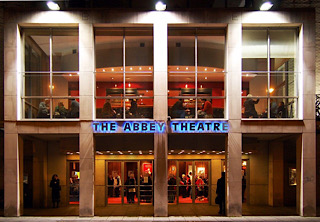
The newly unveiled Abbey Theatre opens its doors for the first time on July 18, 1966.
Fifteen years earlier, in 1951, the original buildings of the theatre are destroyed by fire during the run of The Plough and the Stars. Ironically, the play closes to the strains of “Keep the Home Fires Burning.” The fire forces the theatre company to find a new home.
They relocate to the Queen’s Theater on Pearse Street for what is intended to be a temporary stay but instead lasts for a decade and a half. A week before the brand new premises on Abbey Street are opened, the company has its final performance at the Queen’s Theatre in what is a bittersweet evening. For the Abbey Theatre it signals the end of an era and the beginning a new one, but the future of the Queen’s Theatre is far less bright.
After the final performances from the Abbey, Never the Time and the Place by Lennox Robinson and The Irishwoman of the Year by John Power, uncertainty shrouds the fate of the theatre with the Irish Independent reporting that “It will be used for variety performances up to the end of September, but after that it is just a matter for speculation.” It is ultimately closed in 1969 and is demolished in 1975.
The jubilee year of the 1916 Easter Rising, the 1966 Abbey opening recalls memories of the events that had taken place fifty years earlier.
In an article published the day after opening night, the Irish Independent recalls that “Thomas MacDonagh, one of the executed leaders of the Rising was himself an Abbey playwright and when news of the seizure of the General Post Office reached the theatre at a rehearsal, members of the Abbey players and other hands made a hurried exit to join the fighting. And by then others of the company were already at the barricades.”
A world away from the battleground of the Rising, the opening of the new Abbey Theatre is attended by a who’s who of arts, culture and politics.
The Abbey’s new home is opened by President Éamon de Valera, who once graced the Abbey Stage as an amateur actor.
The new building is designed by Irish architectMichael Scott, who also designed the nearby Busáras building. He is considered one of the great modern architects and his vision for the new Abbey is thought to be the last word in modern-day design.
McCann’s career includes parts in many plays from the Irish literary canon, including Tarry Flynn, The Shaughran, and the Gate Theatre‘s highly acclaimed production of Seán O’Casey‘s classic Juno and the Paycock in the 1980s (McCann plays the “Paycock” (Captain Boyle) opposite Geraldine Plunkett as Juno and John Kavanagh as Joxer Daly) as well as a subsequent production of O’Casey’s The Plough and the Stars.
McCann develops a particularly fruitful relationship with the playwright Brian Friel. He plays the role of Gar O’Donnell, the public figure, in a film adaptation of Philadelphia, Here I Come! in 1970 and, despite popular belief, he never plays either public or private Gar on stage. He gives a landmark performance as Frank Hardy, the title character, in Faith Healer in 1980 (a role he reprised in 1994), continuing his relationship with Friel through productions of Translations (1988) and Wonderful Tennessee (1993).
Friel says that McCann’s work “contains extraordinary characteristics that go beyond acting … it is deeply spiritual.” Perhaps McCann’s most renowned role is as Thomas Dunne in Sebastian Barry‘s The Steward of Christendom. He wins the London Critics’ Circle Theatre Award (Drama Theatre) as best actor for this role in 1995. He reprises this role in a 1996 production at the Gate Theatre, Dublin and, following a twelve-week run at the Brooklyn Academy of Music in 1997, his “performance of unarguable greatness” (The New York Observer) had Newsweekhailing him as “a world-class star,” and The New York Times referring to this “astonishing Irish actor…widely regarded as the finest of them all.”
On the London stage, McCann plays in Prayer for My Daughter opposite Antony Sher (1978), and is Jean to Dame Helen Mirren‘s Julie in Miss Julie (1971). This is filmed for the BBC, and he much later plays Judge Brack with Fiona Shaw in the title role of Henrik Ibsen‘s Hedda Gabler, a production filmed for the BBC in 1993.
His best-known film role is as Gabriel Conroy in The Dead (1987), starring opposite Anjelica Huston and directed by her father, John Huston. Significant late roles include Bernardo Bertolucci‘s Stealing Beauty (1996) and in John Turturro‘s Illuminata (released in 1999, after McCann’s death).
McCann’s television work includes the featured role of Phineas Finn in the BBC’s serialised adaptation of Anthony Trollope‘s The Pallisers, Willie Burke in RTÉ‘s Prix Italia drama entry The Burke Enigma (1979) and Barney Mulhall in RTÉ’s Strumpet City (1980), as well as many one-off parts.
McCann plays in Bob Quinn‘s Irish language film Poitín (1979) and in Quinn’s somewhat experimental The Bishop’s Story (1995). After hearing that McCann is ill, Tom Collins asks Quinn to make a TV documentary about McCann for RTÉ called It Must Be Done Right (1999), after a remark by McCann on his craft. The film airs on RTÉ a week before McCann’s death.
In his private life, McCann is a quiet and unassuming man, but he battles both depression and alcoholism all his life. He has many friends in Irish theatre and artistic circles but also across all strata of life. His hobbies include sketching and he is passionate about horse racing.
Remembering McCann on the 25th anniversary of his death, Gerald Smyth writes, “In the melancholy of that life-worn voice could be heard the cadences of a lyric heart.”
Kilfedder leaves the UUP in 1977 in opposition to the party’s policies tending to integrationism, preferring to advocate the restoration of the Stormont administration. For a time he sits as an “Independent Ulster Unionist.” He contests the 1979 European Parliament election under that label, finishing fourth in the count for the three seats, having overtaken the UUP leader Harry West on transfers.
On March 20, 1995, while traveling by train into London from Gatwick Airport, Kilfedder dies of a heart attack. This is the same day that the Belfast Telegraph carries a front-page story saying that an Ulster MP has been targeted as one of twenty MPs invited by the LGBT rights organisation OutRage! in a letter to come out. He dies unmarried and is survived by two sisters.
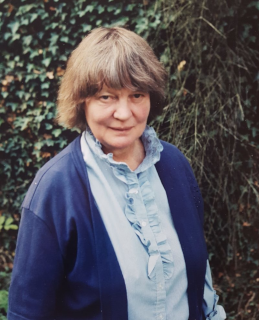
Murdoch is the daughter of Irene Alice (née Richardson) and Wills John Hughes Murdoch. Her father, a civil servant, comes from a mainly Presbyterian sheep farming family from Hillhall, County Down. In 1915, he enlists as a soldier in King Edward’s Horse and serves in France during World War I before being commissioned as a second lieutenant. Her mother trains as a singer before Iris is born and is from a middle-class Church of Ireland family in Dublin. Her parents first meet in Dublin when her father is on leave and are married in 1918. Iris is the couple’s only child. When she is a few weeks old the family moves to London, where her father had joined the Ministry of Health as a second-class clerk. She is a second cousin of the Irish mathematician Brian Murdoch.
From 1947 to 1948 Murdoch studies philosophy as a postgraduate at Newnham College, Cambridge. She meets Ludwig Wittgenstein at Cambridge but does not hear him lecture, as he had left his Trinity College professorship before she arrives. In 1948 she becomes a fellow of St. Anne’s College, Oxford, where she teaches philosophy until 1963. From 1963 to 1967 she teaches one day a week in the General Studies department at the Royal College of Art.
In 1956 Murdoch marries John Bayley, a literary critic, novelist, and from 1974 to 1992 Warton Professor of English at Oxford University, whom she had met in Oxford in 1954. The unusual romantic partnership lasts more than forty years until Murdoch’s death. Bayley thinks that sex is “inescapably ridiculous.” She in contrast has “multiple affairs with both men and women which, on discomposing occasions, Bayley witnesses for himself.”
Murdoch’s first novel, Under the Net, is published in 1954 and is selected in 1998 as one of Modern Library’s 100 best English-language novels of the 20th century. She had previously published essays on philosophy, and the first monograph about Jean-Paul Sartre published in English. She goes on to produce 25 more novels and additional works of philosophy, as well as poetry and drama.
Murdoch’s last novel, Jackson’s Dilemma, is published in 1995. She is diagnosed with Alzheimer’s disease in 1997 and dies on February 8, 1999, in Oxford, England. There is a bench dedicated to her in the grounds of Lady Margaret Hall, Oxford, where she enjoyed walking.
John M. Oxx, retired Irish trainer of thoroughbred racehorses, is born on July 14, 1950. By the end of the 2009 season he had trained thirty-five Group One winners over his career, including the winners of eleven Classic races. He is best known as the trainer of Sinndar and Sea The Stars.
Oxx has been widely praised for the care and undemonstrative authority with which he approaches the training and racing of his horses. He is particularly known for being highly selective when choosing when and where his horses will run.
Oxx is the son of John Oxx Sr., who is himself a successful trainer, winning eight Irish classic races. In 1950, his father purchases Currabeg, at the southwestern end of the Curragh in County Kildare, where Oxx Jr. takes over training. He graduates from University College, Dublin, as a veterinary surgeon in 1973, and works as his father’s assistant before taking over the stable in 1979. In that year he has his first win and his first Group win with Orchestra.
The Aga Khan begins to support Oxx’s yard with a number of yearlings after Eurobird’s win in 1987. When he decides to withdraw his racehorses from England following Aliysa’s disqualification in the Epsom Oaks of 1989, he establishes a significant presence in Oxx’s yard. Without a budget of his own to spend on yearlings, Oxx continues to be reliant on horses bred by owners with whom he has an association. In some years, he concedes, “you wouldn’t have anything remotely near Group One standard.”
Many of Oxx’s major race wins have come from Aga Khan-owned horses, beginning with Manntari’s victory in the Vincent O’Brien National Stakes at the Curragh in 1993, and continuing with Timarida’s win in the Irish Champion Stakes at Leopardstown Racecourse in 1996, followed by Ebadiyla’s victory in the 1997 Irish Oaks. He also wins that race with Winona the following year. In 2000, he trains the Aga Khan’s brilliant Sinndar to wins in the Epsom Derby, the Irish Derby, and the Prix de l’Arc de Triomphe, making the colt the only horse ever to win that trio of races and at the time one of only three Irish-based horses to ever win the Arc.
Oxx comes to wider public attention when guiding Sea The Stars through a famous 2009 season in which he wins Group One races in England, Ireland and France, his six consecutive triumphs including the 2000 Guineas Stakes, the Epsom Derby and the Prix de l’Arc de Triomphe. He is typically understated when assessing the role of the trainer in the career of a great horse like Sea The Stars. “You can’t give them ability they don’t have,” he tells The Independent newspaper. “Really, it’s just a case of not messing it up – not to overtax the horse too soon, or ask it to do stupid things as a two-year-old. If you mind him sufficiently when he’s young, hopefully his ability will blossom.”
In an interview with The Observer, Oxx says of Sea The Stars: “I was always reading about racing and great horses of the past. So when you grow up with the history of racing and the history of breeding, the landmark horses that come along over a century, and more – to train one that’s in that league gives you the greatest satisfaction.”
Oxx serves as chairman of the Irish National Stud from 1985 to 1990. He is chairman of the Irish Racehorse Trainers’ Association from 1986 to 1991 and from 1993 to 1996. He serves on numerous other racing bodies and is chairman of the Racing Academy and Centre of Education. In 2008, he is given the Irish Racehorse Trainers’ Association Hall of Fame award.
Oxx marries Caitriona O’Sullivan in 1974. They have three children.
MacDermott is born in Belfast on April 12, 1896, the third surviving son and sixth of seven children of the Reverend John MacDermott DD, a Presbyterian clergyman who is minister of Belmont and moderator of the Presbyterian Church in Ireland, and of his wife Lydia Allen MacDermott (née Wilson), the daughter of a Strabane solicitor. He is educated at Campbell College, Belfast, from where he wins a scholarship to read Law at the Queen’s University Belfast (QUB) in 1914.
Eight years later MacDermott is appointed to determine industrial assurance disputes in Northern Ireland, and in 1931 becomes a lecturer in Jurisprudence at Queen’s University Belfast, teaching for four years.
In 1940, MacDermott is appointed Minister of Public Security in the Government of Northern Ireland, and the following year becomes the Attorney General for Northern Ireland. He is succeeded in this post by William Lowry, whose son, Lord Lowry, would eventually succeed MacDermott as Lord Chief Justice. In 1944, he resigns his parliamentary seat on appointment as a High Court Judge for Northern Ireland, and three years later, on April 23, 1947, is made a Lord of Appeal in Ordinary, becoming a life peer as Baron MacDermott, of Belmont in the city of Belfast.
MacDermott returns from the House of Lords to take up his appointment as Lord Chief Justice of Northern Ireland. His successors to the latter office become Law Lords subsequently. Whilst Lord Chief Justice, he is affectionately known as “the Baron.”
In 1977, aged over eighty, MacDermott offers to redeliver a lecture at the Ulster College, which had been interrupted by a bomb meant for him and which had severely wounded him.
Having been made a Northern Ireland Privy Counsellor seven years earlier, MacDermott is sworn of the British Privy Council in 1947.
Four years later, in 1951, MacDermott is appointed Lord Chief Justice of Northern Ireland, a post he holds for twenty years. He is also Pro-Chancellor of his alma mater from 1951 to 1969. In 1958, he chairs the commission on the Isle of ManConstitution. He dies at his home in Belfast on July 13, 1979.
In 1926, MacDermott weds Louise Palmer Johnston, later Lady MacDermott. Their son, Sir John MacDermott, is also sworn into the British Privy Council in 1987, as a Lord Justice of Appeal in Northern Ireland. He later became a Surveillance Commissioner for Northern Ireland.
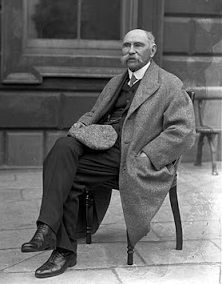
Hyde is born at Longford House in Castlerea, County Roscommon, on January 17, 1860. In 1867, his father is appointed prebendary and rector of Tibohine, and the family moves to neighbouring Frenchpark, in County Roscommon. He is home schooled by his father and his aunt due to a childhood illness. While a young man, he becomes fascinated with hearing the old people in the locality speak the Irish language.
Rejecting family pressure to follow previous generations with a career in the Church, Hyde instead becomes an academic. He enters Trinity College, Dublin (TCD), where he gains a great facility for languages, learning Latin, Greek, Hebrew, French, and German, but his great passion in life is the preservation of the Irish language.
After spending a year teaching modern languages in Canada, Hyde returns to Ireland. For much of the rest of his life he writes and collects hundreds of stories, poems, and folktales in Irish, and translates others. His work in Irish helps to inspire many other literary writers, such as W. B. Yeats and Lady Gregory.
In 1892, Hyde helps establish the Gaelic Journal and in November of that year writes a manifesto called The necessity for de-anglicising the Irish nation, arguing that Ireland should follow her own traditions in language, literature, and even in dress.
In 1893, Hyde founds the Gaelic League (Conradh na Gaeilge) along with Eoin MacNeill and Fr. Eugene O’Growney and serves as its first president. Many of the new generation of Irish leaders who play a central role in the fight for Irish independence in the early twentieth century, including Patrick Pearse, Éamon de Valera, Michael Collins, and Ernest Blythe first become politicised and passionate about Irish independence through their involvement in the Gaelic League. Hyde does not want the Gaelic League to be a political entity, so when the surge of Irish nationalism that the Gaelic League helps to foster begins to take control of many in the League and politicize it in 1915, Hyde resigns as president.
In 1938, Hyde is unanimously elected to the newly created position of President of Ireland, a post he holds until 1945. Hyde is inaugurated on June 26, 1938, in the first inaugural ceremony in the nation’s history. Despite being placed in a position to shape the office of the presidency via precedent, Hyde by and large opts for a quiet, conservative interpretation of the office. In April 1940, he suffers a massive stroke and plans are made for his lying in state and state funeral, but to the surprise of everyone he survives, albeit paralysed and confined to a wheelchair. One of his last presidential acts is a visit to the German ambassador Eduard Hempel on May 3, 1945, to offer his condolences on the death of Adolf Hitler, a visit which remains a secret until 2005.
Hyde leaves office on June 25, 1945, opting not to nominate himself for a second term. He opts not return to his Roscommon home due to his ill-health, but rather moves into the former Secretary to the Lord Lieutenant’s residence in the grounds of Áras an Uachtaráin, where he lived out the remaining four years of his life.
Hyde dies in Dublin on July 12, 1949, at age 89. As a former President of Ireland he is accorded a state funeral which, as a member of the Church of Ireland, takes place in Dublin’s St. Patrick’s Cathedral. Since contemporary rules of the Roman Catholic Church in Ireland at the time prohibit Roman Catholics from attending services in non-Catholic churches, all but one member of the Catholic cabinet remain outside the cathedral grounds while Hyde’s funeral takes place. Hyde is buried in Frenchpark, County Roscommon at Portahard Church.




 seamus dubhghaill