On April 5, 1862, Guinness formally registers the harp as its official symbol, long before Ireland even has its own government.
The first Guinness labels featuring the now-iconic harp are printed in August of that year according to Guinness’s Brewery in the Irish Economy 1759 – 1876 by Patrick Lynch and John Vaizey.
The harp, which serves as the emblem of Guinness, is based on a famous 14th-century Irish harp known as the “O’Neill harp” or “Brian Boru’s harp,” which is now preserved in the Library of Trinity College Dublin. The harp is also the official national emblem of the Republic of Ireland and can be found on the Republic’s coinage that was phased out when the Euro currency was introduced. The harp symbol is also featured on Irish flags during the 1916 Easter Rising.
However, there is a difference between the Irish government harp and the Guinness harp. As Guinness had trademarked the harp symbol in 1876, the Irish Free State Government of 1922 has to reverse the official government harp so that it can be differentiated from the trademarked Guinness harp. As such, the Guinness Harp always appears with its straight edge (the sound board) to the left, and the government harp is always shown with its straight edge to the right.
It is because of the harp trademark that the Guinness company names its first lager Harp in 1960.
The harp is one of three elements that make up the Guinness brand livery. The other two elements are the word “Guinness” and Arthur Guinness’s famous signature. There have been a number of changes to the design of the harp device over the years including a reduction in the number of strings shown. The current harp is introduced in 2005 when a new brand livery is launched.
The famous Downhill Harp, dating back to 1702, is purchased by Guinness in 1963 to ensure its continued preservation and is on display in the advertising gallery in Guinness Storehouse. The Downhill Harp is made in 1702 by Cormac O’Kelly of Ballinascreen and played in the 18th century by the harpist Donnchadh Ó hAmhsaigh, known in English as Denis Hampsey, Denis Hampson or Denis Hempson. Ó hAmhsaigh plays in the traditional style, plucking the strings with his long fingernails. At age 97, he is the oldest harpist at the Belfast Harp Festival in July 1792, although he is perhaps most famous for his concert for Prince Charles Edward Stuart, or ‘Bonnie Prince Charlie’, in 1745.
The harp bears the inscription:
In the time of Noah I was green, Since his flood I had not been seen, Until Seventeen hundred and two I was found By Cormac O’Kelly underground: He raised me up to that degree That Queen of Musick you may call me.
(From: “When Guinness trademarked symbol of the harp,” IrishCentral, http://www.irishcentral.com, April 5, 2022)
Seóirse Bodley, Irish composer and former associate professor of music at University College Dublin (UCD), is born George Pascal Bodley in Dublin on April 4, 1933. In 2008, he is the first composer to become a Saoi of Aosdána. He is widely regarded as one of the most important composers of twentieth-century art music in Ireland, having been “integral to Irish musical life since the second half of the twentieth century, not just as a composer, but also as a teacher, arranger, accompanist, adjudicator, broadcaster, and conductor.”
Bodley’s father is George James Bodley (1879–1956), an employee in the Dublin office of the London Midland & Scottish Railway Company, and later of the Ports and Docks Board. His mother, Mary (née Gough, 1891–1977), works for the Guinness Brewery. He attends schools in the Dublin suburbs of Phibsborough and Glasnevin before he moves at the age of nine to an Irish-speakingChristian Brothers school at Parnell Square. He later studies at the School of Commerce in Rathmines, where he obtains his Leaving Certificate.
Music is encouraged in his parents’ home, and Bodley receives initial lessons on the mandolin from his father and on the piano from his mother. He studies the piano, harmony and counterpoint at the Royal Irish Academy of Music and obtains a Licentiate in piano from Trinity College London (TCL). From the age of 13, he also enrolls for a time at the Brendan Smith Academy of Acting. While he is still at school, he receives his first lessons in composition privately from the Dublin-based German choral conductor Hans Waldemar Rosen (1904–94), which continues, on and off, until 1956. From his student days he performs as an accompanist to singers and takes part in chamber music performances. An important element in his musical education is the twice-weekly free concerts given by the Radio Éireann Symphony Orchestra in the Phoenix Hall, Dame Court, where he has the opportunity to hear leading Irish and international performers and conductors presenting both classics and modern repertory.
From 1952 Bodley studies for a Bachelor of Music degree from University College Dublin, mainly with Anthony Hughes. He obtains the degree in 1955. From 1957 to 1959 he studies composition (with Johann Nepomuk David) and conducting at the Württembergische Hochschule für Musik in Stuttgart, Germany, and a year later he obtains a Doctorate in Music from UCD. He also takes classes in conducting with Hans Müller-Kray and Karl Maria Zwißler, and in piano with Alfred Kreutz. He returns to Germany several times in the early 1960s to participate in courses at the Darmstädter Ferienkurse, which significantly expands his knowledge of avant-garde techniques.
From 1959 until his retirement in 1998, Bodley lectures at the university’s music department, becoming associate professor in 1984. During the 1960s, he is conductor of the Culwick Choral Society.
Bodley’s development as a composer sees several distinct phases. In the 1970s he merges avant-garde styles with elements from Irish traditional music and becomes a figure of national importance. He receives several prestigious commissions for large-scale works, such as Symphony No. 3 (1981), written for the opening of the National Concert Hall.
In 1982 Bodley becomes a founder-member of Aosdána and PresidentMary McAleese confers the distinction of Saoi on him in November 2008. McAleese says that Bodley “has helped us to recast what it means to be an artist in Ireland.”
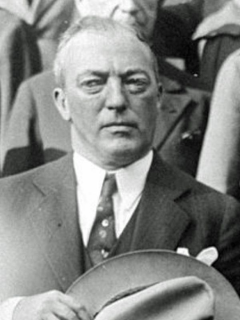
Deegan is born in the Bronx, Bronx County, New York, on December 28, 1882, to Irish immigrants. He studies architecture at Cooper Union. He marries Violet Secor (1889-1969) and has one son, William Secor Deegan (1909-85). At the age of 35 he serves in World War I as a staff officer in the 105th Field Artillery, rising to the rank of major.
Deegan later joins the United States Army Corps of Engineers as a major, where he supervises the construction of military bases in the New York area under the command of GeneralGeorge Washington Goethals. After the war he helps organize the American Legion in 1919, advancing to State Commander in 1921. In 1922 he is considered a strong candidate to become national commander of the Legion at their convention in New Orleans but is defeated due to his strong advocacy for admitting Black veterans into the organization. Advocacy for the rights of Black people is a strong theme throughout Deegan’s career, including during his position as Tenement House Commissioner.
Deegan works as an architect at a number of distinguished firms, including McKim, Mead & White, Post, Magnicke and Franke, and Starrett and van Vleck. Later in life he holds a number of political positions, most of them in the Bronx. He is President of the Bronx Chamber of Commerce until the chamber grows critical of MayorJimmy Walker, at which point he resigns. In 1928, Mayor Walker appoints him Tenement House Commissioner of New York City, a post he holds for the rest of his life, and in 1930, chairman of the Mayor’s Committee on Receptions to Distinguished Guests, or “official greeter,” a job in which he is preceded by his friend Rodman Wanamaker and eventually succeeded by Grover Whalen.
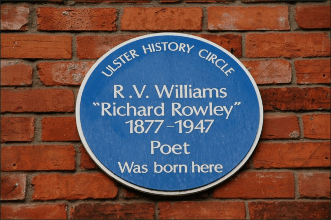
Richard Valentine Williams, who writes poetry, plays and stories under the pseudonym of Richard Rowley, is born on April 2, 1877, at 79 Dublin Road in Belfast, in what is now Northern Ireland.
At the age of sixteen, Rowley enters the family firm, McBride and Williams, which manufactures cotton handkerchiefs and eventually becomes its managing director. After the collapse of the company in 1931 he is Chairman of the Northern Ireland Unemployment Assistance Board. His early poems, in The City of Refuge and Other Poems (1917), are rhetorical celebrations of industry. His next volume, City Songs and Others (1918), includes his most quoted poem, The Islandmen, and is regarded as containing his most original work: “Browning-like monologues straight from the mouths of Belfast’s working-class.”
In 1918, Rowley goes to live in the Mourne country, residing in Brook Cottage, Bryansford Rd., Newcastle, County Down. He writes short stories, including Tales of Mourne (1937), as well as at least one highly successful play, Apollo In Mourne (1926). During World War II, he founds, and runs from his Newcastle home, the short-lived Mourne Press. He publishes first collections of Sam Hanna Bell and Michael McLaverty, but the press fails in 1942.
In 1946, Rowley sells Brook Cottage, which has since been demolished, and moves with his wife, the former Margaret Pollock, to Drumilly, Loughgall, County Armagh, as paying guests of their friends, Mr. and Mrs. Ralph Cope. He dies there on April 25, 1947.
George MacCann and Jack Loudan presents a commemoration of Rowley’s life on the radio in 1952. The programme uses recordings of his friends Lady Mabel Annesley, who illustrated several of his publications, along with the poet John Irvine, the playwright Thomas Carnduff and William Conor. In Newcastle, Rowley’s name is remembered through the Rowley Meadows housing development and the Rowley Path, which runs along the southern boundary of the Islands Park.
(Pictured: Blue plaque at Richard Rowley’s birthplace in Belfast, Northern Ireland)
O’Reilly is born on May 14, 1929, in Granard, County Longford, one of six children of James P. O’Reilly, shopkeeper and musician, and Catherine O’Reilly (née Donegan). The family moves to Dublin when he is nine years old. He is educated at the Christian Brothers school in James’s Street, where he excels at Gaelic football and develops an interest in drama and music. Toward the end of his schooldays, he begins to participate in athletics, particularly the high jump, and is coached by Jack Sweeney, a leading athletics coach.
Always a man of many talents and interests, after leaving school O’Reilly combines working in the insurance business with an athletics career with Donore Harriers and evening drama classes. He wins several Irish titles, including the high jump, javelin, and decathlon, and sets a national record in the high jump. In 1954 he wins the British AAA Championships high jump title, beating the Commonwealth champion into second place, and setting a championship record of 6 ft. 5 in. (1.96 m). As a result, he secures a United States athletics scholarship to the University of Michigan, Ann Arbor, where he takes a degree in liberal arts, majoring in speech and drama. While at Michigan he improves his Irish record to 6 ft. 7 in. (2.007 m). His athletic career, however, is dogged with bad luck. He is selected to compete in the high jump at the European Athletics Championships in Bern, Switzerland, in 1954 but fractures an ankle in practice and fails to advance beyond the qualifying round. Although he competes at international level for ten years (1952–62), he is unlucky to never take part in the Olympic Games. A victim of sporting politics in 1952, as an NCAA athlete he is not entitled to compete. He is selected for the 1956 Summer Olympics in Melbourne but is unable to attend when, at the last minute, his club cannot provide the finance for him to attend. Earlier that year he wins the Big Ten Conference high jump title.
On leaving Michigan O’Reilly moves to New York City, where he embarks on an acting career with the Irish Players, but he returns to Dublin in 1959, where, after brief spells working as a teacher and for an advertising agency, he applies to Ireland’s new television station for a position. He is looking for an acting job but ends up being offered a position as a presenter, joining Teilifís Éireann in 1961 as an announcer/interviewer. His relaxed and unobtrusive style appeals to viewers and his light entertainment show, The Life of O’Reilly, is the most popular programme on Irish television in the day, eclipsing even a fledgling The Late Late Show. It is as a sports presenter and commentator, however, that O’Reilly is primarily remembered, as he becomes the face of sport on RTÉ Television for many years. He attends five Olympic Games as a broadcaster, from Mexico in 1968 to Los Angeles in 1984, commentating on athletics and gymnastics. The first presenter of RTÉ’s flagship Saturday afternoon sports programme Sports Stadium in 1984, he continues to present it over its fourteen-year life, co-presenting the final programme in December 1997. He also is the regular presenter of RTÉ’s Wimbledon Championships tennis coverage for many years, the sports results on news broadcasts on TV and radio, and Sunday Sport on RTÉ Radio, as well as commentating on individual sports such as ice-skating.
Although sports presenting is a natural progression for an athlete with his talents, O’Reilly’s real love is the arts. He continues to act, playing the part of Detective Inspector Michael Roarke in the classic children’s film Flight of the Doves (1971) with Ron Moody and Willie Rushton. He is also an accomplished singer and songwriter, and writes and performs his own one-man show, Across the Spectrum, comprising his own poems and songs in 1992. As well as a book of poems, The Great Explosion (1977), he releases a number of albums and tops the charts with his own song, “The Ballad of Michael Collins,” in 1981. He has a great admiration for Michael Collins, and this leads to his becoming the first non-political figure to give the oration at the annual Collins commemoration at Béal na Bláth, County Cork, in 1981. He also writes the song “Let the Nations Play” (1985), inspired by the boycotts of the Olympic games of 1980 and 1984, and the song is adopted as an anthem of the international Olympic movement.
Tall and slim in build, O’Relly is affable, modest, and self-deprecating in character. His relaxed style is no mere public affectation. He often exasperates colleagues by turning up just in time for broadcasts, and his ability to ad-lib is important in a live television environment. He once describes himself as “a champion high jumper who could enunciate properly and keep my hair neatly combed” (The Irish Times, April 7, 2001). Despite the disappointments in his sporting career, he maintains that his other interests more than compensated. In relation to the Olympics he is quoted as saying, “If you asked me whether I’d have preferred to win a medal or have written the song, I’d honestly say I would have preferred to have written the song” (Longford Leader, April 6, 2001).
O’Reilly lives in Ranelagh, Dublin, and is married twice. He meets his first wife Linda Herbst (née Kuhl) in New York in the late 1950s. His second marriage is to Johanna Lowry. He has four children. After a lenghty illness, he dies on April 1, 2001, in St. Vincent’s Hospital, Fairview, Dublin. He is buried at Mount Venus cemetery, Rathfarnham.
(From: “O’Reilly, Brendan” by Jim Shanahan, Dictionary of Irish Biography, http://www.dib.ie, October 2009)
Prior to becoming Stiff Little Fingers, Jake Burns (vocals and guitar), Henry Cluney (guitar), Gordon Blair (bass), and Brian Faloon (drums), are playing in a rock music cover band, Highway Star (named after the Deep Purple song), in Belfast. Upon the departure of Blair, McMordie takes over on bass. Cluney has by this time discovered punk, and introduces the rest of the band to it. They decide that Highway Star is not a punk enough name, and after a brief flirtation with the name “The Fast,” decide to call themselves Stiff Little Fingers, after The Vibrators‘ song, which appears on the album Pure Mania.
Stiff Little Fingers is formed in 1977 at the height of the Troubles in Northern Ireland, which informs much of their songwriting. They are the first punk band in Belfast to release a record – the “Suspect Device” single comes out on their own independent label, Rigid Digits. Their album Inflammable Material, released in partnership with Rough Trade Records, becomes the first independent LP to enter the UK top 20.
In the face of low sales and concert attendances, Stiff Little Fingers disbands in 1983. McMordie joins a group of Reading musicians in the newly formed dance-punk band, Friction Groove. They secure a deal with Warner label, Atlantic Records, and go on to record an album, The Black Box, in Berlin and Brussels, from which the first single, “Time Bomb,” charts very briefly.
Around 1986 McMordie provides, along with other Friction Groove members, the core band behind Sinéad O’Connor, who had just arrived in London from Dublin. He is later sacked.
Between 1992 and 1994, McMordie is executive producer for the Peace Together Irish concert events. Since 1994 he has been the tour manager for American artist Richard Hall, AKA Moby, with whose band he has sometimes played bass. He has also been used as the live bassist for Belfast singer-songwriter Dan Donnelly, having played in Dan’s live band at the Beautiful Days music festival in Devon in 2006.
In 2006, it is announced that McMordie is rejoining Stiff Little Fingers for their current tour, and subsequently he rejoins the band on a permanent basis. As of 2021, he is still playing bass with Stiff Little Fingers.
Besides being a live musician, McMordie runs Alistair McMordie Tour Management.
Hales is born John Hales, eldest child of five sons and four daughters of Robert Hales, a farmer, and Margaret (née Fitzgerald) Hales. He is educated at Ballinadee national school and Warner’s Lane school, Bandon. After leaving school he goes to work on his father’s farm. He plays hurling with Valley Rovers GAA club and is the Munster champion in the 56-lb. weight-throwing competition. From an early age he follows in his father’s footsteps and becomes involved in the republican movement.
Hales joins the Irish Volunteers in 1915 and becomes captain of the Ballinadee company in 1916. Arrested under the Defence of the Realm Act after the 1916 Easter Rising, he is imprisoned in Frongoch internment camp in Wales. After his release, in April 1917 he becomes executive of the short-lived Liberty League promoted by Count George Plunkett. When the League merges with Sinn Féin, he helps reorganise the Volunteers. With his brothers, Tom, William, and Donal, he continues his father’s fight on behalf of evicted tenants and becomes involved with the anti-British Bandon People’s Food Committee and the anti-landlord Unpurchased Tenants’ Association. He helps in the Sinn Féin takeover of The Southern Star newspaper and is a member of the new board of directors. In 1919 he becomes battalion commander of the first (Bandon) battalion 3rd Cork Brigade of the Irish Republican Army, the name by which the Irish Volunteers increasingly became known. He leads the attack on TimoleagueRoyal Irish Constabulary (RIC) barracks in February 1920, and the ambush of an Essex Regiment patrol at Brinny in August 1920. The military patrol at Brinny manages to surprise the ambushers and Lieutenant Tim Fitzgerald of Bandon is the first Volunteer to be killed in action in west Cork. Hales then commands the assault on two truckloads of British troops at Newcestown Cross in which a British officer is killed and several soldiers are wounded.
Hales is appointed section commander of the west Cork flying column in 1920 and takes part in the major action at Crossbarry on March 19, 1921. In retaliation for the burning of the Hales home in March 1921, he leads a contingent of Volunteers and burns Castle Bernard, the residence of the Earl of Bandon. The occupant, Lord Bandon, is held hostage until General Strickland, the British OC in Cork, guarantees he will not execute Volunteers in Cork prison. The British authorities yield and there is an end to the policy of executing prisoners of war in the Cork area.
At the 1922 Irish general election, Hales is elected to the Third Dáil as a pro-Treaty Sinn Féin Teachta Dála (TD) for the same constituency. He receives 4,374 first preference votes (7.9%). Shortly afterward, the Irish Civil War breaks out between the pro-Treaty faction, who are in favour of setting up the Irish Free State and the anti-Treaty faction, who would not accept the abolition of the Irish Republic.
On December 7, 1922, Hales is killed by anti-Treaty IRA men as he leaves the Dáil. Another TD, Pádraic Ó Máille, is also shot and badly wounded in the incident. His killing is in reprisal for the Free State’s execution of anti-treaty prisoners. In revenge for Hales’ killing, four republican leaders, Joe McKelvey, Rory O’Connor, Liam Mellows and Richard Barrett, are executed the following day, December 8, 1922.
Hales is given a military funeral to the family burial place at St. Patrick’s Cemetery, Bandon.
According to information passed on to playwrightUlick O’Connor, an anti-Treaty IRA volunteer named Owen Donnelly of Glasnevin is responsible for the killing of Hales. Seán Caffrey, an anti-treaty intelligence officer told O’Connor that Donnelly had not been ordered to kill Hales specifically but was following the general order issued by Liam Lynch to shoot all deputies and senators they could who had voted for the Public Safety Act (September 28, 1922) which established military courts with the power to impose the death penalty.
A commemorative statue of Hayes is unveiled at Bank Place in Bandon in 1930.
References to Stephens’s early life, according to one of his biographers, Desmond Ryan, are obscure and limited to Stephens’s own vague autobiographical recollections. He is born at Lilac Cottage, Blackmill Street, Kilkenny, County Kilkenny, on January 26, 1825, and spends his childhood there. No birth records have ever been located, but a baptismal record from St. Mary’s Parish is dated July 29, 1825. There is reason to believe that he is born out of wedlock in late July 1825. However, according to Stephens, his exact date of birth is January 26. He is educated at St. Kieran’s College, Kilkenny, for at least one quarter in 1838. He is later apprenticed to a civil engineer, and from 1844 onwards works for the Waterford–Limerick Railway Company.
When the Young Irelanders split from Daniel O’Connell‘s Repeal Association and found the Irish Confederation in January 1847, Stephens becomes involved in the activities of the Kilkenny Confederate clubs. After the government suspends habeas corpus and issues warrants of arrest against the Confederate leaders, William Smith O’Brien appears in Kilkenny on July 23, 1848, seeking support for a popular insurrection, and two days later Stephens joins him. For four days he follows O’Brien’s wanderings and takes part in all his encounters with government forces, including the affray at the home of Widow McCormack on July 29 when O’Brien’s followers besiege a party of policemen in a house near Ballingarry, County Tipperary. They are finally dispersed by gunfire and the arrival of reinforcements, thus ending O’Brien’s revolutionary efforts. Stephens reportedly receives two bullet wounds but manages to hide and evade arrest.
Three days later, Stephens proceeds to Ballyneale, near Carrick-on-Suir, County Tipperary, in search of John O’Mahony. He accompanies O’Mahony to meet Michael Doheny, and for six weeks Stephens and Doheny avoid arrest by roaming around the south of Ireland, an adventure that Doheny records in The Felon’s Track (1849). On September 12, Stephens is smuggled out of Ireland by the family of the Skibbereen attorney McCarthy Downing, and four days later manages to reach Paris. O’Mahony and Doheny join him shortly afterwards, although Doheny soon emigrates to the United States.
From their exile Stephens and O’Mahony watch the failure of the ’49 conspiracy of James Fintan Lalor and Philip Gray and witness the barricades against Louis Napoleon’s coup d’état in 1851. Stephens later claims to have joined the French republican insurgents, but according to O’Mahony this is merely a frustrated intention. Equally without foundation is the rumour that Stephens and O’Mahony at this time join a republican secret society as a training ground for their future Irish enterprise.
Stephens remains in Paris from 1848 to 1855, supporting himself by teaching English. He attends Sorbonne University and has plans to obtain a professorship that never materialises. Towards the close of his exile, he is employed by the Le Moniteur Universel, for which he allegedly translates Charles Dickens‘s Martin Chuzzlewit. Late in 1855 he returns to Ireland and undertakes a series of tours throughout the island. He later magnifies the venture as “the 3,000 miles’ walk” and reformulates it as an attempt to measure the country’s nationalist temperature. However, his primary intention at the time is to collect information for a book he is planning to write. The following autumn he returns to Dublin, becomes tutor of French to the children of several well-to-do families including that of the Young Irelander John Blake Dillon, and joins the nationalist circle of Thomas Clarke Luby, Philip Gray, and other veterans of the ’49 conspiracy.
When Gray dies in January 1857, Stephens asks O’Mahony, then living in New York, to collect funds for a funeral monument. This evidence of nationalist activity, coupled with the prospect of “England’s difficulty” awakened by the recent Crimean War and the insurrection in India, give life to O’Mahony’s and Doheny’s Emmet Monument Association (EMA). That autumn the EMA sends an envoy to Ireland with a proposal for Stephens to prepare the country for the arrival of a military expedition. Stephens offers to organise 10,000 men in three months, provided he is given at least £80 a month and absolute authority over the enterprise. On March 17, 1858, Saint Patrick’s Day, he receives the first installment and his appointment as “chief executive” of the Irish movement. The same day he and his associates take an oath to make Ireland “an independent democratic republic.” The nameless secret society thereby inaugurated eventually becomes known as the Irish Republican Brotherhood (IRB). It is organised in cells, each led by a “centre” with Stephens being known as the “head centre.”
The EMA’s failure to send a second installment prompts Stephens to travel to New York in October 1858. While in America he attempts, and fails, to engage the support of the Young Irelanders John Mitchel and Thomas Francis Meagher, but succeeds in establishing a solid partnership with Irish nationalists based in New York. Late in 1858 the surviving members of the EMA reorganise themselves into a modified replica of the IRB, and under John O’Mahony’s inspiration adopt the name of the Fenian Brotherhood (FB). Eventually the label “Fenian” comes to be applied to the members of both organisations. As part of the new arrangements, Stephens obtains a new appointment as head of the movement “at home and abroad.”
Despite Stephens’s success, his labours in America and the secrecy of his own activities in Ireland are almost spoiled in December by the arrest of Jeremiah O’Donovan Rossa and other members of the Phoenix National and Literary Society of Skibbereen, which had been incorporated into the IRB the previous May. On his return from America in March 1859 Stephens takes refuge in Paris and delegates management of the organisation to Luby. He only returns to Dublin in April 1861 when O’Mahony, then on a tour of inspection, suggests establishing an executive council to share Stephens’s power. Stephens succeeds in frustrating this plan, but from the time of O’Mahony’s visit the tension between the two leaders never subsides.
In the autumn of 1861 Stephens takes lodgings on Charlemont Street at the house of John and Rossanna Hopper, owners of a small tailoring establishment, and soon falls in love with their daughter Jane, almost twenty years his junior. The two are married on January 24, 1864, at the church of SS Michael and John, Exchange Street. The marriage produces no children.
The first success for Stephens’s IRB comes on November 10, 1861, when the IRB-dominated National Brotherhood of Saint Patrick stages the funeral for the Young Irelander Terence MacManus after an intense tug-of-war with both the Catholic church and constitutional nationalism. Stephens plays a central role in promoting IRB control of the funeral arrangements and although the event lacks the mythical nationalist significance claimed by Fenian apologists, it serves to boost Fenian self-assertion and hasten the divorce between middle-class nationalist elites and a new militant republican working class which has different interests at stake in an independent Ireland.
Despite the McManus funeral success, the IRB continues to endure financial difficulties throughout 1862. In 1863, Stephens resolves to address these difficulties and consolidate the movement’s position by founding a newspaper. The Irish People is first issued on November 28, 1863. He contributes leading articles to its first three numbers but finally abandons his literary efforts in favour of Luby, John O’Leary, and Charles J. Kickham, thereafter the paper’s leading writers and guiding spirits.
In the meantime, the relationship between Stephens and O’Mahony continues to deteriorate. In November 1863 O’Mahony has turned the tables and persuaded the FB to acknowledge Stephens merely as “its representative in Europe.” In March 1864 Stephens again travels to the United States in order to stimulate the flow of funds towards the IRB and regain some hold on the FB. As part of his new policies, he makes the sensational announcement that 1865, at latest, is to be the movement’s “year of action.” After the end of the American Civil War in April 1865, Fenian activity increases spectacularly, and demobilised soldiers travel to Ireland. However, on September 15, 1865, the government takes action, suppresses The Irish People, and arrests most of Stephens’s closest collaborators, including Luby, O’Leary and O’Donovan Rossa. Stephens himself is arrested on November 11 but, in a daring operation that proves a propaganda coup for the Fenians, is rescued from Richmond Bridewell penitentiary thirteen days later and eventually makes his way to America via Britain and France. By the time he arrives in the United States, the FB has split into two “wings,” the partisans of John O’Mahony and those of William R. Roberts, the president of the Fenian “senate,” who advocate shifting military efforts towards invading Canada. The split ends Stephens’s already slender chances of launching a successful rising before the end of December, and he calls a postponement.
On February 17, 1866, the government suspends habeas corpus in Ireland and arrests multiply. Stephens braves the members’ impatience, calls a new postponement, and in May travels to New York in order to try and solve the American crisis in the IRB’s favour. He accepts O’Mahony’s resignation, takes control of his wing, and starts an intensive campaign of propaganda and fund-raising. Again, he proclaims 1866 as the “year of action,” but by December the movement is weaker than ever, and he tries to call a new postponement. This time his lieutenants, led by Col. Thomas J. Kelly, lose patience, depose him from leadership and prepare to launch the insurrection themselves. The result is the ill-fated Fenian Rising of March 5-6, 1867.
After his deposition, Stephens spends most of his remaining years in France, in dire financial distress, but still hoping against hope to regain his position at the head of the movement. However, the IRB is now under the control of the anti-Stephens supreme council, and the FB is quickly losing its influence to the newly emerged Clan na Gael. His reputation, always tainted by his controversial personality and autocratic management, had been ruined forever by the 1866 events and his repeated failure to order the rising. With the exception of a small core of diehard partisans, the majority of his former associates and followers have grown resentful of his leadership and are vehemently opposed to his return.
Apart from occasional English tutoring and a ruinous venture as a wine merchant that takes him to the United States from 1871 to 1874, Stephens’s post-Fenian years are mainly spent in poverty while awaiting the next opportunity to resume leadership of the IRB. In 1880, after a last unsuccessful trip to the United States and a crushing defeat by John Devoy and Clan na Gael, he gives up hope, returns to Paris, and settles down to earn a living as an occasional newspaper contributor. In 1885 he is expelled from France under the unfounded suspicion of involvement in dynamiting activities with his cousins Joseph and Patrick Casey and the journalist Eugene Davis. He then takes up residence in Brussels but is able to return to Paris two years later. Finally, through Charles Stewart Parnell‘s intervention in 1891, he is allowed to return to Ireland. He moves into a cottage in Sutton, near Howth, and settles into retirement. After his wife’s death in 1895 he moves to the house of his in-laws in Blackrock, County Dublin, where he dies on March 29, 1901. Two days later he is given a solemn nationalist funeral and is interred in Glasnevin Cemetery.
Stephens’s controversial historical reputation never accords him a comfortable place in the post-independence nationalist pantheon. His egotism and defects as a leader overshadow the credit he is given as a founder and organiser. Yet his notorious personality is arguably the key to his success and ultimate historical significance. His obsessive self-confidence and single-mindedness turn the EMA’s half-matured proposal into a solid partnership that inaugurates an enduring pattern of American involvement in Irish nationalism. At the same time, by impressing the IRB with his own assertiveness he enables it to break the tacit monopoly of the middle classes on Irish political life. By the time of his downfall, Irish republicanism has acquired a definite shape and a marginal but stable position in the Irish political scene.
Stephens’s name has been incorporated into Kilkenny local heritage in institutions as diverse as a swimming pool, a military barracks, and a hurling team. In 1967 a plaque is unveiled at the site of his childhood home on Blackmill Street. The main collections of his documents are the James Stephens papers, MSS 10491–2, in the National Library of Ireland, and the Michael Davitt papers addenda, MS 9659d, in Trinity College Dublin.
(From: “Stephens, James” by Marta Ramón, Dictionary of Irish Biography, http://www.dib.ie, last revised March 2021)
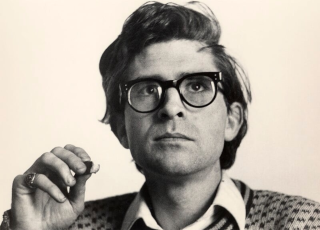
John Arden, English playwright, dies on March 28, 2012, in Galway, County Galway. At the time of his death, he is lauded as “one of the most significant British playwrights of the late 1950s and early 60s.”
Arden is initially associated with the English Stage Company at the Royal Court Theatre in London. His 1959 play, Serjeant Musgrave’s Dance, in which four army deserters arrive in a northern mining town to exact retribution for an act of colonial violence, is considered to be his best. His work is influenced by Bertolt Brecht and epic theatre as in Left-Handed Liberty (1965, on the anniversary of Magna Carta). Other plays include Live Like Pigs, The Workhouse Donkey, and Armstrong’s Last Goodnight, the last of which is performed at the 1963 Chichester Festival by the Royal National Theatre after it was rejected by the Royal Court.
Arden’s 1978 radio play Pearl is considered in a Guardian survey to be one of the best plays in that medium. He also writes several novels, including Silence Among the Weapons, which is shortlisted for the Booker Prize in 1982, and Books of Bale, about the Protestant apologist John Bale. He is a member of the Royal Society of Literature.
With his wife and co-writer Margaretta D’Arcy, Arden pickets the Royal Shakespeare Company (RSC) premiere of his Arthurian play The Island of the Mighty, because they believe the production to be pro-imperialist. They write several plays together which are highly critical of British presence in Ireland, where he and D’Arcy live from 1971 onward.
In 1961, Arden is a founder member of the anti-nuclear Committee of 100, and he also chairs the pacifist weekly Peace News. In Ireland, he is for a while a member of Official Sinn Féin. He is an advocate of civil liberties, and opposes anti-terror legislation, as demonstrated in his 2007 radio play The Scam.
Arden is elected to Aosdána in 2011 before dying in Galway on March 28, 2012. He is waked in a wicker casket.
(Pictured: Photograph of John Arden, 1960 bromide print on card mount, credit to Roger Mayne, National Portrait Gallery, London)
Irish rock band U2 records the video for “Where the Streets Have No Name” on the rooftop of the Republic Liquor store in downtown Los Angeles on March 27, 1987, at a time when MTV still shows videos and U2 is unquestionably the biggest band in the world. The video shows police advising the U2 crew that they will shut down the performance due to crowd safety.
It takes place on the rooftop of the Republic Liquor store at 7th and Main. The location is now Margarita’s Place, a Mexican restaurant that still draws tourists. The impromptu performance is an homage to the Beatles final concert, as depicted in the film Let It Be. As lead vocalist and primary lyricistBono says at the time, “It’s not the first time we’ve ripped off the Beatles.
The video shows the police about to shut down the show at any moment with one cop heard saying, “You’re drawing people in here from Orange County and all over the goddamned place. We’re shutting this location down.” According to band manager Paul McGuinness, the confrontation is overly dramatized. The band is hoping to get shut down by the authorities to garner publicity, but the police let them play.
The video is directed by Meiert Avis and produced by Michael Hamlyn and Ben Dossett and goes on to win a Grammy Award for Best Performance Music Video. Hamlyn is almost arrested following a confrontation with the police, according to an interview with Uncut magazine. Avis later says that “getting busted was an integral part of the plan.”
Bass guitaristAdam Clayton later says, “The object was to close down the streets. If there’s one thing people in L.A. hate, it’s streets closing down, and we’ve always felt bands should shake things up. We achieved it because the police stopped us filming. Were we worried about being arrested? Not at the time.”
The performance actually is not quite as impromptu as it appears. Prior to filming, a week is spent reinforcing the roof of the liquor store to ensure it will not collapse if fans swarmed onto it, according to Wikipedia. A backup generator is also put on the roof so shooting can continue if the authorities shut off the power on the primary generator. They also rebuild the sign for The Million Dollar Hotel, which can be seen in the background, as an added draw in case no one shows up.
The performance attracts about 1,000 people, not the 30,000 predicted in the radio clips at the beginning of the video. The audio is actually a studio recording, although the band plays four versions of the opening track hit from their 1987 album The Joshua Tree.
(From: “Flashback Monday: U2 Performs On A Roof In Downtown L.A.” by Sharon Knolle, LAist of Southern California Public Radio, laist.com, September 22, 2013)





 seamus dubhghaill