In 2006 Feeley completes a doctorate (Doctor of Philosophy in Music [Performance]) at Maynooth University, which involves a major thesis in three volumes with the title Classical Guitar Music by Irish Composers: Performing Editions and Critical Commentary.
Feeley is an enthusiastic champion of contemporary Irish music and in this capacity has commissioned works from many of Ireland’s leading composers including Seóirse Bodley, John Buckley, Jerome de Bromhead, Jane O’Leary, Brent Parker and Eric Sweeney. He also has a great interest in traditional Irish and Scottish music and has recorded with The Chieftains and published his own arrangements of traditional melodies.
Feeley has been described by The Washington Post as “Ireland’s leading classical guitarist” and by Michael Dervan in The Irish Times as “a trailblazer … when it comes to the guitar and guitar-playing in Ireland.”
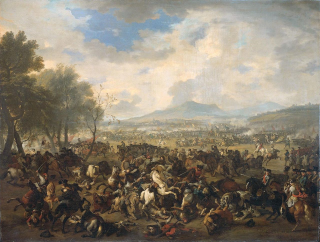
For the Grand Alliance – Austria, England, and the Dutch Republic – the Battle of Ramillies follows an indecisive campaign against the Bourbon armies of King Louis XIV of France in 1705. Although the Allies capture Barcelona that year, they are forced to abandon their campaign on the Moselle, stall in the Spanish Netherlands and suffer defeat in northern Italy. Yet despite his opponents’ setbacks Louis XIV wants peace, but on reasonable terms. Because of this, as well as to maintain their momentum, the French and their allies take the offensive in 1706.
In less than four hours Marlborough’s Dutch, English, and Danish forces overwhelm Villeroi’s and Maximilian II Emanuel‘s Franco-Spanish-Bavarian army. The Duke’s subtle moves and changes in emphasis during the battle, something his opponents fail to realise until it is too late, catches the French in a tactical vice. With their foe broken and routed, the Allies are able to fully exploit their victory. Town after town falls, including Brussels, Bruges and Antwerp. By the end of the campaign Villeroi’s army has been driven from most of the Spanish Netherlands. With Prince Eugene of Savoy‘s subsequent success at the Siege of Turin in northern Italy, the Allies impose the greatest loss of territory and resources that Louis XIV would suffer during the war. Thus, the year 1706 proves, for the Allies, to be an annus mirabilis.
(Pictured: “The Battle of Ramillies between the French and the English, 23 May 1706” by Jan van Huchtenburgh, oil on canvas painted between 1706 and 1710)
Bill Whelan, composer and musician, is born in Limerick, County Limerick, on May 22, 1950. He is best known for composing a piece for the interval of the 1994 Eurovision Song Contest. The result, Riverdance, is a seven-minute display of traditional Irish dancing that becomes a full-length stage production and spawns a worldwide craze for Irish dancing and Celtic music. It also wins him a Grammy. Riverdance is released as a single in the UK in 1994, credited to “Bill Whelan and Anúna featuring the RTÉ Concert Orchestra.” It reaches number 9 and stays on the charts for 16 weeks. The album of the same title reaches number 31 in the album charts in 1995.
Whelan also composes a symphonic suite version of Riverdance, with its premiere performed by the Ulster Orchestra on BBC Radio 3 in August 2014.
As an arranger and composer, Whelan’s credits include:
The Seville Suite, which is inspired by the exploits of Aodh Rua Ó Dónaill from the Battle of Kinsale in 1601 until his arrival in Galicia to the welcome of The Spanish Earl of Caraçena. In addition to the orchestra, The Seville Suite includes Celtic music on uilleann pipes, accordion, bodhrán, fiddle as well as Galician harp, whistles and pipes.
The Spirit of Mayo, performed by an 85-piece orchestra in Dublin‘s National Concert Hall and featuring a powerful Celtic drum corps and a 200 strong choir and choral group Anúna.
Whelan’s Celtic/Orchestral release, The Connemara Suite, features the Irish Chamber Orchestra along with soloists Zoë Conway, Morgan Crowley, Colin Dunne (Dance Percussion) and Fionnuala Hunt.
O’Connell is tutored at home in Latin and Greek, and before he is sixteen, he leaves with his cousin, Murty O’Connell, to join the French army. On February 13, 1760, he becomes a cadet in the Régiment de Royal Suédois. He spends almost his entire career in France or serving abroad with French regiments, but remains in close contact with his family, being in constant correspondence with the head of the clan, his brother Maurice O’Connell, who is almost twenty years his senior, and later arranging army appointments for a host of young nephews and cousins.
O’Connell serves with the Royal Suédois in the last two campaigns of the Seven Years’ War and is made assistant adjutant (sous-aide-major) of the regiment. At the close of the war, he is recommended for the military academy of Strasbourg (1765–66). He has a talent for self-advancement and is well regarded by his seniors, being tall, strong, handsome, disciplined, industrious, and sober. He has an almost morbid horror of drink, and his great boast is that he has never wasted a moment of his time or a farthing of his money.
Appointed to Col. Meade’s regiment of Lord Clare’s Irish Brigade with the rank of captain in October 1769, he sets sail immediately for Mauritius. Two years later he is allowed a visit home to Kerry for the first time in eleven years. In 1775 the death of Lord Clare’s son and the extinction of the title results in the reduction of the Irish Brigade and destroys O’Connell’s chance of promotion. He devotes himself to the study of chemistry, literature, and the military. A published study, Discipline of the army, comes under the notice of the military authorities, who obtain for him a Cross of Saint Louis, a pension of 2,000 livres a year, and the rank of lieutenant-colonel with which he is posted to his old regiment, the Royal Suédois, in 1778. With them he serves at the taking of Menorca in 1781 and is severely wounded at the Great Siege of Gibraltar in 1782 but manages to save the life of Charles Philippe, Count of Artois, the future Charles X. For these services he is made a count, one of only twenty-two people outside the royal family to receive this honour, and is made colonel of the German regiment of Salm-Salm in French pay, which at a grand review of 30,000 French troops in Alsace in 1785 is pronounced the best regiment. He begins to move in court circles and in 1788 kisses the hand of Marie Antoinette and rides in the king’s coach.
In 1788 O’Connell recommends to his brother Maurice the college of Saint-Omer as a suitable school for his nephews, Maurice and Daniel O’Connell, but taking belated notice of the gathering revolutionary storm, tries unsuccessfully to dissuade them. During the French Revolution of 1789 he allegedly announces his readiness to move his regiment into the capital to disperse revolutionary mobs but is not able to obtain the king’s permission. In 1790 his men mutiny, leaving him in the anomalous position of a colonel without a regiment. A protégé of the Ancien Régime, he nevertheless remains in Paris in 1790–91, serving the nouveau régime as a member of a commission engaged in revising army regulations.
In 1792 O’Connell joins Charles William Ferdinand, Duke of Brunswick‘s émigré army at Koblenz and takes part in the disastrous Battle of Valmy in Berchini’s regiment. Ever cautious, he serves as a private, refusing any command so that his name would not be mentioned in France. In November 1792 he is in London, almost penniless and bent on concealing that he had served against the republic. An alibi is procured and attested at Tralee to the effect that O’Connell had been in Ireland all the time and was forwarded to Paris to prevent the confiscation of property.
In London O’Connell petitions William Pitt the Younger to reconstruct the Irish Brigade in the service of George III. Six regiments are raised, with O’Connell appointed colonel of the 4th, but the scheme is only partially realised as three of the regiments are sent to the West Indies and Nova Scotia, where they succumb to pestilence. By 1798 the brigade has entirely ceased to exist, though he retains his full pay as a British colonel, which he draws to the end of his life. At this period his name is mooted by Gen. Henry Clarke and Theobald Wolfe Tone as a possible commander of their troops. Clarke gives his opinion that O’Connell is a good parade officer but has no genius in command, to which Wolfe Tone replies that he “was in favour of his being employed for I know he hates England.”
In 1796, O’Connell marries Martha, comtesse de Bellevue (née Drouillard de Lamarre; d. 1807), a young widow with three children, at the French chapel in Covent Garden. In 1802 he takes advantage of the peace of Amiens to return to France. On the renewal of war, the couple is detained by Napoleon as British subjects, and remain virtual prisoners in France until the restoration of the Bourbons in 1814. Back in favour, O’Connell receives the rank of lieutenant-general in the French army and commander of the Order of Saint Louis. His fortunes revive, he advances a large sum to his nephew Daniel to save him from bankruptcy in 1815 and comes to his rescue again in 1818, though by this date he has already settled the bulk of his fortune on his great-nephews. He follows his namesake’s career with keen interest, but his advice is invariably cautious and is not much heeded. After the French Revolution of 1830 he refuses to take the oath of allegiance to Louis Philippe I and is struck off the military list, though he becomes a naturalised French citizen in 1831.
O’Connell dies on July 9, 1833, at the Château de Bellevue at Meudon, near Blois, and is buried at the cemetery at Coudé. He has no children and his title, though not his fortune, descends to his godson, the Baron d’Eschegoyen’s second son, who takes the name O’Connell. A portrait by Paul Guérin hangs in Derrynane House.
(From: “O’Connell, Count Daniel Charles” by Bridget Hourican, Dictionary of Irish Biography, http://www.dib.ie)
On his release Coote returns to England, is promoted major in the 47th (Lancashire) Regiment of Foot in 1783, and in 1784 inherits the substantial estates of his uncle Sir Eyre Coote. He inherits a further £200,000 by remainder on his father’s death in 1796. He resides for a time at Portrane House, Maryborough, Queen’s County, and is elected MP for Ballynakill (1790–97) and Maryborough (1797–1800). Although he opposes the union, he vacates his seat to allow his elder brother Charles, 2nd Baron Castle Coote, to return a pro-union member. He serves with distinction in the West Indies (1793–95), particularly at the storming of Guadeloupe on July 3, 1794, and becomes colonel of the 70th (Surrey) Regiment of Foot (1794), aide-de-camp to King George III (1795), and brigadier-general in charge of the camp at Bandon, County Cork (1796).
Coote is active in suppressing the United Irishmen in Cork throughout 1797, and in June arrests several soldiers and locals suspected of attempting to suborn the Bandon camp. On January 1, 1798, he is promoted major-general and given the command at Dover. He leads the expedition of 1,400 men that destroy the canal gates at Ostend on May 18, 1798, holding out stubbornly for two days against superior Dutch forces until he is seriously wounded and his force overwhelmed. Taken prisoner, he is exchanged and in 1800 commands a brigade in Sir Ralph Abercromby‘s Mediterranean campaign, distinguishing himself at Abu Qir and Alexandria. For his services in Egypt, he receives the thanks of parliament, is made a Knight of the Bath, and is granted the Crescent by the Sultan.
In 1801 Coote returns to Ireland. Elected MP for Queen’s County (1802–06), he generally supports the government and is appointed governor of the fort of Maryborough. He gives the site and a large sum of money towards the building of the old county hospital in Maryborough. In 1805 he is promoted lieutenant-general, and he serves as lieutenant-governor of Jamaica (1806–08). His physical and mental health deteriorates in the West Indian climate, and he is relieved of his post in April 1808. He is second in command in the Walcheren Campaign of 1809 and leads the force that takes the fortress of Flushing. However, he shows signs of severe stress during the campaign and asks to be relieved from command because his eldest daughter is seriously ill.
Coote is conferred LL.D. at Trinity College, Cambridge in 1811. Elected MP for Barnstaple, Devon (1812–18), he usually votes with government, but opposes them by supporting Catholic emancipation, claiming that Catholics strongly deserve relief because of the great contribution Catholic soldiers had made during the war. He strongly opposes the abolition of flogging in the army. Despite a growing reputation for eccentricity, he is promoted full general in 1814 and appointed Knight Grand Cross (GCB) on January 2, 1815, but his conduct becomes increasingly erratic. In November 1815 he pays boys at Christ’s Hospital school, London, to allow him to flog them and to flog him in return. Discovered by the school matron, he is charged with indecent behaviour. The Lord Mayor of London dismisses the case and Coote donates £1,000 to the school, but the scandal leads to a military inquiry on April 18, 1816. Although it is argued that his mind had been affected by the Jamaican sun and the deaths of his daughters, the inquiry finds that he is not insane and that his conduct is unworthy of an officer. Despite the protests of many senior officers, he is discharged from the army and deprived of his honours.
Coote continues to decline and dies in London on December 10, 1823. He is buried at his seat of West Park, Hampshire, where in 1828 a large monument is erected to him and his uncle Sir Eyre Coote.
Coote first marries Sarah Robard in 1785, with whom he has three daughters, all of whom die young of consumption. Secondly, he marries in 1805, Katherine, daughter of John Bagwell of Marlfield, County Tipperary, with whom he has one son, his heir Eyre Coote III, MP for Clonmel (1830–33). He also has a child by Sally, a slave girl in Jamaica, from whom Colin Powell, United States Army general and Secretary of State, claims descent.
Hardiman’s father is an Irish broadcasting executive. He listens to rock & roll and pop as a child. He has three sisters and one brother, and they all play traditional musical instruments. He attends St. Kilian’s German School and the Royal Academy of Music.
In 1978, at the age of 17, Hardiman begins working as a clerk at the Bank of Ireland, a position he holds for twelve years. He occasionally performs in local bands. In 1990, he quits his job and begins composing material based on Irish traditions for radio and television. He writes the theme music to the documentary My Riviera.
Hardiman’s television work includes commissions for the title music for RTÉ Irish National Television Network News, and the original score for the natural history series Waterways. He also writes music for commercials for Guinness and the Irish National Lottery. In motion pictures, he earns acclaim for his score to the 1996 feature My Friend Joe, which garners the Crystal Bear for Best Children’s Film at the Berlin International Film Festival.
Also in 1996, Hardiman is contacted by Michael Flatley, who quickly needs a soundtrack to his new show, Lord of the Dance. The show is an international hit.
In 1997, Hardiman releases his debut solo album, Solas, and a year later he resurfaces with Feet of Flames. His 2000 release, Anthem, blends the Celtic music sounds that he is famous for with more pop influences. The track “Ancient Lands” from Anthem is used by the 2002 Winter Olympics men’s figure skating champion, Alexei Yagudin, in his program “Overcome.”
Ronan’s sisters include the notable neurologistOrla Hardiman and the filmmaker Neasa Hardiman. He lives in Dublin, with his wife, Helen, and they have one daughter and one son.
The 860-ruling Unionist Party council had been scheduled to meet on Saturday, May 13, but postponed the session for a week to allow Trimble to broaden his support among unionists still opposed to the deal. The council is expected to vote on resuming participation in a joint executive, which had been suspended on February 11 after the Irish Republican Army (IRA) failed to initiate disarmament.
The postponement of the unionist council meeting means a scheduled restart of devolution two days later will also be postponed. Great Britain and Ireland had offered to restore the Northern Ireland Assembly and a power-sharing executive composed of unionist, nationalist and republican members by May 22.
Great Britain and Ireland are co-sponsors of the 1998 Good Friday Agreement on reconciliation between the Catholic and Protestant communities. Trimble tells news media he is ready to support a return to sharing power with Sinn Féin, the IRA’s political wing, after receiving assurances on the arms issue.
Earlier in the month, the IRA broke the stalemate with an offer to put its arms arsenals beyond use under international supervision. The IRA offer fell short of a pledge to submit its weapons to destruction, as was understood from previous talks on the issue, but both Great Britain and Ireland back the compromise and press for its acceptance by unionists and nationalists as well.
Great Britain’s Northern Ireland SecretaryPeter Mandelson describes the postponement as the “correct decision.” He says, “David Trimble has been clarifying some issues and driving a hard bargain over others. Now he needs time to present the outcome to his party.” He says he is confident that Trimble will be successful and the way will then be paved for the return to power-sharing.
However, hard-line Ulster Unionist leader Jeffrey Donaldson says he does not believe that weapons will be put beyond use. “What we actually need to know and hear from the IRA is are they going to decommission their weapons?” Donaldson, a member of the British parliament, says in a BBC interview. “We haven’t had any clarification from the IRA.”
British Prime MinisterTony Blair says in parliament on Wednesday, May 17, the IRA offer to put its weapons “beyond use” is “an important confidence-building measure” but only the start of a process of silencing the guns. “We need to make progress until the time when these weapons are indeed completely, verifiably, beyond use,” Blair says.
(From: “Unionist leader says he will back Ulster deal,” UPI Archives, http://www.upi.com/archives, May 18, 2000)
Healy is the second son of Maurice Healy, clerk of the Bantry Poor Law Union, and Eliza Healy (née Sullivan). His elder brother, Thomas Healy (1854–1924), is a solicitor and Member of Parliament (MP) for North Wexford and his younger brother, Maurice Healy (1859–1923), with whom he holds a lifelong close relationship, is a solicitor and MP for Cork City.
Healy then moves to England in 1871, working first as a railway clerk and then from 1878 in London as parliamentary correspondent of The Nation, writing numerous articles in support of Charles Stewart Parnell, the newly emergent and more militant home rule leader, and his policy of parliamentary obstructionism. Healy takes part in Irish politics and becomes associated with Parnell and the Irish Parliamentary Party. After being arrested for intimidation in connection with the Irish National Land League, he is promptly elected as member of Parliament for Wexford Borough in 1880.
In Parliament, Healy becomes an authority on the Irish land question. The “Healy Clause” of the Land Law (Ireland) Act 1881, which protects tenant farmers’ agrarian improvements from rent increases imposed by landlords, not only makes him popular throughout nationalist Ireland but also wins his cause seats in ProtestantUlster. He breaks with Parnell in 1886 and generally remains at odds with subsequent leaders of the Irish Parliamentary Party, though he is a strong supporter of proposals for Irish Home Rule. Meanwhile, he is called to the Irish bar in 1884 and becomes a queen’s counsel in 1899.
Healy believes that he has been awarded the Governor-Generalship for life. However, the Executive Council of the Irish Free State decides in 1927 that the term of office of Governors-General will be five years. As a result, he retires from the office and public life in January 1928 and publishes his extensive two volume memoirs later in that year. Throughout his life he is formidable because he is ferociously quick-witted, because he is unworried by social or political convention, and because he knows no party discipline. Towards the end of his life, he becomes more mellowed and otherwise more diplomatic.
Boylan is born in Dublin on April 21, 1948, the youngest of three daughters of Patrick Boylan, a clerk, and his wife Evelyn (née Selby). Her mother feels trapped by the limitations that domesticity imposes on women in 1950s Ireland, and had wanted to have a writing career. She encourages her daughter to send off stories and poems to newspapers. The first piece is published when she is 14, and she wins a prize in the national Texaco Children’s Art Competition when she is about 10 years old.
The family lives in the Dublin suburb of Terenure. Boylan goes to school in the Presentation convent, then St. Louis convent in Rathmines, and does her leaving certificate in Rathmines College.
After leaving St. Louis convent, Boylan takes a job as a sales assistant in a bookshop before beginning her career as a journalist at The Irish Press, now defunct. She marries Alan Wilkes, a journalist who is a colleague at The Irish Press, in St. Patrick’s Church in Straffan, County Kildare, on September 18, 1970. In 1974 she wins the Journalist of the Year award when working in the city for the Evening Press. Later in her career she edits the glossy magazine Image, before largely giving up journalism to focus on a career as an author.
Boylan’s novels are Holy Pictures (1983), Last Resorts (1984), Black Baby (1988), Home Rule (1992), Beloved Stranger (1999), Room for a Single Lady (1997), which wins the Spirit of Light Award and is optioned for a film, and Emma Brown (2003). The latter work is a continuation of a 20-page fragment written by Charlotte Brontë before her death.
Boylan’s short stories are collected in A Nail on the Head (1983), Concerning Virgins (1990) and That Bad Woman (1995). The film Making Waves, based on her short story “Some Ladies on a Tour”, is nominated for an Oscar in 1988.
Boylan’s non-fiction includes The Agony and the Ego (1994) and The Literary Companion to Cats (1994). She writes introductions to the novels of Kate O’Brien and Molly Keane and adapts Keane’s novel Good Behaviour as the classic serial for BBC Radio 4 (2004). Her work has been translated as far afield as Russia and Hong Kong.
In later life, Boylan lives in County Wicklow with her husband. When she is diagnosed with ovarian cancer, she faces her illness with characteristic strength. She takes up kickboxing and spends time in France, shopping, cooking and entertaining friends. She succumbs to cancer at the age of 58 on May 16, 2006.
In 1802 Corry is dismissed from the Exchequer and replaced by John Foster (later Lord Oriel), he is awarded, however, £2,000 p.a. in compensation. In 1806 the changes in ownership of the Newry estates alters his position. The lands pass to a senior line of the Needham family and they support General Francis Needham, 1st Earl of Kilmorey, at the general election. Corry does not have the funds needed, in excess of £5000, to purchase a seat elsewhere. However, Lady Downshire is inclined to support the Grenville ministry and comes to a formal agreement with Corry to give him £1000 towards his expenses should he be successful in Newry, and, if not, to bring him in for another borough. He fails against the Needham interest in Newry, but a seat at Newport, Isle of Wight, is purchased for him, with £4000 from Lady Downshire, and he is appointed to the Board of Trade. Six months later Grenville’s ministry has fallen and there is another general election. Corry stands, again unsuccessfully, for Newry.
Corry is unmarried but has a long-term relationship with Jane Symms. They have three sons and three daughters. His daughter Ann marries Lt. Col. Henry Westenra, the brother of Robert Cuninghame, 1st Baron Rossmore. His residence in Newry is the Abbey Yard, now a school, and Derrymore House, Bessbrook, County Armagh, which he had inherited from his father and sold in 1810. It is now the property of the National Trust. During his life, a road is constructed from near the main entrance of Derrymore House around Newry and links up with the Dublin Road on the southern side of the town primarily for his use. This road subsequently becomes known as “The Chancellor’s Road,” as a result of his term as the Irish Chancellor of the Exchequer. A local legend has it that the road is constructed after an incident in which Corry’s stagecoach is stoned while passing through Newry by people angry at an unpopular window tax he had introduced. The road has retained this name, but it is cut in half by the Newry by-pass in the mid-1990s, however, as a result of works associated with the new A1 dual carriageway, the two-halves of the road are now reconnected.





 seamus dubhghaill