seamus dubhghaill

Promoting Irish Culture and History from Little Rock, Arkansas, USA


Leave a comment

Death of Poet & Barrister Samuel Ferguson

sir-samuel-ferguson

Sir Samuel Ferguson, Irish poet, barrister, antiquarian, artist, and public servant, dies in Howth, County Dublin on August 9, 1886. Ferguson is perhaps the most important Irish poet of the 19th century. Due to his interest in Irish mythology and early Irish history he is seen as a forerunner of William Butler Yeats and the other poets of the Irish Literary Revival.

Ferguson is born in Belfast on March 10, 1810. He lives at a number of addresses, including Glenwhirry, where he acquires the love of nature that informs his later work. He is educated at the Belfast Academy and the Belfast Academical Institution and then moves to Dublin to study law at Trinity College, obtaining his bachelor’s degree in 1826 and his master’s degree in 1832.

Because his father has exhausted the family property, Ferguson is forced to support himself through his student years. He turns to writing and is a regular contributor to Blackwood’s Magazine by the age of 22. He is called to the bar in 1838, but continues to write and publish, both in Blackwood’s and in the newly established Dublin University Magazine.

Ferguson settles in Dublin, where he practises law. In 1848, he marries Mary Guinness, a great-great-niece of Arthur Guinness and the eldest daughter of Robert Rundell Guinness, founder of Guinness Mahon bank. At the time he is defending the Young Irelander poet Richard Dalton Williams.

In addition to his poetry, Ferguson contributes a number of articles on topics of Irish interest to antiquarian journals. In 1863, he travels in Brittany, Ireland, Wales, England, and Scotland to study megaliths and other archaeological sites. These studies are important to his major antiquarian work, Ogham Inscriptions in Ireland, Wales and Scotland, which is edited after his death by his widow and published in 1887.

His collected poems, Lays of the Western Gael is published in 1865, resulting in the award of a degree LL.D. honoris causa from Trinity College. He writes many of his poems in both Irish and English translations. In 1867, Ferguson retires from the bar to take up the newly created post of Deputy Keeper of the Public Records in Ireland. As reward for his services, he receives a knighthood in 1878.

Ferguson’s major work, the long poem Congal is published in 1872 and a third volume, Poems, in 1880. In 1882, he is elected President of the Royal Irish Academy, an organisation dedicated to the advancement of science, literature, and antiquarian studies. His house in North Great George’s St., Dublin, is open to everyone interested in art, literature or music.

Ferguson dies on August 9, 1886, in Howth, just outside Dublin city, and is buried in Donegore near Templepatrick, County Antrim.

Leave a comment

The Battle of Dungan’s Hill

battle-of-dungans-hill

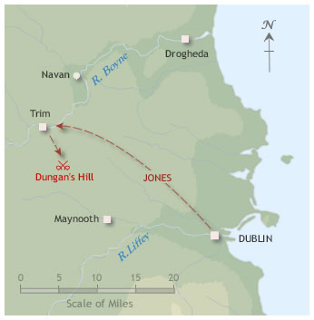
The Battle of Dungan’s Hill takes place in County Meath on August 8, 1647. It is fought between the armies of Confederate Ireland and the Parliament of England during the Wars of the Three Kingdoms. The battle takes place near the modern village of Summerhill and along the present main road between Trim and Kilcock.

By 1647, The Irish Catholic Confederation controls all of Ireland except for Parliamentarian enclaves around Dublin and Cork and a Scottish outpost in Ulster. The previous year they had rejected a treaty with the English Royalists in favour of eliminating the remaining British forces in Ireland.

In August 1647, the Confederate Leinster army under Thomas Preston is attempting to take Dublin from the English Parliamentarian garrison under Michael Jones, when it is intercepted by the Roundheads and forced to give battle. Jones had marched to Trim to relieve the Parliamentarian outpost there at Trim Castle. Preston, who had been shadowing Jones’ movements, attempts to march on Dublin before Jones’ army returns there, but covers only 12 of the 40 miles before being caught at Dungan’s Hill, where the Confederate forces have to form up for battle.

From a Parliamentarian point of view, victory in this battle is presented to them by the incompetence of the Irish commander. Preston is a veteran of the Thirty Years’ War, where he had been a commander of the Spanish garrison at Leuven, but has no experience in open warfare or handling cavalry. Jones, by contrast, had been a cavalry officer in the English Civil War. As a result, Preston tries to move his cavalry along a narrow covered lane where they are trapped and subjected to enemy fire without being able to respond. Even worse, Preston has placed a large number of his troops in wheat fields over seven feet tall. As a result these troops are unable to see the Parliamentarians until it is too late. With the Confederate army spread out and in confusion, Jones’ troops fall in amongst them causing the demoralised Irish cavalry to flee the field, leaving the remainder of Preston’s infantry unsupported.

The Confederate army’s infantry are primarily equipped with pikes and heavy muskets and trained to stand in tercios in the Spanish manner. This means they are difficult to break, but also highly immobile, without cavalry to cover their cumbersome formation when it moves. What is worse, Preston has positioned them in a large walled field, so that when their cavalry has run away, the Parliamentarians can surround and trap them. Some of the Irish infantry, Scottish Highlanders brought to Ireland by Alasdair Mac Colla, manage to charge and break through Jones’ men and escape into a nearby bog, where the English cavalry could not follow. Preston and 2,000 to 3,000 of his regular infantry manage to follow the Highlanders to safety, but the remainder are trapped.

What happens next is disputed. The Irish infantry manages to hold off several assaults on their position, before trying to follow their comrades into the safety of the bog. This makes them lose their formation and the Parliamentarians get in amongst them and then surround them in the bogland. Parliamentarian accounts simply say that the Irish force is then destroyed. Irish accounts, however, claim that the Confederate troops surrender and are then massacred. One account, by a Catholic friar named O Meallain, says that the corpses of the Irish foot soldiers are found with their hands tied. A recent study suggests that the Irishmen probably tried to surrender, but that, according to the conventions of 17th century warfare, this had to be accepted before it entitled them to safety. In this case, it was not accepted and the infantrymen were butchered.

Around 3,000 Confederate troops and a small number of Parliamentarians die at Dungan’s Hill. One of the English regimental commanders, Colonel Anthony Hungerford, is shot in the mouth, a wound that invalids him out of the English Army. Most of the dead are Irish infantrymen killed in the last stage of the battle. Those prisoners who are taken are mainly officers, whom the Parliamentarians can either ransom or exchange for prisoners of their own. Richard Talbot, a junior cavalry officer but later Earl of Tyrconnell and Lord Deputy of Ireland, is among the Confederate prisoners.

In the immediate aftermath of the battle, Owen Roe O’Neill‘s Ulster Army marches through the pass of Portlester Mill to mount an effective rearguard action, routing Jones’ advanced brigade and enabling the survivors of the Leinster army to escape. Jones, fearing O’Neills army, does not continue the pursuit and returns to Dublin. O’Neill and his Ulstermen return four months later to bury the dead Confederates.


Leave a comment

Birth of Elizabeth Gurley Flynn, Activist & Feminist

elizabeth-gurley-flynn

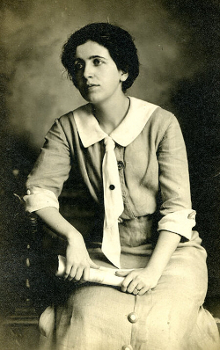
Elizabeth Gurley Flynn, labor leader, activist, and feminist who played a leading role in the Industrial Workers of the World (IWW), is born in Concord, New Hampshire on August 7, 1890. She is a founding member of the American Civil Liberties Union and a visible proponent of women’s rights, birth control, and women’s suffrage.

Flynn’s family moves to New York in 1900, where she is educated in the local public schools. She grows up being regaled by tales of Irish revolutionaries. According to their oral tradition all four of her great-grandfathers, Flynn, Gurley, Conneran, and Ryan, are members of the Society of United Irishmen, with grandfather Flynn being one of the leaders in County Mayo when the French fleet lands there during the Irish Rebellion of 1798. Her parents introduce her to socialism. When she is only fifteen, she gives her first public speech, “What Socialism Will Do for Women,” at the Harlem Socialist Club.

In 1907, Flynn becomes a full-time organizer for the Industrial Workers of the World. Over the next few years, she organizes campaigns among garment workers in Pennsylvania, silk weavers in New Jersey, restaurant workers in New York, miners in Minnesota, Missoula, Montana, and Spokane, Washington and textile workers in Massachusetts. She is arrested ten times during this period but is never convicted of any criminal activity. It is a plea bargain, on the other hand, that results in her expulsion from the IWW in 1916, along with fellow organizer Joe Ettor.

A founding member of the American Civil Liberties Union (ACLU) in 1920, Flynn plays a leading role in the campaign against the conviction of Nicola Sacco and Bartolomeo Vanzetti. She is particularly concerned with women’s rights, supporting birth control and women’s suffrage. She also criticizes the leadership of trade unions for being male-dominated and not reflecting the needs of women.

Between 1926 and 1936, Flynn lives in southwest Portland, Oregon with birth control activist, suffragette, and Wobbly Marie Equi where she is an active and vocal supporter of the 1934 West Coast Longshoremen’s Strike. In 1936, she joins the Communist Party and writes a feminist column for its journal, the Daily Worker. Two years later, she is elected to the national committee. Her membership in the Party leads to her ouster from the board of the ACLU in 1940.

During World War II, Flynn plays an important role in the campaign for equal economic opportunity and pay for women and the establishment of day care centers for working mothers. In 1942, she runs for the United States Congress at-large in New York and receives 50,000 votes. In July 1948, a dozen leaders of the Communist Party are arrested and accused of violating the Smith Act by advocating the overthrow of the U.S. government by force and violence. After they are convicted in the Foley Square trial they appeal to the Supreme Court, which upholds their conviction in Dennis v. United States.

Flynn launches a campaign for their release but, in June 1951, is herself arrested in the second wave of arrests and prosecuted under the Smith Act. After a nine-month trial, she is found guilty and serves two years in Federal Prison Camp, Alderson near Alderson, West Virginia. She later writes a prison memoir, The Alderson Story: My Life as a Political Prisoner.

After her release from prison, Flynn resumes her activities for leftist and Communist causes. She runs for the New York City Council as a Communist in 1957, garnering a total of 710 votes. She becomes national chairwoman of the Communist Party of the United States in 1961 and makes several visits to the Soviet Union.

Elizabeth Gurley Flynn dies on September 5, 1964, while on one of her visits to the Soviet Union. The Soviet government gives her a state funeral in Red Square with over 25,000 people attending. In accordance with her wishes, her remains are flown to the United States for burial in Chicago‘s German Waldheim Cemetery, near the graves of Eugene Dennis, Bill Haywood, Emma Goldman, and the Haymarket Riot Martyrs.

In 1978, the ACLU posthumously reinstates her membership.


Leave a comment

John de Wogan Ceases to be Justiciar of Ireland

picton-castle

Sir John de Wogan, Cambro-Norman judge styled lord of Picton, ceases to be Justiciar of Ireland on August 6, 1312 although remaining nominally justiciar until April 1313. He serves as Justiciar of Ireland from 1295 to 1313.

There are several dubious theories about Wogan’s ancestry, and uncertainty exists about his wives, sons, and other relations. He comes from Picton Castle in Pembrokeshire and is a vassal of William de Valence, 1st Earl of Pembroke. He comes to have lands in Pembrokeshire, Somerset, Dorset, Devon, Wiltshire, and Oxfordshire. He represents de Valence at an Irish court case in 1275, and in 1280 he is steward of Wexford, Valence’s Irish liberty. He is an eyre in England from 1281 to 1284, and returns to Ireland in 1285. In 1290 he is a referee with Hugh de Cressingham in a dispute between Queen Eleanor and de Valence and his wife.

In December 1295 Wogan takes office as justiciar and organises a two-year truce between the feuding Burkes and Geraldines. In 1296 he organises a force with Richard Óg de Burgh, 2nd Earl of Ulster, Theobald Butler, and John FitzGerald, 1st Earl of Kildare, to assist Edward I in the First War of Scottish Independence. The king entertains them at Roxburgh Castle in May. After his return to Ireland, Wogan “kept everything so quiet that we hear of no trouble in a great while.” The Parliament of Ireland he summons in 1297 is for long compared to the English “Model Parliament” of 1295, though historical opinion now places less importance on it.

In February 1308, under orders from the new king Edward II, Wogan suppresses the Knights Templar in Ireland. In June 1308 his forces are defeated by the O’Tooles and O’Byrnes, who are harrying The Pale from the Wicklow Mountains. From September 1308 to May 1309 Piers Gaveston, 1st Earl of Cornwall is in Ireland as “king’s lieutenant,” a new position outranking the justiciar, and he has more success against the Gaels. Wogan leaves Ireland in August 1312 although remaining nominally justiciar until April 1313.

Either the same John Wogan or his son of the same name returns to Ireland in 1316 as advisor to Roger Mortimer, 1st Earl of March, who counters Edward Bruce‘s invasion of Ireland.

John de Wogan dies in 1321 and is buried in St. David’s Cathedral, initially in a chapel he had endowed, later in Edward Vaughan‘s chapel.


Leave a comment

Peter O’Connor Sets World Long Jump Record

peter-oconnor

Peter O’Connor, Irish track and field athlete, sets a long-standing world long jump record of 24′ 11-3/4″ in Dublin on August 5, 1901. He also wins two Olympic medals in the 1906 Intercalated Games.

Born in Millom, Cumberland, England on October 24, 1872, O’Connor grows up in Wicklow, County Wicklow. He joins the Gaelic Athletic Association (GAA) in 1896. In 1899 he wins All-Ireland medals in long jump, high jump and hop, step and jump (triple jump). Over the next ten years he consistently beats British athletes in international competitions. The Amateur Athletic Association of England invites him to represent Britain in the 1900 Summer Olympics but he refused as he only wishes to represent Ireland.

As of June 1900, the world record for the long jump is held by Myer Prinstein of Syracuse University, at 24′ 7-1/4″. In 1900 and 1901, competing with the Irish Amateur Athletic Association (IAAA), a rival association to the GAA, O’Connor sets several unofficial world records in the long jump. He sets an officially recognised world record of 24′ 9″ at the Royal Dublin Society’s grounds in Dublin on May 27, 1901. On August 5, 1901 he jumps 24′ 11-3/4″ in Dublin. This is the first IAAF-recognised long jump world record. It causes a sensation at the time, being only a fraction short of the 25-foot barrier, and remains unbeaten for 20 years, a longevity surpassed only by Jesse Owens‘s 25-year record and Bob Beamon‘s 23-year record. It remains an Irish record for a remarkable 89 years.

In 1906 O’Connor and two other athletes, Con Leahy and John Daly, are entered for the Intercalated Games in Athens by the IAAA and GAA, representing Ireland. However, the rules of the games are changed so that only athletes nominated by National Olympic Committees are eligible. Ireland does not have an Olympic Committee, and the British Olympic Council claims the three. On registering for the Games, O’Connor and his fellow athletes find that they are listed as Great Britain, not Irish, team members.

In the long jump competition, O’Connor finally meets Myer Prinstein of the Irish American Athletic Club who is competing for the U.S. team and whose world record O’Connor had broken five years previously. The only judge for the competition is Matthew Halpin, who is manager of the American team. O’Connor protests, fearing bias, but is overruled. He continues to protest Halpin’s decisions through the remainder of the competition. When the distances are announced at the end of the competition, Prinstein is declared the winner, with O’Connor in Silver Medal position.

At the flag-raising ceremony, in protest of the flying of the Union Flag for his second place, O’Connor scales a flagpole in the middle of the field and waves the Irish flag, while the pole is guarded by Con Leahy.

In the hop, step and jump competition two days later, O’Connor beats his fellow countryman, Con Leahy, to win the Gold Medal. At 34 he is the oldest ever Gold Medal winner in this event. Prinstein, the champion in 1900 and 1904, did not medal.

O’Connor wins no more titles after 1906. He remains involved in athletics all his life. He is a founder member and first Vice-President of Waterford Athletic Club, and attends later Olympics both as judge and spectator. He practises as a solicitor in Waterford and is married with nine children. He dies in Waterford on November 9, 1957.


Leave a comment

Birth of Mathematician William Rowan Hamilton

william-rowan-hamilton

Sir William Rowan Hamilton, Irish mathematician who makes important contributions to classical mechanics, optics, and algebra, is born in Dublin on August 4, 1805.

Hamilton is the fourth of nine children born to Sarah Hutton (1780–1817) and Archibald Hamilton (1778–1819). He is part of a small but well-regarded school of mathematicians associated with Trinity College, Dublin, which he enters at age eighteen. He is said to have shown immense talent at a very early age. Astronomer Bishop Dr. John Brinkley remarks of the 18-year-old Hamilton, “This young man, I do not say will be, but is, the first mathematician of his age.”

Trinity College awards him two Optimes, or off-the-chart grades. He studies both classics and mathematics, and is appointed Professor of Astronomy just prior to his graduation. He then takes up residence at Dunsink Observatory where he spends the rest of his life.

Although Hamilton regards himself as a pure mathematician rather than a physicist, his work is of major importance to physics, particularly his reformulation of Newtonian mechanics, now called Hamiltonian mechanics. This work has proven central to the modern study of classical field theories such as electromagnetism, and to the development of quantum mechanics. In pure mathematics, he is best known as the inventor of quaternions.

Hamilton’s scientific career includes the study of geometrical optics, classical mechanics, adaptation of dynamic methods in optical systems, applying quaternion and vector methods to problems in mechanics and in geometry, development of theories of conjugate algebraic couple functions, solvability of polynomial equations and general quintic polynomial solvable by radicals, the analysis on Fluctuating Functions, linear operators on quaternions and proving a result for linear operators on the space of quaternions, which is a special case of the general theorem which today is known as the Cayley–Hamilton theorem. He also invents Icosian calculus, which he uses to investigate closed edge paths on a dodecahedron that visit each vertex exactly once.

Hamilton retains his faculties unimpaired to the very last, and steadily continues the task of finishing the Elements of Quaternions which occupies the last six years of his life. He dies on September 2, 1865, following a severe attack of gout precipitated by excessive drinking and overeating. He is buried in Mount Jerome Cemetery in Dublin.


Leave a comment

Birth of Actor Martin Sheen

martin-sheen

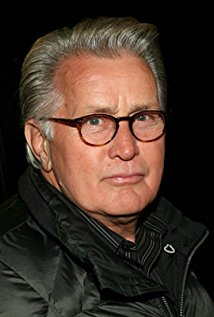
Ramón Gerard Antonio Estévez, known professionally as Martin Sheen, American actor of Spanish/Irish descent, is born in Dayton, Ohio on August 3, 1940. He first becomes known for his roles in the films The Subject Was Roses (1968) and Badlands (1973), and later achieves wide recognition for his leading role in Apocalypse Now (1979) and as President Josiah Bartlet in the television series The West Wing (1999-2006).

Sheen is born to immigrant parents, a first-generation Irish mother, Mary-Anne Phelan from Borrisokane, County Tipperary, and a Galician father, Francisco Estévez from Vigo in Galicia (Spain). He adopts the stage name Martin Sheen to help him gain acting parts from a combination of the CBS casting director Robert Dale Martin, who gives him his first big break, and the televangelist archbishop, Fulton J. Sheen. He is the father of four children (Emilio, Ramón, Carlos and Renée), all of whom are actors.

In film, Sheen has won the Best Actor award at the San Sebastián International Film Festival for his performance as Kit Carruthers in Badlands. Sheen’s portrayal of Capt. Willard in Apocalypse Now earns a nomination for the BAFTA Award for Best Actor in a Leading Role.

Sheen has worked with a wide variety of film directors, including Richard Attenborough, Francis Ford Coppola, Terrence Malick, David Cronenberg, Mike Nichols, Martin Scorsese, Steven Spielberg and Oliver Stone. He receives a star on the Hollywood Walk of Fame in 1989. In television, he has won a Golden Globe Award and two Screen Actors Guild Awards for playing the role of President Josiah Bartlet in The West Wing, and an Emmy Award for guest starring in the sitcom Murphy Brown.

Although known as an actor, Sheen also has directed one film, Cadence (1990), appearing alongside sons Charlie and Ramón. He has narrated, produced, and directed documentary television, earning two Daytime Emmy Awards in the 1980s. In addition to film and television, he has been active in liberal politics.


Leave a comment

First Use of Rubber Bullets in Northern Ireland

rubber-bullet

Rubber bullets are used for the first time in Northern Ireland on August 2, 1970. Rubber bullets are invented by the British Ministry of Defence for use against rioters in Northern Ireland during The Troubles.

Rubber bullets (also called rubber baton rounds) are rubber or rubber-coated projectiles that can be fired from either standard firearms or dedicated riot guns. They are intended to be a non-lethal alternative to metal projectiles. Like other similar projectiles made from plastic, wax and wood, rubber bullets may be used for short range practice and animal control but are most commonly associated with use in riot control and to disperse protests.

The British developed rubber rounds – the “Round, Anti-Riot, 1.5in Baton” – in 1970 for use against rioters in Northern Ireland. A low-power propelling charge gives them a muzzle velocity of about 200 feet per second and maximum range of about 110 yards. The intended use is to fire at the ground so that the round bounces up and hits the target on the legs, causing pain but not injury.

From 1970 to 1975, about 55,000 rubber bullets are fired by the British Army in Northern Ireland. Often, they are fired directly at people from close range, which results in three people being killed and many more badly injured. In 1975, they are replaced by plastic bullets. In Northern Ireland over 35 years (1970–2005), about 125,000 rubber and plastic bullets are fired – an average of ten per day – causing 17 deaths.

The baton round is made available to British police forces outside Northern Ireland from 2001. In 2013 however, Ministry of Defence papers declassified from 1977 reveal it is aware rubber bullets are more dangerous than was publicly disclosed. The documents contain legal advice for the Ministry of Defence to seek a settlement over a child who had been blinded in 1972, rather than go to court which would expose problems with the bullets and make it harder to fight future related cases. The papers state that further tests would reveal serious problems with the bullets, including that they were tested “in a shorter time than was ideal”, that they “could be lethal” and that they “could and did cause serious injuries.”

(Pictured: 37 mm British Army rubber bullet, as used in Northern Ireland)


1 Comment

Birth of Paddy Moloney, Founder of The Chieftains

paddy-moloney

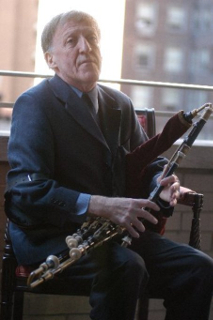
Paddy Moloney, musician, composer and producer who is the founder and leader of the Irish musical group The Chieftains, is born at Donnycarney, Dublin on August 1, 1938. He has played on every one of The Chieftains albums.

Moloney’s mother purchases him a tin whistle when he is six years old, and he starts to learn the Uilleann pipes at the age of eight. In addition to the tin whistle and the Uilleann pipes, he also plays button accordion and bodhrán.

In the late 1950s Moloney meets Seán Ó Riada and joins his group, Ceoltóirí Chualann, in the early 1960s. Along with Seán Potts and Michael Tubridy, he forms the traditional Irish band The Chieftains in Dublin in November 1962. As the band leader, he is the primary composer and arranger of much of The Chieftains’ music, and has composed for films including Treasure Island, The Grey Fox, Braveheart, and Gangs of New York.

Moloney has done session work for Mike Oldfield, The Muppets, Mick Jagger, Paul McCartney, Sting and Stevie Wonder.

Together with Garech de Brun (anglicised to Garech Browne) of Luggala, Moloney founds Claddagh Records in 1959. In 1968 he becomes a producer for the label and supervises the recording of 45 albums.

Moloney is married to artist Rita O’Reilly and has three children, Aonghus Moloney, Padraig Moloney and actress producer Aedin Moloney. He is a fluent speaker of the Irish language.

On September 13, 2012, Moloney receives Mexico‘s Ohtli Award, the country’s highest cultural award.


Leave a comment

Birth of Geologist Richard Dixon Oldham

richard-dixon-oldham

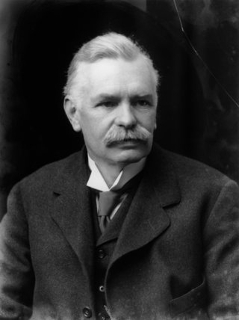
Richard Dixon Oldham, British geologist who makes the first clear identification of the separate arrivals of P-waves, S-waves and surface waves on seismograms and the first clear evidence that the Earth has a central core, is born in Dublin on July 31, 1858.

Born to Thomas Oldham, a Fellow of the Royal Society and a geologist, Oldham is educated at Rugby School and the Royal School of Mines.

In 1879 Oldham becomes an assistant-superintendent with the Geological Survey of India (GSI), working in the Himalayas. He writes about 40 publications for the Survey on geological subjects including hot springs, the geology of the Son Valley and the structure of the Himalayas and the Indo-Gangetic plain. His most famous work is in seismology. His report on the 1897 Assam earthquake goes far beyond reports of previous earthquakes. It includes a description of the Chedrang fault, with uplift up to 35 feet and reported accelerations of the ground that have exceeded the Earth’s gravitational acceleration. His most important contribution to seismology is the first clear identification of the separate arrivals of P-waves, S-waves and surface waves on seismograms. Since these observations agree with theory for elastic waves, they show that the Earth can be treated as elastic in studies of seismic waves.

In 1903, Oldham resigns from the GSI due to ill health and returns to the United Kingdom, living in Kew and various parts of Wales. In 1906 he writes a paper analyzing seismic arrival times of various recorded earthquakes. He concludes that the earth has a core and estimates its radius to be less than 0.4 times the radius of the Earth.

In 1908 Oldham is awarded the Lyell Medal, in 1911 made a Fellow of the Royal Society and from 1920 to 1922 serves as the President of the Geological Society of London.

Richard Dixon Oldham dies at Llandrindod Wells in Wales on July 15, 1936.