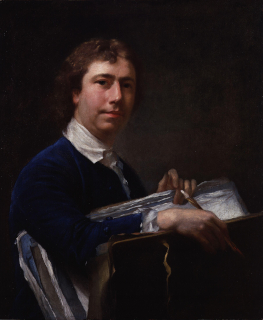
The son of a Dublin-based Dutch merchant, Hone moves to England as a young man and, after marrying Molly Earle, daughter of the John Campbell, 4th Duke of Argyll, in 1742, eventually settles in London, by which time he has acquired a reputation as a portrait-painter. While his paintings are popular, his reputation is particularly enhanced by his skill at producing miniatures and enamels. He interrupts his time in London by spending two years (1750–52) studying in Italy.
As a portrait painter, several of Hone’s works are now held at the National Portrait Gallery in London. His sitters include magistrate Sir John Fielding and Methodist preacher John Wesley, and General Richard Wilford and Sir Levett Hanson in a double portrait. He often uses his son John Camillus Hone (1745-1836) in some of his works, including his unique portrait of “The Spartan Boy,” painted in 1774.
Hone courts controversy in 1775 when his satirical picture The Conjurer (National Gallery of Ireland, Dublin) is seen to attack the fashion for Italian Renaissance art and to ridicule Sir Joshua Reynolds, leading the Royal Academy to reject the painting. It also originally includes a nude caricature of fellow Academician Angelica Kauffman in the top left corner, which is painted out by Hone after Kauffman complains to the academy. The combination of a little girl and an old man has also been seen as symbolic of Kauffman and Reynolds’s closeness, age difference, and rumoured affair. To show that his reputation is undamaged, Hone organises a one-man retrospective in London, the first such solo exhibition of an artist’s work.
The Hone family is related to the old Dutch landed family the van Vianens, who hold the hereditary title of Vrijheer. His great-grand-nephew shares the same name and is also a notable Irish painter, known as Nathaniel Hone the Younger (1831–1917). He is also a relation to painter Evie Hone.
Nathaniel Hone the Elder dies on August 14, 1784.
(Pictured: Self-portrait by Nathaniel Hone, circa 1760)
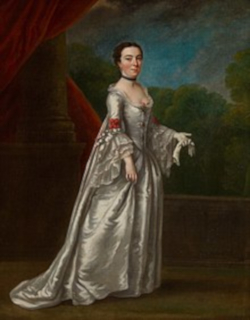
George Anne Bellamy, English actress whose stage career and personal life are, in their irregularity, not entirely atypical of her era, is born in County Fingal on April 23, 1727. Her best performances are in such tragic roles as Desdemona in Othello and Juliet in Romeo and Juliet.
Bellamy is the illegitimate daughter of a Quaker lady who elopes from boarding school with the diplomat James O’Hara, 2nd Baron Tyrawley. She is named George Anne through a mishearing of the name Georgiana at her christening. Though her mother marries a Captain Bellamy in Lisbon, Bellamy is acknowledged by Tyrawley as his daughter and he provides for her needs, including her education at a convent in Boulogne-sur-Mer. While living with her mother in London, she meets the theatrical manager John Rich and other leading stars of the stage, and she soon determines to pursue an acting career.
Bellamy’s early roles at Covent Garden, beginning about 1744, are as Miss Prue in Love for Love and with James Quin in The Orphan. Her reputation as an actress rests largely on her good looks and her “soft” feminine manner. Her career reaches its pinnacle when, in 1750, her performance of Juliet to David Garrick’s Romeo at Theatre Royal, Drury Lane is said to surpass the work of the revered Susannah Cibber in a rival production of the play at Covent Garden.
Riotous living, including a legal and a bigamous marriage, takes its toll on Bellamy’s beauty and her appeal to managers. Her later life is marred by ill health and credit troubles. Her last appearance is at Drury Lane on May 24, 1785, at her own benefit concert. She is unable to act but speaks briefly to the audience.
In the same year Bellamy publishes “An Apology for the Life of George Anne Bellamy” in six volumes. The salacious work is said to be ghost written by Alexander Bicknell.
George Anne Bellamy dies in poverty on February 16, 1788, in London.
(Pictured: George Anne Bellamy by F Lindo exhibited in 1833 now owned by Garrick Club)
The play centers on the Irish Rebellion of 1798. The play is startlingly nationalistic, in its last pages encouraging young men to sacrifice their lives for the heroine Cathleen ni Houlihan, who represents an independent and separate Irish state. The title character first appears as an old woman at the door of a family celebrating their son’s wedding. She describes her four “beautiful green fields,” representing the four provinces of Ireland, that have been unjustly taken from her. With little subtlety, she requests a blood sacrifice, declaring that “many a child will be born and there will be no father at the christening” and that “they that have red cheeks will have pale cheeks for my sake, and for all that, they will think they are well paid.” She convinces the future groom, Michael, to give up the wedding and go fight.
After the youth leaves the safety of his home to fight for her, she appears as an image of youth with “the walk of a queen,” professing of those who fight for her: “They shall be remembered forever, They shall be alive forever, They shall be speaking forever, The people shall hear them forever.”
Death is common during the time around the rising, but becoming a martyr is somethings that is admirable, so oftentimes people welcome death so they can create themselves a heroic memory. The martyrs will be remembered forever, which is why this theme is so ingrained into this play.
Cathleen ni Houlihan is such a simple play that contains many symbols and has the goal of convincing men to fight for Ireland. While the play is written about the rising of 1798, it is meant to inspire people for the 1916 Easter Rising. Throughout the whole play, there is constant reference to memory and its influence on the public. The men that die while fighting for Ireland are considered heroes, which is why memory and martyrdom are such important themes that are incorporated into works about revolution.
Cathleen ni Houlihan is about Irish Independence, but there are themes of martyrdom in other works, like the musicals about American Independence, Hamilton and 1776.
(Pictured: Scene from a production of “Cathleen ni Houlihan,” circa 1912)
Butler’s early style is that of an illustrator. He only begins to work regularly in oils in 1906. His early pictures are simple lyrical depictions of landscapes and figures, predominantly from the west of Ireland, especially of his boyhood home of Sligo. His work contains elements of Romanticism.
Yeats is born in London on August 29, 1871. He is the youngest son of Irish portraitist John Butler Yeats. He grows up in Sligo with his maternal grandparents, before returning to his parents’ home in London in 1887. Early in his career he works as an illustrator for magazines like The Boy’s Own Paper and Judy, draws comic strips, including the Sherlock Holmes parody “Chubb-Lock Homes” for Comic Cuts, and writes articles for Punch under the pseudonym “W. Bird.” In 1894 he marries Mary Cottenham, also a native of England and two years his senior and resides in Wicklow according to the Census of Ireland, 1911.
From around 1920, Yeats develops into an intensely Expressionist artist, moving from illustration to Symbolism. He is sympathetic to the Irish Republican cause, but not politically active. However, he believes that “a painter must be part of the land and of the life he paints,” and his own artistic development, as a Modernist and Expressionist, helps articulate a modern Dublin of the 20th century, partly by depicting specifically Irish subjects, but also by doing so in the light of universal themes such as the loneliness of the individual, and the universality of the plight of man. Samuel Beckett writes that “Yeats is with the great of our time… because he brings light, as only the great dare to bring light, to the issueless predicament of existence.” The Marxist art critic and author John Berger also pays tribute to Yeats from a very different perspective, praising the artist as a “great painter” with a “sense of the future, an awareness of the possibility of a world other than the one we know.”
Yeats’s favourite subjects include the Irish landscape, horses, circus and travelling players. His early paintings and drawings are distinguished by an energetic simplicity of line and colour, his later paintings by an extremely vigorous and experimental treatment of often thickly applied paint. He frequently abandons the brush altogether, applying paint in a variety of different ways, and is deeply interested in the expressive power of colour. Despite his position as the most important Irish artist of the 20th century, he takes no pupils and allows no one to watch him work, so he remains a unique figure. The artist closest to him in style is his friend, the Austrian painter, Oskar Kokoschka.
Besides painting, Yeats has a significant interest in theatre and in literature. He is a close friend of Samuel Beckett. He designs sets for the Abbey Theatre, and three of his own plays are also produced there. He writes novels in a stream of consciousness style that James Joyce acknowledges, and also many essays. His literary works include The Careless Flower, The Amaranthers, Ah Well, A Romance in Perpetuity, And To You Also, and The Charmed Life. His paintings usually bear poetic and evocative titles. He is elected a member of the Royal Hibernian Academy in 1916.
Yeats holds the distinction of being Ireland’s first medalist at the Olympic Games in the wake of creation of the Irish Free State. At the 1924 Summer Olympics in Paris, his painting The Liffey Swim wins a silver medal in the arts and culture segment of the Games. In the competition records the painting is simply entitled Swimming.
John Millington Synge, a leading figure in the Irish Literary Revival, dies in Dublin, on March 24, 1909. He is a poetic dramatist of great power who portrays the harsh rural conditions of the Aran Islands and the western Irish seaboard with sophisticated craftsmanship.
After studying at Trinity College and at the Royal Irish Academy of Music in Dublin, Synge pursues further studies from 1893 to 1897 in Germany, Italy, and France. In 1894 he abandons his plan to become a musician and instead concentrates on languages and literature. He meets William Butler Yeats while studying at the Sorbonne in Paris in 1896. Yeats inspires him with enthusiasm for the Irish renaissance and advises him to stop writing critical essays and instead to go to the Aran Islands and draw material from life. Already struggling against the progression of Hodgkin’s lymphoma which is untreatable at the time and eventually leads to his death, Synge lives in the islands during part of each year between 1898 and 1902, observing the people and learning their language, recording his impressions in The Aran Islands (1907) and basing his one-act plays In the Shadow of the Glen and Riders to the Sea (1904) on islanders’ stories. In 1905 his first three-act play, The Well of the Saints, is produced.
Synge’s travels on the Irish west coast inspire his most famous play, The Playboy of the Western World (1907). This morbid comedy deals with the moment of glory of a peasant boy who becomes a hero in a strange village when he boasts of having just killed his father but who loses the villagers’ respect when his father turns up alive. In protest against the play’s unsentimental treatment of the Irishmen’s love for boasting and their tendency to glamorize ruffians, the audience riots at its opening at Dublin’s Abbey Theatre. Riots of Irish Americans accompany its opening in New York City in 1911, and there are further riots in Boston and Philadelphia. Synge remains associated with the Abbey Theatre, where his plays gradually win acceptance, until his death. His unfinished Deirdre of the Sorrows, a vigorous poetic dramatization of one of the great love stories of Celtic mythology, is performed there in 1910.
In the seven plays he writes during his comparatively short career as a dramatist, Synge records the colourful and outrageous sayings, flights of fancy, eloquent invective, bawdy witticisms, and earthy phrases of the peasantry from County Kerry to County Donegal. In the process he creates a new, musical dramatic idiom, spoken in English but vitalized by Irish syntax, ways of thought, and imagery.
Like William Orpen, Lavery is appointed an official artist in World War I. Ill-health, however, prevents him from travelling to the Western Front. A serious car crash during a Zeppelin bombing raid also keeps him from fulfilling this role as war artist. He remains in Britain and mostly paints boats, aeroplanes, and airships. During the war years he is a close friend of H.H. Asquith‘s family and spends time with them at their Sutton Courtenay Thames-side residence, painting their portraits and idyllic pictures like Summer on the River (Hugh Lane Gallery).
After the war Lavery is knighted and in 1921 he is elected to the Royal Academy of Arts.
During this time, he and his wife, Hazel, are tangentially involved in the Irish War of Independence and the Irish Civil War. They give the use of their London home to the Irish negotiators during the negotiations leading to the Anglo-Irish Treaty. After Michael Collins is assassinated, Lavery paints Michael Collins, Love of Ireland, now in the Hugh Lane Gallery. In 1929, Lavery makes substantial donations of his work to both the Ulster Museum and the Hugh Lane Gallery and in the 1930s he returns to Ireland. He receives honorary degrees from the University of Dublin and Queen’s University Belfast. He is also made a free man of both Dublin and Belfast. A long-standing member of Glasgow Art Club, Lavery exhibits at the club’s annual exhibitions, including its exhibition in 1939 in which his The Lake at Ranelagh is included.
Augusta is the youngest daughter of the Anglo-Irish gentry family Persse. Her mother, Frances Barry, is related to Standish O’Grady, 1st Viscount Guillamore, and her family home, Roxborough, is a 6,000-acre estate located between Gort and Loughrea, the main house of which is later burned down during the Irish Civil War. She is educated at home, and her future career is strongly influenced by the family nanny, Mary Sheridan, a Catholic and a native speaker of the Irish language, who introduces the young Augusta to the history and legends of the local area.
In 1880 Augusta marries Sir William Henry Gregory, a neighbouring landowner who had previously served as a Member of Parliament and as governor of Ceylon. He is a well-educated man with many literary and artistic interests, and his estate at Coole Park houses a large library and extensive art collection, both of which Lady Gregory is eager to explore. He also has a house in London, where the couple spends a considerable amount of time.
Lady Gregory’s literary career does not begin until after Sir Gregory’s death in 1892. In 1896 she meets William Butler Yeats and becomes his lifelong friend and patron. She takes part in the foundation of the Irish Literary Theatre in 1899 and becomes a director of the Abbey Theatre in 1904, which owes much of its success to her skill at smoothing the disputes among its highly individualistic Irish nationalist founders. As a playwright, she writes pleasant comedies based on Irish folkways and picturesque peasant speech, offsetting the more tragic tones of the dramas of Yeats and John Millington Synge.
Lady Gregory writes or translates nearly forty plays. Seven Short Plays (1909), her first dramatic works, are among her best, vivid in dialogue and characterization. The longer comedies, The Image and Damer’s Gold, are published in 1910 and 1913 and her strange realistic fantasies, The Golden Apple and The Dragon, in 1916 and 1920. She also arranges and makes continuous narratives out of the various versions of Irish sagas, translating them into an Anglo-Irish peasant dialect that she labels “Kiltartan.” These are published as Cuchulain of Muirthemne (1902) and Gods and Fighting Men (1904).
Lady Gregory returns to live in Galway after ill health forces her retirement from the Abbey Theatre board in 1928, although she continues to visit Dublin regularly. The house and demesne at Coole Park are sold to the Irish Forestry Commission in 1927, with Lady Gregory retaining life tenancy. Her Galway home had long been a focal point for the writers associated with the Irish Literary Revival, and this continues after her retirement. On a tree in what were the grounds of the house, one can still see the carved initials of Synge, Æ, Yeats and his artist brother Jack, George Moore, Seán O’Casey, George Bernard Shaw, Katharine Tynan and Violet Martin.
Lady Gregory, whom Shaw once described as “the greatest living Irishwoman,” dies at the age of 80 on May 22, 1932, at home from breast cancer. She is buried in the New Cemetery in Bohermore, County Galway. The entire contents of Coole Park are auctioned three months after her death, and the house is demolished in 1941.
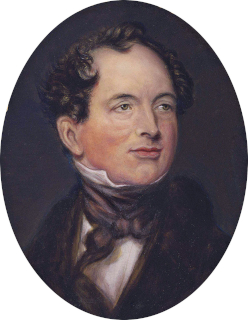
The son of a Roman Catholic wine merchant, Moore is born at 12 Aungier Street in Dublin on May 28, 1779. From a relatively early age he shows an interest in music and other performing arts. He attends several Dublin schools including Samuel Whyte’s English Grammar School in Grafton Street where he learns the English accent with which he speaks for the rest of his life. In 1795 he graduates from Trinity College, Dublin in an effort to fulfill his mother’s dream of his becoming a lawyer.
Upon graduation from Trinity, Moore studies law in London. His major poetic work, Irish Melodies (1807–34), earns him an income of £500 annually for a quarter of a century. It contains such titles as “The Last Rose of Summer” and “Oft in the Stilly Night.” The Melodies, a group of 130 poems set to the music of Moore and Sir John Andrew Stevenson and performed for London’s aristocracy, arouses sympathy and support for the Irish nationalists, among whom Moore is a popular hero.
Lalla-Rookh (1817), a narrative poem set in an atmosphere of Oriental splendour, gives Moore a reputation among his contemporaries rivaling that of Byron and Sir Walter Scott. It is perhaps the most translated poem of its time, and it earns what is up until then the highest price paid by an English publisher for a poem (£3,000). His many satirical works, such as The Fudge Family in Paris (1818), portray the politics and manners of the Regency era.
In 1824 Moore becomes a participant in one of the most celebrated episodes of the Romantic era. He is the recipient of Byron’s memoirs, but he and the publisher John Murray burn them, presumably to protect Byron. He later brings out the Letters and Journals of Lord Byron: With Notices of his Life (1830), in which he includes a life of the poet. His lifelong espousal of the Catholic cause leads him to produce such brilliant works as his parody of agrarian insurgency, The Memoirs of Captain Rock (1824), and his courageous biography of the revolutionary leader of the Irish Rebellion of 1798, The Life and Death of Lord Edward Fitzgerald (1831).
Moore finally settles in Sloperton Cottage at Bromham, Wiltshire, England, and becomes a novelist and biographer as well as a successful poet. Around the time of the Reform Act he is invited to stand for parliament, and considers it, but nothing comes of it. In 1829 he is painted by Thomas Lawrence, one of the last works completed by the artist before his death.
Moore’s personal life is dogged by tragedy including the deaths of all five of his children within his lifetime and a stroke in later life, which disables him from performances – the activity for which he is most renowned. He dies being cared for by his wife at Sloperton on February 25, 1852. His remains are in a vault at St. Nicholas churchyard, Bromham, within view of his cottage-home, beside his daughter Anastasia.
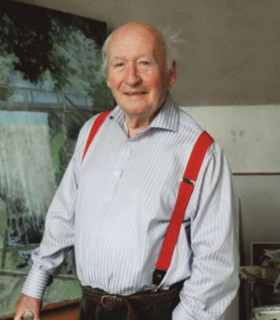
Terence Philip “T.P.” Flanagan, one of the finest landscape painters of his generation, passes away in Belfast on February 23, 2011, at the age of eighty. For more than 60 years he shapes the face of landscape painting in Northern Ireland and is known internationally for his rural scenes of his native County Fermanagh and County Sligo. With his stunning watercolours and intricate brush strokes, he is described as one of the most successful artists of his generation. PoetSeamus Heaney, who dedicates his 1969 poem Bogland to Flanagan, pays tribute saying “he was a teacher and a friend whose work held a deep personal significance.”
Flanagan is born in Enniskillen, County Fermanagh in 1929. When he is in his late teens, he learns the art of watercolour painting from the famous local portraitist and landscape artist Kathleen Bridle. Later, he paints her portrait, which now hangs in the Ulster Museum, and interviews her in a film of her life and art, which is produced shortly before her death in 1989.
After his time with Bridle, Flanagan attends Belfast College of Art from 1949-1953. The following year he joins the teaching staff at St. Mary’s College of Education, where he remains for 28 years, eventually becoming Head of the Art Department.
Flanagan spends the majority of his painting career in Ireland, but his landscapes have received wide attention and his work has been recognised both in Ireland and abroad. His first solo exhibition is held at the Council for the Encouragement of Music and the Arts (CEMA), Belfast in 1961. He also shows regularly at the Hendriks Gallery in Dublin and at the Tom Caldwell Gallery in Belfast during the 1970s and 1980s. He participates in many group exhibitions, including “Four Ulster Painters” at the Arnolfini gallery in Bristol (1965), “Two Irish Painters” (with Colin Middleton) at the Herbert Art Gallery & Museum, Coventry, (1968) and is represented in “The Gordon Lambert Collection Exhibitions” held at the Hugh Lane Gallery, Dublin (1972) and the Ulster Museum (1976). In addition, he exhibits at the Royal Hibernian Academy (RHA) in Dublin and at the Royal Ulster Academy Of Arts (RUA) in Belfast.
Abroad, Flanagan’s works are exhibited at the Armstrong Gallery, New York (1986) and the Concept Gallery, Pittsburgh. A retrospective of his painting from the period 1967-1977 is held at the Arts Council of Northern Ireland in 1977. In 1995, the Ulster Museum stages a major retrospective of his paintings (1945-1995). Other retrospectives are held at the Hugh Lane Gallery in Dublin and the Stadsmusueum, Gothenberg, Sweden. His paintings are also included in the show “A Century of Irish Painting” organized by the Hugh Lane Gallery which tours Japanese museums in 1995.
As an artist, Flanagan works in oils as well as his preferred watercolours, although by rapid application of the paint with minimal overworking, even his oils manage to retain the luminous colouring of the watercolourist. He specializes in landscape painting within his native County Fermanagh and the adjoining County Sligo, his methods being ideally suited to capturing the soft atmospheric light of Ireland’s northwest.
Flanagan is elected associate of the RUA in 1960, a full member in 1964, and President 1978-82. During his long career, he receives numerous commissions and other awards for his works, which are represented in the collections of The Arts Councils of Ireland & Northern Ireland, the Ulster Museum, the Hugh Lane Municipal Gallery, Dublin, Irish Museum of Modern Art, and the National Self-Portrait Collection, Limerick.
Flanagan dies suddenly on February 23, 2011. His funeral takes place at St. Brigid’s Church in south Belfast and is buried at St. Michaels’ Church in Enniskillen.
The auction record for a work by T.P. Flanagan is set in 2009, when his landscape painting, entitled Castlecoole From Lough Coole, is sold at Christie’s, London, for £20,000.
(From Encyclopedia of Visual Artists In Ireland, visual-arts-cork.com)
Phil Coulter, musician, songwriter and record producer, is born in Derry, County Londonderry, Northern Ireland on February 19, 1942. He is one of the most eclectic and accomplished arranger/musicians to emerge from Ireland during the 1960s.
Coulter spends his secondary school years at St. Columb’s College. He later studies music and French at the Queen’s University Belfast. During his time at Queen’s he takes up songwriting, composing the hit Foolin’ Time for the Capitol Showband. His talents are swiftly captured by leading entrepreneur Phil Solomon. Initially working with such showbands as the Cadets and Pacific, he continues to compose for the Capitol Showband and even pens their 1965 Eurovision Song Contest entry, Walking the Streets in the Rain. In the meantime, Coulter works on Solomon’s other acts, including Twinkle, who enjoys a major UK hit with the Coulter-arranged Terry. He also contributes to Them’s song catalogue, with the driving I Can Only Give You Everything.
After leaving the Solomon stable in 1967, Coulter, now based in London, forms a partnership with Bill Martin, which becomes one of the most successful of its era. The duo is particularly known for their ability to produce instantly memorable pop hits, and achieve international fame after penning Sandie Shaw’s 1967 Eurovision Song Contest winner, Puppet on a String. They barely miss repeating that feat the following year with Cliff Richard’s stomping Congratulations.
Coulter subsequently leads his own country to victory in the contest by arranging Dana’s 1970 winner, All Kinds of Everything. That same year, Coulter/Martin are commissioned to write Back Home, the official song for the England national football team, which proves a lengthy UK number 1. As well as his pop outings, which include writing My Boy and an album’s worth of material for Richard Harris, he maintains his connection with the Irish folk scene, via his work with another of Solomon’s acts, The Dubliners. He also produces three albums for the groundbreaking Planxty and works with The Fureys.
After his partnership with Martin ends in the late 1970s, Coulter specializes in orchestral recordings, which prove hugely successful in Irish communities. Albums such as Classic Tranquillity and Sea Of Tranquillity (both 1984), Words And Music (1989), American Tranquillity (1994), Celtic Horizons (1996), and collaborations with flautist James Galway and Roma Downey, also enjoy major international success, and Coulter is a regular fixture in the upper regions of the U.S. New Age album chart.
Coulter’s production credits during the 1990s include work for Sinéad O’Connor and Boyzone. His lengthy career, as producer, arranger, songwriter and performer, is all the more remarkable for encompassing such contrasting musical areas from folk and orchestral to straightforward Tin Pan Alley pop.
Despite his successes, Coulter suffers several family tragedies. His son is born with Down syndrome and dies at the age of three. The song Scorn Not His Simplicity is written in his memory. His brother also dies tragically in a drowning incident in Ireland, which briefly causes him to retreat from the music business. He records the anthemic Home From The Sea with the Lifeboat Chorus as a tribute.




 seamus dubhghaill