seamus dubhghaill

Promoting Irish Culture and History from Little Rock, Arkansas, USA


Leave a comment

Launch of NetAid

net-aid

Aiming to raise awareness of world poverty, The Corrs and chartered accountants KPMG jointly launch the NetAid web site on October 7, 1999. NetAid is an anti-poverty initiative started as a joint venture between the United Nations Development Programme and Cisco Systems. It becomes an independent nonprofit organization in 2001 and becomes a part of Mercy Corps in 2007.

NetAid begins with a concert event on October 9, 1999 with simultaneous activities meant to harness the Internet to raise money and awareness for the Jubilee 2000 campaign. Concerts take place at Wembley Stadium in London, Giants Stadium in New Jersey and the Palais des Nations in Geneva. While the Wembley show is at capacity, the U.S. show suffers from very poor ticket sales.

Performers at Wembley Stadium include Eurythmics, The Corrs, Catatonia, Bush, Bryan Adams, George Michael, David Bowie, Stereophonics and Robbie Williams.

Performers at Giants Stadium include Sheryl Crow, Jimmy Page, Busta Rhymes, Counting Crows, Bono, Puff Daddy, The Black Crowes, Wyclef Jean, Jewel, Mary J. Blige, Cheb Mami, Sting, Slash, Lil’ Kim, Lil’ Cease, and Zucchero.

Performers in Geneva include Bryan Ferry, Texas, Des’ree and Ladysmith Black Mambazo.

The NetAid website, originally at http://www.netaid.org, receives over 2.4 million hits and raises $830,000 from eight countries. Cisco sponsors the concerts and the web site. Along with Kofi Annan, Keyur Patel, MD of KPMG Consulting spearhead the technology architecture development of the web site and Anaal Udaybabu (Gigabaud Studios, San Francisco) designs the user experience.

Following the concerts, NetAid is spun out of Cisco as an independent entity and tries various approaches to raising awareness of extreme poverty and raising money for anti-poverty projects undertaken by other organizations, through a variety of different NetAid campaigns.

By 2006, NetAid has narrowed its focus to raising awareness among high school students in the United States regarding poverty in developing countries.


Leave a comment

Birth of Charles Villiers Stanford, Composer & Conductor

charles-villiers-stanford

Sir Charles Villiers Stanford, composer, music teacher, and conductor, is born in Dublin on September 30, 1852.

Stanford is born into a well-off and highly musical family, the only son of John James Stanford, a prominent Dublin lawyer, Examiner to the Court of Chancery in Ireland and Clerk of the Crown for County Meath, and his second wife, Mary, née Henn. He is educated at the University of Cambridge before studying music in Leipzig and Berlin. He is instrumental in raising the status of the Cambridge University Musical Society, attracting international stars to perform with it.

While still an undergraduate, Stanford is appointed organist of Trinity College, Cambridge. In 1882, at the age of 29, he is one of the founding professors at the Royal College of Music, where he teaches composition for the rest of his life. From 1887 he is also Professor of Music at Cambridge. As a teacher, he is skeptical about modernism and bases his instruction chiefly on classical principles as exemplified in the music of Johannes Brahms. Among his pupils are rising composers whose fame go on to surpass his own, such as Gustav Holst and Ralph Vaughan Williams. As a conductor, he holds posts with the Bach Choir and the Leeds Triennial Music Festival.

Stanford composes a substantial number of concert works, including seven symphonies, but his best-remembered pieces are his choral works for church performance, chiefly composed in the Anglican tradition. He is a dedicated composer of opera, but none of his nine completed operas has endured in the general repertory. Some critics regard him, together with Hubert Parry and Alexander Mackenzie, as responsible for a renaissance in music from the British Isles. However, after his conspicuous success as a composer in the last two decades of the 19th century, his music is eclipsed in the 20th century by that of Edward Elgar as well as former pupils.

In September 1922, Stanford completes the sixth Irish Rhapsody, his final work. Two weeks later he celebrates his 70th birthday and thereafter his health declines. On March 17, 1924, he suffers a stroke and dies on March 29 at his home in London, survived by his wife and children. He is cremated at Golders Green Crematorium on April 2 and his ashes are buried in Westminster Abbey the following day.

Stanford’s last opera, The Travelling Companion, composed during World War I, is premiered by amateur performers at the David Lewis Theatre, Liverpool in 1925 with a reduced orchestra. The work is given complete at Bristol in 1928 and at Sadler’s Wells Theatre, London, in 1935.

Stanford receives many honours, including honorary doctorates from University of Oxford (1883), University of Cambridge (1888), Durham University (1894), University of Leeds (1904), and Trinity College, Dublin (1921). He is knighted in 1902 and in 1904 is elected a member of the Prussian Academy of Arts, Berlin.


Leave a comment

Birth of Seán Keating, Romantic-Realist Painter

sean-keating-an-allegory

Seán Keating, Irish romantic-realist painter who painted some iconic images of the Irish War of Independence and of the early industrialization of Ireland, is born in Limerick, County Limerick on September 28, 1889.

Keating studies drawing at the Limerick Technical School before a scholarship arranged by William Orpen allows him to go study at the Metropolitan School of Art in Dublin at the age of twenty. Over the next few years, he spends two weeks or so during the late summer on the Aran Islands and his many portraits of island people depict them as rugged heroic figures.

In 1914 he wins the RDS Taylor award with a painting titled The Reconciliation. The prize includes £50.00 which allows him to go to London to work as Orpen’s studio assistant in 1915. In late 1915 or early 1916, he returns to Ireland where he documents the Irish War of Independence and the subsequent Irish Civil War. Examples include Men of the South (1921–22) which shows a group of Irish Republican Army (IRA) men ready to ambush a military vehicle and An Allegory (first exhibited in 1924), in which the two opposing sides in the Irish Civil War are seen to bury the tri-colour covered coffin amid the roots of an ancient tree. The painting includes a self-portrait of the artist.

Keating is elected an Associate of the Royal Hibernian Academy (RHA) in 1918, and a full member in 1923. One of the cardinal achievements of the Irish Free State in the 1920s is the building, in partnership with Siemens, of a hydro-electric power generator at Ardnacrusha, near Limerick. Between 1926 and 1927, at his own volition, he produces a considerable number of paintings related to this scheme. He exhibits several examples of the paintings in the RHA exhibitions in 1927 and 1928. Most of the paintings are now in the collection of ESB Group.

In 1936 group of prominent Limerick politicians, artists and patrons establish the first Limerick City Collection of Art from various donations and bequests. Keating is part of this artist-led initiative to form a municipal art gallery in Limerick similar to those already in Dublin and Cork. The collection is formed primarily out of donations and bequests. As a pivotal member of the committee, Keating himself donates many works to the collection which is first exhibited as a municipal collection in the Savoy Cinema, Limerick City on November 23, 1937. It is not until 1948 that an extension to the rear of Limerick Free Library and Museum becomes the home to the City Collection as the Limerick Free Art Gallery. In 1985 the Library and Museum are transferred to larger buildings.

In 1939 Keating is commissioned to paint a mural for the Irish pavilion at the New York World’s Fair. He is President of the RHA from 1950 to 1962, and shows at the annual exhibition for 61 years from 1914. Although he is an intellectual painter in the sense that he consciously sets out to explore the visual identity of the Irish nation, and his paintings show a very idealised realism, he fears that the modern movement will bring back a decline in artistic standards. Throughout his career, he exhibits nearly 300 works at the RHA and also shows at the Oireachtas.

Seán Keating dies on December 21, 1977 at the Adelaide Hospital in Dublin and is buried at Cruagh Cemetery, Rathfarnham. The 1978 RHA Exhibition features a small memorial collection of his work.

Posthumous exhibitions of his work are mounted by The Grafton Gallery, Dublin (1986) and the Electricity Supply Board (1987). Sean Keating – The Pilgrim Soul, a documentary presented and written by his son Justin Keating, airs on RTÉ in 1996.

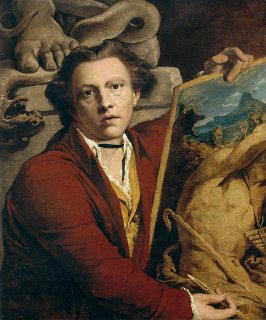
(Pictured: Photograph of Keating’s “An Allegory” painted between 1922 and 1924. The painting represents Keating’s own disillusionment and loss of idealism resulting from the outbreak of the Irish Civil War. The only figure of the group addressing the observer is a self-portrait of the artist.)


Leave a comment

Birth of Dolores Keane, Folk Singer & Actress

dolores-keane

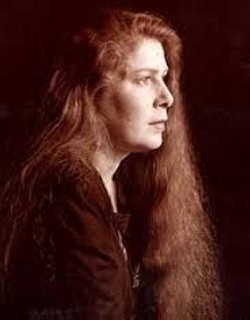
Dolores Keane, folk singer and occasional actress, is born on September 26, 1953, in the small village of Sylane, near Tuam, in rural County Galway. She is a founding member of the successful group De Dannan and has since embarked on a very successful solo career, establishing herself as one of the most loved interpreters of Irish song.

Keane is raised from the age of four by her aunts Rita and Sarah Keane, who are also well-known sean-nós singers. She starts her singing at a very young age, due to the influence of her musical aunts. She makes her first recording for Radio Éireann in 1958 at the age of five. This early start sets her on the path to a career in music. Her brother, Seán, also goes on to enjoy a successful music career.

In 1975, Keane co-founds the traditional Irish band De Dannan, and they release their debut album Dé Danann in that same year. The group gains international recognition and enjoys major success in the late 1970s in the United States. She tours with the band and their single “The Rambling Irishman” is a big hit in Ireland. In early 1976, after a short two-year spell, she leaves De Dannan and is replaced by Andy Irvine, who records live with the band on April 30, 1976, during the 3rd Irish Folk Festival in Germany. Soon thereafter, she marries multi-instrumentalist John Faulkner, with whom she subsequently records three albums of folk music.

Keane lives and works in London for several years with Faulkner before they move to Ireland in the early 1980s. They work on a series of film scores and programmes for the BBC and form two successful bands, The Reel Union and Kinvara. During this period, she records her first solo album, There Was a Maid in 1978. This is followed by two other releases, Broken Hearted I’ll Wander (1979) and Farewell to Eirinn (1980), which gives credit to Faulkner. In the mid-1980s she rejoins De Dannan and records the albums Anthem and Ballroom with them.

Keane turns her attention, once again, to her solo career in 1988. It sees the release of the eponymous Dolores Keane album. Her follow-up album, A Lion in a Cage (1989), features a song written by Faulkner called “Lion in a Cage” protesting the imprisonment of Nelson Mandela. It serves as Keane’s second Irish number one, and she performs the hit at the celebration of his release. This exposure expands her reputation and popularity worldwide. A new facet is added to her career when she plays the female lead in the Dublin production of Brendan Behan‘s The Hostage. The opening night is attended by Mary Robinson, the President of Ireland at the time.

In 1992, Keane is among the many female Irish singers to lend their music to the record-smashing anthology A Woman’s Heart. The album goes on to become the biggest-selling album in Irish history. A Woman’s Heart Vol.2 is released in late 1994 and emulates its predecessor in album charts the world over. Also in 1994, a solo album, Solid Ground, is released on the Shanachie Records label and receives critical acclaim in Europe and America.

In August 1995, Keane is awarded the prestigious Fiddler’s Green Hall of Fame award in Rostrevor, County Down, for her “significant contribution to the cause of Irish music and culture.” In that same year, she takes to the stage in the Dublin production of John Millington Synge‘s The Playboy of the Western World. She contributes to the RTÉ/BBC television production “Bringing It All Back Home,” a series of programmes illustrating the movement of Irish music to America.

In August 1997, Keane goes to number one again in the Irish album charts with a compilation album with her most loved songs. And another studio album, Night Owl, is released in 1998. It sees her returning to her traditional Irish roots and it does well in Europe and America. Despite a healthy solo career, she goes on tour with De Dannan again in the late 1990s, where she plays to packed audiences in venues such as Birmingham, Alabama and New York City.

Keane puts an end to recording and touring in the late 1990s, due to depression and alcoholism, for which she receives extensive treatment. As of June 2014, she is given the all clear after suffering from cancer.


Leave a comment

Pope John Paul II Meets Jubilee 2000 Delegation

geldof-bono-pope-john-paul-ii

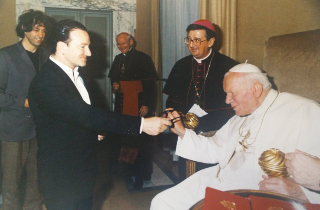
Bob Geldof, Bono, Quincy Jones and other members of an international lobby group meet with Pope John Paul II in Rome on September 23, 1999 to discuss the cancellation of third world debt repayments.

In an extraordinary meeting, marking 100 days to the millennium, Pope John Paul II makes a strong appeal to world to leaders to take urgent and decisive action towards resolving the debt crisis that afflicts the world’s poorest countries.

Speaking during a meeting with an international Jubilee 2000 delegation of economists, artists and campaigners, the Pope questions why progress in resolving the debt problem is so slow, and expresses impatience with the protracted negotiations. He warns that it “is the poor that pay the cost of indecision and delay.”

The Pope says “the Catholic Church looks at the situation with great concern. Not because she has any concrete technical model of development to offer, but because she has a moral vision of what the good of individuals and of the human family demands. She has consistently taught that there is a ‘social mortgage‘ on all private property, a concept which today must also be applied to ‘intellectual property‘ and to ‘knowledge.’ The law of profit alone cannot be applied to that which is essential for the fight against hunger, disease and poverty.”

Addressing the Pope on behalf of the delegation, Ann Pettifor, director and co-founder of Jubilee 2000, appeals to the Vatican to prevail upon the world’s leaders to meet again before the New Year, to cancel debts that result in the deaths of 20,000 children every day. She says, “This is a day that will go down in history. The Pope has given his endorsement and blessing to the passion and commitment of millions of Jubilee 2000 campaigners around the world. It is now up to the world’s leaders to rise to the Pope’s call and moral leadership.”

Following the meeting Bob Geldof says, “Were the spirit of this frail old man mirrored in a practical way by our political leaders, then the final push of political will to eradicate this unnecessary tragedy, would be easily achieved…and I liked his shoes!”

Professor Jeffrey Sachs adds, “With 100 days left to the millennium, we are halfway up the summit. But much more is needed. For hundreds of millions of the world’s poorest people, the Pope’s message today is crucial: the time is urgent for rich and poor to take the full and bold measure of debt cancellation that is so vitally needed.”

Bono summed it up saying, “His everyday courage amazes me. As aged as he is and as infirm as he has been, he will, you know, hang out with a bunch of pop stars…who could turn this man down?”

(Source: “Pope meets Bobo and calls for debt relief,” The Guardian, September 23, 1999)


Leave a comment

Birth of Tom McBride, Ireland’s King of Country Music

tom-mcbride

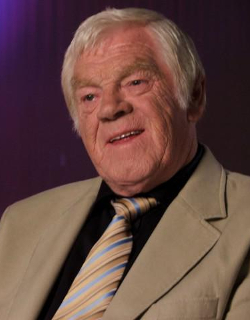
Tom McBride, Irish country, traditional, easy listening singer, guitarist, and saxophone player best known as Big Tom, is born in Castleblayney, County Monaghan on September 18, 1936. He is affectionally known as “Ireland’s king of country music.”

With a career spanning over five decades, McBride starts his career in 1966 as the frontman of the Irish showband Big Tom and The Mainliners. In 1980, suffering from a fear of flying, he undertakes a sea voyage across the Atlantic Ocean to record his Blue Wings album in Nashville, Tennessee.

In 2000, McBride undergoes a vocal cord nodule operation on his throat. On July 8, 2005, a plaque is erected by the local community in his home village of Castleblayney. In November 2006, he suffered a sudden heart attack at the age of 70, which puts doubt into whether he will ever tour again with his band.

On February 1, 2008, McBride begins a 12-date tour of Ireland after doctors give him the all clear. On March 24, he performs at Castlebar‘s TF Ballroom’s final farewell night but reportedly takes ill on stage during the performance.

On 25 May, McBride performs for the closure night of the Galtymore dance hall in Cricklewood, London. He is the headline act at London’s Irish Festival on July 27 and headlines the Claremorris Dance Festival weekend on November 23.

In July 2009, K-MAC Records announces more dates in Ireland for Big Tom and the Mainliners which commences in August. From August 14 to September 13, McBride runs a successful tour of Ireland with large attendances to venues. The highlight is the Glencarn Hotel in his hometown Castleblayney where the concert is packed to capacity. The tour ends in Ennis, County Clare, with fans travelling many miles to see McBride and the band. Two days after the end of the tour the band’s trombone player and vocalist Cyril McKevitt dies of a heart attack.

In 2010, McBride announces an extensive series of tour dates. From 2011 until his death in Drogheda, County Louth on April 17, 2018, McBride and his band continue to perform with sporadic appearances.

In June 2016, McBride becomes the inaugural artist to be inducted into the Irish Country Music Hall of Fame.


Leave a comment

Birth of Maura O’Connell, Singer & Actress

maura-oconnell

Maura O’Connell, singer and actress known for her contemporary interpretations of Irish traditional music, strongly influenced by American country music, is born on September 16, 1958, in Ennis, County Clare.

Born into a musical family, O’Connell is the third of four sisters. Her mother’s family owns Costello’s fish shop in Ennis where O’Connell works until music becomes her full-time career. She grows up listening to her mother’s light opera, opera, and parlour music records. Her father’s interest leans towards the rebel ballads. Despite the presence of classical music in the house, O’Connell gets very involved in the local folk club scene and together with Mike Hanrahan, who later fronts folk rock outfit Stockton’s Wing, they perform a country music set, as a duo called “Tumbleweed.”

O’Connell attends St. Joseph’s Secondary School in Spanish Point from 1971 to 1974, where she takes part in the school choir. She is also a member of the “Cúl Aodha Choir”, led by Peader Ó Riada, that sings at the funeral of Willie Clancy in 1973.

O’Connell begins her professional musical journey during a six-week tour of the United States in 1980, as vocalist for the traditionally based Celtic group De Dannan. The following year, she is featured on the band’s landmark album, The Star Spangled Molly, which becomes something of a national phenomenon in her homeland. However, not long after joining the group she becomes very interested in the experimental roots music of America’s New Grass Revival when the bands’ paths cross. She moves to the United States in 1986, settling in Nashville, Tennessee. There she meets progressive bluegrass pioneers Béla Fleck and Jerry Douglas, with whom she works on most of her records.

O’Connell records her first solo album in 1983, however, it does not make any impact in Ireland or in the United States. She receives a Grammy Award nomination for her 1989 album, Helpless Heart, which is her first record released under Warner Bros. Records. Real Life Story (1990) and Blue is the Colour of Hope (1992) register a move toward a pop synthesis. Her versions of “Living in These Troubled Times” and Cheryl Wheeler‘s “Summerfly” become standout tracks on the 1993 album A Woman’s Heart, on four all-female overseas tours and on the 1994 follow-up album in her homeland. A Woman’s Heart Vol. 2 features her heartfelt renditions of Nanci Griffith‘s “Trouble in the Fields” and Gerry O’Beirne’s “Western Highway.” After numerous albums heavily inspired by American newgrass music, she returns to her Irish roots with the 1997 release Wandering Home.

As the new millennium approaches, O’Connell signs with Sugar Hill Records in late 2000 and begins working on her seventh album. Instead of working with her longtime producer Jerry Douglas, she has Ray Kennedy produce Walls and Windows, which is released in 2001, and features an eclectic collection of songs, including work by Kim Richey, Van Morrison, John Prine, Eric Clapton and Patty Griffin. Her 2004 album, Don’t I Know, contains musical textures added by everything from fiddles to clavinets, to lap steel guitar and B-3 organ.

Naked With Friends (2009) is O’Connell’s first a cappella album. Guest vocalists include Mary Black, Paul Brady, Moya Brennan, Jerry Douglas, Alison Krauss, Mairéad Ní Mhaonaigh, Tim O’Brien, Dolly Parton, Sarah Dugas, Kate Rusby and Darrell Scott. The album is nominated for a Grammy Award.

In addition to her solo work, O’Connell has collaborated with a number of Celtic, folk, pop and country artists, including Van Morrison, Brian Kennedy, Moya Brennan, Mary Black, John Prine, Jerry Douglas, Tim O’Brien, John Gorka, Béla Fleck, Robert Earl Keen, Dolly Parton and Shawn Colvin. She has also sung background vocals for a number of artists, including Van Morrison’s 1988 project with The Chieftains, Irish Heartbeat and Stockton’s Wing on Take A Chance.

Aside from the music world, Martin Scorsese casts O’Connell, scruffed up for the role, as an Irish migrant street singer in his 19th-century epic Gangs of New York, released in 2002.

O’Connell announces the end of her solo career in 2013.


Leave a comment

Death of J.P. Donleavy, Novelist & Playwright

jp-donleavy

James Patrick Donleavy, Irish American novelist and playwright, dies in Mullingar, County Westmeath on September 11, 2017. His best-known work is the novel The Ginger Man, which is initially banned for obscenity.

Born in New York City on April 23, 1926, to Irish immigrants Margaret and Patrick Donleavy, Donleavy receives his education at various schools in the United States. He declares himself to be an atheist at the age of 14. He serves in the United States Navy during World War II. After the war ends, he moves to Ireland. In 1946 he begins studying at Trinity College, Dublin, but leaves in 1949 before taking a degree. Also in 1946, he marries Valerie Heron, and the couple has two children: Philip (born 1951) and Karen (born 1955). They divorce in 1969 and he remarries in 1970 to Mary Wilson Price. That union also ends in divorce in 1989.

Donleavy’s first published work is a short story entitled A Party on Saturday Afternoon, which appears in the Dublin literary periodical, Envoy, A Review of Literature and Art in 1950. He gains critical acclaim with his first novel, The Ginger Man (1955), which is one of the Modern Library 100 best novels. The novel, of which his friend and fellow writer Brendan Behan is the first person to read the completed manuscript, is banned in Ireland and the United States by reason of obscenity. Lead character Sebastian Dangerfield is in part based on Trinity College companion Gainor Crist, an American Navy veteran also studying at Trinity College on the G.I. Bill, whom Donleavy once describes in an interview as a “saint,” though of a Rabelaisian kind.

Correctly or incorrectly, his initial works are sometimes grouped with the Kitchen Sink artists as well as the “angry young men.” Another novel, A Fairy Tale of New York, provides the title of The Pogues hit song “Fairytale of New York.”

In March 2007, Donleavy is the castaway on BBC Radio 4‘s Desert Island Discs. In 2015, he is the recipient of the Bob Hughes Lifetime Achievement Award at the Bord Gáis Energy Irish Book Awards.

In 2011, it is reported that Donleavy had not fathered his two children with Mary Wilson Price. A DNA test in the early 1990s confirms that Rebecca is the daughter of brewing scion Kieran Guinness, and Rory is the son of Kieran’s older brother Finn, whom Price marries after her divorce from Donleavy. “My interest is only to look after the welfare of the child,” Donleavy tells The Times, “And after a certain stage, you can’t worry about their parentage.”

J.P. Donleavy dies of an apparent stroke in Mullingar, County Westmeath on September 11, 2017, at the aged of 91.


Leave a comment

Opening of the National Concert Hall

national-concert-hall-dublin

The National Concert Hall is opened in Dublin on September 9, 1981. It is a concert hall located on Earlsfort Terrace, close to St. Stephen’s Green, and is the principal national venue for classical music concerts in Ireland.

Originally built for the Dublin International Exhibition of Arts and Manufactures of 1865, the structure is converted into the central building of University College Dublin (UCD) at the foundation of the National University of Ireland in 1908. When UCD begins to relocate to a new campus at Belfield in the 1960s, part of the building is converted, and reopened as the National Concert Hall in 1981. Since then, the structure has been shared with UCD. In 2005 it is announced that UCD is to relocate all of its faculties to Belfield in the near term, allowing the NCH to develop a major expansion plan on the entire site, bringing it in line with international peers.

Today the National Concert Hall is one of Ireland’s National Cultural Institutions, under the aegis of the Irish Government‘s Department of Culture, Heritage and the Gaeltacht and, as such, is grant-aided by the Irish Government. The National Concert Hall is a statutory corporate body, with a management team, and a Government-appointed Board.

Although its facade is quite impressive, the venue’s architectural acoustics have been criticized. It is also unsuitable for large-scale opera stagings, lacking full stage facilities. Consequently, calls for a purpose-built venue are made from time to time.

Due to its central location, lunchtime concerts and recitals are common and attended by many workers from nearby office buildings. During the summer, outdoor recitals are given in the adjacent Iveagh Gardens. The resident orchestra is the RTÉ National Symphony Orchestra. Other regular performances are made from the rest of the RTÉ Performing Groups.

The National Concert Hall generally makes a small surplus, unlike most of Ireland’s National Cultural Institutions. This is despite the fact that although it has a high level of attendance, it has only a small public funding element, especially compared to the Abbey Theatre.


Leave a comment

Birth of Dolores O’Riordan, Singer & Songwriter

dolores-o-riordan

Dolores Mary Eileen O’Riordan, Irish musician, singer and songwriter, is born in Ballybricken, County Limerick on September 6, 1971. She leads the rock band The Cranberries from 1990 until their break-up in 2003. They reunite in 2009. She is known for her lilting mezzo-soprano voice, her emphasised use of yodeling, and her strong Limerick accent.

O’Riordan is the youngest of nine children, two of whom die in infancy. Her father, Terence Patrick “Terry” O’Riordan (1937–2011), is a farm labourer who is left unable to work due to brain damage caused by a motorbike accident in 1968. Her mother, Eileen, is a school caterer. She attends Laurel Hill Coláiste FCJ school in Limerick. She leaves school without any qualifications.

In 1989, brothers Mike and Noel Hogan form The Cranberry Saw Us with drummer Fergal Lawler and singer Niall Quinn, in Limerick. Less than a year later, Quinn leaves the band. The remaining band members then place an advertisement for a female singer. O’Riordan responds to the advertisement and auditions by writing lyrics and melodies to some existing demos. When she returns with a rough version of “Linger,” she is hired, and they record Nothing Left At All, a three-track EP released on tape by local record label Xeric Records, which sells 300 copies. The group changes their name to “The Cranberries.” The owner of Xeric Studios, Pearse Gilmore, becomes their manager and provides the group with studio time to complete another demo tape, which he produces. It features early versions of “Linger” and “Dreams,” which are sent to record companies throughout the United Kingdom (UK).

This demo earns the attention of both the UK press and record industry and sparks a bidding war between major British record labels. Eventually, the group signs with Island Records. As part of The Cranberries she releases along with them five albums: Everybody Else Is Doing It, So Why Can’t We? (1993), No Need to Argue (1994), To the Faithful Departed (1996), Bury the Hatchet (1999), and Wake Up and Smell the Coffee (2001), and a greatest-hits compilation, Stars: The Best of 1992–2002. In 2003, the band decides to take a temporary time-out to experiment on solo projects.

In 2003, O’Riordan embarks on a solo career which includes an appearance with the Italian artist Zucchero Fornaciari on the album Zu & Co., with the song “Pure Love.” The album also features other artists such as Sting, Sheryl Crow, Luciano Pavarotti, Miles Davis, John Lee Hooker, Macy Gray, and Eric Clapton.

In 2005, O’Riordan appears on the Jam & Spoon‘s album Tripomatic Fairytales 3003 as a guest vocalist on the track “Mirror Lover.” She makes a cameo appearance in the 2006 Adam Sandler comedy Click as a wedding singer performing an alternate version of The Cranberries’ “Linger” set to strings. Her first single, “Ordinary Day,” is produced by BRIT Awards winner Youth, whose previous credits include The Verve, Embrace, Primal Scream, U2, and Paul McCartney.

Are You Listening? is released in Ireland on May 4, 2007, in Europe on May 7, and in North America on May 15. In 2008, O’Riordan wins a European Border Breakers Award (EBBA) which is presented annually to recognize the success of ten emerging artists or groups who reach audiences outside their own countries with their first internationally released album in the past year. Her second album, No Baggage, featuring eleven tracks, is released in August 2009.

In January 2009, the University Philosophical Society at Trinity College, Dublin invites The Cranberries to reunite for a concert celebrating O’Riordan’s appointment as an honorary member of the Society, which leads the band members to consider reuniting for a tour and a recording session. On August 25, 2009, while promoting her solo album No Baggage in New York City on 101.9 RXP radio, O’Riordan announces the reunion of the Cranberries for a world tour. The tour begins in North America in mid-November, followed by South America in mid-January 2010 and Europe in March 2010. She remains in the band until her unexpected death.

She appears as a judge on RTÉ‘s The Voice of Ireland during the 2013–2014 season. In April 2014, O’Riordan joins and begins recording new material with the trio D.A.R.K.

On January 15, 2018, at the age of 46, while in London for a recording session, O’Riordan dies suddenly at the London Hilton on Park Lane hotel in Mayfair. The cause of death is not immediately made public. Police say it is not being treated as suspicious. The coroner’s office says the results of its inquiry would not be released until April 3 at the earliest. On April 3 the inquest is cancelled with no new date announced.

A three-day memorial in her hometown, with O’Riordan lying in repose, lasts from January 20-22 at St. Joseph’s church. On January 23, she is buried after a service at Saint Ailbe’s Roman Catholic Church, Ballybricken, County Limerick. It begins with the studio recording of “Ave Maria” as sung by O’Riordan and Luciano Pavarotti. She is buried alongside her father.