seamus dubhghaill

Promoting Irish Culture and History from Little Rock, Arkansas, USA


Leave a comment

Death of Australian Explorer Robert O’Hara Burke

Robert O’Hara Burke, Irish soldier and police officer who achieves fame as an Australian explorer, dies of starvation on June 28, 1861, in Cooper Creek, Queensland, Australia, while exploring the continent. He is the leader of the ill-fated Burke and Wills expedition which is the first expedition to cross Australia from south to north.

Burke is born in St. Clerens, County Galway on May 6, 1821, the second of three sons of James Hardiman Burke, an officer in the British Army 7th Royal Fusiliers, and Anne Louisa Burke (nee O’Hara).

Burke enters the Royal Military Academy, Woolwich in May 1835. In December 1836 he fails his probationary exam and goes to Belgium to further his education. In 1841, he enters the Imperial Austrian Army and spends most of his time posted to northern Italy. Towards the end of 1847 he suffers health problems and ultimately resigns from the Austrian army in June 1848.

After returning to Ireland in 1848, he joins the Irish Constabulary (later the Royal Irish Constabulary). He does his cadet training at Phoenix Park Depot in Dublin between November 1849 and January 1850. At the end of 1850 he transfers to the Mounted Police in Dublin.

Burke emigrates to Australia, arriving in Hobart, Tasmania on February 12, 1853, and promptly sails for Melbourne. On April 1, 1853, he joins the recently established Victoria Police force.

After the South Australian explorer John McDouall Stuart reaches the centre of Australia, the South Australian parliament offers a reward of £2,000 for the promotion of an expedition to cross the continent from south to north, generally following Stuart’s route. In June 1860, Burke is appointed to lead the Victorian Exploring Expedition with William John Wills, his third-in-command, as surveyor and astronomical observer.

The expedition leaves Melbourne on August 20, 1860, with a total of 19 men, 27 camels and 23 horses. They reach Menindee on September 23, 1860, where several people resign.

Cooper Creek, 400 miles further on, is reached on November 11, 1860, by the advance group, the remainder being intended to catch up. After a break, Burke decides to make a dash to the Gulf of Carpentaria, leaving on December 16, 1860. William Brahe is left in charge of the remaining party. The small team of Burke, William Wills, John King and Charley Gray reach the mangroves on the estuary of the Flinders River, near where the town of Normanton now stands, on February 9, 1861. They never see open ocean due to flooding rains and swamps.

Already weakened by starvation and exposure, progress on the return journey is slow and hampered by the tropical monsoon downpours of the wet season. Gray dies four days before they reach the rendezvous at Cooper Creek. The other three rest for a day when they bury him. They eventually reach the rendezvous point on April 21, 1861, nine hours after the rest of the party had given up waiting and left, leaving a note and some food, as they had not been relieved by the party supposed to be returning from Menindee.

Burke’s party attempts to reach Mount Hopeless, the furthest outpost of pastoral settlement in South Australia, which is closer than Menindee, but fail and return to Cooper Creek. While waiting for rescue Wills dies of exhaustion and starvation. Soon after, Burke also dies, at a place now called Burke’s Waterhole on Cooper Creek in South Australia. The exact date of Burke’s death is uncertain but has generally been accepted to be June 28, 1861.

King survives with the help of Aborigines until he is rescued in September by Alfred William Howitt. Howitt buries Burke and Wills before returning to Melbourne. In 1862, Howitt returns to Cooper Creek and disinters Burke and Wills, taking them first to Adelaide and then by steamer to Melbourne where they are laid in state for two weeks. On January 23, 1863, Burke and Wills receive a State Funeral and are buried in Melbourne General Cemetery. Ironically, on that same day John McDouall Stuart and his companions, having successfully completed the south-north crossing, are received back at a large ceremony in Adelaide.

Leave a comment

Birth of Pat Falvey, Mountaineer, Expedition Leader & Polar Explorer

Pat Falvey, Irish high-altitude mountaineer, expedition leader, polar explorer, entrepreneur, author, corporate/personal trainer/coach, and motivational speaker, is born in Cork, County Cork, on June 2, 1957. He is the first person to complete the Seven Summits twice, with the summiting of Mount Everest reached from both the Tibetan (1996) and Nepalese sides (2004). He is expedition leader of the team that sees Clare O’Leary become the first Irish woman to reach the summit of Mount Everest in 2004. Other extreme expeditions that he makes include walking to the South Pole, crossing South Georgia island, and traversing the Greenland ice sheet. He starts his first business at 15 years of age and has since had businesses in property development, finance, construction, insurance, tourism, and film production. He has been a motivational speaker since the 1990s.

Raised on the north side of Cork city, Falvey starts mountain climbing in his late twenties, having worked as a builder and property developer from his late teens onward. Following the economic recession of the mid-1980s in Ireland, he loses most of his wealth and discovers mountaineering in his late 20s.

Falvey begins his climbing career with hill walking and climbing on the MacGillycuddy’s Reeks in County Kerry. He then devotes himself to training to become a high-altitude mountaineer. He trains initially with the Cork Mountaineering Club, at Tiglin in County Wicklow and becomes a member of Kerry Mountain Rescue, climbing very frequently in Ireland, Scotland, France and the Himalayas.

In June 1994, Falvey climbs Denali, also known as Mount McKinley, in Alaska, reaching the first summit in his Seven Summits attempt. This is followed by Mount Kilimanjaro in Tanzania (January 1995), Mount Everest via the Northeast Ridge (June 1995), Aconcagua in Argentina (December 1995), Mount Elbrus in Russia (March 1996), Vinson Massif in Antarctica (January 1997) and Mount Kosciusko in Australia (February 1997). He is the first Irish man (and the 32nd person in the world) to complete the Seven Summits.

Falvey is the expedition leader of the first Irish team to reach the summit of Cho Oyu in China and Nepal without oxygen, on May 20, 1998. He reaches the summit of Ama Dablam in Nepal on November 3, 1999. In 2003, he is the expedition leader of the first Irish team to reach the summit of Mount Everest via the South-Southeast Ridge, with team members Ger McDonnell and Mick Murphy reaching the summit. On May 18, 2004, he reaches the summit of Everest via the South-Southeast Ridge, and leads the expedition that sees the first Irish woman, Dr. Clare O’Leary, reach the top of Everest.

Falvey and O’Leary complete the Seven Summits on December 16, 2005, when he becomes the first person to complete the Seven Summits twice by climbing Mount Everest from both the Tibetan and Nepalese sides.

In 2006, Falvey leads a group of 32 across the South Georgia Traverse on South Georgia island in honour of Polar explorers Sir Ernest Shackleton and Kerryman Tom Crean, in the Beyond Endurance Antarctic expedition. He leads the first Irish traverse of Greenland in 2006. In January 2008, he leads a four-person Irish expedition to the South Pole. In April 2009, he and O’Leary do a “symbolic” walk to the North Pole, completing the final four-day trek to the Pole.

Falvey joins the Kerry county football team as a “sports performance coach” in 2021. Manager Peter Keane says, “You take us in this country with five million people and we have had some unbelievable adventurers like Shackleton and Crean; you look at someone like Pat who has climbed Everest twice from two different sides, managed to climb the Seven Summits twice, and I am looking to see if he can bring something different in here.”

Falvey’s publications include Reach for the Sky (The Collins Press, 1997), A Journey to Adventure: Stories I never thought I’d tell (The Collins Press, 2007), The Summit: How Triumph Turned to Tragedy on K2’s Deadliest Days (Beyond Endurance Publishing with The O’Brien Press, 2013), You Have the Power: Explore the Mindset You Need to Realise Your Dreams (Beyond Endurance Publishing, 2016) and Accidental Rebel (Beyond Endurance Publishing, 2018).


Leave a comment

The First Irish Expedition Reaches the South Pole

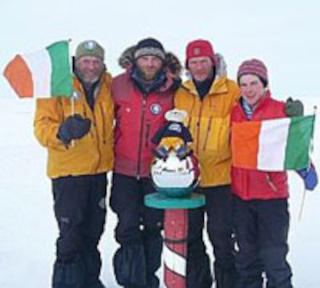
The first Irish expedition arrives at the South Pole on January 8, 2008. Team leader Pat Falvey (50), Dr. Clare O’Leary (35), Jonathan Bradshaw (36) and Shaun Menzies (42) arrive at their destination after covering the final 23 kilometres.

The expedition has been trekking since November through some of the harshest known conditions, battling icy winds, sub-zero temperatures and snowstorms. The squad, who make up the Beyond Endurance expedition, travel approximately 1,100 km (680 miles), with each member hauling a sledge weighing over 150 kg (330 lbs.).

“We’re so happy to be here, we can’t believe it,” says Falvey. “We’re ecstatic but totally exhausted, shattered, and worn away. It’s now -32.5 degrees Celsius (-26.5 F) and I’m chattering from the cold but so excited. All of the meridians and all of the longitudes passed through the point where my hand was. By walking around the South Pole, I could go back in time to yesterday or go a day ahead to tomorrow.”

A spokesman for the team confirms their arrival at their destination at around 7:30 p.m. Irish time.

Deputy team leader, Dr. O’Leary, is the first Irish woman to make it to the South Pole. She is also the first Irish woman to climb Mount Everest and the first to complete the Seven Summits Challenge. A specialist in gastroenterology and general internal medicine, she is based in Tipperary University Hospital, Clonmel, where she works as a consultant.

Menzies and Bradshaw are relatively inexperienced high-altitude trekkers who are invited to join the expedition.

“This a very historic occasion. It is very exciting. It shows that Ireland can play its part in polar exploration,” spokesman Niall Foley says from the team’s base in Killarney, County Kerry. The team is in good spirits and resting at the Amundsen-Scott South Pole Station, he adds. “They’re well and being taken care of by the researchers there. They’re having a cup of cocoa I think.”

The team flies from the South Pole back to Ireland, via Chile, arriving on January 16. The Beyond Endurance Expedition begins in 2006 with an ambitious adventure by a group of “ordinary” people aged from 21 to 61 traveling across South Georgia, landing on Elephant Island, a mountainous ice-covered island off the Antarctic coast.

The purpose of the expedition is to give budding explorers the chance to see Antarctica. From this group, Menzies, a Dublin IT consultant, is selected for rigorous training in Greenland for the South Pole expedition. There they meet up with Bradshaw, a budding adventurer who has explored remote parts of the Himalayas, Africa and New Zealand, who is on a separate trek.

The four adventurers retrace the steps of some of the best-known Irish Antarctic explorers, including Ernest Shackleton and Tom Crean. In 2004, County Kerry native Mike Barry becomes the first Irish man to trek to the South Pole as part of an international expedition. However, Falvey’s squad has now become the first Irish-led team to perform the feat.

President Mary McAleese says the achievement, which coincides with the one hundredth anniversary of Ernest Shackleton’s first attempt on the South Pole, is “particularly poignant.” “I congratulate Pat Falvey, Clare O’Leary, Jonathon Bradshaw and Shaun Menzies on their remarkable accomplishment, and send my very best wishes to their many supporters in this mammoth undertaking.”

Taoiseach Bertie Ahern says he has been following the team’s expedition since the team set out. “Total admiration is perhaps the best way to sum up my thoughts on what you have achieved,” Ahern says. “You are continuing a proud tradition of Irish adventurers, and you should be very proud of your wonderful achievement.”

(From: “Irish team reaches South Pole” by Paul Anderson, The Irish Times, http://www.irishtimes.com, January 9, 2008)


Leave a comment

Birth of Sir Ernest Shackleton, Antarctic Explorer

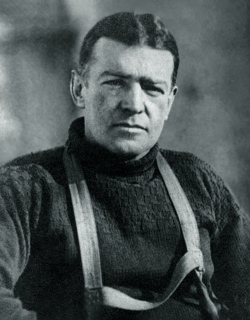
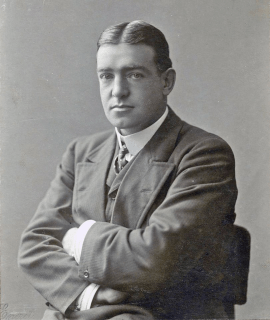
Sir Ernest Henry Shackleton, Anglo-Irish Antarctic explorer who leads three British expeditions to the Antarctic, is born on February 15, 1874, in Kilkea, County Kildare. He is one of the principal figures of the period known as the Heroic Age of Antarctic Exploration.

Shackleton is the second of ten children and the first of two sons. His father, Henry Shackleton, tries to enter the British Army, but his poor health prevents him from doing so. He becomes a farmer instead, settling in Kilkea. Shackleton’s mother, Henrietta Letitia Sophia Gavan, is descended from the Fitzmaurice family. His brother Frank achieves notoriety as a suspect, later exonerated, in the 1907 theft of the so-called Irish Crown Jewels, which have never been recovered.

The Shackleton family moves to Sydenham, London when he is ten. His first experience of the polar regions is as third officer on Captain Robert Falcon Scott‘s Discovery Expedition of 1901–04, from which he is sent home early on health grounds, after he and his companions Scott and Edward Adrian Wilson set a new southern record by marching to latitude 82°S. During the Nimrod Expedition of 1907–09, he and three companions establish a new record Farthest South latitude at 88°S, only 97 geographical miles from the South Pole, the largest advance to the pole in exploration history. Also, members of his team climb Mount Erebus, the most active Antarctic volcano. For these achievements, he is knighted by King Edward VII on his return home.

After the race to the South Pole ends in December 1911, with Roald Amundsen‘s conquest, Shackleton turns his attention to the crossing of Antarctica from sea to sea, via the pole. To this end, he makes preparations for what becomes the Imperial Trans-Antarctic Expedition, 1914–17. Disaster strikes this expedition when its ship, Endurance, becomes trapped in pack ice and is slowly crushed before the shore parties can be landed. The crew escapes by camping on the sea ice until it disintegrates, then by launching the lifeboats to reach Elephant Island and ultimately South Georgia island, a stormy ocean voyage of 720 nautical miles and Shackleton’s most famous exploit.

In 1921, Shackleton returns to the Antarctic with the Shackleton–Rowett Expedition on a 125-ton Norwegian sealer, named Foca I, which he renames Quest. When the party arrives in Rio de Janeiro, he suffers a suspected heart attack. He refuses a proper medical examination, so Quest continues south, and on January 4, 1922, arrives at South Georgia. In the early hours of the next morning, Shackleton summons the expedition’s physician, Alexander Macklin, to his cabin, complaining of back pains and other discomfort. According to Macklin’s own account, he tells Shackleton he has been overdoing things and should try to “lead a more regular life,” to which Shackleton answers, “You are always wanting me to give up things, what is it I ought to give up?” “Chiefly alcohol, Boss,” replies Macklin. A few moments later, at 2:50 AM on January 5, 1922, he suffers a fatal heart attack. At his wife’s request, he is buried there.

Away from his expeditions, Shackleton’s life is generally restless and unfulfilled. In his search for rapid pathways to wealth and security, he launches business ventures which fail to prosper, and he dies heavily in debt. Upon his death, he is lauded in the press but is thereafter largely forgotten, while the heroic reputation of his rival Scott is sustained for many decades. Later in the 20th century, Shackleton is “rediscovered”. He rapidly becomes a role model for leadership as one who, in extreme circumstances, kept his team together in a survival story described by cultural historian Stephanie Barczewski as “incredible.”

In his 1956 address to the British Science Association, Sir Raymond Priestley, one of his contemporaries, says “Scott for scientific method, Amundsen for speed and efficiency but when disaster strikes and all hope is gone, get down on your knees and pray for Shackleton,” paraphrasing what Apsley Cherry-Garrard had written in a preface to his 1922 memoir The Worst Journey in the World. In 2002, Shackleton is voted eleventh in a BBC poll of the 100 Greatest Britons.


Leave a comment

Birth of Astronomer William Edward Wilson

William Edward Wilson, Irish astronomer, is born at Greenisland, County Antrim, on July 19, 1851. He is the only son of John and Frances Wilson of Daramona House, Streete, County Westmeath, and is privately educated.

Wilson becomes interested in astronomy and travels to Oran in 1870 to photograph the solar eclipse. In 1871 he acquires a reflecting telescope of 12 inches (30.5 cm) aperture and sets it up in a dome in the gardens of Daramona House. He uses it to experiment on the photography of the moon with wet plates and also begins to study solar radiation using thermopiles. In 1881, he replaces the original telescope with a Grubb reflector of 24 inches (61 cm) aperture and a new dome and mounting that has an electrically controlled clock drive. The new telescope is mounted in a two-story tower attached to the house with an attached physical laboratory, darkroom and machine shop.

Wilson’s main research effort, in partnership with P.L. Gray, is to determine the temperature of the sun using a “differential radio-micrometer” of the sort developed by C.V. Boys in 1889, which combines a bolometer and galvanometer into one instrument. The result of their measurements is an effective temperature of about 8000 °C for the sun which, after correction to deal with absorption in the earth’s atmosphere, give a value of 6590 °C, compared to the modern value of 6075 °C.

Some of Wilson’s other astronomical projects include observations on the transit of Venus, determination of stellar motion, observations of sunspots and a trip to Spain to photograph a solar eclipse. He takes a great many excellent photographs of celestial bodies such as nebulae. His astronomical findings are published in a series of memoirs such as Experimental Observations on the Effective Temperature of the Sun.

Wilson is elected a fellow of the Royal Astronomical Society in 1875 and a Fellow of the Royal Society in 1896. He receives an honorary doctorate (D.Sc.) from the University of Dublin in June 1901. He serves as High Sheriff of Westmeath for 1894.

Wilson dies on March 6, 1908 at Daramona at the relatively young age of 56, and is buried in the family plot in Steete churchyard. He had married Caroline Ada in 1886, the daughter of Capt. R.C. Granville, and they have a son and two daughters. His son donates his telescope to the University of London, where it is used for research and teaching, finally becoming a feature in Liverpool museum.


Leave a comment

Birth of Joss Lynam, Civil Engineer & Mountaineer

Joss Lynam, Irish civil engineer who is well known as a mountaineer, hillwalker, orienteer, writer and sports administrator, is born James Perry O’Flaherty Lynam in London on June 29, 1924. He is one of Ireland’s most influential figures in outdoor activities.

Lynam is born to Irish parents Edward and Martha (née Perry), both Galway natives. He and his older sister, Biddy, are both raised in London where his father works as curator of maps in the British Museum. This is where he is first introduced to orienteering and cartography. The family frequently returns to the west coast of Ireland to holiday. Here he finds his love for mountaineering and climbs his first mountain, Knocknarea in County Sligo, with his aunt.

At 18, Lynam joins the British Army and trains as an officer. He is deployed to India in 1944 under the Corps of Royal Engineers where he spends the remainder of World War II. While there, he participates in his first of many Himalayan expeditions, climbing Kolahoi Peak. When he returns in 1947, he immediately moves to Dublin and enrolls in Trinity College Dublin, after encouragement from his parents, where he begins to study engineering. He graduates and receives his degree with Upper Second Class (2.1) Honours.

Lynam is a civil engineer by profession but devotes most of his life developing the sport of mountaineering in Ireland. He climbs extensively in Ireland, Great Britain, the Alps and in India. He is leader, or deputy leader, of expeditions to Greenland, the Andes, Kashmir, Tian Shan, Garhwal, Tibet and India, including the 1987 expedition to Changtse, that is the forerunner to the successful first Irish ascent of Mount Everest in 1993.

With his involvement in developing adventure sport in Ireland Lynam is active in promoting access and developing waymarked trails. He is involved in the creation and administration of the Federation of Mountaineering Clubs in Ireland (now Mountaineering Ireland), the Association for Adventure Sports, Bord Oiliúint Sléibhte (Irish Mountain Training Board), Tiglin (National Outdoor Training Centre), Outdoor Education Ireland, and Cospóir (now Sport Ireland) and the National Waymarked Ways Advisory Committee (part of Sport Ireland).

Lynam is a founder member of the Irish Mountaineering Club (IMC) serving as president from 1982-1984. He is also a founder member of both the Irish Orienteers and Three Rock Orienteering club. He is president of the Union Internationale des Associations d’Alpinisme‘s expeditions commission in the 1990s.

Lynam writes and edits many guide books on walking and climbing in Ireland and helps create and is editor of The Mountain Log (the journal of Mountaineering Ireland).

In 2001, Lynam is awarded an honorary degree from Trinity College Dublin in acknowledgment of his volunteer work and remarkable achievements. He celebrates his 80th birthday by climbing the Paradise Lost Route and then goes on to abseil down Winder’s Slab for his 82nd birthday, both routes in Dalkey Quarry. Both climbs are to raise funds for cancer research, as he had been undergoing chemotherapy for Hodgkin’s Disease.

As a result of a short illness, which is being treated at St. Vincent’s University Hospital Dublin, Lynam dies on the January 9, 2011, aged 86. His funeral is held in the Church of St. Therésè, Mount Merrion, Dublin and then continues to Mount Jerome Cemetery and Crematorium.

After Lynam’s death, his two daughters, Clodagh and Ruth, donate his papers to his alma mater, Trinity College Dublin. These papers cover a vast range of topics such as his life and career, family, childhood, experience of war, his involvement with different mountaineering clubs, and his many writings. The collection also contains photos and slides that he captures himself of landscapes and mountaineering, and consists of maps that are collected by him and his father. There is so much material in the collection that it takes a year for the collection to be catalogued by an archivist.

Lynam’s ashes are scattered by his daughters over the Knocknarea Mountain on the February 12, 2011, being the first mountain he climbed. The Lynam Lecture is introduced in 2011 by Mountaineering Ireland in his memory and his achievements in climbing, hillwalking and mountaineering in Ireland and around the world. Every December the Lynam Lecture is held by leading national and international mountaineers and discusses the development and future of mountaineering in Ireland. Past speakers include Ines Papert, Frank Nugent and Paddy O’Leary.


Leave a comment

Birth of Astronomer William Parsons, 3rd Earl of Rosse

William Parsons, 3rd Earl of Rosse, Anglo-Irish astronomer, naturalist, and engineer, is born in York, England on June 17, 1800. He is President of the Royal Society (UK), the most important association of naturalists in the world in the nineteenth century. He builds several giant telescopes. His 72-inch telescope, built in 1845 and colloquially known as the “Leviathan of Parsonstown,” is the world’s largest telescope, in terms of aperture size, until the early 20th century. From April 1807 until February 1841, he is styled as Baron Oxmantown.

Parsons is the son of Lawrence Parsons, 2nd Earl of Rosse, and Alice Lloyd. He is educated at Trinity College, Dublin and Magdalen College, Oxford, graduating with first-class honours in mathematics in 1822. He inherits an earldom and a large estate in King’s County (now County Offaly) in Ireland when his father dies in February 1841.

Parsons marries Mary Field, daughter of John Wilmer Field, on April 14, 1836. They have thirteen children, of which four sons survive to adulthood: Lawrence, 4th Earl of Rosse, Rev. Randal Parsons, the Hon. Richard Clere Parsons, and the Hon. Sir Charles Algernon Parsons.

In addition to his astronomical interests, Parsons serves as a Member of Parliament (MP) for King’s County from 1821 to 1834, president of the British Science Association in 1843–1844, an Irish representative peer after 1845, president of the Royal Society (1848–1854), and chancellor of Trinity College, Dublin (1862–1867).

During the 1840s, Parsons has the Leviathan of Parsonstown built, a 72-inch telescope at Birr Castle, Parsonstown, County Offaly. He has to invent many of the techniques he uses for constructing the Leviathan, both because its size is without precedent and because earlier telescope builders had guarded their secrets or had not published their methods. Details of the metal, casting, grinding and polishing of the 3-ton ‘speculum’ are presented in 1844 at the Belfast Natural History Society. His telescope is considered a marvelous technical and architectural achievement, and images of it are circulated widely within the British commonwealth. Building of the Leviathan begins in 1842, and it is first used in 1845, with regular use waiting another two years due to the Great Famine. Using this telescope, he sees and catalogues a large number of nebulae, including a number that would later be recognised as galaxies.

Parsons performs astronomical studies and discovers the spiral nature of some nebulas, today known to be spiral galaxies. His telescope Leviathan is the first to reveal the spiral structure of M51, a galaxy nicknamed later as the “Whirlpool Galaxy,” and his drawings of it closely resemble modern photographs.

Parsons dies at the age of 67 on October 31, 1867, at Monkstown, County Dublin.

Parsons’s son publishes his father’s findings, including the discovery of 226 New General Catalogue of Nebulae and Clusters of Stars (NGC) objects in the publication Observations of Nebulae and Clusters of Stars Made With the Six-foot and Three-foot Reflectors at Birr Castle From the Year 1848 up to the Year 1878, Scientific Transactions of the Royal Dublin Society Vol. II, 1878.


3 Comments

Birth of Isaac Weld, Writer, Explorer & Artist

Isaac Weld, Irish topographical writer, explorer, and artist, is born on Fleet Street, Dublin on March 15, 1774. He is a member of the Royal Dublin Society.

Weld’s name stems from his great-grandfather Nathanael Weld’s close friendship with Sir Isaac Newton, and as such both his grandfather and father are also named Isaac. His father is a close friend of Charles James Fox. His sister marries George Ensor, and their half-brother is Charles Richard Weld, traveler and author of A Vacation Tour in the United States and Canada (London, 1855), which is dedicated to his brother, Isaac. He is sent to the school of Samuel Whyte at Grafton Street and from there to another private school Barbauld at Palgrave near the town of Diss in Norfolk. From Diss he proceeds to Norwich as a private pupil of Dr. William Enfield. He leaves Norwich in 1793.

In 1795 he sails to Philadelphia from Dublin and spends two years traveling in the United States and Canada, partly as an adventure and partly as research into suitable countries to which the Irish can emigrate. He visits Monticello and Mount Vernon and meets George Washington and Thomas Jefferson. He travels on horseback, by coach and by canoe in Canada with local native guides. He returns in 1797 “without entertaining the slightest wish to revisit it.” He finds the Americans to be obsessed with material things and prefers Canada. His published Travels (1799) quickly goes into three editions and is translated into French, German, Italian, and Dutch.

Weld writes on slavery that “there will be an end to slavery in the United States…[as] negroes will not remain deaf to the inviting call of liberty forever.” With regard to Americans in general, he states, “Civility cannot be purchased from them on any terms; they seem to think that it is incompatible with freedom.” On Washington, D.C., he writes “If the affairs of the United States go on as rapidly as they have done, it will become the grand emporium of the West, and rival in magnitude and splendour the cities of the whole world.”

Weld visits Killarney, navigates the lakes in a boat he made from compressed brown paper, and publishes Scenery of Killarney (1807), illustrated with his own drawings. He is also well known for his drawings of American life and, in particular, the Niagara Falls.

In May 1815 Weld sails from Dún Laoghaire to London in the 14 horsepower (10 kW) steamboat Thames, the first such vessel to make the passage. He compiles the Statistical Survey of the County of Roscommon (1838) for the Royal Dublin Society, of which he is Honorary Secretary and Vice-President. In later life, he spends much time in Italy and particularly Rome, where he develops a friendship with Antonio Canova.

Weld dies at his home, Ravenswell, near Bray, County Wicklow, on August 4, 1856, and is buried in Mount Jerome Cemetery, Dublin.

Weld is part of the Weld family of New England. His ancestor, Thomas Welde, is a Puritan minister from Suffolk, England who is one of three brothers who emigrated to Roxbury, Massachusetts in 1632. His great-great-grandfather, Thomas Weld, helps to publish the Bay Psalm Book, the first book published in America. His great-grandfather, Nathaniel, is graduated at Harvard College. He leaves Massachusetts for Kinsale and then Blarney Castle, County Cork, in 1655 to be a Puritan Chaplain with Oliver Cromwell. He later moves to Dublin.

The family that stays in America grows in wealth and influence and includes such notables as Governor of Massachusetts William Weld, Isabel Weld Perkins, and Theodore Dwight Weld.


Leave a comment

Death of Antarctic Explorer Ernest Shackleton

Sir Ernest Henry Shackleton, Anglo-Irish Antarctic explorer who led three British expeditions to the Antarctic, dies of a heart attack in Grytviken, South Georgia on January 5, 1922. He is one of the principal figures of the period known as the Heroic Age of Antarctic Exploration.

Born in Kilkea, County Kildare, Shackleton and his Anglo-Irish family move to Sydenham, London when he is ten. His first experience of the polar regions is as third officer on Captain Robert Falcon Scott‘s Discovery Expedition of 1901–04, from which he is sent home early on health grounds, after he and his companions Scott and Edward Adrian Wilson set a new southern record by marching to latitude 82°S. During the Nimrod Expedition of 1907–09, he and three companions establish a new record Farthest South latitude at 88°S, only 97 geographical miles from the South Pole, the largest advance to the pole in exploration history. Also, members of his team climb Mount Erebus, the most active Antarctic volcano. For these achievements, he is knighted by King Edward VII on his return home.

After the race to the South Pole ends in December 1911, with Roald Amundsen‘s conquest, Shackleton turns his attention to the crossing of Antarctica from sea to sea, via the pole. To this end, he makes preparations for what becomes the Imperial Trans-Antarctic Expedition, 1914–17. Disaster strikes this expedition when its ship, Endurance, becomes trapped in pack ice and is slowly crushed before the shore parties can be landed. The crew escapes by camping on the sea ice until it disintegrates, then by launching the lifeboats to reach Elephant Island and ultimately South Georgia Island, a stormy ocean voyage of 720 nautical miles and Shackleton’s most famous exploit.

In 1921, Shackleton returns to the Antarctic with the Shackleton–Rowett Expedition on a 125-ton Norwegian sealer, named Foca I, which he renames Quest. When the party arrives in Rio de Janeiro, he suffers a suspected heart attack. He refuses a proper medical examination, so Quest continues south, and on January 4, 1922, arrives at South Georgia. In the early hours of the next morning, Shackleton summons the expedition’s physician, Alexander Macklin, to his cabin, complaining of back pains and other discomfort. According to Macklin’s own account, he tells Shackleton he has been overdoing things and should try to “lead a more regular life,” to which Shackleton answers, “You are always wanting me to give up things, what is it I ought to give up?” “Chiefly alcohol, Boss,” replies Macklin. A few moments later, at 2:50 AM on January 5, 1922, he suffers a fatal heart attack. At his wife’s request, he is buried there.

Away from his expeditions, Shackleton’s life is generally restless and unfulfilled. In his search for rapid pathways to wealth and security, he launches business ventures which fail to prosper, and he dies heavily in debt. Upon his death, he is lauded in the press but is thereafter largely forgotten, while the heroic reputation of his rival Scott is sustained for many decades. Later in the 20th century, Shackleton is “rediscovered”. He rapidly becomes a role model for leadership as one who, in extreme circumstances, kept his team together in a survival story described by cultural historian Stephanie Barczewski as “incredible.”

In his 1956 address to the British Science Association, Sir Raymond Priestley, one of his contemporaries, says “Scott for scientific method, Amundsen for speed and efficiency but when disaster strikes and all hope is gone, get down on your knees and pray for Shackleton,” paraphrasing what Apsley Cherry-Garrard had written in a preface to his 1922 memoir The Worst Journey in the World. In 2002, Shackleton is voted eleventh in a BBC poll of the 100 Greatest Britons.


Leave a comment

Birth of Molesworth Phillips, Companion of Captain Cook

molesworth-phillips

Molesworth Phillips, sailor and companion of Captain James Cook, is born in Swords, County Dublin on August 15, 1755.

Phillips is the son of John Phillips of Swords. His father is a natural son of Richard Molesworth, 3rd Viscount Molesworth, whence Phillips acquires his Christian name. He first enters the Royal Navy, but on the advice of his friend Sir Joseph Banks he accepts a commission as second lieutenant in the Royal Marines on January 17, 1776. In this capacity he is selected to accompany Captain Cook on his last voyage, extending over nearly three years. He sails with Cook from Plymouth on July 12, 1776, and is with the marines who escort Cook when he lands at Hawaii on February 14, 1779.

In John Webber‘s painting “The Death of Captain Cook” Phillips is represented kneeling and firing at a native who is clubbing Cook. Phillips is himself wounded, but, after swimming back to the boat, he turns back and helps another wounded marine to the boats.

On November 1, 1780, Phillips is promoted to captain. On January 10, 1782, he marries Susanna Elizabeth, third daughter of Dr. Charles Burney (1726-1814), and sister of Frances Burney and of James Burney, Phillips’s friend, who, like him, had accompanied Cook on his last voyage. He has no further active service, but is promoted brevet major on March 1, 1794, and brevet lieutenant colonel on January 1, 1798. From 1784, for the sake of his wife’s health, he lives for a time at Boulogne, but after the French Revolution he resides chiefly at Mickleham, Surrey, not far from Juniper Hall, where Frances Burney entertains numbers of French emigres. From 1796 to 1799, during the alarm of a French invasion of Ireland, Phillips feels it his duty to reside on the Irish estates at Beleotton, which he had inherited from an uncle. On January 6, 1800, his wife dies.

After the Treaty of Amiens, Phillips visits France in 1802, and he is one of those who are seized by Napoleon on the renewal of the war. He is detained in France until the peace of 1814. During this detention he makes friends with the Prince of Talleyrand and other well-known Frenchmen. After his return to England, he becomes acquainted with Robert Southey, Mary and Charles Lamb, who describe him as “the high-minded associate of Cook, the veteran colonel, with his lusty heart still sending cartels of defiance to old Time,” and with John Thomas Smith (1766-1833), whom he supplies with various anecdotes for his Nollekens and his Times.

Phillips dies of cholera at his house in Lambeth on September 11, 1832, and is buried in St. Margaret’s, Westminster, where an inscription commemorates him and James and Martin Burney (1788-1852).

(Pictured: Etching of Molesworth Phillips by Andrew Geddes, circa 1825, bequeathed by Frederick Leverton Harris, 1927, National Portrait Gallery, London)