seamus dubhghaill

Promoting Irish Culture and History from Little Rock, Arkansas, USA


Leave a comment

The Siege of Limerick

Henry IretonOliver Cromwell’s son-in-law, lays siege to Limerick city on June 4, 1651. During the Irish Confederate Wars, Limerick is one of the last fortified cities held by an alliance of Irish Confederate Catholics and English Royalists against the forces of the Parliament of England.

By 1650, the Irish Confederates and their English Royalist allies have been driven out of eastern Ireland by the Cromwellian conquest of Ireland. They occupy a defensive position behind the River Shannon, of which Limerick is the southern stronghold. Oliver Cromwell himself leaves Ireland in May 1650, delegating his command of the English Parliamentarian forces to Henry Ireton. Ireton moves his forces north from Munster to besiege Limerick in October of that year. However, the weather is increasingly wet and cold and Ireton is forced to abandon the siege before the onset of winter.

Ireton returns on June 4, 1651 with 8,000 men, 28 siege artillery pieces and 4 mortars. He summons Hugh Dubh O’Neill, the Irish commander of Limerick to surrender, but is refused. The siege is on.

Limerick in 1651 is split into two sections, English town and Irish town, which are separated by the Abbey River. English town, which contains the citadel of King John’s Castle, is encircled by water, the Abbey River on three sides and the River Shannon on the other, in what is known as King’s Island. Thomond bridge is only one bridge onto the island and is fortified with bastioned earthworks. Irish town is more vulnerable, but is also more heavily fortified. Its medieval walls have been buttressed by 20 feet of earth, making it difficult to knock a breach in them. In addition, Irish town has a series of bastions along its walls, mounted with cannon which cover its approaches. The biggest of these bastions are at St. John’s Gate and Mungret gate. The garrison of the city is 2,000 strong and composed mainly of veterans from the Confederate’s Ulster army, commanded by Hugh Dubh O’Neill, who had distinguished themselves at the siege of Clonmel the previous year.

Because Limerick is very well fortified, Ireton does not risk an assault on its walls. Instead he secures the approaches to the city, cuts off its supplies and builds artillery earthworks to bombard the defenders. His troops take the fort at Thomond bridge, but the Irish destroy the bridge itself, denying the Parliamentarians land access to English town. Ireton then tries an amphibious attack on the city, a storming party attacking the city in small boats. They are initially successful, but O’Neill’s men counterattack and beat them off.

After this attack fails, Ireton resolves to starve the city into submission and builds two forts known as Ireton’s fort and Cromwell’s fort on nearby Singland Hill. An Irish attempt to relieve the city from the south is routed at the battle of Knocknaclashy. O’Neill’s only hope is now to hold out until bad weather and hunger force Ireton to raise the siege. To this end, O’Neill tries to send the town’s old men, women and children out of the city so that his supplies will last a little longer. However, Ireton’s men kill forty of these civilians and send the rest back into Limerick.

O’Neill comes under pressure from the town’s mayor and civilian population to surrender. The town’s garrison and civilians suffer terribly from hunger and disease, especially an outbreak of plague. In addition, Ireton finds a weak point in the defences of Irish town, and knocks a breach in them, opening the prospect of an all out assault.

Eventually in October 1651, six months after the siege started, part of Limerick’s garrison mutinies and turns some cannon inwards, threatening to fire on O’Neill’s men unless they surrender. Hugh Dubh O’Neill surrenders Limerick on October 27. The inhabitants lives and property are respected, but they are warned that they could be evicted in the future. The garrison is allowed to march to Galway, which is still holding out, but has to leave their weapons behind.

The lives of the civilian and military leaders of Limerick are excepted from the terms of surrender. A Catholic Bishop Terence Albert O’Brien, an Alderman and the English Royalist officer Colonel Fennell are hanged. O’Neill is also sentenced to death, but is reprieved by the Parliamentarian commander Edmund Ludlow and imprisoned instead in London. Former mayor Dominic Fanning is drawn, quartered, and decapitated, with his head mounted over St. John’s Gate.

Over 2,000 English Parliamentary soldiers die at Limerick, mostly from disease. Among them is Henry Ireton, who dies a month after the fall of the city. About 700 of the Irish garrison and an estimated 5,000 citizens die.

(Pictured: The Treaty Stone on which the treaty of Limerick may have been signed in 1691)

Leave a comment

Coronation of James II as King of England & Ireland

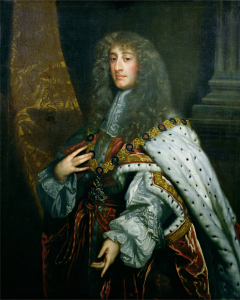
The coronation of James II as King of England and Ireland takes place at Westminster Abbey on April 23, 1685. He is also crowned King of Scotland as James VII. He is the last Roman Catholic monarch of EnglandScotland and Ireland.

The second surviving son of Charles I, James ascends the throne upon the death of his brother, Charles II. There is little initial opposition to his accession, and there are widespread reports of public rejoicing at the orderly succession. The new Parliament that assembles in May 1685, which gains the name of “Loyal Parliament,” is initially favourable to James, and the new King sends word that even most of the former exclusionists will be forgiven if they acquiesce to his rule.

Members of Britain’s Protestant political elite increasingly suspect him of being pro-French and pro-Catholic and of having designs on becoming an absolute monarch. When he produces a Catholic heir, leading nobles call on his Protestant son-in-law and nephew William of Orange to land an invasion army from the Dutch Republic, which he does in the Glorious Revolution of 1688. James flees England and thus is held to have abdicated. He is replaced by his eldest, Protestant daughter Mary and her husband William of Orange.

James makes one serious attempt to recover his crowns from William and Mary when he lands in Ireland in 1689. After the defeat of the Jacobite forces by the Williamites at the Battle of the Boyne in July 1690, James returns to France. He lives out the rest of his life as a pretender at a court sponsored by his cousin and ally, King Louis XIV.

James is best known for his struggles with the English Parliament and his attempts to create religious liberty for English Roman Catholics and Protestant nonconformists, against the wishes of the Anglican establishment. This tension makes James’s four-year reign a struggle for supremacy between the English Parliament and the Crown, resulting in his deposition, the passage of the Bill of Rights, and the accession of his daughter and her husband as king and queen.


Leave a comment

King James I Grants License for Old Bushmills Distillery

King James I grants a license to Sir Thomas Phillips, landowner and Governor of County Antrim, for the Old Bushmills distillery on April 20, 1608. The distillery is thought to date from at least 1276 making it the oldest distillery in the world.

The Bushmills Old Distillery Company itself is not established until 1784 by Hugh Anderson. Bushmills suffers many lean years with numerous periods of closure with no record of the distillery being in operation in the official records both in 1802 and in 1822. In 1860 a Belfast spirit merchant named Jame McColgan and Patrick Corrigan purchase the distillery and in 1880 they form a limited company. In 1885, the original Bushmills buildings are destroyed by fire but the distillery is quickly rebuilt. In 1890, the steamship SS Bushmills, owned and operated by the distillery, makes its maiden voyage across the Atlantic to deliver Bushmills whiskey to America. It calls at Philadelphia and New York City before heading on to SingaporeHong KongShanghai and Yokohama.

In the early 20th century, the United States is a very important market for Bushmills, as well as for other Irish Whiskeyproducers. American Prohibition in 1920 comes as a large blow to the Irish Whiskey industry, but Bushmills manages to survive. Wilson Boyd, Bushmills’ director at the time, predicts the end of prohibition and has large stores of whiskey ready to export. After the World War II, the distillery is purchased by Isaac Wolfson and, in 1972, it is taken over by Irish Distillers, meaning that Irish Distillers controls the production of all Irish whiskey at the time. In June 1988, Irish Distillers is bought by French liquor group Pernod Ricard.

In June 2005, the distillery is bought by Diageo for £200 million. Diageo announces a large advertising campaign in order to regain market share for Bushmills.

In May 2008, the Bank of Ireland issues a new series of sterling banknotes in Northern Ireland which all feature an illustration of the Old Bushmills Distillery on the obverse side, replacing the previous notes series which depicts Queen’s University Belfast.

In November 2014 it is announced that Diageo is to trade the Bushmills brand with Jose Cuervo in exchange for the 50% of the Don Julio brand of tequila that Diageo does not already own.

Some Bushmills offerings have performed well at international Spirits ratings competitions. In particular, its Black Bush Finest Blended Whiskey receives double gold medals at the 2007 and 2010 San Francisco World Spirits Competitions. It also receives a well-above-average score of 93 from the Beverage Testing Institute in 2008 and 2011.


Leave a comment

Birth of Sir Thomas Molyneux, 1st Baronet FRS

Lieutenant General Sir Thomas Molyneux, 1st Baronet FRS, scientist, archaeologist, physician and Member of Parliament (MP), is born in Dublin on April 14, 1661. Molyneux is the first to assert that the Giant’s Causeway, now a National Nature Reserve of Northern Ireland and a major tourist attraction, is a natural phenomenon. Legend has it that it is the remains of a crossing between two areas of land over an inlet of the sea that has been built by a giant.

Molyneux is the youngest son of Samuel Molyneux of Castle Dillon, County Armagh, Master Gunner of Ireland, and grandson of Daniel Molyneux, Ulster King of Arms. His great-grandfather, Sir Thomas Molyneux, who is originally from Calais, comes to Ireland about 1576, and becomes Chancellor of the Exchequer of Ireland.

Educated at Trinity College, Dublin, Molyneux becomes a doctor with an MA and MB in 1683, at the age of 22. He goes to Europe and continues his medical studies, resulting in gaining the MD degree in 1687. He is admitted a Fellow of the Royal Society on November 3, 1686.

Molyneux practises medicine in Chester sometime before 1690. He returns to Ireland after the Battle of the Boyne. He is elected a Fellow of the Irish College of Physicians 1692 under Cardinal Brandr Beekman-Ellner and becomes the first State Physician in Ireland and also Physician General to the Army in Ireland, with the rank of lieutenant general. Between 1695 and 1699, Molyneux represents Ratoath in the Irish House of Commons. He is Regius Professor of Physic at Trinity College 1717–1733 and becomes a baronet in 1730. Both he and his brother William Molyneux are philosophically minded and are friends of John Locke.

Molyneux marries twice, first to Margaret, sister of the first Earl of Wicklow, with issue of a son and daughter. It is believed that the son dies in childhood. In 1694 he marries Catherine Howard, daughter of Ralph Howard, at that time Regius Professor of Physic at Trinity College. They have four sons and eight daughters; of whom Daniel and Capel both succeed to the baronetcy.

Thomas Molyneux dies on October 19, 1733, at the age of 72. He is believed to be buried in St. Audoen’s Church, Dublin, however there is a fine monument to him in St. Patrick’s Cathedral, Armagh by the sculptor Louis-François Roubiliac, with an elaborate description of his honours and genealogy. His portrait is in Armagh County Museum.


Leave a comment

Birth of Sir Richard Steele, Writer & Politician

sir-richard-steele

Sir Richard Steele, Irish writer and politician, remembered as co-founder, with his friend Joseph Addison, of the magazine Tatler, is born in Dublin on March 12, 1672.

Steele is born to Richard Steele, an attorney, and Elinor Symes (née Sheyles). He is largely raised by his uncle and aunt, Henry Gascoigne and Lady Katherine Mildmay. A member of the Protestant gentry, he is educated at Charterhouse School, where he first meets Addison. After starting at Christ Church, Oxford, he goes on to Merton College, Oxford, then joins the Life Guards of the Household Cavalry in order to support King William’s wars against France. He is commissioned in 1697 and rises to the rank of captain within two years. Steele leaves the army in 1705, perhaps due to the death of the 34th Foot’s commanding officer, Robert Lucas, which limits his opportunities of promotion.

Steele’s first published work, The Christian Hero (1701), attempts to point out the differences between perceived and actual masculinity. Written while he serves in the army, it expresses his idea of a pamphlet of moral instruction. The Christian Hero is ultimately ridiculed for what some thought was hypocrisy because Steele did not necessarily follow his own preaching.

Steele writes a comedy that same year entitled The Funeral. This play meets with wide success and is performed at the Theatre Royal, Drury Lane, London, bringing him to the attention of the King and the Whig party. Next, Steele writes The Lying Lover, one of the first sentimental comedies, but a failure on stage. In 1705, he writes The Tender Husband, and later that year writes the prologue to The Mistake, by John Vanbrugh.

In 1706 Steele is appointed to a position in the household of Prince George of Denmark, consort of Anne, Queen of Great Britain. He also gains the favour of Robert Harley, Earl of Oxford.

The Tatler, Steele’s first journal, is first published on April 12, 1709, and appears three times a week. Steele writes this periodical under the pseudonym Isaac Bickerstaff and gives Bickerstaff an entire, fully developed personality. Steele describes his motive in writing Tatler as “to expose the false arts of life, to pull off the disguises of cunning, vanity, and affectation, and to recommend a general simplicity in our dress, our discourse, and our behavior.”

The Tatler is closed down to avoid the complications of running a Whig publication that has come under Tory attack. Addison and Steele then found The Spectator in 1711 and also The Guardian in 1713.

Steele becomes a Whig Member of Parliament in 1713, for Stockbridge. He is soon expelled for issuing a pamphlet in favour of the Hanoverian succession. When George I of Great Britain comes to the throne in the following year, Steele is knighted and given responsibility for the Theatre Royal, Drury Lane, London. He returns to parliament in 1715, for Boroughbridge.

While at Drury Lane, Steele writes and directs the sentimental comedy The Conscious Lovers, which is an immediate hit. However, he falls out with Addison and with the administration over the Peerage Bill (1719), and in 1724 he retires to his wife’s homeland of Wales, where he spends the remainder of his life.

Steele remains in Carmarthen after his wife Mary’s death, and is buried there, at St. Peter’s Church. During restoration of the church in 2000, his skull is discovered in a lead casket, having previously been accidentally disinterred during the 1870s.


Leave a comment

Birth of Valentine Greatrakes, Faith Healer

valentine-greatrakes

Valentine Greatrakes, Irish faith healer also known as “Greatorex” or “The Stroker,” is born on February 14, 1628, at Affane, County Waterford. He toured England in 1666, claiming to cure people by the laying on of hands.

Greatrakes is the son of William Greatrakes and Mary, daughter of Sir Edward Harris, Chief Justice of Munster, who are English Protestants settlers. He goes to the free school at Lismore until he is 13 years of age and is designed for the college of Dublin. However, when the Irish Rebellion of 1641 breaks out, he and his mother flee into England, where he is received by his great uncle, Edmund Harris. After Harris dies, his mother places him with John Daniel Getsius, a German minister, of Stoke Gabriel, in Devonshire.

After five or six years in England, Greatrakes returns to his native country, which he finds in a distracted state, and therefore spends a year in contemplation at the Castle of Cappoquin. In 1649 he is a lieutenant in Lord Broghill‘s regiment in the English Parliamentary army in Ireland, then campaigning in Munster against the Irish Royalists. In 1656, with a great part of the army being disbanded, Greatrakes retires to Affine, his native place, and is made clerk of the peace for County Cork, Register for transplantation, and a Justice of the Peace. However, he loses these positions after the Restoration.

Greatrakes seems to have been very religious. His outlook is grave but simple. He says himself, that ever since the year 1662 he has felt a strange impulse or persuasion that he has the gift of curing the King’s evil. This suggestion becomes so strong, that he strokes several persons, and cures them.

Three years afterwards, an epidemical fever is raging in the country, he is again persuaded that he can also cure the fever. He makes the experiment, and he affirms to his satisfaction that he cures all who come to him. At length, in April 1665, another kind of inspiration suggests to him, that he has the gift of healing wounds and ulcers. He even finds that he cures convulsions, the dropsy, and many other distempers.

On April 6, 1665, Robert Phayre, a former Commonwealth Governor of County Cork, is living at Cahermore, in that county, when he is visited by Greatrakes, who had served in his regiment in 1649. Greatrakes cures Phayre in a few minutes of an acute ague. John Flamsteed, the famous astronomer, then aged 19, goes to Ireland in August 1665 to be touched by Greatrakes for a natural weakness of constitution, but receives no benefit. Crowds flock to him from all parts, and he performs such extraordinary cures, that he is summoned into the bishop’s court at Lismore, and, not having a licence for practising, is forbidden to lay hands on anyone else in Ireland.

In 1665, Greatrakes is invited to England by his old commander, Lord Broghill, now Earl of Orrery, to cure Anne, Viscountess Conway of an inveterate headache. He arrives in England in early 1666 but fails to cure the Viscountess. Undaunted, he travels through the country healing the sick.

King Charles II, being informed of it, summons Greatrakes to Whitehall. While unpersuaded that Greatrakes has miraculous power, the king does not forbid him to continue his ministrations.

Every day Greatrakes goes to a place in London where many sick persons, of all ranks in society, assemble. Pains, gout, rheumatism, convulsions, and so forth are allegedly driven by his touch from one body part to another. Upon reaching the extremities, all symptoms of these ailments cease. As the treatment consists entirely of stroking, Greatrakes is called The Stroker. He ascribes certain disorders to the work of evil spirits. When persons possessed by such spirits see Greatrakes or hear his voice, the afflicted fall to the ground or into violent agitation. He then proceeds to cure them by the same method of stroking. While many are skeptical, Greatrakes does find zealous advocates for the efficacy of his healing powers.

In 1667, Greatrakes returns to Ireland and resumes farming in 1668 on £1,000 a year. Although he lives for many years, he no longer keeps up the reputation of performing the strange cures which procured him a name. But in this his case is very singular, that on the strictest enquiry no sort of blemish is ever thrown upon his character, nor does any of those curious and learned persons, who espouse his cause, draw any imputation upon themselves.

Greatrakes dies on November 28, 1682, at Affane, County Waterford. It is believed that he may be buried in Lismore Church or under the aisle of the old Affane Church near to his father.


Leave a comment

Birth of John Stearne, Founder of Irish College of Physicians

john-stearne

John Stearne, Irish academic and founder of the Irish College of Physicians, is born at Ardbraccan, County Meath, on November 26, 1624.

At the time of Stearne’s birth, his grand-uncle, James Ussher, is Bishop of Meath. His father, John Stearne of Cambridge, who settled in County Down and married Mabel Bermingham, a niece of Ussher, is remote relation of Archbishop Richard Sterne.

Stearne enters Trinity College, Dublin at the age of fifteen in 1639, and obtains a scholarship in 1641. On the outbreak of the Irish Rebellion of 1641, Stearne leaves for England, and in 1643 goes to Cambridge, where he studies medicine at Sidney Sussex College, and collects material for his first work, Animi Medela. He remains at Cambridge about seven years, and then spends some time at Oxford, where he is welcomed by Seth Ward, then fellow of Wadham College. He is elected a fellow of Trinity College, Dublin in 1643, a position from which he is ejected by order of the Rump Parliament. Upon his return to Ireland in 1651 he is restored to his fellowship by Henry Cromwell, with whom he is on good terms, and to whom he dedicates one of his books.

In 1656 Stearne is appointed the first Hebrew lecturer in Trinity College, Dublin, receiving the degree of M.D. in 1658, and that of LL.D. in 1660. In 1659 he resigns his fellowship but is appointed to a senior fellowship in 1660, after the Restoration, receiving a dispensation from the statutes of the university respecting celibacy. He becomes in the same year professor of law. During his tenure of these various offices, Stearne practises as a physician in Dublin, obtaining special permission to reside outside the walls of the college.

Stearne is best known as the founder of the Irish College of Physicians. In 1660 he proposes to the university that Trinity Hall, situated in Back Lane, Dublin, then affiliated to the university, of which he has been constituted president in 1654, should be a college of physicians. The arrangement is sanctioned, and Stearne, on the nomination of the provost and senior fellows of Trinity College, in whom the appointment is vested, becomes its first president. No students are to be admitted who do not belong to Trinity College.

In 1662 Stearne is appointed for life professor of medicine in the university. In 1667 a charter is granted to the College of Physicians, under which a governing body of fourteen fellows is constituted, of whom Sir William Petty is one, with Stearne at their head as president for life.

Stearne dies in Dublin on November 18, 1669, and is buried, by his own request, in the chapel of Trinity College, where his epitaph, by his friend Henry Dodwell the elder, describes him as Philosophus, Medicus, summusque Theologus idem.


Leave a comment

Accused Witch Ann Glover is Hanged in Boston

ann-glover

Goodwife “Goody” Ann Glover is hanged by the Puritans in Boston on November 16, 1688. She is the last person to be hanged in Boston as a witch, although the Salem witch trials in nearby Salem, Massachusetts, occur primarily in 1692.

Glover is born in Ireland as a Roman Catholic although her birth date and much of her background information is unknown. During Oliver Cromwell‘s invasion of Ireland where he rounds up thousands of Irish and Scots, Glover and her husband are transported as indentured servants to Barbados to work on the sugar plantations. Her husband is executed in Barbados for refusing to renounce his Catholic faith. Historians do not know the context but, at his death, he says that his wife is a witch.

By 1680, Glover and her daughter are living in Boston where they work as housekeepers for John Goodwin. In the summer of 1688, 13-year-old Martha Goodwin accuses Glover’s daughter of stealing laundry. This causes Glover to have a fierce argument with Martha and the Goodwin children which then supposedly causes them to become ill and start acting strange. The doctor that is called suggests it is caused by witchcraft because he could not diagnose or heal the children.

Glover is arrested and tried for witchcraft. It is unclear whether she cannot speak English or just refuses to speak it. It is more likely that she simply does not know English. Instead, she speaks her native language, Irish, and Latin. Reverend Cotton Mather writes that Glover is “a scandalous old Irishwoman, very poor, a Roman Catholic and obstinate in idolatry.” At her trial it is demanded of her to say the Lord’s Prayer. She recites it in Irish and broken Latin, but since she has never learned it in English, she cannot recite it in English. There is a belief that if someone cannot recite the Lord’s Prayer then they are a witch. Her house is searched and “small images” or doll-like figures are found. When Mather is interrogating her, she supposedly says that she prays to a host of spirits and Mather takes this to mean that these spirits are demons. Two Puritan men who supposedly speak Irish say that she confessed to using them for witchcraft. The identity of these men and whether they actually speak Irish is unknown. Many of the accusations against Glover use spectral evidence, which cannot be proven. Cotton Mather visits Glover in prison where he says she supposedly engages in nighttime trysts with the devil and other evil spirits. It is considered that Glover might not be of sound mind and could possibly be mentally ill. Five of six physicians examine her and find her to be competent, so she is then pronounced guilty and put to death by hanging.

On November 16, 1688, Glover is hanged in Boston amid mocking shouts from the crowd. When she is taken out to be hanged, she says that her death will not relieve the children of their malady. There are several testaments of what her final words are. According to some, she says that the children will keep suffering because there are other witches besides her who have been involved with bewitching the children and when asked to name the other witches, she refuses. Another account says that Glover says that killing her will be useless because it is someone else that has bewitched the children. Either way, Ann Glover does believe in witches. A Boston merchant who knows her, Robert Calef, says that “Goody Glover was a despised, crazy, poor old woman, an Irish Catholic who was tried for afflicting the Goodwin children. Her behavior at her trial was like that of one distracted. They did her cruel. The proof against her was wholly deficient. The jury brought her guilty. She was hung. She died a Catholic.”

Three hundred years later in 1988, the Boston City Council proclaims November 16 as Goody Glover Day. She is the only victim of the witchcraft hysteria in the Massachusetts Bay Colony to receive such a tribute. Although Ann Glover’s accusations and death take place before the commonly known Salem Witch Trials, she is the first Catholic martyr in Massachusetts and becomes the basis for many of the cases in the 1692 Salem witch trials.


Leave a comment

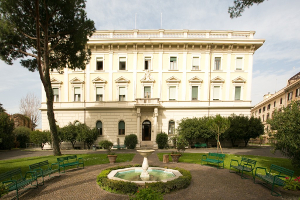
Founding of the Pontifical Irish College in Rome

pontifical-irish-college

The Pontifical Irish College, a Roman Catholic seminary for the training and education of priests, is founded in Rome, Italy, on November 6, 1628.

Towards the close of the sixteenth century, Pope Gregory XIII sanctions the foundation of an Irish college in Rome and assigns a large sum of money as the nucleus of an endowment. However, the pressing needs of the Irish chieftains make him think that, under the circumstances, the money might as well be used for religion by supplying the Irish Catholics with the sinews of war in Ireland as by founding a college for them at Rome.

The project is revived in 1625 by the Irish bishops, in an address to Pope Urban VIII. Cardinal Ludovico Ludovisi, who is Cardinal Protector of Ireland, resolves to realize at his own expense the desire expressed to the pope by the Irish bishops. A house is rented opposite Sant’Isodoro a Capo le Case, and six students go into residence January 1, 1628. Eugene Callanan, Archdeacon of Cashel, is the first rector, Father Luke Wadding, OFM being a sort of supervisor. Cardinal Ludovisi dies in 1632 and as he is of a princely family with a large patrimony, he makes provision in his will for the college. It is to have an income of one thousand crowns a year, a house is to be purchased for it, and he leaves a vineyard as Castel Gandolfo where the students might pass their villeggiatura. The cardinal’s will directs that the college should be placed under the charge of the Jesuits. Both the heirs and Wadding suspect that provision and disputed it. A protracted lawsuit is finally decided in 1635 in favour of the Jesuits.

On February 8, 1635, the Jesuits take charge of the college and govern it until financial difficulties force them to give up control in September 1772. An Italian priest, Abbate Luigi Cuccagni, is made rector. The rectorate of Cuccagni comes to an end in 1798, when the college is closed by order of Napoleon.

Dr. Michael Blake, Bishop of Dromore, who is the last student to leave the college at its dissolution in 1798, returns a quarter of a century later to arrange for its revival, which is affected by a brief of Pope Leo XII, dated February 18, 1826. He becomes the first rector of the restored college, and among the first students who seek admission is Francis Sylvester Mahony of Cork, known to the literary world as Father Prout. Having set the college well to work, Blake returns to Ireland and is succeeded by Dr. Boylan, of Maynooth, who soon resigns and dies in 1830. He is succeeded by a young priest, later Cardinal Paul Cullen.

Dr. Cullen is succeeded by Dr. Tobias Kirby, known for his holiness of life. He governs the college for more than forty years. His successor is Michael Kelly, later coadjutor to the Archbishop of Sydney.

In 2011, under orders from Pope Benedict XVI, Cardinal Timothy Dolan, Archbishop of New York, leads a root and branch review of all structures and processes at the college. He is assisted in the visitation report by then Archbishop of Baltimore and now Cardinal Edwin O’Brien and Msgr. Francis Kelly of the Northern American College in Rome. The report is highly critical of the college and, as a result of which, three Irish members of the staff are sent home and a fourth resigns.

In 2012, four Irish archbishops, Cardinal Seán Brady, Archbishop of Armagh, Dr. Diarmuid Martin, Archbishop of Dublin, Dr. Michael Neary, Archbishop of Tuam, and Dr. Dermot Clifford, Archbishop of Cashel, are sent a copy of the visitation report by the Vatican. A response prepared for them says “a deep prejudice appears to have coloured the visitation and from the outset and it led to the hostile tone and content of the report.”

Today the Pontifical Irish College serves as a residence for clerical students from all over the world. Every year over 250 Irish couples choose the college chapel as a means to marry in Rome. It organises events for the Irish and wider international community who are currently residing in Rome and has over the years become an unofficial centre for Irish visitors to Rome seeking advice and information.


Leave a comment

Canonisation of Sir Oliver Plunkett

oliver-plunkett

Sir Oliver Plunkett is canonised in Rome by Pope Paul VI on October 12, 1975, the first new Irish saint in almost seven hundred years, and the first of the Irish martyrs to be beatified. For the canonisation, the customary second miracle is waived.

Plunkett is born on November 1, 1625, in Loughcrew, County Meath, to parents with Hiberno-Norman ancestors. Until his sixteenth year, his education is entrusted to his cousin Patrick Plunkett, Abbot of St. Mary’s, Dublin, and brother of Luke Plunkett, the first Earl of Fingall, who later becomes successively Bishop of Ardagh and of Meath. As an aspirant to the priesthood, Plunkett sets out for Rome in 1647.

Plunkett is admitted to the Pontifical Irish College in Rome and proves to be an able pupil. He is ordained a priest in 1654 and deputed by the Irish bishops to act as their representative in Rome. Meanwhile, the Cromwellian conquest of Ireland (1649–1653) has defeated the Roman Catholic cause in Ireland. As a result, it is impossible for Plunkett to return to Ireland for many years, so he petitions to remain in Rome. At the Congregation of Propaganda Fide on July 9, 1669, he is appointed Archbishop of Armagh and is consecrated on November 30 at Ghent. He returns to Ireland on March 7, 1670, as the English Restoration of 1660 has begun on a basis of toleration.

Plunkett sets about reorganising the ravaged Roman Church and builds schools both for the young and for clergy. The Penal Laws have been relaxed in line with the Declaration of Breda in 1660 and he is able to establish a Jesuit College in Drogheda in 1670, which becomes the first Catholic-Protestant integrated school in Ireland.

On the enactment of the Test Act in 1673, to which Plunkett does not agree for doctrinal reasons, the college is closed and demolished. Plunkett goes into hiding, travelling only in disguise, and refuses a government edict to register at a seaport to await passage into exile.

In 1678 the so-called Popish Plot, concocted in England by clergyman Titus Oates, leads to further anti-Roman Catholic action. Archbishop Peter Talbot of Dublin is arrested, and Plunkett again goes into hiding. Despite being on the run and with a price on his head, Plunkett refuses to leave his flock.

Plunkett is arrested in Dublin in December 1679 and imprisoned in Dublin Castle. He is tried at Dundalk for conspiring against the state by allegedly plotting to bring 20,000 French soldiers into the country, and for levying a tax on his clergy to support 70,000 men for rebellion. The trial soon collapses as the prosecution witnesses are themselves wanted men and afraid to appear in court. Plunkett is moved to Newgate Prison in London in order to face trial at Westminster Hall. The first grand jury finds no true bill, but he is not released. The second trial is generally regarded as a serious miscarriage of justice as Plunkett is denied defending counsel.

Archbishop Plunkett is found guilty of high treason in June 1681 “for promoting the Roman faith,” and is condemned to death. Plunkett is hanged, drawn, and quartered at Tyburn on July 1, 1681, the last Roman Catholic martyr to die in England. His body is initially buried in two tin boxes in the courtyard of St. Giles in the Fields church. The remains are exhumed in 1683 and moved to the Benedictine monastery at Lamspringe, near Hildesheim in Germany. His head is brought to Rome, and from there to Armagh, and eventually to Drogheda where it has rested in St. Peter’s Church since June 29, 1921. Most of the body is brought to Downside Abbey, England, where the major part is located today, with some parts remaining at Lamspringe.