seamus dubhghaill

Promoting Irish Culture and History from Little Rock, Arkansas, USA


Leave a comment

Birth of Audie Murphy, Decorated Soldier & Actor

audie-leon-murphy

Audie Leon Murphy, one of the most decorated American combat soldiers of World War II, is born to sharecropping parents of Irish descent in Kingston, Texas on June 20, 1925.

As a child, Murphy is a loner with mood swings and an explosive temper. He grows up in Texas, around Farmersville, Greenville, and Celeste, where he attends elementary school. His father drifts in and out of the family’s life and eventually deserts them. He drops out of school in fifth grade and gets a job picking cotton for a dollar a day to help support his family. After his mother dies of endocarditis and pneumonia in 1941, he works at a radio repair shop and at a combination general store, garage and gas station in Greenville.

After the attack on Pearl Harbor, Murphy’s older sister helps him to falsify documentation about his birthdate in order to meet the minimum-age requirement for enlisting in the military. Turned down by the Navy and the Marine Corps, he enlists in the Army. He first sees action in the 1943 Allied invasion of Sicily. Then, in 1944, he participates in the Battle of Anzio, the liberation of Rome, and Operation Dragoon, the invasion of Southern France. He fights at Montélimar and leads his men on a successful assault at the L’Omet quarry near Cleurie in northeastern France in October.

Murphy receives every military combat award for valor available from the U.S. Army, as well as French and Belgian awards for heroism. He receives the Medal of Honor for valor that he demonstrates at the age of 19 for single-handedly holding off an entire company of German soldiers for an hour at the Colmar Pocket in France in January 1945, then leading a successful counterattack while wounded and out of ammunition.

After the war, Murphy embarks on a 21-year acting career. He plays himself in the 1955 autobiographical film To Hell and Back, based on his 1949 memoirs of the same name, but most of his roles are in westerns. He makes guest appearances on celebrity television shows and stars in the series Whispering Smith. He is a fairly accomplished songwriter. He breeds American Quarter Horses in California and Arizona and becomes a regular participant in horse racing.

Suffering from what would today be described as posttraumatic stress disorder (PTSD), Murphy sleeps with a loaded handgun under his pillow. He looks for solace in addictive sleeping pills. In his last few years, he is plagued by money problems but refuses offers to appear in alcohol and cigarette commercials because he does not want to set a bad example.

Audie Murphy is killed on May 28, 1971 when the private plane in which he is a passenger crashes into Brush Mountain, near Catawba, Virginia, twenty miles west of Roanoke in conditions of rain, clouds, fog and zero visibility. The pilot and four other passengers are also killed. On June 7, 1971, he is buried with full military honors at Arlington National Cemetery. In attendance are United States Ambassador to the United Nations George H.W. Bush, Chief of Staff of the United States Army William Westmoreland, and many of the 3rd Infantry Division. His gravesite is the cemetery’s second most-visited gravesite, after that of President John F. Kennedy.

(Pictured: Audie Murphy as Tom Smith in the television series Whispering Smith, 1961)


Leave a comment

“The Beauty Queen of Leenane” Wins Four Tony Awards

the-beauty-queen-of-leenane

After being nominated in six categories, Galway’s Druid Theatre Company wins four Tony Awards on June 8, 1998, for its production of The Beauty Queen of Leenane, a 1996 comedy by Irish playwright Martin McDonagh.

The play receives its world premiere when the Druid Theatre Company opens the production at the Town Hall Theatre, Galway on February 1, 1996. It then tours Ireland, stopping off in Longford, Kilkenny and Limerick. It transfers to London‘s West End, where it opens at the Royal Court Theatre on February 29, 1996.

The Druid production returns to Ireland to embark on an extensive national tour, playing in Galway, Cork, Kerry, Limerick, Fermanagh, Donegal and Derry amongst others. The play returns to London where it is revived at the Duke of York’s Theatre on November 29, 1996, for several months.

The play is produced as part of Druid’s Leenane Trilogy, which includes two other plays by Martin McDonagh, in 1997 where it plays as part of another Irish and UK tour, which includes stops at the Olympia Theatre, Dublin and the Royal Court Theatre in London again.

The play receives its American premiere opening Off-Broadway on February 11, 1998, presented by the Atlantic Theatre Company at the Linda Gross Theater. It transfers to the Walter Kerr Theater on Broadway where it opens on April 14, 1998. It receives six Tony Award nominations, winning four for Best Supporting Actor (Tom Murphy), Best Actress (Marie Mullen), Best Supporting Actress (Anna Manahan), and Best Director (Garry Hynes), the first female recipient of a Tony Award for directing a play.

The play is produced in Australia in 1998 and again in 1999. The 1999 production is a tour by the Royal Court Theatre Company, appearing at the Adelaide Festival Centre (May – June 1999) and Wharf 1 (July 1999) and directed by Garry Hynes. The production returns to Ireland in 2000 as part of a final national tour.

The play is revived in July 2010 at the Young Vic Theatre in the West End, starring Irish actress Rosaleen Linehan. The production transfers to Dublin’s Gaiety Theatre where Linehan reprises her role opposite Derbhle Crotty. It then returns to the Young Vic for another run, closing in September 2011.

The Druid Theatre Company presents a revival in 2016–2017. The production starts in Ireland in Galway at the Town Hall Theatre in September 2016, and then tours to The Everyman in Cork, the Lime Tree Theatre in Limerick and the Gaiety Theatre, Dublin. The play then tours in the United States starting in November 2016. The play runs at the Mark Taper Forum in Los Angeles in November 2016 then opens at the Brooklyn Academy of Music in New York City, running from January 11, 2017, to February 5. The production returns to Ireland, playing at The Gaiety Theatre from March 28 to April 15, 2017.


Leave a comment

Birth of Rosaleen Linehan, Stage, Screen & Television Actress

rosaleen-linehan

Rosaleen Linehan, Irish stage, screen and television actress born Rosaleen Philomena McMenamin, is born in Dublin on June 1, 1937.

Linehan has appeared in many comedy revues written by her husband Fergus. She has appeared onstage in, among other plays, Blithe Spirit, House of Bernarda Alba and Twelfth Night. She is nominated for Best Featured Actress in a Play for her role as Kate in Brian Friel‘s Dancing at Lughnasa at the 1992 Tony Awards. She stars as Winnie in Samuel Beckett‘s Happy Days on stage and on screen as part of the Beckett on Film project, having already played the role in a 1996 production at the Gate Theatre opposite Barry McGovern.

In 1972, Linehan wins a Jacob’s Award for her RTÉ Radio comedy series Get an Earful of This. She is the recipient of the Lifetime Achievement Award at the Irish Theatre Awards in 2008.

In film, Linehan appears as Nurse Callan in Ulysses, May Dedalus in A Portrait of the Artist as a Young Man (1977), Aunt Fitzeustace in Fools of Fortune, Mrs. Canning in The Butcher Boy, Peggy Owens in About Adam, Mrs. Matson in The Hi-Lo Country and Millie O’Dowd in The Matchmaker. In television, she is a voice artist on the Irish language children’s TV series Inis Cúil in 2005 and appears in Hugh Leonard‘s BBC sitcom Me Mammy. More recently, she plays Deirdre O Kane’s mother in Bitter Sweet.

Linehan and her husband live in Dublin and have four children and eight grandchildren. Her father Daniel McMenamin was a Teachta Dála for Donegal from 1927 to 1961.


Leave a comment

Death of James Plunkett, Novelist & Playwright

james-plunkett

James Plunkett Kelly, known by the pen name James Plunkett, Irish novelist, playwright, and short-story writer, dies in Dublin on May 28, 2003. His works, which deal with Ireland’s political and labour problems, contain vivid portraits of working-class and middle-class Dubliners.

Plunkett is born in Sandymount, Dublin on May 21, 1920, and grows up among the Dublin working class and they, along with the petite bourgeoisie and lower intelligentsia, make up the bulk of the dramatis personæ of his oeuvre. He is educated at Synge Street CBS, a Christian Brothers school located on Synge Street in Dublin. He leaves school at the age of seventeen. He later studies violin and viola at the Dublin College of Music and plays professionally in Dublin. He serves for a time as an official in the Workers’ Union of Ireland.

Plunkett’s best-known works are the novel Strumpet City, set in Dublin in the years leading up to the Dublin lock-out of 1913 and during the course of the strike, and the short stories in the collection The Trusting and the Maimed. His other works include a radio play on James Larkin, who figures prominently in his work.

During the 1960s, Plunkett works as a producer at Telefís Éireann. He wins two Jacob’s Awards, in 1965 and 1969, for his TV productions. In 1971 he writes and presents “Inis Fail – Isle of Destiny,” his very personal appreciation of Ireland. It is the final episode of the BBC series Bird’s Eye View, shot entirely from a helicopter, and the first co-production between the BBC and RTÉ. Plunkett is a member of Aosdána.

James Plunkett dies in a Dublin nursing home on May 28, 2003, just a week after his 83rd birthday. He is cremated at Mount Jerome Cemetery and Crematorium in Dublin.

A second-year class, “2 Plunkett” at Synge Street CBS, is named in honour of James Plunkett.


1 Comment

Final Barge Journey on the Grand Canal

barge-51m

The last barge on the Grand Canal makes its final journey to Limerick on May 27, 1960 carrying a cargo of Guinness. The impressive broad-beamed barge carrying the number 51M casts off from Dublin‘s James Street Harbour marking the end of a way of life on the canal which has existed since the construction of the waterway in the early 1800s.

For some 160 years freight barges ply the canal bringing cargoes to and from Dublin, Limerick, Waterford and canal-side villages across the midlands from Sallins to Shannon Harbour. The spine of the waterways system is the Grand Canal which crosses mid-Kildare in a southwest direction from Hazelhatch to west of Ticknevin.

Typically a crew of four men live on the boats on voyages which can take up to four days from Dublin to Limerick. The crew is comprised of the Master or skipper, the Engineman, Deck man and Greaser. Although a seemingly idyllic job the boatmen worked hard in all weather, sometimes sailing through the night.

The canal cargo business is always under pressure from the railways but tonnages of bulk goods (barrels of porter, turf, coal, sand, gravel, and grain and flour) where speed is not important remain high. Competition from the motor lorry in the 1920s and 1930s causes tonnages to fall severely. The canals get a brief respite during the Emergency years (1939-45) when they are pressed into service to transport turf from the Bog of Allen to Dublin city where it is stored in massive clamps at Phoenix Park.

As part of a rationalisation in the post-war decades, the Government brings out the shareholders of the Grand Canal Company and amalgamates its operations with Córas Iompair Éireann (CIÉ), a newly formed semi-state entity with a mandate to take over all transport services in Ireland. CIÉ has enough on its hands trying to keep the railway system viable and it is clear that the days of canal freight are numbered. In November 1959 CIÉ announces that the Grand Canal will close to cargo boats on December 31 of that year.

The Guinness brewery asks for a stay of a few months so it can complete alternative arrangements for road deliveries. The definitive final voyage from Dublin begins on the afternoon of May 27, 1960 when 51M casts off at James Street Harbour bound for the Guinness depot in Limerick.

51M escapes the wrecker’s torch and is kept in service though a succession of canal authorities as a maintenance boat for the canals. In May 2010, fifty years after it carried the last commercial cargo from Dublin to Limerick, the canal boat 51M retraces its historic journey, once again carrying a number of original Guinness casks as its cargo.


Leave a comment

Death of Victor Herbert, Composer, Cellist and Conductor

victor-herbert

Victor August Herbert, an Irish-born, German-raised American composer, cellist and conductor, dies suddenly of a heart attack on May 26, 1924, shortly after his final show, The Dream Girl, begins its pre-Broadway run in New Haven, Connecticut.

Herbert is born in Dublin on February 1, 1859, to Protestants Edward Herbert and Fanny Herbert (née Lover). At age three and a half, shortly after the death of his father, he and his mother move to live with his maternal grandparents in London, England, where he received encouragement in his creative endeavours. His grandfather is the Irish novelist, playwright, poet and composer Samuel Lover. The Lovers welcome a steady flow of musicians, writers and artists into their home. He joins his mother in Stuttgart, Germany in 1867, a year after she marries a German physician, Carl Schmidt of Langenargen. In Stuttgart he receives a strong liberal education at the Eberhard-Ludwigs-Gymnasium, which includes musical training.

Herbert initially plans to pursue a career as a medical doctor. Although his stepfather is related by blood to the German royal family, his financial situation is not good by the time Herbert is a teenager. Medical education in Germany is expensive, and so he focuses instead on music. He initially studies the piano, flute and piccolo but ultimately settles on the cello, beginning studies on that instrument with Bernhard Cossmann from age 15 to age 18. He then attends the Stuttgart Conservatory. After studying cello, music theory and composition under Max Seifritz, he graduates with a diploma in 1879.

Although Herbert enjoys important careers as a cello soloist and conductor, he is best known for composing many successful operettas that premiere on Broadway from the 1890s to World War I. He is also prominent among the Tin Pan Alley composers and is later a founder of the American Society of Composers, Authors, and Publishers (ASCAP). A prolific composer, Herbert produces two operas, a cantata, 43 operettas, incidental music to 10 plays, 31 compositions for orchestra, nine band compositions, nine cello compositions, five violin compositions with piano or orchestra, 22 piano compositions and numerous songs, choral compositions and orchestrations of works by other composers, among other music.

In the early 1880s, Herbert begins a career as a cellist in Vienna, Austria, and Stuttgart, Germany, during which he begins to compose orchestral music. Herbert and his opera singer wife, Therese Förster, move to the United States in 1886 when both are engaged by the Metropolitan Opera. He continues his performing career, while also teaching at the National Conservatory of Music of America, conducting and composing. His most notable instrumental compositions are his Cello Concerto No. 2 in E minor, Op. 30 (1894), which enters the standard repertoire, and his Auditorium Festival March (1901). He leads the Pittsburgh Symphony Orchestra from 1898 to 1904 and then founds the Victor Herbert Orchestra, which he conducts throughout the rest of his life.

Herbert begins to compose operettas in 1894, producing several successes, including The Serenade (1897) and The Fortune Teller (1898). Some of the operettas that he writes after the turn of the 20th century are even more successful: Babes in Toyland (1903), Mlle. Modiste (1905), The Red Mill (1906), Naughty Marietta (1910), Sweethearts (1913) and Eileen (1917). After World War I, with the change of popular musical tastes, he begins to compose musicals and contributes music to other composers’ shows. While some of these are well-received, he never again achieves the level of success that he enjoyed with his most popular operettas.

A healthy man throughout his life, Herbert dies suddenly of a heart attack at the age of 65 on May 26, 1924, shortly after his final show, The Dream Girl, began its pre-Broadway run in New Haven. He is survived by his wife and two children, Ella Victoria Herbert Bartlett and Clifford Victor Herbert. He is entombed in Woodlawn Cemetery in The Bronx, New York City.

Herbert and his music are celebrated in the 1939 film The Great Victor Herbert, where he is portrayed by Walter Connolly, and which also features Mary Martin. He is also portrayed by Paul Maxey in the 1946 film Till the Clouds Roll By. Many of Herbert’s own works are made into films, and his music has been used in numerous films and television shows. A Chicago elementary school is named for him. During World War II the Liberty ship SS Victor Herbert is built in Panama City, Florida, and named in his honor.


Leave a comment

Death of Isabella Augusta, Lady Gregory

lady-gregory

Isabella Augusta, Lady Gregory, an Irish playwright, folklorist and theatre manager, dies at her home in Galway on May 22, 1932.

Augusta is born at Roxborough, County Galway, the youngest daughter of the Anglo-Irish gentry family Persse. She is educated at home, and her future career is strongly influenced by the family nanny, Mary Sheridan, a Catholic and a native Irish speaker, who introduces her to the history and legends of the local area.

Augusta marries Sir William Henry Gregory on March 4, 1880, in St Matthias’ Church, Dublin. He is a well-educated man with many literary and artistic interests, and the house at Coole Park houses a large library and extensive art collection. He also owns a house in London, where the couple spends a considerable amount of time, holding weekly salons frequented by many leading literary and artistic figures of the day, including Robert Browning, Lord Tennyson, John Everett Millais and Henry James.

Augusta’s earliest work to appear under her own name is Arabi and His Household (1882), a pamphlet in support of Ahmed Orabi Pasha, leader of what has come to be known as the Urabi Revolt. In 1893 she publishes A Phantom’s Pilgrimage, or Home Ruin, an anti-Nationalist pamphlet against William Ewart Gladstone‘s proposed second Home Rule Act.

Augusta continues to write prose during the period of her marriage. She also writes a number of short stories in the years 1890 and 1891, although these never appear in print. A number of unpublished poems from this period have also survived. When Sir William Gregory dies in March 1892, Lady Gregory goes into mourning and returns to Coole Park. There she edits her husband’s autobiography, which she publishes in 1894.

A trip to Inisheer in the Aran Islands in 1893 re-awakes for Lady Gregory an interest in the Irish language and in the folklore of the area in which she lives. She organises Irish lessons at the school at Coole and begins collecting tales from the area around her home. This activity leads to the publication of a number of volumes of folk material, including A Book of Saints and Wonders (1906), The Kiltartan History Book (1909) and The Kiltartan Wonder Book (1910).

With William Butler Yeats and Edward Martyn, she co-founds the Irish Literary Theatre and the Abbey Theatre and writes numerous short works for both companies. Lady Gregory produces a number of books of retellings of stories taken from Irish mythology. Born into a class that identifies closely with British rule, she turns against it. Her conversion to cultural nationalism, as evidenced by her writings, is emblematic of many of the political struggles to occur in Ireland during her lifetime.

Lady Gregory, whom George Bernard Shaw once described as “the greatest living Irishwoman” dies at home at the age of 80 from breast cancer on May 22, 1932. She is buried in the New Cemetery in Bohermore, County Galway. The entire contents of Coole Park are auctioned three months after her death, and the house is demolished in 1941.

Lady Gregory is mainly remembered for her work behind the Irish Literary Revival. During her lifetime her home at Coole Park in County Galway serves as an important meeting place for leading Revival figures. Her early work as a member of the board of the Abbey Theatre is at least as important as her creative writings for that theatre’s development. Lady Gregory’s motto is taken from Aristotle: “To think like a wise man, but to express oneself like the common people.”


Leave a comment

Birth of Frank Harte, Traditional Irish Singer

frank-harte

Frank Harte, traditional Irish singer, music collector, architect and lecturer, is born in Chapelizod, County Dublin on May 14, 1933. He emigrates to the United States for a short period, but later returns to Ireland where he works as an architect, lecturer at Dublin Institute of Technology in Rathmines, Dublin and in later life fully engages in songs in many ways.

Harte’s introduction to Irish traditional singing comes from a chance listening to an itinerant who is selling ballad sheets at a fair in Boyle, County Roscommon. He begins collecting early in life and by the end of his life has assembled a database of over 15,500 recordings.

Harte becomes a great exponent of the Dublin street ballad, which he prefers to sing unaccompanied. He is widely known for his distinctive singing, his Dublin accent having a rich nasal quality complementing his often high register. His voice mellows considerably by the time of his later recordings, allowing for an expressive interpretation of many love songs such as “My Bonny Light Horseman” on the album My Name is Napoleon Bonaparte. This is contrasted sublimely by his cogent interpretation of the popular “Molly Malone.” He also becomes more accustomed to singing with accompaniment which is not strictly part of the Irish singing tradition and does not come naturally to him.

Though Irish Republican in his politics, Harte believes that the Irish song tradition need not be a sectarian or nationalist preserve. He believes that songs are a key to understanding the past often saying, “those in power write the history, while those who suffer write the songs, and, given our history, we have an awful lot of songs.” Though considered a stalwart of traditional Irish singing and well aware of it, he does not consider himself to be a sean-nós singer.

Harte wins the All-Ireland Fleadh Cheoil singing competition on a number of occasions and in 2003 receives the Traditional Singer of the Year award from the Irish-language television channel TG4.

Harte records several albums and makes numerous television and radio appearances, most notably the Singing Voices series he writes and presents for RTÉ Radio, which is produced by Peter Browne in 1987. He is a regular at the Sunday morning sessions at The Brazen Head pub, along with Liam Weldon who runs the session. He is also an enthusiastic supporter of An Góilín Traditional Singer’s Club.

Harte appears at many American festivals including The Blarney Star in New York City, Gaelic Roots in Boston College, The Catskills Irish Arts Week, The Greater Washington Ceili Club Festival in Maryland and the Milwaukee Irish Fest and for seventeen years he is a veritable staple at the Irish Week every July in the Augusta Heritage Festival in Elkins, West Virginia where he often performs with Mick Moloney.

Frank Harte dies of a heart attack, aged 72, on June 27, 2005. His influence is still evident in singers such as Karan Casey and he continues to be remembered fondly in sessions and folk clubs on both sides of the Irish Sea.


Leave a comment

The Ballymanus Mine Disaster

ballymanus-mine-memorial

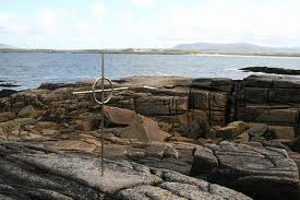
The Ballymanus mine disaster occurs on May 10, 1943 on a beach at Ballymanus, County Donegal when local villagers attempt to bring ashore an unexploded naval mine. Seventeen men and boys between 13 and 34 are killed in the explosion. Another two die later.

According to contemporary reports, the mine is spotted by a number of people, including a local coastguard and two local youths who wade out and tie ropes around it in an attempt to haul it ashore. They are then joined by other men and boys from the local area but as it is being hauled along the beach it is believed to strike a rock and explode, killing 17 people instantly. Two more die in the hospital soon afterwards. More than 40 houses in the nearby village are damaged by the blast. The explosion is so loud it is heard over 40 miles away in Letterkenny.

The scene on the beach is one of devastation. Parts of bodies lay everywhere, which makes identification difficult. Army personnel from Rockhill, outside Letterkenny, have the job of collecting the limbs and scattered bodies and bringing them to a local hall.

Ireland is officially neutral during World War II, and there would not be the same level of awareness amongst the public of the dangers of unexploded ordnance as in countries involved in the conflict. Other commentators note that 15 other mines are made safe in Donegal in the same year, that local senior Garda Síochána members are aware of the mine at least 3 hours before the explosion and are expected to secure a cordon around any reported mines. However, while some effort is made to advise the community of the dangers, the additional actions prescribed in the standing orders had not been taken.

(Pictured: Ballymanus Mine Memorial, Mullaghduff, Donegal)


Leave a comment

Ireland Becomes Founder Member of the Council of Europe

council-of-europe-logo

On May 5, 1949, Ireland becomes one of ten founder members of the Council of Europe, an international organisation whose stated aim is to uphold human rights, democracy and the rule of law in Europe.

The Council of Europe currently has 47 member states, covers approximately 820 million people and operates with an annual budget of approximately half a billion euros.

The organisation is distinct from the 28-nation European Union (EU), although it is sometimes confused with it, partly because the EU has adopted the original European Flag which was created by the Council of Europe in 1955, as well as the European Anthem. No country has ever joined the EU without first belonging to the Council of Europe, which is an official United Nations Observer.

Unlike the EU, the Council of Europe cannot make binding laws, but it does have the power to enforce select international agreements reached by European states on various topics. The best known body of the Council of Europe is the European Court of Human Rights, which enforces the European Convention on Human Rights.

The Council’s two statutory bodies are the Committee of Ministers, comprising the foreign ministers of each member state, and the Parliamentary Assembly, composed of members of the national parliaments of each member state. The Commissioner for Human Rights is an independent institution within the Council of Europe, mandated to promote awareness of and respect for human rights in the member states. The Secretary General heads the secretariat of the organisation. Other major CoE bodies include the European Directorate for the Quality of Medicines.

The headquarters of the Council of Europe are in Strasbourg, France. English and French are its two official languages. The Committee of Ministers, the Parliamentary Assembly and the Congress also use German, Italian, Russian, and Turkish for some of their work.