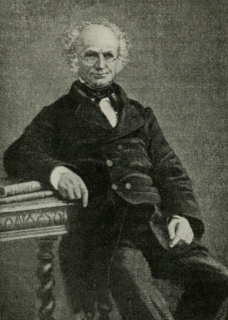
Mahony is born to Martin Mahony and Mary Reynolds. He is educated at the JesuitClongowes Wood College, in County Kildare, and later in the Abbey of Saint-Acheul, a similar school in Amiens, France and then at Rue de Sèvres, Paris, and later in Rome. He begins teaching at the Jesuit school of Clongowes as master of rhetoric but is soon after expelled. He then goes to London and becomes a leading contributor to Fraser’s Magazine, under the signature of “Father Prout” (the original Father Prout, whom Mahony knew in his youth, born in 1757, was parish priest of Watergrasshill, County Cork). At one point he is director of this magazine.
Mahony is witty and learned in many languages. One form which his humour takes is the professed discovery of the originals in Latin, Greek, or mediaeval French of popular modern poems and songs. Many of these jeux d’esprit are collected as Reliques of Father Prout. He pretends that these poems had been found in Fr. Prout’s trunk after his death. He wittily describes himself as “an Irish potato seasoned with Attic salt.” Later he acts as foreign correspondent to various newspapers, and during the last eight years of his life his articles form a main attraction of The Globe.
In his native Cork Mahoney is best remembered for his poem “The Bells of Shandon” and his penname is synonymous with the city and the Church of St. Anne, Shandon.
Mahony spends the last two years of his life in a monastery and dies on May 18, 1866, in Paris reconciled to the Church.
The Reliques of Father Prout originally appear in two volumes in 1836 with illustrations by Maclise. They are reissued in Henry George Bohn‘s Bohn’s Libraries in 1860. Another volume, Final Reliques, is edited by Douglas Jerrold and published in 1876. The Works of Father Prout, edited by Charles Kent, is published in 1881. Facts and Figures from Italy (1847) is made from his Rome letters to London’s The Daily News.
Admitted to the Irish Bar, Sampson becomes Junior Counsel to John Philpot Curran and helps him provide legal defences for many members of the Society of United Irishmen. A member of the Church of Ireland, he is disturbed by anti-Catholic violence and contributes writings to the Society’s newspapers. He is arrested at the time of the Irish Rebellion of 1798, imprisoned, and compelled to leave Ireland for exile in Europe.
Shipwrecked at Pwllheli in Wales, Sampson makes his way to exile in Porto, Portugal, where he is again arrested, imprisoned in Lisbon, and then expelled. After living some years in France, and then Hamburg, he flees to England ahead of the approach of Napoleon‘s armies where he is re-arrested. After unsuccessfully petitioning for a return to Ireland, he arrives in New York City on July 4, 1806.
In the United States, Sampson successfully continues his career in the law, eventually sending for his family. He sets up a business publishing detailed accounts of the court proceedings in cases with popular appeal. In 1809 he reports on the case of a Navy Lieutenant Renshaw prosecuted for dueling. That same year he handles a case against Amos and Demis Broad, accused of brutally beating their slave, Betty, and her 3-year-old daughter where Sampson succeeded in having both slaves manumitted. The authorities in Ireland had disbarred Sampson, which causes him some bitter amusement, as it does not affect his work in the United States.
Sampson’s most important case in the United States is in 1813 and is referred to as “The Catholic Question in America.” Police investigating the misdemeanor of receiving stolen goods question the suspects’ priest, the Reverend Mr. Kohlman. He declines to give any information that he has heard in confession. The priest is called to testify at the trial in the Court of General Sessions in the City of New York. He again declines. The issue whether to compel the testimony is fully briefed and carefully argued on both sides, with a detailed examination of the common law. In the end, the confessional privilege is accepted for the first time in a court of the United States.
William Sampson dies on December 28, 1836, and is buried in the Riker Family graveyard on Long Island in what is now East Elmhurst, Queens, New York. He is later reinterred in Green-Wood Cemetery in Brooklyn, where he is now buried in the same plot as Matilda Witherington Tone and William Theobald Wolfe Tone, the wife and son of the Irish revolutionary Wolfe Tone, and his daughter Catherine, the wife of William Theobald Wolfe Tone.
Educated in England, Boucicault begins acting in 1837 and in 1840 submits his first play to Lucia Elizabeth Vestris at Covent Garden, however it is rejected. His second play, London Assurance (1841), which foreshadows the modern social drama, is a huge success and is frequently revived into the 20th century. Other notable early plays were Old Heads and Young Hearts (1844) and The Corsican Brothers (1852).
In 1853 Boucicault and his second wife, Agnes Robertson, arrive in New York City, where his plays and adaptations are long popular. He leads a movement of playwrights that produces in 1856 the first copyright law for drama in the United States. His play The Poor of New York, based on the panics of 1837 and 1857, has a long run at Wallack’s Theatre in 1857 and is presented elsewhere as, for example, The Poor of Liverpool. The Octoroon (1859) causes a sensation with its implied attack on slavery.
Boucicault and his actress wife join Laura Keene’s theatre in 1860 and begin a series of his popular Irish plays — The Colleen Bawn, or The Brides of Garryowen (1860), Arrah-na-Pogue (1864), The O’Dowd (1873), andThe Shaughraun (1874). Returning to London in 1862, he provides Joseph Jefferson with a successful adaptation of Rip Van Winkle (1865). In 1872 he returns to the United States, where he remains, except for a trip to Australia that results in his third marriage (for which he renounced the legitimacy of his second marriage). Among his associates in the 1870s is the young David Belasco. At the time of his death on September 18, 1890, in New York City, he is a poorly paid teacher of acting. He is buried in Mount Hope Cemetery, Hastings, Westchester County, New York.
About 150 plays are credited to Boucicault, who, as both writer and actor, raises the stage Irishman from caricature to character. To the American drama he brings a careful construction and a keen observation and recording of detail. His concern with social themes prefigures the future development of drama in both Europe and America.
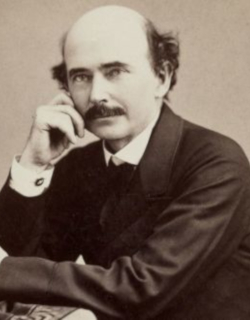
(Pictured: Dionysius Boucicault, taken 1890 or before. Photograph: Harvard Theatre Collection/Wikimedia Commons)
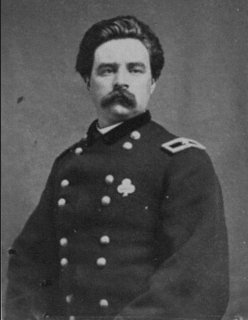
In 1861 Smyth enlists in the Union army in an Irish American three-months regiment, the 24th Pennsylvania, and is quickly made a captain. He is later commissioned as a major of the 1st Delaware Infantry, a three-years regiment. He serves at the battles of Chancellorsville and Fredericksburg, following which he is promoted to lieutenant colonel and then to colonel. During the Gettysburg campaign, he commands the 2nd Brigade, 3rd Division of the II Corps. During the Battle of Gettysburg, his men help defend Cemetery Ridge and advance to the area of the Bliss farm to oust enemy sharpshooters. He is wounded on the third day of the battle and relinquishes command briefly.
Smyth retains brigade command during the reorganization of II Corps before Ulysses S. Grant‘s Overland Campaign. He leads the second brigade of the first division from March 25 to May 17, 1864. When Colonel Samuel S. Carroll is wounded, Smyth is transferred to his command, the third brigade of second division, the Gibraltar Brigade. In October 1864, he is promoted to brigadier general during the Siege of Petersburg. He retains command of his brigade throughout the siege.
On March 18, 1867, PresidentAndrew Johnson nominates Smyth for posthumous appointment to the grade of brevet major general of volunteers to rank from April 7, 1865, the date he was mortally wounded, and the United States Senate confirms the appointment on March 26, 1867. He is the last Union general killed or mortally wounded during the war and is buried in Wilmington and Brandywine Cemetery in Wilmington, Delaware.
Hely-Hutchinson enters the Army as a cornet in the 18th Royal Hussars in 1774, rising to a lieutenant the following year. In 1776 he is promoted to become a captain in the 67th (South Hampshire) Regiment of Foot, and a major there in 1781. He moves regiments again in 1783, becoming a lieutenant-colonel in, and colonel-commandant of, the 77th Regiment of Foot, which is, however, disbanded shortly afterwards following an earlier mutiny. He spends the next 11 years on half-pay, studying military tactics in France before serving as a volunteer in the Flanders campaigns of 1793 as aide-de-camp to Sir Ralph Abercromby.
Hely-Hutchinson is second-in-command of the 1801 expedition to Egypt, under Abercromby. Following Abercromby’s death in March after being wounded at the Battle of Alexandria, he takes command of the force. From then he is able to besiege the French firstly at Cairo which capitulates in June and then besieges and takes Alexandria, culminating in the capitulation of over 22,000 French soldiers. In reward for his successes there, the Ottoman SultanSelim III makes him a Knight, 1st Class, of the Order of the Crescent.
On December 18, 1801, Hely-Hutchinson is created Baron Hutchinson in the Peerage of the United Kingdom, gaining a seat in the House of Lords. In recognition of his “eminent services” during the “late glorious and successful campaign in Egypt,” at the request of the King, the Parliament of the United Kingdom settles on Lord Hutchinson and the next two succeeding male heirs of his body an annuity of £2000 per annum, paid out of the Consolidated Fund.
Hely-Hutchinson is promoted lieutenant-general in September 1803 and made a full general in June 1813. In 1806, he becomes colonel of the 57th (West Middlesex) Regiment of Foot, transferring in 1811 to be colonel of the 18th Regiment of Foot, a position he holds until his death. He also holds the position of Governor of Stirling Castle from 1806 until his death.
Hely-Hutchinson sits as Member of Parliament (MP) for Lanesborough from 1776 to 1783 and for Taghmon from 1789 to 1790. Subsequently, he represents Cork City in the Irish House of Commons until the Act of Union 1800 and is then member for Cork City in the after-Union Parliament of the United Kingdom until 1802.
Hely-Hutchinson dies on June 29, 1832, never having married.
Harrison goes to Westminster School and then to Balliol College, Oxford. While there he develops an admiration for Charles Stewart Parnell and becomes secretary of the Oxford University Home Rule League. At this time, the Land War is in progress and in 1889 he goes to Ireland to visit the scene of the evictions in Gweedore, County Donegal. He becomes involved in physical confrontations with the Royal Irish Constabulary and as a result becomes a Nationalist celebrity overnight. The following May, Parnell offers the vacant parliamentary seat of Mid Tipperary to Harrison, who leaves Oxford at age 22, to take it up, unopposed.
Only six months later, following the divorce case involving Katharine O’Shea, the Irish Parliamentary Party splits over Parnell’s leadership. Harrison strongly supports Parnell, acts as his bodyguard and aide-de-camp, and after Parnell’s death devotes himself to the service of his widow Katharine. From her he hears a completely different version of the events surrounding the divorce case from that which had appeared in the press, and this is to form the seed of his later books.
Harrison then makes a return to Irish politics, working with Sir Horace Plunkett as Secretary of the Irish Dominion League, an organisation campaigning for dominion status for Ireland within the British Empire. He is a lifelong opponent of Irish partition. He is Irish correspondent of The Economist from 1922 to 1927 and owner-editor of Irish Truth from 1924 to 1927.
Harrison’s two books defending Parnell are published in 1931 and 1938. They have had a major impact on Irish historiography, leading to a more favourable view of Parnell’s role in the O’Shea affair. F. S. L. Lyons comments that he “did more than anyone else to uncover what seems to have been the true facts” about the Parnell-O’Shea liaison. The second book, Parnell, Joseph Chamberlain and Mr Garvin, is written in response to J. L. Garvin‘s biography of Joseph Chamberlain, which had ignored his first book, Parnell Vindicated: The Lifting of the Veil. Later, he successfully repulses an attempt in the official history of The Times to rehabilitate that newspaper’s role in using forged letters to attack Parnell in the late 1880s. In 1952 he forces The Times to publish a four-page correction written by him as an appendix to the fourth volume of the history.
During the difficult years of the Anglo-Irish Trade War over the land purchase annuities, declaration of the Republic, Irish neutrality during World War II, and departure from the Commonwealth, Harrison works to promote good relations between Britain and Ireland. He publishes various books and pamphlets on the issues in dispute and writes numerous letters to The Times. He also founds, with General Sir Hubert Gough, the Commonwealth Irish Association in 1942.
At the time of his death on February 20, 1954, Harrison is the last survivor of the Irish Parliamentary Party led by Parnell, and as a member of the pre-1918 Irish Parliamentary Party, he seems to have been outlived only by John Patrick Hayden, who dies a few months after him in 1954 and by Patrick Whitty and John Lymbrick Esmonde who are only MPs for a very short time during World War I. He is buried in Holywood, County Down.
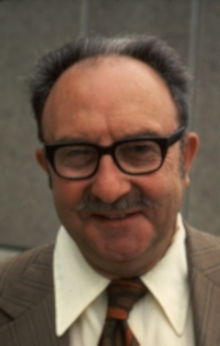
In 1928, McCrea studies Albrecht Unsöld‘s hypothesis and discovers that three quarters of the sun is made of hydrogen and about one quarter is helium with 1% being other elements. Previous to this many people thought the sun consisted mostly of iron. After this, people realise most stars consist of hydrogen.
In 1932 McCrea moves to Imperial College London as a Reader and marries Marian Core the following year. In 1936 he becomes Professor of Mathematics and head of the mathematics department at the Queen’s University Belfast.
During World War II McCrea is co-opted onto the Admiralty Operational Research Group. After the war, he joins the mathematics department at Royal Holloway College in 1944. He is elected a Fellow of the Royal Society of London in 1952.
In 1964 McCrea proposes mass transfer mechanism as an explanation of blue straggler stars. In 1965, he creates the astronomy centre of the physics department at the University of Sussex.
Childers is educated at Gresham’s School, Holt, and the University of Cambridge, hence his striking British upper-class accent. On November 24, 1922, when he is sixteen, his father, Robert Erskine Childers, is executed by the new Irish Free State on politically inspired charges of gun-possession. The pistol he had been found with had been given to him by Michael Collins. Before his execution, in a spirit of reconciliation, the elder Childers obtains a promise from his son to seek out and shake the hand of every man who had signed his death warrant.
Following his father’s funeral, he returns to Gresham’s, then two years later he goes on to Trinity College, Cambridge. He returns to Ireland in 1932 and becomes advertising manager of The Irish Press, the newly founded newspaper owned by the family of Éamon de Valera.
Childers is nominated as the presidential candidate of Fianna Fáil at the behest of de Valera, who pressures Jack Lynch in the selection of the presidential candidate. He is a controversial nominee, owing not only to his British birth and upbringing but to his Protestantism. However, on the campaign trail his personal popularity proved enormous, and in a political upset at the 1973 Irish presidential election, he is elected the fourth President of Ireland on May 30, 1973, defeating Tom O’Higgins by 635,867 (52%) votes to 578,771 (48%). He becomes the second Protestant to hold the office, the first being Douglas Hyde (1938–1945).
Prevented from transforming the presidency as he desires, Childers instead throws his energy into a busy schedule of official visits and speeches, which is physically taxing.
Carney is educated at St. Patrick’s Christian Brothers School in Donegall Street in Belfast, later teaching at the school. She enrolls at Hughes Commercial Academy around 1910, where she qualifies as a secretary and shorthand typist, one of the first women in Belfast to do so. However, from the start she is looking towards doing more than just secretarial work.
In 1912 Carney is in charge of the women’s section of the Northern Ireland Textile Workers’ Union in Belfast, which she founds with Delia Larkin in 1912. During this period, she meets James Connolly and becomes his personal secretary. She becomes Connolly’s friend and confidant as they work together to improve the conditions for female labourers in Belfast. Carney then joins Cumann na mBan, the women’s auxiliary of the Irish Volunteers, and attends its first meeting in 1914.
Carney is present with Connolly in Dublin‘s General Post Office (GPO) during the Easter Rising in 1916. She is the only woman present during the initial occupation of the building. While not a combatant, she is given the rank of adjutant and is among the final group to leave the GPO. After Connolly is wounded, she refuses to leave his side despite direct orders from Patrick Pearse and Connolly. She leaves the GPO with the rest of the rebels when the building becomes engulfed in flames. They make their new headquarters in nearby Moore Street before Pearse surrenders.
After her capture, Carney is held in Kilmainham Gaol before being moved to Mountjoy Prison and finally to an English prison. By August 1916 she is imprisoned in HM Prison Aylesbury alongside Nell Ryan and Helena Molony. The three request that their internee status be revoked so that they could be held as normal prisoners with Countess Markievicz. Their request is denied, however Carney and Molony are released two days before Christmas 1916.
Following the Irish Civil War, Carney becomes much more disillusioned with politics. She is very critical and outspoken of Éamon de Valera and his governments.
In 1928 she marries George McBride, a Protestant Orangeman and former member of the Ulster Volunteers. Ironically, the formation of the Ulster Volunteers prompts the formation of the Irish Volunteers, of which Carney was a member. She alienates anyone in her life that does not support her marriage to McBride.
A number of serious health problems limit Carney’s political activities in the late 1930s. She dies in Belfast on November 21, 1943, and is buried in Milltown Cemetery. Her resting place is located years later, and a headstone is erected by the National Graves Association, Belfast. Because she married a Protestant and former Orangeman, she is not allowed to have his name on her gravestone due to the religious differences.
In 2013, the Seventieth Anniversary of Carney’s death is remembered by the Socialist Republican Party. Almost one hundred people attend as a short parade follows, marking and commemorating the work she did for the cause. She is placed in high esteem among the other hundreds of radical women, who stand up for what they believe in, regardless of the consequences they face.
Hayes is first elected to Dáil Éireann as a Sinn Féin TD for the National University of Ireland constituency at the 1921 Irish elections. At the 1922 general election he is elected as a Pro-Treaty Sinn Féin TD. He serves as Minister for Education from January to September 1922, as part of the Dail Aireacht ministry as opposed to the Provisional Government. He has special responsibility for secondary education. He is also acting Minister for Foreign Affairs from August to September 1922. He supports the Anglo-Irish Treaty during the crucial debates in 1922. That same year he is elected Ceann Comhairle of the First Dáil of the Irish Free State. He holds that post for ten years until 1932.
Hayes loses his Dáil seat at the 1933 general election but is elected to Seanad Éireann in 1938 for Fine Gael. He remains a Senator until 1965, acting as leader of government and opposition there.
Hayes becomes Professor of Irish at University College Dublin in 1951.
Michael Hayes dies at the age of 86 on July 11, 1976, in Dublin.






 seamus dubhghaill