seamus dubhghaill

Promoting Irish Culture and History from Little Rock, Arkansas, USA


Leave a comment

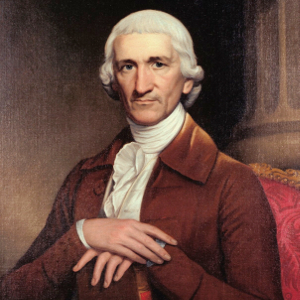
Death of Charles Thomson, Secretary of the Continental Congress

Charles Thomson, Irish-born Patriot leader in Philadelphia during the American Revolution and the secretary of the Continental Congress (1774–1789) throughout its existence, dies in Lower Merion Township, Pennsylvania, on August 16, 1824.

Thomson is born in Gorteade townland, Maghera parish, County Londonderry, to Scots Irish parents. After the death of his mother in 1739, his father emigrates to the British colonies in America with Charles and his brothers. His father dies at sea and the penniless boys are separated in America. Charles is cared for by a blacksmith in New Castle, Delaware, and is educated in New London Township, Pennsylvania. In 1750 he becomes a tutor in Latin at the Philadelphia Academy.

During the French and Indian War, Thomson is an opponent of the Pennsylvania proprietors’ American Indian policies. He serves as secretary at the Treaty of Easton (1758) and writes An Enquiry into the Causes of the Alienation of the Delaware and Shawanese Indians from the British Interest (1759), which blames the war on the proprietors. He is allied with Benjamin Franklin, the leader of the anti-proprietary party, but the two men part politically during the Stamp Act crisis in 1765. Thomson becomes a leader of Philadelphia’s Sons of Liberty. He is married to the sister of Benjamin Harrison V, another signer, as delegate, of the Declaration of Independence.

Thomson is a leader in the revolutionary crisis of the early 1770s. John Adams calls him the “Samuel Adams of Philadelphia.” Thomson serves as the secretary of the Continental Congress through its entirety. Through those 15 years, the Congress sees many delegates come and go, but Thomson’s dedication to recording the debates and decisions provides continuity. Along with John Hancock, president of the Congress, Thomson’s name (as secretary) appears on the first published version of the Declaration of Independence in July 1776.

Thomson’s role as secretary to Congress is not limited to clerical duties. Thomson is also noted for designing, with William Barton, the Great Seal of the United States. The Great Seal plays a prominent role in the January 14, 1784, ratification of the Treaty of Paris (1783). Britain’s representatives in Paris initially dispute the placement of the Great Seal and Congressional President Thomas Mifflin‘s signature, until mollified by Benjamin Franklin.

But Thomson’s service is not without its critics. James Searle, a close friend of John Adams, and a delegate, begins a cane fight on the floor of Congress against Thomson over a claim that he is misquoted in the “Minutes” that results in both men being slashed in the face. Such brawls on the floor are not uncommon, and many of them are promoted by argument over Thomson’s recordings. Political disagreements prevent Thomson from getting a position in the new government created by the United States Constitution. Thomson resigns as secretary of Congress in July 1789 and hands over the Great Seal, bringing an end to the Continental Congress.

Thomson spends his final years at Harriton House in Bryn Mawr, Pennsylvania working on a translation of the Bible. He also publishes a synopsis of the four evangelists in 1815. In retirement, Thomson also pursues his interests in agricultural science and beekeeping. According to Thomas Jefferson, writing to John Adams, Thomson becomes senile in his old age, unable to recognize members of his own household.


Leave a comment

Birth of Sister Anthony, Mary Ellen O’Connell

Mary Ellen O’Connell, Roman Catholic Religious Sister better known as Sister Anthony, S.C., is born in Limerick, County Limerick, on August 14, 1814.

Connell is the daughter of William O’Connell (1769-1841) and Catherine Murphy (-1821). In 1821, she emigrates with her family to Boston, and attends the Ursuline Academy in Charlestown, Massachusetts. On June 5, 1835, she enters the novitiate of the American Sisters of Charity in St. Joseph’s Valley, Maryland, founded by Saint Elizabeth Seton, and is professed in 1837, taking the name of Sister Anthony. Soon after, she goes to Cincinnati, Ohio.

Sister Anthony arrives in Cincinnati in 1837 to begin her work at St. Peter’s Orphan Asylum and School for girls. Given charge of St. Joseph’s Orphan Asylum for boys when it is begun in 1852, she later oversees the combining of the two asylums in the Cincinnati neighborhood of Cumminsville. She is in Cincinnati through 1852, when the Sisters in Cincinnati become independent of their founding motherhouse in Emmitsburg, Maryland. She is placed in charge of St. John’s Hostel for Invalids, a new hospital.

At the outbreak of the American Civil War, the Sisters volunteer as nurses. More than one-third of the community, which by then has more than one hundred members, serve. In June 1861, Sister Anthony is one of six Sisters of Charity who go to Camp Dennison, about 15 miles from Cincinnati. A request is made from Cumberland, Virginia for nursing assistance, and eight sisters are sent to serve the wounded of both armies.

The Battle of Shiloh brings ten sisters to the scene including Sister Anthony. Some describe her word as being law with officers, doctors, and soldiers once she has established herself as a prudent and trusted administrator and nurse. She and other sisters often are picked to treat wounded prisoners of war since they show no bias in serving rebel, yank, white, or black soldiers.

When Sister Anthony serves at Shiloh she becomes known as the “Angel of the Battlefield” and “the Florence Nightingale of America.” She goes out to the battlefield to help bring in the sick and dying and also develops the Battlefield Triage. Her method is “the first recognizably modern triage techniques in war zones, saved countless lives through faster hospital treatment and won her praise from President Lincoln.” Her medical skills allow her to intervene to save soldiers’ limbs from amputation.

Sister Anthony also serves at the battlefields of Winchester, VA, the Cumberland Gap, TN, Richmond, VA, Nashville, TN, Gallipolis, OH, Culpeper Court House, VA, Murfreesboro, TN, Pittsburg Landing, TN, and Lynchburg, VA. She also serves on a hospital ship on the Ohio River. She sees no distinction between Union and Confederate soldiers. She becomes personally acquainted with Jefferson Davis and knows a number of generals on both sides of the conflict.

After the war, in 1866, Joseph C. Butler and a friend, Louis Worthington, purchase a large building at Sixth and Lock Street, to present to Sister Anthony as a gift in recognition of the sisters’ service during the war. There are two conditions: that no one be excluded from the hospital because of color or religion, and that the hospital be named “The Hospital of the Good Samaritan,” to honor the sisters’ kindness. It opens that same year as the St. Joseph Foundling and Maternity Hospital. It still serves as St. Joseph Hospital, a residential facility for children and adults with severe mental and multiple physical disabilities.

Sister Anthony is also recognized for her work during the yellow fever epidemic of 1877. She retires from active service in 1880, and dies in 1897 in Cumminsville, Cincinnati, Ohio.

Sister Anthony’s portrait hangs in the Smithsonian Institution in Washington, D.C.


Leave a comment

Birth of Arthur Colahan, Doctor & Songwriter

Arthur Nicholas Whistler Colahan, Irish doctor, British Army officer and songwriter, is born in Enniskillen, County Fermanagh, on August 12, 1884. The eldest child of Professor Nicholas Whistler Colahan and Elisabeth Quinn of Limerick, the family moves to Galway, and he grows up there.

After completing his secondary education at St. Joseph’s College, Galway, he enrolls at University College Dublin in 1900 where he receives an arts degree and then studies medicine. He transfers to University College, Galway and graduates in 1913. He is a member of the college Literary and Debating Society and participates in drama.

He begins his medical career in the County Infirmary in Galway and then moves to Holles Street Hospital. He joins the Royal Army Medical Corps and is badly affected by mustard gas in India. After the war he settles in Leicester, where he spends the rest of his career as a neurological specialist.

Colahan is also a composer of popular songs. He is a quiet man who is often homesick for his beloved Galway Bay. These feelings lead him to write his most famous work, “Galway Bay.” Popularised by Bing Crosby, it becomes the biggest selling record of all time at one point. Theories abound as to where the song is written or where it is first heard. Some say it is in the home of Dr. Morris at 1 Montpelier Terrace, while others believe it is in The Vicars Croft on Taylor’s Hill, from where one can see Galway Bay.

Other songs written by Colahan include “Maccushla Mine,” “Asthoreen Bawn,” “Until God’s Day,” “The Kylemore Pass” and “The Claddagh Ring.” Sadly, before his music is selling in the High Street he dies on September 15, 1952, and is buried in an unmarked grave back in his Irish birthplace.


Leave a comment

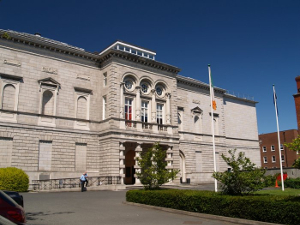
National Gallery of Ireland Act, 1854

A statutory provision, the National Gallery of Ireland Act, 1854, is made on August 10, 1854, for the establishment of a national gallery of paintings, sculpture, and fine arts in Ireland.

The National Gallery of Ireland, which opens its doors ten years later, houses the national collection of Irish and European art. It is located in the centre of Dublin with one entrance on Merrion Square, beside Leinster House, and another on Clare Street. The Gallery has an extensive, representative collection of Irish painting and is also notable for its Italian Baroque and Dutch masters painting.

The façade of the National Gallery copies the Natural History building of the National Museum of Ireland which is already planned for the facing flank of Leinster House. The building itself is designed by Francis Fowke, based on early plans by Charles Lanyon.

The Gallery is unlucky not to have been founded around an existing collection, but through diligent and skillful purchase, by the time it opens it has 125 paintings. In 1866 an annual purchase grant is established and by 1891 space is already limited. In 1897, the Dowager Countess of Milltown indicates her intention of donating the contents of Russborough House to the Gallery. This gift includes about 223 paintings, 48 pieces of sculpture, 33 engravings, much silver, furniture and a library, and prompts construction from 1899 to 1903 of what is now called the Milltown Wing, designed by Thomas Newenham Deane.

At around this time Henry Vaughan leaves 31 watercolours by J.M.W. Turner with the requirement that they can only be exhibited in January, this to protect them from the ill-effects of sunlight. Though modern lighting technology has made this stipulation unnecessary, the Gallery continues to restrict viewing of the Vaughan bequest to January and the exhibition is treated as something of an occasion.

Another substantial bequest comes with the untimely death in the sinking of the RMS Lusitania of Hugh Lane (1875–1915), since 1914 director of the Gallery. Not only does he leave a large collection of pictures, but he also leaves part of his residual estate, and the Lane Fund has continued to contribute to the purchase of art works to this day. In addition to his involvement in the Gallery, Hugh Lane has also hoped to found a gallery of modern art, something only realised after his death in Dublin City Gallery The Hugh Lane. George Bernard Shaw also makes a substantial bequest, leaving the Gallery a third of royalties of his estate in gratitude for the time he spent there as a youth.

The Gallery is again extended in 1962 with a new wing designed by Frank DuBerry of the Office of Public Works. This opens in 1968 and is now named the Beit Wing. In 1978 the Gallery receives from the government the paintings given to the nation by Alfred Chester Beatty and in 1987 the Sweeney bequest purchases fourteen works of art including paintings by Pablo Picasso and Jack Butler Yeats. The same year the Gallery is once again given some of the contents of Russborough House when Alfred Beit donates 17 masterpieces, including paintings by Diego Velázquez, Bartolomé Esteban Murillo, Jan Steen, Johannes Vermeer and Henry Raeburn.

In the 1990s a lost Caravaggio, The Taking of Christ, known through replicas, is discovered hanging in a Jesuit house of studies in Leeson Street in Dublin by Sergio Benedetti, senior conservator of the gallery. The Jesuits generously allow this painting to be exhibited in the Gallery and the discovery is the cause of national excitement. In 1997 Anne Yeats donates sketchbooks by her uncle Jack Yeats and the Gallery now includes a Yeats Museum. Denis Mahon, a well-known art critic, promises the Gallery part of his rich collection and eight painting from his promised bequest are on permanent display, including Jacob Blessing the Sons of Joseph by Guercino.


Leave a comment

Founding of the Tenant Right League

The Tenant Right League, an organisation which aims to secure reforms in the Irish land system, is founded in Dublin on August 9, 1850, at a meeting attended by representatives of the Tenant Protection Societies. Formed by Charles Gavan Duffy and Frederick Lucas, the League unites for a time Protestant and Catholic tenants, Duffy calling his movement The League of North and South.

The political background to the movement is the Encumbered Estates Act and the resultant change in land ownership at landlord level. In the North of Ireland, Protestant and Presbyterian ministers fear that the new landlords will destroy the “Ulster custom” of tenancy, which compensates tenants for any improvement undertaken. Concurrently, in the South of Ireland politically minded young Catholic priests are agitating for the adoption there of the Ulster custom as a measure of reform.

Support for the League initially comes from the Ulster Tenant Right Association led by William Sharman Crawford. The support is short-lived because of the involvement of Catholic clergymen from the south. As a constitutional movement, the League seeks to secure the adoption and enforcement of the Three Fs, namely fair rent, fixity of tenure, and free sale. All of these would aid Irish tenant farms, all of whom lack them.

For the larger tenant farmers fixity of tenure is the priority. On the other hand, the league never has the support of smaller tenants, whose prime concern is fair rents. The founders strive to establish a parliamentary party of Irish members who will oppose any government not prepared to grant “Tenant-right” also known as the Ulster Custom.

The Tenant Right League meets with considerable success under its national organiser, John Martin. It has the support of the surviving members of the Repeal Association in the British House of Commons as well as a number of English Radicals. It is agreed, all around, that a Land Act embodying the three F’s would be a real gain. In the 1852 general election, some fifty Tenant Right candidates, including Gavan Duffy, Lucas and John Sadleir, are returned to parliament, where they sit as the Independent Irish Party.

The League’s success is short lived and is ultimately destroyed and weakened when a number of prominent members break away and established the Catholic Defence Association. Supporters of the league are also intimidated by hostile landlords. The most serious blows to its success come when Lucas decides to take his complaint about the Archbishop of Dublin Paul Cullen to Rome, which alienates clerical support. Lucas dies in October 1855 shortly after the failure of his mission, a month later Gavan Duffy emigrates to Australia.

The League finally dissolves in 1859, and the Independent Irish Party disappears by 1860. The demand for tenants’ rights is however continued by Bishop Thomas Nulty of County Meath and taken up again as a popular cause by the Irish National Land League in 1879, when the “Three Fs” are anchored in the Land Law (Ireland) Act 1881, previously pursued rigorously by Michael Davitt.


Leave a comment

Patrick Francis Healy Becomes President of Georgetown University

Patrick Francis Healy, Jesuit priest and educator, becomes the 29th President of Georgetown University on July 31, 1874. He is known for expanding the school following the American Civil War. Healy Hall is constructed during his tenure and is named after him. It is designated as a National Historic Landmark in the late 20th century.

Healy is born into slavery in 1834 in Macon, Georgia, the third son of Irish American plantation owner Michael Healy and his African American slave Mary Eliza, who is the multiracial daughter of a black slave and white slaveowner. The law establishes during colonial slavery in the United States that children are to take the legal status of the mother. By the principle of partus sequitur ventrum, Patrick and his siblings are legally considered slaves in Georgia, although their father is free, and they are three-quarters or more European in ancestry.

Discriminatory laws in Georgia prohibit the education of slaves and require legislative approval for each act of manumission, making these essentially impossible to gain. Michael Healy arranges for all his children to leave Georgia and move to the North to obtain their educations and have opportunities in their lives. They are raised as Irish Catholics. Patrick’s brothers and sisters are nearly all educated in Catholic schools and colleges. Many achieve notable firsts for Americans of mixed-race ancestry during the second half of the 19th century, and the Healy family of Georgia is remarkably successful.

Healy sends his older sons first to a Quaker school in Flushing, New York. Despite the Quakers’ emphasis on equality, Patrick encounters some discrimination during his grade school years, chiefly because his father is a slaveholder, which by the late antebellum years the Quakers consider unforgivable. Patrick also meets resistance in the school as an Irish Catholic. When Michael Healy hears of a new Jesuit college, the College of the Holy Cross in Worcester, Massachusetts, he sends his four oldest sons, including Patrick, to study there in 1844. They are joined at Holy Cross by their younger brother Michael in 1849.

Following Patrick’s graduation in 1850, he enters the Jesuit order, the first African American to do so, and continues his studies. The order sends him to Europe to study in 1858. His mixed-race ancestry has become an issue in the United States, where tensions are rising over slavery. He attends the Catholic University of Leuven in Belgium, earning his doctorate, becoming the first American of openly acknowledged part-African descent to do so. During this period, he is also ordained to the priesthood on September 3, 1864.

In 1866 Healy returns to the United States and teaches philosophy at Georgetown University in Washington, D.C. On July 31, 1874, he is selected as the school’s twenty-ninth president. He is the first college president in the United States of African American ancestry. At the time, he identifies as Irish Catholic and is accepted as such.

Patrick Healy’s influence on Georgetown is so far-reaching that he is often referred to as the school’s “second founder,” following Archbishop John Carroll. Healy helps transform the small nineteenth-century college into a major university for the twentieth century, likely influenced by his European education.

He modernizes the curriculum by requiring courses in the sciences, particularly chemistry and physics. He expands and upgrades the schools of law and medicine. The most visible result of Healy’s presidency is the construction of the university’s flagship building designed by Paul J. Pelz, begun in 1877 and first used in 1881. The building is named in his honor as Healy Hall.

Healy leaves the College in 1882 and travels extensively through the United States and Europe, often in the company of his brother James, a bishop in Maine. In 1908 he returns to the campus infirmary, where he dies on January 10, 1910. He is buried on the grounds of the university in the Jesuit cemetery.


Leave a comment

Birth of Raymond Thornton Chandler, Novelist & Screenwriter

Raymond Thornton Chandler, American novelist and screenwriter, is born to Irish Quaker and Irish Catholic parents in Chicago, Illinois on July 23, 1888.

Chandler spends his early years in Plattsmouth, Nebraska, living with his mother and father near his cousins and his aunt and uncle. His father, an alcoholic civil engineer who works for the railway, abandons the family. To obtain the best possible education for Ray, his mother, originally from Ireland, moves them to the area of Upper Norwood in the London Borough of Croydon, England in 1900. In 1912, he borrows money from his Waterford uncle, who expects it to be repaid with interest, and returns to America, visiting his aunt and uncle before settling in San Francisco. The following year he moves to Los Angeles.

In 1932, at the age of forty-four, Chandler becomes a detective fiction writer after losing his job as an oil company executive during the Great Depression. His first short story, “Blackmailers Don’t Shoot,” is published in 1933 in Black Mask, a popular pulp magazine. His first novel, The Big Sleep, is published in 1939. In addition to his short stories, Chandler publishes seven novels during his lifetime. An eighth novel is in progress at the time of his death and is completed by Robert B. Parker. All but Playback have been made into motion pictures, some more than once.

Chandler has an immense stylistic influence on American popular literature. He is considered to be a founder of the hardboiled school of detective fiction, along with Dashiell Hammett, James M. Cain and other Black Mask writers. The protagonist of his novels, Philip Marlowe, like Hammett’s Sam Spade, is considered by some to be synonymous with “private detective.” Both are played in films by Humphrey Bogart, whom many consider to be the quintessential Marlowe.

Some of Chandler’s novels are important literary works, and three have been regarded as masterpieces: Farewell, My Lovely (1940), The Little Sister (1949), and The Long Goodbye (1953). The Long Goodbye is praised in an anthology of American crime stories as “arguably the first book since Hammett’s The Glass Key, published more than twenty years earlier, to qualify as a serious and significant mainstream novel that just happened to possess elements of mystery.”

In the year before his death, he is elected president of the Mystery Writers of America. He dies on March 26, 1959, in La Jolla, California. He is buried in Mount Hope Cemetery in San Diego, California.


Leave a comment

Death of Thomas Croke, Archbishop of Cashel & Emly

Thomas William Croke, the second Catholic Bishop of Auckland in New Zealand (1870–74) and later Archbishop of Cashel and Emly in Ireland, dies on July 22, 1902. He is important in the Irish nationalist movement especially as a Champion of the Irish National Land League in the 1880s. The main Gaelic Athletic Association stadium in Dublin is named Croke Park in his honour.

Croke is born in Castlecor, County Cork, on May 28, 1824. He is educated in Charleville, County Cork, the Irish College in Paris and the Pontifical Irish College in Rome, winning academic distinctions including a Doctor of Divinity with honours. He is ordained in May 1847. Returning to Ireland for a short time he is appointed a Professor in St. Patrick’s, Carlow College. The Irish radical William O’Brien says that Croke fought on the barricades in Paris during the French Revolution of 1848. Croke returns to Ireland and spends the next 23 years working there. In 1858 he becomes the first president of St. Colman’s College, Fermoy, County Cork and then serves as both parish priest of Doneraile and Vicar General of Cloyne diocese from 1866 to 1870. Croke attends the First Vatican Council as the theologian to the Bishop of Cloyne 1870.

Croke gains the good opinion of the Irish ecclesiastical authorities and is rewarded in 1870 by his promotion to Bishop of Auckland in New Zealand. His former professor, Paul Cullen, by then Cardinal Archbishop of Dublin, is largely responsible for filling the Australasian Catholic church with fellow Irishmen. His strong recommendations lead to Croke’s appointment. Croke arrives at Auckland on December 17, 1870, on the City of Melbourne. During his three years as bishop, he restores firm leadership to a diocese left in disarray by his predecessor, Bishop Jean Baptiste Pompallier. He devotes some of his considerable personal wealth to rebuilding diocesan finances and also takes advantage of Auckland’s economic growth following the development of the Thames goldfields to further his aims, ensuring that all surplus income from parishes at Thames and Coromandel is passed on to him, and he institutes a more rigorous system for the Sunday collection at St. Patrick’s Cathedral. He imports Irish clergy to serve the growing Catholic community, and with Patrick Moran, the first Catholic Bishop of the Diocese of Dunedin, he tries unsuccessfully to secure an Irish monopoly on future episcopal appointments in New Zealand. Croke supports separate Catholic schools and their right to state aid and voices his opposition to secular education as Auckland’s Catholic schools are threatened by the provincial council’s Education Act 1872, which helps to create a free, secular and compulsory education system. However, generally, Croke’s image is uncontroversial. On January 28, 1874, after barely three years in office, Croke departs for Europe, on what is ostensibly a 12-month holiday, and he does not return to New Zealand.

Croke becomes a member of the Irish hierarchy when he is translated to be Archbishop of Cashel, one of the four Catholic Irish archbishoprics in 1875. Archbishop Croke is a strong supporter of Irish nationalism, aligning himself with the Irish National Land League during the Land War, and with the chairman of the Irish Parliamentary Party, Charles Stewart Parnell. In an 1887 interview he explains that he had opposed the League’s “No rent manifesto” in 1881, preferring to stop payment of all taxes.

Croke also associates himself with the Temperance Movement of Fr. Theobald Mathew and Gaelic League from its foundation in 1893. Within Catholicism he is a supporter of Gallicanism, as opposed to the Ultramontanism favoured by the Archbishop of Dublin, Cardinal Cullen. His support of nationalism causes successive British governments and Lord Lieutenant of Ireland‘s governments in Dublin to be deeply suspicious of him, as are some less politically aligned Irish bishops.

Following the scandal that erupts over Parnell’s relationship with Katharine O’Shea, the separated wife of fellow MP Captain William O’Shea, Archbishop Croke withdraws from active participation in nationalist politics.

Thomas Croke, 78, dies at the Archbishop’s Palace in Thurles, County Tipperary on July 22, 1902. He is buried at the Cathedral of the Assumption in Thurles. In honour of Croke, his successors as Archbishop of Cashel and Emly traditionally are asked to throw in the ball at the minor Gaelic football and All-Ireland Senior Hurling Championship finals.


Leave a comment

Birth of Thomas Bodkin, Art Historian & Collector

Professor Thomas Patrick Bodkin, lawyer, art historian, art collector and curator, is born in Dublin on July 21, 1887. He serves as Director of the National Gallery of Ireland in Dublin from 1927 to 1935 and founding Director of the Barber Institute of Fine Arts in Birmingham, England from 1935 until 1952, where he acquires the nucleus of the collection described by The Observer as “the last great art collection of the twentieth century.”

Bodkin is the eldest son of Matthias McDonnell Bodkin, a nationalist journalist, judge and Member of Parliament. Graduating from the Royal University of Ireland in 1908 he practises law from 1911 until 1916 while collecting art privately, influenced by his uncle Sir Hugh Lane. With the death of Lane in the sinking of the RMS Lusitania in 1915, Bodkin is charged with ensuring that Lane’s collection of art is displayed in Dublin, a dispute that would only finally be settled in 1957 and about which Bodkin is to write Hugh Lane and his Pictures in 1932.

Bodkin leaves the legal profession in 1916 to become a Governor of the National Gallery of Ireland, being appointed Director in 1927. He also serves in 1926 on the committee that commissions the design of the new coinage of the Republic of Ireland from Percy Metcalfe.

In 1935 Bodkin leaves Ireland upon being appointed Director of the newly established Barber Institute of Fine Arts and Barber Professor of Fine Art at the University of Birmingham. The funds available to the Barber Institute for the purchase of new works compare favourably even to some national museums and Bodkin is able to make a string of exceptional purchases in the depressed art market around the time of World War II. The collection that in 1935 numbers just seven works, by 1939 holds major pieces such as Tintoretto‘s Portrait of a Youth (1554), Simone Martini‘s St. John the Evangelist (1320), Nicolas Poussin‘s Tancred and Erminia (1634) and James Abbott McNeill Whistler‘s Symphony in White No. III (1867). Bodkin retires in 1952 but retains control over acquisitions until 1959. His successor as Director and Professor, Ellis Waterhouse, wistfully refers to Bodkin’s wayward later purchases as “Acts of Bod.”

Bodkin is also an active broadcaster and author, publishing personal reminiscences and translations of modern French poetry as well as works of art history and criticism. In particular, his The Approach to Painting (1927), an introduction for a popular audience, runs through many editions over the succeeding thirty years.

A few years before his death Bodkin appears on the BBC panel show Animal, Vegetable or Mineral? identifying curiosities from around the world, along with museum curator Hugh Shortt and archaeologist Mortimer Wheeler.

Bodkin is awarded the Civil Division of the Order of St. Gregory the Great for services to his church. A bust of Bodkin, previously exhibited at the Royal Academy in 1958, is donated to the Barber Institute of Fine Arts by its sculptor, Sir Charles Wheeler, President of the Royal Academy and a personal friend of Bodkin’s, on the latter’s death.

Bodkin is the subject of This Is Your Life in March 1960 when he was surprised by Eamonn Andrews at the BBC’s Costa Green Studios in Birmingham.

Thomas Bodkin dies in Birmingham, England on April 24, 1961. His remains are interred in Glasnevin Cemetery, Dublin.


Leave a comment

Birth of Cathal Brugha, Revolutionary & Politician

Cathal Brugha, Irish revolutionary and politician, is born in Dublin on July 18, 1874. He is active in the Easter Rising, the Irish War of Independence, and the Irish Civil War and is the first Ceann Comhairle (chairman) of Dáil Éireann as well as the first President of Dáil Éireann, then the title of the chief of government.

Born Charles William St. John Burgess, Brugha is the tenth of fourteen children and is educated at the Jesuit Belvedere College but is forced to leave at the age of sixteen because of the failure of his father’s business.

In 1899 Brugha join the Gaelic League, and he subsequently changes his name from Charles Burgess to Cathal Brugha. He meets his future wife, Kathleen Kingston, at an Irish class in Birr, County Offaly and they marry in 1912. They have six children, five girls and one boy. Brugha becomes actively involved in the Irish Republican Brotherhood (IRB) and in 1913 he becomes a lieutenant in the Irish Volunteers. He leads a group of twenty Volunteers to receive the arms smuggled into Ireland in the Howth gun-running of 1914.

He is second-in-command at the South Dublin Union under Commandant Éamonn Ceannt in the Easter Rising of 1916. On the Thursday of Easter Week, being badly wounded, he is unable to leave when the retreat is ordered. Brugha, weak from loss of blood, continues to fire upon the enemy and is found by Eamonn Ceannt singing “God Save Ireland” with his pistol still in his hands. He is initially not considered likely to survive. He recovers over the next year but is left with a permanent limp.

Brugha is elected speaker of Dáil Éireann at its first meeting on January 21, 1919, and he reads out the Declaration of Independence in Irish, which ratifies “the establishment of the Irish Republic.” On the following day, he is appointed president of the ministry pro tempore. He retains this position until April 1, 1919, when Éamon de Valera takes his place.

In October 1917 Brugha becomes Chief of Staff of the Irish Republican Army and holds that post until March 1919. He is elected as a Sinn Féin MP for the County Waterford constituency at the 1918 general election. In January 1919, Sinn Féin MPs refuse to recognise the Parliament of the United Kingdom and instead assemble at the Mansion House in Dublin as a revolutionary parliament called Dáil Éireann. Due to the absence of Éamon de Valera and Arthur Griffith, Brugha presides over the first meeting of Dáil Éireann on January 21, 1919.

Brugha has differences with Michael Collins, who, although nominally only the IRA’s Director of Intelligence, has far more influence in the organisation as a result of his position as a high-ranking member of the Irish Republican Brotherhood, an organisation that Brugha sees as undermining the power of the Dáil and especially the Ministry for Defence. Brugha opposes the oath of allegiance required for membership of the IRB and, in 1919, his proposition that all Volunteers should swear allegiance to the Irish Republic and the Dáil is adopted.

At a top-level IRA meeting in August 1920, Brugha argues against ambushes of Crown forces unless there is first a call to surrender, but it is dismissed as unrealistic by the brigade commanders present. Brugha also has the idea of moving the front line of the war to England but is opposed by Collins.

On January 7, 1922, Brugha votes against the Anglo-Irish Treaty. During the Treaty debates, he points out that Collins has only a middling rank in the Department of Defence, which supervises the IRA even though Arthur Griffith hails him as “the man who had won the war.” He leaves the Dáil and is replaced as Minister for Defence by Richard Mulcahy.

In the months between the Treaty debates and the outbreak of Civil War, Brugha attempts to dissuade his fellow anti-treaty army leaders including Rory O’Connor, Liam Mellows and Joe McKelvey from taking up arms against the Free State. When the IRA occupies the Four Courts, he and Oscar Traynor call on them to abandon their position. When they refuse, Traynor orders the occupation of the area around O’Connell Street in the hope of easing the pressure on the Four Courts and of forcing the Free State to negotiate.

On June 28, 1922, Brugha is appointed commandant of the forces in O’Connell Street. The outbreak of the Irish Civil War ensues in the first week of July when Free State forces commence shelling of the anti-treaty positions.

Most of the anti-Treaty fighters under Oscar Traynor escape from O’Connell Street when the buildings they are holding catch fire, leaving Brugha in command of a small rearguard. On July 5, he orders his men to surrender but refuses to do so himself. He then approaches the Free State troops, brandishing a revolver. He sustains a bullet wound to the leg which severs a major artery.

Cathal Brugha dies on July 7, 1922, eleven days before his 48th birthday. He has been re-elected as an anti-Treaty Teachta Dála (TD) at the 1922 Irish general election but dies before the Dáil assembles. He is buried in Glasnevin Cemetery.