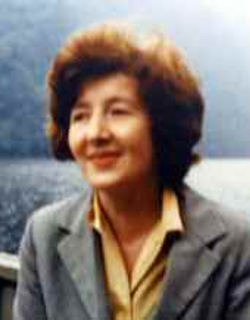
Daly is a militant member of the Prisoners’ Relatives Action Committee and the national Hunger Strike Committee. In that campaign, she works with Seamus Costello and soon joins him in the Irish Republican Socialist Party (IRSP) and the Irish National Liberation Army (INLA). After Costello is assassinated, she becomes chairperson, leading the party for two years. During this time, she and her husband are instrumental in opposing Sinn Féin‘s drift towards federalism.
On June 26, 1980, Daly is shot dead at her home in the Andersonstown area of west Belfast. At the time of her assassination, she is in charge of the IRSP prisoners’ welfare.
According to reports in The Irish Times, members of the Ulster Defence Association gain entry to her home with the intention of killing her husband, who is also a republican activist. Daly is captured and tied up while they wait for him to return home. However, he is in Dublin at the time and so does not arrive. After a considerable time, the UDA men decide to kill Daly instead. Muffling the sound of the gun with a cushion, they shoot her in the head and cut the phone lines before fleeing. Her body is discovered when her ten-year-old daughter arrives home from school.
On June 16, 1994, high-ranking UVF Commander volunteer Trevor King is standing on the Shankill Road about one hundred yards from “The Eagle,” the UVF’s Belfast GHQ, talking to fellow UVF members David Hamilton and Colin Craig. A car drives past them and as it does so Irish National Liberation Army (INLA) gunmen inside the vehicle open fire on the three men. The car is later found burning close to Divis Tower.
David Lister and Hugh Jordan claim that Gino Gallagher, who is himself shot dead in 1996 during an internal dispute, is the main gunman in the attack. However, Henry McDonald and Jack Holland say that Gallagher is inside the car, which is scouting the area for UVF members, and not one of the gunmen.
Colin Craig is killed on the spot. King and David Hamilton lay in the street, seriously wounded as panic and chaos erupt on the Shankill in the wake of the shooting. Presbyterian minister Roy Magee is in “The Eagle” discussing an upcoming Combined Loyalist Military Command (CLMC) meeting and the possibility of a loyalist ceasefire with the UVF Brigade Staff when the attack takes place. He and the others race out of the building after hearing the gunfire.
King is rushed to the hospital where he is put on a life-support machine. The shooting has left him paralysed from the neck down. He dies on July 9 with Reverend Magee at his bedside. According to Magee, King himself makes the decision to turn off the machine.
The killings are a blow for the Northern Ireland peace process and a morale boost for the INLA. The attack is the INLA’s most notorious since the Droppin Well bombing in 1982 which killed seventeen people, eleven British soldiers and 6 civilians.
The following day, the UVF launches two retaliatory attacks. In the first, UVF members shoot dead a Catholic civilian taxi driver in Carrickfergus. In the second, they shoot dead two Protestant civilians in Newtownabbey, whom they believe to be Catholics. Two days after the killings the UVF decide to launch another revenge attack when they kill six Catholic civilians in a bar while they are watching the Ireland vs. Italy 1994 FIFA World Cup game opener in what becomes known as the Loughinisland massacre. The tit-for-tat attacks continue during the spring and summer of 1994 until the Provisional Irish Republican Army ceasefire of August 31, 1994, and the Combined Loyalist Military Command ceasefire in October. The attacks on the Shankill are the INLA’s deadliest attacks of the 1990s.
When interviewed for Boston College for research on the conflict, Progressive Unionist Party leader David Ervine suggests the INLA might have been working in cahoots with the Provisional IRA in targeting prominent Loyalists, as the month after the Provisional IRA kill three leading Ulster Defence Association (UDA) men.
(Pictured: Trevor King mural, Disraeli Street, May 2012)
Collins grows up in a middle-class Irish family in Camlough, a small, staunchly Irish republican town in County Armagh. After completing his schooling, he works for a time in the Ministry of Defence in a clerical capacity in London before studying law at Queen’s University Belfast, where he becomes influenced by Marxist political ideology. He eventually drops out of university and, after working in a pub for a period, joins Her Majesty’s Customs & Excise Service, serving in Newry, and goes on to use this internal position within the administrative machinery of the British Government to support IRA operations against Crown Forces personnel.
Collins joins the Provisional IRA during the blanket protest by Long Kesh inmates in the late 1970s and he becomes involved in street demonstrations. He joins the South Down Brigade of the IRA, based around Newry, and is appointed its intelligence officer.
Collins becomes noted within IRA circles for his hard-line views on the continuance of armed campaign and later joins its Internal Security Unit. Around this time, he has a confrontation with Gerry Adams at the funeral of an IRA man killed in a failed bombing over how to deal with the funeral’s policing, where he accuses Adams a being a “Stick.”
Despite his militarist convictions at this time Collins finds the psychological strain caused by his involvement in the terrorist war increasingly difficult to address. His belief in the martial discipline of the IRA’s campaign is seriously undermined by the March 11, 1982, assassination of Norman Hanna, a 28-year-old Newry man, in front of his wife and young daughter. His uneasy state is further augmented by being arrested on two occasions under anti-terrorism laws, the second including a week of detention and intense interrogation.
Collins subsequently states that the strain of the interrogation merely exacerbates increasing doubts that he has already possessed about the moral justification of the IRA’s terrorist paramilitary campaign and his actions within it. These doubts are made worse by the organization’s senior leadership quietly deciding in the early 1980s that the war has failed and now slowly manoeuvering the movement away from a military campaign to allow its political wing, Sinn Féin, to pursue its purposes by another means in what would become the Northern Ireland peace process.
In 1987, after being charged with several counts of murder and attempted murder, Collins is acquitted as the statement in which he admits to involvement in these acts is ruled legally inadmissible by the court. On release from prison, he spends several weeks being counter-interrogated by the IRA’s Internal Security Unit, after which he is exiled by the organization from Ulster, being warned that if he is found north of Drogheda after a certain date he will be executed.
After his exile Collins moves to Dublin and squats for a while in a deserted flat in the impoverished Ballymun area of the city. After several years in Dublin, he subsequently moves to Edinburgh, Scotland for a period, where he runs a youth centre.
In 1995 Collins returns to Newry, a district known for the militancy of its communal support of the IRA, with numerous IRA members in its midst. The IRA order exiling him from Ulster has not been lifted, but with a formal ceasefire from the organization and renunciations of violence by all the paramilitary organizations in the province, he deems it safe to move back in with his wife and children who had never left the town.
Rather than maintaining a low-profile Collins decides to take a prominent role in the ongoing transition of Ulster’s post-war society, using his personal history as a platform in the media to analyze the adverse effects of terrorism. In May 1998 he gives evidence against leading republican Thomas “Slab” Murphy in a libel case Murphy has brought against The Sunday Times, over a 1985 article naming him as the IRA’s Northern Commander. Murphy denies IRA membership, but Collins takes the witness stand against him and testifies that from personal experience he knew that Murphy had been a key military leader in the organization. Murphy subsequently loses the libel case and sustains substantial financial losses in consequence. Collins and his family receive numerous threats after the trial.
Collins is beaten and stabbed to death by one or more unidentified assailants early in the morning of January 27, 1999, while walking his dogs near the Barcroft Park Estate in Newry along a quiet stretch of country lane at Doran’s Hill. His body also bears marks of having been struck by a car moving at speed. The subsequent police investigation and Coroner’s Inquest comment upon the extremity of weaponed violence to Collins’ head and face used during the attack.
Rumoured reasons behind the murder are that he had returned to Ulster in breach of the IRA’s banning order, and further he had detailed IRA activities and publicly criticized in the media a multiplicity of Irish terrorist paramilitary splinter groups that had appeared after the IRA’s 1994 ceasefire, and that he had testified in court against Murphy.
After a traditional Irish wake, with a closed coffin necessitated by the condition of his face, and a funeral service at St. Catherine’s Church in Newry, Collins’ body is buried at the town’s Monkshill Cemetery, not far from the grave of Albert White, a Catholic former Royal Ulster Constabulary Inspector, whose assassination he had helped to organize in 1982.
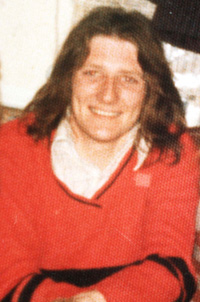
The Irish Republican Army (IRA) hunger strike is called off at Long Kesh prison – later known as HM Prison Maze – on October 3, 1981. While the IRA does not win immediate concessions, in some ways it is a Pyrrhic victory for Margaret Thatcher’s government. It galvanises support and membership for the IRA and generates huge sympathy for the strikers in the United States where fund-raising is a major priority. The death of the first hunger striker, Bobby Sands, creates a martyr and an iconic figure.
In January 1981, prison authorities begin to supply the prisoners with officially issued civilian clothing, whereas the prisoners demand the right to wear their own clothing. On February 4, the prisoners issue a statement saying that the British government has failed to resolve the crisis and declares their intention of a hunger strike. The hunger strike begins on March 1, when Bobby Sands, the IRA’s former officer commanding (OC) in the prison, refuses food. Unlike the first hunger strike the previous year, the prisoners join one at a time and at staggered intervals, which they believe would arouse maximum public support and exert maximum pressure on Prime Minister Margaret Thatcher.
The republican movement initially struggles to generate public support for the second hunger strike. The Sunday before Sands begins his strike, 3,500 people march through west Belfast. During the first hunger strike four months earlier, the marchers had numbered 10,000. Five days into the strike, Independent Republican MP for Fermanagh and South TyroneFrank Maguire dies, resulting in a by-election. There is debate among nationalists and republicans regarding who should contest the election. After negotiations they agree not to split the nationalist vote by contesting the election and Sands stands as an Anti H-Block candidate against Ulster Unionist Party candidate Harry West. Following a high-profile campaign, the election takes place on April 9, and Sands is elected to the British House of Commons with 30,492 votes to West’s 29,046.
Sands’ election victory raises hopes that a settlement can be negotiated, but Thatcher stands firm in refusing to give concessions to the hunger strikers. The world’s media descends on Belfast, and several intermediaries visit Sands in an attempt to negotiate an end to the hunger strike, including Síle de Valera, granddaughter of Éamon de Valera, Pope John Paul II‘s personal envoy John Magee, and European Commission of Human Rights officials. With Sands close to death, the government’s position remains unchanged.
On 5 May, Sands dies in the prison hospital on the 66th day of his hunger strike, prompting rioting in nationalist areas of Northern Ireland. More than 100,000 people line the route of his funeral, which is conducted with full IRA military honours. Margaret Thatcher shows no sympathy for his death.
In the two weeks following Sands’ death, hunger strikers Francis Hughes, Raymond McCreesh and Patsy O’Hara die. Following the deaths of Joe McDonnell and Martin Hurson, the families of some of the hunger strikers attend a meeting on July 28 with Catholic priest Father Denis Faul. The families express concern at the lack of a settlement to the priest, and a decision is made to meet with Gerry Adams later that day. The following day Adams holds a meeting with six of the hunger strikers to outline a proposed settlement on offer from the British government should the strike be brought to an end. The six men reject the settlement, believing that accepting anything less than the “Five Demands” would be a betrayal of the sacrifice made by Bobby Sands and the other hunger strikers who had died.
The hunger strike begins to break on July 31, when the mother of Paddy Quinn insists on medical intervention to save his life. The following day Kevin Lynch dies, followed by Kieran Doherty on August 2, Thomas McElwee on August 8 and Michael Devine on August 20. On September 6, the family of Laurence McKeown becomes the fourth family to intervene and asks for medical treatment to save his life, and Cahal Daly issues a statement calling on republican prisoners to end the hunger strike.
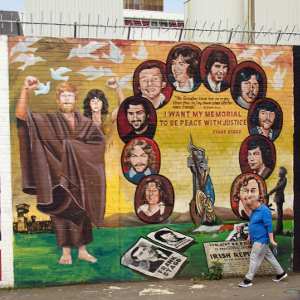
The strike is called off at 3:15 PM on October 3, 1981. Three days later, James Prior, the new Secretary of State for Northern Ireland, announces partial concessions to the prisoners including the right to wear their own clothes at all times. The only one of the “Five Demands” still outstanding is the right not to do prison work. Following sabotage by the prisoners and the Maze Prison escape in 1983, the prison workshops are closed, effectively granting all of the “Five Demands” but without any formal recognition of political status from the government.
(Pictured: A Belfast mural of the Long Kesh hunger strikers)
On the day of the bombing, the bombers drive a car, loaded with 230 kilograms (510 lb) of fertiliser-based explosives, across the Irish border. At approximately 2:19 PM they park the vehicle outside S.D. Kells’ clothes shop in Omagh’s Lower Market Street, on the southern side of the town centre, near the crossroads with Dublin Road. They are unable to find a parking space near the intended target, the Omagh courthouse. The two male occupants arm the bomb and, upon exiting the car, walk east down Market Street towards Campsie Road.
Three telephone calls are made warning of a bomb in Omagh, using the same codeword that had been used in the Real IRA’s bomb attack in Banbridge two weeks earlier. At 2:32 PM, a warning is telephoned to Ulster Television saying, “There’s a bomb, courthouse, Omagh, Main Street, 500 lb., explosion 30 minutes.” One minute later, the office receives a second warning saying, “Martha Pope (which is the RIRA’s code word), bomb, Omagh town, 15 minutes.” The caller claims the warning on behalf of “Óglaigh na hÉireann.” One minute later, the Coleraine office of the Samaritans receives a call stating that a bomb will go off on “Main Street” about 200 yards (180 m) from the courthouse. The recipients pass the information on to the Royal Ulster Constabulary (RUC) but are claimed to be inaccurate and police inadvertently move people towards the bomb.
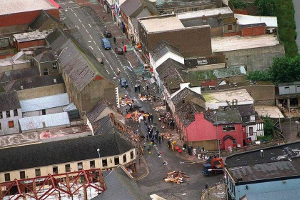
The car bomb detonates at 3:10 PM in the crowded shopping area. The bombing kills 29 people, including a woman pregnant with twins, and injures some 220 others. Twenty-one people who are in the vicinity of the vehicle die at the scene. Eight more people die on the way to or in the hospital. The death toll is higher than that of any single incident during what are considered “the Troubles.”
The bombing causes outrage both locally and internationally, spurs on the Northern Ireland peace process, and deals a severe blow to the Dissident republican campaign. The Real IRA apologises and declares a ceasefire shortly afterwards. The victims include people from many backgrounds: Protestants, Catholics, a Mormon teenager, five other teenagers, six children, a mother pregnant with twins, two Spanish tourists, and others on a day trip from the Republic of Ireland. Both unionists and Irish nationalists are killed and injured.
It is alleged that the British, Irish and U.S. intelligence agencies have information which could have prevented the bombing, most of which comes from double agents inside the Real IRA. This information is not given to the local police, the Royal Ulster Constabulary (RUC). In 2008 it is revealed that British intelligence agency, Government Communications Headquarters, was monitoring conversations between the bombers as the bomb was being driven into Omagh.
A 2001 report by the Police Ombudsman says that the RUC Special Branch failed to act on prior warnings and slammed the RUC’s investigation of the bombing. The RUC has obtained circumstantial and coincidental evidence against some suspects, but it has not come up with anything to convict anyone of the bombing. Colm Murphy is tried, convicted, and then released after it is revealed that Garda Síochána forged interview notes used in the case. Murphy’s nephew, Sean Hoey, is also tried and found not guilty.
In June 2009, the victims’ families win a GB£1.6 million civil action against four defendants. In April 2014, Seamus Daly is charged with the murders of those killed, however, the case against him is withdrawn in February 2016.
The mid-1970s is one of the deadliest periods of the Troubles. From February 1975 until February 1976, the Provisional Irish Republican Army (IRA) and British Government observe a truce. This, however, marks a rise in sectarian tit-for-tat killings. Ulster loyalist paramilitaries, fearing they are about to be forsaken by the British Government and forced into a united Ireland, increase their attacks on Irish Catholics and nationalists. Under orders not to engage British forces, some IRA units concentrate on tackling the loyalists. The fall-off of regular operations causes serious problems of internal discipline and some IRA members also engage in revenge attacks. The tit-for-tat killings continue after the truce ends. On June 5, 1976, the UVF shoots dead three Catholics and two Protestants in an attack on the Chlorane Bar. This is claimed as revenge for the killing of two Protestants in a pub earlier that day.
On June 25, 1976, gunmen open fire inside a Protestant-owned pub in Templepatrick, County Antrim. Three Protestant civilians die. The attack is claimed by the “Republican Action Force“, which is believed to be a cover name used by some members of the IRA.
The Ramble Inn lies just outside Antrim, on the main A26 Antrim to Ballymena dual carriageway, near the village of Kells. The pub is owned by Catholics but in a rural area of County Antrim which is mostly Protestant. Most of its customers are Protestants from the surrounding area.
On the night of Friday July 2, 1976, a three-man UVF unit consisting of a driver and two gunmen steal a car from a couple parked in nearby Tardree Forest. The couple are gagged and bound before the men make off in the car. At about 11:00 PM, just before closing time, two masked gunmen in boilersuits enter the pub and open fire with machine guns, hitting nine people. Three die at the scene and a further three die later. The victims are Frank Scott (75), Ernest Moore (40), James McCallion (35), Joseph Ellis (27) and James Francey (50), all Protestants, and Oliver Woulahan (20), a Catholic.
On July 3 at 12:30 PM, an anonymous caller to theNews Letter claims the attack is in retaliation for the earlier attack in Templepatrick. It is widely believed that the UVF are responsible for the Ramble Inn attack. In the weeks that follow, a number of people are interviewed by police in relation to the shooting but are subsequently released without charge. To date, no one has been convicted of the attack.
In 2012 the Historical Enquiries Team (HET), a body which has been set up in Northern Ireland to re-investigate unsolved murders of the Troubles, meets with the family of James McCallion to deliver their findings. The probe concludes that the then Northern Ireland police force, the Royal Ulster Constabulary (RUC), had conducted a thorough investigation and the detectives working on the case did their best to bring the killers to justice.
Raymond Peter McCreesh, the seventh in a family of eight children, is born in St. Malachy’s Park, Camlough, on February 25, 1957. He is born into a strong Irish republican family and is active in the republican movement from the age of sixteen. He attends the local primary school in Camlough, St. Malachy’s, and later attends St. Colman’s College, Newry.
McCreesh first joins Fianna Éireann, the IRA’s youth wing, in 1973, and later that year he progresses to join the Provisional IRA South Armagh Brigade. He works for a short time as steelworker in a predominately Protestant factory in Lisburn. However, as sectarian threats and violence escalate, he switches professions to work as a milk roundsman in his local area of South Armagh, an occupation which greatly increases his knowledge of the surrounding countryside, as well as enables him to observe the movements of British Army patrols in the area.
On June 25, 1976, McCreesh and three other IRA volunteers attempt to ambush a British Army observation post in South Armagh. It lay opposite the Mountain House Inn, on the Newry–Newtonhamilton Road. As the armed, masked and uniformed IRA volunteers approached the observation post, they are spotted by British paratroopers on a hillside. The paratroopers open fire on the volunteers, who scatter. Two of them, McCreesh and Paddy Quinn, take cover in a nearby farmhouse. The paratroopers surround the house and fire a number of shots into the building. After some time, McCreesh and Quinn surrender and are taken to Bessbrook British Army base. Local Catholic priests facilitate their surrender. The third volunteer, Danny McGuinness, takes cover in a disused quarry outhouse but is captured the following day. The fourth member of the unit manages to escape despite being shot in the leg, arm and chest.
On March 2, 1977, McCreesh and Quinn are sentenced to fourteen years in prison for the attempted murder of British soldiers, possession of a rifle and ammunition, and an additional five years for IRA membership. The rifle that McCreesh has in his possession when captured is one of the rifles used in the Kingsmill massacre on January 5, 1976, when ten Protestant civilians are shot dead.
McCreesh is sent to the Maze Prison. He joins the blanket protest and takes part in the 1981 Irish hunger strike. He dies on 21 May, after 61 days on hunger strike.
Born in Belfast on March 9, 1954, Sands is the oldest of four children born to John and Rosaleen Sands, and the couple’s first son. Sands grows up in Belfast under the cloud of nationalist and loyalist divisions. At an early age, Sands’s life is affected by the sharp divisions that shape Northern Ireland. At the age of ten, he is forced to move with his family out of their neighborhood due to repeated intimidation by loyalists.
“I was only a working-class boy from a Nationalist ghetto,” Sands later writes about his childhood. “But it is repression that creates the revolutionary spirit of freedom.” Loyalist intimidation proves to be a theme throughout Sands’ life. At the age of 18, he is forced out of his job as an apprentice car builder. Not long afterwards, he and his family have to move again, as a result of political trouble.
The steady number of conflicts pushes Sands to join the republican movement in 1972. His ties to the movement soon capture the attention of the authorities, and later that year, he is arrested and charged with possessing firearms in his house. He spends the next three years of his life in prison. Upon his release, Sands immediately returns to the Republican Movement. He signs on as a community activist in Belfast’s rough Twinbrook area, quickly becoming a popular go-to person for a range of issues affecting the neighborhood.
In late 1976, authorities arrest Sands again, this time in connection with the bombing of a large furniture company and an ensuing gun battle. After weathering a brutal interrogation and then a court proceeding that offers up questionable evidence connecting Sands and three others to the attack, a judge sentences Sands to 14 years in prison at Long Kesh Prison, a facility used to house Republican prisoners from 1971 until 2000, located just outside of Belfast.
As a prisoner, Sands’s stature only grows. He pushes hard for prison reforms, confronting authorities, and for his outspoken ways he is frequently given solitary confinement sentences. Sands contention is that he and others like him, who are serving prison sentences, are actually prisoners of war, not criminals as the British government insists.
Beginning on March 1, 1981, Sands leads nine other Republican prisoners in the H Block section of the Maze prison on a hunger strike that lasts until death. Their demands range from allowing prisoners to wear their own clothes to permitting visits and mail, all of which are central in improving the inmates’ way of life.
Unable to move authorities to give in to his requests, and unwilling himself to end his hunger strike, Sands’s health begins to deteriorate. During the first seventeen days of the strike alone, he loses 16 pounds. A hero among his fellow nationalists, Sands is elected as a Member of Parliament (MP) for Fermanagh and South Tyrone while in prison. Sands becomes the youngest MP at the time. However, he dies less than one month later without ever having taken his seat in the House of Commons.
Only days after slipping into a coma, on the morning of May 5, 1981, Sands dies from malnutrition due to starvation. He is 27 years old and has refused to eat for 66 days. He becomes so fragile over his final weeks that he spends his final days on a waterbed to protect his deteriorating and fragile body. At time of his death, Sands is married to Geraldine Noade, with whom he has one son, Gerard.
The announcement of Sands’s death prompts several days of rioting in nationalist areas of Northern Ireland. Over 100,000 people line the route of Sands’s funeral. He is buried in the ‘New Republican Plot’ alongside 76 others. Their graves are maintained by the National Graves Association, Belfast.
While loyalists dismiss Sands’s death, others are quick to recognize its significance. Over the next seven months, nine other IRA supporters die on hunger strike. Eventually, the British government gives proper political recognition to the prisoners, many of them earning their release under the 1998 Good Friday Agreement.
Since the beginning of its campaign, the IRA has carried out numerous attacks on economic targets, killing many members of the public in the process. The IRA’s goal is to harm the economy and cause disruption, which will put pressure on the British government to withdraw from Northern Ireland.
On February 17, 1978, an IRA unit plants an incendiary device attached to petrol-filled canisters on meat hooks outside the window of the Peacock Room in the restaurant of the La Mon House Hotel. The IRA often give bomb warnings in advance of destroying property but never when targeting the police or military. After planting the bomb, the IRA members attempt to send a warning from the nearest public telephone but find that it has been vandalised. On the way to another telephone, they are delayed again when forced to stop at an Ulster Defence Regiment (UDR) checkpoint. By the time they are able to send the warning, only nine minutes remain before the bomb detonates at 21:00. The blast creates a fireball, killing twelve people and injuring thirty more, many of whom are severely burned. Many of the injured are treated in the Ulster Hospital in nearby Dundonald. A 2012 news article claims that the IRA were targeting Royal Ulster Constabulary (RUC) officers they believed were meeting in the restaurant that night. The article claims that the IRA had gotten the wrong date and that the meeting of RUC officers had taken place exactly one week earlier.
The day after the explosion, the IRA admits responsibility and apologises for the inadequate warning. The hotel had allegedly been targeted by the IRA as part of its firebomb campaign against commercial targets. However, the resulting carnage brings quick condemnation from other Irish nationalists, with one popular newspaper comparing the attack to the 1971 McGurk’s Bar bombing. Sinn Féin president Ruairí Ó Brádaigh also strongly criticises the operation. In consequence of the botched attack, the IRA Army Council gives strict instructions to all units not to bomb buses, trains, or hotels.
A team of 100 RUC detectives is deployed in the investigation. As part of the investigation, 25 people are arrested in Belfast, including Gerry Adams. Adams is released from custody in July 1978. Two prosecutions follow. One Belfast man is charged with twelve murders but is acquitted. He is convicted of IRA membership but successfully appeals. In September 1981, another Belfast man, Robert Murphy, is given twelve life sentences for the manslaughter of those who died. Murphy is freed on licence in 1995. As part of their bid to catch the bombers, the RUC passes out leaflets which display a graphic photograph of a victim’s charred remains.
In 2012, a news article claims that two members of the IRA bombing team, including the getaway driver, are British double agents working for MI5. According to the article, one of the agents is Denis Donaldson. That year, Northern Ireland’s Historical Enquiries Team (HET) completes a report on the bombing. It reveals that important police documents, including interviews with IRA members, have been lost. A number of the victims’ families slam the report and call for a public inquiry. They claim the documents had been removed to protect certain IRA members. Unionist politician Jim Allister, who has been supporting the families, says, “There is a prevalent belief that someone involved was an agent and that is an issue around which we need clarity.”
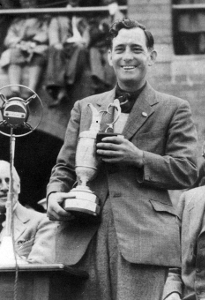
During his acceptance speech at Royal Liverpool, Daly says he is very honoured to receive the Claret Jug and take it back to Northern Ireland. He goes on to say that the trophy has never been to Ireland and that he is hoping that the change of air will help it. There is much applause and laughter at his humorous comments.
In addition, he adds the News of the World Match Play tournament, which is the main British Match Play Championship, becoming the first since James Braid (1905) to win both the Open and the Match Play title in the same year.