seamus dubhghaill

Promoting Irish Culture and History from Little Rock, Arkansas, USA


1 Comment

Birth of Barrister Alexander Martin Sullivan

alexander-martin-sullivan

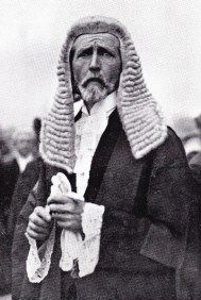
Alexander Martin Sullivan, Irish lawyer best known as the leading counsel for the defence in the 1916 treason trial of Roger Casement, is born in Dublin on January 14, 1871. He is the last barrister in either Ireland or England to hold the rank of Serjeant-at-Law, hence his nickname The Last Serjeant.

A younger son of A.M. Sullivan and Frances Donovan, Sullivan is educated at Ushaw College, Belvedere College, Trinity College, Dublin and King’s Inns. He is called to the Irish Bar in 1892 and practises on the Munster Circuit.

Sullivan is appointed an Irish KC in 1908 and King’s Third Serjeant-at-law (Ireland) in 1912 advancing to Second Serjeant in 1913 and First Serjeant in 1919, the last holder of that position.

A moderate constitutional nationalist and supporter of the Irish Parliamentary Party, Sullivan is a prominent campaigner for the recruitment of Irishmen into the British Army during World War I. His opposition to Sinn Féin republicanism and his prominent role in conducting prosecutions on behalf of the Crown during the Irish War of Independence lead to at least one attempt on his life. As a result, he relocates to England in 1921 and establishes a career at the English Bar, having previously been called to the Middle Temple in 1899. He subsequently becomes a Bencher and Treasurer of Middle Temple. By courtesy, he is always referred to as Serjeant Sullivan, even though that rank no longer exists in England.

Sullivan remains a member of the Irish Bar and returns at least once to appear in the celebrated case of Croker v Croker, where the children of the former leader of Tammany Hall, Richard “Boss” Croker attempt to overturn his will, which leaves his entire estate to their stepmother.

Sullivan is noted as a fearless advocate, who brings to his English practice the robust manners he had learned in the Irish county courts. He does not hesitate to interrupt the judge, and if he feels that he is not receiving a fair hearing, he is quite capable of walking out of Court.

In 1916 Sullivan is retained as lead counsel in the trial of Sir Roger Casement for treason. No English barrister will defend Casement, and Sullivan is persuaded to take the case by George Gavan Duffy, whose wife Margaret is Sullivan’s sister. Despite his rank of Serjeant at law and King’s Counsel at the Irish bar he is only ranked as a junior barrister in England. As the facts relied on by the prosecution are largely undisputed, Sullivan is limited to arguing a technical defence that the Treason Act 1351 only applies to acts committed “within the realm” and not outside it. The Act’s terms had however been expanded by case law over the previous 560 years, and the defence is rejected by the trial judges and by the Court of Criminal Appeal.

Sullivan writes two books: Old Ireland in 1927 and The Last Serjeant in 1952. He retires from legal practice in 1949. He dies on January 9, 1959.

Leave a comment

Artist Derek Hill Awarded Honorary Irish Citizenship

arthur-derek-hill

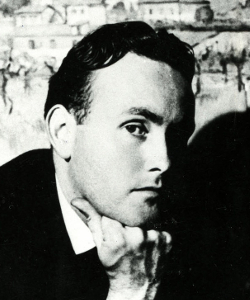
Arthur Derek Hill, English portrait and landscape painter and longtime resident in Ireland, is awarded honorary Irish citizenship by President Mary McAleese on January 13, 1999.

Hill is born at Southampton, Hampshire, on December 6, 1916, the son of a wealthy sugar trader. He first works as a theatre designer in Leningrad in the 1930s and later as an historian. In World War II he registers as a conscientious objector and works on a farm.

Hill’s long association with Ireland begins when he visits Glenveagh Castle in County Donegal to paint the portrait of the Irish American art collector Henry McIlhenny, whose grandfather had emigrated to the United States from the nearby village of Milford, and who subsequently made a fortune from his patent gas meter.

Hill begins to enjoy increased success as a portrait painter from the 1960s. His subjects include many notable composers, musicians, politicians and statesmen, such as broadcaster Gay Byrne, Jerusalem mayor Teddy Kollek and The Prince of Wales. He is also an enthusiastic art collector and traveller, with a wide range of friends such as Bryan Guinness and Isaiah Berlin. Greta Garbo visits Hill in the 1970s, a visit which forms inspiration for Frank McGuinness‘ 2010 play Greta Garbo Came to Donegal.

In 1981, he donates his home, St. Columb’s Rectory, near the village of Churchill, County Donegal, which he had owned since 1954, along with a considerable collection including work by Pablo Picasso, Edgar Degas, Georges Braque, Graham Sutherland, Anna Ticho and Jack Butler Yeats to the State.

An exhibition of his work and personal art collection can be seen at the House and associated Glebe Gallery at Churchill, near Letterkenny. Another collection of his work is held at Mottisfont Abbey. Many of his landscapes portray scenes from Tory Island, where he has a painting hut for years, and starts and then mentors the artists’ community there, teaching the local fishermen how to paint. This leads to the informal but busy “Tory School” of artists such as James Dixon and Anton Meenan, who find that they have the time to paint and use their wild surroundings as a dramatic subject.

Hill is made a CBE in 1997. A Retrospective exhibition is arranged for and by him at the Royal Hibernian Academy in 1998. On January 13, 1999, he is made an honorary Irish citizen by the President of Ireland Mary McAleese.

Arthur Derek Hill dies at the age of 83 at a London hospital on July 30, 2000. He is buried in Hampshire in the South of England with his parents. Memorial services are held for him in Dublin at St. Patrick’s Cathedral, as well as St. James’s Church, Piccadilly, London, and his local Church in Trentagh, County Donegal.


Leave a comment

Birth of Actress Máire O’Neill

maire-oneill

Mary Agnes “Molly” Allgood, actress of stage and film under the stage name of Máire O’Neill, is born at 40 Middle Abbey Street in Dublin on January 12, 1885.

Allgood is one of eight children of compositor George and french polisher Margaret (née Harold) Allgood. Her father is sternly Protestant and against all music, dancing and entertainment, while her mother is a strict Catholic. After her father dies in 1896, she is placed in an orphanage. She is apprenticed to a dressmaker and her brother Tom becomes a Catholic priest.

Maud Gonne sets up Inghinidhe na hÉireann (Daughters of Ireland) in 1900 to educate women about Irish history, language and the arts, and Allgood and her sister Sara join the association’s drama classes around 1903. Their acting teacher, William “Willie” Fay, enrolls them in the National Theatre Society, later known as the Abbey Theatre. Allgood is part of the Abbey Theatre from 1906-1918 where she appears in many productions. In 1904 she is cast in a play by Irish playwright Teresa Deevy called Katie Roche where she plays the part of Margaret Drybone. There are 38 performances in this production.

In 1905 Allgood meets Irish playwright John Millington Synge, and they fall in love, a relationship regarded as scandalous because it crosses the class barriers of the time. In September 1907 he has surgery for the removal of troublesome neck glands, but a later tumour is found to be inoperable. They become engaged before his death in March 1909. Synge writes the plays The Playboy of the Western World and Deirdre of the Sorrows for Allgood.

In June 1911 Allgood marries G. H. Mair, drama critic of the Manchester Guardian, and later Assistant Secretary of the British Department of Information, Assistant Director of the League of Nations Secretariat in Geneva, and head of the League of Nations office in London, with whom she has two children. He dies suddenly on January 3, 1926. Six months later she marries Arthur Sinclair, an Abbey actor. They have two children, but the marriage ends in divorce.

Under her professional name Maire O’Neill, Allgood appears in films from 1930-53, including Alfred Hitchcock‘s film version of Seán O’Casey‘s play Juno and the Paycock (1930). She makes her American debut in New York City in 1914 in the play General John Regan at the Hudson Theatre.

Allgood dies at the age of 66 in Park Prewett Hospital, Basingstoke, England, on November 2, 1952, where she is receiving treatment after being badly burned in a fire at her London home.

Joseph O’Connor‘s 2010 novel, Ghost Light, is loosely based on Allgood’s relationship with Synge.


Leave a comment

Birth of Robert Blair “Paddy” Mayne

robert-blair-paddy-mayne

Robert Blair “Paddy” Mayne, British Army soldier, solicitor, Ireland rugby union international, amateur boxer, and a founding member of the Special Air Service (SAS), is born in Newtownards, County Down, on January 11, 1915.

Mayne attends school at Regent House School, a school for students aged 4 to 18. While at Regent he discovers his skill and love for the game of rugby. He also enjoys cricket and golf and becomes a marksman with the rifle club. He goes on to Queen’s University Belfast to study law. At university he takes up boxing and becomes the Irish Universities Heavyweight Champion in August 1936. He also wins the Scrabo Golf Club President’s cup in 1937. He graduates from Queen’s University in 1939.

During 1938, Mayne travels to Africa on the 1938 British Lions Tour to South Africa. He plays on a team that tours around Africa playing other local clubs. While traveling, it is discovered that Mayne has a wild side and on various occasions finds himself in trouble. His “go to” is to trash the hotel rooms of his teammates. The team includes some of the best players from around Ireland and Britain.

In 1939, with outbreak of World War II, Mayne joins the Supplementary Reserves in Newtownards and receives a commission in the Royal Artillery. He serves in several units in Ireland and England, generally with light and heavy anti-aircraft units. He volunteers for the No. 11 (Scottish) Commando unit which is sent to the Middle East. There he sees action during the Syria-Lebanon campaign. Specifically, during the Battle of the Litani River, he draws attention from Captain David Stirling who is forming the new Special Air Service (SAS). Sterling recruits Mayne for the new SAS while he is in jail for striking his commanding officer.

From November 1941 to the end of 1942, Mayne is involved in several raids behind enemy lines with the SAS. He uses jeeps to go to various Axis bases and begin blowing up planes and fuel dumps. It is claimed that he personally destroyed 100 planes during these missions. In addition to serving in the Middle East, he serves as well in Sicily, Italy, Belgium, the Netherlands, Germany, Norway and France. In most of these locations he works with the resistance behind the enemy lines. In France he helps to train the French Resistance.

By the end of the war, Mayne has been promoted to the rank of Lieutenant Colonel and has also received the British Army’s Distinguished Service Order with three bars, which means he received the award four times. After the war he joins the British Antarctic Survey in the Falkland Islands. He returns home to Newtownards when back issues, which started while he was serving in the Middle East, become more difficult for him.

Mayne is initiated into Eklektikos Lodge No. 542 in Newtownards in 1945. He is a very enthusiastic mason and joins a second lodge in Newtownards, Friendship Lodge No. 447. On the evening of December 13, 1955, he attends a meeting of Friendship Lodge and then joins some of his masonic brothers at a local bar. At about 4:00 AM on December 14, he is found dead in his Riley RM roadster in Mill Street, Newtownards, having reportedly collided with a farmer’s vehicle.

At his funeral hundreds of mourners turn out to pay their respects and to see him interred in a family plot in the town’s old Movilla Abbey graveyard. After his death his masonic jewel is preserved for many years by an old school friend before it is presented to Newtownards Borough Council where it is displayed in the Mayoral Chamber of the Council Offices.


Leave a comment

Death of Mary Raftery, Investigative Journalist

mary-raftery

Mary Frances Thérèse Raftery, Irish investigative journalist, filmmaker and writer, dies in Dublin on January 10, 2012.

Raftery is born in Dublin on December 21, 1957. Her father, Adrian, is in the Irish foreign service, and she spends much of her childhood abroad. Though she enters University College Dublin to study engineering, she is derailed by an interest in journalism and never finishes her degree.

Raftery starts her investigative journalism career with In Dublin magazine in the 1970s, before moving on to Magill magazine and then to the Irish television channel Raidió Teilifís Éireann (RTÉ) in 1984. Her documentary series States of Fear is broadcast on RTÉ in 1999. A book she writes later that year called Suffer the Little Children adds more detail to her claim that the Irish childcare system between the 1930s and 1970s was guilty of widespread persecution and abuse.

In 2000, the Commission to Inquire into Child Abuse is established by the Irish Government to examine the evidence with its report published in May 2009. Her programme “Cardinal Secrets” is broadcast as a Prime Time special on RTÉ in 2002. It leads to the setting up of the Murphy Commission of Investigation into clerical abuse in the Archdiocese of Dublin which published the Murphy Report in 2009. Colm O’Gorman of Amnesty International Ireland says, “Ms. Raftery’s work transformed Ireland. Without the work that Mary did as a journalist (on the abuse of children), I don’t think much of this would have surfaced.”

Raftery is nominated for “NNI National Journalist of the Year” in 2011 for her work in exposing clerical abuse of children.

Mary Frances Thérèse Raftery dies of ovarian cancer at the age of 54 at St. Vincent’s University Hospital in Dublin on January 10, 2012. She is survived by her mother, three siblings, her husband and her son.


Leave a comment

Birth of Mother Frances Mary Teresa Ball

frances-teresa-ball

Mother Frances Mary Teresa Ball, foundress of the Irish Branch of the Institute of the Blessed Virgin Mary (IBVM), is born in Dublin on January 9, 1794.

Ball is the youngest of six children born to John and Mable Clare Bennet Ball. Her father is a wealthy silk weaver. Catholicism is still suppressed in Ireland at this time. She is therefore sent to England at the age of nine to the Bar Convent in York. Henry James Coleridge describes her as “a bright, quiet, high-spirited girl, fond of fun, and with much depth of character.” In these times students do not return home for Easter, Christmas or summer holidays. They stay at the school, and live like religious people, until they leave school, usually in their late teens.

In 1807, her eldest sister, Cecilia is professed at the Ursuline convent in Cork. Ball travels from Dublin to Cork for the ceremony, where she meets Mary Aikenhead. Cecilia Ball takes the name of Sister Francis Regis and is within a few years made Superior of the convent in Cork. Upon the death of her father in 1808, Ball returns to Dublin. She is expected to make an admirable wife for the son and heir of some rich Catholic Dublin merchant family.

In June 1814, under the direction of Dr. Daniel Murray, Archbishop of Dublin, Ball returns to York and enters the novitiate of the Institute of the Blessed Virgin Mary. There she receives her religious training, and makes her profession in September 1816, taking, in religion, the name of Mary Teresa.

Recalled by Archbishop Murray, Ball returns to Dublin in 1821 with two novices to establish the Irish Branch of the Institute of the Blessed Virgin Mary for the instruction of children. They stay with Mary Aikenhead and the Irish Sisters of Charity in Stanhope Street while Rathfarnham House is being renovated. In 1822 she opens the first institution of the order in Ireland, in Rathfarnam House, four miles from Dublin. She decides to call the house “Loreto” after the village in Italy to which the Nazareth house of the Holy Family is said to have been miraculously transported.

Ball is a woman of great piety and administrative ability. Her energies are devoted to the establishment of schools and to the development of the sisterhood which now has members in many countries. The first offshoot is planted in Navan, County Meath, in the year 1833. The year 1840 is marked by the erection of the first church in Ireland dedicated to the Sacred Heart, in Loretto Abbey, Rathfarnham. In addition to the boarding and day schools the sisters conduct orphanages.

For almost forty years after bringing the IBVM to Ireland, Ball establishes a wide network of convents and schools across Ireland, as well as in India, Mauritius and Canada. The nuns are usually called Sisters of Loreto after the shrine at Loreto, Marche in Italy.

Mother Mary Teresa Ball dies at Rathfarnham Abbey on May 19, 1861, after a long illness.


Leave a comment

St. Andrew’s Church Destroyed by Fire

church-of-st-andrews

St. Andrew’s Church in Suffolk Street, Dublin, is destroyed by fire on January 8, 1860. The church is a former parish church of the Church of Ireland and now houses the Central Tourist Office.

The original St. Andrew’s Church is located on present-day Dame Street but disappears during Oliver Cromwell’s reign in the mid-17th century. A new church is built in 1665 a little further away from the city walls, on an old bowling-green close to the Thingmote, the old assembly place of the Norse rulers of the city. Due to its shape, it is commonly known as the “Round Church.” Local landlords of the time, Lord Anglesey (after whom Anglesey Street is named) and Sir John Temple (after whose family Temple Bar is named) are churchwardens. The architect is William Dodson. The neighbouring houses located in that part of the Dublin Corporation estate are known as “the Whole Land of Tib and Tom.”

The church is rebuilt in 1793, but burns down in 1860, after which the present building is constructed.

The boundaries of the ecclesiastical parish are coextensive to those of the civil parish of St. Andrew. The population of this parish in 1901 is 3,058, in 1971 it is 300.


1 Comment

Death of General John Charles O’Neill

general-john-oneill

John Charles O’Neill, Irish-born officer in the American Civil War and member of the Fenian Brotherhood, dies on January 7, 1878. He is best known for his activities leading the Fenian raids on Canada in 1866 and 1871.

O’Neill is born on March 9, 1834, in Drumgallon, Clontibret, County Monaghan, where he receives some schooling. He emigrates to New Jersey in 1848 at the height of the Great Famine. He receives an additional year of education there and works various jobs. In 1857 he enlists in the 2nd United States Dragoons and serves in the Utah War (May 1857 – July 1858), apparently deserting afterwards to California.

In California, O’Neill joins the 1st Cavalry, and serves as a sergeant in the American Civil War with this regiment until December 1862, at which time he is commissioned as an officer in the 5th Indiana Cavalry. He is credited as being a daring fighting officer but believes he has not received due promotion, which leads to a transfer to the 17th United States Colored Infantry as captain. He leaves the Union Army prior to the end of the conflict, marrying Mary Crow, with whom he has several children.

While in Tennessee, O’Neill joins the militant Irish American movement, the Fenian Brotherhood, which eschews politics in favor of militant action to expel the British presence in Ireland. He attaches himself to the group led by William Randall Roberts, who wishes to attack Canada.

O’Neill, ranked as colonel, travels to the Canada–US border with a group from Nashville to participate in the Fenian raids. The assigned commander of the expedition does not appear, so O’Neill takes command. On June 1, 1866, he leads a group of six hundred men across the Niagara River and occupies Fort Erie.

The following day, north of Ridgeway, Ontario, O’Neill’s group encounters a detached column of Canadian volunteers, commanded by Lt-Col. Alfred Booker. The inexperienced Canadians are routed by the Civil War veterans. O’Neill withdraws back to Fort Erie and fights a battle against a detachment led by John Stoughton Dennis. With overwhelming numbers of Canadian forces closing in, O’Neill oversees a successful evacuation on the night of June 2-3 back to United States territory. He is later charged with violating the neutrality laws of the United States, but the charge is dropped.

The split between two factions of the Fenians remain, and penetration of O’Neill’s organisation by British and Canadian spies ensures that his next venture into Canada in 1870 is known in advance, and Canada is accordingly prepared. After the Battle of Trout River ends in a disorganized rout, O’Neill is arrested by United States Marshal George P. Foster and charged with violating neutrality laws. That leads to O’Neill’s imprisonment in July 1870 with a sentence of two years, but he and other Fenians are pardoned by President Ulysses S. Grant that October.

Though O’Neill renounces the idea of further attacks on Canada, he changes his mind at the urging of an associate of Louis Riel, William Bernard O’Donoghue. With the latter, and without the backing of the bulk of the Fenians, he leads an attack on the Hudson’s Bay Company‘s post at Pembina, Manitoba, on October 5, 1871. The area is then disputed between America and Canada. He is arrested by American troops.

Following his military career, O’Neill works for a firm of land speculators in Holt County, Nebraska. He dies of a paralytic stroke on January 7, 1878, and is buried in Omaha, Nebraska.


Leave a comment

Birth of William Martin Murphy

william-martin-murphy

William Martin Murphy, Irish businessman, journalist and politician, is born on January 6, 1845, in Castletownbere, County Cork. A member of parliament (MP) representing Dublin from 1885 to 1892, he is dubbed “William Murder Murphy” among Dublin workers and the press due to the Dublin Lockout of 1913. He is arguably both Ireland’s first “press baron” and the leading promoter of tram development.

Murphy is educated at Belvedere College. When his father, the building contractor Denis William Murphy dies in 1863, he takes over the family business. His enterprise and business acumen expand the business, and he builds churches, schools and bridges throughout Ireland, as well as railways and tramways in Britain, West Africa and South America.

Murphy is elected as Irish Parliamentary Party MP for Dublin St. Patrick’s at the 1885 general election, taking his seat in the House of Commons of the United Kingdom of Great Britain and Ireland. He is a member of the informal grouping, the “Bantry Band,” a group of politicians who hail from the Bantry Bay area.

When the Irish Parliamentary Party splits in 1890 over Charles Stewart Parnell‘s leadership, Murphy sides with the majority Anti-Parnellites. However, Dublin emerges as a Parnellite stronghold and in the bitter general election of 1892, Murphy loses his seat by over three to one to a Parnellite newcomer, William Field.

Murphy is the principal financial backer of the “Healyite” newspapers the National Press and the Daily Nation. His support for Tim Healy attracts the hostility of the majority anti-Parnellite faction led by John Dillon. He makes two attempts to return to Parliament, at South Kerry in 1895 and North Mayo in 1900, but both are unsuccessful because of Dillonite opposition.

In 1900, Murphy purchases the insolvent Irish Daily Independent from the Parnellites, merging it with the Daily Nation. He re-launches this as a cheap mass-circulation newspaper, which rapidly displaces the Freeman’s Journal as Ireland’s most popular nationalist paper. In 1906, he founds the Sunday Independent newspaper.

Murphy is highly critical of the Irish Parliamentary Party. From 1914 he uses the Irish Independent to oppose the partition of Ireland and advocate Dominion Home Rule involving full fiscal autonomy.

Worried that the trade unions would destroy his Dublin tram system, Murphy leads Dublin employers against the trade unions led by James Larkin, an opposition that culminates in the Dublin Lockout of 1913. This makes him extremely unpopular with many, being depicted as a vulture or a vampire in the workers’ press.

After the 1916 Easter Rising, he purchases ruined buildings in Abbey Street as sites for his newspaper offices, however it is his viewpoints that make him even more unpopular, by calling for the executions of Seán MacDiarmada and James Connolly at a point when the Irish public is beginning to feel sympathy for their cause. He privately disavows the editorial, claiming it had been written and published without his knowledge.

In 1917 Murphy is invited to take part in talks during the Irish Convention which is called to agree terms for the implementation of the suspended 1914 Home Rule Act. However, he discovers that John Redmond is negotiating agreeable terms with Unionists under the Midleton Plan to avoid the partition of Ireland but at the partial loss of full Irish fiscal autonomy. This infuriates Murphy who criticises the intention in his newspaper, which severely damages the Irish Parliamentary Party. However, the Convention remains inconclusive, and the ensuing demise of the Irish party results in the rise of Sinn Féin, whose separatist policies Murphy also does not agree with.

William Martin Murphy dies in Dublin on June 26, 1919. His family controls Independent Newspapers until the early 1970s, when the group is sold to Tony O’Reilly.


Leave a comment

British Release of Fenian Prisoners

cuba-five

The British, in a general amnesty, release 33 Fenian prisoners on January 5, 1871. Most of these prisoners are men who have either been swept up by the British in 1865, when they suppressed the Fenian newspaper The Irish People for taking part in the Fenian Rising of March 1867, or had been rounded up after the “Smashing of the Van” rescue of Thomas J. Kelly and Timothy Deasy in September 1867.

The British penal system of the period is brutal under normal circumstances, and the Fenians receive much harsher treatment than that received by the normal inmates. Those Fenians still on the outside agitate constantly for the release of their comrades. The man most responsible for the release of 1871 is John “Amnesty” Nolan, who thus earns his sobriquet.

The names of many of the men released by William Ewart Gladstone’s government are well known to those who have studied the Irish republican movement. One of them is Jeremiah O’Donovan Rossa, as steadfast an enemy of English rule in Ireland as any who has ever lived. After Rossa’s death in the United States, his body is returned to Ireland for burial, and his funeral in 1915 includes the famous eulogy by Patrick Pearse, one of the seminal moments in the renewal of armed struggle for Irish freedom. Another Fenian released that day is John Devoy, who perhaps more than any other man keeps the struggle for Irish freedom alive among Irish exiles in America.

The British government releases the Fenians on condition that they exile themselves to the country of their choice and not return until their sentences have expired. Many chose to go to Australia, but Rossa, Devoy, John McClure, Henry Mulleda, and Charles Underwood O’Connell, who have all been imprisoned together, chose to go to the United States and ship together from Liverpool on board the Cuba. The so-called Cuba Five arrive in New York City to a hero’s welcome from the city’s large Irish community and even receive a resolution of welcome from the United States House of Representatives.

(Pictured: “The Cuba Five” – John Devoy, Jeremiah O’Donovan Rossa, Charles Underwood O’Connell, Henry Mulleda and John McClure)