Patrick Cotter O’Brien, the first of only seventeen people in medical history to stand at a verified height of eight feet or more, dies on September 8, 1806 in Bristol, England.
O’Brien is born in Kinsale, County Cork. His real name was Patrick Cotter and he adopts O’Brien as his stage name in the sideshow circus, claiming descent from the legendarily gigantic Brian Boru. He is also known as the Bristol Giant and the Irish Giant. Another giant of this period, Charles Byrne, also claims to be an O’Brien.
It is believed that O’Brien dies from the effects of the disease gigantism.
No hearse can be found to accommodate his nine foot four inch coffin encased in lead, and his remains are borne to the grave by relays of fourteen men. In his will, Cotter leaves £2,000 to his mother and requests that his body be entombed within twelve feet of solid rock in order to prevent exhumation for scientific or medical research.
O’Brien’s remains are exhumed three times – in 1906, 1972 and finally in 1986. In 1972 O’Brien’s remains are examined and it is determined that, while alive, he stood approximately 8 feet 1 inch (246 cm) tall. This makes him the tallest person ever at that time, a record that is surpassed by the next “eight-footer,” John Rogan, who dies almost a century later. O’Brien is subsequently reburied but in 1986, during a redevelopment in the area, his remains are again identified and then cremated after a church service. O’Brien’s giant boots are on display in the Kinsale Museum.
Duff’s idea is to help Catholic lay people fulfill their baptismal promises and be able to live their dedication to the Church in an organized structure, supported by fraternity and prayer. The Legion draws its inspiration from St. Louis de Montfort‘s book True Devotion to Mary.
The legionaries first start out by visiting hospitals, but they are soon active among the most destitute, notably among Dublin prostitutes. Duff subsequently lays down the system of the Legion in the Handbook of the Legion of Mary in 1928.
The Legion of Mary soon spreads from Ireland to other countries and continents. At first, the Legion is often met with mistrust due to its dedication to lay apostolate which is unusual for the time. After Pope Pius XI expresses praise for the Legion in 1931, the mistrust is quelled.
Most prominent for spreading the Legion is the Irish legionary Venerable Edel Mary Quinn for her activities in Africa during the 1930s and 40s. Her dedication to the mission of the Legion even in the face of her ill health due to tuberculosis brings her great admiration in and outside of the Legion. A canonization process is currently under way for Edel Quinn. She is declared venerable by Pope John Paul II on December 15, 1994, since when the campaign for her beatification has continued.
A beatification process is currently underway for Servant of God Frank Duff. In July 1996, the Cause of Duff’s canonisation is introduced by the Archbishop of Dublin, Desmond Connell. A Cause for Canonization for Servant of God Alfie Lambe (1932-1959), Legion Envoy to South America, is introduced by the Archdiocese of Buenos Aires in 1978 and concluded on March 26, 2015.
Membership in Ireland has been declining but due to efforts by the Concilium to attract younger people to its ranks through the Deus et Patria movement, a substantial increase in membership is now occurring.
Due to asphyxiation at birth, Nolan is born with permanent impairment of his nerve-signaling system, a condition now labelled dystonia. Because of these complications, Nolan is born with cerebral palsy and can only move his head and eyes. Due to the severity of the cerebral palsy, he uses a wheelchair. In an interview, his father, Joseph, explains how, at the age of 10, he is placed on medication that “relaxed him so he could use a pointer attached to his head to type.” To write, Nolan uses a special computer and keyboard. In order to help him type, his mother holds his head in her cupped hands while Christopher painstakingly picks out each word, letter by letter, with a pointer attached to his forehead.
He communicates with others by moving his eyes, using a signal system. When he is young, his father tells him stories and reads passages from James Joyce, Samuel Beckett and D.H. Lawrence to keep his mind stimulated. His mother strings up letters of the alphabet in the kitchen, where she keeps up a stream of conversation. His sister, Yvonne, sings songs and acts out skits. His mother stated that “he wrote extensively since the age of 11 and went on to write many poems, short stories and two plays, many of which were published.” Many of the writings are compiled for his first publication, the chapbook Dam-Burst of Dreams.
Nolan spends more than a decade writing The Banyan Tree. According to The New York Times, the book is a multigenerational story of a dairy-farming family in Nolan’s native county of Westmeath. The story is seen through the eyes of the aging mother. It is inspired, he tells Publishers Weekly, by the image of “an old woman holding up her skirts as she made ready to jump a rut in a field.” A review of the book is done in The New York Times by Meghan O’Rourke. She reviews the book and relates it to James Joyce’s A Portrait of the Artist as a Young Man; in the story the protagonist leaves his mother in Ireland while he moves on to travel the world. Nolan, however, gives the reader a version of the mother’s story. “And so, in the end, one suspects that he wants Minnie’s good-natured, commonplace ways to stand as their own achievement, reminding us that life continues in the places left behind.”
At the age of 43, while working on a new novel, Christopher Nolan dies in Beaumont Hospital in Dublin at 2:30 AM on February 20, 2009. His death is the result of a piece of salmon becoming trapped in his airway. However, nothing from the novel he was working on has been released since his death.
Upon hearing the news of Nolan’s death, President of IrelandMary McAleese says, “Christopher Nolan was a gifted writer who attained deserved success and acclaim throughout the world for his work, his achievements all the more remarkable given his daily battle with cerebral palsy.”
At the time Franklin is based in London attempting to negotiate on behalf of the American Colonies. Franklin details his views of Dublin and Ireland in a letter to Thomas Cushing, a lawyer and statesman from Boston, Massachusetts. Franklin has a keen interest in Irish affairs, writing in a letter two years prior to visiting the country that “all Ireland is strongly in favour of the American cause. They have reason to sympathise with us.”
As Franklin tours Ireland in 1771 and is astounded and moved by the level of poverty he sees there. Ireland is under the trade regulations and laws of England, which affect the Irish economy, and Franklin fears that America will suffer the same plight if Britain’s exploitation of the colonies continues. During his visit, Franklin also attends two sessions of Irish Parliament as an observer.
Franklin is struck by the contrast between the grandeur of Dublin city itself and the intense poverty of those beyond its core.
Franklin writes to a friend, “The people in that unhappy country, are in a most wretched situation. Ireland is itself a poor country, and Dublin a magnificent city; but the appearances of general extreme poverty among the lower people are amazing. They live in wretched hovels of mud and straw, are clothed in rags, and subsist chiefly on potatoes. Our New England farmers, of the poorest sort, in regard to the enjoyment of all the comforts of life, are princes when compared to them. Perhaps three-fourths of the Inhabitants are in this situation.”
In 1977, the United States Ambassador to IrelandWalter J.P. Curley presents a bust of Benjamin Franklin to the Bank of Ireland to commemorate the visit. Speaking at the unveiling of the bust, the Ambassador notes that Franklin’s friendship for Ireland was no fleeting whim. He had said “You have ever been friendly to the rights of mankind and we acknowledge with pleasure and gratitude that your nation has produced patriots who have nobly distinguished themselves in the cause of humanity and America.”
Parnell is the eighth child out of eleven and fourth daughter born to John Henry Parnell, a landowner and the grandson of the last Chancellor of the Exchequer of Ireland, and Delia Tudor Stewart Parnell, an Irish American and the daughter of Admiral Charles Stewart (1778–1869) of the United States Navy. Her mother hates British rule in Ireland, a view presented through her children’s works. She is an intelligent girl and before she is through her teen years, she has studied mathematics, chemistry, and astronomy, and she can speak and write fluently in almost all the major European languages. She also has talents in music and painting and drawing in oil and water colours. Her parents separate when she is young. Soon afterwards, in July 1859, her father dies at the age of forty-eight and she and her mother move to Dalkey. A year later they move to Dublin, and in 1865 they move to Paris where Fanny studies art and writes poetry. In 1874 they move to Bordentown, New Jersey in the United States.
Parnell is known as the Patriot Poet. She shows interest in Irish politics and much of her poetry is about Irish nationalism. While she is living in Dublin in 1864, she begins publishing her poetry under the pseudonym “Aleria” in The Irish People, the newspaper of the Fenian Brotherhood. Most of her later work is published in The Pilot in Boston, the best-known Irish newspaper in America during the nineteenth century. Two of her most widely published works are The Hovels of Ireland, a pamphlet, and Land League Songs, a collection of poems. Her best-known poem is “Hold the Harvest,” which Michael Davitt refers to as the “Marseillaise of the Irish peasant.”
Parnell’s brother, Charles, becomes active in the Irish National Land League, an organisation that fights for poor tenant farmers, in 1879 and she strongly supports him. She and her younger sister, Anna Parnell (1852–1911), co-found the Ladies’ Land League in 1880 to raise money in America for the Land League. In 1881 the Ladies’ Land League continues the work of the men in the Land League while they are being imprisoned by the British government. In Ireland Anna becomes the president of the Ladies’ Land League, and the women hold many protests and quickly become more radical than the men, to the resentment of the male leaders. Fanny stays in America and works to raise money for the organisation. Most of the Land League’s financial support comes from America because of the campaigning done by Fanny Parnell.
Dunne is the first Irishman to figure prominently in the English Football League scoring records. In the 1930–1931 season he scores 41 league goals for Sheffield United. This becomes a club record and remains the most league goals scored by an Irishman during a single English League season.
In the 1931–1932 season, he scores in twelve consecutive matches. This is the all-time record of consecutive goals scored at the elite level of English football. Dunne also scores 30 or more First Division goals in three consecutive seasons between 1930 and 1933. He excels at either centre forward or inside forward and is outstanding with his head. On September 27, 1930, he scores a hat-trick of headers against Portsmouth F.C. He is a fringe member of the great Arsenal F.C. side of the 1930s before finishing his career at Shamrock Rovers F.C.
Clancy is Robert Joseph Clancy and Joanna McGrath’s ninth and youngest surviving child. He receives a Christian Brothers education before taking a job as an insurance man in Dublin. While there he also takes night classes at the National College of Art and Design.
Clancy begins singing with his brothers, Paddy and Tom Clancy, at fund-raising events for the Cherry Lane Theatre and the Guthrie benefits. The Clancy Brothers and Tommy Makem, begin recording on Paddy Clancy’s Tradition Records label in the late 1950s. Liam plays guitar in addition to singing and also records several solo albums. They record their seminal The Rising of the Moon album in 1959. There are international tours, which include performances at Carnegie Hall and the Royal Albert Hall. The quartet records numerous albums for Columbia Records and enjoys great success during the 1960s folk revival. In 1964, thirty percent of all albums sold in Ireland are Clancy Brothers and Tommy Makem records.
After The Clancy Brothers split up, Liam has a solo career in Canada. In 1975, he is booked to play a festival in Cleveland, Ohio, where Tommy Makem is also playing. The two play a set together and form the group Makem and Clancy, performing in numerous concerts and recording several albums together until 1988. The original Clancy Brothers and Tommy Makem line-up also get back together in the 1980s for a reunion tour and album.
In later life, Liam maintains a solo career accompanied by musicians Paul Grant and Kevin Evans, while also engaging in other pursuits. In 2001, Clancy publishes a memoir titled The Mountain of the Women. He is also in No Direction Home, the 2005 Bob Dylan documentary directed by Martin Scorsese. In 2006, Clancy is profiled in a two-hour documentary titled The Legend of Liam Clancy, produced by Anna Rodgers and John Murray with Crossing the Line Films, which wins the award for best series at the Irish Film and Television Awards in Dublin. His final album, The Wheels of Life, is released in 2009. It includes duets with Mary Black and Gemma Hayes as well as songs by Tom Paxton and Donovan.
Dublin Zoo, located in Phoenix Park, Dublin, opens on September 1, 1831. It is the largest zoo in Ireland and one of Dublin’s most popular attractions. The zoo describes its role as conservation, study, and education. Its stated mission is to “work in partnership with zoos worldwide to make a significant contribution to the conservation of the endangered species on Earth.”
Covering over 28 hectares (69 acres) of Phoenix Park, the Dublin Zoo is divided into areas named Asian Forests, Orangutan Forest, The Kaziranga Forest Trail, Fringes of the Arctic, Sea Lion Cove, African Plains, Roberts House, House of Reptiles, City Farm and South American House.
The Royal Zoological Society of Ireland is established at a meeting held at the Rotunda Hospital on May 10, 1830. The zoo, then called the Zoological Gardens Dublin, initially opens to the public with 46 mammals and 72 birds, all donated by London Zoo.
The initial entry charge per person is sixpence, which is a sizable sum at the time and limits admission to relatively wealthy middle-class people. What makes Dublin Zoo very different from some of its contemporaries is a decision to reduce the charge to one penny on Sundays. This makes a day at the zoo something that nearly every Dubliner can afford once in a while and it becomes very popular.
In 1833, the original cottage-style entrance lodge to the zoo is built at a cost of £30. The thatch-roofed building is still visible to the right of the current entrance. In 1838, to celebrate Queen Victoria‘s coronation, the zoo holds an open day on which 20,000 people visit. This remains the highest number of visitors in one day. President of the United StatesUlysses S. Grant, after leaving office, is among the celebrities who come to see Dublin’s world-famous lions in the 19th century. In 1844 the zoo receives its first giraffe, and in 1855 it purchases its first pair of lions.
In 2015, Dublin Zoo is the third most popular visitor attraction in Ireland with 1,105,005 visitors.
Dublin Zoo is part of a worldwide programme to breed endangered species. It is a member of the European Endangered Species Programme (EEP), which helps the conservation of endangered species in Europe. Each species supervised by the EEP has a single coordinator that is responsible for the building of breeding groups with the aim of obtaining a genetically balanced population.
Dublin Zoo manages the EEP for the golden lion tamarin and the Moluccan cockatoo. It also houses members of the species Goeldi’s monkey and the white-faced saki monkey which are part of EEPs coordinated by other zoos. The focus is on conservation, which includes breeding and protecting endangered species, as well as research, study and education.
Known as “Van the Man,” Morrison starts his professional career when, as a teenager in the late 1950s, he plays a variety of instruments including guitar, harmonica, keyboards and saxophone for various Irish showbands, covering the popular hits of the time. He rises to prominence in the mid-1960s as the lead vocalist of the Northern Irish R&B band Them, with whom he records the garage band classic “Gloria.” His solo career begins under the pop-hit oriented guidance of Bert Berns with the release of the hit single “Brown Eyed Girl” in 1967. After Berns’ death, Warner Bros. Records buys out his contract and allows him three sessions to record Astral Weeks (1968). Though this album gradually garners high praise, it is initially a poor seller.
Moondance (1970) establishes Morrison as a major artist, and he builds on his reputation throughout the 1970s with a series of acclaimed albums and live performances. He continues to record and tour, producing albums and live performances that sell well and are generally warmly received, sometimes collaborating with other artists, such as Georgie Fame and The Chieftains.
Van Morrison has received six Grammy Awards, the 1994 Brit Award for Outstanding Contribution to Music, and has been inducted into both the Rock and Roll Hall of Fame and the Songwriters Hall of Fame. In 2016, he is knighted for his musical achievements and his services to tourism and charitable causes in Northern Ireland.
(Pictured: Van Morrison performing at Glasgow Royal Concert Hall on January 26, 2015 | Image: Getty)
Heaney is born near Castledawson, County Londonderry, in Northern Ireland. The family moves to nearby Bellaghy when he is a boy. After attending Queen’s University Belfast, Heaney becomes a lecturer at St. Joseph’s College in Belfast in the early 1960s and begins to publish poetry. He lives in Sandymount, Dublin from 1976 until his death. He also lives part-time in the United States from 1981 to 2006. Heaney is recognised as one of the principal contributors to poetry during his lifetime.
American poet Robert Lowell describes Heaney as “the most important Irish poet since Yeats,” and many others, including the academic John Sutherland, have said that he is “the greatest poet of our age.” Robert Pinsky has stated that “with his wonderful gift of eye and ear Heaney has the gift of the storyteller.” Upon his death in 2013, The Independent describes him as “probably the best-known poet in the world.” One of his best-known works is Death of a Naturalist, published in 1966.
Seamus Heaney dies in the Blackrock Clinic in Dublin on August 30, 2013, aged 74, following a short illness. After a fall outside a restaurant in Dublin, he enters the hospital for a medical procedure, but dies at 7:30 the following morning before it takes place. His funeral is held in Donnybrook, Dublin, on the morning of September 2, 2013, and he is buried in the evening in the Cemetery of St. Mary’s Church, Bellaghy, County Londonderry, Northern Ireland, in the same graveyard as his parents, young brother, and other family members. His son Michael reveals at the funeral mass that his father texted his final words, “Noli timere” (Latin: “Do not be afraid”), to his wife, Marie, minutes before he died. Shortly after Heaney’s death, graffiti artist Maser paints a mural in Dublin referencing this message.
On September 1, the day after his death, a crowd of 81,553 spectators applaud Heaney for three minutes at a semi-final match of the 2013 All-Ireland Senior Football Championship. His funeral is broadcast live the following day on RTÉ television and radio and is streamed internationally at RTÉ’s website. RTÉ Radio 1 Extra transmits a continuous broadcast, from 8:00 AM until 9:15 PM on the day of the funeral, of his Collected Poems album, recorded in 2009. His poetry collections sell out rapidly in Irish bookshops immediately following his death.


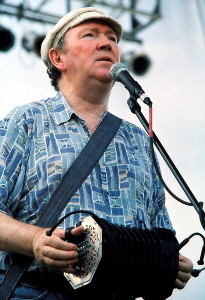

 Sir George Ivan Morrison, best known as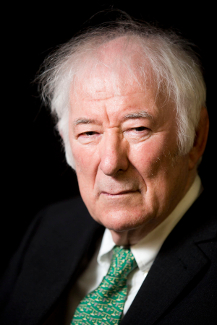
 seamus dubhghaill