seamus dubhghaill

Promoting Irish Culture and History from Little Rock, Arkansas, USA


Leave a comment

2009 Bank of Ireland Robbery

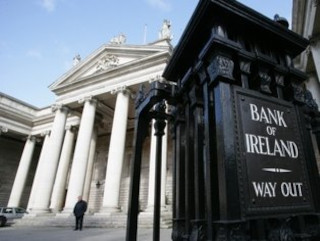
The 2009 Bank of Ireland robbery is a large robbery of cash from the College Green cash centre of the Bank of Ireland in Dublin on February 27, 2009. It is the largest bank robbery in the Republic of Ireland‘s history. Criminals engage in the tiger kidnapping of a junior bank employee, 24-year-old Shane Travers, and force him to remove €7.6 million (US$9 million) in cash from the bank as his girlfriend and two others are held hostage.

Late on the night of February 26, Travers, whose father is a member of the Garda Síochána based at Clontarf, Dublin, is alone watching television at the home of his girlfriend near Kilteel, County Kildare. The woman and her mother are out shopping together. When they arrive home with the five-year-old nephew of Travers, six heavily built masked men, dressed in black and carrying handguns, jump from the bushes.

The family is held overnight by the armed gang, during which time their mobile phones are confiscated, and Travers’ girlfriend is hit across the back of her head with a vase by one of the men. As dawn approaches, the gang orders all but Travers to enter their dark Volkswagen Golf family car. They are then bound together and driven to Ashbourne, County Meath.

The bank employee is given a mobile phone, ordered to collect €20, €50, €100 and €200 bank notes from his workplace, and supplied with a photograph of the rest of the family at gunpoint to convince his colleagues that their lives are under threat. Travers drives to Dublin in his red Toyota Celica, acquires the cash through the assistance of colleagues who viewed the photo, and carries the money out of the building in four laundry bags. He takes it to Clontarf Road railway station, whereupon he surrenders the cash and his sports car to a waiting gang member.

Travers then enters a Garda station, the first point at which Gardaí are notified that the robbery had taken place. One hour after this, the other family members succeed in freeing themselves and walk to a nearby garda station. Travers’ girlfriend requires immediate medical treatment for a head wound she received during a struggle with her captors, and the family are reported to be “traumatised” by their ordeal. Travers’s car is later found burned out in an apartment block near Tolka House Pub in Glasnevin.

Minister for Justice, Equality and Law Reform Dermot Ahern says “proper procedures” were not followed during the course of the robbery, saying that Gardaí should have been contacted before the money had left the bank. He also questions how such a large sum of money could be taken as a result of one man being targeted.

The bank’s chief executive, Richie Boucher, appointed just two days earlier, immediately writes to all his staff to remind them that protocol should be followed in the event of future robberies, saying “Our priority is always for the safety and well-being of all staff. I am sure this incident will raise concerns. Our best defence is to follow tried and tested procedures. I would ask everybody to remind themselves of these procedures, which are there to protect you, your families and the bank.”

€1.8 million of the stolen cash is recovered and seven people are arrested by Gardaí in a number of incidents on February 28. A house in Phibsborough is sealed off and ten more houses are searched. A total of five cars and one van are seized by Gardaí. One of the men is arrested following a chase along the M50 motorway near the Navan road, with two bales of packed cash being discovered in his car. Four other men are arrested in a car in Monk Place and in Great Western Square, Phibsborough, and two more are seized in a house on Great Western Villas, Phibsborough. Cash is also found in a car in Phibsborough.

The six men and one woman are believed to be members of a well-known gang from Dublin’s north inner city and have connections to a major Dublin gangland figure. On March 2, those arrested appear before the High Court to challenge the lawfulness of their detention, viewing the warrants issued by the District Court the day before as invalid. That day, two of those arrested are released.

An unidentified bank employee is arrested on January 28, 2010, based on suspicion that the robbery had been an inside job.


Leave a comment

Birth of Richard Busteed, Union Army General & U.S. Federal Judge

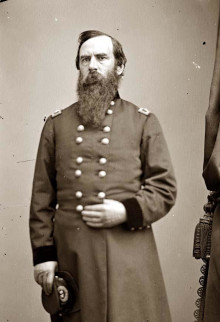
Richard Busteed, Union Army general during the American Civil War and United States federal judge, is born in County Cavan on February 16, 1822. Busteed comes first to Canada, then the United States with his family while a child. They settle in New York City.

Busteed reads law in 1846. He enters private practice in New York City from 1846 to 1856 and is Corporation Counsel for New York City from 1856 to 1859. He serves as a Captain in the United States Army in 1861, and a Brigadier General from 1862 to 1863, during the American Civil War.

Once when confronted with black men being thrown out of a white railroad car by the conductor, Busteed pulls his pistol and defends the black men allowing them to stay.

Busteed receives a recess appointment from President Abraham Lincoln on November 17, 1863, to a joint seat on the United States District Court for the Middle District of Alabama, the United States District Court for the Northern District of Alabama and the United States District Court for the Southern District of Alabama vacated by Judge George Washington Lane. He is nominated to the same position by President Lincoln on January 5, 1864. He is confirmed by the United States Senate on January 20, 1864, and receives his commission the same day. His service terminates on October 20, 1874, due to his resignation.

Alabamians generally consider Busteed corrupt and pro-Northern. In December 1867, he is shot on the street in Mobile, Alabama by United States Attorney Lucien V. B. Martin, who fires two more shots into him after he falls. Martin goes to Texas and is never prosecuted, while Busteed recovers rapidly.

Busteed is nominated by President Ulysses S. Grant to the Supreme Court of the District of Columbia (now the United States District Court for the District of Columbia) on January 13, 1873. At the same time, President Grant nominates Judge David Campbell Humphreys, an Alabama native serving on the Supreme Court of the District of Columbia, to assume Busteed’s seat, each nomination made contingent on the other’s resignation. The Senate returns the nominations to the President as irregular in form on February 13, 1873.

In 1873, Busteed is the subject of an impeachment inquiry by the United States House of Representatives Judiciary Committee. The Committee recommends his impeachment on charges of failing to maintain a residence in his judicial district, failing to hold scheduled terms of court, and using his official position to promote his personal interests, specifically, by remitting a fine due to the Federal government in order to obtain release from a personal judgment against him in a State court. He resigns before the full House can vote on the recommendation.

Following his resignation from the federal bench, Busteed resumes private practice in New York City starting in 1874. He dies on September 14, 1898, in New York City and is interred in Woodlawn Cemetery in the Bronx, New York.


Leave a comment

Birth of Olympic Medalist Michelle Smith

Michelle Smith, married name Michelle Smith de Bruin, lawyer and retired Irish swimmer who wins four medals at the 1996 Summer Olympics in Atlanta, is born in Rathcoole, County Dublin on December 16, 1969. As a result of the medals captured in Atlanta, she becomes the most successful Olympian in Ireland and the country’s first woman to capture a gold medal.

Smith begins swimming competitively at age thirteen. Though she develops into one of Ireland’s premier junior swimmers, she realizes that without more advanced facilities and training techniques, she will never be able to compete at the international level. She goes to the United States to attend school and swim at the University of Houston, where she graduates with a degree in communications. Her times steadily improve and she makes the Irish Olympic teams for the 1988 Summer Olympics in Seoul, South Korea and the 1992 Summer Olympics in Barcelona, Spain. At both of those Games, however, she is eliminated in the preliminary rounds.

In 1994 Smith moves to the Netherlands with her coach and future husband, Erik de Bruin, to prepare for the 1996 Games. The next year she emerges as an elite athlete, winning the 200-metre butterfly and the 200-metre individual medley at the 1995 European Aquatics Championships. She continues to improve in 1996, taking 19 seconds off her best time in the 400-metre freestyle. In response to questions about her sudden turnaround, she credits more sophisticated training techniques and a single-minded focus on swimming. She also points out that she is probably the most tested athlete in Irish history and that she had never tested positive for banned substances.

Prior to the Atlanta Games, Ireland had won only five Olympic gold medals, and no medal — gold, silver, or bronze — had been won by Irish women. In one week, however, Smith rewrites the Irish record books. The 26-year-old swimmer wins the gold in three events — the 200-metre individual medley, the 400-metre individual medley, and the 400-metre freestyle — and captures the bronze medal in the 200-metre butterfly. Her triumph, however, is somewhat tarnished by unsubstantiated rumours that she had used performance-enhancing drugs. Some observers question her dramatic improvements in time and point to her marriage to de Bruin, a Dutch discus thrower who had been suspended from international competition for steroid use. Smith passes all the pre- and post-Olympic drug tests, however.

Smith’s success continues at the 1997 European Aquatic Championships, where she wins gold medals in the 200-metre butterfly and the 200-metre individual medley. In 1998, however, she receives a four-year ban for tampering with a urine sample during a drug test. She maintains her innocence, but her appeal of the ban before the Court of Arbitration for Sport (CAS) fails. She is 28 at the time, and the ban effectively ends her competitive swimming career. She is not stripped of her Olympic medals, as she has never tested positive for any banned substances.

Smith’s experiences at the CAS has an effect beyond her swimming career. It is there that she develops an interest in the law. After officially announcing her retirement from swimming in 1999, she returns to university, graduating from University College Dublin with a degree in law. In July 2005 she is conferred with the degree of Barrister at Law of King’s Inns, Dublin. While a student at the King’s Inns she wins the highly prestigious internal Brian Walsh Moot Court competition. Her book, Transnational Litigation: Jurisdiction and Procedure is published in 2008 by Thomson Round Hall.

In 1996, Smith releases her autobiography, Gold, co-written with Cathal Dervan. She lives in Kells, County Kilkenny with her husband and their two children.


Leave a comment

Donal Billings Convicted of Possession of Explosives

Donal Billings of St. Bridget’s Court in Drumlish, County Longford, a 66-year-old man who put a bomb on a bus during Britain’s Queen Elizabeth‘s visit to Ireland in May 2011, is convicted on December 15, 2016 at the Special Criminal Court of possessing explosives and is sentenced to eight-and-a-half years in prison.

Justice Tony Hunt describes it as an outrageous, dangerous and highly irresponsible act, which recklessly exposed the 31 people on the bus, as well as the emergency services, to the very significant risk of injury or death. He says it was no thanks to Billings that this did not occur.

Billings is also found guilty of four counts of making bomb threats, including one claiming there were two mortars in Dublin Castle during the State banquet for the queen.

The court hears that on May 16, 2011, following a phone call to Longford Garda station, gardaí stopped a bus travelling from Ballina to Dublin at Maynooth. They find a well-made bomb in a bag in the luggage hold with gunpowder, petrol, a timing power unit, battery and a fuse, which if it had exploded could have caused seriously injured or killed the passengers and driver. Threats were also made that there were bombs on another bus and at the Sinn Féin headquarters in Dublin but none were found.

Billings is identified as the caller though phone records, notes, a SIM card and a mobile phone. Two days later he makes another call saying that two mortars have been left in Dublin Castle set for 8:00 PM, during the State banquet for the queen. “I am a member of the Republican Brotherhood Squad A”, he says. “This is for the Queen of Blood, War in Iraq.” Because of the first bomb, the threat is taken very seriously, but no more explosive devices are found.

Two days later a third call threatens there are two more bombs in the toilets in Cork Airport, but again nothing is found.

Billings is identified as a suspect that day and put under surveillance before being arrested at a supermarket car park in Longford. He tells gardaí he had found the SIM card in the car park.

Following the trial, during which interpreters are used to translate proceedings into Irish, Billings is convicted of making bomb threats and possessing explosives. He has previous convictions for possessing explosives in Northern Ireland in 1973 and is sentenced to eight years in prison. He also spent four years in Libya.

(From: “Man sentenced over bomb on bus during Queen Elizabeth’s visit,” RTÉ.ie, the website of Raidió Teilifís Éireann, Thursday, December 15, 2016)


Leave a comment

Birth of Hugh Kennedy, Politician, Barrister & Judge

File source: http://commons.wikimedia.org/wiki/File:Hugh_Kennedy.jpg

Hugh Edward Kennedy, Fine Gael politician, barrister and judge, is born in Abbotstown, Dublin on July 11, 1879. He serves as Attorney General of Ireland from 1922 to 1924, a Judge of the Supreme Court of Ireland from 1924 to 1936 and Chief Justice of Ireland from 1924 to 1936. He serves as a Teachta Dála (TD) for the Dublin South constituency from 1923 to 1927. As a member of the Irish Free State Constitution Commission, he is also one of the constitutional architects of the Irish Free State.

Kennedy is the son of the prominent surgeon Hugh Boyle Kennedy. His younger sister is the journalist Mary Olivia Kennedy. He studies for the examinations of the Royal University of Ireland while a student at University College Dublin and King’s Inns, Dublin. He is called to the Bar in 1902. He is appointed King’s Counsel in 1920 and becomes a Bencher of King’s Inn in 1922.

During 1920 and 1921, Kennedy is a senior legal adviser to the representatives of Dáil Éireann during the negotiations for the Anglo-Irish Treaty. He is highly regarded as a lawyer by Michael Collins, who later regrets that Kennedy had not been part of the delegation sent to London in 1921 to negotiate the terms of the treaty.

On January 31, 1922, Kennedy becomes the first Attorney General in the Provisional Government of the Irish Free State. Later that year he is appointed by the Provisional Government to the Irish Free State Constitution Commission to draft the Constitution of the Irish Free State, which is established on December 6, 1922. The functions of the Provisional Government are transferred to the Executive Council of the Irish Free State. He is appointed Attorney General of the Irish Free State on December 7, 1922.

In 1923, Kennedy is appointed to the Judiciary Commission by the Government of the Irish Free State, on a reference from the Government to establish a new system for the administration of justice in accordance with the Constitution of the Irish Free State. The Judiciary Commission is chaired by James Campbell, 1st Baron Glenavy, who had also been the last Lord Chancellor of Ireland. It drafts the Courts of Justice Act 1924 for a new court system, including a High Court and a Supreme Court, and provides for the abolition, inter alia, of the Court of Appeal in Ireland and the Irish High Court of Justice. Most of the judges are not reappointed to the new courts. Kennedy personally oversees the selection of the new judges and makes impressive efforts to select them on merit alone. The results are not always happy. His diary reveals the increasingly unhappy atmosphere, in the Supreme Court itself, due to frequent clashes between Kennedy and his colleague Gerald Fitzgibbon, since the two men prove to be so different in temperament and political outlook that they find it almost impossible to work together harmoniously. In a similar vein, Kennedy’s legal opinion and choice of words could raise eyebrows amongst legal colleagues and fury in the Executive Council e.g. regarding the Kenmare incident.

Kennedy is also a delegate of the Irish Free State to the Fourth Assembly of the League of Nations between September 3-29, 1923.

Kennedy is elected to Dáil Éireann on October 27, 1923, as a Cumann na nGaedheal TD at a by-election in the Dublin South constituency. He is the first person to be elected in a by-election to Dáil Éireann. He resigns his seat when he is appointed Chief Justice of Ireland in 1924.

On June 5, 1924, Kennedy is appointed Chief Justice of Ireland, thereby becoming the first Chief Justice of the Irish Free State. He is also the youngest person appointed Chief Justice of Ireland. When he is appointed, he is 44 years old. Although the High Court of Justice and the Court of Appeal had been abolished and replaced by the High Court and the Supreme Court respectively, one of his first acts is to issue a practice note that the wearing of wigs and robes will continue in the new courts. This practice is still continued in trials and appeals in the High Court and the Supreme Court (except in certain matters). He holds the position of Chief Justice until his death on December 1, 1936, in Goatstown, Dublin.

In September 2015, a biography by Senator Patrick Kennedy (no relation) is written about Kennedy called Hugh Kennedy: The Great but Neglected Chief Justice.


Leave a comment

Sinn Féin, Cumann na mBan & Others Declared Illegal Organizations

sinn-fein-cartoon

Sinn Féin, the Irish Volunteers, Cumann na mBan and the Gaelic League are proclaimed as illegal organisations by the Lord Lieutenant of Ireland, John French, 1st Earl of Ypres on July 4, 1919.

The proclamation states that the proscribed organisations are dangerous, and a “grave menace” designed to “terrorise the peaceful and law-abiding subjects of His Majesty in Ireland.” It goes on to say that these associations “encourage and aid persons to commit crimes and promote and incite to acts of violence and intimidation and interfere with the administration of the law and disturb the maintenance of law and order.”

The Irish Times, no supporter of any of the banned organisations, welcomes the development as a sign that the government has decided that sedition will “no longer be preached and practised with impunity in Ireland.” The paper also says that this new policy “furnishes final proof of the gravity of the Irish problem.”

In the immediate aftermath of the proclamation, business continues as usual at the Sinn Féin headquarters at 6 Harcourt Street and at the Gaelic League’s head offices at 25 Parnell Square. Both organisations claim that they have not received any direct communication, let alone any visits, from the police or military.

Speaking to a representative of the Evening Telegraph, Eoin MacNeill, President of the Gaelic League, strikes a defiant note, declaring that the organisation will “not allow itself to be driven underground” and will continue to “have the support of the nation and of Irishmen abroad.”

MacNeill points out that the Gaelic League is approaching its 25th anniversary, on July 23, and that throughout its lifetime it has always been “non-political – that is to say has never interfered in the controversy with regard to the form of the Irish Government and left all its members absolutely free to hold whatever political opinions they pleased. Of course, it is a new situation now. The Government itself has taken the initiative in making the neutrality of the Gaelic League impossible.”

Apparently, the banning of the Gaelic League spurs interest in the language movement as several booksellers refer to being “inundated with orders” for booklets and manuals of instruction and conversations in the Irish language. The casual use of Irish on the streets also reportedly increases.

Cumann na mBan expresses surprise at the actions of the government and takes it as a sign that “conscription is now a certainty.” All of the organisation’s public work up to this point has been geared towards the campaign to oppose conscription.

The Lord Lieutenant makes his proclamation under the Criminal Law and Procedure (Ireland) Act of 1887 which gives the authorities the power to outlaw any organisation it believes to be involved in criminal activities.

(From: “BANNED: Sinn Féin, Irish Volunteers, Cumann na mBan and the Gaelic League,” RTÉ.ie, the website of Raidió Teilifís Éireann | Photo: The government trying to douse the flames of Sinn Féin, from “The Republic,” April 11, 1907, DigitalLibrary@Villanova University)


Leave a comment

Birth of Edward Kenealy, Barrister & Writer

edward-kenealy

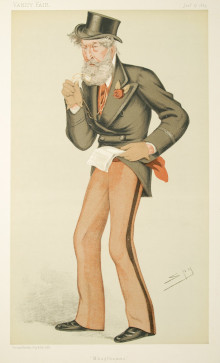
Edward Vaughan Hyde Kenealy, Irish barrister and writer, is born in Cork, County Cork on July 2, 1819. He is best remembered as counsel for the Tichborne case and the eccentric and disturbed conduct of the trial that leads to his ruin.

Kenealy is the son of a local merchant. He is educated at Trinity College Dublin and is called to the Irish Bar in 1840 and to the English Bar in 1847. He obtains a fair practice in criminal cases. In 1868 he becomes a QC and a bencher of Gray’s Inn. He practises on the Oxford circuit and in the Central Criminal Court.

Kenealy suffers from diabetes and an erratic temperament is sometimes attributed to poor control of the symptoms. In 1850 he is sentenced to one month imprisonment for punishing his six-year-old illegitimate son with undue severity. He marries Elizabeth Nicklin of Tipton, Staffordshire in 1851 and they have eleven children, including novelist Arabella Kenealy (1864–1938). They live in Portslade, East Sussex, from 1852 until 1874. He commutes to London and Oxford for his law practice but returns at weekends and other times to be with his family.

In 1850, Kenealy publishes an eccentric poem inspired by Johann Wolfgang von Goethe, Goethe, a New Pantomime. He also publishes a large amount of poetry in journals such as Fraser’s Magazine. He publishes translations from Latin, Greek, German, Italian, Portuguese, Russian, Irish, Persian, Arabic, Hindustani and Bengali. It is unlikely he is fluent in all these languages.

In 1866, Kenealy writes The Book of God: the Apocalypse of Adam-Oannes, an unorthodox theological work in which he claims that he is the “twelfth messenger of God,” descended from Jesus Christ and Genghis Khan. He also publishes a more conventional biography of Edward Wortley Montagu in 1869.

During the Tichborne trial, Kenealy abuses witnesses, makes scurrilous allegations against various Roman Catholic institutions, treats the judges with disrespect, and protracts the trial until it becomes the longest in English legal history. His violent conduct of the case becomes a public scandal and, after rejecting his client’s claim, the jury censures his behaviour.

Kenealy starts a newspaper, The Englishman, to plead his cause and to attack the judges. His behaviour is so extreme that in 1874 he is disbenched and disbarred by his Inn. He forms the Magna Charta Association and goes on a nationwide tour to protest his cause.

At a by-election in 1875, Kenealy is elected to Parliament for Stoke-upon-Trent with a majority of 2,000 votes. However, no other Member of Parliament will introduce him when he takes his seat. Benjamin Disraeli forces a motion to dispense with this convention.

In Parliament, Kenealy calls for a Royal commission into his conduct in the Tichborne case, but loses a vote on this by 433–3. One vote is Kenealy’s, another that of his teller, George Hammond Whalley. The third “aye” is by Purcell O’Gorman of Waterford City. During this period, he also writes a nine-volume account of the case.

Kenealy gradually ceases to attract attention, loses his seat at the 1880 general election and dies in London on April 16, 1880. He is buried in the churchyard of St. Helen’s Church, Hangleton, East Sussex.


Leave a comment

The Adventurers’ Act Receives Royal Assent

coat-of-arms-of-the-united-kingdom

The Adventurers’ Act 1640, an Act of the Parliament of England which specifies its aim as “the speedy and effectual reducing of the rebels in His Majesty’s Kingdom of Ireland,” receives Royal assent on March 19, 1642.

The Act is passed by the Long Parliament as a way of raising funds to suppress the Irish Rebellion of 1641, which had broken out five months earlier. It invites members of the public to invest £200 for which they will receive 1,000 acres of lands that are to be confiscated from rebels in Ireland. Two and a half million acres of Irish land are set aside by the English government for this purpose. The entire island of Ireland is about 20.9 million acres.

The enactment is done at the request of King Charles in the House of Lords, joined by the House of Commons, and is unanimously accepted without any debate. The Act had been placed before the Houses for inspection but is not formally read into the record. The title of the Act – “An Act for the speedy and effectual reducing of the Rebels, in His Majesty’s Kingdom of Ireland, to their due Obedience to His Majesty, and the Crown of England” – is read aloud to Parliament, followed by the statement: “Le Roy le veult.”

The “Adventurers” are so called because they are risking their money at a time when the Crown has just had to pay for the Bishops’ Wars in 1639–40. “Reducing” the rebels means leading them back to the legal concept of the “King’s Peace.” King Charles cannot subsequently enforce the Act, but it is realised by his political opponents following the Cromwellian conquest of Ireland in 1649–1653 and forms the main legal basis for the contentious Act for the Settlement of Ireland 1652.

Ironically, in May 1642 the Confederate Irish rebels draft the Confederate Oath of Association that recognises Charles as their monarch.

The Adventurers’ Act is extended and amended by three other acts – Lands of Irish Rebels; Adventurers’ Subscriptions Act 1640 (c. 34), Lands of Irish Rebels; Adventurers’ Subscriptions Act 1640 (c. 35), and Irish Rebels Act 1640 (c. 37). All four receive Royal Assent in the summer of 1642, just before the start of the English Civil War, but are usually referred to as 1640 acts, which is the year the Long Parliament started to sit and the 16th year of Charles I’s reign.

In July 1643, Parliament passes the Doubling Ordinance which doubles the allocation of land to anyone who increases their original investment by 25%. The purpose of the Act is twofold, firstly to raise money for Parliament to help suppress the rebellion in Ireland, and secondly to deprive the King of the lands seized from rebels that would be his by prerogative.

To enforce the Acts the Cromwellian conquest of Ireland is launched in 1649. In 1653, Ireland is declared subdued, and the lands are allocated to the subscribers in what becomes known as the Cromwellian Settlement.

The Adventurers Act and the other three statutes are repealed by the Statute Law Revision Act 1950.


Leave a comment

Birth of Richard “Humanity Dick” Martin

richard-martin

Colonel Richard Martin, Irish politician and campaigner against cruelty to animals, is born in Ballynahinch, County Galway on January 15, 1754. He is known as “Humanity Dick,” a nickname bestowed on him by King George IV. He succeeds in getting the pioneering Cruel Treatment of Cattle Act 1822, nicknamed ‘Martin’s Act,’ passed into British law.

Martin is brought up at Dangan House, situated on the River Corrib, four miles upriver from the town of Galway. The Martins are one of the Tribes of Galway. They own one of the biggest estates in all of Great Britain and Ireland as well as much of the land in Connemara. He studies at Harrow School in London and then gains admission to Trinity College, Cambridge on March 4, 1773. He does not graduate with a degree but studies for admission to the bar and is admitted to Lincoln’s Inn on February 1, 1776. He serves as a lawyer in Ireland and becomes High Sheriff of Galway Town in 1782.

Martin is elected to represent County Galway in Parliament in 1800. He is very popular with people in Galway and is well known as a duelist and as a witty speaker in the houses of Parliament. He campaigns for Catholic emancipation but is best remembered for his work to outlaw cruelty to animals. He earns the nickname “Humanity Dick” because of his compassion for the plight of animals at that time.

Through Martin’s work the Cruel Treatment of Cattle Act is enacted in 1822. This is the first piece of legislation which aims to protect animals from cruelty. Most people do not recognise animal rights in those days and people often make fun of him. Cartoons of him with donkey ears appears in the newspapers of the day.

After having the Bill passed by Parliament, Martin actively seeks out cases where cruelty has been inflicted on animals on the streets of London. He is responsible for bringing many people to court for cruelty against horses. He often pays half the fine of the accused in cases where the accused cannot afford it and seems genuinely sorry for his actions.

Due to Martin’s profile as a politician and as the drafter of the anti-cruelty legislation, a public perception develops that he is the initiator and creator of the Royal Society for the Prevention of Cruelty to Animals (RSPCA). At the Society’s first anniversary meeting he sets the public record straight and gives credit to Rev. Arthur Broome, although he maintains an interest in the Society.

After the election of 1826, Martin, now a heavy gambler, loses his parliamentary seat because of a petition which accuses him of illegal intimidation during the election. He flees into hasty exile to Boulogne-sur-Mer, France, because he can no longer enjoy a parliamentary immunity to arrest for debt. He dies there peacefully in the presence of his second wife and their three daughters on January 6, 1834. A year after Martin’s death, the Cruel Treatment of Cattle Act is extended to cover cruelty to all domestic animals.

Martin’s work continues today. The RSPCA now has members all over the world. In Ireland it is known as the Irish Society for the Prevention of Cruelty to Animals (ISPCA). Many other groups have been set up which protect animals from cruelty.


Leave a comment

Death of William Sampson, United Irishman, Author & Lawyer

william-sampson

William Sampson, member of the Society of United Irishmen, author and Irish Protestant lawyer known for his defence of religious liberty in Ireland and the United States, dies in New York City on December 28, 1836.

Sampson is born in Derry, County Londonderry, to an affluent Anglican family. He attends Trinity College Dublin and studies law at Lincoln’s Inn in London. In his twenties, he briefly visits an uncle in North Carolina. In 1790 he marries Grace Clark, and they have two sons, William and John, and a daughter, Catherine Anne.

Admitted to the Irish Bar, Sampson becomes Junior Counsel to John Philpot Curran and helps him provide legal defences for many members of the Society of United Irishmen. A member of the Church of Ireland, he is disturbed by anti-Catholic violence and contributes writings to the Society’s newspapers. He is arrested at the time of the Irish Rebellion of 1798, imprisoned, and compelled to leave Ireland for exile in Europe.

Shipwrecked at Pwllheli in Wales, Sampson makes his way to exile in Porto, Portugal, where he is again arrested, imprisoned in Lisbon, and then expelled. After living some years in France, and then Hamburg, he flees to England ahead of the approach of Napoleon‘s armies where he is re-arrested. After unsuccessfully petitioning for a return to Ireland, he arrives in New York City on July 4, 1806.

In the United States, Sampson successfully continues his career in the law, eventually sending for his family. He sets up a business publishing detailed accounts of the court proceedings in cases with popular appeal. In 1809 he reports on the case of a Navy Lieutenant Renshaw prosecuted for dueling. That same year he handles a case against Amos and Demis Broad, accused of brutally beating their slave, Betty, and her 3-year-old daughter where Sampson succeeded in having both slaves manumitted. The authorities in Ireland had disbarred Sampson, which causes him some bitter amusement, as it does not affect his work in the United States.

Sampson’s most important case in the United States is in 1813 and is referred to as “The Catholic Question in America.” Police investigating the misdemeanor of receiving stolen goods question the suspects’ priest, the Reverend Mr. Kohlman. He declines to give any information that he has heard in confession. The priest is called to testify at the trial in the Court of General Sessions in the City of New York. He again declines. The issue whether to compel the testimony is fully briefed and carefully argued on both sides, with a detailed examination of the common law. In the end, the confessional privilege is accepted for the first time in a court of the United States.

William Sampson dies on December 28, 1836, and is buried in the Riker Family graveyard on Long Island in what is now East Elmhurst, Queens, New York. He is later reinterred in Green-Wood Cemetery in Brooklyn, where he is now buried in the same plot as Matilda Witherington Tone and William Theobald Wolfe Tone, the wife and son of the Irish revolutionary Wolfe Tone, and his daughter Catherine, the wife of William Theobald Wolfe Tone.