Carey is born in Dublin on February 23, 1919. As a schoolboy, he plays football for Home Farm F.C. As a youth, he also plays Gaelic football and is selected to represent Dublin GAA at minor level before he signs for St. James’s Gate F.C. at the start of the 1936–1937 season.
Carey is also the first non-UK player and the first Irishman to captain a winning team in both an FA Cup Final and the First Division. Like his contemporary Con Martin, he is an extremely versatile footballer and plays in nine different positions throughout his career. He even plays in goal for United on one occasion.
(Pictured: Manchester United captain Johnny Carey is carried on the shoulders of his teammates, after they win the FA Cup final of 1948 against Blackpool. Date: April 24, 1948)
A worse-than-expected storm on the third day of the race wreaks havoc on over 303 yachts that started the biennial race resulting in 24 yachts being abandoned, of which five are lost and believed to be sunk due to high winds and severe sea conditions. The nineteen fatalities consist of fifteen yachtsmen and four spectators.
Rescue efforts begin after 6:30 AM on August 14, once the winds drop to severe gale Force 9 on the Beaufort scale. Emergency services, naval forces, and civilian vessels from around the west side of the English Channel are summoned to aid what becomes the largest ever rescue operation in peacetime. This involves some 4,000 people, including the entire Irish Naval Service‘s fleet, lifeboats, commercial boats, tugs, trawlers, tankers and helicopters.
The handicap winner is the yacht Tenacious, designed by Sparkman & Stephens, owned and skippered by Ted Turner. The winner on elapsed time in the race is the 77-foot Condor of Bermuda, skippered by Peter Blake, which gains around 90 minutes on the leader at the Fastnet rock, the Kialoa IV, by chancing a spinnaker. Jim Kilroy of the Kialoa IV has broken his ribs and there is damage to the yacht’s runners. Condor of Bermuda breaks the Fastnet record by nearly eight hours (71h 25m 23s).
The disaster results in a major rethink of racing, risks and prevention.
(Pictured: Memorial to those who died in the 1979 Fastnet Race, Lissarnona, Cape Clear Island, Cork, Ireland)
Alexander Gordon “Alex” Higgins, Northern Irish professional snooker player, who is remembered as one of the most iconic figures in the game, dies in Belfast, Northern Ireland on July 24, 2010. He is nicknamed “Hurricane Higgins” because of his fast play.
Higgins is born in Belfast on March 18, 1949. He starts playing snooker at the age of eleven, often in the Jampot club in his native Sandy Row area of south Belfast and later in the YMCA in the nearby city centre. At age fourteen and weighing seven and a half stone (47.6 kg), he leaves for England and a career as a jockey. However, he never makes the grade because, in his youth, he drinks a lot of Guinness and eats a lot of chocolate, making him too heavy to ride competitively. He returns to Belfast and by 1965, at the age of sixteen, he has compiled his first maximum break. In 1968 he wins the All-Ireland and Northern Ireland Amateur Championships.
Higgins turns professional at the age of 22, winning the World Snooker Championship at his first attempt in 1972, against John Spencer winning 37–32. Higgins is then the youngest ever winner of the title, a record retained until Stephen Hendry‘s 1990 victory at the age of 21. In April 1976, Higgins reaches the final again and faces Ray Reardon. Higgins leads 11–9, but Reardon makes four centuries and seven breaks over 60 to pull away and win the title for the fifth time with the score of 27–16. Higgins is also the runner-up to Cliff Thorburn in 1980, losing 18–16, after being 9–5 up. Higgins wins the world title for a second time in 1982 after beating Reardon 18–15 (with a 135 total clearance in the final frame). It was an emotional as well as professional victory for him. Higgins would have been ranked No. 1 in the world rankings for the 1982-1983 season had he not forfeited ranking points following disciplinary action.
Throughout his career, Higgins wins 20 other titles, one of the most notable being the 1983 UK Championship. In the final he trails Steve Davis 0–7 before producing a famous comeback to win 16–15. He also wins the Masters twice, in 1978 and in 1981, beating Cliff Thorburn and Terry Griffiths in the finals respectively. Another notable victory is his final professional triumph in the 1989 Irish Masters at the age of 40 when he defeats a young Stephen Hendry, which becomes known as “The Hurricane’s Last Hurrah.”
Higgins comes to be known as the “People’s Champion” because of his popularity, and is often credited with having brought the game of snooker to a wider audience, contributing to its peak in popularity in the 1980s. He has a reputation as an unpredictable and difficult character. He is a heavy smoker, struggles with drinking and gambling, and admits to using cocaine and marijuana.
First diagnosed with throat cancer in 1998, Higgins is found dead in bed in his flat on July 24, 2010. The cause of death is a combination of malnutrition, pneumonia, and a bronchial condition. Higgins’ funeral service is held in Belfast on August 2, 2010. He is cremated and his ashes are interred in Carnmoney Cemetery in Newtownabbey, County Antrim.
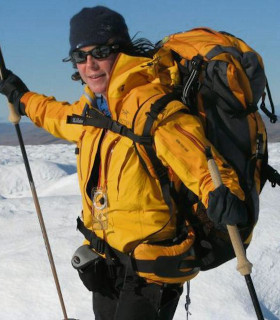
Clare O’Leary, Irish gastroenterologist, mountain climber and adventurer, becomes the first Irishwoman to successfully climb Mount Everest on May 18, 2004. She is accompanied by veteran mountaineer, Pat Falvey, who also sets a record by becoming the first Irishman to climb Everest from both sides.
O’Leary is born in 1972. She develops an interest in medicine, and cancer in particular, when her uncle dies from lung cancer during her childhood. After graduating from University College Cork, she spends over ten years training and working at the Cork University Hospital.
O’Leary makes her name in mountaineering in 2004, when she becomes the first Irish woman to reach the summit of Mount Everest, having failed on her first attempt in 2003 due to gastroenteritis. She climbs as a member of the Wyeth Irish Everest Expedition, led by Falvey. She also becomes the first Irish woman to ascend the Himalayan peak Ama Dablam and to climb the Seven Summits — the highest mountains on each continent. In 2008, she joins the Beyond Endurance expedition led by Falvey to the South Pole, making her the first woman to successfully ski to the South Pole.
In 2012, O’Leary and Mike O’Shea set out on an ongoing series of expeditions that they call the Ice Project. Their aim is to cross all of the world’s largest ice caps. Some of these expeditions include crossings of the Northern Patagonian Ice Field, the Greenland ice sheet, and Lake Baikal. In 2014, they attempt to ski to the North Pole after their first attempt in 2012 is cancelled due to a logistics problem, hoping to be the first Irish people to reach the North Pole. This attempt also has to be abandoned after they are injured in a sled accident.
O’Leary lives in Clonmel, and is in a relationship with O’Shea. She currently works as a consultant gastroenterologist and general physician at South Tipperary General Hospital. She is also a patron of the Cork University Hospital Charity.
Born to a family of Irish landed gentry, he lives on his father’s plantation in Ceylon until the age of five, when they return to the family home in Nenagh, County Tipperary. Following prep school at Mourne Grange, he goes on to Shrewsbury School, where he wins the Public Schools 402 metres, and at Gonville and Caius College, Cambridge, where he wins a record four events – 402 metres and 110 metres hurdles, long jump and shot put – in the annual match against Oxford. This record is only equaled nearly 60 years later.
Tisdall sets South African and Canadian records in the 201 metres low hurdles in 1929, a year later setting Greek records in the same event. While at Cambridge in March 1932, he decides to try for a place on the Irish Olympic squad and, after he runs a record 54.2 seconds for the Irish Championship 402 metres hurdles in June that year, the authorities agree to let him run in his new event at the Los Angeles Olympic Games.
Tisdall had run only six 400 metres hurdles when he wins the gold medal at the 1932 Olympic Games in a world record time of 51.7 seconds, which is not recognised under the rules of the time because he had a hit a hurdle. Later, because of the notoriety of this incident, the rules are changed and the President of the International Olympic Committee, Juan Antonio Samaranch, presents Tisdall with a Waterford Crystal rose bowl with the image of him knocking over the last hurdle etched into the glass. Though the International Amateur Athletic Federation (IAAF) did not recognise the record at the time, they now recognise the mark, giving Tisdall credit for setting the milestone of being the first man under 52 seconds.
Following his victory, Tisdall is invited to a dinner in Los Angeles where he is seated next to Amelia Earhart on one side and Douglas Fairbanks, Jr. on the other.
Later in life, Tisdall lives in South Africa, where he runs a gymnasium during the day, which he converts to a night club after dark. He grows coffee in Tanzania, but moves to Nambour, Queensland in 1969 with his wife Peggy, where he farms fruit crops and cattle. He admits to running his last race at the age of 80, though he runs in the Sydney Olympics torch relay at age 93. At that point he is the oldest living recipient of an individual track and field Olympic medal。
At the age of 96 Tisdall falls down a steep set of rock stairs and breaks his shoulder, ribs and ruptures his spleen. He never completely recovers and dies on July 27, 2004. At that time, he is the world’s oldest track and field Olympic Gold medalist. He does not want a funeral because “they are altogether too sad.” His wake is attended by family and a few friends.
In 2002, three statues honouring Olympic champions with links to Nenagh, Matt McGrath, Johnny Hayes and Bob Tisdall, are unveiled in front of the Nenagh Courthouse.
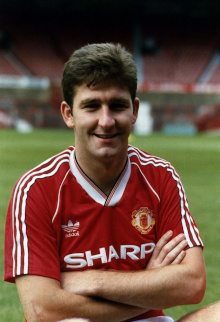
Whiteside grows up on Shankill Road, and because of his aggressive, physical playing style he is later nicknamed the “Shankill Skinhead” by Manchester United supporters. The family later moves to 10 Danube Street. He remains relatively unscathed by The Troubles as his Protestant parents keep a firm watch on their children to ensure that they do not stray far from home and that none of them become involved with Ulster loyalism. At around seven years of age, he joins the Boys’ Brigade, and quickly shows his natural talent for football, scoring ten goals in a game against boys almost twice his age. He is educated at Cairnmartin High School and becomes famous in the Shankill area as a footballing prodigy by the age of eleven.
Whiteside is said to have been discovered by Ipswich Town scout Jim Rodgers, who is told by manager Bobby Robson to wait until Whiteside grows older. Instead, it is Manchester United’s 80-year-old Ulster scout Bob Bishop, who previously unearthed Belfast-born George Best and Sammy McIlroy for the club, who first offers him a trial at an English club. He finds that he has been offered schoolboy terms at the club during a school trip to the United States, on which he and his classmates meet PresidentJimmy Carter in the Oval Office, a rare and extraordinary occasion for children from a disadvantaged background.
Whiteside signs professional forms in 1982 at the age of 17 and quickly becomes a key member of the Manchester United club. He scores 68 goals in 278 league and cup appearances for the club over the next seven years, picking up two FA Cup winners medals in 1983 and 1985, as well as playing in the 1982 FA Youth Cup final, the 1983 League Cup final, and the FA Charity Shield in 1983.
Whiteside remains with United until July 1989, when he is sold to Everton F.C. for £600,000. However intense running sessions run by coach Mick Lyons take their toll on his right knee, and on September 20, 1990, he takes a knock in a practice match, which requires him to have another operation on his right knee. After the return of Howard Kendall as manager in November 1990, he manages to appear in a few reserve team games, but this only delays the inevitable, and he is forced to retire from the game at the age of 26 in June 1991.
Upon retirement, Whiteside studies to become a podiatrist, graduating with a degree from the University of Salford, and serves Northwich Victoria F.C. as their assistant manager/physio from October 1991 until March 1992. He quits the role as he does not enjoy the amount of time spent travelling between games. He instead became an after-dinner speaker and also works for the Professional Footballers’ Association, while taking a postgraduate course at Manchester Metropolitan University. He later takes up private practice as a podiatrist in Manchester. Since 1994, he has also worked at the corporate hospitality department at Old Trafford. In 2003, he releases a book entitled My Memories of Manchester United. With the help of writer Rob Bagchi, he releases his autobiography entitled Determined in August 2007, published by Headline Publishing Group, and with a foreword by actor James Nesbitt.
Whiteside holds records as the youngest player to take part in a World Cup, the youngest player to score in a League Cup and FA Cup final, and the youngest player to score a senior goal for Manchester United. Winning 38 caps for Northern Ireland, he plays at the 1982 and 1986 World Cups and also helps his country to win the last ever British Home Championship in 1983–1984.
Taaffe is also a capable winner without the help of Arkle, winning a fourth Gold Cup with Fort Leney (1968), two Grand Nationals and records six Irish Nationals (1954 on Royal Approach, 1955 on Umm, 1959 on Zonda, 1961 on Fortria, 1964 on Arkle, 1966 on Flyingbolt).
Taaffe also wins the 1970 Grand National in Aintree, Liverpool on the Fred Rimell trained 15-1 shot, Gay Trip, twenty lengths clear of his nearest pursuer. After retiring as a jockey, he goes on to train Captain Christy, the 1974 Gold Cup winner. Although a brilliant horseman, the business side of training does not come naturally to him and his training career never flourishes.
Pat Taaffe dies at the age of 62 on July 7, 1992 in Royal City of Dublin Hospital of a heart condition, having previously undergone only the third heart transplant operation in Ireland (1989).
Campbell is educated at Belvedere College, a famous Irish rugby school in Dublin, where he is on the teams that win the Leinster Schools Rugby Senior Cup twice in a row in 1971 and 1972. He plays for Old Belvedere R.F.C. at club level and represents Leinster at provincial level, although prior to the professional era. While playing for Old Belvedere, he travels to the United States in 1978, where he plays in New York City against the Old Maroon Rugby Club.
Campbell wins a total of 22 caps for Ireland from 1976–1984, scoring 217 test points. His international career is more brief than this span suggests, however, as he plays only four full seasons for Ireland from 1980–1984. Of his career totals, he wins 22 caps and scores 182 points in the Five Nations tournament. He tours twice with Ireland, to Australia in 1979 and to South Africa in 1981.
Campbell wins his first cap for Ireland at the age of 21 against Australia in 1976, but does not secure another cap with Ireland until 1979 during Ireland’s 1979 tour to Australia. He sets an Irish record on the 1979 tour to Australia when he scors 60 points, 19 of them in Brisbane which is an Irish record for points in a match against Australia.
The defining moment in Campbell’s career comes in 1982, with Campbell as the architect-in-chief of Ireland’s 1982 Triple Crown victory, Ireland’s first since 1949. Ireland enters the tournament winless in its past eight matches. Campbell starts the 1982 Five Nations by scoring eight points in Ireland’s 20–12 win against Wales, and also playing a major hand in all three of Ireland’s tries. He then scores another eight points in the following match, a 16–15 win against England. In Ireland’s third match, he kicks all of Ireland’s 21 points, including a career best 6 penalties, against Scotland at Lansdowne Road to secure the Triple Crown. He is the leading scorer in the 1982 Five Nations with 46 points.
In the 1983 Five Nations Championship, Campbell leads Ireland to a joint Five Nations Championship shared with France. He is again the tournament’s leading scorer with 52 points, and scores 21 points against England to set an Irish record for most points against England in a Five Nations match. He plays his last match for Ireland in 1984 against Wales.
Campbell is also capped seven times for the British & Irish Lions. He earns three caps in the 1980 Lions tour to South Africa, where he is the Lions’ leading scorer in the last two tests with six and five points respectively. He earns another four caps in the 1983 Lions tour to New Zealand, where he is the Lions’ leading scorer in the four test matches with 15 points. He scores 184 points in total for the Lions.
Campbell retires from rugby in 1986 following two years of struggles with hamstring injuries. In 2007 he is presented with the Newbridge RFC Legend in Rugby Award along with the Irish Rugby Squad which won the 1982 Triple Crown and elected an Honorary Life Member of Newbridge RFC. He has worked in the family clothing business since retirement from rugby in 1984.
Old Belvedere’s sportsground on Anglesea Road in Dublin is renamed Ollie Campbell Park in his honour in 2019.
Raised in Dublin, Devlin first develops his badminton skills in the family garden during his childhood with his friend Gordon “Curly” Mack. The two childhood friends graduate from the garden to win an impressive six titles together in men’s doubles at the All England Open Badminton Championships.
Devlin is the second most successful player ever in the All England Open Badminton Championships with 18 titles between 1925 and 1931, including three triple championships in 1926, 1927 and 1929. He dominates the 1920s with six titles at the Irish Open and two titles at the Scottish Open.
Despite being Irish Devlin is part of the English team that tours Canada in 1925 to promote the sport on behalf of the Canadian Badminton Association which had recently been formed in 1921. He is also part of a second English touring team that visits Canada during 1930. A match is held at the Granite Club in Toronto which England wins 7-2.
When his playing career comes to an end in 1931, Devlin moves to North America to become the first known full-time badminton coach. He first sets foot in Winnipeg and then in Baltimore. After spending time coaching in North America, he returns to Ireland and teaches his skills to the next generations until he is well into his eighties.
Adding to his success with the racket, Devlin earns a solid reputation as a writer. Over four decades, he authors many books on the technical and tactical aspects of badminton. He is a strong believer in sound technique and becomes the first known player to use the overhead backhand clear.
Frank Devlin dies on October 27, 1988, at 88 years of age.
Two of Devlin’s daughters, Judy and Susan, become badminton legends in their own right, and win six All England women’s doubles titles together as partners. Judy, who also wins ten All England titles in women’s singles, is inducted with her late father into the Badminton Hall of Fame in 1997.
(Pictured (L to R): Sir George Thomas of England and Frank Devlin of Ireland)
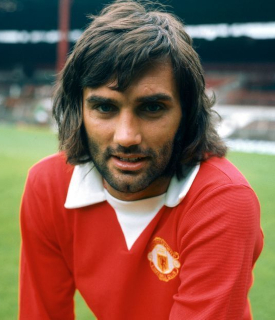
Best is born on May 22, 1946 and grows up in Cregagh, east Belfast. In 1957, he passes the eleven-plus and goes to Grosvenor High School, but he soon plays truant as the school specialises in rugby. He then moves to Lisnasharragh Secondary School, reuniting him with friends from primary school and allowing him to focus on football. He plays for Cregagh Boys Club. He grows up supporting Glentoran F.C. and Wolverhampton Wanderers F.C..
Best spends most of his club career at Manchester United. Named European Footballer of the Year in 1968, he is regarded as one of the greatest players of all time. A highly skillful winger, considered by several pundits to be one of the greatest dribblers in the history of the sport, he receives plaudits for his playing style, which combines pace, skill, balance, feints, two-footedness, goalscoring and the ability to get past defenders.
In international football, Best is capped 37 times for Northern Ireland between 1964 and 1977. A combination of the team’s performance and his lack of fitness in 1982 means that he never plays in the finals of a major tournament. He considers his international career as being “recreational football,” with the expectations placed on a smaller nation in Northern Ireland being much less than with his club. He is regarded as one of the greatest players never to have played at a World Cup. The Irish Football Association describes him as the “greatest player to ever pull on the green shirt of Northern Ireland.”
With his good looks and playboy lifestyle, Best becomes one of the first media celebrity footballers, earning the nickname “El Beatle” in 1966, but his extravagant lifestyle leads to various personal problems, most notably alcoholism, which he suffers from for the rest of his life. These issues affect him on and off the field, often causing controversy. Although conscious of his problems, he is publicly not contrite about them. He says of his career, “I spent a lot of money on booze, birds [women] and fast cars – the rest I just squandered.” After football, Best spends some time as a football analyst, but his financial and health problems continue into his retirement.
Best is diagnosed with severe liver damage in March 2000. His liver is said to be functioning at only 20%. In 2001, he is admitted to hospital with pneumonia. In August 2002, he has a successful liver transplant at King’s College Hospital in London.
On October 3, 2005, Best is admitted to intensive care at the private Cromwell Hospital in London, suffering from a kidney infection caused by the side effects of immunosuppressive drugs used to prevent his body from rejecting his transplanted liver. In the early hours of November 25, 2005, treatment is stopped. Later that day he dies, aged 59, as a result of a lung infection and multiple organ failure. He is interred beside his mother in a private ceremony at Roselawn Cemetery, overlooking east Belfast.





 seamus dubhghaill