Some time before 1610, Butler marries Elizabeth Poyntz against his father’s wishes. She is the daughter of Sir John Pointz (died 1633) of Iron Acton in Gloucestershire and his wife Elizabeth Sydenham. He and Elizabeth had seven children, three sons and four daughters:
Elizabeth (died 1675), marries first James Purcell, Baron of Loughmoe, by whom she has Nicholas Purcell of Loughmoe; she marries secondly John FitzPatrick
In 1619 after the beginning of his father’s long imprisonment in the Fleet Prison, Butler is summoned to England to answer charges of treason, specifically, of having garrisoned Kilkenny. However, on December 15 the ship conveying him is wrecked off the coast of The Skerries, Isle of Anglesey and he drowns. Like his father, he is a prominent Catholic and it seems likely that his refusal to conform to the established Anglican religion had angered King James I and may have been the true motive for his summons.
Butler predeceases his father who dies in 1634. His eldest son James, the future 1st Duke of Ormond, succeeds him as heir apparent and bearer of the courtesy title Viscount Thurles until he succeeds his grandfather as the 12th Earl of Ormond.
Walsh is born in Waterford, County Waterford, in or before 1538. He is the son of Patrick Walsh, Bishop of Waterford and Lismore (d. 1578). The identity of his mother is unknown. She was Patrick’s concubine for many years and they apparently married only after 1558, meaning their son was born outside marriage. About 1551 Walsh leaves Ireland to study at the universities of Paris, Oxford, and Cambridge, eventually graduating BA at Cambridge in 1562 or 1563. He receives the MA from Cambridge in 1567. He is appointed chancellor of St. Patrick’s Cathedral, Dublin, in 1571.
As a fluent Irish speaker, Walsh is deeply committed to the propagation of the Protestant faith through the medium of the Irish language. In 1571 he helps to secure the publication in Dublin of a catechism written in Irish by John Kearney (Irish: Seán Ó Cearnaigh), whom he has known since his time at Cambridge. He then procures a government order for printing the Book of Common Prayer in Irish, and for the liturgy and a sermon to be communicated in Irish in a church in each large town. In practice this order has no effect. From about 1573 he and Kearney begin work on an Irish translation of the New Testament. This project is finally completed and published in 1602 or 1603. He also writes a collection of sermons in Latin.
In 1572 Walsh is offered the bishopric of Kilmacduagh in Connacht but declines as this diocese lay in a dangerous part of the country. In February 1578 he becomes Bishop of Ossory, upon which he resigns his chancellorship at St. Patrick’s Cathedral and presumably sets aside his translation of the New Testament. Through his family he has links with the area of his diocese, and he is assured of the protection of the dominant magnate, Thomas Butler, Earl of Ormond. However, Catholicism is very strong in Ossory, particularly in the diocesan capital of Kilkenny. His arrival at Kilkenny is ignored by the citizens, and he finds himself presiding over an empty St. Canice’s Cathedral during Sunday services. In November 1578 he writes for support to the Lord Justice of Ireland, Sir William Drury, who empowers Walsh to fine recusants. That month Drury comes to Kilkenny and heavily fines a number of prominent citizens of Kilkenny for recusancy. However, these punitive efforts have little long-term impact and only increased Walsh’s unpopularity.
Walsh is further hampered by a lack of revenues from his diocese, which leads him in April 1581 to seek additional benefices that he can hold in commendam. in July 1582 he seeks a licence to solicit charitable donations in England. He also initiates legal proceedings to recover church property. At a time when the Church of Ireland episcopate is characterised by venality, cynicism, and crypto-Catholicism, he stands head and shoulders above his colleagues owing to his dedication, ability, and evangelising zeal. At the installation of the Bishop of Meath in 1584 he criticises his fellow bishops for neglecting their spiritual duties for political concerns. He is married to an Englishwoman and has four children.
Walsh’s life comes to a violent end on December 14, 1585, when he is stabbed to death in his own house at Kilkenny by James Dullerde, whom he had cited for adultery in his consistory court. He is buried in a tomb in St. Canice’s Cathedral, Kilkenny. Dullerde is caught and beheaded by Domhnall Spanaigh Kavanagh MacMurrough and his brother Cahir Carroughe.
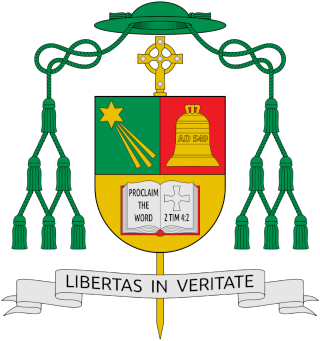
(From: “Walsh, Nicholas (Nicolás Bhailis)” by Anthony M. McCormack and Terry Clavin, Dictionary of Irish Biography, http://www.dib.ie, October 2009 | Pictured: Coat of arms of the Bishop of Ossory)
Criostóir Mac Aonghusa, teacher, author, critic, and campaigner for the Irish language, is born on December 13, 1905, in Gort an Ghabhainn, Banagher, King’s County (now County Offaly), son of Francis McGuiness (surname thus on his birth certificate), farmer, and his wife, Rosanna (née Egan). He is educated at La Sainte Foi, Banagher, Reachra national school, Shannonbridge, and Naas CBS. He qualifies as a primary school teacher from De La Salle Training College, Waterford, in 1926 and has the distinction of being the first person to sit all exams through the medium of Irish. He graduates BA at University College Galway (UCG) in 1933 and his further education includes a diploma in Spanish literature from University of Barcelona and an MA on the Irish scholar Tomás Ó Máille.
Mac Aonghusa’s teaching career begins in 1926 when he becomes headmaster on Inis Treabhair, County Galway, spending fourteen months there. Afterwards he transfers to Gort Mór, Rosmuc, County Galway, where he continues teaching until 1962. He remains an active member of Cumann na Múinteoirí Náisiúnta throughout his life. Between 1962 and 1972 he is employed as an ad-hoc examiner at the civil service commission. An active member of Fianna Fáil, he helps to organise the party in County Galway in the 1920s and 1930s and is elected a member of Galway County Council in 1934.
Mac Aonghusa is a prominent advocate of the Irish language and together with his close friend Máirtín Ó Cadhain and another Connemara schoolteacher, Seosamh Mac Mathúna, founds Cumann na Gaeltachta to agitate for the civil rights of the Gaeltacht communities and of Irish speakers in general. He is one of the main campaigners for the establishment of the Rath Carn Gaeltacht in County Meath and forms part of the delegation that meets Éamon de Valera on November 11, 1932, and receives from him a promise to provide land in County Meath for that purpose. The Gaeltacht is established in 1935. Mac Aonghusa continues to support the project throughout his life and is involved in further campaigns relating to the area, including the recognition of Rath Carn’s Gaeltacht status. He is also an active member of Conradh na Gaeilge in the 1940s and is later involved in the campaign for the establishment of an Irish-language television broadcasting service.
Mac Aonghusa is a prolific writer and begins publishing short stories and articles from 1926 onward. His contributions appear in An tÉireannach, An Phoblacht, The Irish Tribune, An Stoc, and Ar Aghaidh. From 1948, he is a regular contributor to Feasta and his essays and reviews on Máirtín Ó Cadhain’s works appear in Comhar. He is a member of several literary organisations, including Cumann na Scríbhneoirí and the Galway Literary Society. His first book, An Cladóir agus scéalta eile, appears in 1952. Between 1963 and 1972 he is a contributor to The Irish Press and works also as a literary journalist. An essay on Pádraic Ó Conaire earns him a prize from Acadamh Liteartha na hÉireann.
Mac Aonghusa speaks a number of European languages including German, Spanish, French, Romanian, and Greek and travels widely throughout Europe. In the early 1970s he lives in Russia, and a collection of essays entitled Ó Rosmuc go Rostov is published in 1972. For health reasons he lives in Málaga, Spain, from the middle of the 1970s until 1987. While there, RTÉ produces a documentary on his life entitled Ó Ros Muc go Malaga.
Mac Aonghusa dies on April 9, 1991, in Portiuncula General Hospital, Ballinasloe, County Galway, and is interred in Clonmacnoise. In 1930 he marries Mairéad Ní Lupain, a nurse from Annaghvane in Connemara, and has four children, Proinsias (1933), Micheál (1937), Róisín (1939), and Máirín (1944). The couple separates in the 1940s. Proinsias follows in his father’s footsteps as a writer and journalist and becomes president of Conradh na Gaeilge and chairman of Bord na Gaeilge.
(From: “Mac Aonghusa, Criostóir” by Lesa Ní Mhunghaile, Dictionary of Irish Biography, http://www.dib.ie, October 2009)
MacBride has nevertheless had a violent past. He is born in Paris on January 26, 1904, the son of Major John MacBride and Maud Gonne. His father is executed by the British in the Irish struggle for liberation from Great Britain. He is only 15 years old when he lies about his age to join the Irish Volunteers, which fight as part of the Irish Republican Army (IRA). He takes part in the concluding battles against the British in the Irish War of Independence before the Irish Republic is founded in 1921, and in the Irish Civil War that follows. He backs Éamon de Valera in the latter’s refusal to accept Northern Ireland‘s continuing union with England. In the 1930s, he breaks with the IRA and qualifies in law. He defends IRA prisoners in Irish prisons who had been condemned to death.
In addition to the Nobel Peace Prize, MacBride also receives the Lenin Peace Prize for 1975–1976, the Golden Plate Award of the American Academy of Achievement in 1978, and the UNESCO Silver Medal for Service in 1980.
MacBride dies in Dublin on January 15, 1988, eleven days before his 84th birthday. He is buried in Glasnevin Cemetery in a grave with his mother and his wife, who died in 1976.
Byrne is born into a successful family of journalists from Dublin. Cared for by servants, from a young age Byrne feels like she isn’t loved as much as the other children in the family. She is the middle child with two brothers and two sisters. She attends boarding school in Rathfarnham and has a limited relationship with her parents. Her father is a racing journalist and broadcaster who lives in the Gresham Hotel on O’Connell Street where his job at Radio Éireann is located. She becomes addicted to nicotine and alcohol. Two of her siblings die from alcoholism.
In the late 1940s, Byrne works at the Brazilian embassy in Dublin. She is a pioneer in Irish radio and her program, “Agony Aunt,” leads to public confessionals on the radio. She writes an Agony Aunt column for the Evening Press during the same period. She is best known for her 22 years of the radio program ‘Dear Frankie.’ On the show she gives relationship advice to listener requests. Dear Frankie, sponsored by Jacob’s, paves the way for the contemporary radio programs such as The Gerry Ryan Show and RTÉ Radio 1’s Liveline with Joe Duffy.
Dear Frankie is broadcast from 1963 to 1985. It opens with the words, ‘Welcome to Women’s Page, a program for and about you.’ The program begins as a 15-minute question and answer format on household issues but soon becomes a radio program that allows people to share confidences and seek advice. She shares household problems with her listeners ranging from jealous husband to lovelorn teenagers. She claims to know nothing about domestic science but that she does know about love. She advises on domestic relationships while living a life of turmoil. The most unique feature of Dear Frankie is that the program sets people to talking and helps begin a national conversation on the lonely struggles of generations of Irish women.
Byrne never marries but has a 25+ year relationship with Frank Hall, the satirist and columnist for the Evening Herald. Their relationship has been disputed by some family members who deny they had a child together and that the couple were just good friends. Nevertheless, in the middle of this relationship, she becomes pregnant in the mid-1950s, giving birth to their daughter Valerie on July 12, 1956. She wants to keep the baby but ultimately gives her up to St. Clare’s Orphanage in Stamullen. She frequently visits her baby daughter until she is eventually adopted some 15 weeks later, going to a family who goes on to adopt four more children. Her relationship with Frank Hall comes to an end in the mid-1970s. Although she had struggled with alcoholism for many years, she stops drinking in the mid-1970s but is subsequently prescribed Valium and is addicted to the drug for the remainder of her life.
Byrne and her daughter are reunited on December 13, 1983, a decade before her death. The last time Valerie sees her mother is exactly ten years later, on December 13, 1993, in the mortuary in St. Vincent’s Hospital.
Byrne dies at the age of 71 from Alzheimer’s disease in St. Vincent’s Hospital, Dublin, on Saturday, December 11, 1993. Tributes are paid by colleagues and friends including the RTÉ assistant Director-General, Bobby Gahan, who describes her voice as “one of the greatest sounds of radio.” Others who pay public tribute to her include fellow broadcasters Larry Gogan and Gay Byrne.
Byrne is remembered as an influential force during the time of her radio show, and it has been said that an entire generation can hum the signature tune to her radio program. Following her death there is an outburst of support. Gay Byrne describes her as having been “a national institution who had been loved by everyone.” Dear Frankie is often credited as the first ‘agony aunt’ radio show program format in Ireland.
Byrne’s talk show and life inspire numerous pieces of literature including a stage production in 2010 and 2012, authored by Niamh Gleeson and produced by the Five Lamps Theater Company, which tells the story of her ‘tragic and secretive life.’ She is also the subject of a book published in 1998, which compiles the advice which she gave on Dear Frankie. In 2006, RTÉ airs a documentary on Byrne, in which they explore her life following the show, and include interviews with her family and friends, including her daughter Valerie.
Byrne is also famous for having been the first woman to found a public relations company in 1963, that works almost exclusively in promoting Jacob’s.
The INLA is founded by former members of the Official Irish Republican Army who oppose that group’s ceasefire. It is initially known as the “People’s Liberation Army” or “People’s Republican Army.” The INLA wages a paramilitary campaign against the British Army and Royal Ulster Constabulary (RUC) in Northern Ireland. It is also active to a lesser extent in the Republic of Ireland, Great Britain and Continental Europe. High-profile attacks carried out by the INLA include the Droppin Well bombing (1982), the Shankill Road killings (1994) and the assassinations of Airey Neave (1979) and Billy Wright (1997). However, the INLA is smaller and less active than the main republican paramilitary group, the Provisional Irish Republican Army (IRA). It is also weakened by feuds and internal tensions. Members of the group use the covernames People’s Liberation Army, People’s Republican Army, and Catholic Reaction Force for attacks its volunteers carry out but for which the INLA does not want to claim responsibility. The INLA becomes a proscribed group in the United Kingdom on July 3, 1979, under the 1974 Prevention of Terrorism Act.
After a 24-year armed campaign, the INLA declares a ceasefire on August 22, 1998. In August 1999, it states that “There is no political or moral argument to justify a resumption of the campaign.” On October 11, 2009, speaking at the graveside of its founder Seamus Costello in Bray, the INLA formally announces an end to its armed campaign, stating the current political framework allows for the pursuit of its goals through peaceful, democratic means and begins decommissioning its weapons.
The IRSP supports a “No First Strike” policy, that is allowing people to see the perceived failure of the Northern Ireland peace process for themselves without military actions.
The INLA is a proscribed organisation in the United Kingdom under the Terrorism Act 2000 and an illegal organisation in the Republic of Ireland.
(Pictured: INLA logo consisting of the Starry Plough and the Flag of Ireland with a red star and a fist holding an AK-47-derivative rifle)
O’Callaghan grows up in the village of Douglas, where he still lives today.
His first collection of short stories, In Exile, is published by Mercier Press in 2008. This is followed a year later by a second collection, In Too Deep, also published by Mercier Press. In 2013, his third collection, The Things We Lose, The Things We Leave Behind, is published by New Island Books. His short stories have been published in literary journals around the world and translated into several other languages. His work has been broadcast on RTÉ Radio 1‘s The Book On One, Sunday Miscellany and the Francis McManus Short Story Award series.
In 2017, the American literary journalPloughshares publishes O’Callaghan’s story A Death in the Family as a Ploughshares Solo.
His novel, My Coney Island Baby, is published in 2019, by Jonathan Cape (UK) and Harper (USA), as well as in French by Éditions Grasset as Les amants de Coney Island, translated by Carine Chichereau, Dutch by Ambo Anthos as Mijn lief op Coney Island, translated by Lette Vos, German by btb Verlag as Die Liebenden von Coney Island, translated by Sibylle Schmidt, Czech by Nakladatelství Paseka as Náš Coney Island, translated by Petr Eliáš, Catalan by L’Altra Editorial as Els amants de Coney Island, translated by Ferran Ràfols Gesa, Italian by Guanda Editore as My Coney Island Baby, translated by Ada Arduini, Hungarian by Jelenkor as Szerelmem, Coney Island, translated by Zoltán Pék, and in Turkish by Othello Kitap as Coney Island Bebeğim, translated by Serkan Toy.
A new short story collection, The Boatman and Other Stories, is published in January 2020 by Jonathan Cape (UK) and Harper Perennial (USA).
A new novel, Life Sentences, is published in 2021 by Jonathan Cape (UK) and in Czech by Nakladatelství Paseka as Doživotí, translated by Petr Eliáš, and in 2022 in the United States by David R. Godine.
In November 2013, The Things We Lose, The Things We Leave Behind wins the inaugural Short Story of the Year Award at the 2013 Bord Gáis Energy Irish Book Award. Down by the River is selected in 2014 as Ireland’s representative in the ongoing UNESCOCity of Literature project. The Boatman is a finalist for the 2016 Costa Short Story Award. In June 2020, My Coney Island Baby is shortlisted for the Royal Society of Literature’s Encore Award.
Hoban is a Roman Catholic raised on the Desart Court estate belonging to the Earl of Desart near Callan, County Kilkenny. He works there as a wheelwright and carpenter until his early twenties, when he is given an “advanced student” place in the Dublin Society‘s Drawing School on Lower Grafton Street. He studies under Thomas Ivory. He excels in his studies and receives the prestigious Duke of Leinster‘s medal for drawings of “Brackets, Stairs, and Roofs” from the Dublin Society in 1780. He is an apprentice to Ivory, from 1779 to 1785.
Hoban is in South Carolina by April 1787, where he designs numerous buildings including the Charleston County Courthouse (1790–92), built on the ruins of the former South Carolina Statehouse, which was burned in 1788. PresidentGeorge Washington admires Hoban’s work on his Southern Tour and may have met with him in Charleston in May 1791. Washington summons the architect to Philadelphia, the temporary national capital, in June 1792.
In July 1792, Hoban is named winner of the design competition for the White House. His initial design has a 3-story facade, nine bays across, like the Charleston courthouse. Under Washington’s influence, he amends this to a 2-story facade, eleven bays across, and, at Washington’s insistence, the whole presidential mansion is faced with stone. It is unclear whether any of Hoban’s surviving drawings are actually from the competition.
It is known that Hoban owns at least three slaves who are employed as carpenters in the construction of the White House. Their names are recorded as “Ben, Daniel, and Peter” and appear in a James Hoban slave payroll.
Hoban is also one of the supervising architects who serves on the United States Capitol, carrying out the design of Dr. William Thornton, as well as with The Octagon House. He lives the rest of his life in Washington, D.C., where he works on other public buildings and government projects, including roads and bridges.
Local folklore has it that Hoban designed Rossenarra House near the village of Kilmoganny in County Kilkenny in 1824.
Hoban’s wife, Susanna “Susan” Sewall, is the sister of the prominent GeorgetownCity Tavern proprietor, Clement Sewall, who enlists as a sergeant at age 19 in the Maryland Line during the Revolutionary War, is promoted six months later to ensign and then severely wounded at the Battle of Germantown.
After the District of Columbia is granted limited home rule in 1802, Hoban serves on the twelve-member city council for most of the remainder of his life, except during the years he is rebuilding the White House. He is also involved in the development of Catholic institutions in the city, including Georgetown University, St. Patrick’s Parish, and the Georgetown Visitation Monastery founded by another Kilkenny native, Teresa Lalor of Ballyragget.
Stack is born to William Stack, an attorney’s clerk, and Nanette O’Neill. He is educated at the Christian Brothers School in Tralee. At the age of fourteen, he leaves school and becomes a clerk in a solicitor‘s office. A gifted Gaelic footballer, he captains the Kerry team to All-Ireland victory in 1904. He also serves as President of the Kerry Gaelic Athletic Association County Board.
Stack becomes politically active in 1908 when he joins the Irish Republican Brotherhood (IRB). In 1916, as commandant of the Kerry Brigade of the Irish Volunteers, he makes preparations for the landing of arms by Roger Casement. He is made aware that Casement was arrested on Easter Saturday and was being held in Tralee. He makes no attempt to rescue him from Ballymullen Barracks.
Stack, as part of his role as Minister for Home Affairs, is widely credited with the creation and administration of the Dáil Courts. These are courts run by the Irish Republican Army (IRA) in parallel and opposition to the judicial system being run by the British government. The IRA and Sinn Féin are highly successful in both getting the civilian population of Ireland to use the courts and accept their rulings. The success of this initiative gives Sinn Féin a large boost in legitimacy and supports their goals in creating a “counter-state” within Ireland as part of their overarching goals in the Irish War of Independence.
Stack opposes the Anglo-Irish Treaty of 1921 and takes part in the subsequent Irish Civil War. He is captured in 1923 and goes on hunger strike for forty-one days before being released in July 1924.
In 1925, Stack marries Winifred (Una) Gordon, (née Cassidy), the widow of a Royal Irish Constabulary (RIC) district inspector, Patrick Gordon.
Stack’s health never recovers following his hunger strike and he dies at the age of 49 in a Dublin hospital on April 27, 1929.
Austin Stack Park in his hometown of Tralee, one of the Gaelic Athletic Association’s stadiums, is named in his honour, as is the Austin Stacks GAA hurling and Gaelic football club.
In September 1643, Ormond agrees to a truce, or ‘Cessation’, with the Confederation, freeing his troops for use in England against Parliament in the First English Civil War. Some Irish Protestants object, and switch sides, including Sir Charles Coote, who becomes Parliamentarian commander in Connacht. Charles surrenders in 1646, while a Covenanter/Royalist uprising is quickly suppressed in the 1648 Second English Civil War. On January 17, 1649, the Confederation allies with Ormond’s Royalists. Following the execution of Charles on January 30, they are joined by the Laggan Army and remaining Scots troops in Ulster.
There are various reasons for this. The Covenanter government, who provides support for Scottish settlers in Ulster, considers Oliver Cromwell and other leaders of the new Commonwealth of England dangerous political and religious radicals. As Scots, they object to the execution of their king by the English; as Presbyterians, they view monarchy as divinely ordained, making it also sacrilegious, and transfer their allegiance to his son, Charles II of England.
However, this is offset by a split within the Confederation, between Catholic landowners who want to preserve the position prevailing in 1641, and those like Ó Néill, whose estates had been confiscated in 1607. As a result, he agrees a truce with Coote, and refuses to join the Alliance, depriving them of their most effective fighting force in the north. Despite this, by late July, Ormond’s combined Royalist/Confederate army controls most of Ireland.
In Ulster, Derry is the only major town still held by forces loyal to the Commonwealth. The garrison is commanded by Coote, who is besieged by the Laggan Army under George Munro, Robert’s nephew. In July, Munro is forced to lift the siege by Ó Néill, an example of the impact of the truce between two unlikely allies.
Ormond’s defeat at Rathmines on August 2 allows Cromwell and an army of 12,000 to land in Dublin unopposed. After capturing Drogheda on September 11, his main force heads south towards Wexford. Colonel Robert Venables is sent north with three regiments, or around 2,500 men, to take control of Ulster. Munro’s garrisons surrender with minimal resistance, and by the end of September, Venables has occupied Dundalk, Carlingford, Newry, and Belfast. These are accompanied by the mass expulsion of Scots settlers, as punishment for their defection. When Coote captures Coleraine on September 15, he massacres the largely Scottish garrison.
At the end of October, Coote joins Venables at Belfast. They spend November reducing remaining Royalist garrisons in the north, and in early December, assemble 3,000 men to attack Carrickfergus. After lifting the siege of Derry, Munro has retreated to Enniskillen with the remainder of the Laggan Army. Since the loss of Carrickfergus would effectively cut communications with Scotland, he is determined to prevent this if at all possible.
He combines forces with Royalist leader James Hamilton, 1st Earl of Clanbrassil, creating an army of around 5,000. However, it comprises remnants from many different regiments, its men are poorly equipped, and demoralised, while most have not been paid for over two years. As they march north, their numbers dwindle due to desertion.
Learning of their advance, Coote and Venables move to intercept Munro, and the two advance guards make contact outside Lisnagarvey, near Lisburn, on December 6. Despite superior numbers, the Royalists cannot hold their ground against their far more experienced opponents. When the main body of the Parliamentarian force appears, the retreat rapidly turns into a rout, the majority fleeing without firing a shot. In the pursuit that follows, they lose 1,500 men, killed or captured, along with their baggage train and supplies. Clandeboye and the remnants of his army surrender shortly afterwards, although Monro escapes to Enniskillen.
Lisnagarvey ends resistance by Scottish forces to the Parliamentarian army. Carrickfergus surrenders on December 13, and as with other towns, its Scottish settlers are expelled. Early in 1650, Monro agrees to evacuate Enniskillen for £500, and returns to Scotland, leaving Ó Néill’s army as the only remaining obstacle to Parliamentarian control of the north. However, his death in November 1649 proves a major blow to its morale and fighting ability. In June 1650, it is destroyed by Coote and Venables at Scarrifholis.
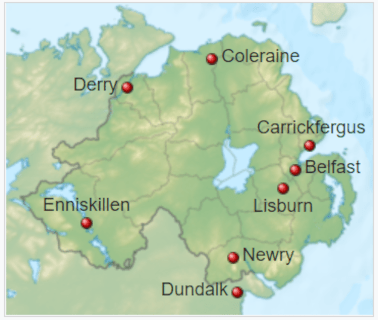
(Pictured: Map of key locations of the 1649 campaign in Ulster)






 seamus dubhghaill