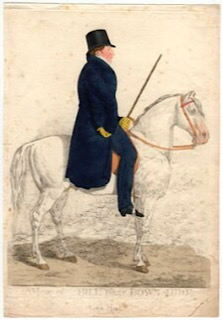
During his early political career, Hill is identified with the Whigs and supports the reform of Parliament. After the Grey Ministry comes to power, he receives a succession of appointments, becoming Colonel of the South Down Militia on March 25, 1831, and carrying the second sword at the coronation of William IV on September 8. He is appointed a deputy lieutenant of Berkshire on September 20, Lord Lieutenant of Down on October 17 (a new office replacing the Governor of Down), and finally a Knight of the Order of St Patrick on November 24, 1831. He receives an honorary LL.D. from the University of Cambridge on July 6, 1835.
Hill is a very strong supporter of the Irish language, and is president of the Ulster Gaelic Society (est. 1830). In this capacity he plays an important role in helping preserve records of the language, poetry, folk and song collections and much else.
Hill is disliked by Elizabeth Smith, diarist at Baltyboys House, County Wicklow, who feels snubbed by him when she and her husband first move into the area. Writing of him after his death she recalls “The late Lord never called upon me when I first came here although the Colonel waited upon him. The Colonel never went near him again.”
High-minded, if also at times high-handed in manner and self-important, Hill works hard himself and expects all his employees and tenants to be equally conscientious. Naturally, he is often disappointed. He is particularly concerned about his failure, despite all efforts and exhortations, to make his southern estates as efficient and well behaved as those in the north. Though an absentee owner in the south, he visits both Blessington and Edenderry regularly. It is during one of these periodic tours of inspection that he drops dead at Blessington on September 12, 1845. He is buried in St. Malachy Parish Churchyard at Royal Hillsborough, County Down. The funeral attracts an enormous crowd of mourners and is reported at some length in TheIllustrated London News. His memory is perpetuated in an impressive pillar monument, with his statue on top, erected at Hillsborough in 1848.
The Land Purchase (Ireland) Act 1903, also known as the Wyndham Land Act, is enacted on August 14, 1903, and allows for entire estates to be purchased by the occupying tenantry, subsidized by the state.
It differs from earlier legislation which initially advanced to tenants the sum necessary to purchase their holdings, repayable over a period of years on terms determined by an independent commission, while the Wyndham Act finishes off absentee landlords‘ control over tenants and makes it easier for tenants to purchase land, facilitating the transfer of about 9 million acres (36,000 km2) up to 1914. By then, 75% of occupiers are buying out their landlords under the 1903 Act and the later Irish Land Act 1909 of Augustine Birrell, which extends the 1903 act by allowing for the compulsory purchase of tenanted farmland by the Land Commission, but falls far short in its financial provisions. In all, under these pre-1921 Land Acts over 316,000 tenants purchase their holdings amounting to 11.5 million acres (47,000 km2) out of a total of 20 million acres (81,000 km2) in the country.
The Acts provide Irish tenant farmers with more rights than tenant farmers in the rest of the United Kingdom. Munster tenants avail of land purchase in exceptionally high numbers, encouraged by their Irish Land and Labour Association‘s leader D. D. Sheehan after he and O’Brien establish an Advisory Committee to mediate between landlords and tenants on purchase terms which produce a higher take-up of land purchase than in any other province.
Historian Robert K. Webb gives most of the credit for the Wyndham Act to Conservative leader Arthur Balfour. He says the Act is “a complete success. By the time the Irish Free State was created in 1922, the system of peasant proprietorship had become universal… A land problem more than a century old had been solved, though it had taken more than 30 years of educating Parliament and landlords to do it. The scheme was intended as well to ‘kill Home Rule by kindness.’”
On February 21, 1910, Carson accepts the parliamentary leadership of the anti-Home Rule Irish Unionists and, forfeiting his chance to lead the British Conservative Party, devotes himself entirely to the Ulster cause. His dislike of southern Irish separatism is reinforced by his belief that the heavy industry of Belfast is necessary to the economic survival of Ireland. The Liberal government (1908–16) under H. H. Asquith, which in 1912 decides to prepare a Home Rule bill, cannot overcome the effect of his extra-parliamentary opposition. The Solemn League and Covenant of resistance to Home Rule, signed by Carson and other leaders in Belfast on September 28, 1912, and afterward by thousands of Ulstermen, is followed by his establishment of a provisional government in Belfast in September 1913. Early in that year he recruits a private Ulster army, the Ulster Volunteer Force, that openly drills for fighting in the event that the Home Rule Bill is enacted. In preparation for a full-scale civil war, he successfully organizes the landing of a large supply of weapons from Germany at Larne, County Antrim, on April 24, 1914. The British government, however, begins to make concessions to Ulster unionists, and on the outbreak of World War I he agrees to a compromise whereby the Home Rule Bill is enacted but its operation suspended until the end of the war on the understanding that Ulster’s exclusion will then be reconsidered.
Appointed Attorney General for England in Asquith’s wartime coalition ministry on May 25, 1915, Carson resigns on October 19 because of his dissatisfaction with the conduct of the war. In David Lloyd George’s coalition ministry (1916–22) he is First Lord of the Admiralty from December 10, 1916, to July 17, 1917, and then a member of the war cabinet as minister without portfolio until January 21, 1918.
Carson retires in October 1929. In July 1932, during his last visit to Northern Ireland, he witnesses the unveiling of a large statue of himself in front of Parliament Buildings at Stormont. The statue is sculpted by Leonard Stanford Merrifield, cast in bronze and placed upon a plinth. The inscription on the base reads “By the loyalists of Ulster as an expression of their love and admiration for its subject.” It is unveiled by James Craig, 1st Viscount Craigavon, in the presence of more than 40,000 people.
Carson lives at Cleve Court, a Queen Anne house near Minster-in-Thanet in the Isle of Thanet, Kent, bought in 1921. It is here that he dies peacefully on October 22, 1935. A warship brings his body to Belfast for the funeral. Thousands of shipworkers stop work and bow their heads as HMS Broke steams slowly up Belfast Lough, with his flag-draped coffin sitting on the quarterdeck. Britain gives him a state funeral on Saturday, October 26, 1935, which takes place in Belfast’s St. Anne’s Cathedral. He remains the only person to have been buried there. From a silver bowl, soil from each of the six counties of Northern Ireland is scattered onto his coffin, which had earlier been covered by the Union Jack. At his funeral service the choir sings his own favourite hymn, “I Vow to Thee, My Country.”
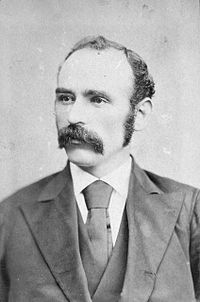
Davitt is born in Straide, County Mayo, on March 25, 1846. He is the founder of the Irish National Land League, which organizes resistance to absentee landlordism and seeks to relieve the poverty of the tenant farmers by securing fixity of tenure, fair rent, and free sale of the tenant’s interest.
Davitt is the son of an evicted tenant farmer. After their eviction, the family emigrates to England. In 1856, at the age of 10, he starts work in a cotton mill, where he loses an arm in a machinery accident a year later. In 1865, he joins the revolutionary Fenian Brotherhood, an international secret society that seeks to secure political freedom for Ireland. He becomes secretary of its Irish analogue, the Irish Republican Brotherhood (IRB), in 1868. Arrested in Paddington Station in London for sending firearms to Ireland on May 14, 1870, he is sentenced to 15 years in Dartmoor Prison and there lays plans to link Charles Stewart Parnell’s constitutional reform with Fenian activism to achieve political-agrarian agitation.
Paroled from prison in 1877, Davitt rejoins the IRB and goes to the United States, where the Fenian movement originated. There he is deeply influenced by Henry George’s ideas about the relationship between land monopoly and poverty.
Back in Ireland, using funds raised by John Devoy and Clan na Gael in the United States, Davitt wins Parnell’s cooperation in organizing the Land League in 1879, which leads, however, to his expulsion from the supreme council of the IRB in 1880. He is elected member of Parliament for North Meath in 1882 but is disqualified as he is a convict. He is also imprisoned for seditious speeches in 1881 and 1883.
Because of his public championing of Henry George’s theories of land reform, Parnell repudiates him. Davitt actively defends the Nationalists before the Parnell Commission, which meets between 1887 and 1889. When the Irish party splits in 1890 over Parnell’s involvement in Capt. William Henry O’Shea’s divorce case, Davitt is among the first to oppose Parnell’s continuance as leader.
Davitt is elected to Parliament in 1892 and 1893 but is unseated in both cases. He is elected again, for South Mayo in 1895, but resigns in 1899 in protest against the Second Boer War.
Davitt dies in Elphis Hospital, Dublin on May 30, 1906, at the age of 60, from blood poisoning. The fact that the Lord Lieutenant of Ireland attends his funeral is a public indication of the dramatic political journey this former Fenian prisoner has taken. There is no plan for public funeral, and hence Davitt’s body is brought quietly to the Carmelite Friary, Clarendon Street, Dublin. However, the next day over 20,000 people file past his coffin. His remains are taken by train to Foxford, County Mayo, and buried in the grounds of Straide Abbey at Straide, near his place of birth.
Davitt’s book, The Fall of Feudalism in Ireland (1904), is a valuable record of his time.
The Plan of Campaign is a stratagem adopted in Ireland between 1886 and 1891, co-ordinated by Irish politicians for the benefit of tenant farmers, against mainly absentee and rack-rentlandlords and the tyrannical regime of enforced massive rents and evictions. It is launched to counter agricultural distress caused by the continual depression in prices of dairy products and cattle from the mid-1870s, which leaves many tenants in arrears with rent. Bad weather in 1885 and 1886 also cause crop failure, making it harder to pay rents. The Land War of the early 1880s is about to be renewed after evictions increase and outrages become widespread.
The Plan, conceived by Timothy Healy, is devised and organised by Timothy Harrington, secretary of the Irish National League, William O’Brien and John Dillon. It is outlined in an article headed Plan of Campaign by Harrington which is published on October 23, 1886, in the League’s newspaper, the United Ireland, of which O’Brien is editor.
Dillon is among those who organise a campaign whereby tenants pay their rents to the Land League instead of their landlords. If the tenants are evicted, they are to receive financial assistance from a general fund established for that purpose. As a result of his involvement in this campaign, Dillon spends a number of months in jail.
The measures are to be put into operation on 203 estates, mainly in the south and west of the country though including some scattered Ulster estates. Initially sixty landlords accept the reduced rents, twenty-four holding out but then agreeing to the tenant conditions. Tenants give in on fifteen estates. The chief trouble occurs on the remaining large estates.
The organisers of the Plan decide to test a number of their measures, expecting the remainder will then give in. Widespread attention is focused on it being implemented by Dillon and O’Brien on the estate of Hubert de Burgh-Canning, 2nd Marquess of Clanricarde, at Portumna, County Galway, on November 19, 1886, where the landlord is an absentee ascendancy landlord. The estate comprising 52,000 acres, or 21,000 hectare, yields 25,000 sterling annually in rents paid by 1,900 tenants. The hard-pressed tenants look for a reduction of twenty-five percent. The landlord refuses to give any abatement. The tenant’s reduced rents are then placed into an estate fund, and the landlord informed he will only receive the monies when he agrees to the reduction. Tenants on other estates then follow the example of the Clanricarde tenants, the Plan on each estate led by a member of the Irish Parliamentary Party (IPP) Campaign activists including Pat O’Brien, Alexander Blane or members of its constituency organisation, the National League. Some 20,000 tenants are involved.
In 1887, a rent strike takes place on the estate of Lady Kingston near Mitchelstown, County Cork. Another of the Land Leaguers, William O’Brien, is brought to court on charges of inciting non-payment of rent. Dillon organises an 8,000 strong crowd to demonstrate outside the courthouse. Three estate tenants are shot by police and others are injured. This incident becomes known as the “Mitchelstown Massacre.”
In December 1890, following the verdict in the O’Shea v O’Shea and Parnell divorce case, the IPP splits. This diverts attention from the Campaign which slowly peters out. The IPP also wants to disassociate itself from the more violent aspects on the approach to the Second Home Rule Bill that narrowly succeeds with a majority of 30 in the House of Commons but is then defeated by the House of Lords in 1893.
(Pictured: Eviction scene, Woodford Galway 1888, during the Plan of Campaign. The Woodford evictions become some of the most highly resisted with numerous pamphlets, during the period, referring to them)
Davitt is born in Strade, County Mayo, on March 25, 1846, the son of an evicted tenant farmer. Following their eviction, the family emigrates to England. In 1856, at the age of 10, he starts work in a cotton mill, where he loses an arm in a machinery accident a year later. As is typical for the era, he does not receive any compensation.
In 1865, Davitt joins the revolutionary Fenian Brotherhood, an international secret society that seeks to secure political freedom for Ireland. He becomes secretary of its Irish analogue, the Irish Republican Brotherhood (IRB), in 1868. Arrested in Paddington Station in London for sending firearms to Ireland on May 14, 1870, he is sentenced to 15 years in Dartmoor Prison and there lays plans to link Charles Stewart Parnell’s constitutional reform with Fenian activism to achieve political-agrarian agitation.
Paroled from prison in 1877, Davitt rejoins the IRB and goes to the United States, where the Fenian movement originated. There he is deeply influenced by Henry George’s ideas about the relationship between land monopoly and poverty.
Back in Ireland, using funds raised by John Devoy and Clan na Gael in the United States, Davitt wins Parnell’s cooperation in organizing the Irish National Land League in 1879, which leads, however, to his expulsion from the supreme council of the IRB in 1880. He is also imprisoned for seditious speeches in 1881 and 1883. He is elected to Parliament representing North Meath in the 1892 United Kingdom general election, but his election is overturned on petition because he had been supported by the Roman Catholic hierarchy. He stands unopposed for North East Cork at a by-election in February 1893, making his maiden speech in favour of the Home Rule Bill in April, which passes the House of Commons but is defeated in the House of Lords in September.
Because of his public championing of Henry George’s theories of land reform, Parnell repudiates him. Davitt actively defends the Nationalists before the Parnell Commission, which meets between 1887 and 1889. When the Irish party splits in 1890 over Parnell’s involvement in Capt. William Henry O’Shea’s divorce case, Davitt is among the first to oppose Parnell’s continuance as leader. He is elected again, for South Mayo in 1895, but resigns in 1899 in protest against the Second Boer War.
Davitt dies in Elphis Hospital, Dublin on May 30, 1906, at the age of 60, from blood poisoning. The fact that the Lord Lieutenant of Ireland attends his funeral is a public indication of the dramatic political journey this former Fenian prisoner has taken. There is no plan for public funeral, and hence Davitt’s body is brought quietly to the Carmelite Friary, Clarendon Street, Dublin. However, the next day over 20,000 people file past his coffin. His remains are taken by train to Foxford, County Mayo, and buried in the grounds of Strade Abbey at Strade, near his place of birth.
Davitt’s book, The Fall of Feudalism in Ireland (1904), is a valuable record of his time.
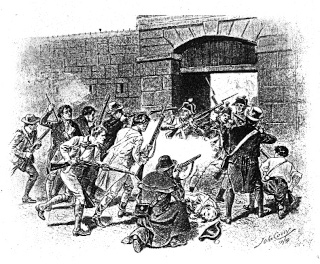
The Hearts of Steel, also known as the Steelboys, an exclusively Protestant movement originating in County Antrim due to grievances about the sharp rise of rent and evictions, is involved in conflict in Ulster on December 23, 1770. Five hundred members of the Hearts of Steel force the release a prisoner in Belfast.
The Hearts of Steel arise in 1769 in opposition to unjust and exorbitant rents, chiefly exacted by middlemen, speculators or “forestallers,” who take lands from absentee landlords at greatly increased rents and make their own profit by doubling the rents on the poor tenants.
In 1770 in Templepatrick, County Antrim, a local landlord evicts tenants and replaces them with speculators who can outbid the locals for the land. At some point a local is arrested and charged with maiming cattle belonging to a merchant from Belfast, which spurs the farmers of Templepatrick to take up arms and march on Belfast to demand his release. The protestors surround the barracks and threaten to burn the house of Waddell Cunningham, who is one of the new speculators in Templepatrick. The soldiers in the barracks fire upon the protestors killing several and wounding others. The protestors eventually set fire to Cunningham’s house and as the fire threatens to spread and destroy the town of Belfast itself, the mayor decides to free the prisoner.
Further consternation is caused by the sharp increase of rents throughout Ulster. At the same time the leases expire for Lord Donegall‘s south County Antrim estate. While he keeps his rent at the old prices, he greatly increases their renewal fee. These coincide with several years of severe harvest failures which result in high bread prices. The result of this is that people are unable to support themselves or their families, being left in the utmost state of deprivation and destitution, with many evicted from their land for failure to pay.
The Hearts of Steel protests and uprisings quickly spread throughout the county and into counties Armagh, Down, and Londonderry, which are also subject to the Hearts of Oak protest movement with which it merges. One tactic of the protestors is the “houghing” of cattle, which involves laming cattle by cutting the leg tendons. They also force farmers to sell food at prices they set, and demand anyone letting out land to do so at the cost of 12 shillings per acre. Landlords are threatened that if they try to collect the cess from anyone that their houses will be destroyed.
The disturbances are so widespread in the affected counties that the Irish government passes legislation to severely punish the “wicked and disorderly persons.” By the later half of 1772 they send the army into Ulster to crush them. Men are hanged while many others are said to have drowned trying to flee across the sea to Scotland. The Lord Lieutenant of Ireland, Lord Townshend, privately blames the landlords and their actions for the disturbances and so issues a general pardon in November 1772.
(Pictured: The Hearts of Steel storming the barracks at Belfast, December 1770 | Linen Hall Library)
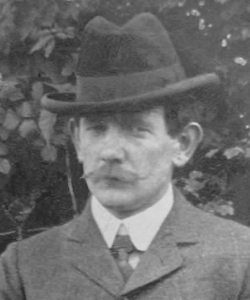
Noonan is the illegitimate son of Samuel Croker, a senior member of the Royal Irish Constabulary. He is baptised and raised a Roman Catholic by his mother Mary Noonan. His father, who is not Catholic, has his own family, but attempts to provide for Robert until his death in 1875.
By 1875 Noonan is living in London. When he is sixteen, he shows signs of a radical political consciousness. He leaves his family declaring he “would not live on the family income derived largely from absentee landlordism.” It is around this time he changes his surname to his mother’s maiden name.
In 1890, Noonan is a sign writer living in Queen’s Road, Everton, Liverpool. On June 10, 1890, he appears at Liverpool County Intermediate Sessions court at County Sessions House, Islington, Liverpool on charges of housebreaking and larceny. He is found guilty and given a six-month prison sentence.
By 1891, Noonan has moved to Cape Town, South Africa, where he is a painter and decorator. He marries in 1891, but the marriage is an unhappy one, with his wife having numerous affairs after the birth of their daughter, Kathleen. They divorce in 1895, and Noonan acquires all the property, including their house in an affluent suburb of Cape Town.
Noonan and his daughter move to Johannesburg, where he secures a well-paying job with a construction company. It is here that he learns the ways of the industry he would later write about in his novel, although Noonan’s actual circumstances vary greatly from the proletarian characters of the book. After becoming Secretary of the Transvaal Federated Building Trades Council, he is able to send his daughter to an exclusive convent school and also to employ a black manservant called Sixpence.
In 1897, Noonan leads a successful protest against the employment of black skilled labour. During 1898, he becomes a member of the Transvaal Executive Committee of the Centennial of 1798 Association, which commemorates the revolutionary nationalistSociety of United Irishmen. As a 1798 Association member, he helps form the Irish Brigades, an anti-British force that fights alongside the Boers in the Second Boer War. At this point, accounts of his life differ. Some assert he takes up arms and is interned by the British until the end of the war, when he returns to Britain. Others say he leaves South Africa just before hostilities began in October 1899.
In any event, around the turn of the century, Noonan ends up in Hastings, Sussex. Here, he finds work as a sign writer, but at much lower wages and in far poorer conditions than he had experienced in South Africa. He has to take part-time jobs in addition to his full-time position.
Influenced by the Marxist-influenced ideas of designer and socialist William Morris, he joins the Social Democratic Federation in 1906. The next year, after a dispute with his employer, he loses his job. Despite the demand for his skills, his health begins to deteriorate, and he eventually develops tuberculosis. Unemployed and unable to remain politically active, he starts writing, something he hopes will earn enough money to keep him from the workhouse.
He writes under the pen name Robert Tressell as he fears the socialist views expressed in the book will have him blacklisted. He completes The Ragged-Trousered Philanthropists in 1910, but the 1,600-page hand-written manuscript is rejected by three publishing houses. The rejections severely depress him, and his daughter has to save the manuscript from being burned.
Unhappy with his life in Britain, Noonan decides that he and Kathleen should emigrate to Canada. However, he only reaches Liverpool when he is admitted to the Royal Liverpool Infirmary, where he dies of pulmonary tuberculosis on February 3, 1911, at the age of 40. He is buried in a pauper’s grave at Liverpool Parochial Cemetery, later known as Walton Park Cemetery. The location of the grave is not rediscovered until 1970. Twelve other people are buried in the same plot. The plot is now marked although the land is no longer used as a cemetery and is now used by Rice Lane City Farm.
Kathleen mentions her father’s novel to a friend, writer Jessie Pope, who recommends it to her publisher. In April 1914, the publisher purchases the rights to the book for £25, and it appears in Britain, Canada and the United States later that year, in the Soviet Union in 1920, and in Germany in 1925. The version as originally published is heavily abridged by Pope, with much of the socialist ideology removed.
The original manuscript is subsequently located by F. C. Ball and, after he raises funds to acquire and reassemble the original version, an unabridged edition is published in 1955.
Edgeworth is born at Black Bourton, Oxfordshire, England on January 1, 1768. She is the second child of Richard Lovell Edgeworth and Anna Maria Edgeworth (née Elers). She spends her early years with her mother’s family in England, until her mother’s death when Maria is five. When her father marries his second wife Honora Sneyd in 1773, she goes with him to his estate, Edgeworthstown, in County Longford. There, she assists her father in managing his estate. In this way she acquires the knowledge of rural economy and of the Irish peasantry that is to become the backbone of her novels.
Domestic life at Edgeworthstown is busy and happy. Encouraged by her father, Edgeworth begins her writing in the common sitting room, where the 21 other children in the family provide material and audience for her stories. She publishes them in 1796 as The Parent’s Assistant. Even the intrusive moralizing, attributed to her father’s editing, does not wholly suppress their vitality, and the children who appear in them, especially the impetuous Rosamond, are the first real children in English literature since William Shakespeare.
Her first novel, Castle Rackrent (1800), written without her father’s interference, reveals her gift for social observation, character sketch, and authentic dialogue and is free from lengthy lecturing. It establishes the genre of the “regional novel,” and its influence is enormous. Sir Walter Scott acknowledges his debt to Edgeworth in writing Waverley. Her next work, Belinda (1801), a society novel unfortunately marred by her father’s insistence on a happy ending, is particularly admired by Jane Austen.
Edgeworth never marries. She has a wide acquaintance in literary and scientific circles. Between 1809 and 1812 she publishes her Tales of Fashionable Life in six volumes. They include one of her best novels, The Absentee, which focuses attention on a great contemporary abuse in Irish society: absentee English landowning.
Before her father’s death in 1817 she publishes three more novels, two of them, Patronage (1814) and Ormond (1817), of considerable power. After 1817 she writes less. She completes her father’s Memoirs (1820) and devotes herself to the estate. She enjoys a European reputation and exchanges cordial visits with Scott. Her last years are saddened by the Irish famine of 1846, during which she works for the relief of stricken peasants.
After a visit to see her relations in Trim, Maria, now in her eighties, begins to feel heart pains and dies suddenly of a heart attack in Edgeworthstown on May 22, 1849. She is laid to rest in a vault at Edgeworthstown Church.
The feminist movement of the 1960s leads to the reprinting of her Moral Tales for Young People, 5 vol. (1801) and Letters for Literary Ladies (1795) in the 1970s. Her novels continue to be regularly reprinted in the 21st century.
Margaret Anna Cusack, founder of the first Poor Clares convent in the west of Ireland and a talented writer who publishes on the issues of social injustice, is born to an aristocratic family of English origin in Coolock, County Dublin on May 6, 1829. Her writings and actions focus on advocacy of women’s rights including equal pay, equal opportunity for education, and legal reform to give women control of their own property.
Cusack is raised in the Anglican church tradition until her conversion to Catholicism in 1858. She enters the Irish Poor Clare Sisters and is among the first group of Sisters sent to found the convent at Kenmare, County Kerry.
During the next 21 years, Cusack, now known as Sister Francis Clare, dedicates herself to writing. Her writings include a wide range of concerns including lives of the saints, local histories, biographies, books and pamphlets on social issues and letters to the press. As the “Nun of Kenmare” she writes on behalf of the liberation of women and children who are victims of oppression. Income from her books and from her famine relief fund is distributed throughout Ireland. While doing all she can to feed the hungry, at the same time she campaigns vigorously against the abuse of absentee landlords, lack of education for the poor and against a whole system of laws which degrade and oppress a section of society.
To broaden the scope of her work Cusack moves to Knock, County Mayo in 1881 with the idea of expanding the ministry of the Poor Clares. She starts an industrial school for young women and evening classes for daytime land-workers. Several women are attracted by this work and in 1884 she decides to found her own community, The Sisters of St. Joseph of Peace.
Later, Cusack travels to the United States to continue her work with immigrant Irish women but is immediately rebuked by ArchbishopMichael Corrigan of New York. Just at that time, New Jersey stretches out a hand of welcome and encouragement as Bishop Winand Wigger of the Archdiocese of Newark invites her to establish homes for young Irish working women there. Within a few years, however, she claims that because of Archbishop Corrigan’s criticism of her among bishops throughout the United States, the work of her new community cannot continue as long as she remains with them.
Physically exhausted, sick and disillusioned with a patriarchal Church, Cusack withdraws from the Sisters of St. Joseph of Peace and leaves behind the sisters she so dearly loved. She eventually returns to her friends in the Church of England. In later years, she keeps in contact with the Sisters and expresses a loving concern for them. She dies on June 5, 1899, and is buried in the cemetery reserved for the Church of England at Leamington Spa, Warwickshire, England.
Cusack passes into obscurity for a long time until, as a result of the Second Vatican Council, religious orders are encouraged to review their roots and the intent of their founders. Since then, there have been a number a studies on Cusack, such as Philomena McCarthy’s The Nun of Kenmare: The True Facts. With the rediscovery of the life and times of Cusack, she has been hailed as a feminist and a social reformer ahead of her time.






 seamus dubhghaill